Restaurant Review – Kayi Mezze Grill, Mickleover

Experiencing a different culture’s dietary habits really broadens your horizons where the use of ingredients is concerned, some familiar and some not so. Kayi Mezze Grill, named after the owners two daughters, is based in Mickleover and features a mix of delightful Turkish and Syrian cuisine , refreshingly clean to the palette. But we will come back to the food later. Situated on the corner of Vicarage Road just off Uttoxeter Road in Mickleover, Kayi Mezze Grill has a crisp clean look from the outside and it just gets better as you walk though the door. The work on the restaurant was designed and carried out by owner Mr Ahmed Binsh who we were delighted to meet during the evening. The pale stone work, with vertical strip lighting built in, was evocative of a traditional Turkish restaurant, and the huge, white floor tiles sparkled cleanliness. Having been open for two years, with an obvious gap whilst the Covid pandemic raged through the country, the restaurant and takeaway is now in full swing. Dining with good friends, we received a warm welcome from MJ our host for the evening. Whilst we enjoyed our Morretti Zero beer, MJ was happy to go through the menu and explain how the dishes were all prepared from fresh produce all sourced locally, and many of the vegetables and herbs were grown in the owners garden, with the emphasise on organic produce wherever possible. Our dining companions had experienced Turkish food and were already keen fans. We needed a little help and were grateful for the descriptions on the menu. Behind us, and behind a surround of toughened glass, the chef was busily turning food over on a giant grill above glowing Peruvian, charcoal embers. It was a warm evening so we chose the sharing platter for 4, from the Mezze cold starters. The selection arrived with a thin, lightly cooked flat bread each, and then it was up to us to dip in to the selection of dishes. There was hummus, garnished with pomegranate and chickpeas, Mutabak and Muhammara with its mix of sweet and savoury, and hint of spices. Muttabal, my personal favourite, made from grilled Egg plant (Aubergine)blended with Tahini and spices, and Baba Ghanouch, again with egg plant as a core ingredient. The freshness of the ingredients, and oils used really stood out to me. MJ serve us a little extra course here of Halloumi; charcoal seared cheese made from a mixture of goat and sheep’s milk, and barbecued spring lamb ribs, marinated in special herbs and spices then roasted over the Peruvian wood charcoal grill. Grilled King Prawns in a signature marinate, left overnight before being smoked over Peruvian wood charcoal with a special sauce. Lamb Kofta was Esther’s favourite, tender ground spring lamb seasoned with in-house spices fused with onions and parsley, shaped into kebabs, and then smoked over Peruvian wood charcoal and served with a fresh salad. My choice was the chicken shawarma, a dish of succulent marinated chicken, layered on a vertical rotisserie where it’s slow-roasted in its own juices until perfectly tender and extra flavourful served on a flat bread along with rice and bulgur wheat and a side salad. A generous portion which was absolutely delicious. Meanwhile Brian was carefully de-constructing his Sea bass, which also was marinated overnight in herbs and spices and then smoke roasted over the Peruvian wood charcoal, whilst saying how fresh and succulent the white flesh was. True to form, my wife chose the grilled king prawns. Again these are slit along their back before being left overnight in Kayi Mezze’s signature marinade and then smoked over Peruvian wood charcoal and adorned with an in-house special sauce. Finally served with the freshest of salads and generous chunks of lemon. After such a lovely evening, we just needed a small taste of something sweet for dessert and Baklava was the perfect thing to share, with its chopped pistachio nuts and honey . With extensive experience gained from working all over the Mediterranean, Kayi Mezze Grill have created a restaurant where you can experience signature dishes, carefully chosen from a variety of regions, by their chefs. On reflection, I thought that this had been the perfect evening for my introduction to Turkish and Mediterranean cuisine, one which I truly enjoyed. I was impressed by the simplicity of the dishes, and how the fresh ingredients were enhanced by the light touch of added herbs and spices. Everything was cooked freshly as you ordered it, and as a bonus I also realised how very much healthier food prepared and served in this way is. All in all we had a fantastic evening and agreed that this was a place to revisit to explore more of the menu, to immerse ourselves in the Turkish and Syrian style of dining. Kayi Mezze Grill also provide a takeaway service and offer a discount if you collect. There is parking for a few cars behind the restaurant, with two free car parks in close proximity. Kayi Mezze Grill3 Vicarage Rd, Mickleover DE3 0EA.https://kayi-grill.co.ukTel: 01332 595861 00
Restaurant Review – The Little Kitchen, Little Eaton

On our travels Susan and myself have eaten breakfast in some very memorable places: an ‘all American’ diner on I50, somewhere near Williamsburg, Maryland, overlooking one of the many picturesque creeks that litter the shores of the Chesapeake Bay. In the roof top restaurant of the Hotel Bristol, Sorrento, Italy, with its magnificent view of the bay of Naples, watching the ferry depart for Capri. And on a Boeing 747; the TWA ‘red eye’ from Chicago to London; memorable for all the wrong reasons. It was a warm mid-week morning and we’d been invited for breakfast at the Little Kitchen, Little Eaton; a venue we’d passed many time and remarked on how busy it looked. For many years, what is now the Little Kitchen, had been, primarily, a newsagents run by the husband and wife team, David and Donna Baxter. They expanded the café and dining venture as newspaper deliveries declined, eventually developing Little Kitchen in to the bistro style venue it is today. The entrance to Little Kitchen is through a Parisian café influenced, pavement forecourt with dark grey waist high wooden planters along the boundary. These are topped with glazed panels keeping the area bright, and along with the gazebo keep it shielded from the odd rain shower. The interior of Little Kitchen is ‘industrial-vintage style’ from the bare ceiling lights with their exaggerated filaments to the mid-century, steel framed chairs and workmanlike tables. There is an open kitchen at one end of the building and a well stocked bar at the other. It was a warm, sunny morning and I said that we’d like to sit outside. And so we were escorted through to the garden court. An intimate area dotted with gazebos and a selection of tables that can seat from two to eight diners. With so much outside space it’s no wonder the eatery is also dog friendly. The friendly and knowledgeable waitress asked us what we’d like to drink from a selection of various coffee combinations and teas. We both went for the double espresso and it was excellent. Golden brown with a good crema. A rich flavour, not too bitter or watery. The breakfast menu ranges from the loaded full English, through hot sausage or bacon breakfast rolls to pancakes with maple syrup, fresh fruit and Nutella. Plus there’s a ‘specials board’; it’s a roll of brown parcel paper hanging from the wall with daily offerings written on it. I selected the lean bagel stacker. Sandwiched between a split and toasted bagel, spread with cream cheese, with a generous portion of wilted spinach topped with sautéed mushrooms. Plus a grilled, thick cut, rasher of bacon and a meaty, country style, sausage. The latter sliced length ways to stop it falling out of the stack. The final touch was half of a grilled tomato. The whole tower held in place with a wooden skewer. The bagel was what it should be; simple and a little chewy. The spinach was tasty and along with the mushrooms was a delicious combination. The bacon and sausage was just the right amount of meat for this well balanced breakfast combination. The alternative mean stacker has even more ingredients. Susan’s choice was more brunch than breakfast: eggs royal. A round of farmhouse toast covered with a small pile of sliced smoked salmon. This was topped with two perfectly poached eggs and accompanied with a smooth hollandaise sauce. The slightly salty salmon provided all the seasoning the meal required. Little Kitchen is versatile. The spectacular display of home-made cakes, ready for the afternoon teas, caught my eye. They also cater for parties and are popular with cyclists. Their weekend evening menu features ‘add your own topping’ pizza. It’s only a few miles north of Derby and is open every day at 8am and on Monday to Thursday they close at 5pm. Friday and Saturday they close at 10.30 and on Sunday: 6pm. And yes, we did visit Tiffany’s in New York. It was early on a cool Autumn morning in 1984. But, back then, they didn’t do breakfast. 00
Walk Derbyshire – The Roaches

As a few members of my brood have a nought at the end of their birthdates this year, we decided to celebrate by holding a family get-together. The venue decided upon was the Mermaid Inn, an old drovers’ pub high on Morridge Ridge above Leek. Due to the change in drinking habits following the ‘drink/drive’ regulations, the pub was fast losing its traditional clientele and either had to close, or change to something better than simply being a supplier of alcoholic drinks. The scheme a developer came up with was to improve the place by changing it into a high class self-service guest house, something that was perfect to our requirements as it easily covered the demands of a family group whose ages ranged from a few months to ninety. By some miracle of organisation, everyone was free for the chosen weekend and travelled safely from points north, south, east and west without too much difficulty. The Mermaid by the way, takes its name from a nearby moorland pool, the haunt of a mermaid who is supposed to snare unwary travellers. Overlooking the head waters of the River Trent’s highest tributaries and on high ground opposite the long ridge known as the Roaches, it makes an ideal base for anyone wishing to explore both the Roaches and Dane Valley as well as the little known areas above the headwaters of the Manifold Valley. It was the Roaches which attracted me most strongly. As an area I have neglected as of late, I decided to take time off and re-explore this long sinuous arm of gritstone, the last fling of that rough stone marking the southern end of the Pennines. The name ‘Roaches’ is supposed to have been conjured up by French monks based on their now ruined Dieulacress Cistercian Abbey to the south of Tittesworth Reservoir. One can imagine that when asked about the name of the line of rocks cresting the skyline at the valley’s head, the questioned monk would simply give a Gallick shrug and maybe said ‘we call them les Rochers’ – the Rocks. As a result and over the years the name stuck, and became anglicised to Roaches. The Roaches offer some of the finest gritstone climbs in the Peak District. This is where many of the top Manchester climbers such as Joe Brown and Don Whillans first developed their skills. Routes of everyday standard can also be found on these crags, along with those that might seem to a novice, as appearing to require the most acrobatic moves. Originally the whole area was private land where animals such as wallabies and a single yack once roamed. Nowadays we have free access to the moors and rocks, which this walk enjoys to the full. During its early stages, the walk passes past an attractive cottage tucked into the lower tier of rocks lining this long gritstone ridge. Called Rockhall Cottage, it is now a comfortable climbers’ hut, but was inhabited until his death a decade or so ago, by the self-styled ‘King of the Roaches’. A constant harrier of walkers and climbers alike, he scoured the local moors for bog oak and other firewood to keep him and his ailing wife warm. The walk starts from roadside parking beneath the sharp peak of Hen Cloud to the south east. It then follows an elongated figure of eight route along the ridge crest as far as the Dane Valley, before returning by the road winding along the foot of the Roaches, and also allowing the tiring walker to enjoy far ranging views across the North Staffordshire Plain; on a clear day it is possible to see as far as the outliers of Snowdonia. Other interesting views will be of Shutlingsloe, Cheshire’s Matterhorn and to the west above Rudyard Lake is The Cloud where because of the mountain’s conical shape, the sun appears to set twice around mid-summer. Another pond, Doxey Pool where another water-sprite is supposed to live, is passed during the walk: strangely the pool does not appear to have any entry or exit, yet it never overflows. At the walk’s turning point in the wooded Dane Valley, the main feature apart from the scenery, is Lud’s Church, a natural ravine cutting deeply into the rocky hillside. This is where Walter de Ludbank, a follower of Wycliffe held dissenting religious services in the 14th century. A more recent legend links the cave with the medieval poem to ‘Sir Gawain and the Green Knight’. If this is correct, then it was upon this spot that King Arthur’s champion met and fought the Green Knight. THE WALK – STEP BY STEP Either take the courtesy bus along the foot of the Roaches, or park in a convenient lay-by along the road. Go through the narrow stone stile on your right of the road to follow the signposted path climbing upwards to the col between Hen Cloud and the Roaches. Walk past Rockhall Cottage and as far as the first rocks on your left. Turn left and scramble through the rocks lining the crag’s upper tier. Turn left at the top and follow the ridge crest. Continue along the airy ridge for around three miles. Go past the mysterious tiny pool where the sprite called Doxey is said to reside. Cross the road where it cuts through the gap at the end of the Roaches. On the far side of the gap, turn right along an access track for about 50yards and then go to the left through a narrow stile, continuing downhill over the rough moor by following the direction of a line of yellow waymark arrows. Use the boundary wall to continue along the way, by keeping it on your right. Follow the heather-clad moorland path for about a mile, then go down into the Dane Valley. Approaching the densest part of the tree-line, turn left away from a more distinct path joining from your right. Continue to follow the pine wood’s upper edge for
Celebrity Interview – Arthur Smith

There are some people you think you’re going to like even before you speak to them. Anyone who’s written a memoir called My Name Is Daphne Fairfax sounds a fascinating character and Arthur Smith lives up to expectations. When I rang Arthur to talk about his upcoming show in Derby, I didn’t interview him; we had a chat like two old mates and there was plenty of laughter at both ends of the telephone. He’s known primarily as a comedian and broadcaster but he’s also a playwright, poet and singer. “I count myself as the third best Leonard Cohen tribute act in south London,” says Arthur of the Canadian singer-songwriter known for his dark lyrics and depressing tunes. “If you look at his lyrics he’s often very witty. I think it’s partly the slowness and deepness of his voice. But he’s not one for singing happy songs.” One of Cohen’s tunes will probably be included in Arthur’s show Laughter, Music, Thoughts and The Odd Poem. Like many young adults Arthur wanted to be a rock star and sang with a band called The Results. “We actually did a few gigs, even released a single but we left them on a radiator or something and they melted. And then we all fell out, as you do. “My introductions to the songs got longer and I was getting laughs. I could sing all right but I’m better at making people laugh.” Brian Arthur Smith was born on 27 November 1954 in Bermondsey, south east London. His father Syd was a survivor of the Colditz prisoner-of-war camp and became a police constable. Arthur went to a grammar school before graduating from the University of East Anglia with a degree in comparative literature. Friends and family know him as Brian but when he started as a comedian he had to join the entertainers’ union Equity to be able to work. There was already someone with the name Brian Smith, so he used his middle name instead. He came to prominence as a stand-up performer on the alternative comedy scene in the 1980s. He’s still referred to as an “alternative” comedian today although he says the title is now meaningless. “It was about the time that (Margaret) Thatcher came in. We were a reaction against comedians like Bernard Manning and Stan Boardman. They just did gags. A lot of it was racist, homophobic and sexist.” Arthur’s laid-back, individual style meant he picked up plenty of broadcasting work. He continues to appear on the Radio 4 conversation, music and comedy programme Loose Ends while on television he became one of the Grumpy Old Men – middle-aged blokes talking about any issues of modern life which got on their nerves. So does Arthur class himself as a grumpy old man these days? “If they pay me, I’m prepared to be grumpy! There are lots of things that irritate me. It’s a question of framing them in a way that makes them sound funny. “I’ll be doing a bit of grumpy stuff in the show. I’ve had a few good responses when I ask audiences what makes them grumpy. Everyone’s a bit grumpy as they get older.” Arthur is still deciding what material to include in his Derby show although there will be some poetry. He may recite one or two of his own poems or he may choose Happy The Man by John Dryden, the first British Poet Laureate. “It’s funny how poetry fits in quite well with comedy,” says Arthur. “You find with comedy that you can deliver a punchline but if the words aren’t quite in the right order, you don’t get a laugh. But if you switch a couple of words around, you do get a laugh. There’s definitely a connection between poetry and stories and gags. I try to reflect that.” There may well be readings from Arthur’s memoir. His opening line at hundreds of comedy performances has been: “My name is Arthur Smith, unless there’s anybody here from the Streatham tax office. In which case I’m Daphne Fairfax.” Arthur could almost be described as a hellraiser a couple of decades ago but a health scare forced him to take a look at his lifestyle. “I was drinking way too much and living the high life. I ended up with acute necrotising pancreatitis and then I got diabetes as a result of it. “I seem to be okay these days and I’ve given up the drink. I have an occasional glass of red wine but I haven’t had a hangover for more than 20 years.” His busy schedule means that before he comes to Derby he will return to the Edinburgh Fringe with a show which is typically Arthur. “I’m doing a show called My 75 Years at the Edinburgh Fringe because it’s the 75th anniversary of the Edinburgh Festival and the Fringe, so I’m telling people I’ve been here every year. And I revisit some of the ridiculous times I’ve had there. “I once got arrested at the end of a gig. I did this late-night tour of the Royal Mile. I was arrested for making a lot of noise – breach of the peace and possession of a megaphone is what they said.” You can also expect to hear Arthur on more editions of Loose Ends but you’ll have to be quick if you want to hear him introducing shows on the Comedy Club on BBC Radio 4 Extra which is shortly to close, becoming an online-only service. Another of Arthur’s successes is his voiceover work on the BBC One daytime show Money For Nothing. In it presenters save objects destined for council refuse tips and experts turn them into desirable items which are sold for a profit. Some people regard Arthur’s contribution as the highlight of the programme. “I used to have to go to Glasgow to record that but now I do it from home with a mattress around my computer and a proper microphone. They give me
Lost Houses of Derbyshire – Middleton – By – Youlegreave

As is the case with so many other of Derbyshire’s lost houses, the present Middleton Hall, at Middleton-by-Youlgreave, is a replacement, on another site in this case, of an earlier house. Indeed, there had been a manor house in Middleton from a relatively early date, for there had been a domestic chapel there before the mid-twelfth century, remains of which were discovered by Thomas William Bateman in the grounds of the present hall (of which he was then owner) in 1870. How this chapel came into being is cloaked in uncertainty. In 1066 man of Norse descent called Dunning appears to have held Middleton, along with Pilsley, one of the eight manors of Barton Blount, and one of the two manors of Holme, Wadshelf and Brampton. By 1086, when Domesday Book was compiled, he had lost the lot but had been compensated by being installed as King’s thegn in the manor of Calow, by Chesterfield, and thus became ancestor of the Calow family. In 1086, Youlgreave was part of the extensive holdings of Henry de Ferrers, who installed as sub-tenant a man called Col or Colle, another person of Norse ancestry, and his family held it from the King, along with Middleton, Stanton, and Harthill. Robert son of Colle seems to have resided at Harthill, where he built a fine manor house with a chapel (which still stands, despite conversion, long ago, to agricultural use), and it would appear that Middleton was sub-tenanted by a family of that name, just as Stanton was sub-tenanted by the Stanton family. Indeed, we find Miles de Middleton there in 1230 and his grandson William was involved in a land transaction there in 1291. These Middletons held under the descendants of Colle, later the de Harthills, and after them from the Cokaynes. From the latter the manorial estate went to the Howes of Langar in Nottinghamshire in the 17th century. After the Middletons died out, the Medieval house seems to have fallen into decay and been abandoned, chapel included: even Dr. Cox, author of Notes on the Churches of Derbyshire (1875-1879), seems to have missed it. Meanwhile, Robert, third son of Hugh Bateman of Hartington Hall bought a house and some land in Youlgreave which included part of Middleton in 1615 and in 1626 he built a new house, Middleton Hall, in the village, which seemingly included fragments of an earlier residence. In 1670, his son paid tax on seven hearths there, suggesting that it was a reasonably substantial place. They also held some land at Hartington. Robert’s house was clearly a simple E-plan or H-plan upland stone manor house, but as the only view we have of it was done shortly before demolition in 1812, our information is based on surmise. What the drawing actually shows is a typical late 18th century three bay two and a half storey farm house with a central entrance and an oeuil-de-boeuf attic window over the centrally positioned entrance with its Adam-influenced fan lit door, all enclosed by gritstone quoins, implying that the main building material was difficult-to-work carboniferous limestone from a local source. There are similar farmhouses, even down to the bull’s eye window, all over the White Peak, and especially on the former Bateman family’s Hartington Hall estate. What we also see on the left, however, is a surviving early 17th century cross wing of two storeys and attics, with typical mullioned casemented windows under cranked hood moulds with a group of tall stacks to one side. From this we may be fairly sure that the Batemans decided to enlarge the house c. 1770 and did it by replacing two-thirds of the original building with a brand new large farmhouse, probably put up by the local builder using a pattern book, leaving a third of the old house as a service wing. This seems to have been the work of Richard Bateman (1727-1774). Furthermore, the family estate kept on expanding, fuelled by successful lead trading and a cloth business in Manchester, mainly run by Richard’s youngest son, William. The eldest son was Thomas (1760-1747), who managed to buy from Viscount Howe, all the manorial land at Middleton which had been acquired the previous century by the Howes. In 1786, Thomas married Rebecca the daughter and co-heiress of Arthur Clegg, another Manchester cloth merchant, again increasing the family fortune. Their only son was William, who grew up to be a distinguished archaeologist and was elected a Fellow of the Society of Antiquaries. He, however, died aged 47 in 1835, also leaving a son, Thomas, who caught the archaeology bug from his father, and became famous as the excavator (but without the methodical care expected today) of Bronze Age and later barrows all over Derbyshire, Staffordshire and southern Yorkshire, chronicled in two detailed books, now highly desirable. Young Thomas, born in 1821, was thus much influenced by his father’s example, but also by that of his grandfather in architecture, into whose care following his father’s death, when he was 14, he was placed. Meanwhile, old Thomas, buoyed up by his increasing wealth, his acquisition of the rest of the land in Middleton, and a fire which left the hall unlivable, resolved to replace the old family home rather than repair it. He therefore retired temporarily to Meadow Pleck, another house on the estate, and in 1823 – the year he served his High Shrievalty – unceremoniously demolished the old house. He was, however, already personally designing its successor, which was begun in 1824 and completed in 1826 on a new site, but quite near to the old house, off Rake Lane. It was two storey, flatted topped with a balustrade, very four square, with slim octagonal angle turrets and a projecting lancetted entrance in antis. It has a fine hall with an elegant Hoptonwood staircase with an iron balustrade. Much of the oak panelling from the old house, however, was transferred and survives within. The stables were a simpler version of the same. This, however, was
A Voyage Around the Small Isles of Scotland

This little ditty was taught to us by our Scottish geography teacher many years ago, and because of it, I have always wanted to explore the group of tiny sea-washed islands to the south of Skye. This opportunity came about when Sheila spotted an advert by a company called The Majestic Line. Apparently they operate a fleet of small luxury motor cruisers holding around twelve passengers and four crew. What they had on offer was not only a cruise around our chosen waters of the Hebrides, but all the while enjoying meals (prepared in our case) by a Paris trained Cordon Blue chef. We booked the tour of what are known as the Small, or Sma’ Isles quite early in view of the limited number of spaces available, later making our way as instructed to the quayside in Oban. About a quarter of a mile off shore our home for the next few days, the Glen Etive waited our arrival. We soon discovered that access was by a small tender that came bouncing its way across the open water, an early introduction to the standard method of reaching the island stop-offs. The Majestic Line has only been running for a few years and takes its title from an episode in a Para Handy tale. He was the skipper of a Clyde Puffer called The Vital Spark, hilariously filmed in a BBC TV comedy series a few years back. A member of Para Handy’s nefarious crew was called McPhail, the self-styled engineer who spent his spare time when not tending the rickety engine by reading cheap romantic novels. One day he went missing, only to return a few weeks later with the story that he had sailed with the Majestic Line, whose ships had golden funnels. The founders of the company we were travelling with decided to call it the Majestic Line and, in keeping with the story, all their ships’ funnels are painted gold. But that is the only link with Para Handy tales, no black smoking coal burning steam engines and accommodation is way ahead on anything offered by the Vital Spark. Not only does it border on five star luxury, but as I discovered when I chatted to Skipper Peter, the spoked ship’s wheel is only for decoration and the Glen Etive steers itself by sat/nav and computer programme. While Peter was responsible for our safety and comfort at sea, our inner comfort came via the culinary skills of Chef Gordon, a man whose life has to say the least, been quite an adventure. After a spell in the SAS he turned to cooking, becoming along the way the owner of an Alnwick-based Michelin-starred restaurant until he was ‘captured’ by the Duchess of Northumberland. Parisian training also led him to the job of catering for the demands of film crews. Looking after the likes of us filled in the gaps between commissions. Every meal was a culinary delight, using foods caught or grown around the waters of the Western Isles. For example our first dinner, a true taste of the Hebrides, was made up of lobster, langoustines, mussels and locally grown salad and new potatoes. Fish was plentiful and blended in with venison and my favourite, haggis! Two other crew members were there to make sure we enjoyed every comfort; Jill the ‘Jack’ of all trades was officially Bosun and Ian, a young lad from the Clyde Valley was quickly getting his sea legs as an up and coming deck hand. A gentle burble from the engines told us we were on our way along the Sound of Mull, the canal-like stretch of water between Mull and the rest of Scotland. With the tender bouncing in our wake like a well-trained puppy we made our way to a sheltered anchorage near the mouth of Loch Sunart. Sleep came easily, but I was woken later to the sound of roaring, not the Sunart monster, but amorous stags. With a strengthening wind behind us we made our way up the Sound of Sleat, past Ardnamurchan Point, the most westerly part of mainland Britain. Onwards beyond the wilderness of Kintail to a quiet bay below the ruins of ‘Saucy Marty’s’ castle – she was a medieval princess who spread a chain across the channel in order to exact tolls from passing ships. What the rest of M.V. Glen Etive’s crew and passengers seemed unaware of was that very near to where we anchored lies the wartime wreck of a ship full of mines. Apparently it was in collision with another ship while anchored at Kyle of Lochalsh and burst into flames. In order to avert a disaster, the burning ship was towed across the sound to a quiet spot where it sank, fortunately without the mines exploding, but it is still there almost eighty years later. Bright sunshine and a gentle wind took us up to Loch Kintail opposite Applecross, site of the famous road across the Pass of the Cattle, the highest road in Britain, it winds its way from sea level to over 2000 feet in a matter of four miles. At its foot, two redundant North Sea oil rigs were being dismantled, brought back to their birthplace, they show how fragile the North Sea oil industry has become. With attractive views of distant peaks, we turned towards Plockton, one of the prettiest villages in Scotland. This is where a quirk of the Gulf Stream encourages flowering shrubs to bloom well away from their normal habitat. Being Scotland the weather changed overnight, with strong winds and a choppy sea taking us back into the Sound of Sleat. Unlike the trainee captain of a submarine a year or so ago who ran aground nearby, we passed under the bridge connecting Skye to the mainland at Kyle of Lochalsh. It was around here that the first of the friendly, inquisitive dolphins came to see us and playfully splash and grin as they enjoyed our company. Turning the
Tried & Tested With Diptyque

Diptyque pays tribute to Mediterranean nature by dedicating its entire summer collection to its inexhaustible source of inspiration for the maison and featuring special illustrations from the young french artist Matthieu Cossé. Summer Essentials collection The Summer Essentials collection pays tribute to Mediterranean nature by dedicating its entire summer collection to its inexhaustible source of inspiration. With inspiration from the Mediterranean landscapes such as those of Italy, Provence, and Greece where Yves Coueslant and Desmond Knox-Leet, two members of the trio who founded diptyque, spent their time discovering the beauty of these landscapes; this collection sees French artist Matthieu Cossé create drawings visualising the world of the summer collection. Summer Body Spray with Essential Oils £45 diptyque has specially developed a functional and beautiful body spray with a base of essential oils of lemongrass, geranium, and lemon eucalyptus that helps to repel mosquitoes. The spray is also scented with soft floral notes and musk to bring forth the feeling of summer. Eau des Sens Travel Spray £90 Diptyque invites you to discover its iconic destinations and to explore new ones through its new travel fragrance, a portable fragrance to take on all of your journeys. The bottle is a traveller, but it is also much more. It conjures up imaginary destinations, taking inspiration from vintage notice boards that were once in airportsand train stations. PRODUCT TEST :: PRODUCT TEST :: PRODUCT TEST Diptyque Paris Travel Spray This was both a beautiful, light, summery fragrance but also a little bit of fun. It came with 72 letters and symbols for me to add my name to the smart black spray container and its own black and white bag, perfect to carry with you or take on holiday. This would make the perfect gift for a friend who has everything !! JP Body Spray A lovely summery spritz for day or nighttime. You can smell the essential oils. Great added bonus of citronella especially for the summer evenings to ward off those biting flies. VP 00
Food In Derbyshire – Mitchells Butchers
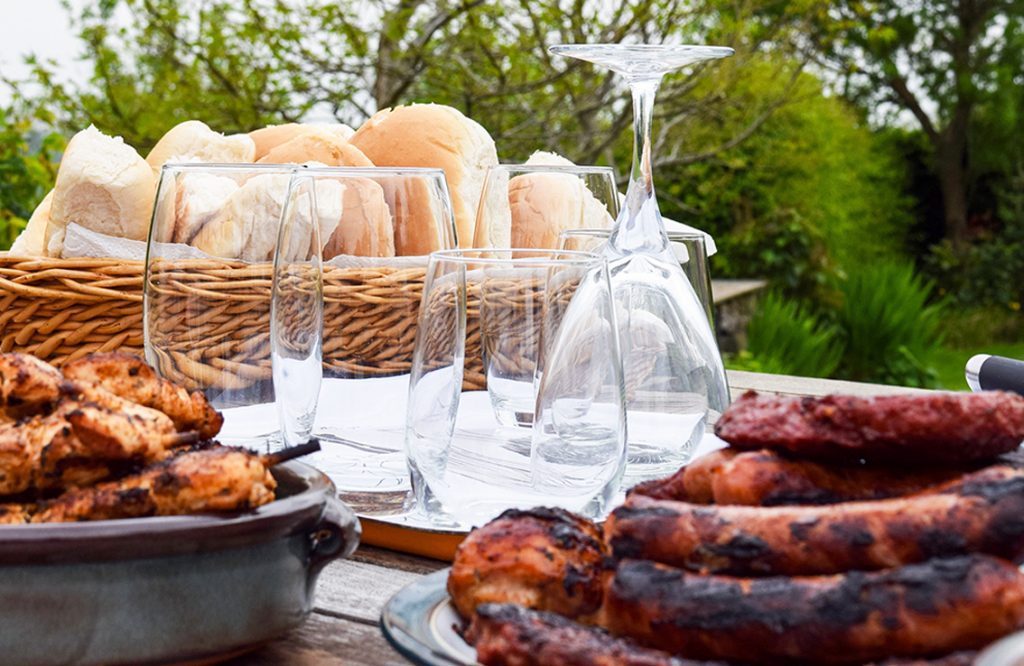
There’s no better way to start the summer than with a sizzling BBQ. Eating Al Fresco, or even under the cover of a garden gazebo outside is a delight especially after enduring a grey and dull winter that seemed to last forever. To make it a truly enjoyable experience, throw away the skinny, dubious cheap sausages, the chicken drumsticks with no chicken and the wafer-thin burgers that burn to a frazzle. Instead, do as we did and visit your local butcher. For our first family BBQ of the summer, we visited Mitchell’s Artisan Butchers on the main road in Wirksworth. Parking was easy and the traditional looking shop was inviting. Mitchell’s is independently owned and their focus is on supplying meat from local farms. The benefit of this practice is that they control the quality by choosing farmers who employ good farming practice, for example the chicken is free roaming and ethically sourced. Davey Mitchell is a traditionally trained Master Butcher with a creative flare. So, this was perfect as we could buy meat ready prepared with herbs and spices for our BBQ, complete with advice and suggestions. The burgers were lamb, born just up the road in Hazelwood and raised in Derbyshire fields. We also had beef burgers, the perfect size for our large floury baps, unfortunately our teenagers devoured them all before we could say we needed their comments, but I suppose that was praise enough. The chicken kebabs had succulent chunks of chicken which had been marinated in a subtle Mediterranean dressing, and the chicken drumsticks were chunky with lots of meat, the best I’ve had. Personally, I often skip the sausages, but these had me coming back for more. With the addition of two or three different salads, some lovely wines we were set for the evening. It wasn’t the warmest of days, but hot coffee and a pile of blankets kept us warm and sitting outside until late. There really is nothing like it. Mitchell’s also sell a range of cooked meats, pork pies and meat pies all made by themselves, as well as oven ready meals. ‘The Sauce Shop’ chutneys, Snowdonia cheese, (which I must try) and many other products from independent small companies. Mitchell’s Artisan Butchers, 21 Market Place, Wirksworth, Matlock DE4 4ET Tel. 01629 820261. 00
Restaurant Review – Chevin Golf Club

Times change and so that means businesses have to adapt with them. Golf clubs traditionally have been a pretty no go area for members of the public but all that has changed at Chevin Golf Club, and their latest development reflects that refreshing approach. Light, airy and up to date with the emphasise on friendliness, this is the name of the game for 2022. We were invited by Manager Andy Mellor to sample the new menu and enjoy the updated decor and furnishings. We chose the best day of the year so far. Bright sunshine and a light breeze really highlighted the beauty of the surrounding countryside, with carefully tendered greens rising to the Chevin hills beyond. The Chevin Golf club rests in a sheltered hollow just on the outskirts of Duffield where beyond the trees the little electric train rumbles along adding to the ambience. Situated just off the main A6 it is easily accessible too. So, what’s on offer? Fairways at Chevin Golf Club provides an excellent food and bar service seven days a week and you can choose to sit outside on the terrace which surrounds the conservatory restaurant, in the cosy Spike bar where walkers (and well behaved dogs) are welcome, or in the bright conservatory restaurant with views over the course. On arrival we were welcomed by house manager Hollie Pace who has a wealth of experience in hospitality locally and head chef Tom Gaskin, who heads an efficient young team. Tom is a very capable young chef very much in tune with modern dining trends, set to establish a reputation for Fairways for its excellent food. On our lunchtime visit we enjoyed a pleasant little complimentary appetiser presented on an edible spoon, of crab mousse with dill, and a Mediterranean inspired spinach cone with sun-dried tomato, attractively presented. As asparagus is in season my friend chose this as his starter, with a perfectly poached duck egg smothered in a rich Hollandaise sauce. I don’t quite know why but the distinctive flavour of asparagus is the perfect partner to duck eggs. The addition of slithers of home smoked salmon were very acceptable. My thinly sliced smoked salmon encased a very creamy mousse with dill, a Tempura prawn added crisp texture, and the granary bread a welcome base. The selection of starters can also be ordered as tapas, and the portions reflect this. From the Gastro mains menu the chef has selected to offer a variety from traditional home-made pie of the day, fish and chips, lasagne: a favourite of my friend and so his choice, to herb topped rack of lamb. The latter was my choice, not the easiest dish as it needs a crispy topping yet succulent pink middle. Mine did accomplish this and I really enjoyed the jug of mint jus and generous swirl of pea puree. The separately served Dauphinoise potatoes were excellent. Sadly the portion was a little too large for me, but far better than being left hungry. Creative to the finish, our desserts were a picture with surprises at every taste as the pictures will show.For me this is a little hidden gem, somewhere I can come to enjoy a light lunch with friends, or maybe a sandwich with a bowl of chunky chips, a mid morning breakfast or if time is short a coffee and pancake. Or a leisurely evening meal for those larger parties. This beautiful setting lends it’s self to hosting your special event or function, and the best thing is that you don’t have to be a member, everyone is given a warm welcome, and the same hospitable service is extended to all. Our thanks to all for a most enjoyable lunchtime experience. To view the menus visitwww.chevingolf.co.uk Chevin Golf Club, Golf Lane, Duffield, Derbyshire, DE56 4EE To book a table please Telephone 01332 840497 00
Walk Derbyshire – Osmaston Park

The A52 Derby to Ashbourne road passes through some of the gentlest rural countryside in Derbyshire. Tiny villages little changed in centuries sit around junctions of minor roads that wander pleasantly between both ploughed fields and pasture. This walk skirts three of them, one barely bigger than a hamlet; starting at Osmaston, the largest, it wanders through Osmaston Park and on to Shirley. Field paths and farm tracks then take us by way of Shirley Mill and into the outskirts of Wyaston. Here a right turn takes the walk back into Osmaston Park, entering the village by way of its delightful green. It is complete with a duck pond and seats to rest and admire the scenery. Osmaston where the walk begins and ends was the home village to Osmaston Park, whose estate employees’ thatched cottages are now much sought after properties. The village church appears Victorian, rebuilt by the architect H I Stephens of Derby in 1845, but from the size of the venerable yews in its churchyard and the mediaeval font, it is obviously built on ancient foundations. While the parkland is magnificent, the 19th century Osmaston Manor is no more, abandoned apart from estate houses and the odd tower peeping over the surrounding trees as seen on the latter stages of the walk. Shirley, like Wyaston is only entered by a short but worthwhile extension to the walk as it passes so close: this village easily dates from the 14th century, but there are even older Norman stones slotted around the church doorway. The remains of a much damaged Saxon cross in the churchyard and a massive yew that was once badly damaged in a gale give some hint of its age. Further on is Wyaston that nestles in a green hollow a quarter of a mile off route, sharing its pub with neighbouring Edlaston, another village with an ancient yew in its churchyard. The Walk From the car park beside the village hall, turn right and walk down the street, past several thatched cottages and attractive brick-built old houses and their gardens. Bear left around the pond to follow a wide bridleway to the left of the park gates. This track is signposted to Shirley and is arrow-straight almost all the way. Walk on between fields and downhill through mature woodland. Go straight on at a crossing, continuing downhill to a causeway between two mill ponds. Go past a substantial one time water-powered saw mill on your right and re-enter the forest. Walk uphill and out of the tree cover, keeping the forest boundary on your right. Go past what appears to be kennels for the local hunt. The water mill was recently renovated and converted into a house. Parts of two long distance walks are used on this walk; the section between Osmaston and Shirley is along Bonnie Prince Charlie Walk, supposedly following his ill-fated route between Ashbourne and Derby. The other is from Shirley along part of the Centenary Way, a walk that wanders pleasantly across the fields of south-central Derbyshire. A surfaced lane continues along the route out of Osmaston Park. Where it meets the lane into Shirley, look out for a flight of wooden steps on the right. Climb these and follow a waymarked path, past a private garden and alongside hedgerows, then across fields. An extension into the compact village of Shirley is worthwhile if time allows. The village sits tightly around a staggered cross roads together with its venerable church where its broken cross is worth seeking out, or maybe the handy pub. This part of the walk is along a short section of the Centenary Way. Follow it slightly downhill towards the mature woodland of Shirley Park. Bear left in front of the woodland boundary, on to a farm track (muddy when wet), following it as far as a minor road. Turn right at the road and go between a farm and Shirley Mill now converted into a private house. Beyond the mill house look out for a finger post pointing the way through a gate and into fields. Walk past the mill pond and then begin to bear left, uphill on a pathless route through meadowland. At the top of the rise, climb a stile and go forwards to the right of farm buildings. Follow the farm lane around a sharp bend and then continue towards woodland marked by a cottage and a handful of caravans. Continue to follow the lane along the edge of the wood. Go past the drive to the first of two farms. Where the lane begins to go left at the second farm, climb over a stile on the right and into a field. Cross this and then over another stile. Follow the path through a wheat field. When the growing crop ends and overgrown grass begins, drop down alongside some trees to the road, reaching it through a gap in a broken wall. Turn right downhill along the road, going past the attractively yellow painted hollow square of Charity Farm to climb the hill opposite. At the top of the rise and unless diverting to Wyaston (return to this point if so doing), turn right and go down a bridle track and then out into fields gradually leading towards Osmaston parkland. With the rather eerie sight of the remnant towers of Osmaston Manor peeping above treetops on your right, go forwards along the track, past a couple of estate houses and the village cricket field to your left. Reaching a ‘T’ junction, turn left along the drive and go through two substantial gate posts, the remnants of the manor’s one time splendour. Walk past the village pond and go back into Osmaston village. Seats around the pond are just made to rest weary limbs and have the remaining drink left in the thermos. A rockery gone wild is in the middle of the pond and pretty thatched cottages make a perfect background. USEFUL INFORMATION: 6 miles (8.8km) of