Restaurant Review – Nicco Restaurant & Bar

Set in the heart of Pride Park sits a refreshingly new dining experience. Tall glass doors open into a jaw-dropping, spacious restaurant with touches of glamour, high lights and low lighting, marble tables and comfortable seating. Across half of the back wall, floor to ceiling, the cocktail bar displays more drinks than I can give a name to and on the other side you can see straight into the kitchen where the chefs are hard at work. Centre stage sits a gnarled and twisted olive tree, just a nod to the varied menu on offer. The building, on Wheelwright Way, Pride Park was formerly a restaurant however they have embarked on a total restoration that included stripping every wall back to the bare blockwork and extending one side to bring more light in. On our visit I found it a quite surreal experience to be in the city and yet to look out on to the changing autumn trees across the way. Sanj the owner, named the restaurant after his son Nicco which gives just a hint at the relaxed atmosphere here. The menu is created with all tastes in mind from young to old and of course those in the middle. Sanj explained to us how the menu came about, “It was quite simple really, I took my top chef on a tour of my favourite places to eat and pointed out things on the menu that I enjoyed from many different dining experiences around the world”. It was obvious from what followed that Sanj has a wide range of tastes where food is concerned and that whilst Nicco’s is a Contemporary Indian Dining Restaurant & Cocktail Bar the menu at Nicco’s is definitely a fusion of dishes from varying countries. Sanj employed the services of a top-class development chef with restaurants in London and Switzerland, setting high standards for both the menu, presentation and service. From A La Carte dishes to salads, grills to a ‘naanwich’, this is an exciting menu, it dips into Indo Chinese, Tibetan, French and European cuisine. And if you’re wondering… a naanwich is a classic naan served with either chargrilled chicken, onion bhaji, herb paneer and masala chips. The dessert menu really exemplifies the best of traditional dishes from around the world. Nicco’s opens at 12 o’clock midday and with a variety of small plates and grills to choose from, is perfect for a light lunch with friends, business meeting or just a break away from the office. Refreshingly there is a great selection of vegetarian dishes, which when most of us are becoming ever conscious of conserving our environment is really welcoming to see. There’s also an innovative children’s two course menu which has obviously been created with great thought. ‘At night the Cocktail Bar comes into its own and after your meal becomes somewhere to extend the evening, relaxing with friends and enjoying good company.‘ Live music evenings at the weekends are scheduled and something to look forward to. Nicco’s is definitely somewhere to put on your radar, to try at different times of day and somewhere to make a regular favourite place to be. 00
Walk Derbyshire – A Walk from Grin Low & Buxton Country Park

There are not many walks claiming to start downhill, but this one does (although the height lost must be regained at the end, but nothing is perfect, is it?) The walk starts from the car park accessing Solomon’s Temple before dropping down to the centre of Buxton and its Pavilion Gardens, returning by way of Poole’s Cavern Country Park. A once devastated landscape covered with small scale limestone burning has changed into a pleasant hillside, where mature woodland criss-crossed with meandering footpaths leads to three interesting features. The walk explores them together with the rest of the byways. Around the early 1800s Grin Low hillside was devastated by the results of two centuries of quarrying and lime burning, leaving a lunar landscape of humps and hollows where whole families lived like troglodytes. As part of his ambition to turn Buxton into a northern spa, in competition with Bath and Harrogate, the 6th Duke of Devonshire planted the 100 acre wood with a mix of broad leaf trees such as beech, oak and sycamore together with a few conifers. These have now grown into maturity and along with the grassy moor around Solomon’s Temple they have created what is now designated as a Site of Special Scientific Interest (SSSI) where swathes of rare sub-alpine species bloom, along with many wild animals and birds making their home here. Along with paths meandering through the woods and across the open hilltop, there are three specific features that will provide plenty of interest to young and old. Starting from the car park and picnic site, these are: Poole’s Cavern Arguably this is the most natural cavern open to visitors in the Peak District. Even though it was never mined, it has links with ancient people from long before the Romans settled in what became Buxton. Formed by the action of floodwater, meandering passages are lined with stalactites ranging from delicate straw-like growths to huge columns that seem to hang without support. Rainwater falling where there are still large amounts of waste lime powder, percolates down through the earth, laden with calcite that precipitates in what has been aptly called the ‘Poached Egg Chamber’. The stream flowing through the cave rises far into the hillside, way beyond the end of the public access section, eventually forms’ part of the Derbyshire River Wye. When Poole’s Cavern was first developed as a tour cave, it was decided to remove a large section of glacial sediment blocking the easiest entrance to the cave. By doing this it links with the cavern’s earliest users whose story came to light in the shape of animal bones, iron objects and pottery, suggesting that people had sheltered in its damp recesses since at least Neolithic times (between 2000 and 1500 BC). Bronzesmiths plied their trade in its shelter during the Roman occupation, making domestic objects for the wives of soldiers stationed on what were then the wild uplands of ‘Peclond’. Who Poole was, the man who supposedly gave the cave his name has never been proven, but the traditional explanation is that an outlaw called Poole or Pole sheltered in the cavern sometime around the mid1400s; there was however, a Poole family living at Hartington, a mere 10 miles away and records dating from 1432 state that John Poole Esq held a large area of land in ‘Buckstone’, so it could be that as law abiding people they owned the cave, or maybe a renegade member of the family hid there. Whichever story is true will probably never be known, but what is on record is the visit Mary Queen of Scots made in 1580 during her spell of captivity in the Peak. A hundred years later, Charles Cotton listed the cave as one of his ‘Seven Wonders of the Peak’, and in so doing put the attraction on the visitor map. Poet laureate Sir John Betjeman visited the cave in 1980 and thanked the guide for ‘moving his unwieldy body through the vast wonders of the cavern’. Go Ape A few yards uphill from the play area beside the car park, a purpose-built modern wooden building marks the start of ‘Go Ape’, billed as the UK’s number one tree-top adventure. After being fitted with safety harness, adventurers tackle zip wires, Tarzan swings, rope ladders and complex high-wire crossings linking a course through the forest. Solomon’s Temple There are at least four ways up to the airy ridge-top tower known as Solomon’s Temple – you could even fit it in with a quick spin around the orienteering course if so inclined. The name given to the tower links it to the original benefactor who paid for it as a ‘job creation scheme’ for unemployed local quarrymen. Built in 1896, the folly or look-out tower, call it what you will, overlooks not only Buxton, but a wide swathe of Peak District scenery. The effort of climbing the hillside from the car park should only take about 25 minutes, following the wide woodland path, and the effort is well worthwhile. Don’t worry if you hear explosions coming from the group of buildings on the hillside over to your left. They will be coming from the Explosion and Fire Laboratory of the Health and Safety Executive, where they have been known to assess the explosive characteristics of custard powder! Useful Information A short 1½ mile (2.4km) easy stroll downhill and back up (totally 880feet – 268 metres) using open footpaths, side roads and public parkland. RECOMMENDED MAP Ordnance Survey 1:25000 scale Outdoor Leisure Explorer Map, Sheet OL24 – The Peak District, White Peak Area. PUBLIC TRANSPORT Hourly TP service from Derby via Matlock into Buxton Market Place. REFRESHMENTS Chaise of many pubs, cafes and restaurants, in and around Buxton town centre. CAR PARKING Above Grin Low camp site. (Honesty box payment). DIRECTIONS From Grin Low campsite car park (signposted off the Harpur Hill/A53 Leek road link), walk uphill on a footpath through a small wood. Go through a kissing gate and bear right,
Celebrity Interview – Tristan Gemmill

He’s played cool, confident consultant Adam Trueman in Casualty, complicated bistro owner Robert Preston in Coronation Street and on stage he was hunky Frank Farmer, the title character of the musical The Bodyguard. Now Tristan Gemmill is to play a totally different role in Nottingham. He is hoping to be jeered in the Theatre Royal pantomime Robin Hood as he will portray the wicked Sheriff of Nottingham. He’s really excited about it. “It’s much more fun to play the baddie because you can do things that you normally wouldn’t do as a nice, polite, well brought-up person. You can really go to town. “Everyone knows how pantos work, everybody knows how they should behave even down to the youngest children. They boo and they hiss and you react to that. “Panto’s a really great medium because you know exactly where you are. It’s not like a play when you don’t know how the audience is receiving it. Hopefully panto audiences are enjoying themselves and they know what they’re supposed to do.” This will be only the second pantomime that Tristan has performed in. He played Captain Hook in Peter Pan in Swansea in 2019 and was due to be in panto in Manchester last year. But the pandemic put paid to that. When he took the role of Captain Hook, he admits he didn’t know what to expect. “Obviously I’ve taken my kids to pantos and I went to pantos myself as a child. But I’d never experienced it from the other side.” “It was really hard work because you’re doing two shows a day. It was just brilliant fun being with a great bunch of people and you just fed off the audience.” “You work really hard but you get the rewards straightaway because hopefully, if you’re doing it right, the audience is having a good time.” Lockdown meant Tristan did not have much work, so he made the most of the experience, home-schooling his son and two daughters. It came as a welcome break for him after he had appeared in Coronation Street for five years. “I hated the pandemic part of it but I quite liked spending a lot of time with my kids. I’d missed out a little bit on that in the years previously. We were lucky – we didn’t get sick or anything. We had some really good family time so we ended up making a bit of a virtue out of an awkward situation.” Now Wilfred, Mabel and Violet are looking forward to seeing their dad in pantomime. “They’ll come up for probably a week or so before Christmas and maybe a second week after Christmas, so we won’t be apart for too long. There’ll be an element of adventure to it for them as well.” “Again we’re trying to make a virtue of things. Being absent from home is never great but we’re going to turn it into something fun.” Tristan John Gemmill was born on 6th June 1965. He grew up in Kent and he got the acting bug at school when he was 13. ITV were filming a mini-series, Winston Churchill: The Wilderness Years, with Robert Hardy as Churchill. When Churchill had a car accident, everyone was too nervous to ask him if that was the end of his career because he was approaching 70.” “These schoolkids come and interview him for a school magazine and they basically steamroller on and ask him the questions that adults dare not ask. It was just one scene and they wanted local schoolkids.” “They came to our school and did an open audition and I was lucky enough to do it. That was my first job and it absolutely gave me the bug. That was a long time ago now. It’s a bug that’s lasted my whole life.” A couple of years later Tristan’s parents and his family emigrated to Australia. He stayed there for ten years. He studied history and languages at Melbourne University, then decided to come back to England to see some old school friends. “I ended up getting a bit of acting work. That led to another job and then suddenly I’d been back here two or three years. It wasn’t that I chose to leave Australia for good. I came over here and just sort of followed which way the wind blew and it blew me along this path.” “I was very lucky to get work in the ‘90s. Then I met my wife” – he married actress Emily Hamilton in 2001 – “and put down firmer roots here. I’ve still got a lot of affection for Australia: I spent a good chunk of my life there and I try to get back whenever I can.” On his website, Tristan says he likes things that take him out of his comfort zone and into areas he’s not done before. So can we look forward to seeing him in something completely different next year? “As brilliant as Casualty and Coronation Street were for me, if you play the same character for four or five years, I think there’s always a danger of getting a bit comfortable in your shoes.” “When I first wanted to become an actor all those years ago, it was to experience different things and to play different parts. It’s a great security blanket to have a long-term job on one of those shows but at the same time it’s slightly counter to why you wanted to become an actor in the first place.” “I’m just open to new challenges. I would be happy to try something new if it turned up and that’s what I’m looking to do but I don’t have anything concrete to tell you. Beyond the panto I don’t know. “Let’s hope 2022 throws up some interesting possibilities. It’s got to be better than 2021.” After leaving Corrie, Tristan went into the West End in the musical The Bodyguard. He describes himself as “not really a musical theatre person” but the
Places Pevsner Forgot III – Froggatt & Bretton
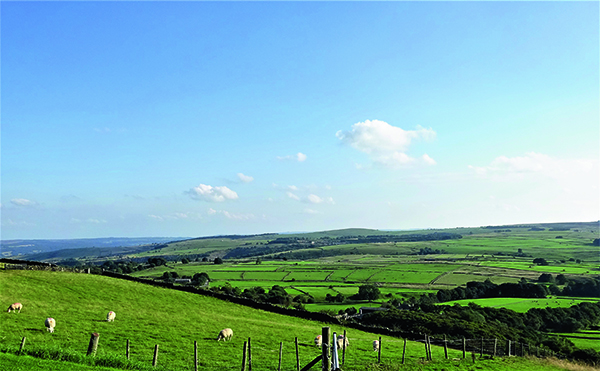
There have to be places that Sir Niklaus Pevsner omitted simply because the buildings there were not really worthy of record, but whilst one could not really say that about Froggatt, with Bretton it is different, for there are precious few buildings there in any case, but, like Aston and Thornhill, the scenery is electrifying. That said, there is not exactly a superfluity of buildings in Froggatt, either, hence the necessity of taking both together although, unlike Aston and Thornhill, they are not contiguous. Bretton lies half way up the ridge behind Eyam, whilst Froggatt is on the east side of the Derwent some three miles to the east of Bretton as the crow flies, but a deal further by car. Visiting Froggatt, which lies a couple of pastures east of the Derwent and overhung by the spectacularly craggy millstone grit Froggatt Edge, is best done by beginning at the lowest point. There are two ways of approaching the village, both equally rewarding. One is to take the A625 Sheffield road from Calver. One crosses the Derwent on a highish bridge over a miniature gorge, passing a grade II listed toll cottage and, having done so, one takes the next turning left, Froggatt Lane north into the village. The alternative is to drive up the B6001 Hope road from Calver up through a couple of turns until you meet the first tight turn, Stoke Lane. This gives one a splendid view of the exquisitely restored Stoke Hall, once the seat of the Simpson family, designed by James Payne no less, with help from James Booth, the gifted Stoney Middleton builder who contrived the octagonal church there. This lane takes one to a delightful 18th century stone bridge over the river (probably also the work of Booth and also grade II listed) which we cross and, in a short while, one arrives at a T-junction at which a left turn will bring you into Hollowgate, where both access routes converge. We left the car near the junction of Hollowgate with Spooner Lane, which runs level northwards, and Moorlands Lane, which diverges to your left and climbs. The cluster of mainly 18th century stone built cottages here make a delightful ensemble, and we were struck by the fact that the least pretentious, standing just by the junction, was a Wesleyan Reform Chapel no less, and indeed, its sheer undemonstrative charm seemed to us wholly appropriate. It bears the date 1832, but as the Methodist Reform movement was only formed in 1859 by a group which broke away from mainstream Methodism a decade earlier, the little building either began life as a barn or similar, or began life as a mainstream Wesleyan chapel. Adjoining it was (presumably) the former Manse, very early 19th century, with a pair of listed seventeenth century cottages beyond, whilst opposite, on the inside of the junction, stands eighteenth century Rose Cottage (also Listed Grade II), the giveaway being the unmoulded stone mullions to the windows. There are six or seven stone built cottages on the east side of Spooner Lane, too, which add charm to the ensemble at this point. However, we chose not to pursue this lane as it peters out in water meadows slightly further north, but instead turned up Moorlands Lane. This lane ascends through a number of gentle curves towards a junction with the Sheffield Road, well above the main village. It is delightfully bosky and affords excellent views of the valley, although most of the houses are 20th century ones. Whilst few are of any real pretension (and so would not have detained Sir Niklaus), they are all sequestered, and no doubt pretty expensive to buy for the punters from Sheffield, too which, one has to remember, is within commuting distance. The one house that did attract our attention was Frog Hall, a late Victorian stone-built villa superbly positioned overlooking the valley to the west but its façade largely obscured by a lush growth of creeper. The name seemed rather unlikely, and indeed, I recalled that I had a postcard of it, when it was relatively new, captioned The Moorlands, hence, of course the name of the lane (or vice versa); re-naming it so whimsically seemed to us a bit of a shame, really. Architecturally, it is Jacobethan in style with one section breaking forward, well furnished with mullioned windows and sprouting a cluster of diamond stacks on top, which the postcard shows were originally crowned by long salt-glazed cylindrical pots, now removed. Whilst it might be the work of a Sheffield architect, it may really be the work of a local firm, like John and Samuel Fletcher, father and son, builders and masons based in the village at this time and armed with a pattern book. We were amazed to find it unlisted but felt sure that Pevsner would have enjoyed critiquing it! The house was probably built for Harvey Foster, who was certainly in residence when the postcard was sent (confirmed by the directory for 1908); we imagine that he was possibly a Sheffield businessman. If so, he had died or moved away by 1926, when it became the home of the widow of Chesterfield manufacturer Charles Paxton Markham JP DL (1865-1926), Frances Margaret, née Nunneley. He had divorced his first wife and married her in 1925, but had barely survived a year before the excitement became too much for him. His younger brother Arthur survived to be made a baronet in 1931. By 1932 though, one Brian Cooke was living there and remained there at least until the war. We reached the top and turned hard right onto the main road, and were pleased to be able to descend, past the end of The Green, a pleasant if vertiginous street (ending as a path) running up from the village, before coming to rest at The Chequers inn, occupying a pleasant row of varied 18th century cottages on the east side of the road, with the woods below Froggatt Edge
The Lost Houses of Derbyshire : Coney Green House – North Wingfield

The name Brailsford is a common one in Derbyshire (not to mention elsewhere), and received added lustre through the knighthood granted to Shardlow-born Sir Dave Brailsford in 2012 for services to cycling (notably Olympic cycling). As Brailsford is an unique place-name, it is generally accepted that all people of this name descend from the ancient knightly family of that name, who descend from Elfin (otherwise Aelfwine or Elsinus) de Brailsford, a man of Anglo-Saxon ancestry who, unusually, held the manor of Brailsford when Domesday Book was compiled in 1086. Fortunately, they are well documented, even in this early period, so we know much about the younger sons and their posterity. Eventually, Brailsford passed from the family with the death without male issue of Sir Henry Brailsford in 1356 when the estate passed through his daughter Joanna to Sir John Basset of Cheadle and from the Bassets eventually to the Shirleys. Robert de Brailsford, second son of Nicholas, Aelfwine’s son, called himself de Wingerworth, having inherited through marriage an estate there and other land in the area including North Wingfield. Sir Engenulf de Brailsford, a great-grandson of this Robert was living in 1232 and 1259 and left two sons, of whom, the elder William, was granted house and land at Tupton (probably Egstow) and other land at North Wingfield by Sir Henry, the last of Brailsford, and with his wife Agnes he settled there. His posterity acquired an estate at Seanor two miles to the east (nothing seems to remain of the house) and members of the family are found at Little Brailsford in North Wingfield, and The Hill there. Thomas Brailsford of Seanor married Penelope, daughter and heiress of John Clay of Crich and their third son, Thomas is described as being ‘of Coneygree’ in a list of freeholders of 1633. His son of the same name, a doctor, later sold Seanor and settled at Coney Green (as the name later became). He was assessed for hearth tax on a substantial seven hearths in 1670, and in 1681 (if we are to believe the record of a datestone from the house) rebuilt the house, dying in 1720. The next we hear of the house is a notice in the Derby Mercury for 31st July 1772 for its sale by Francis Brailsford with an estate of 110 acres, its ‘grounds within a ring fence and coal under the greater part of the premises.’ The buyer, probably keen to invest in mining, was Thomas Fanshaw of Brough, but clearly his plans came to nought – perhaps he couldn’t raise the necessary finance to start mining – and two years later the house and estate ‘convenient for a gentleman’s family’ was again sold, this time to Thomas Wilson, who paid £4,000 for both Coney Green Hall and Pilsley Old Hall (on which watch this space!) Wilson was a member of an old-established local family, and was already a coal-owner, so we may be confident that he was well funded in his endeavour. It was, without doubt Wilson who re-fronted Dr. Brailsford’s old house, with a classical façade of locally quarried and ashlared coal measures sandstone, probably the seam known as Top Hard Rock – much sought after for building. The result was a slightly bizarre mix of Palladian with Baroque overtones, and was probably composed by a local builder using a pattern-book. There must have been some ornate pleasure grounds surrounding the house too, for a pair of lakes in a small park-like enclosure still remained according the 6 inch OS map surveyed in 1878. There was also a courtyard surrounded on three sides by farm buildings to the SW of the house, too. As we only have one image of the house (a photograph dated 1883) it is impossible to assess how much of Dr. Brailsford’s house remained, but the likelihood is that most of it did. The new façade was of five bays, a particularly wide central one breaking forward slightly with rusticated quoins at the angles under a modillion cornice and plain parapet. This probably fronted a set of spacious new rooms flanking a notably wide hall, a fact that can be deduced from the width of the central bay of the house. The thoroughly wayward entrance is tripartite, with the door’s fanlight rising through an open pediment (very Palladian and out of date by 1774) but both that and the sidelights were embellished with rusticated surrounds best known as Gibbs surrounds, after the Baroque architect James Gibbs who first used them, and which can be seen on Derby Cathedral, which he designed in 1723. Above that is a Serlian (‘Venetian’) window matching the entrance in width, but strangely plain after the bravura treatment of the doorcase below. Otherwise, the fenestration is notably plain except for discreet key-blocks. The only architect operating locally who made much use of Gibbs surrounds was Edmund Stanley of Chesterfield, who used them in 1754 on the entrance of Lea Hall, but this is a much more disciplined piece of architecture. Working with Joseph Pickford at Ogston Hall just over a decade later, and in Palladian mode, seems to have cured him of this sort of thing in any case, hence the suggestion that we are looking at the work of a local builder cherry-picking things from a builder’s pattern book. One suspects that the hall was quite a grand affair and it probably had a columned screen on its far side with Dr. Brailsford’s Restoration staircase rising behind. This would explain why Wilson’s homonymous son decided to further rebuild the house in 1811 which feat he marked with a second datestone which read: At this remove one can have little idea as to what Thomas, junior had done, but it probably involved ‘modernising’ the rear range. Either way, he retained the 1681 date stone in the fabric. By 1827, the house had passed to his son William and by 1843 his brother Thomas Wilson III had the house, and the demesne was
A Glimpse of Today’s Buxton

With the restoration of the historic Crescent fully completed and open to visitors, Buxton can once again bask in its early glory. Brian Spencer explores this, the highest market town in England. Buxton retains the best of its Victorian spa-town layout, especially around the town centre, managing to ignore the massive limestone quarries on its doorstep. The town can trace its roots to the Celts who discovered thermally heated water and dedicated its flow to their goddess Santan. Later on this well provided warm water for a Roman Bath built to cleanse and relax troops garrisoning the nearby fort of Aquae Arnemetiae, thought to lie somewhere near Buxton’s present market place. Heated to a constant 28°C (82°F), rising from deep within the earth, the waters have never failed and from medieval times onwards, people came to Buxton on pilgrimage. Dedicated to St Ann, a Christianised version of the Celtic name, at one time the well was thought to have miraculous powers; pilgrims left mementos of their alleged cure, but Henry VIII thought it was going too far and ordered it to be closed. Canny folk still collect their drinking water from the constant flow of pure water that gushes from the ornamental well next to the Tourist Information office opposite the Crescent. The development of modern Buxton began with the fashion of ‘taking the waters’ for their curative powers. The well was visited by the great and the good, including Mary Queen of Scots during her imprisonment at Chatsworth, but the major expansion of the town came about in the eighteenth century. This was when the 5th Duke of Devonshire by using the £120,000 annual profits from his copper mines in the Manifold Valley planned to create the northern version of Bath. For the centre piece of his grand design, he appointed the architect John Carr of York to build the splendid Crescent which originally contained hotels, lodging houses, grand assembly rooms and several baths. Failing with the decline of spas, the Crescent fell into disrepair, but following restoration has now come back to life as Grade I listed building as a thermal spa and 79-bed five star Buxton Crescent Hotel. Included in the development are eight specialist shops, the refurbished pump room. Around the corner from the Crescent, arcaded shops now fill the space where bathers once eased their rheumatic limbs. Across the way from the Crescent a short queue of devotees can usually be seen waiting their turn to collect free spa water flowing constantly from St Ann’s Well – the same water that is bottled close by and sold throughout the land. Behind the well, graded paths known as the ‘The Slopes’ that once tested the benefits of the water cure, were laid out by Sir Jeffry Wyatville in 1811. It was he who also designed the classical church of St John, situated behind the Crescent. Bright and spacious within, fine stained glass windows light the massive marble and alabaster pulpit and attractive font. Outside and above the imposing portico, the stately cupola oddly enough only holds one bell. Opposite the church and overlooking roads to the north and west, the circular dome of the Devonshire Hospital was originally a riding school. Now used by the High Peak section of Derby University, when it was built in 1790, the central part was open to the skies and used for equestrian events, together with stabling and grooms’ accommodation built around the side of the circle. In 1858 the 6th Duke converted half of the building into a hospital specialising in orthopaedic treatments, and then in 1880 it was decided to cover the central space with what is still the world’s largest unsupported dome, with a span of 154ft. Along with visitors from far and wide, it became fashionable for Manchester textile barons’ families to move in for the ‘season’, with fathers commuting at weekend. The stately Palace Hotel was built about this time to accommodate the increased numbers of visitors, and to entertain them, the Pavilion together with its attractive riverside gardens was opened in 1871. The gardens still evoke their Victorian splendour, but what was lacking in those days was a public swimming pool. Using the readily available thermal water, a modern indoor pool now fits into one corner of the park. Of all the buildings from this bygone era, the opulently ornate Opera House, ‘The Theatre in the Hills’, the masterwork of the theatrical architect, Frank Matcham, still evokes its Edwardian elegance. Throughout the year, concerts and plays with nationally acclaimed actors and performers are staged; Gilbert and Sullivan productions as well as festivals are a regular feature, drawing groups from all over the world as well as local societies. Buxton and its Opera house now plays host to the internationally renowned Buxton Festival for Music and the Arts. Opposite the entrance and often missed there is an angular shaped Victorian pillar box, a rarity in this day and age, which has stood there almost as long as the theatre. Buxton’s history from the dawn of time almost to the present day is explained in the award winning Museum and Art Gallery near the market place. Dioramas, complete with sound effects, graphically bring back the time of the dinosaurs. Along with the archaeological remains and fine examples of objects made from Derbyshire black and coloured marbles and Blue John stone, the study of the local philosopher, Sir William Boyd-Dawkins has been lovingly recreated as it would have looked a hundred years or so ago. The town is old and new, Higher and Lower Buxton. Higher Buxton is the older part beyond The Slopes, and where the village green is now the market place and bus terminus. The remains of a Saxon stone preaching cross which was once a central feature has been moved for its safety to the side of the square. Set back a little in a secluded corner is Buxton’s oldest church. It was built in 1625 to replace the well-chapel closed by
Celebrity Interview – Amanda Owen

Running a 2,000-acre hill farm in one of the most remote parts of the Yorkshire Dales might not be everyone’s cup of tea. But Amanda Owen takes everything as it comes – which you have to do when you’re a shepherdess, writer, photographer, public speaker and mother to nine children! Amanda is known to millions as The Yorkshire Shepherdess through the Channel 5 factual television programme Our Yorkshire Farm. She may be considered a TV personality whose fifth book is currently being loaded onto the shelves of bookshops around the country. But in reality Amanda is first and foremost a farmer who has 1,000 sheep to look after. And she never shies away from getting her hands dirty. The day before our conversation, Amanda received an early-morning telephone call to say some of her cows had escaped and were running amok. “They were heading down the road, they’d knocked someone’s wing mirror off and they were making for a camp site. I couldn’t have woken up and anticipated that, could I?” But Amanda, who points out she is definitely not a domestic goddess, found a bonus to the problem. “While I was putting the cows back I found a load of raspberry bushes. I thought ‘what I should do now is go back home, tidy up, load the dishwasher and get my baking done.’ But actually my head was saying ‘get the raspberries before anybody else or the birds find them.’ “There’s a thing called prioritising. Sometimes I go with my heart and not my head. The kids all had big smiles on their faces even though they were covered with raspberries. The point is we’re happy, we’re getting on and that’ll do.” Yorkshire people are known for being down to earth, straight-talking and unpretentious. Amanda who laughs a lot during our chat fits the bill perfectly. “There’s always summat to do and fitting it all in can be a bit of a nightmare. It’s hard, it’s tough but it’s also inspiring” says Amanda of her way of life at Ravenseat, the traditional farm in Upper Swaledale that she runs with her husband Clive. Despite being a townie – she was born in Huddersfield in 1974 – Amanda developed a love of the great outdoors at an early age. After accidentally stumbling on a book called Hill Shepherd by John and Eliza Forder, she set her heart on becoming a shepherdess. So does reality live up to the young Amanda’s expectations? “It’s a bit of a rollercoaster ride because there are so many variables that affect your daily life. It’s a never-ending circle that you don’t really understand until you’re doing it. It’s not all sunshine and birds. At the end of the day, what we’re doing is real.” Amanda approaches everything with energy and charm. It’s one of the reasons why so many people tune into the Channel 5 series about life on her farm. But she never had a plan to have a television career and, like most things, it started accidentally. Just after getting married Amanda and Clive pitched a tent in one of their fields. Walkers passing by asked if it was there to supply refreshments. “That sparked an idea in my mind that there were 16,000 people a year walking through the farm and I simply offered to make them a cup of tea. “One day a person came who was dressed like a walker. He turned out to be a TV scout. He was looking for people to be involved in a show called The Dales with Ade Edmondson. “We were one of the families who signed up to do that. Afterwards I was approached by a literary agent who asked me if I’d be interested in writing a book to tell my story. Being a bit of a chancer, I thought ‘why not? I’ll give it a go.’” The Yorkshire Shepherdess book got to number three in the best sellers chart, leading to an approach to make a television series. But she doesn’t see herself as a TV personality. “When people say ‘author’, I shudder. When people say ‘photographer’, I shake. I’m just myself, Jill of all trades, master of none. I just take opportunities and see if I’m any good at it,” she says modestly. Three more books followed, A Year In The Life Of The Yorkshire Shepherdess, The Adventures Of The Yorkshire Shepherdess and Tales From The Farm. Her new tome, Celebrating The Seasons, published by Pan Macmillan and costing £20, appears to be ground-breaking as it’s part photography book, part recipe book and part memoir. “The fact that it’s a bit of all those things probably sums me up perfectly. When it comes to order and planning, is there any? Not really. “Once I start writing and once I start talking and once I start thinking, my mind goes all over the place. I think that’s the best thing about living in the countryside in a place like this: it gives you head space.” Amanda took inspiration from Hill Shepherd, the book which she says was visually beautiful. “Those pictures were real and gritty. They told the story. And that’s where I wanted to go because I take pictures. I do a virtual diary. Every day, whatever I’m doing, I’m taking pictures. It reminds me of what’s been happening. “My camera is the worst in the history of the world. It’s held together with gaffer tape and I’m having real trouble with the on-off switch for the simple reason there was a ripe banana in the camera case and somehow it managed to get itself into the switch.” Obviously Amanda’s family plays a large part in her photos and she stresses it’s essential for them to be involved in life on the farm. “For the children to feel a sense of self-worth and to feel they’re important, they must take some responsibility. Ooh, that sounds terrible, doesn’t it? “Is it really that bad to ask them to go and
Product Test – Smell Good with River Island Fragrances

Womenswear fragrance fashion Capitals of the World. Inspired by the fashion capitals of the world, Paris, Milan and London, these fragrances have been designed to complement your style, day or night. Leaders, not followers, take cues from iconic cities and push your boundaries. Nothing will complete your looks like a deliciously unique scent. London – NEW London is River Island’s new fragrance withing the collection. The perfume is beautiful, bold and crowned with confidence, inspired by the capital city. The notes of Jasmine are fresh and vibrant and are combined with the top note of neroli, which has a sweet-floral scent with an element of citrus, creating a refreshing summery London EDT: 100ml RRP £16 Milan Inspired by the glamour and elegance of Milan, the fragrance has a sweet floral scent. Bergamot is the top note, which has a gorgeous citrus-like scent. This being combined with the sweetness of the peach, lavender and jasmine Milan the ideal fruity perfume for a summer’s day. Milan EDT: 75ml RRP £14 Paris by Night Paris by night embodies the mystery and allure of the fashion capital. An oriental floral scent is built through the inclusion of mandarin, grapefruit and orange flower note to ensure that the fragrance has a light feel to it. However, additional warmth is created through caramel and vanilla notes. Paris by Night EDT: 75ml RRP £14 Paris It’s as easy to fall in love with this fragrance as it is the fashion capital. In River Island’s Paris perfume, the top notes of cut grass, combined with Italian lemon, bergamot, and apple blossom, create a beautiful oriental summer scent. Paris EDT: 75ml RRP £14 For more information and to buy online visit www.riverisland.com TRIED & TESTED :: TRIED & TESTED :: TRIED & TESTED London This has really good quality packaging and glass bottle. A sweet scent lasts most of the day. Very impressed with this. VP Paris A very feminine perfume, long lasting and individual. Beautifully presented to sit elegantly on any dressing table.JP 00
Walk Derbyshire – Taddington to Flagg & Chelmorton

This month’s walk has a little bit of archaeology thrown in for good measure. All it takes is a strong pair of legs, keen eyesight and maybe but not essentially, a lightweight set of binoculars. Starting and finishing in the delightful village of Taddington, a place where winter snows seem to come long before other Peakland settlements. Walking almost due south at first, the way begins by crossing seven tiny fields; small strip fields seem to be a feature locally. Crossing the Bakewell/Chelmorton road, a field path follows the length of one of the narrow strips to reach Flagg where they have races for riders ranging from teenagers to mature middle aged farmers every Easter Sunday, a day when nature invariably arranges a snow storm to keep everybody on their toes. The long narrow fields date back to Saxon times when their shape was dictated by how much land a man and two oxen could plough in a day. From Flagg a sharp right-hand turn leads through a series of slightly larger fields, traditionally left unploughed. The walk then follows minor roads and footpaths all the way to re-join the Bakewell/Chelmorton road; a left turn here for about 150 yards and steadily descends beyond a moorland cross-roads, as far as a minor road going right, downhill into Chelmorton, arriving conveniently opposite the Church Inn. This village has the best preserved collection of unspoilt narrow, strip fields. Its church is dedicated to Saint John the Baptist, the saint who the Bible tells us, spent time in the wilderness, where he lived on locusts: a locust weather vane on top of the church steeple commemorates the event. After a little under half a mile of walking on field paths over an airy limestone upland filled with tiny flowers, the path crosses an unsurfaced lane. Here you can make a short diversion by turning left to the lane end, and then right over the grassy moor to reach one of the Peak’s finest pre-historic sites. This is Five Wells chambered cairn, a unique remnant from Neolithic (latest stone age) times. The site has been excavated in the distant past, when remains of skeletons were found alongside small fragments of flint tools. The remains of long abandoned lead mines show themselves by path-side humps and hollows along the way to the descent back into Taddington where the Queen’s Arms welcomes walkers. USEFUL INFORMATION An easy to moderate 5¾ mile (9.25km) walk on field paths and a short section of a couple of rural roads. RECOMMENDED MAP Ordnance Survey1:25000 scale Peak District, White Peak Area: Explorer Map, Sheet OL24. PUBLIC TRANSPORT Trans Peak Derby/Buxton hourly service via Matlock as far as the Queen’s Arms in Taddington. REFRESHMENTS Pubs in Chelmorton and Taddington. CAR PARKING Roadside on the outskirts of Taddington, but please ensure you do not interfere with anyone’s rightful access. DIRECTIONS Take one of the side paths, southwards and away from the village main street. Pass a dew pond on your left at the bottom of Slipper Low. (Water was always a problem around Taddington, causing villagers to walk considerable distances carrying pails of the precious liquid). Cross a stile and turn left on a back road, known locally as The Jarnett. Where The Jarnett makes a ‘Y’ junction with another minor road, Moor Lane, climb a stile and walk diagonally right across the middle of the intervening fields. Cross field boundaries by stiles or gates in order to keep to the official right of way. Go diagonally again over three more fields, all the time walking down their centres, until you reach a path ‘cross roads’. Go forwards again down the centre of the fields until the path reaches a field access track via yet another stile. Turn left and follow the grassy lane, down to Flagg Lane. Turn right here for about 45 yards and turn left into the first of three long, narrow fields. Go round the back of Flagg Hall, then down its drive to reach a road at a ‘Y’ junction. Turn right and follow the road through Flagg until the road joins Pasture Lane at this junction. Turn left and follow the side road for about 150 yards until it makes a sharp left turn at the apex of a sharp bend. Do not follow the road round the bend, but turn right on to a field path crossing six medium sized fields. Use stiles and gates in their boundaries to follow the correct route. Turn left on to Flagg Lane and follow this road (can be busy, so keep to your right and walk in single file). Go over a cross roads and then begin to walk downhill as far as a minor road going right. Turn right and follow the minor road down into Chelmorton village, conveniently opposite the Church Inn. (Dogs are welcome and are even accommodated with their own barrel on tap). Turn right on entering the village and walk past the church. Climb steadily uphill on a rough track, past the village water supply until the track is joined by a path coming round from the side of Chelmorton Low. The rough surface around the path, is an indication of one-time lead mining activity. A diversion going left along an unmade lane will lead, beyond its end, to a concessionary path to Five Wells Chambered Cairn. Return to the lane to continue the walk. Follow the lane back to the point where it is crossed by the path from Chelmorton. Follow this path (to your left if you have been to Five Wells Cairn. Follow the high level, airy path, forwards alongside a boundary wall over Sough Top, the highest point of the walk, then downhill, crossing a minor road back to Taddington, reaching the village opposite the church. 00
Places Pevsner Forgot III – Aston & Thornhill-in-Peak

If Sir Nikolaus Pevsner had included scenery as well as buildings, the hamlets of the Hope Valley might have taken up as much room in his Buildings of England volume on Derbyshire as Chatsworth but, of course, it’s buildings that he is attempting to record and they are a little sparse in these places, but what charm they have! Aston (one of three Astons in Derbyshire) and Thornhill lie in the lee of Win Hill just east of Hope. All three are what historians call discrete settlements, in that they have no real nuclei, but consist of scattered farms and cottages. In this, they are a legacy of the kind of rural settlement which existed prior to the evolution of the modern village, mainly after the Norman conquest; such settlements were the Norm in the Iron Age, under the Roman Empire and subsequently. They are far more common in Wales and Cornwall, where the cultural impact of Saxon expansion had little effect, nor indeed that of the Norman, who imposed castles but few new settlements. Anglo-Saxon control of the Peak came late – probably from the middle of the seventh century – the Pecsaetan, much later called the Peakrells, were a distinct element in the make-up of early Mercia. Eventually, the whole tract of the Dark Peak was absorbed at the Norman conquest and became under the direct jurisdiction of the King. Parishes were enormous, those of Hope and Hathersage particularly so. Hope, in which Aston and Thornhill still lie, still contained ten townships (essentially scattered settlements retaining little more than an identity) and nine formal hamlets, even in the 19th century, when the majority of the land was part of the Eyres’ vast Hassop Hall estate, later inherited by the Leslies of Balquhain and broken up by sale in 1919. Aston is best visited from the A6187 (Station Road) just east of the Netherhall Bridge over the Noe. It contains a couple of fine farmhouses, of which Kilncroft on your left as you ascend Aston Lane is the most architecturally formal, being two storeyed, three bays and stuccoed, work carried out in the 19th century for one Scott Wells. The name implies some kind of industrial activity on site at some distant time in the past, but unlikely to have been pottery, for the area is devoid of suitable clay. It is more likely to have been connected to lead smelting. To the NW lies a virtually invisible gem, one of the township’s two seriously impressive buildings, Birchfield Lodge. This was built as a shooting box for Sheffield steel magnate Mark Firth in 1875. It is a very plain house, the very palest reflection of Jacobean revival, but of three blocks, two ranges at right angles joined by a three-storey castellated octagonal tower containing the hall, and with a third, later, Arts-and Crafts block to the NW, very tall; the main façade is plentifully gabled and the whole once sat in a glorious park, now somewhat truncated but still identifiable on the ground. Firth embellished the interior of his occasional residence to a high quality, despite mixing Classical with Gothic elements. He also embellished the house with that rare thing, a Blue John window in the porch, which we saw during a visit during renovations in 1981 when my colleague Mick Stanley (then assistant director of the long defunct Derbyshire Museum Service) suggested it be removed for safe keeping to Buxton Museum, where it arrived in 1983. This move was simplified by the fact that the house was then, and is still, unlisted: no consents required! By 1914 it had been let as Win Hill Holiday Home but in 1932 was sold as an hotel, but in the war became an hostel for Sheffield steelworkers. From the 1950s to 1981 it belonged to the Wood St. Mission, Manchester, later the Greater Manchester Youth Association, these uses being facilitated by the proximity of Hope Station (never, as so often today, ‘train station’ an egregious Americanism) – actually also in Aston. It is now divided as three luxurious private homes, and is not really visitable. If one continues along Aston Lane, which turns to the east, one reaches the core of the settlement, lying in a picturesque declivity, with a former stone clapper stile allowing access to a footpath to Hope. Proceeding up the hill, the lane meets at the summit Parson’s Lane, which also rises thence from the valley. Here, at the junction, stands Aston’s gem, Aston Hall farm, its centrepiece a small Elizabethan manor house, set behind a low wall amidst its later outbuildings. Despite its remoteness from the latest metropolitan trends in the architecture of the era, its builder miraculously managed to embrace the basic Classical dispositions of the symmetrical façade, decorating it with a top pediment centered by a three light mullioned window beneath a subsidiary pediment, parapet with ball finials and a delightful front door set under a broken pediment supported on fluted and stop-fluted Doric columns – absolutely charming. Above the top central window stands the little carved figure of a naked man (the builder? a lead miner? a Classical deity?) and below, amidst chunky strapwork, appear the arms of its builder – or three lozenges azure, a roundel for difference – the opulent lead trader Thomas Balguy (the ‘L’ is silent and the ‘A’ long as ’aw’) and the date 1578. When this branch of the Balguys died out (the other branch built Derwent Hall four miles to the north – see Country Images July 2016) the estate came to the Bournes of Ashover, from whom it descended to another Sheffield family the Nodders. They let the house and its modest estate to the Walkers, also Sheffield ironmasters. Later it was for several generation farmed by the Daltons local farm biliffs to the Hassop estate, but was later sold to the Shuttleworths of Hathersage who sold to Miss H. Cuthbert who entertained us to tea and cake there in 1981. Whilst Aston