Celebrity Interview – Paul Jones of the Manfreds
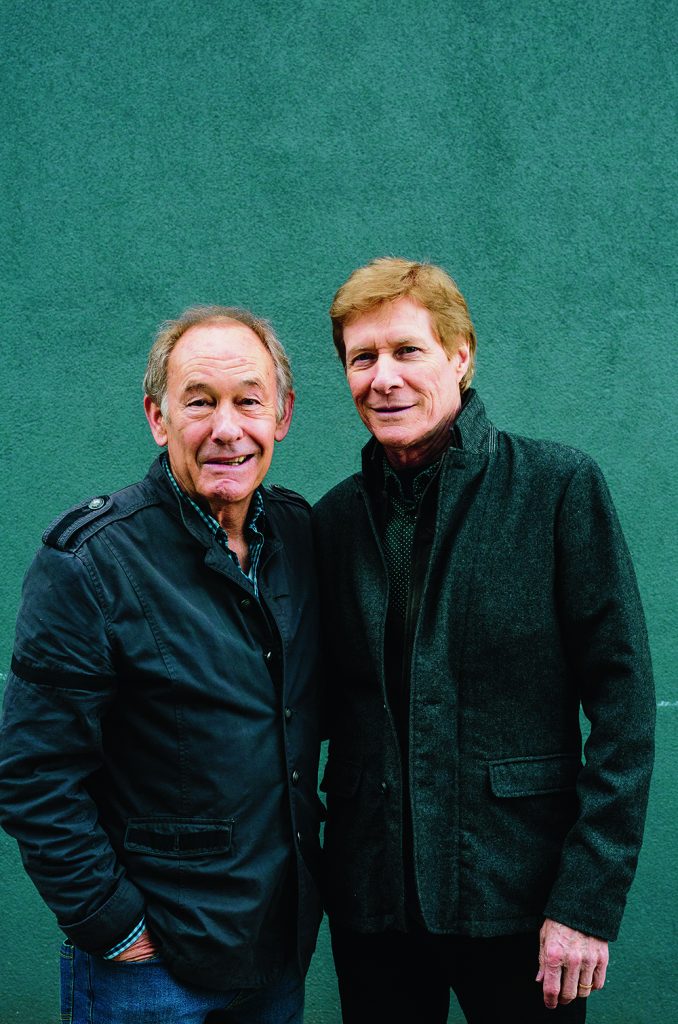
Paul Jones laughs a lot as he happily looks forward to the next few months. The singer, harmonica player, actor, radio personality and television presenter has had a stellar career – yet at the age of 79 he’s going on the road again with the band he made his name with, the Manfreds. Not only that: the group will be joined by legendary keyboard player Georgie Fame, described by Paul as his favourite. Paul reveals he tried many times to persuade Georgie that he would really enjoy touring with the Manfreds, as other guests had done including Alan Price, Colin Blunstone and Long John Baldry. Eventually Georgie agreed. “A couple of years ago we had such fun on the road. Georgie obviously enjoyed it because when we said ‘how about doing it again?’ he said, ‘yes, I’m your man.’ “Georgie is the best,” says Paul. “I suppose he’s exactly in the place that I consider to be the right place musically – with a strong helping of jazz, an equally strong helping of blues and rhythm and blues, and basically an ability to enjoy audiences and relate to them.” Many music fans consider Paul Jones to be their favourite. He was the vocalist on three number one singles by Manfred Mann, as they were originally known: Do Wah Diddy Diddy, Pretty Flamingo and Mighty Quinn. He left to go solo and had a successful career in musical theatre before becoming a presenter on BBC Radio 2, hosting The Blues Show for 32 years. Preparing for the new tour, he tells me why he loves playing Buxton Opera House, why so many of today’s stars want to work with him and how he turned down the chance to become the Rolling Stones’ singer. Paul Jones was born Paul Pond in Portsmouth, Hampshire on 24 February 1942. When he was 20 he joined Manfred Mann and three others in a group that took the keyboard player’s name. They shared a love of jazz and blues but the success of Do Wah Diddy Diddy meant they turned into a pop band – which was not a direction Paul wanted to pursue. So he left. “As an adult I’ve always been interested in what’s sometimes called music of black origin. That means blues, rhythm and blues, soul, jazz. When we started with the Manfreds that’s exactly what we did. “Gradually, as time went by, we started to do other things. I suppose it was the preponderance of Bob Dylan songs (that made him want to leave). Not that I’ve got anything against Bob Dylan but it just wasn’t what I wanted to do.” As a solo artist Paul had hits with High Time which reached number four in the charts and I’ve Been A Bad, Bad Boy which peaked one place lower. After that he turned to acting, appearing on television in The Sweeney and The Protectors. On stage he took roles in Andrew Lloyd Webber’s Cats and played Petruchio in the Royal Shakespeare Company production of Kiss Me Kate. “The acting was very important to me when I first started to do it. I studied hard and I did take it very seriously. But because I’d been a singer, people tended to cast me in musicals. “I found I was doing music but it wasn’t quite the music that I wanted to do. That’s why I started The Blues Band.” Paul has released seven solo albums over the years although only two are still available, Starting All Over Again which was released in 2009 and features Eric Clapton and Percy Sledge; and Suddenly I Like It from 2012, with Jools Holland on keyboards for three of the tracks and one of the world’s greatest guitar players Joe Bonamassa playing on another number. Paul has met so many musicians over the years that it seems they will help out on his albums without a second thought. But, according to Paul, “not everybody gets asked!” He has come a long way since turning down an offer from the late Brian Jones to become the Stones’ vocalist. Does he have any regrets about that? “No, not really. When I say not really, it hides a reservation. Musically I have no regrets at all. In every way I’ve had a career I wanted and I’m still having it, whereas if I’d joined the Rolling Stones I don’t know what it would have been. It only became the Rolling Stones when Mick (Jagger) and Keith (Richards) were involved as well as Brian. “The only thing I would say is that if I had got into that band Brian might not have developed some of the bad habits that he did and he might still be with us. But that’s pure speculation.” The Manfreds got back together in 1991 and the new tour will almost be like a who’s who of 1960s music. As well as Paul and Georgie Fame, the band features Mike D’Abo who replaced Paul; drummer Rob Townsend who used to be with rockers Family; Simon Currie and Marcus Cliffe who have worked with Mark Knopfler, Eric Clapton and Rod Stewart; and Manfred Mann founder members Mike Hugg and Tom McGuinness. Tom will also be presenting McGuinness Flint hits including When I’m Dead And Gone as everyone gets their turn in the spotlight. “It’s all quite a melting pot, but he won’t be doing any Blue Mink hits!” jokes Paul. “Everybody gets a moment or several moments to shine.” But will some fans be disappointed because the Manfreds will have to leave out some of their hits because there simply won’t be time for all of them? “There’s always a risk when you go and hear a band that’s had a lot of hits that you’re going to miss one you wanted. But, hey, you get all the others.” Paul is looking forward to returning to Buxton where he has played several times before: “I’m very familiar with the Opera House and love it to
Places Pevsner Missed: Milton

It is exactly seventy years since the late Sir Nikolaus Pevsner’s Buildings of England county guides were first published by Penguin, six years after Sir Nikolaus began work on the research. These invaluable pocket books have been helping us to appreciate what we look at whilst travelling round England ever since. In Derbyshire, we were subject of a guide first published in paperback in 1953 and revised by Elizabeth Williamson (with some help from the author and a great deal from the late Edward Saunders and other local experts) in 1978 as a hardback version. In 2016 came the third edition, undertaken with local input by Claire Hartwell, much enlarged in scope and in format, too. These days, instead of a side pocket, one needs a poacher’s pocket to lodge one about one’s person! Sir Nikolaus is said to have written them by being driven around by one of his Birkbeck students in a Land Rover whilst standing up behind the cab with another student beside him, jotting down his musings and the guides cover most of the important sites, settlements and buildings in each historic county. However, a fair number of lesser settlements were omitted (probably through sheer lack of space) and not restored in later revisions. This is also true for Derbyshire, and indeed, some of the omissions are quite significant, although they might well have appeared less so in the 1940s and ’50s. I recently analysed the contents of the Derbyshire edition, following which Carole and I decided to visit each of the omitted places and record what we saw in terms of buildings for posterity, starting, we decided, with Milton. Milton is a linear village running either side of the road which hereabouts runs south from Repton towards Foremark reservoir and Ticknall. It is one of Derbyshire’s best estate villages and a complete delight visually, greatly worthy of a visit. Pevsner’s accounts of settlements invariably begin with a description of the church, usually followed by the most important buildings, but as Milton lacks a church, we thought to forego this formula. Thus, if one enters the village from Repton, the road turns right (southwards) and a fork continues east to Foremark. The junction is marked by the sight of a good white stuccoed classical villa behind a wall, built very much in the post-Regency tradition. This was erected on the site of a stone-built farm house between 1878 and 1891 (and probably much nearer the latter) for John Edward Harpur Crewe, formerly of Repton Park. Historically, Milton was divided between the Harpurs of Calke and the Burdetts of Foremark but, in 1821, a rationalisation led to the lot passing into the hands of Sir Francis Burdett 5th Bt., in exchange for land elsewhere. Ironically therefore, J E Harpur Crewe was forced to re-acquire the land for his new house from the Burdetts. He called it The Grange, but after his death, it was let to a Mrs. Garton before passing again to the Burdetts, who installed their upper-crust Welsh agent, Llewellyn Caradoc Picton JP and re-named it Bramcote Lodge, after the family’s original estate in Warwickshire. Having turned into Main Street, one finds either side lined with delightful brick estate cottages, almost all built or rebuilt by the Burdetts after 1821. The village would appear to have been historically largely stone built with cottages on crofts end-on to the road and many original stone courses have been retained or re-used. The rebuilding was done in brick and deploys various conceits, like blind arcading (even in small cottages) to splendid effect. The only reservation is that far too many have had uPVC and lumpy hardwood windows installed, wrecking their appearance. This must have been allowed by the local authority sadly. Amidst all this, a number of buildings stand out. The most obvious is brick and stucco Kirby Holt, on the west side some way along, built in the 1820s as a well-proportioned but modest sized Regency villa of two storeys, bays and with a Doric portico. It was built for corn miller Thomas Somers (‘Gent. and freeholder’ according to the directory – and of a notable Repton family) in the 1820s, probably to the designs of James Smith (1782-1862) of Repton, a builder/architect capable of some excellent work, like Repton Hayes and Laurel Hill there. One suspects that the Burdetts engaged him to aid their estate foreman in rebuilding much of the rest of the village, too. Whilst Kirby Holt and its pretty Regency cottage to its left (sold to the Foremark estate in 1869 and later the home of their equally upper-crust farm bailiff, Richard Hesketh) is striking visually, the most sophisticated building in the hamlet architecturally, which Pevsner would have loved, was The Farm, slightly further north of the same side as Main Street. It is of 1820s date, in brick, of two storeys and gabled attic, three bays wide, lit by extraordinarily wide sash windows in the outer bays, of five panes over four under gauged brick lintels. The whole is slightly set back from the road’s edge and flanked by a pair of two storey pavilions with similar fenestration, really of Palladian inspiration, with hipped roofs, with a fine plain iron railing on a stone plinth running between them: why it’s not listed I cannot imagine. If this is Smith’s work, he goes up in my imagination no end. Kirby Holt is listed, as is Common Farm, to its south, a pattern book three bay, two and a half storey farmhouse but again, with the same extraordinarily wide five-over-four sashed which embellish The Farm thus assuring us of a late Regency date. The local authority’s Conservation Area Appraisal claims this as dating from 1766 on the strength of an inscribed brick bearing farmer John Brown’s initials, but this survivor must have been retained in what must have been a thorough rebuild, done after 1821. Opposite, should you be feeling in need of refreshment after viewing these delights, stands the Swan inn,
Beamish – The Living Museum of the North

Maybe Durham folk have collecting genes in their make-up, but it led three individuals to create two unique museums, one in the Victorian era and the other more recently around fifty years ago. John and Joséphine Bowes used their wealth for the public good, while at the same time indulging their passion by creating a French château to hold their priceless art collection. A few miles to the east of Bowes, Frank Atkinson, a museum curator by profession realising that traditional industries such as coal mining, ship building and other traditions were fast disappearing, set about collecting relics from the recent past. His policy of ‘unselective collecting’ as he called it, needed somewhere to display everything. This he found in the fields surrounding traditionally run farms on the Pockerley Old Hall estate near Beamish. His idea soon gained public interest and with help coming from many sources; everything from family heirlooms to volunteer labour willingly arrived along with a wide range of financial grants. Working within Covid-19 rules, we travelled north on a Slacks coach for their three-day excursion to Durham; this feature is about the day we spent at Beamish Open Air Museum. The twin legs of a huge drop hammer known as ‘Tiny Tim’, made a fitting entrance to the museum, and soon we were clambering on one of the vintage buses alternating with rattling old trams along the perimeter road around wild flower hayfields where two magnificent shire horses were dragging a dusty chain harrow. All the fully restored exhibits are laid out within their particular era. Ranging from the 1820s landscape around Pockerley Old Hall, there is a ‘Doctor Who’ kind of time travel through a pit village as it would have looked in the 1900s, to two farms each showing how agriculture changed rapidly between 1940 and the 1950s. We began our tour in the ‘Town’, a collection of restored houses and businesses that flourished around the time of Queen Victoria’s last years on the throne. A typical Co-op emporium fills half of the south side of Town Street prior to the small public park with its traditional band stand. The store was moved lock, stock and barrel, from its position in the mining village of Anfield Plain near Consett. All the departments were fully stocked, ranging from grocery to drapery where I shuddered at the thought of struggling to wear one of the stiff collars on sale. All the basic foods like flour, butter and sugar were sold from bulk and had to be carefully weighed and packed – no plastic pre-wrapped shopping for the Edwardian housewife. What did catch my eye and brought back childhood memories, was the contraption that fed cash held in a screwed container, and when after a sharp tug on a chain, ran all the way round the departmental ceiling to a hidden den. Here the account’s clerk would unload the container, check the bill, make a note appropriate to the customer in a ledger and send the container back to the counter where the customer was waiting. One of the advantages she would have had was the annual dividend or ‘divi’, from her purchases. According to the poster, this became an important part of the lady’s housekeeping, especially when the divi was, according to the poster, forty (old) pennies in the pound! No question of fitting manufacturer’s parts in the garage next door to the Co-op, the mechanics would make whatever was needed. Petrol didn’t come out of a pipe, but from two gallon cans carefully packed in a wooden case. If you wanted to buy a new car, there was a rare 1906 Armstrong Whitworth on sale, or locally made SHEW (Seaham Harbour Engine Works), one of scores of back street car makers up and down Britain at the time. Incidentally the garage once featured in an edition of the TV drama Downton Abbey. Fortunately with modern surgery, a truss is something few if any of us need, but in the early part of the twentieth century they must have been quite common. That is if the advert in the chemist’s shop is anything to go by. Fitting such implements appears to have been a husband and wife team affair – wife to look after ladies and husband for the men. All this is on offer at W. Smith’s chemist shop where prescriptions were made to order, no doubt working closely with John R. Edis the local photographer who had a small shop-cum-studio next door. But if it was bread or pastries you wanted then the warm aroma of freshly baked bread directed you to Joseph Heron’s Bakery at the end of the row. The bakery currently marks the end of the south side of Town Street, but fairly soon now there will be a new development when a row of 1950s houses will bring the Town closer to date. A substantial looking building stands across the road, a place where many of the local businessmen would meet. When the Masonic hall in Sunderland’s Park Terrace closed, rather than destroy the building, it was rebuilt on Beamish Town Street. Nowadays visitors can wander and explore the mysteries of what outsiders often look on as a secret society. Much of the society’s regalia is on show, together with such items as the voting box used to decide on admitting a new member. This was done by placing a white ball in a closed box if they decided to admit, or black if not, hence the term ‘to be blackballed’. Hopefully though, they could expect to be held in higher esteem by the bank manager residing next door. Set out rather like the bank where Private Pike laboured when not on duty in Dad’s Army, it still has its high-level desks and safe-rooms in the cellar which look as though they could withstand a bomb. Moving west along Town Street, the next set of buildings after the tram waiting room, is a sweet shop and its enticing
Celebrity Interview – Gaynor Faye

Eighteen months after last appearing on the stage of Nottingham’s Theatre Royal, Gaynor Faye is coming back to the city which she says has a “special place in my heart”. That’s because the 49-year-old actor who is recognisable for stints in two television soap operas began her professional career in the city in 1992. She played a secretary in John Godber’s play The Office Party at the Playhouse and says she is always drawn to Nottingham. Now she is to appear in the stage adaptation of Peter James’s best-selling crime novel Looking Good Dead which stops off in the East Midlands at the end of the month. During a break in rehearsals Gaynor revealed that working on her last television job didn’t have the usual sparkle. She also explained why she’s given up skating despite winning the first series of Dancing On Ice and what it’s like working alongside her mum – writer and director Kay Mellor. In Looking Good Dead Gaynor is Kellie Bryce, the wife of Tom Bryce, played by Adam Woodyatt – Ian Beale from EastEnders – who will be taking to a stage for the first time in 39 years. She tells me she’d worked with producer Josh Andrews on a previous show and he asked if she’d be interested in a part in Looking Good Dead. “He sent me the script and I really enjoyed it. I’d seen a couple of the other ones (adaptations of James’s books) and I thought they were fantastic. “I really wanted to work with Josh again and I wanted to get back into theatre. I’ve been really excited to get going and now we’re in it, it’s brilliant.” Looking Good Dead features Tom Bryce inadvertently becoming a witness to a vicious murder. Reporting the crime to the police has disastrous consequences, placing him and his family in grave danger. “I’ve never worked with Adam before,” says Gaynor. “He’s very funny. He’s down to earth and lovely to work with. “What I’m really excited about is the fact that people have got a thirst for wanting to go to see live theatre. Peter James’s play is going to be just what people want. People can get lost in theatre for a while and forget about Covid.” Gaynor Kay Mellor was born on 26 August 1971 to Kay and Anthony Mellor. She started performing her mother’s plays in their garden. After her professional career started with a year-long tour of The Office Party, she was given the part of Judy Mallett in Coronation Street. “Wow! I loved that character. She changed my life around, really. It was such a fantastic time to be in Coronation Street. It was like a golden era with Sarah Lancashire, Julie Goodyear, Betty Driver – all iconic soap queens. I was so lucky: I got loads of brilliant storylines.” After returning to the stage in the original West End production of Calendar Girls – based on a true story of a group of middle-aged Yorkshire women who produced a nude calendar to raise money for charity – Gaynor did Corrie!, the play about Coronation Street. Then she took part in the first series of Dancing On Ice, winning it with her partner Dan Whiston. “I really concentrated on the skating. I learned how to skate forwards, backwards, the disciplines and the technical skills, but what the audience wanted to see was people being flung around and lifted above people’s heads. “There were quite a few accidents but luckily I came off unscathed. Dan looked after me so well. He was such a great partner and we’re still really good mates now.” Lunch with Stuart Blackburn, producer of Emmerdale, led to Gaynor playing Megan Macey in that soap for seven years. It came at the perfect time for her: she has a boy and a girl with her long-term partner Mark Pickering, so she was able to spend plenty of time with them because Emmerdale is shot near her home in Leeds. “Emmerdale was fantastic too. Absolutely wonderful. Again I was lucky with some good storylines.” Then came a dilemma for Gaynor: she wanted to return to the stage to be in the world premiere of Band of Gold, the TV show written by her mum. “It was a really tough choice,” says Gaynor. “I knew I wanted to do Band of Gold, so I left Emmerdale. But the door’s open and that’s wonderful to know.” So is working with her mum difficult? Does she tell Gaynor what to do all the time? “Well, she’s my mum. Of course she does. Put it this way: she doesn’t hold back because I’m her daughter. It’s the opposite. She doesn’t let me off the hook but we have a short cut – it’s a telepathy kind of thing with family.” In Band of Gold Gaynor played Rose, the character portrayed so memorably on television by Geraldine James. Gaynor’s mum had faith in her that she could fill Geraldine James’s shoes. “I had to make sure I filled them as well as I could. I was first out on the stage with a monologue and addressing the audience, so the pressure was on. “Obviously you always want a project to be a success. But I wanted it to work on so many different levels. You can’t help but take on everything when it’s family.” The last show Gaynor appeared in on television was The Syndicate, the fourth series of the BBC One drama written by her mum about a group of people who win the lottery. Gaynor played Cheryl Armitage, the fiancée of a convenience store owner, played by Neil Morrissey, who steals the winning £27 million ticket and disappears to Monaco. The series was shot in the middle of the pandemic. “As much as it was wonderful to be working as an actor within that time, it was hard and a little bit of the sparkle wasn’t there because we had to adhere to Covid rules which were very
The Lost Houses of Derbyshire – Fenny Bentley Old Hall

When travelling to Buxton from Derby, as we did in May to visit the annual Buxton Antiques Fair, we usually go via Ashbourne and the A515 rather than the A6, which is slower, if more direct. This takes us through Fenny Bentley and one of the delights of passing that village is to be able to refresh oneself at the Coach and Horses (usually on the way back) and the other is to catch sight of the Old Hall, situated on a corner of the road just beyond the pub, as one sweeps up the hill towards the railway bridge. What one sees is the arresting sight of a gnarled old square three storey stone tower with a couple of superimposed doorways facing the road, shielded on the west by a remnant of cyclopean walling. Attached, behind, is a 17th century house of two storeys with a wide attic gable. The ensemble is delightful and arresting, and the tower marks the surviving vestiges of another lost Derbyshire country house, described by Samuel and Daniel Lysons as ‘once a large castellated mansion’ At Domesday, Bentley was held as an outlier of the King’s manor of Ashbourne, but by the 1180s it appears to have become constituted as a separate manorial estate, and was held by Richard de Bentley. Presumably his family built a capital mansion there, probably moated (the present site is said to contain remnants of a moat), but the passage of the estate and family are confusing in the extreme, and after John son of William de Bentley, who was also of Broadlow Ash nearby, we hear no more of them at Fenny Bentley, and the manor appears to have been divided, probably between two coheiresses, one marrying a Beresford of Beresford, a spectacular site overlooking the Dove, slightly to the west (possibly with an intervening generation of Bassets), the other, it would seem, a Bradbourne of Bradbourne. By the fifteenth century, we find a capital mansion being held at Fenny Bentley by John Beresford, who was also of Newton Grange, a couple of miles to the north, and also now a farmhouse. His son Thomas died in 1473, leaving Fenny Bentley to his son Aden and Newton Grange to his other son, Thomas. By this time the manor house, of which the surviving tower was once part, had been built. As the Beresfords were an important family, the likelihood is that the house was built around two courtyards, like Haddon and now Norbury, which was discovered to have been on this scale by archaeological excavation in 2009. The surviving fragment has been canvassed as a gatehouse, but if so, how to explain the remaining stub of wall running westward from it, and the fact that until the 18th century there was a second, similar tower to its east? Furthermore, both towers were crenellated, as the Lysons (writing in 1817) attest. The supposition must be that the towers marked the outer courtyard of a stoutly defended house, and Dr. Anthony Emery has pointed out a similarity to the surviving tower of Smisby Manor. The superimposed internal doors on the west side, along with the wall stub suggest a two storey north range of the outer courtyard having once stood here with the tower at the angle. The house passed down through the generations of Beresfords until Olivia Beresford married John Stanhope of Elvaston and their daughter brought it in marriage to Charles Cotton, whose son, another Charles, was the likeable poet and intimate of Izaak Walton, who fished in Cotton’s section of the Dove. He fell hopelessly into debt (partly through backing the King in the Civil War) resulting in its ultimate sale to the Jacksons of Stanshope, Staffordshire. Whilst Charles Cotton lived at Beresford Hall, the old manor house was something of a burden, and he seems to have reduced it and let it, ironically to Mrs. Beresford, mother of the then Beresford of Newton Grange and Compton (Ashbourne), who was assessed for tax on only eight hearths there in 1670, which suggests that probably an entire courtyard had been de-commissioned. Nor did the Jacksons have any use for the old house once Mrs. Beresford had died, so they sold it to the Recorder of Derby, Sir Simon Degge (1612-1703), of Abbot’s Hill House in Derby a year or two before 1680. He also had a small ancestral estate at Stramshall in Staffordshire, and one wonders if he had any intention of using the house himself. Nevertheless, he spent some money on it. It would appear that he demolished all the medieval house except the two towers and built the present rather high quality farmhouse between them. The portion to the west behind the tower may have been fashioned in the 18th century from a fragment of the old house, too. Degge’s work bore his initials and the date of 1680 (no longer visible) and the symmetry of the design: taller ceilings on the first floor with rooms lit by one four and two six-light mullioned and transomed windows with a four light window in matching style lighting the attic above. The retention of the surviving tower was originally to provide a newel staircase which leads into the principal chamber which has chamfered door jambs surviving from the original house, and a south facing room was fashioned on the tower’s first floor lit by a full width mullioned and transomed window. Despite the present simplicity of the central entrance, one did not, in the third quarter of the 17th century, build a suite of grand rooms on the first floor with rather meaner service accommodation below for a farmer to enjoy. Clearly this was no farmhouse, and it seems likely that Degge intended to use it perhaps, as a summer residence. Sir Simon’s grandson, Dr. Simon Degge FRS, FSA was an antiquary, who excavated at Repton amongst other places, but on his death in 1724, the house and estate were sold, being bought by the descendants
Sheffield’s Industrial Heritage Brought To Life

The museum was founded in 1982 following a great deal of background work, by Councillor Enid Hattersley, mother of Lord (Roy) Hattersley, one time deputy leader of the Labour Party. The museum is an ideal place to take children, either as family groups or in school parties, a perfect way for them to learn about Sheffield’s industrial and engineering heritage. Ever since the River Don flooded central Sheffield in June 2007, we intended taking the grandchildren to see the wonders of Steel City’s industrial heritage. Fortunately we managed it just before the outbreak of Covid-19. In keeping with its image the museum uses an abandoned iron foundry, displaying just a few of the machines ranging from tiny to the really massive, all in mainly hands on, or easy to watch equipment. Man-made Kelham Island was created in the twelfth century when part of the River Don was diverted to make a mill stream in order to power a corn mill. The mill or something similar operated at least well into the 1600s when the Town Armourer built a workshop powered by a second water wheel. His name was Kellam Homer and the wheel was named after him. How the change of spelling came about is unclear, but the island was called Kelham in the 1800s and it seems to have stuck ever since. With the expansion of Sheffield manufacturing in Victorian times, all kinds of industries moved on to the site and a small foundry, Kelham Island Ironworks was built by John Crowley in 1829. Concentrating on making the sporting fad of the time, penny farthing bicycles, he also made corn grinders, lawn mowers, another invention of the day and decorative pieces cast in iron. He became so successful that by 1870 he was able to open a larger foundry at Meadowhall, now the site of Meadowhall shopping complex. Crowley’s Kelham Island foundry ran for a further twenty years until he concentrated everything on Meadowhall. The plant at Kelham Island was sold to Sheffield Corporation in early Edwardian times and demolished in order to build an electricity generating station, powering the city’s tram network. This continued until the 1930s when the building was used for storage; it is this building which now houses the museum. The huge bulk of a 25 ton Bessemer Converter is the first indication of many huge and sometimes scary links with Sheffield’s steel industry and stands firmly rooted to the ground as we approached the museum. This monster when working acted like some massive firework, converting pig iron to steel. Just one of the wonders waiting inside, we soon were lost in the magic of steel making, exploring its history and the people who toiled in frequently hot, dangerous environments. In one gallery there is a mock-up of Benjamin Huntsman’s crucibles for making small quantities of steel; but the system was soon overtaken in 1913 by Harry Brearley’s ability to make stainless steel. Several of the larger exhibits are in working order, from a Crossley gas engine, to the awesome three-cylinder River Don engine which drove a rolling mill in its working life. Just to stand and watch this monster fairly takes your breath away in the way it rapidly builds up speed first in one direction, only to reverse in a matter of seconds as it did when it drove billets of white hot steel to and fro through ever tightening rollers, producing sheet steel or girders on demand. The monster rolling mill could produce sheet steel inches thick to make armour-plating for long gone battleships that once ruled the waves world-wide. The power of the engine, especially its ability to produce such heavy steel sheeting, vied for our attention against the casing of a 10 tonne Grand Slam Bomb. One of only 42 used, the bomb was designed by Barnes Wallis of bouncing bomb fame, in order to penetrate reinforced concrete protecting U-Boat pens and also sink the Tirpitz hiding in a Norwegian fjord during the last war. Fortunately this particular bomb in the museum display was empty, unlike one that stood guard for several years beside the main gate of RAF Scampton. By mistake it was fully charged and when the error was discovered the monster bomb was gingerly carried south on a low-loader and safely exploded at Shoeburyness artillery range. Rolled steel sheeting was also made to clad nuclear reactors towards the end of the River Don rolling mill. Sheffield seems to have had the ability to produce brilliant inventors from time to time. Alongside Bessemer and Brearley, Joseph Brahmah who lived from 1749 to 1814, in his lifetime managed to design such things as a hydraulic press to flatten extra-large sheets of paper destined for maps. Other things to come from his inventive brain ranged from the design of beer pumps that are still used today, to fire engines, fountain pens, water closets and an unpickable lock. He was so confident with the latter that he was able to offer a reward of 200 guineas to anyone managing to pick one of his locks, but no one did. Benjamin Huntsman, another innovator, made a clock entirely composed of stainless steel. We might think that Sheffield was a city devoted solely to making steel, but things like Yorkshire Relish, Bassett’s licorice allsorts, snuff, mushy peas, Izal toilet paper and beer have all first seen the light of day in and around a city where in the 1920s the short lived Sheffield Simplex luxury car was made in competition with Rolls Royce. The car on display is just one of three known to exist at the moment; the car was once described as one of the best and most remarkable vehicles ever made. Other inventions include a cast iron fireplace produced by Henry Hoole & Co for the Great Exhibition that could fetch thousands today. Galleries on higher levels are given over to the tool collection of Ken Hawley and a cross section of transport with local links. Sheffield cutlery was
Crich Tramway Village

Recently it has become almost fashionable for major cities to bring back trams to their streets. Some like say Manchester, have done it with the minimum interruption to normal street traffic. There, it was managed by mainly using defunct railway tracks, but in other places the radical idea of reinventing a long gone system of transport developed into a political shuttlecock. Mainly because of spiralling costs and also the prospect of snarled-up roads well into the foreseeable future prompted both Nottingham and Edinburgh to drastically amend their individual schemes. Only time will tell especially in Edinburgh, if the apparently chopped-off tracks currently puzzling observant by-standers will eventually continue along the way to their planned termini. Tramcars developed as a means of mass transport for commuters and shoppers living in the crowded towns and cities expanding to meet the demands of the Industrial Revolution. They filled that need perfectly until motorised transport began to compete for space on the narrow roads laid out in more leisurely times. As a result trams disappeared off the streets at a rapid pace, a pace some forward thinking people thought was too much and too soon. No longer do the behemoths of yesterday clatter and spark along wet cobbled streets, but fortunately many of them were saved from the breaker’s yard and, carefully restored can be seen moving at their stately pace at the foot of Crich Stand. Only Blackpool kept its trams, making them something of a tourist attraction. The founders of Crich tramway village and museum could not have chosen a more perfect site, both scenically and historically. Set amidst trees on a high ledge overlooking the southern corner of the White Peak where the Derwent carves its majestic way south, the view must be one of the finest in Derbyshire. Historic connections go back to the early days of the railway network. This was when George Stephenson towards the latter part of his career built a network of narrow gauge railways from Cliff Quarry down to lime kilns at Ambergate. It is one of his tracks that now bears the weight of the trams trundling along from the tramway village to its terminus above Wakebridge. The friendly co-operation of the current quarry owners has allowed a worked out section of quarry floor to be used as a car park. From the entrance kiosk and, armed with our old currency pennies later to be exchanged for as many tram rides as we wanted, we walked the few yards down into the tramway village and so stepped back in time to the 1950s, or earlier. It is hard to realise that many of the buildings and even the cobbles beneath our feet have seen service in towns around the North Midlands. Now housing a video theatre and historic tram displays, the most imposing building is the sandstone façade of the elegant Georgian Derby Assembly Rooms, salvaged from a disastrous fire in 1963. At its front in what could pass as an Edwardian town centre, Town End as it is now called, is the main tram terminus. Dotted around amongst other last century artefacts are an old rectangular telephone box complete with its still working A & B buttons and a Police Sentry box. To the right is the Eagle Press where hand-set printed leaflets are produced to order, with much hissing and thumping of a beautiful piece of machinery. Next in line is Frederick’s Ice Cream Parlour, then Barnett’s Sweet Shop complete with its jars of sticky offerings, alongside a display of wartime rationed tins of food with their paper-saving half labels. For a good cup of tea there is nothing to beat Rita’s Tea Rooms, a cafe that must surely have once adorned the semi-rural edge of some Midlands town. Below it and offering something stronger than tea is the Red Lion, a pub rescued brick by brick from the Stoke on Trent developers. There was a tram waiting at Town End as we emerged from Rita’s cafe, so we decided to save the exhibition and workshops until later. This tram turned out to be one of Glasgow Corporation’s 1940s vintage models. Resplendent in its cream and brown livery I must admit to a feeling of insecurity as we reached our wood-slatted seats. My memory of Glasgow trams goes back to the days when I passed through on my way to climbing trips in the Highlands. It seemed to me that each trip was marked by the memory of one of these monsters lying on its side in some Glasgow side street. I mentioned this to the conductor when he came round and much to my amazement he was fully aware of the problem and was quick to assure me that it wasn’t the trams that were faulty, but the fact that many sections of the Glasgow network had bends too tight for the trams then operating. Parting with our pennies and half pennies, we were given tickets validated by a 1920s ticket punch and were told to hang on to them as they gave us the right to travel on as many trams as we wanted. Clanking and swaying our way up the track, passing beneath the ornate Bowes-Lyon Bridge from Stagenoe Park in Hertfordshire, one of the estates belonging to the Queen Mother’s family, we made our way to the track end above Wakebridge. Trams don’t need to do a three-point turn, the driver simply walks from one end to the other and, after the trolley pole is turned round and reconnected to the over head cable, with the odd spark creating much amusement to young time travellers, the vehicle is ready to start its return journey. We stopped off at the Glory Mine to visit Peak Historical Mining Society’s excellent display, and then walked through the tree-lined glade opposite to marvel at the array of wood sculptures, such as the massively realistic giant ant; inverted root heads have been turned into yet more green men, or
Product Test – Paula’s Choice

Paula’s Choice Calm Repairing Serum, £33 This silky-soft serum soothes sensitive skin and calms redness with a gentle yet powerful blend of antioxidant plant extracts and skin-replenishing ingredients. The concentrated anti-ageing formula minimises the appearance of wrinkles while leaving skin soft, hydrated and calm. What are the key ingredients? SEA WHIP EXTRACT Extract from the sea that has skin-soothing properties, especially suitable for sensitive or redness-prone skin. CERAMIDES Major components of skin’s outer layers, necessary for their water-retention capacity and provide replenishing and restoring benefits. BETA-GLUCAN Excellent ingredient for improving the look of redness and other signs of sensitive skin. It has some antioxidant properties and is a skin-soothing agent Paula’s Choice Calm Nourishing Cleanser, £20 This lightweight gel cleanser for normal to oily skin gently removes excess oil and make-up. Skin replenishing ingredients work to soften and soothe red, irritated skin, making it perfect for the most sensitive of complexions. Paula’s Choice Calm Mineral Moisturizer SPF 30, £30 This gentle daytime moisturiser replenishes dry, sensitive skin while shielding it from daily sun damage with mineral-based sunscreens. A redness-minimising blend of soothing plant extracts, antioxidants and peptides works to calm sensitive skin so it looks visibly younger and feels healthier. Tried & Tested :: Tried & Tested :: Tried & Tested :: Mineral Moisturiser Very cool and calming, a gentle product with reassuringly natural ingredients. I did find it made me look a little pale, but if you need to calm any redness down this would be perfect. Ideal for use in the summer months as it has a high SPF of 30. Repairing Serum After about 2 weeks I could tell the difference using this product. My skin looked smoother and did seem a little less sensitive which is great! VP 00
Celebrity Interview – Val McDermid

Her books have sold 16 million copies worldwide, been translated into 40 languages and recently her work topped the fiction, non-fiction and children’s book charts all in the same week. But Val McDermid isn’t sitting back basking in her success: she’s always looking for new challenges. The 64-year-old crime writer is working on her next thriller, she’s been commissioned to write a play and she’s developing a graphic novel. Apart from that, she’ll be speaking next month at Derby Book Festival and she’ll also be “murdering” songs – not my description – with her band Fun Lovin’ Crime Writers. She will no doubt be promoting her current paperback, How The Dead Speak, the 11th book featuring clinical psychologist Tony Hill and police detective Carol Jordan. Val will probably talk too about her next release, the sixth involving cold-case detective Karen Pirie, which is due to be published in August. ITV is working on a dramatization of the Karen Pirie novels although there is no date yet for transmission. It will do well to match the popularity of one of Val’s earlier TV series, Wire In The Blood, which was first broadcast from 2002 until 2009. It starred Robson Greene as Hill and Hermione Norris as Jordan. Val thinks ITV did a really good job with the series: “I thought Robson Greene was a very good Tony Hill. I thought the scripts were great, as were the production values. “It’s still running on TV now, people still watch it. People Tweet me: ‘I’ve just discovered Wire In The Blood, I think it’s amazing.’ If you look at it now you see a lot of things we pioneered that have been picked up subsequently by other crime series.” Some of Val’s readers might be wondering why more of her work hasn’t transferred to the small screen. She says it’s the luck of the draw. “All my books have been optioned pretty much at one time or another. Some have got made, others haven’t. “I had a series called Traces at the end of last year on the Alibi channel. I created it, did the storyline and Amelia Bullmore (actor who appeared in the crime series Scott & Bailey) wrote the scripts. That was the most successful drama Alibi have ever shown.” Val says she likes to be involved when her work is turned into television but she realises she can’t exert control over how it appears. “it’s a completely different medium and they have different storytelling values and different ways of telling stories. “What you can do is work with people that you trust. I’ve said ‘no’ plenty of times because I didn’t like the people or I didn’t trust them or I thought they didn’t get what I was trying to do.” She adds: “Ultimately what you want is good television. It doesn’t have to slavishly follow the books, it has to have the same sort of ambience as the book. What you want is for someone to make a good television series that brings more readers to your books because ultimately it’s about getting people to engage with the books which of course are much more dense, much more complex than the television series because you can’t compress 400 pages even into six hours of television and not leave stuff out.” Val is renowned for her gritty novels and some commentators refer to her descriptions of violence. But when I bring up this part of her work she lets out a deep sigh and maintains that it is merely one strand. “The Tony Hill and Carol Jordan novels deal very directly with the nature of violence, what it is and the effect it has on people. “Every week in this country three women are murdered by their partners. There’s serious sexual violence around us all the time and ignoring it is not going to make it go away. I think we have to deal with the world as it is, not as we would like it to be.” Val McDermid was born on 4 June 1955 in Kirkcaldy, Fife to a working-class family. She was the first student to be admitted to St Hilda’s College, Oxford from a Scottish state school. After graduating in English she became a journalist, working for 14 years on national newspapers in Glasgow and Manchester. She started writing her first novel, Report For Murder, in 1984. It was published three years later. It wasn’t until 1991 that she finally gave up her day job. Val has so far published 32 novels. She mainly writes four series featuring Hill and Jordan, Karen Pirie, journalist Lindsay Gordon and private investigator Kate Branningan. There have also been nine stand-alone stories. She has penned two books of short stories, three non-fiction works including a picture book for children called My Granny Is A Pirate and a couple of radio plays. So what drives her on to keep coming up with new projects? “I like to take on new challenges. That’s how I keep interested in what I’m doing. I couldn’t just write one set of characters. I don’t understand how people can keep one single series going all through their career and never write anything else. “I have a very low boredom threshold I’m afraid. I can’t write two books back to back with the same characters. So I try doing different things and when the opportunity arises I’ll grab it with both hands.” Just like Agatha Christie, Val has been dubbed the queen of crime, something she’s not entirely comfortable with. “It’s very flattering but it’s also quite embarrassing really, particularly since I’m a republican. One journalist called me the shop steward of crime which I find much more satisfying in many ways.” Away from her keyboard Val divides her time between south Manchester and Edinburgh where she lives with her partner and son. She is a staunch football fan and sponsors the shirts of Raith Rovers, “the mighty Raith” as she calls them, who this season
Lost Houses of Derbyshire – Hazelbarrow Hall, Eckington

Like Norton, about which I wrote last year, Hazelbarrow – part of Norton in my opinion, but according to Historic England belonging to Eckington – is one of those places which were included in the considerable chunk of our county which was appropriated by the City of Sheffield in 1936 to boost rate income. Hazelbarrow Hall, which Joseph Hunter described as a ‘good old mansion’, was a particularly venerable house, built in the 16th century (probably the 1570s) on an H-plan: that is with a central great hall with entrance offset to one side, flanked by a pair of cross-wings, quite long to the south (entrance front) and ending in coped gables. Of two storeys and attics, the house was constructed of ashlar, partly of coursed rubble and with ashlar dressings of coal measures sandstone, and latterly with a slate roof, although undoubtedly built with a rood of stone slates. At the rear there was a stair tower containing a stone newel staircase, and an entrance there was equipped with a depressed four- centered arch in true 16th century style. The entrance was not only offset from the centre of the 4 recessed great hall part, but was via an attached and gabled two storey porch facing across the courtyard, rather like one at Whittington Old Hall (now vanished and about which we will write in the future), and also at Barlborough Old Hall, although the latter, housed in a crenelated porch, is now plain. The windows were mullioned and transomed, superimposed eight-light ones gracing the gable ends of the cross-wings with cranked hood moulds, and un-transomed four-light windows to the central section and porch, whilst the attic windows were simple two-light mullioned ones, but still with hood moulds. Ancient panelling apparently survived within, and a bowling alley was listed in a survey of 1635. The surviving picture (a painting by Miss Pearson of Norton Vicarage done shortly prior to demolition in 1810, and an ink copy by John Fenney Parkin of Sheffield) makes the house look pretty modest, but as tax was paid on eleven hearths in the 1670 Hearth Tax Assessment, it was in fact, bearing in mind its age, getting on for medium sized for a typical Derbyshire Gabled manor house. The estate was small but ancient, having originally been held by a family who took their name from the estate, but an heiress transferred it briefly to a Lincolnshire family from whom it was purchased by Robert Selioke before 1313. The Seliokes were a local family, taking their name from Selloak in neighbouring Cold Aston, a locale now remembered in Selloak Spring Wood. Indeed, their coat-of-arms includes three oak leaves proper (i.e. in their natural colour), a herald’s take on their surname. These may be seen on an alabaster grave-slab in the church at Norton, which came to light during G E Street’s alterations in the 1880s. His descendant in the ninth generation, William son of George Selioke, was the supposed builder of the house, but his son mortgated the estate in 1587 to William Dickenson of Sheffield who, after the foreclosure of which, sold it to Peter Frescheville of Staveley Hall, who let it to a family called Beverley, The heiress of Frescheville’s son 1st Lord Frescheville, disposed of it in 1635 for £2,450 to Anthony Morewood of the Oaks, the neighbouring estate. Somehow, it has a habit of continually changing hands: in 1670, the Morewoods sold it to lead merchant John Storey (who paid the hearth tax), from whom it passed on his death only four years later to John Wingfield (1651-1732), a descendant of the Wingfields of Leatheringsett in Norfolk and thus distant cousins of the Irish Viscounts Powerscourt. A forebear had obtained land in Derbyshire by marriage with a coheiress of Sir Robert Goushill of Barlborough and John’s mother was the sister-in-law of Lord Frescheville’s co-heiress, demonstrating that the new owners were very nearly ‘family’ after all! Wingfieold made various improvements to the house, including the provision of a pair of imposing rusticated gatepiers with large ball finials, the centrepiece of an ornamental timber screen which ran across the front of the house (like the surviving iron one in front of nearby Beauchief Hall) to enclose a cour d’honneur and an ornamental garden. The heiress of John brought the estate to her husband, Robert Newton of Mickleover – and also of Norton House, whom we met when that lost house was being described. With the death of their son, Robert, unmarried in 1790, the Newtons let the house to the Jenkin family. His heirs included William Cunliffe-Shaw whose daughter Priscilla carried the estate to her husband Wingfield Wildman, whose mother had also been a Wingfield of Hazelbarrow. Wildman’s daughter, Harriet who in 1810 terminated the lease of the tenant Edward Jenkyns and pulled down the old house, this in spite of Robert Newton’s will specifying a legacy of £2,000 ‘to lay out and expend on improvement of the said house and place’. The site, I am told, lies just to the north of the farm, partly covered by tree planting. Harriet’s heirs continued to own the estate throughout the 19th century, and had developed the closely adjacent home farm, in the rebuilding of which, a mullioned attic window and a Gothic doorcase were incorporated, whilst numerous pieces of walling were retained, along with the imposing gate piers which John Winfield added in the 1680s and which now rather prosaically provide a grand entrance to the stackyard. The group, including the gatepiers, are now (with the farmhouse) listed grade II by Historic England. As regards the present century, the City of Sheffield, once possessed of the parish, proceeded to buy the farmhouse and the remaining estate (by then 250 acres) ‘as part of the green Belt’, which, miraculously, it has remained, with the farm still tenanted and worked. 00