Walk Derbyshire – Holymoorside

DISTANCE: 3½miles (5.6km) of easy walking along farm lanes and woodland, plus by-roads and side lanes. RECOMMENDED MAP: Ordnance Survey 1:25000 scale Explorer Map, Sheet 269, Chesterfield & Alfreton. PUBLIC TRANSPORT: Stagecoach X17 from Matlock. CAR PARKING: Roadside on Belland Lane, connecting the A632 Matlock/Chesterfield road to the B5057 Darley Dale /Two Dales road. REFRESHMENTS: Bull’s Head in Holymoorside and Peak Edge Hotel near Stone Edge. High fields Farm Shop and Restaurant about a quarter of a mile to the west (Darley Dale Side) of Belland Lane is highly recommended. This short walk visits Holymoorside, one of Chesterfield’s satellites, a little bit of rural attachment left behind when the Industrial Revolution swept across the north Midlands. Apart from a street name, nothing remains of the one cotton mill that was powered by water from what is now the local duck pond. There was even a short-lived silver mine, but this failed a long time ago. What we do have from time gone by, are a couple of strategically placed pubs and a popular farm café, all within striking distance of the walk, whether it be at the start, or around the half-way point. Holymoorside village lies below the eastern edge of Beeley moor. The village has many tales associated with its isolation. Local legend has it that there is a tunnel from Chander Hill Farm just off the Chatsworth Road, passing under Holy Moor to reach Harewood Grange, once a monastic farm. Despite all these myths and legends, there has never been an explanation of the term Holy Moor, or Holymoorside. There are two ways to start the walk, the first and the main one described in the text, starts and finishes on Belland Lane just off the Darley Dale road near Stone Edge. The alternative uses public transport; the X17 Stagecoach Matlock/Chesterfield/Sheffield service from Matlock. Ask to be dropped at the Stone Edge stop on the A632 and follow the woodland path starting directly from the bus stop up to and across the golf course. This path joins the walk near the club house. The return bus stops opposite the point where the Bage Hill/High Lane road meets the A632 Chesterfield road. Belland, or Belond is an old Derbyshire word for the disease cattle caught by grazing on grass contaminated by lead – there was a smelter nearby, its chimney still stands, a lonely sentinel on the adjacent skyline. The local pronunciation of Stone Edge is Stanage for some reason. THE WALK 1 From the car parked carefully on Belland Lane, walk down to the B5057 Darley Dale road and cross. The lone stone chimney over to your left on walking down the lane, is the tangible remains of a lead smelter that once stood here. The fumes would pollute the surrounding land, poisoning grazing cattle, giving them the Derbyshire disease called ‘belland’. 2 Follow the narrow lane opposite, down past a group of stone farm buildings and continue towards woodland to your front. 3 continue to follow it until it passes the club house of Stanage Golf Club. 4 The alternative route joins the main at this point (see end of main description). 5 Walk on past the club house, continuing forwards for about 100 yards when the lane turns left towards a group of farm buildings. Go forwards on a grassy path. 6 Look out for a sign post beside a small hut and turn left on a path leading towards woodland. Follow this along the edge of the trees and then into them. 7 At the far side of the woods, follow a track along the right hand side of them. 8 When the track reaches a farm lane, turn right along it and follow it up to the farm. 9 Reaching the farm, turn left on to a path and follow it with more woodland on your right. 10 When the path reaches a track, continue forwards, downhill to a pond. 11 Walk round the edge of the pond until the track reaches houses on the outskirts of Holymoorside village. 12 Turn left to reach the Bull’s Head. 13 With the pub on your left, walk back up the road and climb the section called Cotton Mill Hill. 14 Look out for an un-signposted road junction and turn right on to Bage Hill. Follow this for about a mile. There is no footpath, so walk on your right hand side of the road and take a careful look out for traffic. 15 In about three quarters of a mile, the road forks. Turn right and walk on until this road bears sharp right at a pair of houses. If using the bus ignore the next set of instructions and climb up to the main road. Cross over in order to stand at the stop for Matlock. The X17 Stagecoach service is hourly. 16 For the main walk, do not pass the houses, but turn right immediately before them and go through a wooden stile. 17 Walk forwards on a footpath towards the golf club, taking care not to encroach on the fairways. 18 Reaching the club house, walk on along the narrow lane back to the Darley Dale road and cross it to reach Belland Lane. 00
A Passion For Mosaic
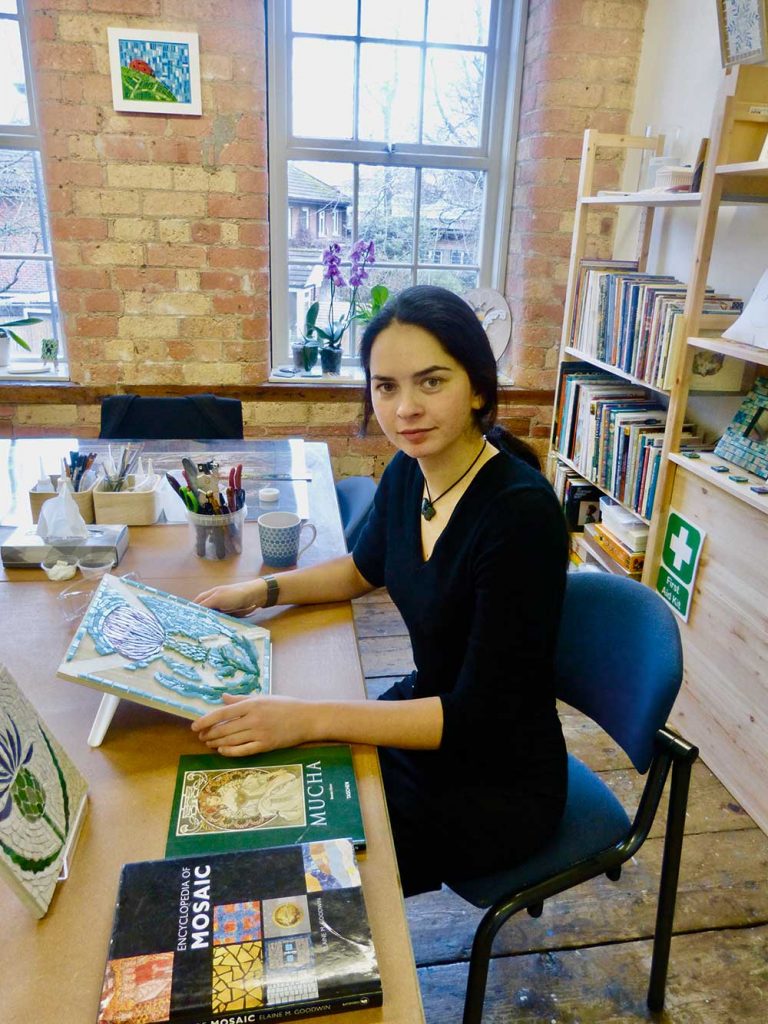
Although it’s a while since I waved a hot glue gun in anger, I’m confident I could give craft queen Kirstie Allsopp a run for her money if only I had the time, money and patience to follow basic instructions. Sadly, my previous attempts at crafting – toy making and calligraphy – only left me with a scar on my thumb and ink stains I’ll never get out of my dungarees. But putting aside my husband’s complaints that my homemade Fox Terrier project was a waste of good pipe cleaners; I decide to have one more stab at mastering a craft without having paramedics on stand-by. Thanks to the handmade boom (the £3bn UK craft market is currently growing by 4.5% a year) it really is possible to learn the basics of most crafts via workshops. Although I was tempted by batiking in Belper and weaving woodland animals in the Peaks, I reached out to multi-media artist and animator Magdalena Aron (30), because her motto ‘If life gives you broken pieces, make a mosaic,’ appealed to both my artistic soul and my clumsy fingers. “Don’t worry,” Magdalena reassures when I tell her about the unhappy hour I’d spent unravelling thread from my sewing machine after completing a six-week sewing course. “We will be making heart-shaped mosaic but I can adapt the class to suit all levels from absolute beginners to professional artists.” Transylvanian-born Magdalena has loved mosaics since visiting historical sites in Italy when she was a teenager. Her initial stab at mosaic, a beautiful self-portrait, re-ignited this passion and eventually led her to set up Minoan Mosaic Studio in July 2019. Since then, she’s on a personal crusade to breathe new life into this 3,000-year old discipline. In addition to Magdalena’s own projects, she sets aside regular Sunday mornings to host workshops for children and adults creating everything from decorated vases to Faberge-style eggs (workshops usually cost £25-30 for a session). “Even people with no drawing or painting skills can be successful with mosaics,” Magdalena says. “I think the outcome of mosaic is more predictable than say painting and will teach patience and calm like no other medium. It’s so rewarding when tiny tiles come together to make a story. Once you try it, and find out how amazing it is, you’ll become addicted.” The smiling faces of fellow students together with a large cup of Italian coffee does much to allay my pre-craft nerves. Most of the attendees at Magdalena’s stunning workspace in Bank Mill Studios, Derby, have done previous workshops and they are potty about mosaic. “I’ve made a heart before and a thistle,” says Angie Bethwaite, of Littleover. “I’m hoping to make something different and don’t mind if it’s something challenging or fiddly. I’d love to make a butterfly.” It’s a tribute to Magdalena’s teaching prowess (as a freelance instructor, she’s taught a variety of art and ceramic classes to children and adults over the past six years) that she doesn’t raise an eyebrow when others decide to do their own thing. She’s equally enthusiastic when Anna Pearman, of Borrowash, prepares to make a mosaic replicating patterns in her mum’s Persian rug. “I think we’ve all got the urge to be creative,” Anna says as she starts work on the intricate mosaic she intends to gift to her mum. “I tend to devote my weekends to learning a craft. That’s why I love my weekends so much.” Before we are allowed to get too creative (we are all giddy with the excitement of rifling through the delicious assortment of candy coloured tiles) Magdalena gives us a safety briefing on how to handle the tools of the mosaic trade. “You have to be careful as chips can fly everywhere,” Magdalena says handing out safety goggles. “Even into your coffee so don’t leave cups on the table. It does happen, I was cleaning up after a session with a soft brush and a little piece flew into my eye. Keep the glasses on when cutting and use tweezers to pick up glass to avoid cuts.” “It reminds me a bit of the welding course I once did,” Pauline Axby, of Sawley, laughs as she adjusts her goggles. “I can tile a wall so I might be able to put my skills to good use today. I’m also going to make a butterfly because I have the perfect spot for it at the top of my stairs. I love anything to do with nature.” Although I stick to the allotted task – decorating a pre-cut heart – I decide to add a flower cut from opaque glass using a wheeled nipper (a fancy tile cutter). Thanks to Magdalena’s calm encouragement, it’s all done without loss of any fingers. “It’s a lovely thing to do and in such a friendly atmosphere,” Jenny Woolley, of Mickleover, observes as we get busy with our nippers. “Everyone should make space in their life for crafts, it’s so relaxing.” Jenny is spot on. I didn’t expect the mood to change so quickly from one of skittish excitement to sheer calm. When Magdalena suggests we break for coffee and cream cakes, she almost has to click her fingers to get us back into the room. “After teaching art to people for years, I can often see the positive effect on people’s moods. It’s like a yoga class for the mind,” Magdalena concludes. “It’s even more beneficial learning in a group as people support and inspire each other. I think we’ll live to see a day when people view art’s centres in the same way as they do the gym; one exercises the body, the other the mind.” The positive effects of crafting certainly resonate with Gerry Henegan-Barr, a professional artist and holistic therapist from Nottingham. “My mum was big on craft. She had five children in total so I think making things gave her an outlet from the family and much-needed time on her own,” Gerry recalls. “I also find arts and craft help
Tried & Tested – Nourish with Diptyque

Fresh Lotion For The Body £36 200ml Cool, fluid, pleasing. The bright scent of Orange Blossoms. Like a morning breeze that awakens the bay of Alexandria, this lotion refreshes sleepy skin, leaving it soft and replenished. Smoothing Body Polish £48 200ml Sumptuous, rich, regenerating. “Queen of All Fruits” the bountiful pomegranate from Carthage is brimming with virtues. This unique body polish provides twice the benefits: delicately exfoliating dead skin cells while generously restoring a supple, resilient look and feel. The Formula: Pomegranate Seed Oil, rich in fatty acids and antioxidants, moisturizes and protects the skin, leaving it soft and silky. Jasmine Floral Water is a natural antiseptic that gently purifies the skin and activates cell renewal. Peach Butter comforts and nourishes the skin, making it extra supple. The Fragrance: Spiked with the crisp, fruity notes of Pink Peppercorns and Peach, Jasmine Sambac is delightfully tender on the skin. Revitalizing Body Balm £52 125ml Silky, invigorating, nourishing. This moisturizing cream absorbs almost instantly, leaving the skin soft and smooth as satin. Blood orange stimulates and invigorates the entire body. The Formula:Blood orange oil extract stimulates and invigorates the skin, leaving it soft and supple. Sesame oil, rich in essential fatty acids, helps the skin restructure and renew itself. Moringa oil revitalizes the skin, revealing its radiance. For more information and to buy online visit www.diptyqueparis.com/en_uk Product Test Smoothing Body Polish I love the product packaging for the polish. The polish itself smells absolutely luxurious and divine. It rubs on well to your skin and leaves such softness behind it’s well worth using. VP Revitalizing Body Balm This feels a truly luxurious balm, with a beautiful fresh fragrance. I used it regularly after showering and was surprised how quickly it melted into my skin. My hands too felt the benefit especially after the winter winds. JP Fresh Lotion The fragrance is absolutely delicious, fresh and lively. The cream I found really softened my skin and was easily absorbed and long lasting. A beautiful, luxurious product. CB 00
Taste Derbyshire – Bottle shops, tap rooms & micro-pubs

It was 2005 when Thornbridge Brewery, in Derbyshire, started producing one of the UK’s first craft ales. There are now 70 micro-breweries in the county and there’s been a huge rise in the number of outlets – bottle shops, tap rooms and micro-pubs – on a mission to bring these bespoke beers to the public. Taste Derbyshire’s Amanda Volley visited award-winning micro-pub and bottle shop Maison Du Biere in Ashbourne to find out why there is such a thirst for artisan ales. It has been the best part of two years since Matt Warren and his partner Jo Glover opened Maison Du Biere but the couple still savour the slack-jawed reaction of customers confronted by the 400-odd varieties of beers, ales and ciders. “We don’t give too much away as, from the front, the shop gives the illusion of being a little beer shop so the first thing they say is ‘wow’ followed by ‘oh my word’,” explains Jo (51), originally from Barnsley. “Then they notice we also have a bar area and ten cask beers on tap and they get a bit flummoxed by it all.” Her partner Matt (59), laughs; “I wish we had a pound for everyone who says they’ve walked into Willy Wonka’s factory.” “It’s either that or a sweet shop for adults.” The Ashbourne-based bottle shop and bar may contain a mind-boggling amount of beers (and gins) but the couple are confident they can match everyone, from serious ale buffs to timorous first-timers, with their perfect tipple. “We spend a lot of time talking to people about the beers and how and where they’re made,” says Matt who hails from Bristol. “Some people need a lot of help, others know more about beer than we do. It’s a relaxed place where everyone’s welcome and I think people love us for it.” There is a lot of love flowing in the direction of this cracking shop-cum-bar. In the first year, they were named ‘Pub of the Season’ 2018 by the Ashbourne & District sub branch of CAMRA with the couple praised for their ‘friendliness and enthusiasm’. In January, Maison Du Biere was runner-up in CAMRA’s Ashbourne’s Pub of the Year 2020, pipped only by the Barley Mow at Kirk Ireton; one of the area’s oldest pubs. “We’ve had an amazing reception. The minute we opened our doors in July 2018, it was just ‘kaboom’. The shop was packed and we smashed our weekly sales target on the first night,” says Matt. “People like the fact that we’re an independent retailer and that we stock beer from around 40 local breweries. Our customers enjoy taking a bit of the Peak District home.” Incredibly, considering all the praise flowing their way from industry experts, the couple had no experience of the speciality beer market before throwing themselves into Maison Du Biere. Matt and Jo both worked in sales for a national bookseller. “I knew a little about the hospitality industry as I’d had part-time jobs in pubs since my son Luke (now 26) was born,” explains Jo. “My brother, Nigel Mount, opened the original Maison Du Biere in Barnsley and he invited us to spend a day there. We loved it and, with his blessing, we decided to open our own branch.” Matt admits he also owes Nigel a debt of gratitude; “He took me along to a bar specialising in Belgian beer. I bought a round of four beers which came to £35 even though they were all just one third of a pint and mainly froth,” he laughs. “When the beer touched my lips – I got it. That beer blew everything else out of the water. It was beautiful and delicate. I’m now an evangelist on a mission to convert others to great beer.” Deciding they wanted sell beer was one thing, finding the location was another. The couple were living in Cheshire (they’ve since relocated to Clifton, near Ashbourne) but decided the area was too well-served with independent beer shops. “We knew Ashbourne pretty well from coming to walk here but we decided to drive down and have a proper look,” says Matt “I think we knew instantly it was the right spot as it had a lovely vibe. When this shop came up, Jo went on her own to have a look. She walked in and rang me to say ‘This is it.’ It had been an antique shop housed in a gorgeous 18th century mansion built for Lord Beresford. We didn’t have to do anything other than putting in fridges, shelving and second-hand finds like old trunks and church pews – our approach to furnishings has always been ‘no expense spent’.” Matt says local support has been overwhelming; “I like to think we’re helping to put Ashbourne on the map because it’s a beautiful town with amazing people,” “We lived in Cheshire for 16 years and could probably count the number of close friends on one hand. Now I could name at least 20 who I could call on for favours – day or night – and they’re more like family than friends. The same goes for our suppliers. The craft industry as a whole is very tight-knit. A lot of the beer producers are now our besties or ‘crafties’.” With this, Matt bounds over to the shelves to ‘introduce’ some of the beers. “On the one shelf we have world beers with most coming from the great beer producing nations like Belgium, Germany and Czechoslovakia. They are brewed to traditional recipes which haven’t changed in hundreds of years,” he says. “On the adjoining wall, we have craft beers. Typically made by young brewers who are trying to stamp their identity on a beer. This is where you’ll find people really innovating with flavour. For instance, there’s one tasting of marshmallow while another features chocolate, cinnamon, vanilla and chilli. One of our latest additions tastes of caramel brownie and peanut butter, it really is dessert in a can.”
Walk Derbyshire – Miller’s Dale

DISTANCE: 5 miles (8km) of field and river path walking linked by a mile of walled farm track. Reasonably dry underfoot except during lengthy wet spells. RECOMMENDED MAP: Ordnance Survey1:25,000 scale Outdoor Leisure Series Sheet 24, White Peak area. PUBLIC TRANSPORT: TM Travel service 65 between Sheffield, Miller’s Dale and Buxton, hourly service, Monday to Sunday. G&J Holmes/Hulley’s Buxton/ Miller’s Dale service 66. Monday to Sunday. CAR PARKING: Station yard – pay and display. Toilets on station platform. REFRESHMENTS: Station waiting room on platform. This walk starts and finishes at the Monsal Trail car park on the site of the old Miller’s Dale Station. Considering the fact that it appears at first glance to be only serving a scattered rural community, what was the need for such a large station? The answer lies in the fact that it served two railways, the mainline from London St Pancras to Manchester and the Buxton branch line. Both lines were closed in 1968 following Doctor Beeching’s notorious report. Realising that the mainline passed through some of the finest dale-scenery in Derbyshire, Peak District National Park acquired the section of track between Bakewell and Wyedale, creating the popular Monsal Trail, an all weathers trail for walkers, cyclists and horse riders. A café was opened in what was once the station waiting room, which together with the adjacent car park, made it an ideal starting point for walks along the trail and on the network of surrounding footpaths. I must have inadvertently travelled on one of the last trains to call at Miller’s Dale Station in 1968. I had an appointment in Leicester on what turned out to be a densely foggy day, so as I lived at the time, conveniently near the Buxton/Manchester line, I decided to travel by train. Returning later in the day, I got off the London/Manchester train in order to connect with Buxton. As I stood on the platform I became conscious of an elderly couple being helped down from the First Class coach of the London train, along with their wicker suit cases. Waiting for them was a chauffeur complete with old-fashioned leather gaiters and carrying a plaid rug for their comfort. Who the couple were I never discovered, but for a moment I was convinced I had walked into the set of a 1920s film. This walk starts and finishes at Miller’s Dale Station (pay and display). Dropping down from the Monsal Trail, it follows the road for a quarter of a mile before climbing the hillside in order to join a section of the Limestone Way. This track runs in a northerly direction to join a minor side road where a left turn drops down to and then across the upper reaches of Monk’s Dale. When this road starts to climb it is abandoned by turning left through a narrow stone stile. This is the start of the only significant climb on the walk; it follows a field path up and across a series of ancient fields leading to the farmstead village of Wormhill. Turning left on to the road through the village the route passes the well dedicated to the canal builder James Brindley who was born nearby. Leaving the road beyond the village, a path on the right is joined and followed downhill, going under the Monsal Trail to reach the River Wye. A footpath along the left bank of the river leads to the road bridge connecting the riverside hamlet of Miller’s Dale to Wormhill. Here the planned walk follows either the road or a path climbing back to the station car park. THE WALK 1. Leave the station car park and turn right to walk down the side road. 2. At the bottom turn left and follow the main road, going beneath the twin viaducts which once carried powerful Midland Railway steam trains from London St Pancras to Manchester. 3. About 50 yards beyond a corrugated iron cottage, turn left up the rough side road for about 150 yards (135m). 4. Go to the left on reaching a stony track passing behind a group of farm buildings. Join the access lane to Monksdale Farm where there was a small chapel in the 14th century – hence the name Monk’s Dale. 5. Go through a gate on the right of the farmhouse and out on to a rough farm lane. Follow it towards the upland pastures. 6. Follow the now grassy walled lane up a steep hill at first and then across the gentle open hill top. Continue along this track for about a mile, enjoying the views beyond Monk’s Dale. The dale is a nature reserve famous for its rare wild flowers. 7. Reaching a surfaced road, turn left and go downhill. 8. Continue with the road, across Monk’s Dale for about 20 yards (18m) and turn left through a narrow stone stile about 100yards (92m) uphill. 9. Climb the grassy path through a series of narrow fields until it joins a narrow, walled track. Take a breather now and then to enjoy the views of the eastern White Peak beyond Monk’s Dale. 10. Where the track forks, take the left, continuing left into the farmstead village of Wormhill. 11. Follow the village road, past James Brindley’s memorial well, going to the left, downhill for about 200yds (180m) away from the village. 12. At the bottom of the dip in the road where it bears left, turn right at the footpath signpost and go past a stone cottage, moving downhill through the rocky dell. 13. Walk down the steep scrub-covered hillside as far as the river. Do not cross the footbridge, but turn left and follow the riverside path, downstream, going under the huge railway bridge along the way. 14. Reaching the road, turn left beside the bridge and follow the way marked path up to Miller’s Dale station. There is a good view of the twin viaducts from this point. 00
Celebrity Interview – Robert Daws

So often one can awake from a reverie in the corner seat of a railway carriage when the train stops and look out through a grimy window to see where one is: a helpful sign on the platform, lamp standard or station building quickly puts one right and allows one to slip back into the arms of Morpheus. Hours after our conversation, Robert took to the York Theatre Royal stage in Alan Ayckbourn’s Ten Times Table. In the audience was the legendary playwright himself. No wonder Robert had a touch of the jitters. He plays “excitable” committee chairman Ray Dixon in the fictional town of Pendon which is trying to organise a pageant. But the committee is divided. “Alan Ayckbourn has dissected the world of the committee and the people on it with wonderful comic observation,” says Robert. “He spent years on committees being stopped at every turn and occasionally getting a green light. He was certainly writing from something that he knows quite a lot about. “The play hasn’t been done professionally, I believe, since about 1978 after it had been in the West End. It’s been done by amateur groups fairly regularly. In fact I can remember my parents doing it at one point 30 years ago.” Speaking about Ayckbourn’s watching from the stalls, Robert says: “That’ll put a little bit of fear on the committee!” He laughs, as he does several times during the interview. It’s obvious Robert, actor, author and more recently podcaster, enjoys what he does. He loves meeting people on his travels across the country almost as much as he relishes being on stage. But the erudite, affable Bedfordshire resident always makes time for his family, even if it means a 10-hour train journey back home from Edinburgh because of Storm Ciara. “That’s the reason for everything,” he declares sincerely. Chesterfield’s Pomegranate is on the list of theatres that Ten Times Table will visit and Robert is really enjoying the play. The cast includes Deborah Grant who was in Bergerac and Not Going Out, Robert Duncan of Drop The Dead Donkey fame and former Blue Peter presenter Mark Curry. “It’s a lovely company of people and everyone gets on well, which is quite nice when you’re doing an ensemble piece. “Alan writes lots of sections where two or three people are talking at the same time. It’s very much like life, of course. Bu it has its technical challenges.” The tour lasts eight weeks and Robert prefers travelling around Britain to acting in the West End which usually involves a long contract. “I try to go out once every two years to keep the old theatre muscles going. On tour you get to visit some wonderful places. Every week is an opening night so you have to keep yourself focused. “Audiences around the country are great. They’ve made an effort to come and see a show. And you get to play some of the most beautiful theatres in the world. “I like the diversity of touring and the constant changes and moving from place to place, theatre to theatre and audience to audience. I find that exciting.” Robert Daws was born on 4th May 1959 at Leigh-on-Sea, Essex. He trained at the Royal Academy of Dramatic Art. His first jobs after graduating were, believe it or not, at the old Derby Playhouse in 1980. He was cast to appear in a stage adaptation of Bram Stoker’s Dracula, Loot by Joe Orton and Richard Brinsley Sheridan’s comedy of manners The School for Scandal. Robert felt nervous as he prepared for his first day at the Playhouse – and struggled to find the building. “I thought ‘I’m lost, I’m going to be late.’ Then someone said ‘you want the Eagle Centre.’ I think the theatre was heavily disguised as a supermarket and then I found this lovely Playhouse. I had a marvellous time.” After that Robert’s career blossomed. He played pompous cricket captain Roger Dervish in the ITV series Outside Edge for which he was nominated for best comedy actor at the British Comedy Awards. He then played the co-owner of Cresta Cabs in Roger Roger and Dr Gordon Ormerod in eight series of The Royal on ITV. It was on set that he met Amy Robbins, the younger sister of entertainers Ted and Kate Robbins. She played Dr Jill Weatherall. Robert and Amy married in 2003. Robert has also had roles in Coronation Street, Doc Martin, Father Brown, Midsomer Murders and Death In Paradise as well as playing Dr Choake in Poldark. So is there one part people remember Robert for? “Some actors become very well known for one particular thing. Because I’ve been fortunate enough to do a variety of work, what tends to happen is that someone will come up and say ‘I loved you in this’ and someone else will say ‘I loved that show.’ And someone else will come up with something I did 30 years ago that I’d completely forgotten about. “It’s one of the fortunate benefits of being what used to be called a character actor. I’ve never been typecast. I’ve been able to play a variety of things.” Eight years ago Robert became an author when his crime novel The Rock, about a couple of detectives on Gibraltar, was published. He’s written two more murder mysteries and he’s currently working on a psychological thriller. Some actors write while they’re on tour – but not Robert. “The thing with theatre is you’re working anti-social hours, so you’re always conserving your energies. “I’m acutely aware that I’ve got to have a bit of mental and physical puff available at the end of the day or on a midweek or Saturday matinee. “But I do use the time to read, cogitate and think a lot which is as much a part of the writing process as anything else. “I tend to work best when I’ve got a clear space of a few weeks when I can just get into a routine
Modern Collectibles – Station Name Signs

So often one can awake from a reverie in the corner seat of a railway carriage when the train stops and look out through a grimy window to see where one is: a helpful sign on the platform, lamp standard or station building quickly puts one right and allows one to slip back into the arms of Morpheus. Such signs go back to the earliest days of railways and stations. By the way, avoid the Americanism ‘train station’: in this country ‘station’ has always meant a railway station (the correct qualification), whereas it was fire, police, feeding and other stations that required qualification! Modern collectible station name signs really begin with the grouping of our railways into the ‘Big Four’ in 1923 and ends more recently with the denationalisation of the railways from 1996. Usually each station used to have a large board towards the ends of the platforms, sometimes two, mounted in a ‘V‘, with timber (occasionally cast iron) letters applied to a wooden board. These are now very rare, especially as, being outside, they tended to decay. Thus from 1923 each of the four companies: the Southern (SR), Great Western (GWR), London Midland & Scottish (LMS) and London & North Eastern (LNER) tended to replace such signs with enamelled metal ones in their own colours. The SR produced target signs, green background with the name horizontally across a central annulet with white centre. The LMS used a maroon background and similarly used a circular centre but it was integral with the banner part of the sign to make a solid effect, whilst the LNER used dark blue rectangular enamel with white lettering. The GWR as a rule used white letters on a black background. These signs can fetch from about £30 up to around £400, depending on condition and most especially, what place’s name they bore. Some places have resonance: large cities (obviously), long lost stations, places where a potential purchaser lives, and those with associations, like Adlestrop (GWR: Edward Thomas’s touching 1917 poem). These factors can push up the price enormously. A typical example of an ex-GWR platform lamp tablet is one for Horsehay & Dawley (Salop) which made £580 at auction last year, whilst a large wooden station sign for Park Hall Halt (GWR) made £750. A similar one for Adlestrop was rescued in 1965 upon closure and was re-erected under the ’bus stop shelter for the replacement ’bus service. Alnwick (LNER blue lamp tablet) made £520. But if one cannot source a sign from before the Railways were nationalised in 1948, there is plenty of scope over the ensuing 20 years (when a boring new corporate image began to eat into the colour) but, oddly, the price tends to rise. British Railways, as the system then became, evolved what is called the totem sign: the round-ended banner being placed across a round angled rectangle and edged in white, with white letters. These were applied universally, although less so on the former Southern, where that company’s rather similar target signs tended to survive in large numbers. What gave the totem signs their interest, apart from the places themselves (many of which ceased to have any function since the start of the slashing and burning régime of Lord Beeching of East Grinstead in the mid-1960s), was that the Nationalised concern split the network up into regions approximately based on the territories of the ‘Big Four’. Thus, the Southern’s signs remained green (albeit of a more virid shade), the GWRs were brown, the Midland (ex-LMS) region was still maroon (a distant echo of ‘Midland Red’ as applied to rolling stock and locomotives at Derby from the 1870s) and the LNER was a blue similar to that used previously. Added to that a region was created for the North East (orange) and another for Scotland (bleu de celeste). Although these signs are much more ubiquitous and prices for unremarkable places can start at £500, resonance again can inflate the cost of acquiring one considerably. Whilst Mablethorpe (Eastern Region) made £2,800 recently, Northampton Castle (Midland) made £6,100, Stourbridge Junction made £1000 whilst Overton (Southern), a measly £960. Waterloo, being common (from the sheer size of the station – 21 platforms) made but £820. Yet on an on-line auction site, Grove Park (Southern Railway target) had failed to make its reserve of £21 in January! Another subject of nostaligic poetry (this time John Betjeman) was totem (SR) for Dilton Marsh Halt, estimated at £2,000-2,500. The value of these later signs, though, have led to a burgeoning trade in replica ones, of the right size and colour. You can order one from any one of a number of firms who will make you one with whatever name you want on it. The problem is, how do you tell the difference? The answer (assuming the name borne is not obviously unlikely) is: wear. The originals were set up in stations either outside or, if under canopy cover, at least open to weather, smoke, steam, aerial pollution and casual vandalism. They will show signs of wear, and signs of fixing. Many were attached to lamp standards with brackets, and the brackets tended to rust whereas the signs, unless damaged, were protected by their enamel. Thus, whilst signs in generally tatty condition are likely to be genuine, those appearing to be in superb condition, need to be looked at much more closely for signs of attachment and wear if they are to pass muster as genuine. Later and post-BR signs tend to lack colour and interest and, although there are substantial numbers out there, they do not appear to be particularly collectible. Their sheer uniformity and lack of colour has militated against that! 00
The Lost Houses of Derbyshire – Allen Hill, Matlock
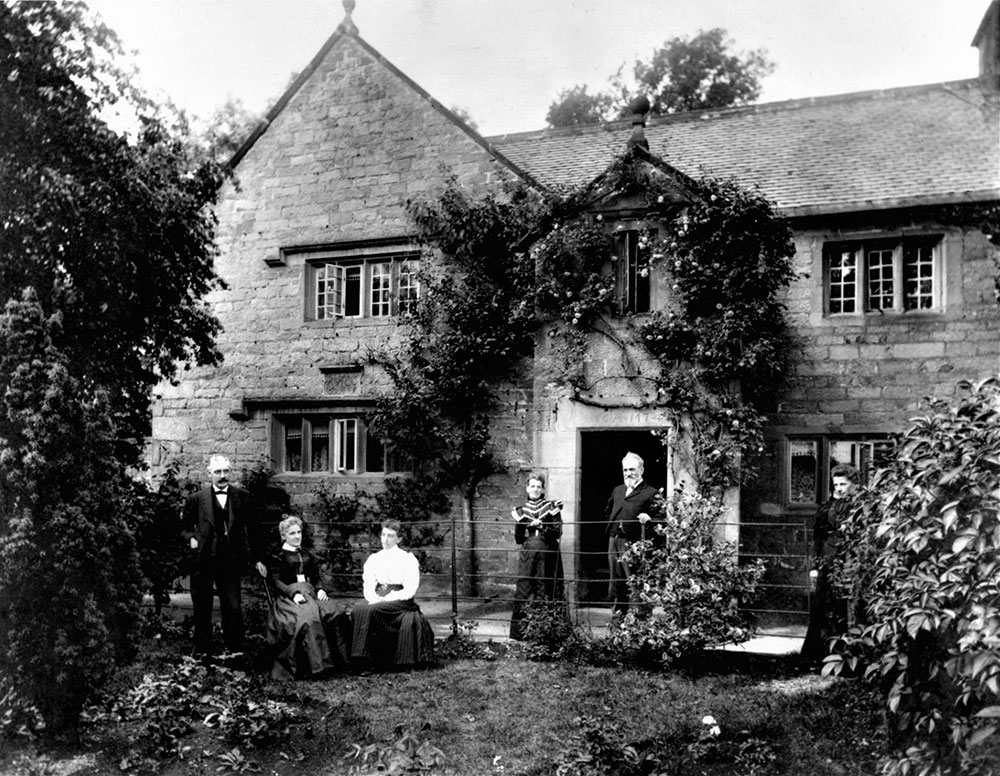
As you proceed out of Matlock going north you will pass on your right the end of Dimple Road, which rises vertiginously up the steepish hillside. Some way up you might just miss Allen Hill a narrow road leading down into a mass of 1960s housing and rising out on the other side as little more than a footpath ending in Woolley Road. From Woolley Road, you will also encounter Edge Road which, although on the hillside, has nothing to do with topography but everything to do with the former ownership of the land. Malpas Road also opens off Woolley Road. All these have resonance with a very modest, very old, minor country house which once graced this hillside, Allen Hill. The house itself – at least in its latter three centuries – was of L-plan, built of rough ashlar blocks of Ashover Grit from a local quarry and edged with long-and-short blocky quoins. The cross wing was to the left of the entrance and had a four light mullioned window lighting the floor above a five light one, both set beneath cranked hood moulds. Between the two was inset a stone plaque under another very short hood moulding which read AW | GC 1624 | V The cross-wing gable was irregular, for the fenestration was by no means central, suggesting a rebuild of an earlier house. The porch was a charming confection of two storeys which projected beyond the cross-wing and like it was topped by stone coping with a ball finial at the apex. A two-light mullioned window under a hood mould lit the tiny room above the entrance, which was a nineteenth century replacement, in smooth ashlar of Stancliffe stone, quite rectangular but with a discreet moulding, but over which was inscribed, probably secondarily rather than transplanted: 16 AOM 74 To the right of the entrance was a four light ground floor mullioned window with a three light one above, neither graced with a hood mould, a pattern repeated on the next bay to the east and the range – unusually long for a Derbyshire small manor house – ended with a superimposed pair of two light mullioned windows. At this end, the walling was closer to random rubble, but it turned the angle with another stone coped and finialled gable. The roof was slated. This front faced southwards, down the slope towards the river, but the west side was blind and interrupted only by a very substantial projecting chimney breast supporting a pair of diamond section stone stacks, the chimney breast probably well pre-dating 1624. The north side seems to have escaped visual record but, with the ground rising steeply and a north aspect, it probably had few windows but a door to the farmyard and stables. There were six hearths taxable in 1670, and ten rooms in the domestic part of the house according to the census of 1911. The stable block appears to have been approximately contemporary with the house at one end and bore yet another inscription, 1653, over the door. Further long, the range had been extended, presumably in the eighteenth century, probably as a carriage shed, and a final stone was inscribed: I W 1774 The estate was reportedly modest, about 800 acres, and the land, which seems to have taken its name from an unrecorded family called Alleyne (to give the earliest recorded spelling, which was how most Allens were spelt prior to the Early Modern period) was originally part of the once extensive estate of the Wendesley family of Wendesley, who, we must presume, inherited it from a branch of the White Peak Alleynes, who had given it their name. The hill itself, called The Dimple had lead mines within it, and at the foot a small spa was later opened on the family’s land. The well head survives, listed grade II and was restored by Adam Wolley in 1821. In Queen Elizabeth’s reign, we find a Richard Wendesley, presumably of a junior branch of the family, selling the estate to one Anthony Wolley (as it was then spelt) of Riber Manor. Although the surviving pedigrees do not show it, it seems likely that Anthony had married Richard Wendesley’s sister, for his coat-of-arms in the heralds’ visitation shows his arms impaled (placed alongside on the same shield) with those of the junior Wendesleys: ermine on a bend engrailed gules three escallops. Thus, the Wolleys of Riber acquired Allen Hill. TheWo[o]lleys had originally come from Wolley in Hollingworth, Cheshire, in the later 13th century. Their arms bear a chevron vairé or and gules, the colouring of the arms of their feudal overlords, the de Ferrers Earls of Derby, who probably granted them at some date prior to their disgrace and attainder in 1268. William, son of Ralph, settled at Broadbottom Hall in Longendale, but in 1460 his descendant in the fourth generation, acquired by marriage with the heiress of John Robotham of Riber a small estate there and, enlarging his holding by purchase, established a house on the site of the present manor house. Anthony Wolley died in 1576 leaving three sons: Adam who inherited Riber, and whose descendants built the present hall, Thomas who settled at Bonsall, and John who was given Allen Hill. John probably built the original house, and his efforts were no doubt the east end of the building where the stone blocks were much rougher and unevenly brought to course, and the west wall of the cross-wing. However, if we may trust the date stones, the house that survived to be photographed was rebuilt by Anthony Wolley (1594-1655). He had married in 1615 and probably began to rebuild gradually, the date probably marking the completion of the works. What the ‘GC’ and the hieroglyph beneath meant is quite unclear: neither his wife nor anyone in the family bear these initials; they may have been re-cut from an unreadable original. The next date, re-cut over the door, is 1674. The A and M stand for
South Wingfield Station – A Lost Beauty

The large, attractive village of South Wingfield no longer relies on mining coal, or producing knitted fabrics for its industries, but has become a quiet dormitory town for the surrounding area. Its one major feature is Wingfield Manor. It was here that Mary Queen of Scots was held captive for several years, all the while and with some justification, complaining bitterly of the smell from the midden directly beneath her bedroom window. It was from here that the abortive Babbington Plot tried to free her, costing its perpetrator his head. About half a mile outside the village, the Midland Mainline railway crosses the Alfreton road. A few yards beyond the railway bridge, a short length of mud covered cobbles leads to a group of abandoned station buildings where the converted station master’s house is now a dual residence, partly hidden in a wild-wood of self-sown trees. This was South Wingfield’s very own station. Until 1967, South Wingfield rail travellers could hop on one of the main line trains stopping at the village station and ride in comfort to do their shopping in Chesterfield and beyond, or Derby and all points south as far as London. Despite the station being designated as a Grade II* listed building, it was deemed unnecessary for this rural part of Derbyshire and was closed in 1967. Express trains still thunder down the Amber Valley and roar through what is left of South Wingfield Station, but nowadays anyone from the village wanting to catch a train going north or south, must travel some distance for the privilege. What was originally called the North Midlands Railway was built by George Stephenson and his son Robert. Funding was initially organised by George Hudson of York, known as the railway king in his short-lived notoriety. During the railway building mania of the mid 1800s, he encouraged investors to put money into his schemes, artificially inflating the value of the railway company shares by paying dividends out of investments rather than profits, a kind of pyramid scheme in its day. When this illegal practice was discovered, Hudson was indicted and sent to prison as a broken and penniless man. Fortunately the plan to build a railway linking Leeds to London by way of Derby was properly funded. So with Derby at the junction of lines from London, Birmingham and Nottingham, the route of the North Midland (later the Midland) Railway was surveyed by George Stephenson assisted by Joseph Locke. Stephenson proposed building the line by using 72 miles of river valleys between Derby and Leeds. This would result in a route designed to mainly carry coal; using gentle gradient; building viaducts and tunnels only where necessary. Although it had the advantage of allowing heavily laden coal trains to run mostly downhill, his route frequently by-passed many large towns such as Sheffield. Connecting them meant building costly branch lines. This led to disagreement between Stephenson and Locke who saw the economic advantages of connecting as many towns and cities as possible along the route, rather than relying on simply carrying coal. Eventually a compromise was reached, just in time to cater for the growing interest in passenger trains, despite the many inconveniences such as travelling in coal wagons. The first train to run along what eventually had become the 73½ mile long railway, left Leeds with suitable Victorian pomp and ceremony on the morning of the 7th of May 1840, with a formal lunch at Derby on arrival at 1.30 p.m., returning to Leeds on time at 6.55 p.m. One part of the ceremonial inaugural run was to formally open Derby Station, then, as now an important junction serving the three lines between London, Birmingham and Leeds. The original Derby Station was designed by the architect Francis Thompson who was commissioned by Robert Stephenson, son of George, to design 24 stations along the Derby to Leeds section of the North Midlands Railway. They were all architectural masterpieces, whether they served a large town or small village. Due to modernising and other schemes in later years, only one survived, it was South Wingfield. Following gradual deterioration and standing empty since its closure over 50 years ago, despite being classified as a Grade II* Listed Building, South Wingfield became what someone described as a ‘maimed beauty, deserving better’, one of the ten most important buildings at risk in the British Isles. In November 2019 a saviour came on the scene in the shape of the Derbyshire Historic Buildings Trust (DHBT), in order to take over South Wingfield Station’s ownership, raise funds, restore the station buildings and find commercial and educational uses for them. With the backing of Historic England, the Architectural Heritage Fund and the local council for Amber Valley, who placed a compulsory purchase order on the semi-ruined building, ownership of the station was transferred to the Derbyshire Historic Buildings Trust. Once over this hurdle, the Trust is beginning to work towards securing full funding for the restoration and adaptation of Wingfield Station. So the trust have begun the massive task of arranging funding for restoring and adapting South Wingfield Station. The plan after removing all the rubbish and invading shrubs and trees, cleaning off graffiti and generally making the building safe and accessible, is to make it available for living history events, telling the story of the station through the recorded memories of those who worked there or travelled from it; arranging bursaries for young people to learn traditional rural craft skills and offering open days for the local community – bringing the station back to life and allowing it to be part of the community once more. Thanks to National Lottery players, funds from The National Lottery Heritage Fund and others, including the Pilgrim Trust Foundation are already generated for the initial work in generally tidying up the site, undertaking surveys, developing plans, consulting with the local community and developing partnerships. An initial development grant of £137,000 from The National Lottery Heritage Fund has been awarded to
IMAGES BIG 2020 QUIZ

Answer Sheet Download the JPEG Download the PDF The person with the most correct entries will win the prize. Judges decision final. Send your entries by post to: Image 2020 QuizImages Publishing Ltd. Unit 5, Keypoint Village, Keys Road, Alfreton, Derbyshire DE55 7FQ or email competition@imagespublishing.co.uk.All entries to reach us by January 25th 2020 Download 1 JPEG Download 2 JPEG Download 3 JPEG Download 4 JPEG Download 5 JPEG Download 6 JPEG Download PDF 00