Dining at The White Horse

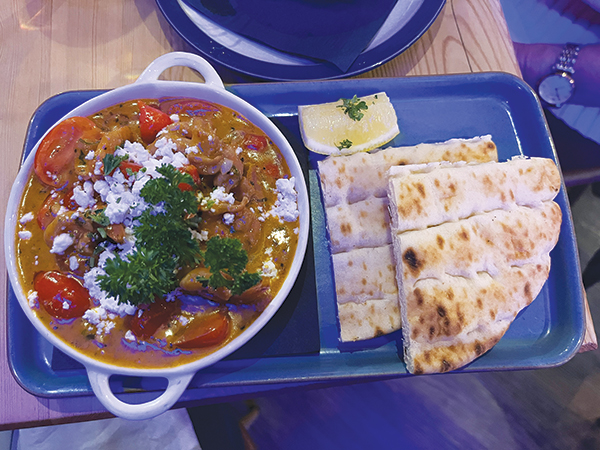
Dining at The White Horse, Woolley Moor The White Horse conjures up the happiest of memories for us as it was here that we spent many sunny evenings with our children and friends enjoying the spectacular, beautiful Derbyshire countryside and a quiet drink. However, that was many years ago and happily, like our family, it has developed and matured into something of a treasure. The village of Woolley was flooded in 1958 and the villagers relocated to the hamlet of Badger Lane which over time became Woolley on the Moor, and then to simply Woolley Moor. It is here that you will find the delightful White Horse Inn, built from traditional Derbyshire stone and with hundreds of years of history. ‘The View’ offers 5 star accommodation suites; from its luxury Hypnos beds and spacious en-suite bathrooms, to its wall-wide windows and private patios. But… we were here to enjoy an evening with old friends over a glass of wine and an excellent meal. We had chosen the White Horse because from the moment you arrive the atmosphere is friendly and relaxing, and the greeting warm. Simply and tastefully decorated we sat in the bar and enjoyed a drink while we chatted about what we were going to order, with both a menu and specials board to choose from. Our friends enjoy fish and the chef always has a good selection of fresh fish dishes on the menu, as well as lamb, chicken, steaks and vegetarian. Locally sourced food is used wherever possible and a local gardener had brought a selection of heritage tomatoes in that afternoon which chef had used to add a new starter to the menu. If like me you’re concerned about ‘low air miles’ it doesn’t come better than that. Moving through to the restaurant we had homemade sour dough bread with a selection of butters to nibble on. But first to starters. My choice was the baked goat’s cheese, warmed until it just brought out the full flavour, slightly sour but soft and creamy. Served on a disc of flaky pastry, the delicious fig jam with those crunchy seeds was a lovely sweet contrast. I also persuaded my friend to let me taste his smoked haddock tart, this was so soft and the fish so subtle, creme fraiche with chopped dill was all that was needed to complete the dish. Local Derbyshire lamb, when expertly cooked is hard to beat and this rump, although cooked a little longer than the chef would have recommended I expect, was sweet and tender. I’m sorry but I just had to beg a taste and it fell apart, I was also intrigued to try it with the basil mashed potatoes and roasted pepper, and they worked perfectly together and made a real change to the traditional mint. The whole dish was brought together with the richness of a red wine sauce. My own choice was the hake, a lighter dish with a moist deep piece of fish, and mixture of finely chopped herbs covering its crispy skin. It sat on a bed of warm new potatoes and finely diced peppers, red onion and spring onions. The lemon and caper oil dressing was fresh and didn’t over power the fish. Desserts are where a chef can really allow his artistry to flourish, and the presentation of my hazelnut parfait was superb, with tiny edible pansies and miniature marigolds. It tasted just as good as it looked, not too sweet, nicely cool and sharp from the smooth berry sorbet, and lots of different textures…a perfect finish. If though you have a more robust appetite, (like my husband !) the traditional puddings such as the Bakewell tart and treacle tart are really not to be missed. The wine menu is extensive as you’d expect and the well-stocked bar boasts Chatsworth Gold and Bakewell Bitter from Peak Ales Brewery. I was reliably informed and noticed that the well-kept beer was going down a treat. Like fine wine, the White Horse has matured to be one of our favourite places in Derbyshire to enjoy an evening with friends. We thank Dave and Melanie, owners of the White Horse for the last 12 years, and all their staff for a great evening. +10
Walk Derbyshire – Chelmorton and Deepdale

4¼miles (6.8km) of moderate walking on field paths and cart tracks; rocky in DeepdaleRECOMMENDED MAP: Ordnance Survey 1:25,000 scale Outdoor Leisure map Sheet 2; The White PeakBUS SERVICES: Transpeak TP service from Derby stops at the Monyash road-end. Hulleys 177 Bakewell to Buxton via Monyash service stops at Chelmorton Post Office. High Peak 193 Tideswell to Buxton service also stops at Chelmorton Post Office. For up to date bus times, check with Traveline on 0871 200 22 33. Open daily 0700 – 2200REFRESHMENTS: Church Inn opposite the parish church at the top end of Chelmorton village.CAR PARKING: Roadside or at the pub but only if you intend visiting after the walk. People have been living around Deepdale for thousands of years. Their early burial mounds are on the surrounding heights and, nearby, is the mysterious stone tomb of Five Wells. Badly damaged by Victorian archaeologists, there were once two chambers within this elongated limestone cairn containing pottery and flint tools. Chelmorton is a linear village with its houses filling the gaps between farms. They all use water which flows from a well above the road end – it goes by the delightful name of Illy Willy Water. The 700 year-old parish church is dedicated to St John the Baptist and the traditional locust weather vane commemorates the time he spent in the wilderness. The village sits at the lower half of a west-facing slope, covered by a unique pattern of narrow enclosed fields – the preserved relics of medieval husbandry. Oxen were used to drag simple ploughs and these lumbering beasts were difficult to turn. As a result, fields tended to be long and narrow, with each farmer working those around his farm and sharing common grazing on larger fields beyond the village. Deepdale to the north of Chelmorton is a complete contrast to the ancient fields above the ravine. With the exception of the stark ugliness of Topley Pike Quarry, the dale is completely unspoiled and nature is in command. Away from the quarry, the path is across rough stony ground and care must be taken, otherwise a twisted ankle could mar a fascinating walk. THE WALK 1. He walk starts at the cross roads below the Church Inn. Walk down the left-hand lane below and almost opposite the church by following a footpath sign. Chelmorton’s complex field system is laid out across a gentle slope behind the village. No longer suitable for modern farming methods, the walls and their enclosed field pattern are preserved with co-operation from the farmers and grants from the Peak District National Park Authority. 2. Cross the main road and, of the two lanes opposite, take the right-hand one. Follow this downhill and out to the lower fields. 3. Go through a narrow stile into open meadowland. Keep to the right of Burrs Farm, following a grassy path all the way. Enjoy the view to your front. It covers the northern dales of the Peak District, dales which drain into the Derbyshire River Wye – they start high on the gritstone moors, carving deep troughs as they flow south. In the middle distance you can see some of the major limestone quarries of the Peak. Humps in the surrounding grazing denote the boundaries of Celtic fields, not marked by stone walls like those closer to Chelmorton, but just as old. 4. Take care when descending the rocky tree shrouded path into Deepdale as it can be slippery in wet weather. CHURN HOLES: To the right where the path zig-zags steeply through a gap in the limestone crag, there is a series of shallow holes created by water action at the end of the last Ice Age. Topley Pike quarry suddenly hits the senses. It is a hard fact of life that limestone, needed for safe roads, is mostly found in beautiful areas such as the Peak District. 5. Joining a second path coming up through the bushes, turn sharp left and go through a small gate in the dale bottom and, after a few yards climb a flight of steps on the left up to the dale edge. 6. Turn right as indicated by the temporary waymarking. Follow this part of the route along the dale-top until the path descends back to its proper route. This part of the route has, as the notice advises, been diverted temporarily while the quarry debris is removed and the dale bottom restored. 7. Follow the path, left along the valley bottom. DEEP DALE. Beyond the slurry lagoon, the tranquillity of Deep Dale soon takes over. Specialised plants and shrubby trees live on the sparse rock-strewn soil. The dale bottom is damp, but above it, dry scree slopes lead to limestone crags. Caves in the outcrops on both sides of the dale below Raven’s Tor, were once the dwellings of stone-age people. 8. Keep left where the dale forks, using a wide grassy path known as the Priest’s Way, along what is now Horseshoe Dale. The name Priest’s Way probably dates from the time when much of the land in the Peak District was owned by various monasteries. The track would be used to link the grange, a monastic farm near Brierlow, with grazing on land above King’s Sterndale. The roughly worked opening at the bottom of Bullhay Dale on your left, is an adit, or mine entrance. This one-time lead mine was worked for its content of fluorspar in recent years. A useless hindrance to lead miners, fluorspar is used in toothpaste, or as a flux in steel making and as a source of the gas fluorine. What was once a waste product is now a valuable commodity. Do not enter the mine, as it is in a dangerous condition. 9. Walk uphill and then go through the abandoned stock-yard to reach a wicket gate offering access on to the main road. Turn left and follow the road, continuing with it past the turning for Chelmorton for a total of about 400 yards. 10. Turn right, away
Gardening – Spring

I wouldn’t say that the Winter has been particularly bad, looking back on my gardening diary we had 7ft snow drifts in 2014 in South Derbyshire but I do think it has been a long one. For the first time in 20 years we had snow early in December so after stop – start with the Gardening we are now getting some clearer, warmer days. This month sees the start of the “grow your own” season, again with many new varieties of vegetables. I can’t wait to start on my own allotment and I’ve already planted my potatoes and onion sets – but I also had great success with carrots so I’m going to try the heritage varieties. I sprayed less insecticide last year because of the companion planting I used (blackpepper mint and basil) to keep away greenfly and whitefly. Also another tip, using white alyssum (the summer bedding plant) planted in containers near plants or vegetables, thrips are attracted to the alyssum and not your plants or veg. Once the alyssum are swamped with thrips simply dispose of them in the green waste wheely bin.Look out for the N.G.S Open Garden booklets. The reason I love the open garden scheme is because these are “real” gardens that easily relate to our own gardens. So pick up a yellow booklet for dates and locations from any good plant nursery or garden centre and also look out for the yellow posters – the open gardens are a great source of inspiration. Allotment or Vegetable Patch: Still a good time to sow green manure Buy vegetable plug plants (approx Easter weekend onwards) Fertilise spring cabbage with a high nitrogen feed Plant new asparagus “crowns” Potatoes, shallots and onion sets should still be available to buy Feed fruit trees and bushes with sulphate of potash Crops to sow directly outside or under cloches are peas, mange tout, mixed salad leaves, radish, cauliflower, turnip, lettuce, carrots, beetroot, cabbage, Brussels, broad beans, leeks, rocket, Swiss chard and spinach. Also sow in your vegetable plot tagetes and poached egg plant to attract beneficial insects. In the Greenhouse: Protect any seedling from cold Water any seedling trays or pots with copper fungicide to help prevent damping off disease. Remember to increase ventilation on warm days If too hot, put up shading to protect plants Buy plug plants to grow on for pots, bedding displays and baskets. Sow French and runner beans in pots. Sow melons, cucumbers, marrows and courgettes in a heated propagator Check plants regularly for signs of pests or disease Plant tomatoes in grow bags or large pots. General Garden Maintenance: Repair or sow new lawns with grass seed. Apply moss killer to lawns – or sulphate of iron which is the active ingredient in moss killers. Rake out any dead grass from lawns. Start to feed the lawn with a suitable lawn fertiliser. Prune out any green shoots (reversion) off any variegated shrubs. Check that stakes are not rubbing against trees or tree ties are not too tight. Cut away any “suckers” growing around the base of trees and shrubs. Last month’s top shrubs forsythia and ribes (flowering currants) prune back after flowers have finished. Sprinkle a handful of sulphate of potash around tulips to improve flowering Sow sweet peas outside around the base of cane supports, obelisks or even try a hanging basket for them to trail down. Give camelias, rhododendrons, azaleas and pieris a good handful of ericaceous (acidic) fertiliser. Now is the ideal time to start to spray roses as a preventive for mildew, rust and blackspot. Keep topiary in check by giving a light clip now. Look out for new varieties of trees and shrubs this month but here are some that are old favourites. Japanese Maples: My most favourite of all shrubs, these stunning shrubs / trees are ideal in containers and make a great feature plant in the garden. The choice of varieties is vast, with red or green, finely cut or palmate leaf. Pick a variety like Acer Palmatum Sango Kaku and you also get colourful stems in winter. Acers like a moist but well drained, neutral to acid soil in a non exposed windy position. Despite what you read in some books, Acers with sensible care are easy to grow. My personal favourites are … Acer Palmatum `Sango Kaku` (coloured stems) , Acer Palmatum `Bloodgood` (the best upright red leaf maple) Acer Palmatum Dissectum `Greenlace` (very finely cut, green leaf maple), Acer Palmatum Dissectum `Garnet` (very finely cut, red leaf maple) and Acer Shirasawanum `Aureum` (bright yellow leafed maple). Spiraea x cinerea `Grefsheim`: or “bridal wreath” currently mine at home is full of flower bud so this will look fantastic at this time of year, long flower racemes of pure white hang down almost weeping. Very easy to grow it likes most soils in full sun to part shade. I wouldn’t recommend this for a pot but planted in a border or a informal hedge makes a good feature. The R.H.S has given this plant the Award of Garden Merit. Cercis chinensis `Avondale`: Might be a bit hard to find this one but worth hunting it out. This is a beautiful species which is native to China, Cercis chinensis ‘Avondale’ has bare stems which are studded with pretty, rich purple-pink flowers in late April or early May before the foliage emerges. This variety is grown mainly for it’s striking flowers but there is also Cercis canadensis `Forest Pansy`which has beautiful deep plum red leaves and new this year Cercis canadensis `Hearts of Gold` which has large bright yellow leaves. 00
Lost Houses – Swarkestone Old Hall
If you drive along the road from Swarkestone Bridge to Chellaston you will notice, just as you turn east after passing the Crewe & Harpur Arms, a pair of sturdy stone gatepiers topped with large ball finials. Those not having to concentrate upon the road ahead will also see, in the field beyond the gate piers, an engaging stone two storey structure with a pair of ogee domed turrets. The latter, beautifully restored, is now a holiday cottage for two, although I visited once, soon after commissioning, when it was being occupied by a lady barrister appearing at Burton Crown Court. It was ferociously cold and the only way to the loo (in one turret) was to cross the leads from a door (in the other turret). On the day I called, the leads were a lethal sheet of ice, making the essential transition exceedingly hazardous! This is Swarkestone Stand, still with gun embrasures on the side facing the road, evidence of a Civil War siege. Were one to wander beyond the former bowling alley in front of the building, onto the pasture of the present 17th century Swarkestone Hall farm house, one might well notice some unusually high field boundaries, one with superimposed fireplaces still in situ. All these component parts once made up the whole of a lost mid-Tudor great house, built by Chief Justice Sir Richard Harpur (1515-1577), a Royal legal officer who dexterously served four sovereigns – Kings Henry VIII, Edward VI, Queens Mary I and Elizabeth – without losing his head. The Harpurs were an old Warwickshire and later Staffordshire family, seated at Pelsall. Sir Richard’s branch had become merchants at Chester, of which County Palatine Sir Richard latterly became Chief Justice. In 1544 he married Jane Fynderne, whose family owned estates at Findern, Littleover and Twyford. Although she was her brother’s heiress, she was of a junior branch of her family, although when her cousin Michael died two decades after her in 1618, her children inherited all that was left of the family estates. Ironically, most of them had been purchased by the Harpurs years before to prevent young Michael frittering them away! Harpur began buying up land in and around Swarkestone, from the Wilne family, some from the Sacheverells and most in 1558 from John Rolleston. Thereafter he began to build (probably on the site of its predecessor) his ‘newe mansion howse’ which was completed in 1567. From what evidence remains, it must have been quite impressive; the house was approximately 115 ft. square and with a central court yard. The best rooms were, almost certainly, from the evidence of remains, on the first floor (the piano nobile), with others facing the church to the west. The structure was built in coarse Keuper sandstone blocks with fine ashlar quoins and detailing, all from the nearby quarry at Weston Cliff. The whole ensemble was approximately orientated north-south, the northernmost feature being the Stand added by Sir Richard’s grandson in 1632, built by Richard Shepperd at a cost of £111 – 12s – 4d and designed, according to Professor Mark Girouard, by John Smythson, creator of Bolsover Castle. The Stand, or pavilion, has a south facing arcade with a viewing room above with big windows to observe the bowling in the rectangular sward on the south side. Opposite is a re-positioned Tudor door-case set in the surviving boundary wall. Beyond again would have been the 38 foot wide two storey gatehouse, probably also embellished with onion or ogee domes, but now entirely vanished bar a few fragments at ground level. From this a straight drive took one to the north range of the house through an impressive archway and into the courtyard. The present farm house to the south east is post-civil war and some consider it was probably adapted from the original stable block and indeed, it may have served a similar purpose, at least for a while, before conversion, prior to 1750, into a farmhouse. Other schools of thought consider it to have been a factor’s house or similar, as with the equally adjacent ‘Georgian House’ at Hampton Court, but altered later. On the west side of the main house, where there is still a two storey stretch of wall with three chimney pieces surviving. To its west lay a large formal garden with cruciform paths radiating from a circle containing a pond, to divide the parterres, all revealed by work on the farm in 1988 and partly excavated. To the north west lies the so-called tithe barn, tactfully converted into a pair of luxury homes in 1988. Clearly it was never a barn as such, lacking the usual full height wide doors, but the suggestion that it was a malt-house has not found universal favour either. It probably formed part of a utilitarian yard with other buildings, but its five bays of south facing windows in moulded surrounds over two storeys and lack of chimneys would suggest some kind of storage was intended. The best way to appreciate the entire once very grand ensemble is to stand on the leads at the pavilion and look south towards where once stood the gatehouse and main residence. During the Civil War the house, still then held by the Royalist Harpurs, held out, ultimately unsuccessfully, against Sir John Gell’s Parliamentary forces from Derby, under the command of Sir John Harpur (1612-1679) from December 1642 to January 1643. Sir John survived exile as a widower and married again after the war. In 1662 he had to pay the new hearth tax on a massive 28 hearths, one more than Sir Edward Coke at Longford (less than half of whose house survives today), two more than Sutton Scarsdale and two less than Staveley. Risley, another very similar house, was taxed on 33 hearths. William Woolley, writing about 1713, wrote of Swarkeston that it was ‘a large, convenient stone building, seated on the banks of the Trent’, but within months the house had become empty on
Lost Houses – Hasland House
Hasland is one of the many outliers of the Manor of Chesterfield, and was long held by the ancient family of Linacre, under whom it was, in the 15th century, tenanted by a cadet branch of the Leakes of Sutton Scarsdale. Thomas Leake of Hasland, for instance, was Bess of Hardwick’s maternal grandfather. After the death in a duel in 1597 of another Thomas Leake, the succession to the estate was thrown into disarray and it was eventually acquired by Col. Roger Molyneux of the Teversal (Notts.) family, later a prominent Parliamentary officer but, ironically, he disposed of it shortly before the Civil war to a Royalist Capt. John Lowe of Owlgreaves (now Algrave) Hall, second son of Anthony Lowe of Alderwasley – if only he’d known!. The estate and house – the still extant old Manor House is written up in The Derbyshire Country House 3rd edition (Ashbourne 2001) Vol. II. pp. 277-8 – continued amongst their descendants until in 1727 the heiress brought it to her husband (and kinsman) Henry Lowe of Park Hall, Denby, whereupon it was sold to the upwardly mobile Lucas family. It seems to have been at this juncture that Hasland House was built in a small park immediately NNW of the village centre, presumably because the old hall was considered inadequate for more up-to-date requirements and was thereupon let as a farm. Thomas Lucas alias Oliver was the son of Bernard (originally from Grindleford) and started out as a Chesterfield butcher being fined for operating without being a burgess in 1689. Nevertheless, thanks to him and his sons, the family swiftly became unconscionably rich. It is not clear who actually built the house. In 1727 Thomas was getting on and had a house elsewhere and it was more likely his second son, Bernard, who built a fine new brick house. It was five bays wide on both main facades, of three storeys with a hipped roof behind a low parapet, the gauged brick lintels having triple stone keyblocks. There were plain pilasters at the angles and the entrance – surely aping the style of Francis Smith of Warwick – set in a stone surround crowned with a segmental pediment. The fact that the roof was irregular, ending with a hip to the west but not to the east, might suggest that a fairly substantial earlier house with gables might have been rebuilt, rather than the house being entirely new. Inside there were three excellent panelled rooms and a timber staircase of very fine joinery with three balusters per tread and carved tread ends. From its style and appearance, the house must have been built within a year or two of Lucas acquiring the estate and it was later described as “a commodious and pleasant mansion”. It could even have been built to a design by the great Francis Smith, who was then building Wingerworth Hall not very far away for the much grander Hunlokes, but no building records appear to have survived. Bernard Lucas (1708-1771) was Mayor of Chesterfield in 1741 and was succeeded by his son – another – Bernard, who died unmarried in 1810, and then by the latter’s younger brother Thomas (1731-1818). Thomas’s son, yet another Bernard, greatly increased his fortune by marrying Esther, sister and heiress of Anthony Lax (later Maynard) of Chesterfield, an opulent attorney with a Yorkshire estate and decided to build a new house again, not so far away. This is the present Hasland Hall, for many years now a school, and Hasland House was let and later sold to Josiah Claughton, a Chesterfield druggist and wholesale chemist with 35 acres. The Claughtons were thereafter in residence for almost the whole of the 19th century for, although Josiah died in 1836, his widow Elizabeth only died in1853 and four unmarried daughters – Jane, Catherine, Ellen and Fanny – lived there until the death of Catherine, the last survivor, in 1895. Nobody, in all this time seems to have sought to alter or rebuild the old house, which appears nevertheless to have had much charm. The only exception seems to have been that during the Claughton regime, the three over four glazing bar sashes were replaced by plate glass ones with Victorian margin glazing bars, which did nothing for the appearance of the house. The house was briefly let to Capt. Herbert Murray having been inherited by Catherine Claughton’s nephew Revd. Maurice Beedham, and then by his son, John, who was based in Canada and sold their house and modest acres in 1904. The purchaser was Chesterfield grandee Bernard Lucas, a descendant of the original Lucas owner in the 18th century, who paid £7,650. His tenant was another member of a notable local family, Eric Drayton Swanwick, second son of Russell Swanwick and grandson of Frederick Swanwick of Whittington Hall, the man who surveyed the North Midland Railway for George Stevenson (later of Tapton Hall) in 1838-1840. Frederick also designed many of the buildings, the stations not done by Francis Thompson, and bridges on the NMR. E. D. Swanwick, however, later moved to the family seat, Whittington Hall, and Hasland House entered its last phase. The house and only 15 acres of grounds were acquired in 1912 by the philanthropic Chesterfield Alderman George Albert Eastwood, who had been Mayor of Chesterfield over three successive years from 1905 to 1907/8. He was exceedingly wealthy and was the manufacturer of railway wagons. He gave the house and grounds for a public park, opened 2nd July 1913 in memory of his father, George Eastwood (1826-1910). The following year, former owner’s son Bernard Chaytor Lucas built a new community hall adjacent to the house, in front of which was positioned a rather fine fountain from the grounds of Ringwood Hall, given courtesy of Charles Markham who had lived at both Ringwood and Hasland Halls. The community hall was six bays long, the windows separated by buttresses, and boasted a broken pediment towards to park, a tall round headed window penetrating
Lost Houses – Barbrook Edensor
It is unfortunate that the first really substantial house that Sir Joseph Paxton built was knocked down in the early 1960s, for today, I suspect, it would be greatly valued as an early example of the architectural talents of this highly talented man. It was built for himself, was grade II listed, but, when it became infested with dry rot and bedevilled the lack of a suitable role, it was still the era when all the owner of a listed building had to do, was to notify the Local Authority and the Ministry of Works, that he intended to demolish; no consents then had to be sought. Readers of this magazine will not need reminding that Paxton was born the son of a tenant farmer at Milton Bryant, Bedfordshire, on 3rd August 1803. He learned the gentle art of gardening under his elder brother, who was head gardener at Wimbledon House, going on to work at Chiswick horticultural gardens, which adjoined those of Chiswick House, then still owned by the Dukes of Devonshire, and hence he came to the attention of the 6th (“Bachelor”) Duke. This celebrated individual was known amongst his family and friends as Hart, from the courtesy title he bore until his succession in 1811 (Marquess of Hartington), bestowed originally upon him by his mother, the unforgettable Georgiana. From May 1826, the young Paxton was gardener at Chatsworth to the Duke, moving in to the modest, but then fairly new stone built house, near the entrance to the kitchen garden, on the east side of the Baslow Road at Edensor. In 1827 he married Sarah Bown, a local girl descended from a family of moderately competent Matlock clockmakers of the previous century and descended from a blacksmith, recorded in the 16th century. Paxton swiftly rose in the Duke’s esteem to become, eventually, agent for the estate. In 1840, he built, in association with the Duke’s then architect Decimus Burton, the “Great Stove”, a cast iron and glass building of extraordinary ingenuity, having already displaced Burton in the designing of the new village of Edensor from 1838. He also designed Burton Closes at Bakewell, for the Allcards (whom he met in his role as railway company director and friend of George Hudson of York, the ill-starred “Railway King”), and his career culminated in the sensational Crystal Palace – a clear architectural offspring of the Great Stove – and its successful transplantation to Sydenham Hill. He was knighted in 1851 and elected Liberal MP for Coventry in 1854, dying at Rocklands, Sydenham, 8th June 1865. As a follow-on from the development of the new Edensor, Paxton was allowed by the Duke to aggrandise his cottage to make a suitable new residence for himself and his family. Consequently, between 1842 and 1847 he completely transformed it, with John Robertson – once draughtsman to John Claudius Loudon and who worked with him on Derby Arboretum – as his assistant, as with the building of the new Edensor itself. Using the same local millstone grit sandstone as Chatsworth, he built a robustly detailed ashlar villa, centered on a four-stage Italianate tower, which owed a little to Nash, a little to Thomas Cubitt and thus, perhaps to Prince Albert’s then celebrated Isle of Wight mini-palace, Osborne, building at the same time, a little to Loudon and something, too, to Thomas Hope’s Deepdene near Dorking. The tower, with its pyramidal roof, stood in the centre of the south front, with a three stage tower-like feature attached to its north side, its roof marrying rather unhappily with its taller twin, a visible consequence of Paxton’s architectural inexperience. The stages were marked by banding, with rusticated pilasters (lesnes) running up the angles to the third stage, which boasted two narrow round-headed lights, the fourth stage having triple windows of this type between plain pilasters. To the right of the tower ran a three bay two storey range to the east with a garden entrance set asymmetrically in a loggia. Behind, at right angles, ran a longer but basically similar range, the single storey entrance being extended from the angle between the two. To the left of the tower was the end bay of a third two storey range, itself embellished with a canted bay, with yet another two bay wing beyond. The gable ends were turned into broken pediments by the returns of the eaves bracket cornices on the longer sides of each range; there were quoins and the fenestration was embellished with entablatures with the odd ground floor pediment thrown in. The roofs were slated and were set off by tall paired stacks with a narrow tall arch separating them, round headed above an impost band. The interiors relied on the fine proportion of the rooms for their grandeur rather than elaborate stucco decoration which was kept to a minimum. In its overall detailing, the house echoed the style of his slightly later and much more conveniently sized Dunsa House nearby which, happily, survives. The house was finished in 1847, but in 1851, Paxton, no doubt influenced by his success with the Crystal Palace and flushed with his knighthood, built on another wing, leaving it really a quite substantial house, the grounds artfully landscaped as only Paxton knew how. By this time too, he was also the Duke’s assistant auditor, as well as his confidant, trusted advisor and friend and Hart rewarded him, not with the freehold of the land upon which it stood, but the right to bestow his open lease upon whomsoever he wished. Nevertheless, the Paxtons rarely thereafter lived in Barbrook (named after the adjacent stream), parliamentary and Crystal Palace related business keeping Joseph in London, but we know that Lady Paxton sorely missed it, and returned there on his death. When she died in 1871 she was interred beside him and two of their numerous children in Edensor churchyard, whereupon the house reverted to the 7th Duke. It was rather too large for most purposes, and was consequently divided into
Lost Houses – Abbot’s Hill House
It is very difficult to imagine, when looking at Derby’s Babington Lane with its endless tail-backs of ’buses, that less than a century ago it was virtually rus in urbe: the countryside in town par excellence. Indeed, the last owner of Abbot’s Hill House, that stood for just on two centuries between Babington and Green Lanes, W. H. Richardson, was a keen huntsman and kept his hunters in the stable block there. Architecturally, Abbot’s Hill was one of Derby’s more important mansions, being one of a small group of early 18th century town houses which all appear to have been designed by the same architect. We have no certain idea who he was except that he worked in the style of Francis Smith of Warwick, architect of Darley Hall (1727). Another similar house was Castle Fields, nearby (demolished 1838) and The Friary. The house was built in about 1720 on a large area of elevated semi-parkland that lay east of Green Lane and west of the grounds of Sitwell Hall (later Babington House), at The Spot, now the site of Waterstone’s. This was once the park of Babington Hall, a Tudor (or earlier) mansion belonging to the Babingtons of Dethick. That venerable building, wherein Mary Queen of Scots passed one night in January 1586, was demolished in 1811, and the land itself was by then bounded by Babington Lane, a new street pitched by Derby’s Second Improvement Commission in 1789. This left a wedge to the east of Green Lane (then more picturesquely, and accurately, called Green Hill) on which Dr. Simon Degge, FRS, FSA began to erect Abbott’s Hill. The name has no obvious resonance with any of Derby’s six whilom monastic establishments and may have been a conceit of Degge’s, for he was a keen archaeologist and indeed was the first man to have excavated the necropolis in the vicarage garden at Repton, subsequently opened in much more scientific style by Professor Martin Biddle in the 1980s. Degge was the great-grandson of Staffordshire born Sir Simon Degge, who was a notable Recorder of Derby, who is locally famous for having spared the life of the waterborne gentleman counterfeiter Noah Bullock in the 1670s. Dr. Degge also had a country estate at Stramshall in Staffordshire, so Abbot’s Hill was, strictly speaking, a town house, or occasional residence. The house itself was typical of the period, being brick, of two-and-half storeys, with a flat roof hidden by a parapet set on a modest cornice. It was five bays wide with the central bay breaking forward by a brick’s width and the sides were of four bays. It and an entrance set within a bolection moulding topped by an entablature supported on brackets with a central keyblock. The windows had cambered heads with gauged brick lintels again centered by keyblocks with small cornices on them, rather like those on The Wardwick Tavern of 1708. The south side (of which no illustration appears to survive) was presumably similar, with grounds coming to an apex where Green Lane and Normanton Road met Babington Lane and Burton Road began. The dining room was panelled with oak which was said to have been rescued from Babington Hall. As the latter co-existed with Degge’s house for almost a century, and bearing in mind that Georgian dining rooms were invariably panelled in order to facilitate the removal of tobacco deposits, there must have been some earlier panelling which was presumably moved elsewhere c. 1811. The room itself was 25ft 8in by 16ft 3in, opening off the entrance hall from which also rose an impressive oak staircase with a ramped handrail set on a balustrade with three turned balusters per tread. Also opening off the hall were the breakfast parlour, study and drawing room, the latter altered as a laboratory by a later owner, Dr. Forester French, a friend of William Strutt, to conduct medical experiments. There was also a second staircase, a private drawing room on the first floor, three bedrooms with sitting rooms and a further five bedrooms in the attic. In 1817 the Derby builder/architect Joseph Cooper built a new stable block and extended the service wing to include a ‘fireproof safe’ and a self-flushing water closet after the design by John Whitehurst FRS for Clumber Park as refined by Charles Sylvester and William Strutt. The gardens were terraced down to St. Peter’s church yard. Dr. French, a brother-in-law of F N C Mundy of Markeaton Hall, had bought the house from Dr. Degge’s heirs, and in 1844 his heirs in turn sold it to Alderman Robert Forman, an exceedingly rich 53-year old Chellaston-born maltster who went on to serve as Mayor of Derby in 1848. His maltings were nearby and in 1823 he had somewhat compromised the setting of his new house by building a terraced row of 28 cottages on the opposite side of Babington Lane with a malting floor set above the living accommodation and all the windows facing away from the street, presenting therefore an intimidating windowless aspect to Babington Lane. Alderman Forman’s son Robert inherited less than a decade later and died in 1862, leaving it to his brother, Cllr. Frederick Forman. He, though, built himself a new house (to the designs of Edward du Sautoy, great grand-father of the late Cllr. Martin du Sautoy), on the grounds, at the edge of Green Lane opposite Wilson Street. Completed in 1869, this was called Green Hill Villa and was a fine house unpardonably destroyed in 2006 to build an exceedingly intrusive hostel. Thus in 1869, the remaining grounds of Abbot’s Hill plus house and stables were sold to lace magnate Walter Boden, brother of Henry Boden of The Friary. In 1888 Boden added a rather odd looking new wing and formed a new drive from Green Lane, now Degge Street. He also sold part of the land to the Council to build the Art College and more just south of St. Peter’s church, to form Gower Street. The architect for
Lost Houses – Sutton Scarsdale
The Arkwright family always did things in a big way. After all, was not Richard Arkwright junior – the cotton entrepreneur Sir Richard’s only son – called the “Richest Commoner in England”? Young Richard had six sons and four had estates bestowed upon them, on which to put down roots, the exceptions being Richard, the eldest son, who pre-deceased his father, and Peter, the third son who took over as heir to Willersley Castle the house built for Sir Richard and finished by the younger Richard. The rest – Robert, John, Charles and Joseph – were settled respectively at Sutton Scarsdale, Hampton Court (Herefordshire), Dunstall Hall (Staffordshire) and Mark Hall (Essex), all with rather large houses, of which Mark Hall has been demolished and now lies beneath Harlow New Town. Robert Arkwright (1783-1859), the second son, had the most splendid house, which was probably why he forebore to step up as heir to Willersley rather than his younger sibling Peter. He and his wife, the actress Fanny Kemble, settled at Sutton Scarsdale, which had passed from the last Leake Earl of Scarsdale to the Clarkes of Chesterfield and had been sold to Arkwright by their ultimate heir, the 1st Marquess of Ormonde KP, in 1824. Robert managed to outlive his eldest son, Maj. William Arkwright of the 6th Dragoons by two years, and was succeeded by his grandson another William, who was barely a month or two old when his grandfather died. The house and estate were therefore vested in the infant’s uncle Godfrey for life, and reverted to young William in 1866 when Godfrey died. Although only seven, William had an elder sister, Emily Elizabeth who, in 1874, married William Thornhill Blois (1842-1889), brother of Sir John Ralph Blois, 8th Bt., and they were settled in a large house half a mile to the west of Sutton Scarsdale, at first called Sutton House but later Sutton Rock, on the estate, just in Duckmanton parish. It is not clear exactly when Sutton Rock was built, but it seems likely to have been erected specifically for Emily and William Blois and the architecture certainly looks the date – c. 1874-5. It was described in the directories of the time as “…a beautiful residence a short distance from Sutton Hall, built by William Arkwright Esq.” It was a rather grand but conservatively styled two storey house with a first floor sill band and a matching plat band below. It was stone, built of ashlared blocks of coal measures sandstone, probably Rough Rock from local Wrang Quarry. It had originally had an East (entrance) front of three bays, widely spaced, with the central one containing the entrance under a portico of paired Ionic columns. Above it was a window with Corinthian columns from which sprang the segmental head with prominent keyblock, flanked by paired matching pilasters supporting the entablature that ran right round the house with a modillion cornice above, a low parapet and a hipped roof behind. There were skinny Corinthian pilasters at the angles, too and the sashed plate glass windows were all set in stone surrounds with entablatures. The south front was also of three bays, but with a narrower central one and paired sashes near the SE angle to light the drawing room. The expansion of the Blois family (there were to be a total of four children) seems to have been the trigger for the enlargement of the house. This seems to have been done either whilst building was still in progress or not very long after completion, for another bay was added on to the entrance front at the North end in exactly matching style, but slightly recessed from the remainder. This wrapped round the north side taking in a substantial service wing, although lower, and having a glass roof lighting a substantial gallery which must have been de-commissioned before the house appeared in the 1919 sale catalogue, where it fails to get a mention. This wing also acquired a second staircase of a dog-leg type, whereas the main one was in the centre of the house, top lit and of cantilevered Hopton Wood stone with an elaborate cast iron balustrade. That the extension was an afterthought is clear from the asymmetry it bestowed on the entrance. Had the additional accommodation been initially intended a Classical design of this type would surely have been adjusted to give a measure of symmetry. The garden front may have been completed contemporaneously with the extension, though because it ran the full width of the extended building, and consisted of a recessed centre with a single bay of paired windows flanked by slightly projecting pairs of bays at the ends. The recessed part also boasted an arched loggia. The interiors were very plain, but there were nevertheless, nine bedrooms and four reception rooms two of which measured a generous 22 by 17 ft. The stables, coach house and offices were situated to the west, running E – W of the pleasure grounds suggesting that the house replaced an earlier one of late 18th century date – or incorporated parts of it. Unfortunately, it is quite unclear who designed the house; it is too pedestrian a design to have been by a London man, so perhaps Thomas Flockton of Sheffield or Giles & Brookhouse of Derby might be suggested. Blois and his wife lived there until his death in 1889 aged forty eight; his widow and their four sons had moved out by 1891, when the house was let to A. W. Barnes, who seem to have been in residence only for about four years before it was taken over by Scots aristocrat Charles Edward Stuart Cockburn JP (1867-1917), grandson of Sir William Cockburn of That Ilk, 7th Bt. His name suggests that his father, at least, was a dyed-in-the-wool Jacobite sympathiser! He married Lilian the daughter of Sir Morton Manningham-Buller, 2nd Bt. of Capesthorne in 1894, which is probably when he, as the sub-agent to the Arkwright estate, moved in.
Lost Houses – Potlock House
Potlock – the name derives from Old English ‘potte’ (depression) and ‘lacu’ (stream) has had a long history. The site is crossed E-W by one of Derbyshire’s two Neolithic cursus monuments, huge communal enterprises of unknown utility, which are today only visible as crop marks and, in the case of this one, as a geophysics reading in places. A bronze age settlement, which sprang up near it, lasted until the period of the English settlements in the 7th century AD, when it was replaced by a new settlement further away, itself deserted in the Middle Ages. Potlock emerges onto the pages of history in the Domesday Book as part of the large manor of Mickleover, originally granted by Wulfric Spot to Burton Abbey around 1002, taken by the Conqueror in 1066 and returned to the monks by 1086, when the book was complied. We know from other sources that Potlock, with land at Willington and Findern was then held by Humphrey de Touques, otherwise Humphrey de Willington or de Chebsey, a Norman sub-tenant of the Abbey. His sons were the crusader Geoffrey de Potlock who held Potlock, later deemed a manor in its own right, with its mill by the Trent and John de Willington of Willington, ancestor of the family of that name. Geoffrey’s offsprings included Humphrey de Thoca, ancestor of the Toke family, who held Potlock, Anslow (Staffs.), Sinfin, and part of Hilton, and another Geoffrey, ancestor of a family called de Potlock. Dr. Cox, in his four volume Derbyshire Church Notes tells us that the manor lay either side of the Trent, the larger part, to the south, having been granted by the Findern family to Repton Priory, the family having retained the northern part, on which lay the manor house and “close to it”, the chapel of St. Leonard. He also tells us that the chapel was first endowed by John de Toke in 1323 with a chaplain, house and 14 acres, and that the Finderns, who inherited Potlock from this John by marriage, used Potlock Manor as their principal seat, rather than that at Findern. This as all fine and dandy as far as it goes, but the Burton Chartulary clarifies matters. The manor did lie on both sides of the river, but the islands there were granted separately to the Abbey by Ralph Gernon, Earl of Chester during the civil war or Brother Cadfael’s war, as readers of the detective stories of Ellis Peters might prefer to term it (1135-1154). They were then granted to the Tokes. The chapel was actually founded by around 1210 when a chaplain (un-named) is mentioned, and in 1255 a charter sets out the terms under which, it was to be maintained in some detail. John de Toke in 1323 was merely confirming what had been a going concern since at least 1200, probably longer. One odd thing is the dedication (not mentioned in the charters): St. Leonard was usually reserved for leper colony chapels, like Locko, Derby and Burton Lazars (Leics.). Could there be more to be learnt about this chapel, which from all accounts appears principally to be that pertaining to the manor house? The Finderns bought back the chief lordship from William, 1st Lord Paget, who in 1546 had obligingly purchased all the Burton Abbey lands from his monarch. They probably rebuilt the old manor house, which without much doubt had been built around a central courtyard (this is how what was then left of it appeared on the 1781 Enclosure Award map). They were not a notably wealthy family, probably contented themselves with rebuilding the south range (as being the sunniest) endowing it with perhaps a new great hall, lit from high up fairly deep windows. From the death of Michael Findern in the earlier 17th century, though, the estate passed to the Harpurs of Swarkestone, if Judge Richard Harpur hadn’t already bought it fifty years earlier when he married Michael’s great aunt and ultimate heiress (as it turned out). In either case, as a manor house it had become redundant after the tenure in the 1670s of John Thacker, a son of Godfrey Thacker of Repton Hall. By this time, it is generally agreed that the chapel had been despoiled or ruined; the village had probably vanished earlier, in the Black Death. The end of the Finderns inevitably led to the reduction of the house to become a tenanted farm. This may have involved the demolition of its older ranges, or their conversion into farm buildings and the division of the great hall horizontally to make two storeys, where one had been previously. It would further appear that the Chapel had gone entirely; its raison d’etre, its usefulness as a domestic chapel, would have evaporated anyhow. Only Chapel Close, lying between the site of the Manor house and the Trent, south of the road, remains, although it is said that the foundations, visible in 1805 when the last vestiges of the Manor were cleared away, could be clearly seen from the air in the dry summer of 1976. We are told that the old house was destroyed by John Glover, who described himself as a gentleman and had been its Harpur tenant (no doubt with the support of the estate). It was replaced by a very pleasing five bay two storey house with a central break-fronted pediment containing a delightful ogiform Gothick light. It was of brick and covered with Brookhouse’s Roman Cement, manufactured on The Morledge, Derby. The rear was much plainer and may also have contained earlier work, left over from the Medieval manor house. There seems to be no record of the interior. A peculiarity of this delightful house, latterly pale pink washed, was that the two storeys to the west (left) of the entrance were typical of 1805 in being half-height first floor over full-height ground floor, but that the remainder was of two storeys where the first floor was actually higher than that below. Now this arrangement is
Lost Houses – Stainsby House
Any reader who thinks I might have run out of substantial lost country houses to describe by now will be, I am afraid, mistaken. I may have been seduced into writing about some modest ones, but more substantial casualties are still unrecorded in this series. One of them is Stainsby House, Smalley, seat of the Wilmot-Sitwell family. In The Derbyshire Country House (3rd edition 2001), I described this house as ‘remarkably large and incorrigibly unlovely’ and I feel that I can stand by that assessment without demur. One always expects Classical country houses to be symmetrical, but Stainsby was anything but. Stone built of finely ashlared Rough Rock from Horsley Castle quarry, the entrance front, which faced approximately North, had a recessed, wide, three bay three storey centre flanked on the left by a two bay wing which was built slightly forward of the centre and which extended by a further three bays to the west but of only two lower storeys. To the right was a much longer four bay wing, also breaking forward, and the two projections were joined by a ground floor loggia centered by a pedimented Ionic portico. There were quoins at the angles, a top parapet and grooved cornice. As if that wasn’t enough, the south (garden) front had a regular three bay pedimented centre, flanked by two bays either side set slightly back, although the attic storey to the right had three lights, whilst that to the left only two. The east portion ended with a full height canted bay, but this feature was absent from the west end of the façade, which stopped abruptly with the lower three bay two storey part seemingly tacked on and set back a little further. At the west end, too, was a sort of pavilion wing with five bays facing west, beyond which was the coach house and stable court with a high arcaded lantern, probably the handsomest part of the entire building. The origin of the house and estate are equally complex. A part of Smalley came into the hands of the Morleys of Morley but, by c1250 it had come to William de Steynesby, a member of the family of Steynesby from the village near Hardwick we now spell Stainsby, and it is thanks to him that the estate acquired that name. His grandson, Sir William de Steynesby died c1300 and from him it somehow became the property of the Sacheverells of Hopwell about 1601. Because the estate was rich in coal, it was extremely valuable and was sold on again to George, second son of George Mower of Barlow Woodseats, whose name in the context of Stainsby is more often spelled More. In 1629, aged 21 he married Mary daughter of Robert Wilmot of Chaddesden. With his son also George (died c1705), he exploited the coal. The second George More died without surviving issue when the estate was again sold to a Heanor mining entrepreneur John Fletcher (died 1734), whose newly granted (1731) coat-of-arms was a riot of mining implements. He probably built the core of the later house, being the wide three bay three storey centre portion. Indeed, the Mores’ house must have been a much more modest affair, taxed on only three hearths in 1670. Fletcher’s son married the eventual heiress of the Smalley Hall estate (which went on his death to the eldest grandson). The youngest grandson , John Fletcher, inherited Stainsby. With his death without issue, it came to his sister, married to Francis Barber of Greasley, Notts, who like all the other families involved, were coal owners. The estate then passed to Francis’s son John (1734-1801), who lived amongst the family’s Warwickshire coal mines at Weddington and allowed his mother to remain in the house until her death. He is notable as a friend of John Whitehurst and was the inventor of the gas turbine. When old Mrs Barber died the estate was sold, through a middle man called Samuel Buxton, to Edward Sacheverell Wilmot, a grandson of Robert Wilmot of Chaddesden Hall, Derby who had married Joyce, the heiress of the famous Whig politician, William Sacheverell, whose extensive estate included that of Morley. His aim in acquiring the estate was to unite the two portions of the original Morley family holding, half of which he had already inherited from the Sacheverells. Another Sacheverell heiress had conveyed a third portion of the estate to the Sitwells of Renishaw and George Sitwell’s heiress Elizabeth, had left it to him in her will, obliging him to assume the surname and arms of Sitwell in addition to Wilmot. He seems immediately to have set about enlarging the house by adding the projecting wings, presumably in view of their irregularity in separate building campaigns, although the four bay one may originally have been narrower. Whatever additions had previously been made to the Fletchers’ house is beyond our ken, but it may have dictated the disparity in size of the projecting bays and the strange placing of the attic windows on the garden front. Whether he had an architect – Thomas Gardner of Uttoxeter built in this plain monumental style in the 1790s locally – or used a local builder we do not know. The new owner died in 1836 whereupon his son, Edward Degge Wilmot-Sitwell decided on a rebuild which Charles Kerry claims was done in 1839, including having the house ‘refaced and restored’. This seems to have included the west extension, the entrance front arcaded loggia and the canted bay on the right of the garden front. It may also have included the Main Road boundary wall with its strange conically roofed bastions and Gothick gateway, along with the expansion of the right hand bay of the entrance front as well. As it would seem likely that any scheme of rebuilding would have surely included a matching bay to the left of the garden front, one is of the opinion that the alterations were actually set in train by Wilmot-Sitwell senior