Will an Electric Bike work for you?

The electric bicycle market is changing rapidly. Only a few years ago most people wouldn’t have considered buying an electric bike. However with changes in ideas and the environmental benefits of buying an electric bike making sense, there is now a strong argument for owning one. For more information and some great deals on electric bikes visit www.cyclomonster.com Why Buy an Electric Bike? It’s not uncommon to hear people say it’s cheating or it makes you lazy. In reality, it’s the opposite. Many electric bike owners will ride their bike much more often than they would have without a motor. This is because some of the barriers to riding are removed when you have an electric bike. You can go further and ride harder routes than previously possible. Here is a list of benefits of buying an electric bike: Hills become much more pleasant to ride up. How many times have you avoided a certain hill or decided not to head in a particular direction because of what lies ahead? Commuting becomes a viable option as you can travel much further distances without getting too fatigued or arriving hot and sweaty. Carrying additional weight becomes much less of a problem such as with full panniers or a child seat. It’s significantly cheaper than driving a car or taking public transport and depending on the route it might be quicker. It’s a great way to increase your fitness and ease yourself into cycling and make it more accessible. Electric bikes are good for the environment because they have a much lower carbon footprint compared to other vehicle types. You can get to places that would have been hard to reach without strenuous effort. Electric bikes give the elderly and people recovering from illness or lack of fitness the chance to ride again without getting too tired. Fit riders will also benefit significantly as their effort will be enhanced and allow very hard rides to be completed at faster speeds. Very steep climbs most riders wouldn’t have thought possible can now be ridden and it can be done all over again afterwards. Electric bikes encourage you to explore. How Do Electric Bikes Work So how does an electric bike work? As luck would have it riding an e bike is very similar to riding a standard bike. When you start to pedal the motor kicks in and provides additional assistance at the chosen power level. Most bikes have 4-5 power levels. With power levels ranging from 50-820% assistance depending on the equipped motor. It is also possible to ride the bikes with the power level set to off. One of the other benefits of buying an electric bike is that if you want to work harder you can turn the power down. Electric bikes tend to have 2 main motor types. Crank driven or hub drive. Generally, crank driven or mid-drive motors are regarded as the best type of motors as they give the bike better balance and tend to be smoother and more efficient than hub motors which tend to deliver the power quite forcefully. The most popular motors are crank driven which are for people who want a more refined ride and intend to use the bike regularly for longer distances. The newton meters (Nm) of torque outputted by the motor is the best way to work out the power rather than the wattage. Typically in the range of 40-120Nm. All legal motors operate at a max wattage of 250W so using the motor wattage when considering performance isn’t really relevant as two 250W motors can deliver completely different amounts of torque. Electric Bike Batteries Charging the batteries can normally be done on or off the bike and takes around 3-6 hours from completely empty. This depends on the battery size and charger supplied. Charging speed will be determined by the amperage of the supplied charger. A charger of 4A will charge a battery twice as fast as a 2A. Quality batteries as seen on Bosch or Shimano systems will usually allow for 500-1000 full charges before the storage capacity levels start to tail off. This is plenty for most people, meaning the average user could get 8-10 years or more from the original battery without seeing much of a drop in performance. Electric Bike Range The range depends on many factors. Size of the battery, overall system weight, the power level being used, terrain, weather conditions, temperature, pedalling cadence, tyres etc. In practice on a route with some hills and a 500Wh battery, a range of 60-100 miles is quite possible. How Much Do Electric Bikes Cost Electric bike prices can vary hugely, a quick search on the internet will find many electric bikes for sale in the UK. Cheap electric bikes can be found from £400 to high-end electric bikes over £10000. How much you need to spend should be based on what you need from the bike. The old phrase that you get what you pay for very much applies to e-bikes. For a hub driven bike £1000 – £2000 is a reasonable target price. For a crank driven hybrid or hard-tail mountain bike £2000 – £3000 gets a very good bike. Capable off-road full suspension e-bikes with a good spec go for around £3500 upwards depending on the specification. For more information and some great deals on electric bikes visit www.cyclomonster.com Phil Topliss Spondon Derbywww.cyclomonster.com 00
Walk Derbyshire – Fernilee & The Goyt Valley

The South Manchester town of Stockport gets most of its water from two reservoirs filling the narrow upper reaches of the Goyt Valley near Buxton. It is hard to realise that this was a self-supporting estate with its own coal mines and small industrial estate where gun powder was made. Errwood Hall, the central building in this complex, its ruins now partly hidden in a side valley draining from high moors to the west, was the home of the estate’s owners. The family’s children were educated by a Spanish governess. Loved by the children, when she died prematurely, her grave was placed in a beautiful woodland situation, alongside senior members of the Grimshaw family. There is also a wayside shrine above the valley. More akin to those in the Alps it stands high on the hillside, below the summit of Long Hill road and is usually decorated by floral tributes. The Upper Goyt Valley is surrounded by high moorland surrounding mature pinewoods, to the west is a long ridge that overlooks both the valley and sweeping hills dominated by Shutlingsloe, Cheshire’s highest hill, a steep sided cone that can claim the title of a peak, a rarity in a county more commonly known for its low-lying or flat-topped hills, than sharp-tops, better known as peaks, proof that the word ‘Peak’ in the title of the Peak District has nothing to do with sharp-pointed hills. The meaning behind this expression is said to connect the district to the tribe of ‘Peaclonders’’ who inhabited the region in Celtic times. The eastern side of the valley is mainly open treeless moorland overlooking the spa town of Buxton far below. The heights of Combs Moss, one of the Peak District’s lesser known features, shelters Buxton from most of the cold scouring winds blowing in winter. A railway, one of the earliest lines in the country, entered the realms of the Goyt Valley by passing through an abandoned tunnel cut through Burbage Edge on Goyt’s Moss. Originally catering for horse-drawn wagons, it pre-dated steam and as it was originally constructed by canal-builders who were unable to take on the idea of trains of goods wagons climbing by their own power, the line was cut as though it used locks to climb up or down hillsides. As a result, the line from Cromford Canal to the Peak Forest Canal at Whaley Bridge, climbs the dry limestone hillsides aided by fixed steam engines at several points along the way. One of these steam driven haulage sections is now used as a surfaced road leading steeply downhill beyond Burbage Edge from Long Hill to the dam that created Errwood Reservoir and is where the walk begins. The walk is in two halves. Leaving Errwood Reservoir and the road at the western end of the dam, a woodland path is followed steadily downhill towards the western bank of Fernilee Reservoir. Beyond this point, the path begins to climb steadily, before dropping down to a track along the dam wall. This track is followed, soon uphill, to the Long Hill Road. This famous road, is followed to the left for a few yards in order to join a farm track bearing right towards the edge of a wood. The field track joins a minor road for a short distance, climbing past a farmhouse to where the road bears left. Do not continue along the road, but turn right and cross the nearby stile. Walk down the field as far as the road and join it, to the right as far as a sharp right-hand bend. Here we must climb over a stile and go steadily downhill towards a stream. Climb steeply up the far side and aim for a ruined barn in order to downhill on a grassy path. On reaching the road beside Bunsal Cob, turn right and cross the dam wall back to the car park. THE WALK :: THE WALK :: THE WALK • From the car park beside Errwood Reservoir, drop down towards the maturing pinewood at the head of Fernilee Reservoir. Follow its bank until the path begins to bear left, uphill. • Turn left and climb uphill for about 100 yards to join an upper path. Turn right at this point. • Climb the stile above the end of the reservoir and turn right, away from the reservoir, following the dam wall. • Bear half-left along the reservoir access road at the end of the dam wall and then climb up to the main roads. • At a signpost, turn sharp right and walk steeply downhill towards the head of Fernilee reservoir. Turn left and follow the reservoir for about a quarter of a mile. • Where the path meets is a deeply cut stream. • Turn left and follow a footpath on its far bank until it joins an upper path and turn right to follow it. • Walk on through mature pinewood and cross over another stream, feeding the reservoir. • Drop down to the western end of the dam wall and turn right. • Cross a stile and turn right to follow the farm lane over the dam. Begin to climb bearing left uphill from the dam’s far end. • Turn left on reaching the main road and follow it for about 100yds. • Climb over a stile overlooking the road and turn right to follow an uphill path, heading towards a farm lane but not reaching Overhill Farm. Keep well to the right of the farm buildings. • Turn right, following the farm lane for about 80 yards and bear left to cross a stone wall by a stile. • Aim uphill past a small plantation. On reaching the moor lane, turn right and follow it past an isolated house. • Walk on for about 150 yards until the lane bears sharp left. Do not follow it round the bend, but turn right to cross a dry-stone stile. • Do follow the path leading directly into the valley to
Celebrity Interview – Ed Byrne

By Steve Orme Writers going back as far as Shakespeare have recognised that comedy can be found in tragedy. And that’s what chirpy Irish comedian Ed Byrne is aiming to demonstrate in his latest show. Tragedy Plus Time is about the death of Ed’s brother Paul. And Ed discovered that the show could work when he performed a couple of preview gigs in Derbyshire. Ed explains that his latest offering is different from what he normally gets up to: “It was Mark Twain apparently who said humour could be defined as tragedy plus time. Something that’s not funny at the time can become funny later. I’m just seeing how far I can stretch that as a concept.” Paul died from liver damage almost two years ago at the age of 44. He directed comedy shows and, according to Ed, was himself very funny. “I do think he would want me to turn his death into a one-person touring comedy show and that’s what I’ve done. But it was more difficult than anything I’ve done before. I had to balance being funny with telling what’s quite a sad story. “It doesn’t really help to tell the story in a linear way. It jumps about a bit but it’s not a film, it’s not like you have to follow a plot. That way the whole thing works better.” Normally Ed, known to many people for his appearances on several television panel games, would go to a comedy club to try out new material. But he didn’t think a comedy-club audience would want to hear the type of humour that’s in Tragedy Plus Time. “Very early on I had to go and hire little rooms to start building the show from scratch. I did a couple of gigs in Derbyshire, one in Eyam and one in Bamford. They were a half hour each. That was when I first started to get feedback on the show and I thought maybe it was going to work.” You might be wondering about Ed’s connections with Derbyshire. His wife Claire’s parents live in Alport and you might see him walking around Bakewell when he visits the county. He admits his relationship with his brother was fractious: “We got on well, we made each other laugh but we could also wind each other up. “We had a massive row a little over a year before he passed and then we didn’t talk for a long time. But we did make up which I also talk about in the show. “One of the things which was quite difficult in writing it was knowing exactly where to put things. The reconciliation we had forms a positive end to the show.” Ed admits that initially he found it hard keeping his emotions in check although now he is fine most of the time. “The first few times I did it I was crying on stage. Every now and again it will hit me. The better the audience is the more I get into the emotions of the show. Earlier in the year I did Horsham. They were such an amazing audience that it all came back to me and I came off stage in absolute floods.” Despite that Ed, who’s been making people laugh for three decades, knows there has to be humour in this his 14th show. “It’s a very dour subject but it is funny. I was talking to a lot of the clients that Paul directed and they said his thing was you can be as serious as you want but there always has to be a joke. Just being serious is no use. So I made sure to honour that. “There’s nothing new in doing something sad and then having a punchline. It’s surprising the quality of a laugh you get when you deliver a joke after sad news. You’re creating a more emotional image or moment in the show and then puncturing that with a laugh. “The symbol for drama is a laughing mask and a crying mask. You watch TV shows like Scrubs, M*A*S*H or even Friends where they create a sad moment followed by a laugh. I’m not exactly re-inventing the wheel here. “But after 30 years in the job it’s nice to be still finding new things. I still feel I’m getting better. The last tour I did, If I’m Honest, was the funniest show I’ve done. I think this show is the best I’ve done.” Edward Cathal Byrne was born on 16th April 1972 in Swords, County Dublin, Ireland. He was the third of four children. He studied horticulture at the University of Strathclyde in Glasgow and while there he started a comedy night in a pub. He gave up studying and moved to London. His observational comedy and social satire proved popular on the stand-up circuit. He was nominated for the Perrier comedy award at the 1998 Edinburgh Fringe, by which time he’d appeared on the small screen in Father Ted. His curmudgeonly, nerdy persona led to his becoming a regular on shows including Never Mind The Buzzcocks and Have I Got News For You. He appeared on Mock The Week over 70 times – more than any other panellist. He’s performed sell-out tours, did a two-week run in the West End and regularly entertains old and new audiences alike at the Edinburgh Fringe. Recently he won the celebrity edition of The Weakest Link, donating his £19,350 prize money to Scottish Mountain Rescue. Tragedy Plus Time received fantastic reviews when Ed performed it north of the border and it will tour for the rest of this year, going to Australia and New Zealand as well as all over the UK. He doesn’t relish all the travelling and being away from the Essex home he shares with Claire and their two sons Cosmo and Magnus. But he does enjoy “the pre-show pint” and sometimes “the post-show curry” as well as being on stage. “I’ve been trying to keep myself healthy, going
The Lost Houses of Derbyshire – Beaufort House, Derby

By Maxwell Craven “Some years ago, a friend who is a keen collector of local postcards, Don Gwinnett, sent me a copy of a postcard of a delightful house with Gothic windows, labelled Cowsley Fields. I loved the look of the house, and decided to try and identify it, which I may say I had great difficulty in doing. Being on the edge of Chaddesden and just down the slope from the termination of the memorable Stanley Footrill Colliery Tramway, but (just) within the Borough boundary, I consulted Peter Cholerton, who has researched and understood the history of Chaddesden most thoroughly, and he was very helpful.” What emerges is that this photograph is of Beaufort House in Cowsley Fields – the area due north of Nottingham Road, abutting the cricket ground/racecourse (as was) and a few hundred yards north east of St. Mark’s Church – hence, of course, Beaufort Street, which runs N-S across the site, and is the only street in the area not named after a British or Irish county. We came to the conclusion that the name on the card got there because the house lay in Cowsley Fields and not because it was itself called that, although it wasn’t called Beaufort House either prior to 1853. Nearby Cowsley Field House and Cowsley Farm (also long vanished) looked completely different. Peter told me that by 1853 the house was The Pavilion Tea Gardens, built as a place of public resort and refreshment which faced west and would have provided a pleasant view across the racecourse. The racecourse at Derby had been on The Holmes from the turn of the century, but in 1833 racing was discontinued and, by the time a new committee had been set up to effect a revival, plans to build the new Trijunct railway station on the site had been mooted. A new venue had to be found. For some years the new Derby Race Committee – chaired by the Duke of Devonshire – had a struggle to find a new venue. Eventually, some of the land in Little Chester, to the east of the canal, including Cowsley Fields, was lighted upon and after some years’ development, the first meeting at the new racecourse was held in May 1848. This upheaval therefore, led to the foundation of the Pavilion Tea Gardens for, in that era of temperance, it was clearly felt that a place of refreshment should be available for racegoers. Furthermore, temperance notwithstanding, it is clear from the sale particulars of 1853, that it was not only tea that was on offer! That the house was there before the racecourse though is clear from its appearance and from its design: it does not have the partly open-fronted façade of those tea rooms one sees in architectural pattern books of the period. From the only extant (to my knowledge at least) photograph of the building, it was of brick with stone dressings, of two storeys and seemingly five bays wide, with a eastward (rear) extension for kitchen and services. The entrance, sheltered by a picturesque timber gabled portico, was centrally placed and was flanked on either side by Tudor Gothic fenestration with depressed pointed arched tops and filled with cast iron glazing bars set out as elongated hexagons, of a type being produced locally from the first decade of the 19th century. Coach house of Richard Leaper’s demolioshed Rycote House, Kedleston Road, c 1828 Beyond this set-piece portion of the façade it sported an extra bay in the picture, clearly added, with more conventional fenestration and one suspects that the bay to the right of the person taking the photograph was similar. The house, from its absence from early maps, must have been built in 1835 or ’36, and its architectural congruence with various ancillary buildings designed by the amateur architect, Derby Alderman Richard Leaper, at Rycote House, Kedleston Road, and the neat lodges to The Pastures, Littleover (now the Boys’ Grammar School), Hilton Lodge and Bladon Castle would suggest the hand of Leaper himself, although at 76, he might well have given up by this date and we are more likely looking at the hand of a follower, like his former right-hand man, Joseph Cooper. Either way, we know that the ground later occupied by the racecourse and that lying east of it, 50 acres in all, was owned by George Wallis (1791-1851) stage coach proprietor and the third of his family to be landlord of the New Inn, Bridge Gate, Derby (on which see Country Images November 2022). The Wallises had begun as blacksmiths in King Street, but had built the New Inn and established an ever-increasing network of coaching routes. George’s uncle John had married Sarah Yates, son of John Yates, a notable Crown Derby China painter and close relative of Joseph Wright, whilst George’s sister Anne married his fellow China painter George Robertson and her sister later became the sister-in-law of the most famous China painter of all, William Billingsley. Recently widowed and with a young family of five, George had also succeeded to the proprietorship of the King’s Head, a coaching inn in Corn Market, by marrying in 1834 Joanna, the relict of John Hoare of Litchurch Lodge, its previous landlord, and seems to have disposed of the land to the Race Committee for the new racecourse. That part of the land not required, however, he sold to Chaddesden freeholder and gentleman farmer William Holland, ‘Gent’ who seems to have built the house before the end of the 1830s. Secure in the knowledge that the races were coming to the fields below his house, Holland only a few years afterwards decided to adapt his new house to serve as a refreshment establishment to cater for racegoers, adding a plan bay at each end and rebuilding the service wing. He called it the Pavilion Tea Gardens, wisely put it into the ownership of an independent trust and installed a manager, called John Ward. 1852 Board of
An Iron Bridge

Brian Spencer visits one of the industrial revolution’s longest lasting major relics Gouged out by the last ice age over 15,000 years ago, in the Industrial Revolution the Severn Gorge became a convenient means of moving coal and iron and general commerce, downstream to the burgeoning industrial areas surrounding the river estuary. Later on and with the expansion of trade, especially when the skills and techniques of forging raw iron grew locally, the industry expanding from simply digging the stuff out of the ground and letting someone else mould it into finished goods. Coal and limestone had been exploited since the Middle Ages, with iron founding and moulding following during Henry VIII’s reign. In the early eighteenth century, the Quaker ironmaster, Abraham Darby 1st found ways of increasing the efficiency of iron moulding, allowing the production of everyday objects at easily afforded prices. The earliest form of iron moulding which used charcoal as a means of heat, was soon overtaken by another new invention. This was brought about by using coke derived as a by-product left over from the production of coal gas in airtight kilns. Oddly enough, the area where this raw material came from, was called Coalbrookdale, the old name of the district which still covers the scattering of small hamlets along both sides of the Severn Gorge. Small iron foundries as well as coal and ironstone mines expanded to meet the need for the raw material. In order to cope with this demand, fleets of sailing barges moved both raw materials and finished goods, up and down the Severn. By 1758 around 400 vessels daily were trading along the river between Gloucester and Welshpool, and by the end of the century, this number had doubled. As a result, traffic on the river was getting out of hand, especially during winter when the river often flooded. By then roads were steadily improving, but only one bridge of any use to the burgeoning industrial area was two miles upstream. Ideally a bridge at Coalbrookdale would link the two banks and the proposal to build a new bridge was awarded to Abraham Darby 3rd, the youngest member of the iron family. Linking both banks of the Severn meant that scattered hamlets and a system of narrow lanes, could be linked into one thriving industrial unit. A company of trustees headed by Abraham Darby 3rd approached the government asking for permission to build a bridge across the Severn at what they considered was its busiest point. M.Ps. realising that this was likely to be a profitable exercise were quickly in favour of the scheme and as a result, the Act of Parliament authorising the building of a bridge was quickly passed and the scene was set to design a suitable means of crossing the gorge at one of its narrowest points. It only left a handful of unanswered questions – what was the bridge’s design, and by whom, and what was it to be made from? In 1773 the question was answered by the trustees asking John Farnolls Pritchard of Shrewsbury to act as architect for the new bridge. He was a trained joiner, turned architect and his initial thoughts, hardly surprisingly, were to build a wooden bridge, in fact his eventual design, although cast iron, is built as though it is in fact, made from timber. He was probably only persuaded to use cast iron because it was fashionable, and chosen by the local ironmaster and entrepreneur ‘Iron Mad’ John Wilkinson. Although this was the first iron bridge Pritchard had designed, he had already designed several wooden bridges and specialised in the restoration and modernisation of grand houses. He produced his first design, a single arched structure that avoided the need for a central pier which allowed shipping to pass beneath the bridge in safety. The only snag was that Pritchard wanted to build the single arch in stone, or timber! Work began on erecting the bridge in November 1779, in cast iron. Strong stone pillars held the sideways pressure of a fully loaded bridge made from linked iron arches, admittedly keeping to Pritchard’s love of timber, following joinery techniques in its design down to their interconnected joints such as mortice and tenon without the need of some form of the little known process of welding. Pritchard died soon after work on the bridge commenced, so never lived to see the result of his compromise design of cast iron made to look like timber. Having won his case for the use of cast iron, Abraham Darby was magnanimous towards Pritchard, even after the latter’s death. In 1779, Darby was so convinced that the bridge would be a success that he gave £40 to Pritchard’s brother, in payment for drawings and scale models of the bridge, although the final design and construction of the bridge incorporated several modifications to the original design. What became known as Darby’s Bridge was the first in the known world to use load bearing cast iron as its main structure. Acknowledged almost as a new Wonder of the World, artists and writers waxed lyrically about it and spies came from all over the world in order to capture details of its design, a design that was soon to be spotted in different versions crossing gaps and waterways around the developing world. Basically the bridge was a series of five semi-circular cast iron load bearing arches linked by cast iron copies of timber joints, made by using joinery techniques. Sideways pressure was held by stone pillars that also allowed approach roads to rise high enough to cross the bridge’s load bearing summit arch. The joints being copies of those made from timber, such as dovetails and mortices and tenon, allowed the bridge a degree of flexing, that in turn allowed it to withstand the pressure of flood water even into the twenty-first century. Bridge building then as now was an expensive undertaking. Abraham Darby’s Iron Bridge when it was officially opened on New Year’s
Celebrity Interview – John Tams

by Steve Orme When your work has been seen by an audience of 60 million people, you’ve appeared on stage with some of the finest actors in the country and you’ve made more than 80 albums, you might be forgiven for blowing your own trumpet. But not Derbyshire musician, composer and singer John Tams. Ask him what he is most proud of and he replies self-deprecatingly: “Getting away with it.” John who counts film director Steven Spielberg and legendary composer John Williams among his colleagues has been working for more than 50 years in every branch of performing. In a wide-ranging chat over lunch in The Spanker at Nether Heage John told me how he made up qualifications in his younger days to get jobs, how he went from being a professional musician to acting at the National Theatre and how he became involved in the phenomenon that is War Horse. Yet John says he never had a career path: “I just do whatever comes up. I had an agreement with myself just to say yes to everything.” Some people may know John as an unsung hero of folk music, winning seven BBC Radio 2 folk awards, and as a member of groups such as Mukram Wakes, the Albion Band and Home Service. Others may remember his regular role as rifleman Daniel Hagman in the ITV 1990s drama series Sharpe alongside Sean Bean. He is also known for War Horse. He composed the music for the stage version of Sir Michael Morpurgo’s book, did an adaptation for Radio 2 and was also involved in the music for Spielberg’s film. Yet he started his working life as a journalist. He left Somercotes Secondary Modern School at 15 without any qualifications. “We just didn’t do them. I couldn’t get a job, so I worked on fairgrounds for a bit. Then I thought I needed to move on. “I made some O-Levels up and I got a job working for G C Brittain in Ripley. They ran the Ripley and Heanor News, the Eastwood and Kimberley Advertiser and the Heanor Observer. “I reported. I didn’t know how to do it. I filled loads of notebooks in longhand.” He must have learned his trade well because after working for the Derbyshire Times he ended up editing the Belper News. “What I like about local journalism is it’s entirely community-oriented, so you’re doing chrysanth shows and brass band contests at one end and then you get the big stories as well.” These included investigating nuclear waste being stored in Derbyshire. “Men in dark macs and trilbies turned up, tipped my desk up and slid everything into a couple of bin liners including my typewriter. Quite interesting but scary” is his matter-of-fact assessment. “When I’d had enough of that I made a few A-Levels up and got into teacher training college. So I’m a complete fraud, really. Storyteller. Romancer, my grandma would say.” John claims he was not very good at teaching. Then a friend, Ashley Hutchings who was in Fairport Convention and later Steeleye Span, rang John and asked him for help with an album. That was the start of John’s career as a full-time professional musician. In 1978 John went to work at the National Theatre on an adaptation of Flora Thompson’s novel Lark Rise. It was later republished as part of the trilogy Lark Rise to Candleford. Ashley Hutchings was the music director. “Bill Bryden who directed it raised the line between musicians and actors so that you couldn’t see the join. He wanted the singers and musicians to be seen to be performing. “We were doing a Eugene O’Neill season of his American plays. Bill said: ‘Stop singing, will you? Do some acting.’ So I just watched everybody. “I used to go and watch John Gielgud and Ralph Richardson, Judi Dench and Maggie Smith acting during the day if I wasn’t called to rehearsal. I’d sneak in, sit at the back, drink tea and watch to see where the tricks were. They were all brilliant actors. There were no tricks involved.” Over the years John worked for the Royal Shakespeare Company and most of the major theatres in the country. A highlight was playing one of the Rude Mechanicals in A Midsummer Night’s Dream alongside legendary Paul Schofield, recognised as one of our greatest Shakespearean performers. John was often asked to write the music as well as appearing in shows. When he became a regular character in the Sharpe TV series he ended up writing a lot of the scripts too. Again John plays down his talents, saying “I was never very good” at acting. One man who was an admirer of his work was Tom Morris. He was co-director and producer of the stage version of Michael Morpurgo’s War Horse which premiered at the National Theatre in 2007. He met John in a pub on the South Bank and gave him the job of “songmaker” on the production. The Times newspaper described War Horse as ”the theatrical event of the decade” and it proved popular with the Royal Family. “The Queen and Prince Philip came to see it dressed in street clothes – he’d got a flat cap on,” says John. “They just looked like an oldish couple out for a night in the theatre. They came to see it several times. The Queen was fascinated by it.” John along with Chris Shutt and Adrian Sutton were nominated for an Olivier Award for best sound for War Horse. John performed Only Remembered, one of the songs from the show, at the Festival of Remembrance at the Royal Albert Hall in 2014. It was seen by an audience of 60 million people and can be viewed on YouTube. John’s next task was to turn Sir Michael’s work into a radio play. “The theatre version is very different to the book, so I did an adaptation honouring the book which we recorded for BBC Radio 2. “We had Timothy Spall playing the
Lost Houses of Derbyshire The Hough, Hulland

by Maxwell Craven The standing remains of the moated secondary seat of the de Bradbourne family no longer exist for me to share with you, but, like Brizlincote Old Hall, the site is marked by a well-preserved moat, and moated sites are relatively rare in Derbyshire, although many more are recorded in the sources than survive. The site lies east of Brunswood Lane and south of the A517 at Hulland; the well-preserved moat measures 150 by 125 feet (45.7 x 38 m) and includes traces of the abutments of a bridge, although much less well preserved and far less discernable than that at Bearwardcote (see Country Images for August 2014). The name Hough has two old English derivations: either from hoh = ‘spur of a hill’ or from haga = ‘enclosure’. As The Hough is not in the spur of a hill, but in the valley by the immature Brailsford Brook, the latter derivation is probably the correct one, especially as the entire area north of the Ashbourne Road is full of ancient hunting parks. Hulland was owned by the aristocratic Danish settler Toki in 1066, along with much else in the area, but it was granted, as a manor which included Ednaston, before 1086 to Geoffrey Alselin. It descended in his family with Ockbrook, to the Bardolphs (as in Stoke Bardolph in Nottinghamshire) who seem to have had a seat there but who sold The Hough estate before 1250 to Sir Robert de Ashbourn of Ashbourne. He founded a chantry in a domestic chapel previously added to the building (which at that date would undoubtedly have been of timber). His heirs eventually sold the estate to Sir Roger de Bradbourne of Bradbourne, some time before 1296 This family descended from Gerard de Bradbourne, a follower of the de Ferrers Earls of Derby, who had been granted the tenancy of Bradbourne before about 1150 and his descendant, the Sir Roger who acquired the estate, soon afterwards built a house here. His first effort was fashionably moated and may well have been of timber, as was the norm in those days, but at some unknown date – probably around 1451, it was replaced by one of brick and stone, the builder being John Bradbourne, the first of the family to be specifically referred to as ‘of The Hough’. Previously, the junior branch of the family had been settled there, descendants of Sir Roger’s third son, another Roger, whose line ended with an eldest son, Henry. He came to a sticky end, having been executed at Pontefract in March 1322 for joining the rebellion of Thomas, Earl of Lancaster (who was also Earl of Derby), ignominiously defeated at the Battle of Boroughbridge. This was part of the long-running civil war waged between Edward II and various, really quite disparate elements, opposed to the King’s choice infelicitous of advisers. In this case it was the appointment, following the defeat at Bannockburn, of the Despenser family, which enraged the powerful Mortimer clan and, in due course, put out of joint the nose of Earl Thomas, too, for he had been in control of policy since the clear-out of advisers following the defeat by the Scots in 1314. John Borrowe’s late 17th century Hulland Old Hall, north front with the earlier (or re-constructed) portion to the left In the event, the much under-rated Edward II pursued a policy of dividing his opponents; he first disposed (temporarily as it turned out) of the Mortimers in a crushing defeat early in 1322, before turning his attention to Thomas of Lancaster. Unfortunately for the heir of the Bradbournes, Henry ended up on the wrong side! The Bradbourne dynasty, despite this setback, went on from strength to strength. Having rebuilt the house in stone, in 1463, John Bradbourne founded another chantry in the domestic chapel attached to the manor house (in manerio meo de Holendo – ‘in my manor of Hulland’), dedicated to Our Lady, which managed to survive the Reformation, when it became a chapel-of-ease of the parish of Ashbourne but, by the early 18th century it was ‘little used’ and indeed was completely gone by 1750 or thereabouts. The estate, with Lea Hall (see last month’s Country Images) and other nearby property, was inherited by William Bradbourne, on the death of his father Sir Humphrey in 1581. In 1594, however, beset by debts and childless, William sold it all to his brother-in-law, Humphrey Ferrers, who lived on the Bradbournes’ wider estate on a property at Boylestone, inherited from the Waldeschef family, whilst his father was alive and himself occupying the family seat at Tamworth Castle. This is despite William having a brother, Anthony, who was a prosperous London merchant with three sons; what happened to them and whether they had any descendants is not clear. Indeed, despite several other junior branches of the family, the Bradbourne name seems to die out at this juncture altogether. Humphrey Ferrers later inherited Tamworth Castle from his father and was knighted, but his son John (died 1633) lived at Lea Hall and consequently from this time the old house at The Hough appears to have been left empty; indeed it could well be that the Civil War accounted for its eventual destruction. Certainly, the Ferrers family were left in much reduced circumstances after the Restoration – the price of loyalty to the Crown – and in 1690 they sold the estate to the up-and-coming John Borowe of Castlefields, Derby a Nottingham-born former soap boiler. Both William Woolley and Dr. Pegge make clear that by then (the end of the 17th century) the house at The Hough had become a quarry for the convenience of any scavenging old villager wanting to effect an inexpensive home makeover, although Woolley adds that Hulland Old Hall, nearby, was ‘built out of the ruines’ of the Bradbournes’ old house by John Borowe. Examination of the earliest portion of the Old Hall house, which John Borowe had built in the village rather than out at
We Are Derby
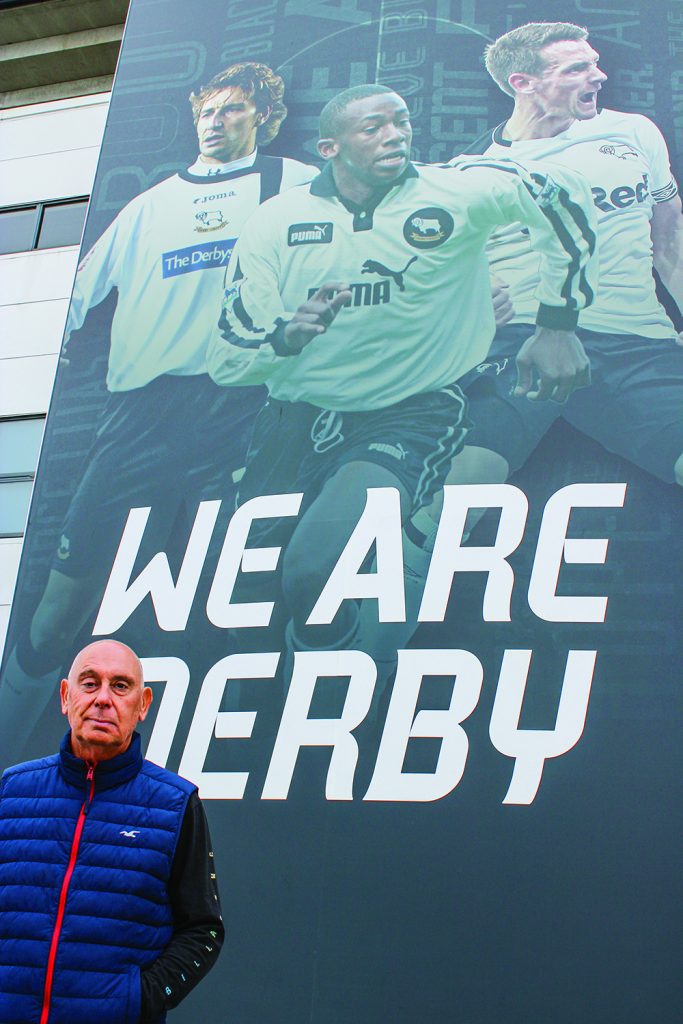
Just over 50 years since the legendary Brian Clough and Peter Taylor handed in their resignations at Derby County, fans have been speculating whether the good times will ever return. The view of one Rams legend is “never say never” but a media expert isn’t so sure because these days the game is dominated by money. The 1970s was an amazing time for Derby County fans. Despite not being one of the biggest clubs in the Football League, the Rams won the old First Division title twice in four years. Under Clough and Taylor they became champions in 1971-72 and reached the lofty heights of the European Cup semi-final the following year. When the dynamic duo fell out with the board of directors who astonishingly accepted their resignations, the Rams turned to Dave Mackay. He’d won a championship medal as a defender and under his leadership Derby won the title again in 1974-75. One of the players signed by Clough and Taylor was a raw, 21-year-old striker from Worcester City. Roger Davies who is now a club ambassador remembers that Clough was unique. “Coaching isn’t the right word. He didn’t do a lot. When he bought players he knew what they were good at, so he would just say ‘do your job’. The game is complicated now. Under Cloughie it was simple. “But you could never read what he was going to do. His man-management was off the scale. And Peter Taylor never got the credit he deserved. The ’70s was so special.” Roger who is 73 will talk to anyone about football. We spent an hour chatting in a Derby coffee shop. He says it was a “smart move” to bring in Mackay when Clough and Taylor left. Colin Gibson with Derby’s silverware in 1984 “He was more of a joker. He made some good signings: Francis Lee, Bruce Rioch, Rod Thomas. Every year Derby were always in with a chance of winning something.” One young man who watched the first Division One championship team from the terraces was Colin Gibson. Now 67, he is back part-time at BBC Radio Derby. He presented sports programmes for 30 years there before working for Derby County for eight years. He started going to the Baseball Ground when the Rams were promoted to Division One: “It was unreal. I just thought it was the norm that the team I started following were the best team in the land and this was how it was going to be for ever. “The ’71-72 season was remarkable because we didn’t expect to win the league. They were a more exciting team under Dave Mackay, more free scoring, and signing players like Lee and Rioch gave the team an extra edge.” Colin’s knowledge of the Rams led to his getting work at Radio Derby where he reported on Derby’s successes and failures over the decades. One of his best memories is a Sunday afternoon in 1996 when the Rams beat Crystal Palace at the Baseball Ground to earn promotion to the Premier League. “It was such good fun because the players were a great group who knew how to enjoy themselves and so was manager Jim Smith. He was a delight to work with.” He also fondly recalls the Rams’ beating West Bromwich Albion at Wembley in the Championship play-offs in 2007 which meant they would return to the Premier League. “Unlike other clubs who go to Wembley every year, it’s not something that happens a lot to Derby. That win was incredible.” Probably his best experience? “After years of decline Arthur Cox came in, steadied the ship and on a Friday night in May 1986 at the Baseball Ground Derby beat Rotherham to get promotion from the old Third Division. “I was invited into the dressing room to interview players there while they were celebrating. If I’m pushed that’s the most special moment.” Colin has also experienced sad times including financial problems which almost forced the club out of business on more than one occasion, relegation and play-off final defeats. “Being relegated is obviously never great. In 1984 Derby were relegated to the Third Division, as it was then, now League One. Nine years previously they were Football League champions. They’d gone through the High Court and survived a winding-up order but were relegated to the third tier of English football. That was a fairly horrible day. “Worst of all was ten years ago this coming May – losing to Queens Park Rangers in the play-off final in 2014. That season was one of the best I’ve ever known. It was a magnificent season under Steve McLaren, Paul Simpson and Eric Steele. They played brilliant football. But we hadn’t reckoned on Bobby Zamora.” Zamora scored a last-minute goal which meant Rangers progressed to the Premier League. “I’m not sure that Derby ever quite recovered from that,” Colin thinks. Just over a year ago the unthinkable almost happened: the Rams were in administration and the end looked near. Potential saviours were cast aside when it was revealed they didn’t have the money they claimed to have. The outlook was bleak. Then Derby businessman and staunch Rams fan David Clowes bought the club and gave it stability. By then the English Football League had docked Derby 21 points for going into administration and for breaking accounting rules. Clowes decided a change of manager was needed and brought in Paul Warne from Rotherham as head coach on a four-year contract. Roger reckons Warne will achieve success at the club: “He’s brought in his own players but they’ve had a lot of injuries to contend with. I think they’ll go up this year.” Colin believes returning to the Championship won’t be as easy as many people imagined: “I think he’ll take us out of League One but it might take a little bit longer than we first thought. Yes, there’s stability but there’s still a lot of work to be done.” Will the glory days ever come back
Cumbria and its Ancient History

by Brian Spencer Carlisle’s Crown and Mitre Hotel was our base for our visit to Cumbria with Slacks Travel. Overlooking the town square where Bonnie Prince Charlie mustered his bedraggled troops on his retreat from Derby, it was time for a quick look round this ancient Border city where captured Scottish Reivers (cattle rustlers) were publicly hanged. Emperor Hadrian’s Wall builders left little in Carlisle to remind us of their stay, the Wall crossed the River Eden below what, since Norman times, became the modern city. In 1092, the conquerors built a substantial castle which, thanks to its being still used as a barracks for local militia, remains unaffected by the passing of time. It was within its walls that Mary Queen of Scots began her long unhappy imprisonment in 1568. Much of Carlisle’s history is displayed in Tullie House Museum, based on the records of the north’s equivalent of diarist Samuel Pepys. The cathedral dating from 1123 is built on Norman work, with windows rivalling those in York Minster. From the range of emperors covered by the extensive coin collections in Tullie House Museum, it looks as though the Romans who occupied northern Britain were very careless with their small change. The last time I stayed at the Crown and Mitre was on a business trip north. Retiring to the bar for a well-earned G&T, and specifying Gordon’s Gin, I was obviously overheard because one of two other men standing at the bar introduced himself as the local Gordon’s rep and in thanking me for specifying his company’s brand, would I please accept a double on him! Carlisle’s wonderful street market Carlisle’s links with all things alcoholic are unusual. During the Great War, as a break from making the town’s famous biscuits, being well away from danger, it became an important base for the production of munitions. While the work of making shells and other explosives was highly lucrative, production barely kept pace with battlefield demand. At that time there was no such thing like today’s licencing laws. The highly paid munition’s workers were accused of drinking and spending too much time in the local pubs. As an experiment, the Government decided to take over the local breweries and pubs, making Carlisle’s the only State-owned businesses in the country, an anomaly that continued until a few decades ago. On day two we were enjoying a cross country trip over to Ravenglass for a run on ‘l’al ratty’ the narrow gauge railway that runs from the coast, up into the hills above Eskdale, but due to unforeseen circumstances this sadly had to be delayed by a day. The original plan was to make a quick visit to the tiny dales’ market town of Kirkby Stephen and then drive over the limestone moors across the western edge of the Yorkshire Dales National Park, then to Settle. Here we would join the famous Settle – Carlisle line on its northern journey. This was the plan, but first we had the enjoyment of Kirkby Stephen’s market stalls and quaint shops lining side streets leading into the square. The parish church stands on one of them, overlooking the town. Surprisingly for such a small place, the church has almost cathedral-like proportions, with carvings and memorials to the Musgraves and Whartons, local gentry who for generations lived nearby at Wharton Hall, now mostly converted into a farmhouse. There is a popular spot just below the town, where an ancient stone-arched bridge crosses the infant River Eden. Legend has it that the devil made the bridge when he dropped a pile of rocks during an attempt to cross the river while it was in flood. Maybe we should have heeded the legend, but the drive across the moors, beneath the awesome bulk of dales’ giants such as Penyghent, Ingleborough and Whernside, the famous Three Peaks of the Dales was awesome. A short stop at Ribblehead gave us a view of the multi-arched Ribblehead Viaduct we were to cross in about an hour, or so we thought. With Penyghent on our left, and lofty Ingleborough to the right, we ambled steadily along upper Ribblesdale, stopping at Settle Station in good time for the train back to Carlisle. This was the line that Michael Portillo M.P. saved from closure when he was Transport Minister. Standing at the southern end of the line, the station is part-volunteer run, on the Settle to Carlisle Railway. The station shows the volunteer aspect to the full, with carefully nurtured flower beds and fresh paint everywhere, it is a reminder of what can happen when staff have the time and interest to care for their station; it takes you back to what small railway stations once looked like. Finishing the rural atmosphere was the view across to the rolling western fells above the famous Giggleswick School. The happy sound of less privileged children competing in their annual sports day rose from the village rugby field far below the station, a sound that was to entertain us for rather longer than expected. We wanted a train, but where was it? Standing in bright sunshine on a warm summer’s day with the happy sound of children competing with bug-hunting thrushes and blackbirds, soon began to lose interest. We were kept informed of events by an enthusiastic S.C.R volunteer, who passed on reports as they came from some controller further back along the line. Apparently it was the almost predictable signal failure somewhere south of Hellifield Junction, but the train did eventually make an appearance, only an hour or so late. So off we went, enjoying Yorkshire’s finest dales’ scenery from the luxurious comfort of air conditioned coaches, upholstered with the latest design in seats. The 73 mile journey back to Carlisle went smoothly, stopping at remote stations (Dent is the highest main line station in Britain), and crossing the 440 yards long, 24-arched Ribblehead Viaduct complete with its admirers far below. A prompt early start on the last day took us round the
A Visit to White Peak Distillery
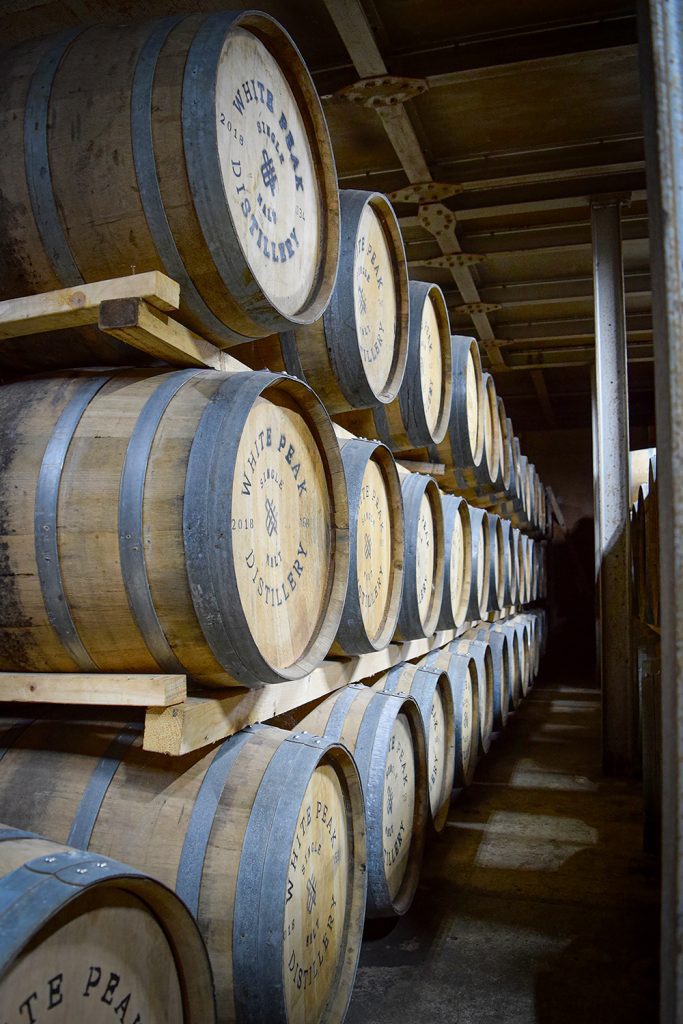
On a rainy day in October I was booked in with my wife to go on the White Peak distillery tour, I could not think of a better place to be, the thought of a nice whisky warming me from top to toe seemed just the tonic!! The tour lasts 1 hour and cost £15 each, paid online through their website. Our guide for the tour was Sarah who joined the company two years ago, her knowledge of the whole process from distilling to bottling was second to none. On arrival we were warmly greeted in their small but fascinating shop, where you can buy a bottle of Wire Works whisky , gin, or rum, as well as some very stylish glassware for the tipple of your choice. A nice touch is that you can bring your empty bottle of Wire Works spirit and refill it while enjoying 15% off the retail price, very ethical in today climate. The shop leads into the tasting room with its industrial modern feel and a very welcoming stove just to keep the cold at bay. This is a good time to get to know your fellows, some of whom had come from as far away as Sweden! The distillery is housed in the old maintenance building where wire was manufactured from 1876. It’s great to see that these historic buildings have now found a new use, in this case no longer producing wire but Derbyshire’s first single malt whisky. When you enter the main still house you cannot help to be impressed by the copper stills, one of which is lovingly called ‘Betty’, the 600 litre still that is used to make their award winning Shining Cliff gin and rum. I was so impressed with the whole process of whisky making, no computers controlling things, just the knowledge and craft of the distillers. What is great to hear is that local produce is used as much as possible, for example the Thornbridge Jaipur yeast, used in the fermentation. Once we had seen the beautiful copper stills and fermentation tanks we were taken into the storeroom where the whisky comes to rest, in this case either in bourbon casks from Kentucky or Rioja STR casks. STR stands for scraped (or shaved), toasted and re-charred and indicates that the cask has undergone rejuvenation by having its staves shaved down and then recharred. How this affects the whisky is fascinating, but you will find out on your tour. Our tour ended back in the cosy tasting room where we were able to enjoy a sample of these beautiful spirits. A firm favourite for me was the Caduro Whisky, which has won a Gold medal in the World Whisky Masters. This release is a unique vatting of Derbyshire single malt, matured in a combination of American and French oak, both first fill ex-bourbon and White Peak’s signature STR Casks. This was followed by the Rum and Shining Cliff Gin, then my wife’s favourite, the 1876 single malt cocktail. A warming, perfectly balanced blend of their Derbyshire single malt spirit, with simple syrup, Angostura bitters and an absinthe rinse. I must say we really enjoyed the whole experience. The knowledge of the distilling process shared by our guide Sarah really brought the tour alive, it makes you apprciate how much love, patience and hard work goes into making the whisky , gin and rum. To have the White Peak Distillery on our doorstep in Derbyshire is something special, so take advantage of it, and get yourself booked in for a tour, just make sure you sort out who is driving first!! 00