


It might occasion no surprise amongst readers that the parish of Spondon was part of the seemingly limitless holding of Henry de Ferrers by 1086. Henry’s great grandson, Robert de Ferrers, 2nd Earl of Derby, at an unknown date after 1154, granted the right to appoint an incumbent of the church of St. Werburgh there to the monks who ran the Hospital of St. Lazarus, a leper hospital at Burton, Leicestershire, hence Burton Lazars, just north west of Melton Mowbray.
This gift was later confirmed by his son in 1180 and by the King in 1200 and later de Ferrers Earls of Derby (prior to their fall in 1273) followed by the royal earls and dukes of Lancaster who confirmed the gift and of several parcels of land in the north of Spondon parish, the rents of which would help to boost the hospital’s income. These landholdings were consolidated as a new manorial estate in Spondon called Over and Nether Locko.
Why was it called Locko? Well Professor Kenneth Cameron, author of the magisterial three volume epic, The Place Names of Derbyshire (1959) thought that the first element was from loca (a lock), whilst 80 years before, Revd. Dr. J. C. Cox, in his Notes on the Churches of Derbyshire (another epic, four volumes this time!) estimated that it derived from old French lognes (rags) and Old English hay (pasture). Personally, I have always taken the view that the monks named it from Latin locus (place), which seems to me to have the advantage of simplicity. One can at least imagine them referring coming from their Derbyshire property as ‘from that place’ (ex illo loco) or similar, hence the Latin phrase (bearing in mind 12th century churchmen were fluent Latin speakers) quickly providing the vernacular shorthand ‘Locko.’
That said, by 1296, a preceptory, or off-shoot of the Burton Lazars hospital had been founded at Locko with its own infirmary and chapel, all dedicated to St. Mary Magdalene. From then on, much of the attached estate was let: an estate in Upper Locko to the Sallowe family (later spelt Sawley) and another in Nether Locko to the Bird family.
The Birds are believed to have built the first house on the site of Locko Park, probably built by John Bird, grandson of another John, the original grantee. He sat as MP for Derby 1366 and 1377 and also had an estate at Stanton-in-Peak, sub-let to the Foljambes of Darley. A relative, Richard settled at New Mills, his house, Beard Hall (the name mutated) having survived, much reduced and rebuilt, to the present as an attractive farmhouse.
The John Bird who served as MP was succeeded by another John, MP Derby in 1460, who settled his brother Ralph as a tenant of the Sallowes at Upper Locko, where the manor house survived until at least 1713 with a holy well alongside, dedicated to St. Ann. A later Bird, William sold the lot to his cousin by marriage, William Gilbert.
Meanwhile, the old Lazar House had been dissolved in 1539 and granted to John Dudley in 1544. His executors sold it to the Birds and it also descended to the Gilberts, and it is possible that their new house was on the site. The house, described by William Woolley as ‘a very good stone house’ was reasonably substantial, being assessed for tax on ten hearths in 1662. William’s son, Henry Gilbert (1598-1657) was succeeded by his eldest son, also Henry (1630-1716), who ‘built a curious chapel of stone for the use of his family…consecrated on 31st August 1673.’
This delightful domestic chapel, which survives as an important element of the present house, was designed by George Eaton of Etwall (who designed Derby’s Shire Hall in St. Mary’s Gate, and the Etwal Hospital). It has two bays of tall arched windows, with keyblocks and is of Keiper sandstone from a nearby outcrop. The parapet bears the date 1670 and the words in fretted stonework: Domus mea vocabitur domus orationis (‘my house shall be called a house of prayer’ – the words of Our Lord from Matthew, xxi.13). Inside, there is much contemporary panelling and pews, with a pretty carved pulpit and altar rail. The ceiling, also of timber, is coffered with rather old fashioned (for the period) pendentives at the angles along with a group of plaster ones, decorated with swags, in the centre of each coffer.
The house itself was depicted by surveyor Thomas Hand in 1721, when the estate was sold by John, Henry Gilbert’s son, to Robert Ferne, who had made a fortune in the lead trade. It had a recessed three bay centre with two light mullioned windows on each main floor flanking the arched entrance with attic gables above. This was enclosed by gabled cross-wings of matching style, but with string courses between the main floors. The chapel may be seen attached to the SW angle with a rudimentary bell cote. As we know that the windows of the chapel were two separate tall classical ones, it may be that Hand’s drawing of the house actually depicts a five bay classically fenestrated centre flanked by two bay wide cross-wings and that what appear in the drawing as two light mullions were merely shorthand for this arrangement. This would accord better with a mid-17th century build for the house (by Henry) as would the tall chimneys.
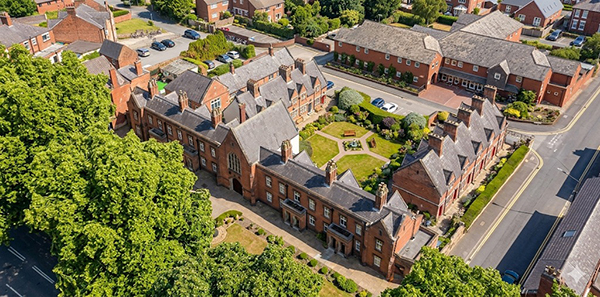
Ferne, as often with gentlemen of modest means suddenly come into considerable riches, had no time for his predecessor’s house (which may, of course, contained older work of the Birds’ house) and decided to replace it entirely, turning to the job architect then engaged in rebuilding All Saints’, Derby (now Derby Cathedral) for James Gibbns – Francis Smith of Warwick. As this fine, much larger house stands on the same site as its predecessor, we can say confidently that the old Locko Hall was taken down in 1725-6, and the new house completed by 1737.
The exact date of the building of the old house is by no means clear, but it looks mid-17th century or a trifle earlier, so is presumably the work of the first Henry Gilbert, whose means had been increased by his marriage to Dorothy, daughter and heiress of Sir Richard Harpur of Swarkestone. However, his son’s marriage gives Derbyshire its own link to the greatest writer in the English language, William Shakespeare.
It is of topical interest currently that there is a film, not wholly appreciated by the critics who mainly thought it overblown (readers may disagree), about Shakespeare’s son Hamnett, who died suddenly as a boy. I must say I thought Ben Elton dealt with it far more touchingly in his otherwise hilarious comedy Upstart Crow of a few years ago (we particularly liked Lisa Tarbuck and her perfect Brummie accent). This tragedy left Shakespear with no son to succeed to his modest wealth, only a daughter and heiress, Susannah (1583-1649).
In 1607 Susannah Shakespeare married Dr. John Hall of Hall’s Croft, Stratford-upon-Avon, whom she outlived by fourteen years leaving, again, an only daughter, Elizabeth (1608-1670). She married twice, first to Thomas Nash of Welcombe Park, Warwickshire, who died childless in 1647. She then re-married Sir John Bernard of Abington Hall, Northamptonshire, but by which time she was beyond childbirth (for those days at least).
However, Sir John had been married before and brought Elizabeth a step daughter, also Elizabeth (1630-1665) who, in 1657 (aged seventeen) married the seventeen year old Henry Gilbert, who had just inherited the Locko estate from, his father. Hence, their son, the third Henry Gilbert of Locko was the step great-great grandson of the Bard, whose actual bloodline died with Elizabeth, Lady Bernard in 1670. Dorothy, the last Henry Gilbert’s daughter, married John, son of Sir Roger Cooper of Thurgarton Priory, whilst one brother settled at Boylestone, appointing his younger brother rector there. The eldest brother, eventually inherited Thurgarton estate and assumed the surname and arms of Gilbert. From Robert Ferne, meanwhile, the Locko estate passed to the Drurys and Drury Lowes to the present.
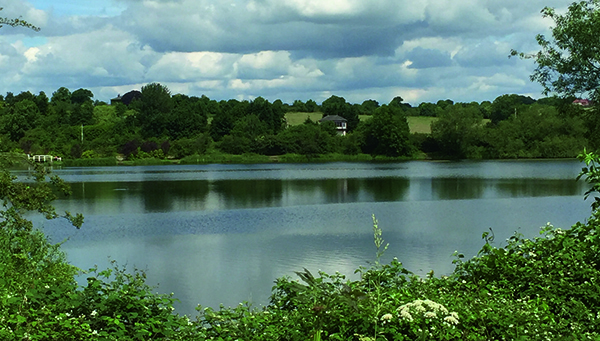
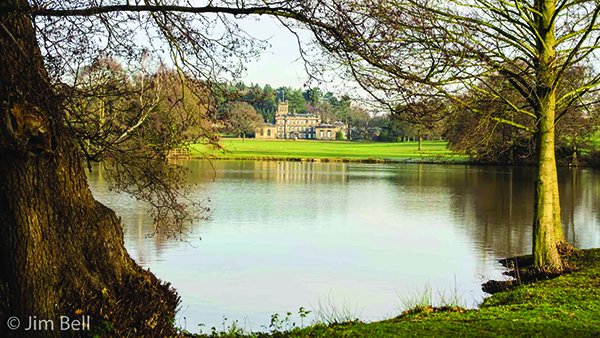
Whilst the house and the chapel – the only surviving part of lost Locko Hall – are not open to the public, there are guided wildlife walks, and a car park with picnic tables. Whist the park was a creation of Joseph Pickford’s friend William Emes – England’s best landscaper after Lancelot Brown – in 1792, the lake is also a relic of the early history of the site, for it is fed by a stream that flows from St. Ann’s Well, once close to the vanished house of the Sallowes at Over Locko and a precious survivor of the days when the Monks of St. Lazarus cared for the Medieval victims of leprosy and the waters of which supplied their needs.