The Lost Houses of Derbyshire – Parkfields, Derby

by Maxwell Craven A notable surge in prosperity in Derby during the Napoleonic wars and afterwards, led to the building of nearly a dozen Regency villas on the fringes, in the suburbs and in the immediate area of the borough, of varying size and quality. Most were built by prosperous merchants and a few by landed gentlemen who, like the Batemans of Hartington Hall, found their town houses becoming unlivable, as the town infilled and industrialised. Unfortunately, many have been demolished, no less than three in the first decade of the millennium. The unfortunate demise of another casualty, Parkfield, occurred even earlier, in summer 1993, despite it being locally listed. Yet, although its merits were perhaps less than apparent in its later years, it was a villa of some style. Parkfield was originally one of the vast common fields belonging to the ancient borough of Derby, grazing and cultivation rents from which helped provide the town with income. However, this kind of income, along with fairs and tolls, did not bring in enough money for the corporation to spend on infrastructure, so in the 18th and early 19th century, improvement acts were obtained enabling parcels of it to be sold off so people build houses, great and small on the land thus released. Ironically, no less than four substantial villas were built on portions of the old Parkfield, three called Parkfield! One lay on the north side of Kedleston Road, called Parkfield House – still standing now on Park Grove, although divided into three dwellings now and listed grade II – another in 1818 just to the west of it, called Parkfield Cedars (lost, see Country Images June 2016) and the third, Parkfields, on the west side of Duffield Road, not far north of Five Lamps. Originally the plot was bought by a family called Bingham, who had iron founding interest in the town, but they later sold it to the Columbell family who were Derby’s fashionable tailors and drapers of the period. One of the improvement commissioners who had originally sold the land on behalf of the Corporation in 1812 was Alderman John Sandars JP (1782-1867). He was a scion of the gentry family long settled at Cauldwell in the south of the country, and of their most notorious son, Col. Thomas Sandars of Little Ireton, the fierce republican commander under Sir John Gell’s command on behalf of Parliament during the Civil War. John himself was a second generation bookseller, however, and he served as Mayor of Derby in 1839-40. Indeed, it was thanks to his fascination with the borough’s ancient records, that he had a considerable number of them at home with him in Parkfield for study when the 1828 Guildhall burnt down on the night of Trafalgar Day, 1841, when those that remained were irretrievably lost. Sandars built his house in 1833-34, although we are not clear who designed it; quite probably it was a fellow Alderman and prolific amateur architect, Richard Leaper (1759-1838), who had built Parkfield Cedars for himself in 1818. It was in brick under a low hipped roof, was sparing of stone dressings, with facades of varying dispositions. Yet it betrayed some sophistication, having brick Tuscan pilasters at the angles, with stone bases and capitals, a moulded frieze and cornice with stone lintels over the sash windows grooved in a Greek revival manner clearly derived from Sir John Soane’s confected Boetian Order, all similar except for a sarcophagus shaped one over the original front door set in its contemporary iron trellis portico. There was a curved bow on the west side, and a service wing adjacent; inside there was a good ironwork balustrade on the cantilevered Hoptonwood stone stair, mahogany doors, moulded plaster cornices, polished limestone chimney-pieces and one room was decorated in French revival neo-classical boiserie-style mouldings. This seems to have been something of a favourite with Richard Leaper, because his surviving (but much extended) villa which now houses the Boys’ Grammar School in Littleover has a similar room and there is another at Allestree Hall (another Derby building at risk!) which Leaper modified for J. C. Girardot. The grounds were landscaped by William Barron and at least one of the stone urns from the 1731 Derby Guildhall ended up being rescued by Sandars and used as garden features. John Sandars died at Parkfield 10th January 1867 at a great age and in 1869 his son sold it to Charles Henry Smith, one of the directors of Boden’s Castlefields Lace Mill. He was succeeded by his nephew, Alderman Sir John (‘Brassy’) Smith, who served as mayor of Derby in 1872 when he was knighted, as was the convention, for being en poste during the Prince of Wales’ visit on 17th December that year. He was also co-founder of Smith’s important white metal (essentially brass for railway rolling stock building) foundry in Cotton Lane which ultimately became a nation-wide concern. Brassy Smith was one of Derby’s super-rich and set about enlarging the house sparing no expense, with a westward extension, essentially a little taller than the original part, but in matching style, even down to the window lintels, and in so doing, he altered the way the interior plan worked. The new entrance had a stone portico with a fanlight resembling one in Becket Street (suggesting R. Ernest Ryley as the architect) and led into a new lobby and a new main stair was installed, lavishly panelled in mahogany, leading to luxuriously fitted out new bedrooms, and plenty of up-to-the-minute modern plumbing, furnished by Thomas Crump of Friar Gate. Needless to say, there was plenty of opulent looking brass fittings almost everywhere. Sir John died in 1909, when the house was sold to Thomas Carline Eastwood, a director of Eastwood and Swingler’s foundry (now the new HQ of Great Northern Classics). Eastwood, however, soon moved out to the country, and let the house to Capt. Lionel Morley but, when he left after the Great War, it was sold to Gerard Hamilton
Lost Houses of Derbyshire – The New Inn Derby
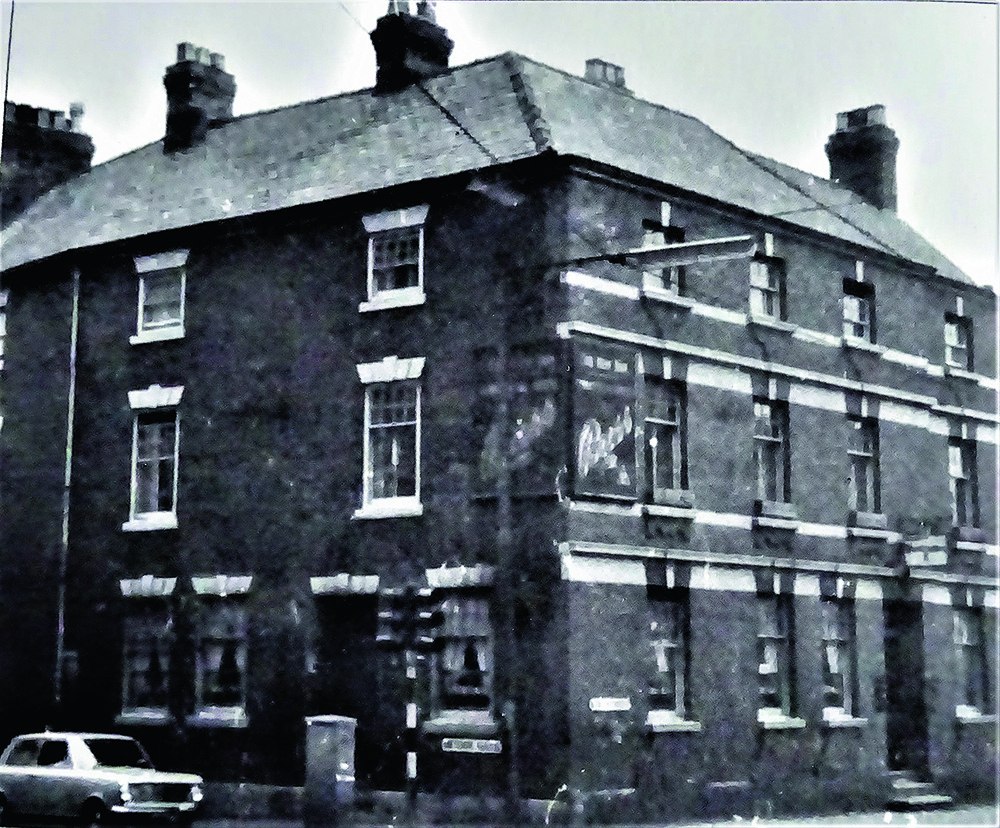
by Maxwell Craven I decided to take a break from country houses this month and mention a licensed house – not that I have run out of the former, but I felt a building as substantial as this merited inclusion, especially as it had a notable place in the history of local coaching and for its connections with the great and good of Derby. As one travels about and, from time to time, calls at inns for refreshment, one is often amazed by the number which style themselves coaching inns without the slightest justification. The coaching inn was, after all, effectively home from home for the well-heeled traveller, aiming to provide the sort of accommodation as a modest country house for the convenience of the inside passengers, extensive stabling for teams of horses, and accommodation for the crews as well. Frequently, the stops en route, rather than overnight ones, were done with enormous speed, such was the competition and tight scheduling on the turnpike roads of the 18th and 19th centuries. Hence, they tended to be spaced at approximately a half-day’s drive between each other on major routes and were mainly in towns and always in the turnpike roads rather than down narrow lanes. One of the last of the celebrated coaching inns in Derby to be built, between 1761 and 1766, was the appropriately named New Inn at the corner of Bridge Gate and King Street and opposite St. Helen’s House. Like the latter, it was probably designed by Joseph Pickford of Derby (1734-1782), although stylistic confirmation is not possible due to a thorough rebuilding some-time after 1873, when a part of it had been lost to street widening and a new façade was put onto the original two and a half storey brick building – and rather awkwardly, to boot, as its cornice stood forward of the roof eaves by a foot. The new King Street front, however, was handsome enough, the window openings almost certainly corresponding to those originally existing, although the sashes were of the upper leaf with glazing bars over plate glass type. Below, the sills were shaped aprons of rubbed brick which, with the playful interplay of string courses, banding and keyblocks, evoked the style of the young Alexander MacPherson (who was a Nottingham man with a busy Derby office) as having been the architect for the alterations. The side elevation was also re-fenestrated at the same time, but within the old openings with their rusticated lintels retained. The inn was built for George Wallis, a relative of Joseph Wright and of the Gells of Hopton; indeed, Sir William Gell is known to have stayed there when in Derby in 1793, on the occasion on which he painted old St Helen’s House from an upper window, giving us a vital record of its appearance seven years prior to its demise. The Wallises were probably the single most important inn-holding family in Derby’s history, and the New Inn remained in their family through three generations and four proprietorships. George Wallis (1694-1780) was the son of a John Wallis, both blacksmiths in King Street, the site of their works – almost opposite the site of the inn – being so occupied until the later 1960s. George’s son, George Wallis I (1731-1786) was a born entrepreneur, and probably had access to the funds he needed through his marriage in 1753 to Rebecca, daughter of John Clarke, a Nottingham Road maltster, whose family ran the Derby Brewery right through the 19th century. George had, though, been apprenticed to his father, becoming a freeman of the Borough in 1754, and initiated a series of stage coach and mail services from his newly founded inn from the start, buying up others’ routes and consolidating his hold both regionally and nationally in a remarkably short period of time. Notable amongst these coaches was the Derby Diligence (‘Dilly’), a service which, amongst others, he later franchised out (to the Bell in this case) simply because the New Inn could not alone cope by the dawn of the following century, with the pressure of all the Wallis services running through Derby. The ‘Dilly’ ran from Derby to Nottingham on Mondays, Wednesdays and Fridays at a fare for inside passengers of 4/- (20p). Wallis also had, by 1773, a mourning coach and hearse for hire and did a roaring trade in funerals and wakes. His sister, Sarah married Dr. Richard Wright, the painter Joseph’s older brother, in 1774 but the absence of any known portrait of a Wallis by the artist seems strange: perhaps they are out there still, but the identity of their sitters has got lost. On George Wallis’s death, he was succeeded by his eldest son William Wallis I (1763-1791). His wife was a cousin of Alderman Samuel Rowland, the co-proprietor of the Derby Mercury, and his elder sister, Sarah married Alderman Dr. Thomas Haden, Richard Wright’s young partner, later father-in-law of Kirk Boott, the founder of Lowell, Massachusetts, USA. Although Wallis died young, like his father, he left three children, of whom the only son, George Wallis II (1788-1834) was too young to succeed him at the New Inn but later married the widowed Mrs. Hoare and through this astute move became also the proprietor of the King’s Head in Corn Market, another much more venerable coaching inn. One of William’s daughters, Sarah, became related by marriage to William Billingsley, the celebrated Derby China painter, and through him to William Wheeldon, another China painter, whilst the other daughter, Anne, married one of Billingsley’s former colleagues, the talented George Robertson. In 1791, therefore, William Wallis’s widow Felicia took the inn over, but was quickly supplanted by her brother-in-law, Alderman John Wallis (1776-1821). He was a prominent Tory, the founder of the Derby True Blue Club (which, inevitably, met at the inn, but later at the King’s Head). He was also the All Saints’ team leader in the Derby Shrovetide football. He, too, ran a tavern, the Black Boy, St.