Lost Houses of Derbyshire – Old Walton Hall, Chesterfield
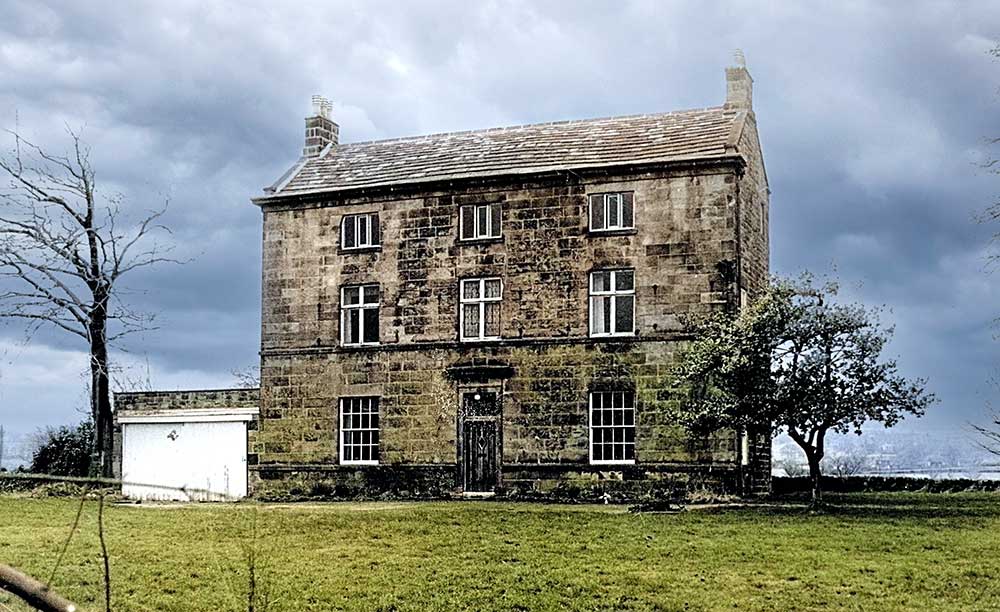
The present Walton Hall, built in the closing decade of the 18th century as a fairly substantial farmhouse, nowadays survives entirely surrounded by modern housing, its lush farmlands lost to a succession of extractive industries followed by the SW expansion of Chesterfield, which gobbled the unpretentious village of Walton up towards the close of the 19th century – and didn’t stop. The site, however, is an ancient one, held by an otherwise unknown man called Hardulf at the time of the Norman conquest, and from him, doubtless compromised by supporting or fighting on the losing side at Hastings, it came into the hands of the King. Who the King’s tenant was at Walton, we seem not to know, but by the next generation it was in the hands of Roger le Brito, otherwise le Breton. Roger, whose name suggests Breton origin – a good number of William the Conquerors comrades-in-arms were Bretons – is otherwise thought to be identifiable with Roger, son of Steinulf, the Domesday Book tenant of Calow, but as the name Steinulf is Nordic not Breton, this may not be a tenable supposition. However, whilst Calow descended amongst more easily attested descendants of Steinulf (bearing the name Calow, of course), Walton descended to the posterity of this Roger. His grandson, Sir Robert le Breton, received a licence from the king to found a chantry on his land at Walton, clearly suggesting he also had a capital mansion there, too. Nevertheless, the family continued for eight generations until Isabella, daughter and sole heiress of another Sir Robert brought the estate to the Lowdhams of Lowdham, in Nottinghamshire. In the next generation another heiress brought it to Thomas, a younger son of the Peakland grandee Sir Thomas Foljambe of Tideswell, around 1390 and his family held it until 1633. The old house was one of many Derbyshire manor houses to host Mary Queen of Scots, in this case, for two nights in February 1568. The last hall to be occupied prior to the building of the present one was that built by Godfrey Foljambe, who inherited the estate on the death of his father, Sir Godfrey, in 1585, and the existence of two chimneypieces and overmantels bearing his initials and dated 1591 (one was dismantled and reconstructed for installation at Dene Park in Kent; the other came into the hands of Sir George Sitwell but is lost) suggests that his new house was being fitted out in that year and was thus ready for re-occupation, perhaps before the end of the year. The house’s predecessor was set in a park, bordered on the north by the Hipper and this had a tower therein, which can be picked out on both the map of Christopher Saxton of 1577 and that of John Speed of 33 years later, probably a hunting stand, like that at Chatsworth. The new house is only known from a survey of 1633 by surveyor William Senior, and consisted of an entrance front with end gables, from which ran cross wings, with two further lesser gables flanking the entrance. This ensemble formed a deep courtyard, and was closed at its open end by a timber screen, beyond which lay the stable block. On the other side of the house was the domestic chapel, founded as a chantry by Sir Robert le Breton, by 1623 embellished with a tower, spire and extended chancel. Sir Godfrey Foljambe, who lived there ‘wherein great contynewall housekeeping was mayntayned’, died in 1595, whereupon his widow, Isabella, was left a life interest in the estate, allowing her to live there with her second husband Sir William Bowes. She outlived him, too, and died in 1623; both were very keen Puritans. In 1609, they had been host to Lady Arbella Stuart, the King’s cousin and Bess of Hardwick’s grand-daughter. The house by then was surrounded by gardens, orchards, a bowling alley and pleasure grounds extending to twelve acres, the estate itself running to over 2,336 acres. The building itself was described as in good repair. However, once Lady Bowes had died, the male heir, Sir Francis Foljambe, 1st Bt. (the title created in 1622) inherited it. He was MP for Pontefract (his main estate then lay at Aldwarke in Yorkshire) and High Sheriff of Derbyshire in 1633, in which year he decided to sell up and the house seems never to have been properly lived in ever again. The purchaser was Sir Arthur Ingram MP of Temple Newsham, Yorkshire, a colourful character described by one contemporary as ‘a rapacious, plausible swindler who ruined many during a long and successful criminal career’, but it would seem that his purchase – at an eye-watering £16,000 – may have been an element of some other transaction, for within three years he too had sold the estate, this time to Paul Fletcher, a local ironmaster. Fletcher’s heir was another local merchant, Richard Jenkinson, who in 1648, with the Civil War still raging, decided that the old house – un-lived in since 1623 and in decay – was too large for him and he reduced it considerably, supposedly to make it more convenient. His son, Sir Paul, was created a baronet (of Walton) in 1685, but the family allowed the building to continue to decay, until in 1713 William Woolley could write of it: “The ancient seate Walton nere Chesterfield….is utterly ruyned, plucked downe, and sould, no materiall, as ys reported left, nor almost any mencyon made were so greate hospytality, and that in my tyme used.” With the death of Sir Jonathan Jenkinson, 3rd Bt. in 1739, his niece and heiress inherited it and forthwith bestowed it upon her mother Barbara, widow of Sir Paul, who had died in 1714. By this time, she was married to John Woodyear who, like the Jenkinsons, lived elsewhere and promptly cleared the site of the old hall, in order to convert what was left of the estate (after several parcels had been sold off to local coal-masters) into a working farm.
The Lost Houses of Derbyshire – Hoon Hall

By Maxwell Craven Hoon is a strange little place, a civil parish created from the larger ecclesiastical parish of Marston-on-Dove by some zealous bureaucrat in the early 20th century, which stretches from the low hills on the north side of the Dove down to the river itself, yet is barely a mile and a half wide, east to west. It was called ‘Hougen’ in 1086, when there were two manorial estates there, one of which was given to the Abbey of Burton and the other, which was granted to the Norse-descended grandee Saswalo or Sewallis, ancestor of the Shirley family. The name itself derives from the old Englishword (in the ablative) for ‘by the barrows’, and indeed a large barrow – presumably Bronze Age – survives to this day. The name later mutated to ‘Howen’ and ‘Hone’ before the OS settled on the present spelling in the earlier 19th century, suggesting that the name was traditionally pronounced with an ’oh’ sound instead of an ‘oo’ one as its current spelling would suggest. The Shirley family held the estate until 1559 when George Shirley of Staunton Harold sold Hoon to Roger Palmer of Kegworth, whose grandson, Robert, lived at Church Broughton, when he is said to have built the first hall in 1624. We know little about the house, but it must have been very modest, for it is unlocatable in the 1670 hearth tax returns, although by that date, it had been sold to John Stafford of Blatherwick in Northamptonshire who in turn had sold it on during the Civil War. The purchaser in those lean and uncertain times was Robert Pye (1585-1662), who, it must be confessed, shared a common ancestry with your author, from the Pyes of The Mynde and Kilpeck in Herefordshire. Indeed, I had a kinsman who even bore the Pye name as his given name: I used to joke that it was a mercy the names were not deployed the other way round, strongly suggesting some dubious comestible. Pye was a Royalist and had been nominated as a baronet on the outbreak of civil strife by Charles I but, with the upheavals, the honour failed to pass the Great Seal, and it was his son John (1626-1697) who, after the Restoration, did actually receive a baronetcy. Normally, in those circumstances (as with the Boothbys of Broadlow Ash) the baronetcy would have been confirmed to the father (alive or dead) but, as the elder son had been a keen Parliamentary commander, this idea failed to find favour with Charles II, so John received a fresh baronetcy – of Hoon, where he then lived. The house of 1624 was probably timber framed, for in 1816 the Lysons described it as ‘an ancient half timbered building’. However, the latter add that it had ‘pointed gables’ and our only picture, a woodcut of 1892, shows just that, three of them, but with any timber framing stuccoed over. It also shows a pretty modest house – a farmhouse – with early 19th century cambered headed casement windows in place of the mullion and transom cross windows that must originally have graced the façade. Furthermore, the fenestration is clustered centrally, suggesting that, when the house was adapted as a tenanted farm, it underwent a drastic reduction and a re-façading, possibly even in brick, where previously there had been timber framing. There were almost certainly cross-wings at each end of the façade, the loss of which might have necessitated the change to the fenestration and its disposition that we see in the drawing. The somewhat complex subsequent history of the house does throw some light on the matter, however. Sir Robert soon after moved to Faringdon, where he had acquired a larger property, to which he repaired, leaving his son, Charles, to go and live at Hoon after he came of age in 1672, although he was later described as ‘of Derby’ in 1713. He died in 1721, and his son only three years later, leaving it to his grandson, the dilletante Sir Robert, 4th Bt., but who lived at Clifton Campville, Staffordshire, leaving Hoon Hall empty after 1724, when he succeeded. Sir Robert died in 1734 aged only 38 leaving no male heir , whereupon the baronetcy became extinct. His heiress had married Thomas Severne, whose son died in 1787 leaving the estate to Charles Watkins of Aynho, Northamptonshire. Watkins, like the Pyes, had little need of Hoon Hall and he is the one who reduced it, sometime prior to 1812, when he died, leaving the – now tenanted – farm and estate to a kinsman. That kinsman, however, brings us almost full circle, for ironically he was Henry John Pye of Clifton Campville, who had just succeeded his father there. The father, Henry James Pye MP (1745-1813) was a descendant of then first Sir Robert Pye’s Cromwellian brother, Robert, who was excluded from the grant of the by then extinct baronetcy, but who had succeeded to all the other Pye properties except Hoon, in 1734. H. J. Pye the elder is also of interest because from 1790 until his death in 1813, he had been poet laureate, a position he had been given not for being in the slightest bit talented as a poet, but in exchange for political favours toward William Pitt the younger, the prime minister. Pye was the first poet laureate to receive a fixed salary of £270 instead of the historic tierce of Canary wine – Madeira to you and me, these days a rather unfashionable drink. Nevertheless, young Henry Pye’s ownership of the estate was relatively brief for, being so far from his other properties, it was difficult in those days to administer and the house, of course, was by this time a working farmhouse. He therefore sold it to the Derby attorney William Jeffrey Lockett the younger (see Lockett’s House, Derby, Country Images, May 2022). Lockett died unmarried in 1848 aged 51, whereupon the house and farm were sold to Thomas Orme from whom
The Lost Houses of Derbyshire – Old Kedleston Hall by Maxwell Craven

No-one knows what the ancient hall at Kedleston looked like, except that it was built before 1198 by one the earlier Curzons, which family had inherited the estate by 1100 probably through marriage from the Domesday Book holder, Wulfbert, who held it from Henry de Ferrers. We do know, however, that a new house had been built by about 1600, but whether it was an Elizabethan prodigy house, or a late Medieval pile, we do not know, only that by 1664 it was taxed on a pretty substantial 22 hearths, making it about the same size as Calke Abbey and Drakelow then, both of which were taxed on 23 and both of which have either gone or been rebuilt entirely. Barlborough Hall, a miniature version of Hardwick is the only house in the county to survive of equivalent size, having been taxed on 21 hearths. However, the Curzons, by 1641 honoured with a baronetcy, decided to replace the house entirely around 1700, and the resulting very handsome house had been completed before the end of the decade, for it was described by county historian William Woolley in 1713 as having been ‘built a few years ago’. He then goes on to describe it as ‘a very useful noble pile of building of brick and stone on a little eminence which is pretty conspicuous,two of the fronts are to be good building.’ A painting fortunately survives, showing the house as it was about 1750, surrounded by its brick stables and late Medieval or early Tudor outbuildings, the latter closely resembling those once at Markeaton Hall, being of box-frame timber on a buttressed stone plinth. The house was of two storeys and attics, with hipped roofs punctuated by dormers, and with projecting full height pavilions at the angles. One or two windows appear to have crossed mullions and transoms, and most have pediments, possibly added later. As the family would have had to reside in the house’s predecessor during building, we presume that it was erected on a new site, probably slightly to the west of the old one, hence the proximity of the church to the present house, a similar situation to that prevailing at Sutton Scarsdale, where the parish church (which after all originated as a domestic chapel) was perilously close to the south front. Perhaps the National Trust should have taken advantage of the dry summer to fly a drone over the site to see if any vestiges were showing up under the parched grass – but then again, they were probably too busy fighting their culture wars. Fortunately, a plan also survives, confirming the existence of the two bay pavilions at the angles, much like those at Calke Abbey, built at a similar date, and establishing that each symmetrical front was nine bays wide. The real prototype of this plan lies with Robert Hooke’s Ragley Hall, Warwickshire of the 1680s, and William Smith had used a variant of it already at Umberslade, in the same county. The entrance, to the south, gave into a spacious hall with a second large room, the saloon, beyond which was a lobby from which steps led down to the north terrace, where today’s main entrance is. Three of the pavilions contain a staircase, whilst the SE one merely houses the breakfast room. The west front, facing the church, consisted of a columned loggia. We know the architect was either William or Francis Smith of Warwick (probably the two working together, as at St. Modwen’s church, Burton), because the painting, which hangs in the SE quadrant corridor of the present house, is so titled, but we do not know of the precise date of building nor which Smith designed it. Two celebrated craftsmen worked on the house, the Derby plasterer Joshua Needham and joiner Thomas Eborall, the latter charging a considerable £63 – 10s – 6d (£63.521/2). This building is usually assigned to Sir Nathaniel Curzon 2nd Bt. (1635-1719) who in 1671 had married Sarah, daughter of William Penn, whose kinsman gave his name to the American state. Yet he was already 51 by the time he inherited, and a dizzying 65 (for the time) when the house was probably started. Why would he go through all the upheavals of building a whole new and very grand house at that age? His two sons John and Nathaniel, though, were 26 and 24 respectively, and the elder, a barrister, was elected Tory MP for Derbyshire in 1701, and one suspects was the driving force behind the move, no doubt supported by his brother, who entered Parliament for Derby just when Woolley was writing about the house, in 1713 and whose Parliamentary career continued until 1754. Woolley, in his account of the house includes an odd passage, writing, ‘There may be, perhaps, some deficiency in the roof as some critics have reported’ which is quite strong criticism for the time, but might well be the reason why Francis Smith had to return in 1724 and charged £54 – 1s – 0d (£54.05) for ‘alterations’. This visit may well have been to re-design whatever fault was found with the roof, at the behest of Sir John, 3rd Bt. Sir John also called in Charles Bridgman to design new park and gardens in 1724, and James Gibbs, fresh from designing Derby Cathedral, to design garden pavilions. Yet the house cannot still have been entirely satisfactory, for whilst Gibbs was there, he was asked to design a whole new house too, but Sir John died in 1727 and was succeeded by his brother, Sir Nathaniel, 4th Bt., whom he succeeded as MP for the county. Gibbs’s new house and the garden pavilions were set aside but instead, Francis Smith was called back again to re-design the interior of the house that same year, possibly on Gibbs’s recommendation, as the two frequently worked together (Smith as Gibbs’s contractor at Derby Cathedral, for instance). This must have been very drastic, for work did not conclude until 1734, which cost a
The Lost Houses of Derbyshire – The Grove, Darley Dale

The name Alsop (with multitudinous variations of spelling) is by no means uncommon in Derbyshire, if only because it derives from an unique place name, Alsop-en-le-Dale, next to Parwich, just north of Ashbourne. The Alsops had a Norman or Norse ancestor, called Gamel (probably derived from the Latin for ‘twin’- gemellus), who took his name from the place when granted the sub-tenancy of the manorial estate there by Henry de Ferrers before 1086. His descendant remained there until poverty forced a sale in the late 17th century and a tall portion of the family’s Elizabethan house remains as an ornament to the village to this day. As the place name is unique, it is likely that all Alsops today descend from Gamel, although you would need to DNA test everyone bearing the name to establish that most were actually of the same blood, so to speak. Furthermore, the preservation of the uniform spelling of names was in the hands, before the 1870 School Board Act, of semi-literate parish clerks which is why many surnames have sometimes quite extraordinary phonetic variants. With the Alsops, it rested with the duplication or otherwise of ‘l’s and ‘p’s. Hence, TV personality Hon. Kirsty Allsopp and her ancestors, back to Derby tobacco merchant Thomas, all spell with two of each. When her ancestor, Sir Samuel Allsopp, Bt., 1st Lord Hindlip, was first ennobled, he wanted to take the title Lord Alsop of Alsop, but he failed to establish his descent from the ancient family, and the Heralds in 1886 refused and whilst such a descent seemed likely, lack of proof forced him to take the name of his Worcestershire country house, Hindlip Hall (now the West Midlands Police HQ) as his title, becoming ‘Lord Hindlip of Hindlip and of Alsop-en-le-Dale’ (of which parish he had thoughtfully acquired a modest amount of land). He also had to accept changes to the historic coat-of-arms. Back in Derbyshire, lead trader John Alsop of Snitterton who wrote his will in 1798, was a similar case. His descent, possibly from Luke Alsop of Wirksworth, living in 1693, cannot be provably traced to Alsop-en-le-Dale either, although for all his family’s skyrocketing wealth, he was never offered a peerage! John Alsop had two sons, the elder Anthony, was barmaster (legal controller of lead mining) at Wirksworth and was ancestor of the Alsops of Wensley Hall, three generations of whom were barmasters at Wirksworth. The younger son, John Alsop was a lead merchant like his father and settled at Lea Wood, dying there in 1831; his memorial still graces the wall of the former chapel there to this day. He had two sons and two daughters, of whom the elder son Luke lived at Lea Hall, a delightful Baroque villa (albeit facing the chilly north winds) high up in Lea, and married Lydia the daughter of his father’s brother Anthony. The house at Lea Wood stayed in this branch. The younger son was John who was also a lead merchant and acquired some land on the east side of the main road (now the A6) through Darley Dale. Here, about 1790, he built a decent, four-square three storey and three bay wide villa with a top parapet, which he named The Grove. Some twenty-five years later he decided to increase the size of his house, adding a pediment over the whole width of the original villa, and two bay wings of two storeys on either side, but containing somewhat loftier rooms than those in the original part, with the result that the wings were nearly as tall as the main, central, block. At the same time, he provided the garden front with a cast iron trellis verandah with an iron roof. The grounds ran to over 50 acres, but who undertook the landscaping is not known. John Webb, in the 1790s active at Willersley Castle, is a possibility. Indeed, we was working in conjunction with Thomas Gardner of Uttoxeter there, formerly assistant to Joseph Pickford of Derby, and it is not impossible that Gardner might have built Alsop the original villa. The finished house was, therefore, of some size, and was inherited in 1834 by John Alsop, the son, also a lead merchant who, for reasons not wholly clear to me (one assumes financial difficulties or the lure of becoming a gold trader) emigrated to Australia in about 1850. He let the house to Revd. William Hiley Bathurst (1796-1877) the second son of Charles Bathurst MP (formerly Bragge) who had inherited the Lydney Park estate in Gloucestershire from an uncle, Poole Bathurst, in 1804. Incidentally, the ‘a’ in Bathurst is always short. W. H. Bathurst himself had married Mary Anne Rhodes, the daughter of a Leeds businessman, but in 1863, his brother died and he inherited the Lydney Park estate, moving there that year. His successor was a lowland Scot and an Indian ‘nabob’, Robert Keith Pringle (1802-1897) of an old Selkirk family, who had risen high in the Indian Civil Service at Bombay (now Mumbai) under the Honourable East India Company. In 1848 he married Mary Jane, daughter of General George Moore of the Indian Army, but the couple had moved back to England in 1862, following the changes brought about in the wake of the mutiny. At the Grove, now re-christened Darley Grove (confusingly, bearing in mind there was then a substantial house in Derby of the same name – see Country Images August 2015) the couple added a canted bay to the south front along with a conservatory, supplied by Messenger & Co. of Loughborough. Here, at Darley Grove, they reared a brood of five sons and five daughters, and it may have been lack of space that persuaded them to sell up, in 1876 to a Manchester millionaire, William J. Roberts. Within a few years, Roberts decided to replace the house with something more befitting his status, so in 1884 demolished The Grove and set about building a completely in-your-face essay in Jacobean revival, of
The Lost Houses of Derbyshire – Stretton House

Stretton, along with Measham and Appleby Parva (for the lost houses at which see Country Images December 2019 and October 2020), lay within a large ‘island’ of Derbyshire, separated since Saxon times from the bulk of the county, itself created in the mid-10th century. This ‘island’ also included Oakthorpe, Donisthorpe, Chilcote and Willesley (see Country Images for March 2018 for the lost hall there) and in another, even further south, lay Ravenstone, all since 1888 safely transferred to Leicestershire, except Chilcote which went to Staffordshire Not only that, but Stretton is about the most sequestered place you could possibly find in the local area, despite lying north of Appleby and west of Measham flanked by the A42 and the A444, the river Mease forming the third side of a sort of topographical triangle. With a population barely in double figures there is a fine church, St. Michael, long redundant and with an uncared-for look and a strange brooding atmosphere – or so it appeared to me and Mick Stanley when we visited, in the process of writing volume two of The Derbyshire Country House in 1981. The site of the hall was covered by what appears to be a tangled growth of impenetrable bocage. Even when Nichols was writing his history of Leicestershire over two centuries ago (in which these Derbyshire islands were included) the village was essentially a seriously shrunk one, having but the hall, a mill, the church and a few cottages. The Domesday tenant under Robert de Ferrers was almost certainly the ancestor of the de Stretton family, which managed to hang on to the estate, despite some intervening hiatuses until at the beginning of the fifteenth century it was split between three cousins, being later united by the Findernes of Swarkestone and then sold to the Blounts of Barton Blount, Lords Mountjoy. In around 1540 they sold the estate to John Browne of Horton Kirby, Kent, a London merchant and Henry VIII’s mint master. His father and grandfather had both been Lords Mayor of London, so there was no shortage of cash with which to invest in land. John’s son built a new hall at Stretton towards the end of that century. It continued with the Brownes until the death of William Browne in 1744, whereupon it descended to his grandson John Cave, also of Ravenstone nearby and of Eydon, Northamptonshire. In that same year he added the surname and arms of Browne to his own. In 1757 he married, which in due course necessitated him enlarging the hall, according to Nicholas, ‘by a large stone edifice on the north side’ probably in the 1760s. It is this house of which that author provides an engraving, revealing the late Tudor house as having had two storeys with attics in four gables of which the central pair broke forward. There were string courses above the mullion and transom cross windows, tall slim chimney stacks and a low wing to the north east. In 1670 there were 12 hearths taxable, indicating a reasonably substantial house but it was at that time divided as two distinct households between John Browne and the widower of his half-sister, Christian, Henry Adams. John Cave’s addition, as the engraving makes clear, did the north side of the house no favours aesthetically, being three full storeys high and essentially a canted bay added centrally, uniting the two central projecting gables, like a Palladian penetrating pediment. Here, there was a double string course and sash windows, pedimented on the ground floor with the windows either side of the addition turned into, on the left, a segmentally headed niche and on the right by a matching doorcase and all crowned by a pyramidal roof, the whole arrangement looking thoroughly awkward, although the fault may well lie with Nichols’ artist who made the sketch for the engraving. The architect may have been Joseph Pickford’s contemporary William Henderson of Loughborough (c. 1739-1797) whom we encountered when talking of Measham Hall, trying to make the best of a bad job. Yet the arrangement, bearing in mind that all this new accommodation faced north, cannot have been wholly satisfactory. What precisely he did to the garden front, however, seems to emerge later, when we look at the next stage in the alterations. John’s son, William, in 1810 inherited the baronetcy of the Caves, succeeding a distant cousin as 9th baronet, subsequently adding Cave to his already double-barrelled name by Royal Licence in 1839 thus ending up as Sir William Cave-Brown-Cave. Sir William’s son, Sir John decided in 1845 to do something about the house, Bagshaw remarking that in that year it was ‘undergoing considerable repair’, which is something of an understatement, for the appearance of the surviving mansion demonstrates that he essentially pulled down much of the previous house – probably piecemeal, so that the family could continue living there – and largely rebuilt it. The south (garden) front had clearly been similar to that on the north, but the 1757 rebuilding seems to have led to the deletion of the central two gables, and the insertion of a two storey, five bay recessed centre with Georgian sashed windows, a feature also applied to the windows of the gables. In 1845, a further bay was added at each end of the façade and the gables embellished with ornamental bargeboards, the architect being clearly influenced by the contemporary enthusiasm for the cottage orné style, as championed by John Claudius Loudon, creator of the Derby Arboretum. Judging from the low pyramidal roof just visible over the roof in the Keene photograph of the south front the awkward canted bay of 1757 was allowed to remain. Unfortunately, no photograph of that side of the house has ever emerged to tell us how it was primped up. Despite this, the house was let in the 1850s, first to Charles Colville of nearby Lullington Hall (whilst his house was being rebuilt) then to Capt. Lewis Conran, a military friend of the family
Lost Houses of Derbyshire – Mackworth Castle

The stone shell of the gatehouse to site of the ancient seat of the Mackworth family is one of the most memorable sites in the County. Lying only a few hundred yards from the City boundary of Derby, it invariably excites interest from those who see it for the first time, and it has been drawn and painted numerous times by local artists as diverse as Frank Gresley and Ernest Townsend; it was also photographed at a very early date by the ubiquitous Richard Keene. Its picturesque qualities are enhanced by a row of early 18th century brick farm labourers’ cottages, originally thatched, attached to the right. The reason it is called Mackworth Castle is because the name is entirely colloquial, applied to the existing gatehouse simply because it commands a castle-like air in the lane leading through the still largely unspoilt village. Many people actually do not realise that it is merely a rather grand gatehouse behind which once stood the seat of the Mackworth family, although what it was actually called when standing is far from clear – probably ‘the hall’ or similar. In surviving documents it is merely referred to as a ‘capital mansion’ which is fairly typical Medieval legalese for a manor house. What we see today is a two storey three bay Keuper Sandstone crenelated gatehouse with a central depressed arch with ogiform crocketting executed in relief and a hood-mould above it. There are stepped buttresses either side of the central opening and at the angles, an impost band and a cornice below the crenelated parapet which winds round the slender bartizans at the angles and is punctuated by a row of three gargoyle spout heads. The windows were originally traceried, vestiges of which survived by the bricking up of the outer pair. Yet there is neither roof, nor on the north side any wall at all, only two later brick lean-tos put up in the last couple of centuries in order to provide storage for the Regency farm house built behind. Originally there were side rooms with a two-chamber lodging for the gate keeper above, the large room being furnished with a fireplace with a projecting hood, finials and a castellated chimney above. Beside the fireplace is a corbel upon which to place a lamp. Dr. Emery, Britain’s foremost expert on Medieval Country houses is of the opinion that originally there was a rear wall, and visible vestiges of a low pitched roof, their dismantling in the 17th century possibly explaining the appearance of tooled ashlar blocks similar to those still in the building in a lean-to added to the adjoining cottages and to be found elsewhere round about. A closely related gatehouse is that to Worksop Priory, also late 15th century which, although lacking the crenellations (it is today surmounted by what may be a 17th century gable and roof) is of the same general scale, with similarly placed buttresses and windows, although an elaborate traceried shrine to the right of the door relates solely to its religious use. That fronting the North Yorkshire Meynell’s ancient castle at Whorlton is also comparable, although slightly earlier and simpler, with less ornamentation. Yet if this was a gatehouse, built in the third or fourth quarter of the fifteenth century (as its architecture clearly indicates) what happened to the house? A survey undertaken in 1900 identified two house platforms behind the gatehouse, but the reported position of these seems out of kilter with the extant building. More likely the distinct platform on which the present Castle Farm house rests is a more likely site. Here in 1888 some low rubble walling was found suggestive of a timber framed building on a rubble plinth. The inference is that there was a timber framed manor house and a group of the usual outbuildings on adjoining house platforms, raised up to cope with the occasional flooding of the Markeaton Brook, nearby, just as the Medieval stable block of Tudor Markeaton Hall, demolished in 1754, had been. Mackworth family are recorded here at Mackworth from the first quarter of the 13th century. The first of the family to be called ‘de Mackworth’, Philip, was almost certainly a member of the family of Touchet of Markeaton, which included Mackworth, and he and several of his descendants were stewards to the Touchets, especially after they inherited the Barony of Audley of Heleigh, in Cheshire. Several younger sons were also parsons, one being vicar on Longford and another rector of Kirk Langley; a third became a Prebendary of Peterborough Cathedral and Dean of Lincoln. Thomas Mackworth was, on 1st August 1404 the recipient of the earliest datable grant of arms in Derbyshire being allowed, on the authority of his feudal lord, John Touchet, Lord Audley, a shield bearing the arms of Touchet and Audley divided vertically by a jagged line (called dancettée in heraldic jargon) and with a red chevron superimposed bearing gold fretwork. This Tomas, a lawyer and twice MP for Derby, without doubt lived in the timber framed manor house, the vestiges of which were recorded over a century ago in the farmyard of Castle Farm. He also managed to marry an heiress, in Alice, daughter of Sir John Basings of Empingham and Normanton in Rutland and heiress of her childless brother, another Sir John. On Thomas’s death in 1447, he was succeeded by his son Henry, who also held land at Ash (Etwall) and Trusley. Probably in the 1450s, he is thought to have begun improving his estate at Mackworth, starting by erecting the grandiose gatehouse we can still enjoy today, no doubt leaving rebuilding the house itself in matching style (and no doubt of much increased size) until phase two. However, at this stage Sir John Basings the younger died, and Mackworth suddenly found himself unexpectedly possessed of a much larger landed estate in Rutland, and it became clear from surviving documents that he moved there quite soon afterwards. From that moment on, then, all thought of
Lost Houses of Derbyshire – Stuffynwood Hall

One of my oldest friends is a great enthusiast for huge spiky Gothic Victorian country houses. He thinks Samuel Sander Teulon (‘the good ship Teulon’ as he always calls him) a genius who far outshines Wren or Adam and considers Damien Hurst deserving almost of deification for buying and restoring vast, inchoate and sprawling Toddington Manor in Gloucestershire, designed by Charles Hanbury-Tracy, 1st Lord Sudeley, for himself and built between 1819 and 1840. Derbyshire is (in my view) blessedly free of houses like Toddington, or Somerleyton, or Mentmore. Most of our Jacobean is real Jacobean and Victorian prodigy houses have nearly all been demolished. Readers will recall an account of Snelston Hall last year – architecturally the best of them – of Osmaston Manor the year before, and you can still visit Eckington Hall (albeit seized by Sheffield City Council in 1936) in the NE of the County, which is a classic Hollywood ‘haunted house’ of a building. Locko Park although large, is largely Victorian, but harmoniously designed, spread around a fine early 18th century central block, tactfully incorporated. One particularly lumpish example of eclectic Victorian on a fairly epic scale was Stuffynwood Hall which stood just south of Shirebrook and a short distance NW of Mansfield Woodhouse. Built in 1857-58, it is in French Chateau style – French chateau on speed – with a huge, chunky tower behind and a lower wing to one side, like the main house, steep-roofed and prickling with skinny chimney stacks and pop-up dormers. The entire composition was wonderfully asymmetrical, largely over two lofty floors (plus attics), faced throughout in muscular rock-face ashlar of Permian Magnesian Limestone, and with a main block of three bays to the left and another three, wrapped round a vast canted bay with its own hipped roof, to the right. To the right was another two bays, the end one breaking forward with a loggia-like run of six ground floor windows to the right of the entrance, all much lower than the main block, with a service wing beyond again ending in a little pyramidally hipped roofed pavilion with a largish outshut behind beyond which was a large stable block arranged round a courtyard and a further service court to its east. This extraordinarily top-heavy looking house stood in a modest stretch of parkland running to 51 acres, and the entire estate, despite the proximity of numerous coal mines, was well sequestered. The name of the architect has completely evaded my research, but one might expect the culprit to have been a Nottingham man, or even a Chesterfield one. The estate itself was carved out of the manor of Shirebrook, held by a branch of the Meynell family who took the place as their surname, but sub-let most of it to Alan de Stuffyn around 1270, who was the park-keeper of the hunting park of Pleasley, where the Bec family then had a lodge, long vanished. Their park was stocked and emparkation granted by Edward I in 1288. The family were Bishops successively of St. Davids, Durham and (titular) Jerusalem. This Alan is almost certainly to be identified with Alan son of Hugh de Glapwell and grandson of Simon de Pleasley, facts which we can be fairly sure of thanks to the survival of the charters of the Woolhouse family, later of Glapwell Hall. By the middle of the fourteenth century Robert Stuffyn, probably great grandson, was of Shirebrook, and before long his name had become attached to the landscape, when a portion of his estate was called Stuffynwood. John son of Hugh Stuffyn (1615-1695) was the first of the family to be styled ‘gent’ instead of ‘yeoman’. His eldest son, John died aged 55 a year after him without leaving issue and his widow married Gilbert Mundy of Allestree Old Hall. His brothers having predeceased him unmarried, the estate passed to John Hacker of Trowell and by various inheritances and sales to Robert Malkin of Chesterfield. Having never seen an inventory for any of the Stuffyn family, I cannot really assess what sort of or size of house they lived in, but suffice it to say that when Charles Paget, a member of an old Ibstock family lately grown affluent through business, mainly in Nottinghamshire, bought the 300 acre estate from Malkin, there was a modest Georgian house on the site of the hall. The Pagets had intermarried with the Hollins family, who had acquired the Pleasley Mills from that supreme entrepreneur, Henry Thornhill (1708-1790), and thus Charles was keen that his son Joseph should live nearby with a view to taking a hands-on role at the mills. The upshot was the building of Stuffynwood Hall, which was to enjoy a short and really rather unhappy existence. Photographs of the interior have proved elusive, although some may exist in the family papers lodged at the LSE. Fortunately my copy of Leonard Jacks’s account of the country houses of Nottinghamshire (1881) strays over the border here so that he can continue to flatter the Pagets, who also owned Ruddington Grange. He tells us that the house was greatly extended by Joseph Paget from 1873-1880, adding the rear wing, the hulking great tower (complete with skied water tank to improve the domestic economy) and a domestic (Catholic) chapel. Joseph married Helen, daughter of Revd. Edward Abney of The Firs, Derby. He was a great friend of W H Fox-Talbot, the photographic pioneer who was married to a Mundy of Markeaton. They are known to have made Talbotypes of several Derbyshire houses in the late 1840s early 1850s. Abney also encouraged Derby’s pioneering Victorian topographical photographer Richard Keene (1825-1894). Would that we still had any photograph Joseph’s father-in-law might have made of Stuffynwood! Jacks notes that the house boasted ‘large and well-lit rooms, had a separate billiard room with an adjustable frosted glass roof (to let out the fragrant vapours of the contestants’ Havanas no doubt) and that the house was very early fitted with self-generated electricity, hence
Lost Houses of Derbyshire – The Devonshire Hospital
Someone mentioned to me the other day that there were many other lost houses of historic and architectural importance apart from country mansions and town gentry houses and why didn’t I write about something just slightly different every now and again? Well, often the problem is that a paucity of images prevents one from doing so, but the other day I was going through a folio of drawings and came across a re-constructed elevation of the Devonshire Hospital in Full Street, beautifully drawn by the later Edward Saunders. It occurred to me that here was a building designed and built to the highest standards to house a specific group of people which richly deserved to be chronicled. The story goes back to Bess of Hardwick (which Derbyshire stories often do). This much married woman rose from minor gentry to Countess in a progression of four glittering marriages, and she ended up allied to royalty, fabulously wealthy and a formidable operator all round. She was a patron of the arts amongst other things and a keen builder, commemorating her projects on her epitaph in Derby Cathedral. Her buildings – mainly paid for by her second husband, Sir William Cavendish and her fourth, George Talbot, 5th Earl of Shrewsbury – included Chatsworth, Worksop Manor, Oldcotes, Hardwick Old and New Halls, just to name the most prominent projects. Most were built under the guidance of the Tudor builder/architect Robert Smythson, and thereby gained immortality if only through his ability to build spectacularly and innovatively. On 5th October 1599 Bess, by then Countess of Shrewsbury, decided to found a charity in Derby, the Shrewsbury Hospital, to house eight poor men and four poor women, to be endowed with a rent-charge of £100 per annum (pretty generous in 1599) raised out of the tenants’ receipt from Little Longstone, in the Peak. The lucky dozen were to be chosen from the parishes of All Saints’, St. Michael and St. Peter, and had to be ‘the most aged poor or needy persons within the said town of Derby, being of good and honest conversation, and not infected with any contagious disorder.’ They also had, once it had come into being, to cleanse, dust and sweep over’ the large and ornate monument, designed by Smythson, to be erected to their benefactress on her death (which occurred in 1680), and that they attend (if not bedridden) divine service in the church daily. They were also to receive £1 – 13s – 4d [£1.67p] each every quarter with £1 expenses to buy a gown in the livery of the Cavendish family with a silver heraldic badge of Bess’s arms, a ‘bedstead, bolster, two pairs of sheets, two coffers, two tables, a cupboard, two stools, four peter dishes, iron tongs, fire shovel, etc.’ They had to keep off the booze and not have strangers to stay either. They also had Richard Haywood, the resident warden, and his wife on site, too. The building was put up immediately behind the chancel of All Saints’ and consisted of a two-storey range parallel to the street in stone, of nine bays, the central entrance being ensigned by a large carved armorial panel and giving access to a courtyard behind. There were two doors alternating with two ground floor three-light stone mullioned windows either side of the centre, with two-light windows above, providing the accommodation of the four old women and the warden. Flanking the courtyard were two ranges at right angles to the front one, each of four units in matching style, the roofs being pitched and tiled. Each person had a parlour, a kitchen and a bedroom above. Gardens led down to the Derwent. This agreeable building, the maintenance income of which was topped up by William Cavendish, Bess’s eldest son (later 1st Earl of Devonshire), by rents from Edensor, sufficed for the twelve pensioners, until the time of William, 5th Duke of Devonshire, who succeeded in 1764. He was somewhat infected by the same desire to build as his ancestrix, Bess, and was, by the time of his death in 1811, responsible for many improvements at Buxton (including the Crescent, currently being restored), Chatsworth and many other family properties, probably as a distraction from the gloriously wayward Georgiana. He was especially keen to improve the Chatsworth estate, and at first hired James Paine to replace the stables there with the present epic construction, along with the unfinished Palladian mill in the park. When Paine moved on to other projects, he hired Paine’s acquaintance John Carr to undertake work at Buxton, and Derby’s Joseph Pickford to continue at Chatsworth. Pickford’s greatest tour-de-force at Chatsworth was the Edensor Inn, a brick building of outstanding subtlety, the Edensor rectory (later destroyed when the village moved), the North Lodge, Ashford Hall for the agent, and three eighths of a vast but unfinished octagonal stable block, also in Edensor, opposite the Inn. Hence it fell to Pickford to come up with a design to replace Bess’s rather poky almshouses with something altogether rather more up-to-date, re-named the Devonshire Hospital. Pickford, whose style tended to be pitched to accord with his clients’ requirements, was Neo-Classical when employed by a Tory (as at Kedleston) and Palladian, the favoured style of the Whigs, led locally by the Duke, when employed by the governing Tories’ political opponents. Hence the new almshouses, also in stone, were firmly in the Palladian revival style: ancient Roman elements disposed according to the published precepts of the Italian architect Andrea Palladio, ironically a rather older contemporary of Bess of Hardwick. This time, instead of having the inmates living on the road frontage, they were housed rather comfortably in two wings parallel to the road, and a range connecting them nearer the river with an arch through to the gardens which went down to it, all shielded by a very grand screen facing the road with a central entrance wide enough for vehicles and a pair of pedestrian entrances. The end bays consisted of interpenetrated
Lost Houses – Crich Manor House
Crich is really rather a confusing place, not least in respect to its country houses. The descent of the manorial estate since Hubert Fitz Ralph, the Domesday proprietor has been something of a saga, and many of the subsequent lords were non-resident. This phenomenon certainly would have put paid to the original manor house, built, as one might reasonably expect, beside the church. Quite when it was built is not really known. Hubert was a tenant-in-chief of the Crown and was described in several documentary sources as ‘of Crich’ or ‘Lord of Crich’ which would suggest that he was probably seated there. There is, however, some room for doubt as he held 25 manorial estates in Derbyshire alone, of which only eight had recorded sub-tenants holding under him in 1086. Hubert’s father was a Norman called Ralph de Ryes, and a younger branch of the family were the Ryes of Whitwell. As there is a field to the NW of the church at Crich called Hall Croft, it would seem safe to conclude that this is where one of the FitzRalphs built their capital mansion, although it is not mentioned in any document until it had passed via an heiress in 1218 to Ralph de Frecheville. He certainly, therefore, lived at Crich, but his son, Anker, married the heiress of the much richer manor of Staveley and re-located thence. At this juncture, the house at Crich may have been used either as a dower house or by younger members of the family. Eventually, the Frechevilles decided they no longer needed the manorial estate and sold it to Roger Belers of Kirkby Park, Leicestershire (hence Kirkby Bellairs) around 1301. They were a branch of the Norman family of d’Albini, so were much out of the same mould as the FitzRalphs. They were also descendants of the FitzRalphs, as Alice de Wakebridge, Roger’s wife had Juliana, sister of a later Hubert FitzRalph of Crich for a mother. Although his son Sir Roger is also frequently described as ‘of Crich’, his brother Thomas seems to have been the one that lived in the manor house. Despite four wives, Sir Roger left only daughters, between whom the manor was split, but the elder, initially married to Sir Robert Swillington of Swillington, in Yorkshire, had a son, Sir Roger, who managed to re-unite the two halves of the patrimony. One of his two sons may have lived at Crich, but the family by and large remained in Yorkshire. Eventually, both died without have had children, and the estate passed by marriage to Sir John Gray of Ingleby, Lincolnshire from whom it came to Ralph, Lord Cromwell, Henry VI’s Treasurer, who already owned the South Wingfield estate. Thus Crich became for nearly 150 years, part of the extensive holdings of the Cromwells and their heirs the Talbots, Earls of Shrewsbury. It was without doubt from this point (1467) that the original manor house would have disappeared. The patrimony of the Shrewsburys was eventually split three ways amongst his daughters, on the death of the 6th Earl in 1616, Two thirds of the manorial estate were sold off by their descendants, a third in 1660 to a group of seven rich local farmers, and another third in 1710 to William Sudbury. From these, the manor was rapidly split into a number of small freeholds. Nevertheless, under the long sequence of absentee chief lords, there were families who held sub-tenancies of parts of the estate, Anthony Babington of Dethick (the plotter) being one. Just prior to his fall, trial and execution, probably in anticipation of the possibility of the plot to free Mary Stuart failing, he off-loaded some of the family holdings, including an estate at Crich, held under Lord Shrewsbury. So it was, that in 1584, John Clay, grandson of another John, who held a modest but lead-rich estate at Chappell in Crich, purchased this Babington tenancy, by this date a rich one, through the exploitation of its minerals. He twice married well, obtained a grant of arms at the Heralds’ Visitation of 1569 and died in 1632, by which time he had built himself a manor house, thought to be the one visible on the celebrated early 18th century panoramic painting bought by the late Col. Denys Bower of The Grove and now at Chiddingstone Castle in Kent. Here we see a stone built L-plan house of two storeys and attics, the gables being coped with ball finials on the kneelers. The windows are clearly mullioned and the house is set in a garden on the SW and a farmyard on the SE with a range of outbuildings to the north. It much resembles houses like Goss Hall in Ashover, Rowtor in Birchover or Allen Hill at Matlock. John Clay’s monument in Crich church establishes that his two sons William and Theophilus, died before him and his daughter Penelope married Thomas Brailsford of Seanor in Ault Hucknall, not far from Hardwick, who duly inherited what amounted to an extensive estate. One of their eight sons was duly named Theophilus after his uncle and the eldest John after old Clay himself. It seems unlikely that the Brailsfords altered the house and it was taxed on six hearths in 1670 when it appears to have been let to the Wood family, the Brailsfords being still ensconced at Seanor. Towards the end of the 17th century (certainly before 1712) it passed to the Flint family of Crich and they seem to have rebuilt the house fairly extensively. This seems to have taken the form of demolishing the cross wing and extending the hall range by three bays, but in a fashionable classical style, with vertical mullioned and transomed cross windows (later adapted as sashes). A new entrance was included where this new range joined the 16th century or early 17th century work, so that to the left there was this new two storey range, and to the right the old three bays, which included the original attics. Hence