Taste Derbyshire – Food Festivals
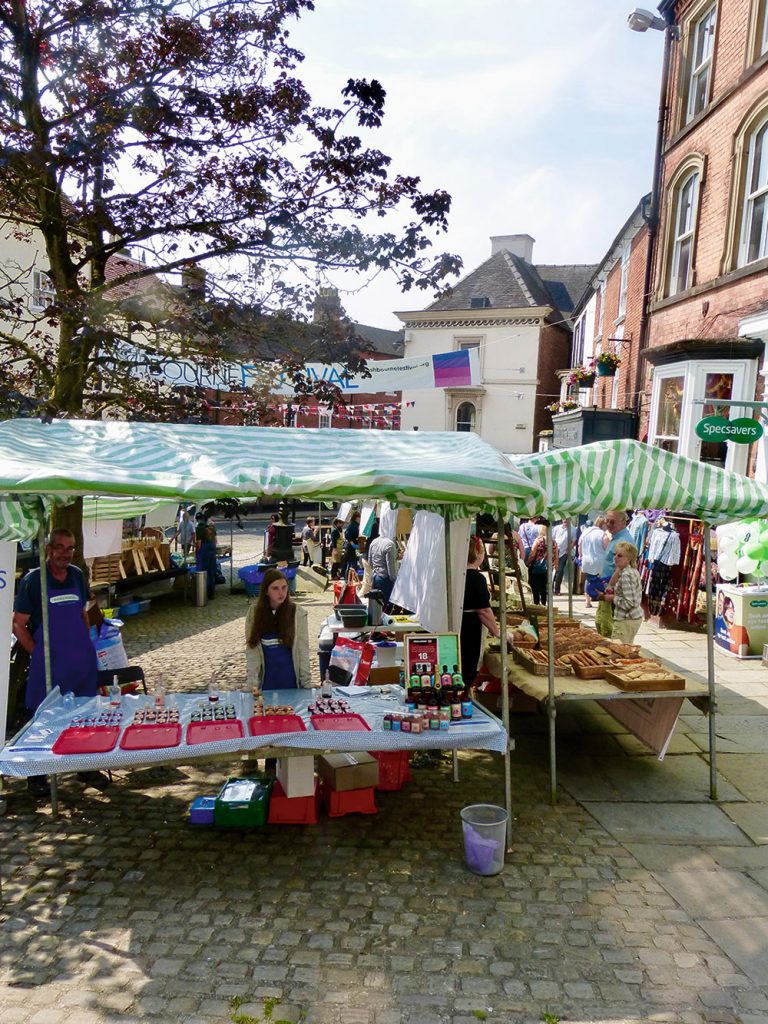
Move over Glastonbury, Y Not and Download, the hottest festivals in the UK this year are more likely to feature ciabatta than The Cure. While some hardy folk still enjoy wading through slippery mud and vegan jugglers at music festivals – everyone, and their Labrador, loves a food festival. They are everywhere and so the headline acts have to be increasingly more-ish to stand-out (chicken wings and whisky weekender anyone?). On the day I decided to swan off to Ashbourne Food Fest’ – lured by a tasty line-up of the Cheddleton cheeses, giant sausage rolls and sweet chilli jam – I had to turn down my VIP pass to a man v doughnuts challenge at the Big Food Festival on Shipley Park. “Food festivals are such a great way to spend a weekend,” enthuses Lisa Wallace, owner of Ashbourne Bakehouse and organiser of the food fest’ held in Victoria Square as part of the Ashbourne Festival. “One of the reasons I wanted Ashbourne to have one is that I’m a food festival groupie myself – much to my husband’s dismay.” Lisa originally tried an on-line market selling food to a select group of local producers but, while the idea attracted hundreds of followers on social media, it only converted into a handful of customers. “I think people want to meet the people and hear the story behind the food,” Lisa said to explain why the real-life food festival was such an instant success when it launched last year. “Like me, I think food festival-goers are excited by new things but they also want to try before they buy. The festival is a lot of fun and I’m pleased to say all of the producers asked to come back next year. It’s good for the town because people come up and say ‘Oh wow – Ashbourne is so lovely’.” While many of the UK’s food festivals are big productions featuring live cooking demonstrations, celebrity chefs and even pop-up cookery bookshops, Lisa was keen to keep Ashbourne’s ‘little and local’. “It was never about creating a profit stream, it’s a way of promoting great producers who don’t always have a shop window,” she says. “The stall-holders are chosen carefully so they complement each other. If someone buys my sour-dough bread I’ll recommend some Staffordshire cheese and a jar of Sarah Ball’s chutney from the neighbouring stalls. In fact, it’s a perfect blend of stalls if someone can get a complete meal – with drinks – from the festival complete with after-dinner chocolates and great coffee.” For details of the forthcoming Christmas foodie events, contact Lisa Wallace, Ashbourne Bakehouse, 29 Market Place, Ashbourne 01335 347206. ‘Taste Derbyshire’ writer Amanda Volley was despatched with wicker basket in hand to the Ashbourne Food Fest’ to grill some of the stall-holders and ask the burning question ‘Have you got any free samples?’ Kniveton Cider Company It was seeing so many apples left to rot on the ground in and around Kniveton which sparked an idea in the mind of locals Kev Woolley, wife Hannah Barton and a group of their friends. “It was such a waste of drinkable apples,” Kev smiles in a way which lets you know he wasn’t thinking of pressing them into non-alcoholic juice. We all chipped in to buy the equipment to make 800 litres of cider. Trouble was, we gathered so many apples we couldn’t drink the lot and approached local pubs to see if they wanted the surplus.” That was the start of the commercial operation which saw the soon-to-be cider company double the production of their award-winning ciders (Never Mind the Hillocks, Four in a Corner, Wynnsum and OB1) every year. It was so successful Kev had to look for larger premises and – as the original friends dropped out – give up his job to work on cider production full-time. “I worked in pubs before I got a proper job. Ironically, I then had to give it up to work with booze again,” he laughs. Festivals and markets are how we like to retail it,” says Hannah who is the only woman on the board of SICA (Small Independent Cidermaker’s Association). “We now stock seven pubs but we still rely on friends and family for apples from their trees. In fact, we collect from trees just 500 metres from this very market stall…you can’t get more local than that.” Find out more about Kniveton Cider Company by visiting www.knivetoncider.co.uk Cup and Saucer A passion for good tea and food festivals saw Gail Hannan having a light-bulb moment when she was made redundant after spending 15 years working in the social care sector. “I went to lots of food festivals and markets and, as a tea enthusiast, I didn’t see anyone doing any exciting loose-leaf tea blends,” says Gail, of North Wingfield. “I’d always wanted to be my own boss but it was my daughter Jess (28), who provided the push. She’s one of those annoying optimists who told me redundancy wasn’t an ending but an opportunity to pursue my dream – and she was right.” Although Gail is at pains to stress she doesn’t grow the tea – it’s a bit too chilly in North East Derbyshire – she perfects the blends by hand, often using fruit and flowers she has grown and dried. “I’m forever coming up with ideas for blends,” Gail smiles when I survey shelves bursting with tea blends which helped her win Chesterfield Food Producer of the Year at last year’s food and drinks awards. The best part of what I do is taking those blends to food festivals and meeting people. Funnily enough, I thought I’d be mostly selling to older people but they’re the ones who say ‘I prefer Typhoo’ when I ask them to sample something like my ‘Roaring Rhubarb’ blend. Younger people are far more adventurous with tea.” As for tourists who visit Derbyshire food festivals, Gail says she can predict the teas which will end up in their
Northern Tea Merchants – A World of Teas Under One Roof
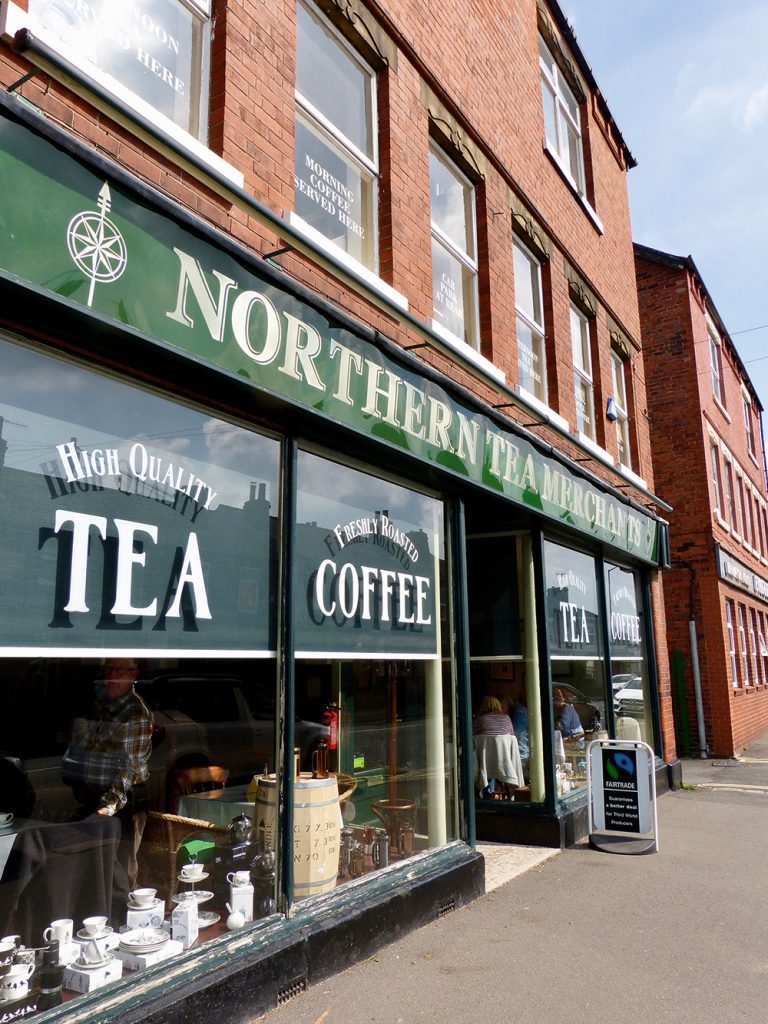
My lack of tea-making skills is legendary. Even workmen choking on brick dust refuse to drink it. It doesn’t matter how much gourmet blend and organic milk I throw into the cup – it always has the slight undernote of a licked battery. In short, if I want people to drink my tea, I get my son to make it. I blame my parents. They were both of solid Northern stock and liked their tea as strong, dark and brooding as the skies. You could stand a spoon in my mum’s tea, and if it was anything lighter than dark shoe polish brown, it was condemned as ‘ribby’. In the UK, making good tea does matter. It’s the first thing offered to a visitor, someone in shock or a stressed colleague. Just as there are an infinite variety of teas – it pays to know your Assam from your oolong – there are as many fuss-pots who claim they’ll drink your tea ‘as it comes’ before laying down a few unbreakable rules about bag shape and brewing times. And it’s wise to establish if your guest is a Mif (milk in first) or someone who thinks this is an abomination on a par with putting trousers on before your underpants. Naturally, when the subject of how to make tea can drive mild mannered people to boiling point, it’s wise to turn to an expert. In tea terms, James Pogson is an undisputed connoisseur of char. As director of the award-winning Northern Tea Merchants, James and his father (David) and his father’s father (Albert) have been trading in quality tea for 60 years. Someone overseeing the production of 100 million tea bags a year must be able to help the likes of me and the four out of five Britons who, according to research by University College London and the British Science Museum, are doing it wrong when it comes making our favourite brew. “For me, there’s no right or wrong,” smiles James Pogson (47), which is a refreshing opening statement from a man who claims that, if you cut him, ‘he bleeds tea’. “If you want to drink your tea out of a wellington boot with clotted cream and brown sugar I really don’t mind – as long as it’s my tea.” James agrees to give me a master-class on tea-making after giving me a potted history of tea at the company’s base on Chatsworth Road in Chesterfield. His office is packed with testing bowls and tiny pots – it’s where much of the testing and blending takes place – which explains why James can sample a 100 cups a week with a further 37 slurped purely for pleasure. “Our kettle is never cold,” he jokes. “If we’re testing tea, we do spit it out otherwise we’d have caffeine over-load. Even so, I bet my father, who is 82, has drunk in excess of half a million cups in his life-time. We both still enjoy tea, it’s just so nice.” James’ devotion to tracking down the world’s finest tea not only has him tasting samples, but travelling to estates and plantations around the world. “Tea isn’t just about the liquid in the pot. I think you appreciate tea so much more if you understand the person behind the process,” he explains, showing me some photographs of a 2017 trip to Hubei tea estate in China where the firm buys some of their black tea for their Keemun Mao Feng. “All our tea is touched by human hands. I like to have a personal relationship with the growers and I enjoy trying the local tipples. In Morocco, tea is made in front of the guest and poured from a height of more than a foot in the air. As the saying goes the taste changes over the course of three cups from ‘as bitter as life, to as strong as love and the third is as gentle as death’.” While tea accounts for a third of his sales, (the firm roasts 250 tonnes of coffee per year and pack 120 tonnes of cocoa and chocolate) James laughs at the suggestion that coffee could take-over as our national drink. “Let’s put it this way, we drink 165 million cups a day in the UK which makes it the most popular drink excluding water. Around 95 per cent is consumed in the home but people tend to go out for coffee – hence all the coffee shops. We’re the fifth biggest consumers of tea in the world,” he says. “Although we think it’s our traditional drink, tea was only imported to Britain in the 1700s and there was such a high tax on it so only the nobility could afford it – that’s why they had lockable tea caddies with the key worn around the neck. It was Queen Victoria who started the fashion for afternoon tea and this habit spread to the middle and lower classes when tea became more affordable.” At this point, James introduces me to his dad David, who tells me his own father started out in in 1926 working for the Ceylon Tea Growers Association going from door to door in Nottingham trying to convince house wives to buy tea for ‘economy and health’. “Tea was promoted as good for the digestion, ‘PG’ in PG tips is short for pre-digested as it was supposed to help dyspepsia,” explains David who also sold tea on the doostep when he established the company in May 1959. “Typhoo is Chinese for doctor.” Even today, James says there are always fresh claims being made about the health benefits of tea – last year green tea was linked with a reduction in the risk of heart attacks – and many of these are investigated by The UK Tea and Infusions Association; an independent body for whom James has been both president and vice president. James is convinced tea gives people a lift; “It’s a treat and the brain registers this and you get
Taste Derbyshire – The Spice Sisters

When it comes to curry, I adopt a relaxed ‘Jamie Oliver’ approach and simply chop, chuck, dice and drizzle the contents of my entire store cupboard into a pot until I have something runny enough to stick on some rice. I draw the line at using the nine-year-old tin of fruit cocktail. I stopped putting fruit in curry after realising tangerine was no substitute for lemon and that banana curry does not appear on your average takeaway menu for a reason. My husband still goes the colour of an unripe banana at the thought of it, 35 years on. Veena Gost and her spice sister Nilam Wright are behind the Curry on Cooking spice kit – formulated to give British ex-pats their curry fix. They promise that just one masterclass will banish my ‘throw it in and pray’ approach to Indian cooking for good. It was Veena and Nilam’s flair for cooking – and sense of fun – which made them such popular guests at BBQs in the Murcia region of Spain where Nilam and her family now live. Veena and Nilam would take along things like pakoras and bhajis and curry-starved ex-pats would grill them about where to buy the spices. One ‘light bulb’ moment later and sisters came up with the idea for the ‘curry kit’ – a spice mix with ‘no hidden nasties’ (chemicals or colours) which comes stapled to a recipe card. “It was funny we ended up launching a food business as Nilam and I didn’t want to learn anything about cooking as children,” laughs Veena. “My mum is one of the best cooks I have ever come across. The house was always full of people and mum would spend hours preparing a feast inspired by her Northern Indian heritage. Friends and family were always asking mum for recipes but Nilam and I were focussed on education and careers. From the age of nine, I wanted to become a journalist – not a housewife.” Veena says she and Nilam sometimes felt self-conscious about eating different food from their schoolfriends. “Nilam and I were only talking the other day about our trips to Skegness when we’d often be the only Asian family on the beach,” she recalls. “Mum would be up at 5am to make the most amazing picnics. She’d make things like spicy pickles and stuffed parathas but Nilam and I wanted to eat fish and chips like everyone else. Now we appreciate how hard she worked. Spices and other Indian staples were so hard to get in Derby in the 70s – we’d often go to Birmingham or London to stock-up. If anyone offered to bring something from India, mum would ask for something ‘exotic’ like a mango.” Mum’s cooking was the first thing Veena missed after starting work in Southampton; “I lived on Derby Road which is fitting because I was always running to the phone box on the corner to ring home,” she recalls. “If I wanted a make a tarka – which is a mixture of spices fried in ghee or oil – I’d have to ring my mum and she’d talk me through the processes. Mum couldn’t read me a recipe because she has never written anything down. There’s no teaspoon or tablespoons, just a case of a ‘sprinkle of this, a sprinkle of that’.” Whatever she says, an instinct for cooking is in Veena’s DNA. As I begin my chicken curry, Veena whips up ‘the best and quickest’ vegetable side-dish of courgette fried in spices. It’s made before I have time to chop a pepper. But what’s truly fascinating is watching Veena ‘fine-tuning’ the flavour. There’s no recipe or measuring; Veena simply stands over the dish holding her spice tray like an artist’s palette – adding the odd pinch or two – until the masterpiece is complete. Small wonder Veena’s cooking skills were often required when her sister Nilam, husband Darren and son Josh (14), emigrated to Spain in 2009. “After a short time living in Malaysia, they finally settled in Murcia,” Veena explained. “I was working for the BBC at the time but would visit them a few times a year. As spices are hard to get in Spain, I’d have to pack a load in my suitcase. For years, all my holiday clothes smelled of curry. We’d cook Indian food for our ex-pat friends and they’d tell us how much they really missed it. People started asking us to cook dishes for them.” Although the number of Indian restaurants in Spain has increased in the last five years, Veena says they are often too expensive for ex-pats. As for home-cooking, while the Spanish supermarkets and shops stock saffron, paprika and cinnamon; things like coriander, cumin and fenugreek are much harder to get because they are not traditionally used in Spanish dishes. “Inspiration struck while house-sitting for someone who had the most fabulous kitchen. Nilam and I don’t travel anywhere without our spice trays and we couldn’t resist the urge to cook” recalls Veena. “As we started cooking we decided to create a spice mix which could be used by ex-pats to make dishes like Balti and Aloo Gobi. We did little packs of spice, wrote the recipes out in long-hand on a A4 pad and gave them out to our friends for feed-back.” The feed-back was so encouraging, the sisters started to approach traders. “I don’t think the irony hit us at the time but we were Indian girls from Derby looking for ‘English’ corner shops in Spain,” she laughs. “We also gave a korma curry kit and our instructions to all the foodie friends of ours and said we wanted totally honest feedback. One of the most useful comments came from my nephew Josh, who was ten at the time. He did our ‘Bombay potato’ blend and the chunks of potato were far too big and he didn’t wash them. Quite rightly, he said there was nothing about preparing the potatoes in the instructions. We
It’s Not Just Any Old Hooch

Ten years ago, you would expect to find one or two brands of gin on offer at the golf club and, if you were lucky, a slice of lemon from a jar. Only a teetotal hermit could fail to notice gin is everywhere. There are gin parties, ginemas (gin and a film night), ginvent calendars and gin-flavoured spa treatments. Even Burton-on-Trent, the spiritual home of beer, hosted a Gin and Rum Festival in the market hall in May this year. It’s not just any old hooch. Ten years ago, you would expect to find one or two brands of gin on offer at the golf club and, if you were lucky, a slice of lemon from a jar. These days, the clubhouse is likely to have a gin menu featuring artisan and craft gins laced with exotic ingredients like buckthorn, loganberry and peppercorns. It all adds up to an industry which is worth £1.2 billion a year according to the Wine and Spirit Trade Association. Since gin shook off its Mother’s Ruin image, quaint cafes and farm shops are getting in on the act. Whereas the strongest thing on offer may once have been a cup of English Breakfast, The Apple Tree tea house, Ockbrook is offering gin tasting evenings hosted by a be-suited booze raconteur. Considering we are in the grip of a revolution, it is still a big surprise to find there is a new craft gin being produced in the Derbyshire woods. Shining Cliff Woods at Ambergate may be on the map with local ramblers and people who have a thing about bluebells, but it is completely unexpected to stumble across a ‘proper’ distillery business (as opposed to one man in his shed) occupying 11,000 square feet in the former Johnson & Nephew wire works in the woods. White Peak Distillery has risen from the ashes of the old wire industry thanks to one man – Max Vaughan of Quarndon – driven by his long-term dream to make whisky. But it was the hiring of a talented head distiller, Shaun Smith, which led Max to consider producing an artisan gin packed with flavours found in the local woodland. “If we put our name on the bottle, we have to be proud of it. We love being in the Peak District and the area around us and we wanted our gin to be an expression of this,” explains Max as he stands by the distillery gates through which you can glimpse acres of verdant woodland. “Shaun had previously made a successful gin and he was determined to create something authentic and different. Shining Cliff gin was inspired by the flowers and herbs we found in the wood like rosehip, elderberry and Mayflower.” The pair spent many months in the wonderfully aromatic ‘research and development bunker’ where – with only a 30 litre still at his disposal – Shaun began to perfect the inaugural gin. “It meant lots of trips out and about the woods on my bike looking at the plants and the hedgerows to find things suitable for Shining Cliff gin,” Shaun recalls. “We had around ten styles of gin initially which we narrowed down to six, then to three that we were really happy with. We also discarded a few flavour combinations along the way. Like wild garlic, even though we have lots in the wood, we’ll never see a wild garlic or spruce needle gin coming to market.” The months of tinkering can be seen by counting the glass bottles on a large unit of pigeon holes; each contains single flavour distillations used while devising the prefect blend. The final Shining Cliff gin really is stunning testimony to all Shaun’s chemistry, if not alchemy skills and features 13 different flavourings or botanicals; many evocative of the woodland setting around the distillery. “We had a lot of positive feed-back on the gin – people even saying it’s the best they’ve tried which is a huge compliment,” Max adds. “Our goal was to make a gin which, like whisky, is good enough to be served neat. I call it a sipping gin. It’s got flavours of citrus so it doesn’t really need anything added except, perhaps, a slice of orange peel.” Shining Cliff gin may have gathered a loyal fan-base but it’s actually a delicious warm-up act to the star of the show. At the end of April Max and Shaun took delivery of 18 tonnes of barley; the first stage in the development of a single malt whisky. It will be the first ever commercially produced in Derbyshire. White Peak will be one of only 15 other distilleries making, or developing, whisky in England. “It will be twelve months before the first tasting and three years before it can be officially called whisky,” Max explains. “We’re currently inviting people to join our Temperance Club, so-called because they will have to wait. But their patience will be rewarded with a limited-edition bottle once a year for the next decade. In addition, the members’ names – 1876 of them in honour of the date of the factory opening – will be etched onto bricks and built into the distillery wall.” As Max describes it – surrounded by the bespoke gleaming copper still built in Scotland and stainless steel-work made by Musk Engineering at Swadlincote – you can almost taste the light peaty, slightly floral malt which will be housed in bourbon casks shipped over from America and wine casks from Portugal. “I am a whisky fan,” says Max when asked why he is so passionate to develop a whisky when he has a ‘hit’ gin product on his hands. “My dad Barrie introduced me to whisky and to the Scotch Whisky Society. It’s there I heard about a guy who worked behind the member’s bar who had started a small whisky distillery in Battersea. Something about this story really resonated with me. I did a lot of research over three years, visiting distilleries and talking