Haddon Hall – A Sleeping Tudor Beauty

by Brian Spencer “What we see today is basically the unaltered fortified manor house developed between the late 12th century, and 1620 when the last and minor ‘improvements’ were made” One autumn evening a few decades ago, driving home along the A6, just short of the entrance to Haddon Hall I was stopped by a police barrier, complete with bollards and flashing blue lights. Unable to see any problems ahead or behind, I sat there and waited for developments. The answer soon became clear when a large black car drove quickly past and turned left into the hall’s entrance. As the car overtook me, I got a glimpse of its passenger, the then young Prince Charles, the Prince of Wales. Apparently, he and his sister Princess Anne used the castle when visiting Derbyshire and needing overnight accommodation they slept amidst Tudor grandeur! Their signatures together with that of their grandfather HRH King George V, are etched in the plaster above a small fireplace in the Earl’s Apartment. That their visit must be a privilege no one could deny, but who would turn down the chance of staying in this romantic relic of time gone by. What we see today is basically the unaltered fortified manor house developed between the late 12th century, and 1620 when the last and minor ‘improvements’ were made. Throughout that time Haddon Hall was owned by only three families, the Avenels, the Vernons and the Manners. It was the Avenels from Northamptonshire who built the original house, and it was lived in permanently until the Manners more or less abandoned it when Sir John Manners, 9th Earl of Rutland was created the 1st Duke of Rutland in the early eighteenth century, and the family moved to the much grander Belvoir Castle, leaving Haddon Hall suspended in time. Before that time, Haddon had been owned by the Vernons for ten generations between 1262 and 1514 with Sir George Vernon’s legendary parties which could last for weeks, earning him the title of ‘King of the Peak’. His daughter Dorothy Vernon became the best known female family member. When she eloped with Sir John Manners by crossing the pack horse bridge below the house, her escapade laid the foundations of another legend; romantic though it may be, the trouble with it is that the bridge did not exist at that time. However, one way or another, she did marry Sir John Manners, and so the Manners dynasty are still the owners of Haddon. For almost three centuries Haddon Hall remained empty and almost but not quite unloved until the 10th Duke opened the house to visitors. Little is known about the origins of Haddon, but there seems to have been a small manor house based on Saxon foundations either on the site of the present building, or nearby. The estate on which it stood stretched almost as far as Sheffield. Together with farming and lead mining, from entries in the Domesday Book of 1086 it sounds as though whoever owned the estate became very rich. The Avenels acquired the property in the 12th century, originally being tenants of William Peverel, one of King William the Conqueror’s knights. How they managed to expand these interests can only be guessed, but we can assume that their wealth grew by hard work and perhaps more than a little grovelling at the feet of their lord and master, William Peverel. What we do know is that the first mention of a house and chapel stood on the site and were thought to have been built around the mid-1100s. This was when it was mentioned in the marriage settlement of Avice Avenel, William Avenel’s eldest daughter, to Richard de Vernon in 1189. Haddon remained with the Vernon family until it passed to the Manners when Dorothy Vernon married Sir John Manners in 1567, with whose family it has remained ever since. Visitors entering the Haddon estate walk in through the gatehouse away from the car park on the opposite side of the main road. Beyond the gatehouse, the gravelled drive winds its way, over the beautiful River Wye before dividing in front of the excellent café and tea rooms. The hall sits high above to the right, on an imposing limestone outcrop. Built from local stone Haddon looks just like the setting for a Sleeping Beauty pantomime. A weathered oak door opens directly on to the gritstone flagged surface of the lower courtyard and in its right hand, south-east corner, the Tudor chapel projects like a bastion on an impregnable fortress wall. Fading yet still vibrant frescoes line the chapel walls and a jumble of box pews fill what little space the tiny nave can provide. To one side is the poignant stone effigy of a young boy, nine year old Lord Robert Charles Manners, known as Lord Haddon. This one is the copy of the sculpture now in the chapel at Belvoir Castle and was carved in 1894 by his grief-stricken mother. If Lord Haddon had lived, he was destined to become the 9th Duke of Rutland. The sloping gritstone slabbed yard is surrounded by a complex of mysterious doorways and time worn steps. The first door on the left of the entrance door gives access to a small room where many of the odds and ends found when it became necessary to lift centuries old floors during maintenance work are displayed. The museum is full of everyday items ranging from a remarkably well-preserved shoe, to a still readable child’s prayer-book. There are even accounts of worker’s wages, such as what a skilled craftsman was paid for three day’s thatching. Steps on the north-east side of the courtyard lead, on the left, to the kitchens, where the banquets prepared for the enjoyment of Sir George Vernon earned him the title, ‘King of the Peak’. We can imagine him and his guests warming themselves before a roaring log fire in the nearby Banqueting Hall. These feasts were legendary, especially when
Lost Houses of Derbyshire – Stapenhill Hall
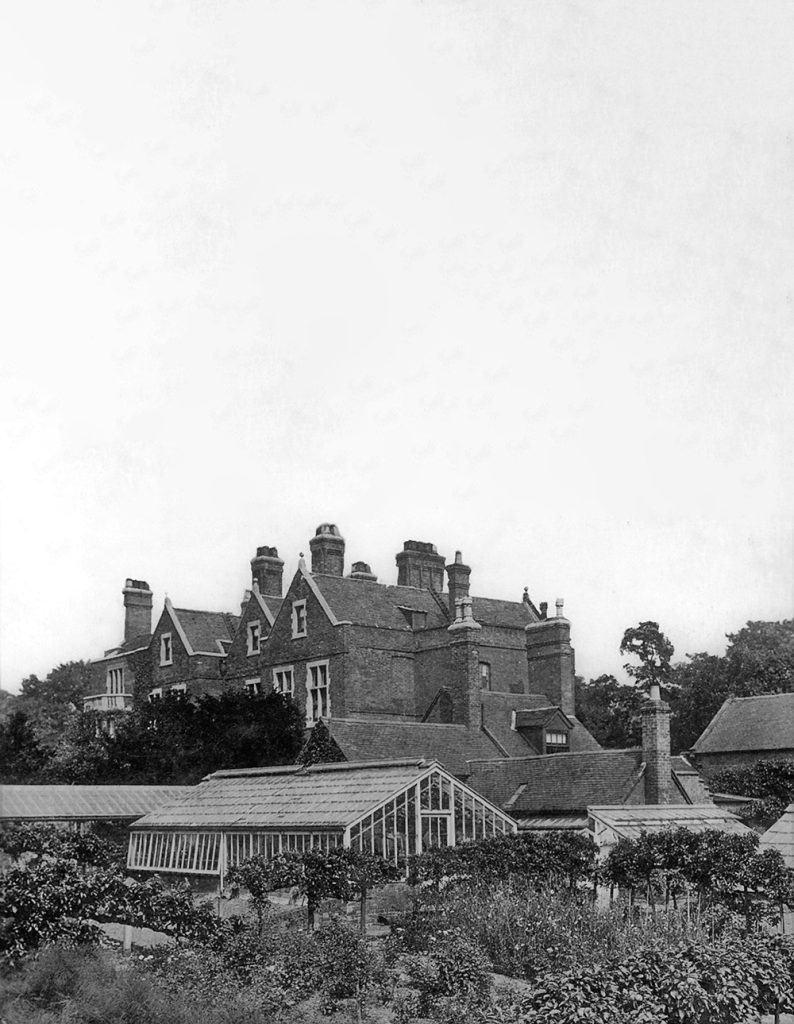
By Maxwell Craven Derbyshire lost more parishes to Staffordshire than it gained under the local government reforms of 1887 and thereafter: Clifton Campville, Croxall, Edingale, Winshill and Stapenhill among them. The desire of the Borough Burton-upon-Trent to increase rating revenue, for instance, added to a sort of municipal tidy mindedness, resulting in the transfer in 1894 of Stapenhill and Winshill to that Borough as well. There was some logic in this, as Stapenhill and Burton face each other across the Trent, the former on a bluff and the latter upon water-meadows prone, since the fourteenth century climate anomaly and the ‘little ice age’ which followed, to flooding. Even by 1894, the great and good of the Borough tended to build opulent villas there (mainly brewers or their well remunerated legal advisors), giving them splendid views west and south west over the river and town. Here, the brewers could keep an eye on their works from the comfort of their smoking room banquettes. Until 1538, Burton was dominated by its Abbey, founded by the Saxon grandee Wulfric Spot in 1004. Their land holdings grew to include part of Stapenhill, enhanced in 1192 by bequest on the death of its long-standing lord, Bertram de Verdon. According to the Staffordshire Victoria County History, there was a capital messuage at Stapenhill by the time the abbey was dissolved which, in 1546, was acquired with the rest of the abbey’s property, by William, 1st Lord Paget of Beaudesert, whose family were to dominate the history of Burton for the next four centuries, rising in eminence to become Marquesses of Anglesey. The Abbey’s leading tenants of the estate were the Abell family, originally recorded at Ticknall in the early 14th century, and who continued in occupation under the Pagets. John Abell was tenant at the dissolution, and his family must have built the first hall. His descendant, George Abell had his coat-of-arms confirmed in 1611, but his son Robert decided for reasons of religion (he was a Puritan) to migrate to America and settled in Massachusetts, where his family continued to flourish. The house as recorded on an early map and later in 1731 by Samuel and Nathaniel Buck, was a relatively simple L-plan brick house of two storeys and attics with an extension added to its rear. The only clue we have to the successors of the Abells as tenants is that Edward Hunt was taxed on nine hearths there in 1670, indicating that the house was of a pretty reasonable size. Nothing much can be discovered about Hunt, who was probably the person who married Dorothy Parker at Lichfield in 1659. It may be that he was steward to 6th Lord Paget, an eminent diplomat and consequently rarely in Staffordshire. However, thanks to Derbyshire historian William Woolley, we know that the house was renewed or replaced in the late 17th century by Hunt’s successor Charles Blount, who, he stated in 1713, ‘… had an estate here and not long since built a pretty good house on the banks of the Trent., which runs under it, who sold it to Paul Ballidon, Esq.’ Charles Blount was the younger son of Sir Henry Blount of Tittenhanger, descended from the Blounts of Blount’s Hall, a long-vanished house in Burton itself. The family, which also had Stenson House for a while, were a junior branch of the Medieval Blounts, Lords Mountjoy, of Barton Blount. The transaction implies, also, that the property had become detached from Lord Paget’s estate by that time, too. Ballidon married Sarah, daughter of Sir Thomas Gresley of Drakelow, Bt., at Stapenhill in 1715, suggesting he was already in residence by that date, but he died in 1729 without leaving any surviving issue, being followed by his widow in 1736, both being interred at Derby, where Paul’s grandfather (another Paul) had been a merchant and his great-grandfather, a mercer, had been Bailiff in 1574. The family took their name from Ballidon, in the White Peak, where one Peter de Ballidon was recorded as early as 1201. It has proved impossible to identify exactly what happened then. There was a cousin, Robert in London and others at Trusley, so one or other branch of the family probably inherited the estate, and perhaps sold it, but to whom is a mystery, although Paul’s will would no doubt make matters a little clearer. Stapenhill Hall next appears on record in 1833 when John Levett (of the family then living at Wychnor Hall) was the owner and also in residence, as a notice in the Derby Mercury assures those interested in the house and 15 acres of gardens, that he would be available to show them round. Clearly the Levetts had acquired the estate and John lived there while his father, Theophilus, was alive, moving to Wychnor once his Stapenhill residence was let. The new tenant was Thomas Allsopp of the brewing family, who later moved to The Mount at Newton Solney. Yet, ten years previously, the Levett family had sold the estate (but retained the house and gardens) to banker and brewer Joseph Clay in 1823. The Clays were directors of Bass, who had been building up a portfolio of property in Stapenhill from 1817 when Joseph had acquired the Stapenhill holdings of Thomas Lea, bankrupt, against a mortgage of £1,280 and, also through marriage with Sarah, only daughter of John Spender of Stapenhill. His eldest son Henry, soon afterwards bought the house as well into which he moved, although he much later settled grandly at now derelict Piercefield Park, on the edge of Chepstow racecourse. He thereupon rebuilt the house, subsequently re-named and described as ‘Stapenhill House…a handsome mansion’. The rebuilding, completed by 1857, was fairly drastic, providing the south (garden) front with three stone coped gables and fairly deep mullion and transom cross windows also in stone. To the west there was an extension of another wide bay, carried towards the rear by a further four bays, the central pair, like the central bay of
The Lost Houses of Derbyshire – Old Thornbridge Hall – Ashford in the Water

Thornbridge was once part of the estate of the Longsdon family of Little Longstone, who claim a descent (never securely sorted out, but nevertheless highly likely) from Serlo de Longstone living around 1100 and, although the estate was held by that family (latterly spelling their name Longsdon) from the twelfth century until 1790, there seems no evidence that there was ever a house there, although there certainly may have been. Nevertheless, the family were numerous and still flourish today, although the claim made by G. T. Wright, JP in his very substantial book, Longstone Records (Bakewell 1900) that he himself and the Wrights of Eyam were descended from them in the male line does not really stand up to scrutiny. Thomas Longsdon of Little Longstone (1706-1780) was twice married and produced no less than eight sons, who began rebuilding the family’s fortunes after some decades of decline, for the eldest son, James Longsdon (1745-1821) was a partner until 1786 of Andrew Morewood, a Manchester cotton merchant, as were his younger half-brothers Anthony, Matthew and Peter, all of whom actually lived in Manchester, not to mention David, a grandson. This effective family migration towards Manchester in pursuit of cotton riches, led to the sale of Thornbridge by James, in 1786 when he inherited Little Longstone. The purchaser, after over three years without a taker, was his former business partner, Andrew Morewood (1714-1794), of a younger branch of the Morewoods (later Palmer-Morewoods) of Alfreton. The sale was probably to raise capital to invest in the remaining Longsdon estates. The price for the estate was apparently £10,000, and did include a house about which little is known. It was most likely a modest farmhouse, conceivably that upon which hearth tax was assessed in 1670 for one hearth when it was inhabited by a member of the family. Andrew Morewood, had made a considerable fortune in the cotton trade, although it should be remembered that, contrary to what one might read on various websites, Manchester at this period traded cotton, not from the southern states of the USA (as later in the 19th century), where it was picked by slaves, but from India and Egypt, where cotton was picked by paid labour (although I would not vouch for the free status of those who picked for the Mamluks, Ottoman Egypt’s de facto rulers). He therefore decided to build himself a modest country villa, the first Thornbridge Hall, completed in about 1792, and died there two years later. His new seat was a typical later Georgian country house, built of Carboniferous Limestone with Millstone Grit sandstone dressings, probably from Bakewell Edge, and of two storeys. The entrance front was five bays wide with a three-bay pedimented central section which broke slightly forward. The right return was of one wide bay under each pile of the building, expressed as Venetian windows, superimposed, one above the other, with flat mouldings, and there were quoins at the angles. Who designed it is difficult to say; probably an architect who was also a builder, as was then usual, although from the relative sophistication of the design it was unlikely to have been a local man armed only with a pattern book; perhaps he chose someone from Manchester. John Morewood (1754-1811), who soon succeeded, extended the house by adding a matching range at right angles to that already existing, but with an oeuil-de-boeuf or oculus in the pediment. A modest park of 20 acres was also laid out around the house, to which he added a further 20 acres leased from the Duke of Devonshire. The situation of the house cannot have lacked grandeur in the first place, and it is doubtful whether a professional landscaper was involved. John Morewood was succeeded by his brother, George and, after his death in 1854, by his third daughter’s husband, James McConnell, a Prestwich cotton spinner who in 1835 had bought nearby Cressbrook Mill and built the hall there to the designs of Thomas Johnson of Lichfield. He soon decided that Thornbridge was not quite to his taste after all and decided that he preferred the more overtly Gothic Cressbrook which was set in an even more spectacular setting. Therefore, in 1856 McConnell decided to move on, placing an advertisement in The Times for 17th December 1856 offering it to let, but, receiving no takers, eventually sold it in 1859. The buyer, rather surprisingly, was the Revd. Henry Longsdon (1826-1899) of Little Longstone Hall, whose ancestor had sold it in the first place. He had inherited the family estate at Little Longstone aged 18 months in 1827, but his senior line of the family had not benefited quite so royally from the family’s excursion into cotton trading, and he was then the newly appointed vicar of Eyam. However, he still needed somewhere nearby to live, as the Joseph Pickford designed vicarage at Eyam had not then become available, and the family manor house was occupied by his mother. However, after a year or two this situation resolved itself, and Thornbridge was again put on the market, shorn of much of its estate, which was retained as part of that of Little Longstone. The next new owner was John Sleigh of Leek, whose exhaustive History of Leek came out in 1862, with a second edition (less desirable to the collector, but slightly more helpful to the researcher) followed in 1883. He also wrote frequent antiquarian articles for The Reliquary, an historical periodical edited by his friend Llewellyn Jewitt of Winster Hall. The Sleigh family ultimately descended out of Hartington and had at one time acquired the Etwall estate too, but quite why Sleigh wanted to move from Leek, which he clearly loved, is not clear. Nevertheless, he was prepared to spend £10,000 on it (the same price as Andrew Morewood had splashed out in 1790, but, of course, with much less land) remained there until 1871, when it again came onto the market. One attractive feature which enhanced the value of Thornbridge
Walk Derbyshire – A Walk from Grin Low & Buxton Country Park

There are not many walks claiming to start downhill, but this one does (although the height lost must be regained at the end, but nothing is perfect, is it?) The walk starts from the car park accessing Solomon’s Temple before dropping down to the centre of Buxton and its Pavilion Gardens, returning by way of Poole’s Cavern Country Park. A once devastated landscape covered with small scale limestone burning has changed into a pleasant hillside, where mature woodland criss-crossed with meandering footpaths leads to three interesting features. The walk explores them together with the rest of the byways. Around the early 1800s Grin Low hillside was devastated by the results of two centuries of quarrying and lime burning, leaving a lunar landscape of humps and hollows where whole families lived like troglodytes. As part of his ambition to turn Buxton into a northern spa, in competition with Bath and Harrogate, the 6th Duke of Devonshire planted the 100 acre wood with a mix of broad leaf trees such as beech, oak and sycamore together with a few conifers. These have now grown into maturity and along with the grassy moor around Solomon’s Temple they have created what is now designated as a Site of Special Scientific Interest (SSSI) where swathes of rare sub-alpine species bloom, along with many wild animals and birds making their home here. Along with paths meandering through the woods and across the open hilltop, there are three specific features that will provide plenty of interest to young and old. Starting from the car park and picnic site, these are: Poole’s Cavern Arguably this is the most natural cavern open to visitors in the Peak District. Even though it was never mined, it has links with ancient people from long before the Romans settled in what became Buxton. Formed by the action of floodwater, meandering passages are lined with stalactites ranging from delicate straw-like growths to huge columns that seem to hang without support. Rainwater falling where there are still large amounts of waste lime powder, percolates down through the earth, laden with calcite that precipitates in what has been aptly called the ‘Poached Egg Chamber’. The stream flowing through the cave rises far into the hillside, way beyond the end of the public access section, eventually forms’ part of the Derbyshire River Wye. When Poole’s Cavern was first developed as a tour cave, it was decided to remove a large section of glacial sediment blocking the easiest entrance to the cave. By doing this it links with the cavern’s earliest users whose story came to light in the shape of animal bones, iron objects and pottery, suggesting that people had sheltered in its damp recesses since at least Neolithic times (between 2000 and 1500 BC). Bronzesmiths plied their trade in its shelter during the Roman occupation, making domestic objects for the wives of soldiers stationed on what were then the wild uplands of ‘Peclond’. Who Poole was, the man who supposedly gave the cave his name has never been proven, but the traditional explanation is that an outlaw called Poole or Pole sheltered in the cavern sometime around the mid1400s; there was however, a Poole family living at Hartington, a mere 10 miles away and records dating from 1432 state that John Poole Esq held a large area of land in ‘Buckstone’, so it could be that as law abiding people they owned the cave, or maybe a renegade member of the family hid there. Whichever story is true will probably never be known, but what is on record is the visit Mary Queen of Scots made in 1580 during her spell of captivity in the Peak. A hundred years later, Charles Cotton listed the cave as one of his ‘Seven Wonders of the Peak’, and in so doing put the attraction on the visitor map. Poet laureate Sir John Betjeman visited the cave in 1980 and thanked the guide for ‘moving his unwieldy body through the vast wonders of the cavern’. Go Ape A few yards uphill from the play area beside the car park, a purpose-built modern wooden building marks the start of ‘Go Ape’, billed as the UK’s number one tree-top adventure. After being fitted with safety harness, adventurers tackle zip wires, Tarzan swings, rope ladders and complex high-wire crossings linking a course through the forest. Solomon’s Temple There are at least four ways up to the airy ridge-top tower known as Solomon’s Temple – you could even fit it in with a quick spin around the orienteering course if so inclined. The name given to the tower links it to the original benefactor who paid for it as a ‘job creation scheme’ for unemployed local quarrymen. Built in 1896, the folly or look-out tower, call it what you will, overlooks not only Buxton, but a wide swathe of Peak District scenery. The effort of climbing the hillside from the car park should only take about 25 minutes, following the wide woodland path, and the effort is well worthwhile. Don’t worry if you hear explosions coming from the group of buildings on the hillside over to your left. They will be coming from the Explosion and Fire Laboratory of the Health and Safety Executive, where they have been known to assess the explosive characteristics of custard powder! Useful Information A short 1½ mile (2.4km) easy stroll downhill and back up (totally 880feet – 268 metres) using open footpaths, side roads and public parkland. RECOMMENDED MAP Ordnance Survey 1:25000 scale Outdoor Leisure Explorer Map, Sheet OL24 – The Peak District, White Peak Area. PUBLIC TRANSPORT Hourly TP service from Derby via Matlock into Buxton Market Place. REFRESHMENTS Chaise of many pubs, cafes and restaurants, in and around Buxton town centre. CAR PARKING Above Grin Low camp site. (Honesty box payment). DIRECTIONS From Grin Low campsite car park (signposted off the Harpur Hill/A53 Leek road link), walk uphill on a footpath through a small wood. Go through a kissing gate and bear right,
Lost Houses of Derbyshire – The Devonshire Hospital
Someone mentioned to me the other day that there were many other lost houses of historic and architectural importance apart from country mansions and town gentry houses and why didn’t I write about something just slightly different every now and again? Well, often the problem is that a paucity of images prevents one from doing so, but the other day I was going through a folio of drawings and came across a re-constructed elevation of the Devonshire Hospital in Full Street, beautifully drawn by the later Edward Saunders. It occurred to me that here was a building designed and built to the highest standards to house a specific group of people which richly deserved to be chronicled. The story goes back to Bess of Hardwick (which Derbyshire stories often do). This much married woman rose from minor gentry to Countess in a progression of four glittering marriages, and she ended up allied to royalty, fabulously wealthy and a formidable operator all round. She was a patron of the arts amongst other things and a keen builder, commemorating her projects on her epitaph in Derby Cathedral. Her buildings – mainly paid for by her second husband, Sir William Cavendish and her fourth, George Talbot, 5th Earl of Shrewsbury – included Chatsworth, Worksop Manor, Oldcotes, Hardwick Old and New Halls, just to name the most prominent projects. Most were built under the guidance of the Tudor builder/architect Robert Smythson, and thereby gained immortality if only through his ability to build spectacularly and innovatively. On 5th October 1599 Bess, by then Countess of Shrewsbury, decided to found a charity in Derby, the Shrewsbury Hospital, to house eight poor men and four poor women, to be endowed with a rent-charge of £100 per annum (pretty generous in 1599) raised out of the tenants’ receipt from Little Longstone, in the Peak. The lucky dozen were to be chosen from the parishes of All Saints’, St. Michael and St. Peter, and had to be ‘the most aged poor or needy persons within the said town of Derby, being of good and honest conversation, and not infected with any contagious disorder.’ They also had, once it had come into being, to cleanse, dust and sweep over’ the large and ornate monument, designed by Smythson, to be erected to their benefactress on her death (which occurred in 1680), and that they attend (if not bedridden) divine service in the church daily. They were also to receive £1 – 13s – 4d [£1.67p] each every quarter with £1 expenses to buy a gown in the livery of the Cavendish family with a silver heraldic badge of Bess’s arms, a ‘bedstead, bolster, two pairs of sheets, two coffers, two tables, a cupboard, two stools, four peter dishes, iron tongs, fire shovel, etc.’ They had to keep off the booze and not have strangers to stay either. They also had Richard Haywood, the resident warden, and his wife on site, too. The building was put up immediately behind the chancel of All Saints’ and consisted of a two-storey range parallel to the street in stone, of nine bays, the central entrance being ensigned by a large carved armorial panel and giving access to a courtyard behind. There were two doors alternating with two ground floor three-light stone mullioned windows either side of the centre, with two-light windows above, providing the accommodation of the four old women and the warden. Flanking the courtyard were two ranges at right angles to the front one, each of four units in matching style, the roofs being pitched and tiled. Each person had a parlour, a kitchen and a bedroom above. Gardens led down to the Derwent. This agreeable building, the maintenance income of which was topped up by William Cavendish, Bess’s eldest son (later 1st Earl of Devonshire), by rents from Edensor, sufficed for the twelve pensioners, until the time of William, 5th Duke of Devonshire, who succeeded in 1764. He was somewhat infected by the same desire to build as his ancestrix, Bess, and was, by the time of his death in 1811, responsible for many improvements at Buxton (including the Crescent, currently being restored), Chatsworth and many other family properties, probably as a distraction from the gloriously wayward Georgiana. He was especially keen to improve the Chatsworth estate, and at first hired James Paine to replace the stables there with the present epic construction, along with the unfinished Palladian mill in the park. When Paine moved on to other projects, he hired Paine’s acquaintance John Carr to undertake work at Buxton, and Derby’s Joseph Pickford to continue at Chatsworth. Pickford’s greatest tour-de-force at Chatsworth was the Edensor Inn, a brick building of outstanding subtlety, the Edensor rectory (later destroyed when the village moved), the North Lodge, Ashford Hall for the agent, and three eighths of a vast but unfinished octagonal stable block, also in Edensor, opposite the Inn. Hence it fell to Pickford to come up with a design to replace Bess’s rather poky almshouses with something altogether rather more up-to-date, re-named the Devonshire Hospital. Pickford, whose style tended to be pitched to accord with his clients’ requirements, was Neo-Classical when employed by a Tory (as at Kedleston) and Palladian, the favoured style of the Whigs, led locally by the Duke, when employed by the governing Tories’ political opponents. Hence the new almshouses, also in stone, were firmly in the Palladian revival style: ancient Roman elements disposed according to the published precepts of the Italian architect Andrea Palladio, ironically a rather older contemporary of Bess of Hardwick. This time, instead of having the inmates living on the road frontage, they were housed rather comfortably in two wings parallel to the road, and a range connecting them nearer the river with an arch through to the gardens which went down to it, all shielded by a very grand screen facing the road with a central entrance wide enough for vehicles and a pair of pedestrian entrances. The end bays consisted of interpenetrated