The Lost Houses of Derbyshire – Kirk Hallam
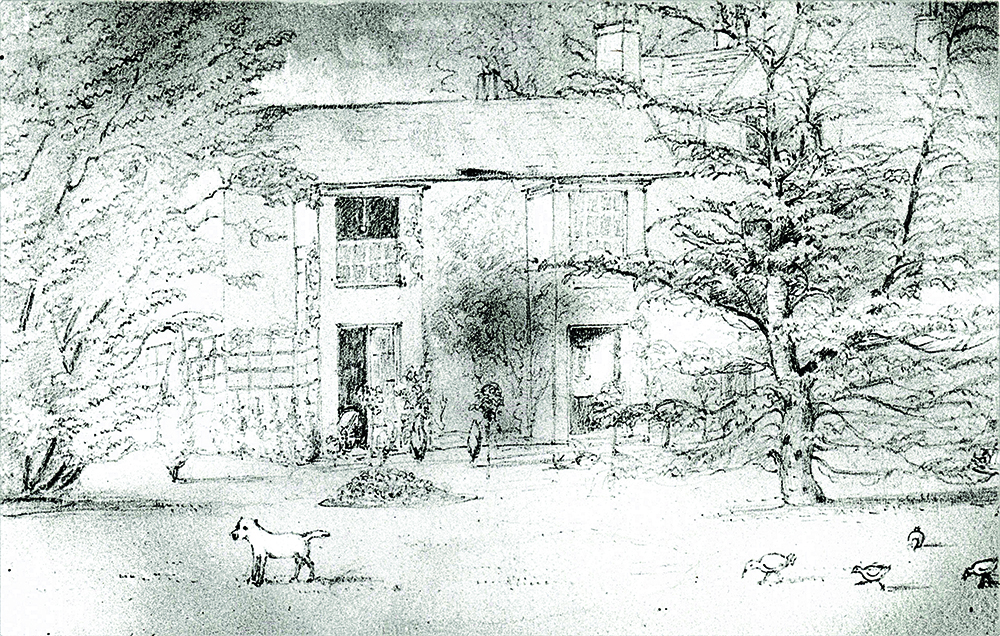
by Maxwell Craven Kirk Hallam was originally a small hamlet atop the ridge that overlooks the Nut Brook and the homonymous canal as one travels east towards Little Hallam and Ilkeston. It takes its name from the Old Norse hallr (= a hill) + kirk (= church) which perfectly describes the settlement, even as it appears on the 1880 OS map, on which there is little to be discerned bar the church, the hall and a scatter of houses to the south of the main road. It is thought that the ‘Kirk’ element was added in the early 12th century as the later settlement that became West Hallam expanded, to differentiate the two. In 1066, the manorial estate was held by one Dunstan, but two decades later, when Domesday Book was compiled, it had come into the hands of Ralph de Burun, one of the great barons and few chief lords holding land in Derbyshire and, under him it was held (so later charters establish) by a family taking their name from the place. In 1155, Hugh de Burun of Horsley Castle, the last of his line, died and the estate passed via his daughter Aelina to Peter de Sandiacre, son of a Viking called Toli, who not only held Sandiacre, but a great amount of property in Derby, too. His son, another Peter, married Beatrice de Hallam, a member of the family that were Peter’s sub-tenants at Kirk Hallam, and we can only presume that they had a capital mansion of some description there. From maps, we know that the later hall lay just slightly SSW of the ancient church of All Saints, and it would be reasonable to assume that the ancient manor house would have been on or very near the same spot. As with one of two of the other lost houses we have looked into, it was never the chief seat of the family that owned the land, so always ranked as a secondary residence. Furthermore, in 1260 John de Sandiacre granted the patronage of the church and much of his estate at Kirk Hallam to the Abbey of Dale, so whoever lived in the manor house was from the later 12th century, a tenant of the Abbot and Canons there. In fact, the generous John de Sandiacre died shortly after his gift to the Abbey, in 1277, leaving two daughters and co-heiresses, of whom one carried Sandiacre and Kirk Hallam to her husband, John de Grey, a younger son of Henry de Grey of Codnor. The estate remained thereafter with the great English baronial house of Grey until it was bestowed upon the daughter and co-heiress of the last de Grey who brought it to John Leake of Hasland in 1409. Yet, once again, the manorial estate had fallen into the hands of a fairly grand, but definitely upwardly mobile, family with a primary residence elsewhere, this time at still extant Hasland Manor House. They also inherited Sutton Scarsdale from the de Greys, too, and the family had also married another heiress, that of the d’Eyncourts of North Wingfield, so they found themselves, by the time of the beginning of the Tudor dynasty, very rich and well endowed with estates, in Derbyshire particularly. The Leakes later built a great house at Sutton Scarsdale and Sir Franics Leake, made one of the very first baronets by James I in 1611, added a hunting lodge nearby called Staveley Hagg, which survives as Hagg Farm. He also aggrandized Sutton Scarsdale, and found much favour with Charles I, who made him 1st Lord Deincourt (the title chosen from his antecedents the d’Eyncourts), a favour he returned by great loyalty to his sovereign during the Civil War, for which he had his estate compounded by Parliament as a ‘delinquent’. The impecunious King rewarded him with an earldom for his pains, and he became 1st Earl of Scarsdale in 1645. We have no information about the manor house at Kirk Hallam through all this time, and it may have decayed through neglect, as we saw at Chellaston. However, the Leakes got their estates back at the Restoration, and the 1670 hearth tax records a house assessed on five hearths at that time, split between a father and son, both called William Blunstone, and it seems likely that the elder was then the tenant. Indeed, the Blunstones were long lived in that area, having come from Sandiacre – probably co-incidentally – at the beginning of the 17th century. However, another William Blunstone was farming in Kirk Hallam in 1827 and his family were still there a generation later, but by then at Ladywood Farm as copyholders, rather than as tenants of the Hall. One wonders if any descendants still live in the area. Meanwhile, their feudal masters had been going from strength to strength until, that is, the time of Francis Leake, 4th Earl of Scarsdale, who managed to blow the family’s considerable fortune, mainly through the expense of building a vast new house (but incorporating parts of its predecessor) at Sutton Scardsdale, designed by Francis Smith of Warwick in 1724 (see Country Images May 2021). Having completed it, he gambled away much of what remained, before dying, broke, in 1736, the last of his line. The estate was, needless to say sold, including the Kirk Hallam elements of it. The purchaser was Francis Newdigate of Nottingham. He, for once, actually decided to live at Kirk Hallam, and elected to build himself a new house. We only have a pencil sketch of this house, although it survived well into the 20th century, so it is difficult to say just what it was like. It appears to have been of brick with gabled cross wings with attic windows, the rest being of two storeys. The roofs were tiled and it was set on a modest park just west of the church. Clearly, Mr. Newdigate was a modest sort of fellow, although by the time of his death in 1764 he