Lost Houses of Derbyshire – Old Walton Hall, Chesterfield
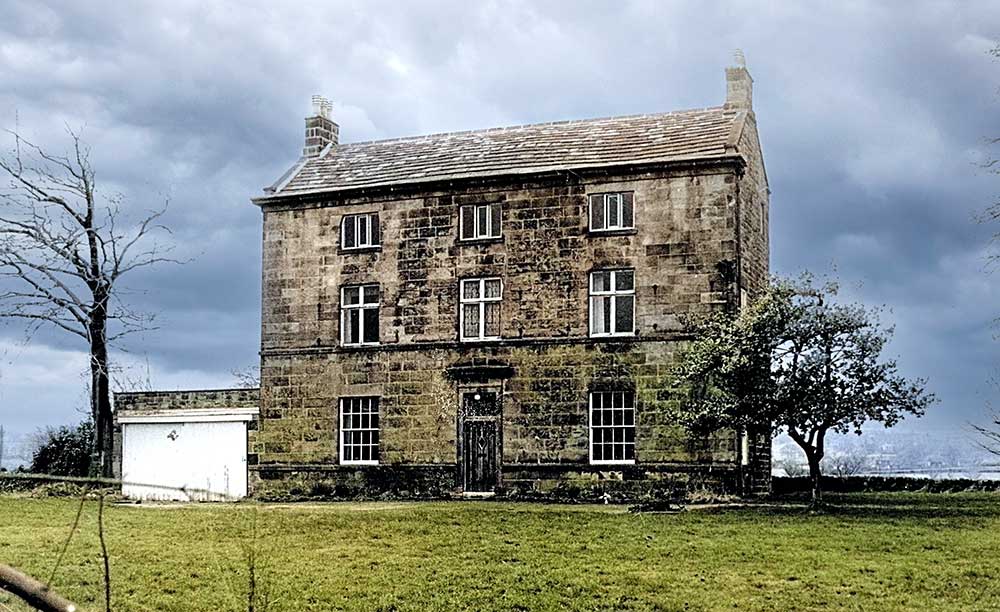
The present Walton Hall, built in the closing decade of the 18th century as a fairly substantial farmhouse, nowadays survives entirely surrounded by modern housing, its lush farmlands lost to a succession of extractive industries followed by the SW expansion of Chesterfield, which gobbled the unpretentious village of Walton up towards the close of the 19th century – and didn’t stop. The site, however, is an ancient one, held by an otherwise unknown man called Hardulf at the time of the Norman conquest, and from him, doubtless compromised by supporting or fighting on the losing side at Hastings, it came into the hands of the King. Who the King’s tenant was at Walton, we seem not to know, but by the next generation it was in the hands of Roger le Brito, otherwise le Breton. Roger, whose name suggests Breton origin – a good number of William the Conquerors comrades-in-arms were Bretons – is otherwise thought to be identifiable with Roger, son of Steinulf, the Domesday Book tenant of Calow, but as the name Steinulf is Nordic not Breton, this may not be a tenable supposition. However, whilst Calow descended amongst more easily attested descendants of Steinulf (bearing the name Calow, of course), Walton descended to the posterity of this Roger. His grandson, Sir Robert le Breton, received a licence from the king to found a chantry on his land at Walton, clearly suggesting he also had a capital mansion there, too. Nevertheless, the family continued for eight generations until Isabella, daughter and sole heiress of another Sir Robert brought the estate to the Lowdhams of Lowdham, in Nottinghamshire. In the next generation another heiress brought it to Thomas, a younger son of the Peakland grandee Sir Thomas Foljambe of Tideswell, around 1390 and his family held it until 1633. The old house was one of many Derbyshire manor houses to host Mary Queen of Scots, in this case, for two nights in February 1568. The last hall to be occupied prior to the building of the present one was that built by Godfrey Foljambe, who inherited the estate on the death of his father, Sir Godfrey, in 1585, and the existence of two chimneypieces and overmantels bearing his initials and dated 1591 (one was dismantled and reconstructed for installation at Dene Park in Kent; the other came into the hands of Sir George Sitwell but is lost) suggests that his new house was being fitted out in that year and was thus ready for re-occupation, perhaps before the end of the year. The house’s predecessor was set in a park, bordered on the north by the Hipper and this had a tower therein, which can be picked out on both the map of Christopher Saxton of 1577 and that of John Speed of 33 years later, probably a hunting stand, like that at Chatsworth. The new house is only known from a survey of 1633 by surveyor William Senior, and consisted of an entrance front with end gables, from which ran cross wings, with two further lesser gables flanking the entrance. This ensemble formed a deep courtyard, and was closed at its open end by a timber screen, beyond which lay the stable block. On the other side of the house was the domestic chapel, founded as a chantry by Sir Robert le Breton, by 1623 embellished with a tower, spire and extended chancel. Sir Godfrey Foljambe, who lived there ‘wherein great contynewall housekeeping was mayntayned’, died in 1595, whereupon his widow, Isabella, was left a life interest in the estate, allowing her to live there with her second husband Sir William Bowes. She outlived him, too, and died in 1623; both were very keen Puritans. In 1609, they had been host to Lady Arbella Stuart, the King’s cousin and Bess of Hardwick’s grand-daughter. The house by then was surrounded by gardens, orchards, a bowling alley and pleasure grounds extending to twelve acres, the estate itself running to over 2,336 acres. The building itself was described as in good repair. However, once Lady Bowes had died, the male heir, Sir Francis Foljambe, 1st Bt. (the title created in 1622) inherited it. He was MP for Pontefract (his main estate then lay at Aldwarke in Yorkshire) and High Sheriff of Derbyshire in 1633, in which year he decided to sell up and the house seems never to have been properly lived in ever again. The purchaser was Sir Arthur Ingram MP of Temple Newsham, Yorkshire, a colourful character described by one contemporary as ‘a rapacious, plausible swindler who ruined many during a long and successful criminal career’, but it would seem that his purchase – at an eye-watering £16,000 – may have been an element of some other transaction, for within three years he too had sold the estate, this time to Paul Fletcher, a local ironmaster. Fletcher’s heir was another local merchant, Richard Jenkinson, who in 1648, with the Civil War still raging, decided that the old house – un-lived in since 1623 and in decay – was too large for him and he reduced it considerably, supposedly to make it more convenient. His son, Sir Paul, was created a baronet (of Walton) in 1685, but the family allowed the building to continue to decay, until in 1713 William Woolley could write of it: “The ancient seate Walton nere Chesterfield….is utterly ruyned, plucked downe, and sould, no materiall, as ys reported left, nor almost any mencyon made were so greate hospytality, and that in my tyme used.” With the death of Sir Jonathan Jenkinson, 3rd Bt. in 1739, his niece and heiress inherited it and forthwith bestowed it upon her mother Barbara, widow of Sir Paul, who had died in 1714. By this time, she was married to John Woodyear who, like the Jenkinsons, lived elsewhere and promptly cleared the site of the old hall, in order to convert what was left of the estate (after several parcels had been sold off to local coal-masters) into a working farm.
The Lost Houses of Derbyshire : Coney Green House – North Wingfield

The name Brailsford is a common one in Derbyshire (not to mention elsewhere), and received added lustre through the knighthood granted to Shardlow-born Sir Dave Brailsford in 2012 for services to cycling (notably Olympic cycling). As Brailsford is an unique place-name, it is generally accepted that all people of this name descend from the ancient knightly family of that name, who descend from Elfin (otherwise Aelfwine or Elsinus) de Brailsford, a man of Anglo-Saxon ancestry who, unusually, held the manor of Brailsford when Domesday Book was compiled in 1086. Fortunately, they are well documented, even in this early period, so we know much about the younger sons and their posterity. Eventually, Brailsford passed from the family with the death without male issue of Sir Henry Brailsford in 1356 when the estate passed through his daughter Joanna to Sir John Basset of Cheadle and from the Bassets eventually to the Shirleys. Robert de Brailsford, second son of Nicholas, Aelfwine’s son, called himself de Wingerworth, having inherited through marriage an estate there and other land in the area including North Wingfield. Sir Engenulf de Brailsford, a great-grandson of this Robert was living in 1232 and 1259 and left two sons, of whom, the elder William, was granted house and land at Tupton (probably Egstow) and other land at North Wingfield by Sir Henry, the last of Brailsford, and with his wife Agnes he settled there. His posterity acquired an estate at Seanor two miles to the east (nothing seems to remain of the house) and members of the family are found at Little Brailsford in North Wingfield, and The Hill there. Thomas Brailsford of Seanor married Penelope, daughter and heiress of John Clay of Crich and their third son, Thomas is described as being ‘of Coneygree’ in a list of freeholders of 1633. His son of the same name, a doctor, later sold Seanor and settled at Coney Green (as the name later became). He was assessed for hearth tax on a substantial seven hearths in 1670, and in 1681 (if we are to believe the record of a datestone from the house) rebuilt the house, dying in 1720. The next we hear of the house is a notice in the Derby Mercury for 31st July 1772 for its sale by Francis Brailsford with an estate of 110 acres, its ‘grounds within a ring fence and coal under the greater part of the premises.’ The buyer, probably keen to invest in mining, was Thomas Fanshaw of Brough, but clearly his plans came to nought – perhaps he couldn’t raise the necessary finance to start mining – and two years later the house and estate ‘convenient for a gentleman’s family’ was again sold, this time to Thomas Wilson, who paid £4,000 for both Coney Green Hall and Pilsley Old Hall (on which watch this space!) Wilson was a member of an old-established local family, and was already a coal-owner, so we may be confident that he was well funded in his endeavour. It was, without doubt Wilson who re-fronted Dr. Brailsford’s old house, with a classical façade of locally quarried and ashlared coal measures sandstone, probably the seam known as Top Hard Rock – much sought after for building. The result was a slightly bizarre mix of Palladian with Baroque overtones, and was probably composed by a local builder using a pattern-book. There must have been some ornate pleasure grounds surrounding the house too, for a pair of lakes in a small park-like enclosure still remained according the 6 inch OS map surveyed in 1878. There was also a courtyard surrounded on three sides by farm buildings to the SW of the house, too. As we only have one image of the house (a photograph dated 1883) it is impossible to assess how much of Dr. Brailsford’s house remained, but the likelihood is that most of it did. The new façade was of five bays, a particularly wide central one breaking forward slightly with rusticated quoins at the angles under a modillion cornice and plain parapet. This probably fronted a set of spacious new rooms flanking a notably wide hall, a fact that can be deduced from the width of the central bay of the house. The thoroughly wayward entrance is tripartite, with the door’s fanlight rising through an open pediment (very Palladian and out of date by 1774) but both that and the sidelights were embellished with rusticated surrounds best known as Gibbs surrounds, after the Baroque architect James Gibbs who first used them, and which can be seen on Derby Cathedral, which he designed in 1723. Above that is a Serlian (‘Venetian’) window matching the entrance in width, but strangely plain after the bravura treatment of the doorcase below. Otherwise, the fenestration is notably plain except for discreet key-blocks. The only architect operating locally who made much use of Gibbs surrounds was Edmund Stanley of Chesterfield, who used them in 1754 on the entrance of Lea Hall, but this is a much more disciplined piece of architecture. Working with Joseph Pickford at Ogston Hall just over a decade later, and in Palladian mode, seems to have cured him of this sort of thing in any case, hence the suggestion that we are looking at the work of a local builder cherry-picking things from a builder’s pattern book. One suspects that the hall was quite a grand affair and it probably had a columned screen on its far side with Dr. Brailsford’s Restoration staircase rising behind. This would explain why Wilson’s homonymous son decided to further rebuild the house in 1811 which feat he marked with a second datestone which read: At this remove one can have little idea as to what Thomas, junior had done, but it probably involved ‘modernising’ the rear range. Either way, he retained the 1681 date stone in the fabric. By 1827, the house had passed to his son William and by 1843 his brother Thomas Wilson III had the house, and the demesne was
The Lost Houses of Derbyshire – Foston Hall
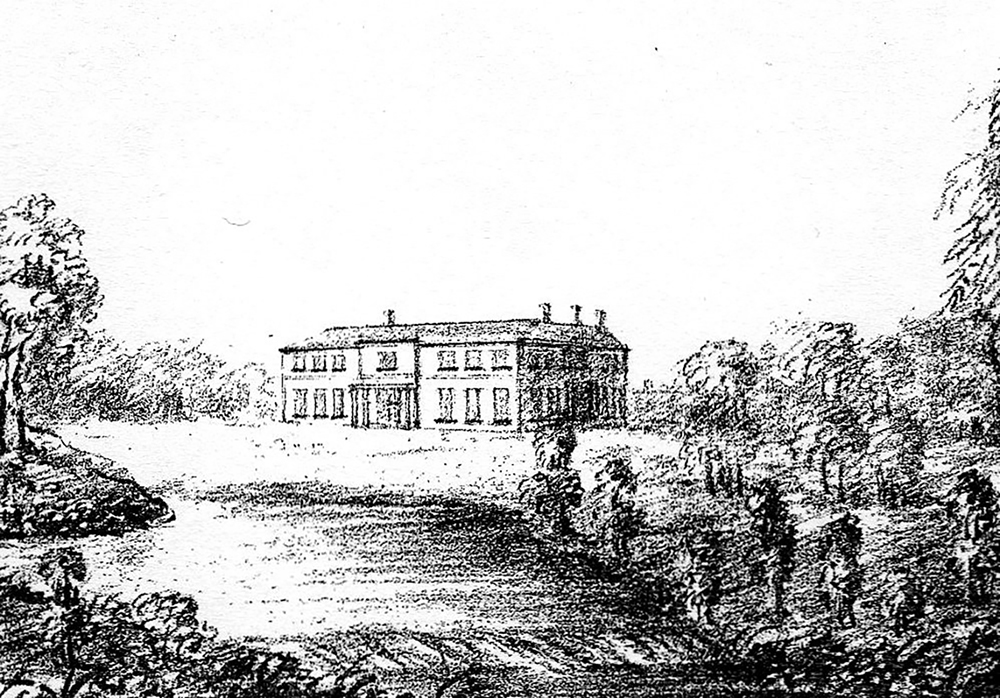
Most readers, on seeing the title of this piece, might instantly be tempted to pen a letter to the editor complaining that Foston Hall is not lost at all, but a prison for convicted women criminals, easily seen from the modern A50. Well, that is true, but we know of two previous houses on the site, both significant and worth recording. The first, of which no known picture exists, was built in the Tudor or early Stuart period, but was replaced in 1809 by a very stylish Regency house, of which some vestiges remain embedded in the present structure. We do not know who the sub-tenant of Henry de Ferrers was at Foston at the time of the Domesday Book in 1086, but it came to Henry de Derby in around 1100 (he may have married the heiress of the first sub-tenant) and was in the hands of his son Robert when the latter died without issue in 1130 and left the manorial estate to his younger brother John. It is unclear exactly who these de Derbys were; a family of that name (and of Norse descent) were virtual rulers of Derby from shortly after the Conquest until they were finally decimated during the Black Death, but Henry does not show up on their pedigree as reconstructed from surviving charters. By 1286 one Walter de Agard held Foston and we are told by one ancient document that he was fifth in descent from the first of his family to settle at Foston (presumably by marrying the heiress of the de Derbys) and that this man, Richard de Agard, was from Lancashire. Allowing 25 years per generation this would suggest that Richard Agard married a daughter or sister of John de Derby, which at least fits: only positive documentation is missing. All this suggests that there must have been a capital mansion at Foston from an early date, but where it stood is unclear. The park was landscaped in the late 18th century (perhaps by William Emes, a lake enthusiast) and the complex of lakes to the south of the present house, fed by the Foston Brook, may have been adapted from a moat. (I must confess to being unable to say whether these survive, for on my visit to Foston over thirty years ago, I was told by my personable hostess, Miss Scriven the then governor, that a survey of the grounds was understandably not possible for security reasons, and of course, I forgot to ask about any surviving features.. The Agards take their name from the Danish Ǻgǻrd, a habitation name (which does not appear to have survived to be entered into modern gazetteers) comprising the Norse elements à (= river) and gard (= enclosure), which hardly hands us any clues as to where in Lancashire they may have come from! They continued as proprietors of Foston, Scropton, Sapperton and Osleston into the Tudor period, when Clement Agard’s second son Arthur (1540-1615), was appointed Escheator and Coroner to the Honour of Tutbury and of the Bailiwick of Leek (Staffs.), a post he held for an astonishing 45 years. He was succeeded by his nephew, Sir Henry whose right to hold these profitable offices was challenged by the Crown, but he maintained he held it by tenure of ‘A white hunter’s horn, garnished with silver, inlaid with gold, in the middle and at both ends. To which is fixed a girdle of black silk, adorned with certain buckles of silver embellished with the arms of England’ which he claimed Arthur had received on appointment by and from his predecessor, and that the item had descended from Walter de Agard in the late 13th century. The coat of arms on the horn (which still exists) is in fact that of John of Gaunt, as Duke of Lancaster (but used to represent the honour of Tutbury, the seat of the Duchy’s control in our area) impaling the arms of Ferrers, once Earls of Derby, which confirms its status as a hereditable badge of office so the article must date from after about 1375. The horn continued in the family until the death of Sir Henry in 1635, when it passed to as distant cousin, Sir Charles Agard, previously of Mackworth, Croxall and Osleston. He was assessed for tax on 12 hearths at Foston, suggesting a medium sized Tudor or slightly later manor house, the first hint we get of anything about the place. Unfortunately Sir Charles found himself, at the Restoration, facing financial disaster as a result of having supported the King in the Civil War, a predicament that even holding the High Shrievalty of the County in 1660 had failed to ameliorate. His son John, having died before him, he sold Foston in 1675 and died five years later, when his remaining property passed through marriage of his daughter to the Stanhopes of Elvaston, including the horn and what by then was its remaining perk, the right to appoint the coroner for the area. Later, one of the Earls of Harrington sold it with its privileges to Samuel Foxlowe and from him it descended to the Bagshawes of Ford. The Foston estate, was sold to Col. William Bate, who owned an estate in Barbados too and was a colonel of militia there. His father had come into the property through shrew conduct, having arrived in the Caribbean as a surgeon. William’s son Richard married Mary, daughter of John Newton of King’s Bromley and it was her brother Samuel who was living in the hall when Woolley wrote of him in 1712 as ‘…having a very good commodious seat there and to complete its pleasantness there is a pretty brook runs through his garden.’ The brook being the same that probably formed a medieval moat round the first house and was later to be dammed to created the double lake which was the centrepiece of the modest parkland from the end of the 18th century. Richard’s son married Arabella, one
Lost Houses – Aldercar Hall
It was of brick with quoins and other dressings of coal measures sandstone, undoubtedly from a local quarry (or re-used from Codnor Castle, at this date, rapidly in decline). Aldercar, a portion of the parish of Heanor and in the Middle Ages being one of four parks attached to the Zouche family’s Codnor Castle estate, takes its name from the Old English for an Alder plantation. At some stage in the downward spiral of the fortunes of the Zouches, Aldercar Park was sold off. That the Codnor estate was large enough to split without too much damage to the income (mainly from agriculture and coal rents) will be apparent when it is realised that the total parkland alone ran to 3,000 acres. The purchaser was Heanor merchant Henry Hyde, although we cannot tell precisely the date of his acquisition. Probably he was a freeholding yeoman farmer who had made a fortune by letting the rights to mine for coal under his land. In those days, mining was a family or extended family affair done in bell pits, the land being rented from the freeholder for a share of the take. This indeed, was probably Hyde’s incentive for buying part of the Codnor estate. Henry died in 1610, probably relatively young, for his son and heir, John, who succeeded to the land, was only twelve at the time; a younger son was Henry, only eight. John married a lady called Joyce around 1626 and they had a son, also John, born two years later, and it may well be the death of one of other of them that allowed the estate to be sold. Whether the Hydes actually built a house at Aldercar is not wholly clear, but the elder Hyde is once or twice described as ‘of Aldercar’ which suggests they lived there rather than in Heanor. The purchaser of the estate was extractive entrepreneur Richard Milnes of Dunston Hall, Sheepbridge, near Chesterfield, but all he did was to detach part of the estate which he wished to add to some coal-rich land he already owned nearby, and in around 1667 he sold the remainder on. It was bought by his kinsman Thomas Burton of Holmesfield Hall, near Chesterfield, the scion of a then numerous but very ancient family. He too was a coal owner, but he had at first settled in Derby, building Thorntree House at the bottom of St. Peter’s Street, now the site of the HSBC. The impetus for this was his marriage, during the Commonwealth, to Frances, the daughter of the aristocratic gynaecological pioneer Dr. Percival Willoughby, who lived in the house later known as the Old Mayor’s Parlour, nearby, which I described in these pages two years ago. Frances died in childbirth, and his father died in 1657 so Thomas returned to Holmesfield. He re-married in 1662, his bride being Prudence, a daughter of Francis Lowe of Owlgreaves Hall, very close to Aldercar (now called Aldgrave and replaced). Indeed, it may have been the spur for Thomas buying land near his wife’s father’s estate. What is certain is that he built a house – or perhaps, rebuilt the one that the Hydes had. It was of brick with quoins and other dressings of coal measures sandstone, undoubtedly from a local quarry (or re-used from the castle, at this date, rapidly in decline) It was of two piles deep, plus a northern service wing, with twin gabled end elevations. The gables being straight coped and decorated with finials, with two light mullioned windows on the attic storey and mullion and transom cross windows on the lower floor. The whole being of two tallish storeys with attics. Inside there was a fine oak staircase with turned balusters and much panelling of the period.. It seems to have been taxed on seven hearths in 1670, when it must have been very new; a sundial was dated 1668, which might well mark the completion date of the building. William Woolley, writing in 1713, said of it that it was a ‘good house and a pretty commodious seat’ but by his time, Burton had died (not long after his wife, who died in 1679). He had three sons, of whom the youngest., Capt. Thomas Burton had the single misfortune to have been killed in action fighting under Marlborough at the Battle of Blenheim in 1705.Michael, the eldest, married the co-heiress of Henry Wigley of Wigwell, an opulent lead trader.Moving to Wirksworth he sold Aldercar to Richard Milnes’s grandson (also Richard), from whom it descended in 1787 to Robert Mower and through his daughter’s marriage in 1791 to Thomas Smith of Dunston, ancestor of my esteemed kin the Craven-Smith-Milnes family of Winkburn Hall in Nottinghamshire. Thomas Smith’s brother, John sold the house and estate to George Jessop, youngest son of Butterley Company co-founder William, sometime around 1848, when the latter became involved with the running of the company after his return from setting up an ironworks in India. He moved to Honley Hall in Yorkshire in the 1850s, and sold it to his Butterley co-director, Francis Wright of Osmaston, who installed his 16 year old son Francis Beresford there in 1857. In 1862 the latter married Adeline FitzHerbert (of the Norbury branch of the family), whose family occupied a superb Carolean house in Warwickshire, the hall at Wootton Wawen, which they bought outright in 1882 Aldercar failed to sell, due to the agricultural depression, and was instead let as a school for young gentlemen wishing to make a career in the colonies, run by Francis Hugh Adams and later by Ernest Nicholls. In 1895 the house was described as ‘venerable looking’. However, in 1896, the Wright’s eldest son Arthur came of age, and he re-occupied Aldercar, soon afterwards (certainly before 1908) completely rebuilding it. His architect was John Reginald Naylor of the Derby partnership of Naylor & Sale of Derby, who were then building extensively for other members of the family, enlarging Swanwick Hayes for Francis Wright’s brother FitzHerbert in 1893-96
Lost Houses – Castlefields
With heavy machinery at work and much building going up in the tract of land between the Railway Station and Traffic Street in Derby, the site of the most ambitious country house close to Derby will be developed for the second time since its demolition nearly 180 years ago. The area is now called Castleward – the name of the voting district, of course – but derives from Castlefields, the ancient name of the area and of the later house. That in itself derives from the shadowy castle at Derby, of which no trace remains, nor has since the Civil War, when a bank and ditch were reported, roughly where Albion Street is now. Castles, even totally vanished ones, usually leave a documentary trace, if only because if the Crown did not build them, one of the great magnates will have done so and not without Royal approval either. Yet no documents survive concerning a castle at Derby, although place name evidence is early enough to be convincing as proof that one did exist. In many of these undocumented cases, the missing fortification turns out to have been a prehistoric (often Iron Age) fort, but this is exceedingly unlikely at Derby, the topography being all against it. The discovery of a previously undocumented motte and bailey castle at Repton by Professor Martin Biddle in the Headmaster’s garden in 1989 (at first thought to have been a Viking dock!) gave the key. It was established as part of a chain of fortifications set up by Hugh Lupus, Earl of Chester around 1141, during the anarchy of King Stephen’s reign. He hoped to use the chaos to secure a separate Northern sovereign principality for himself, and these unauthorized or adulterine castles to defend his southern border, roughly along the Trent Valley, were the result. That at Castle Gresley is another example, and it rapidly became clear that the one at Derby fitted the distribution pattern perfectly. After the war, when Henry II managed to establish order again, they were mainly destroyed, Derby and Repton amongst them. Only the toponym lingered on, in the SE corner of the town. The Castle Fields lay south of Cockpit Hill (possibly the site of the castle’s motte), west of the Derwent and east of Osmaston Road, there being no London Road as we know it then. Before the early 18th century, one went to London following the Roman/Prehistoric route along Osmaston Road to Swarkestone Bridge and thence to Leicester. London Road was only formalised in the age of the turnpike. In order to raise funds, the Corporation, the rather paltry income of which derived from stall rents at fairs and tolls, from time to time sold some of the generous quantities of land it controlled around the edge of the town, the original common fields, of which Castle Fields was one. Others included Parkfield, Whitecross Field, Newlands and so on. At the end of the first decade of the 18th century money was required to build a new Guildhall to replace the 15th century one camped out in the middle of the Market Place. Castle Field was therefore sold to Isaac Borrow of Hulland Hall (1673-1745), whose father John had migrated from Gotham, Notts., and was descended from a family living at Thrumpton in the 16th century. The historian William Woolley wrote of ‘…Castlefields, where Mr. Boroughs [sic] builds a very good house (with a curious garden and paddock for deer)’. Woolley’s MS is undated but internal evidence suggests that he wrote the Derby portion in 1713, which fixes the date for a house that one would on architectural grounds describe as ‘Queen Anne’ fairly firmly. Castlefields was a provincial Baroque house in brick of three storeys oriented east – west. The two main fronts were astylar, seven bays wide, the central three recessed on the east side and breaking forward by a brick’s width on the west. The two entrance aedicules have segmental pediments, and the angles are marked by stone quoins. It is difficult to tell whether the fenestration is set in stone surrounds, but if it is, they were clearly fairly skimpy. There were also recessed blind brick panels above the windows on the second floor forming the parapet, which had no cornice only copings, as at Clifton Campville (Staffs., 1708 by William Dickinson) and the Wardwick Tavern, Derby (also 1708). There are no sill or plat bands and no visible string courses. The north & south sides appear to have been of two bays if the painting is to be trusted, but south and north Bucks’ 1728 view suggests a much more credible deeper, double pile house, probably giving five bays on the returns. Both pictures suggest that the south front at least projected by a further bay, recessed from the main facade, like the central section on the east. From Woolley’s description the park was intended for deer, and the curious garden may have been the rather dated looking parterre seen in the picture. There were two slightly detached service wings to the north and south, too with stables beside the former. The whole ensemble was really quite grand. I am coming to the opinion that its similarities to the square, three storey houses without an order of columns or pilasters (astylar) like Wingerworth (1725), Umberslade (1700, Warw.), Newbold Revel (Warw. 1715), Longnor (Staffs. 1726) link it firmly to the oeuvre of Francis Smith of Warwick. He designed all the foregoing (or is firmly linked to them) and whilst building All Saints’, Derby for James Gibbs seems to have acquired seven other Derbyshire commissions from amongst the subscribers to the new church (now the Cathedral). Nor was Smith unknown locally before that, having designed and built Kedleston (1700-1721) and rebuilt Etwall Halls. Indeed, the very year Castlefields was ‘building’, 1713, he was providing a design for a new Guildhall for the Corporation of Derby. As Isaac Borrow was a member of the Corporation then, this may be the link between
Lost Houses – Oldcotes
On the vast, exuberant and lavishly decorated monument in Derby Cathedral to Bess of Hardwick is an inscription, lauding the late Derbyshire grande dame, which includes the lines: ‘This most illustrious Elizabeth, Countess of Shrewsbury, built the houses of Chatsworth, Hardwick and Oldcotes, highly distinguished by their magnificence.’ In fact, this is only some of what she was instrumental in building or rebuilding, for it makes no reference to her hunting lodge at Blackwall-in-the-Peak, nor of her impressive town house in Derby Market Place, nor of various other family enterprises in which she was in one way or another involved. Chatsworth, of course, and the two houses she built at Hardwick are well known, but what of Oldcotes, today rendered as Owlcotes? Oldcotes was part of the estate of the very grand family of Savage of Stainsby, and was held under them by the Hardwicks of Hardwick, and thus became the property of Bess of Hardwick on the death of her brother James, whose father also bought out the Savage interest. It was when her son by Sir William Cavendish came of age, that she resolved to build a new house there for him, he being her favourite son. Bess made William Cavendish payments between 1593 and 1597 for the construction of this house, which was going up concurrently with new Hardwick just a couple of miles away. It is thought that the architect for the house was without doubt Robert Smythson, then working on Hardwick and who also designed Wollaton for the Willoughbys and Worksop Manor (another lost house, but in Nottinghamshire) for Bess’s fourth husband, the much put upon George Talbot, 6th Earl of Shrewsbury. Smythson also designed Bess’s monument in Derby Cathedral, all made and paid for nine years before it was required!. The contract for the stonework at Oldcotes is dated March 1593, and involved six men already working under Smythson at Hardwick. The new house also appears to have included part of its predecessor, as at Hardwick Old Hall, was two rooms deep, had two turrets with a 20 foot high great hall. As no ashlar work was involved, it was clearly to be constructed of coursed rubble, and it was to be finished in eight months – that is, by January 1594. As Bess was still giving further subsidies to William of £100 five years later, we may be sure that, like all builders, they fell behind on the job, and furthermore, that Bess having a reputation for changing her mind in mid-contract (witness the chaotically planned old hall at Hardwick) delays were also thus incurred . Clearly the house was considerably smaller and simpler than Hardwick, but that notwithstanding, the Pierrponts (its owners in 1670 when the assessment was made) still had to pay tax on 48 hearths there, the same total as Haddon, and exceeded in Derbyshire only by Bretby, Chatsworth and Hardwick. A drawing for an unknown house in the RIBA Smythson Collection is generally thought to represent Oldcotes as built, and shows a two storey house on a high plinth, with a three storey two bay centrepiece supported on a three bay loggia and topped with shaped strapwork, with a raised portion behind supporting a group of chimney stacks. The house then – most unusually, even for Smythson – receded back in three stages, as the drawing clearly implies with its return cornices appearing to overlap the following bays, implying recession. Most of Smythson’s houses receded from the edges to the middle and allowed the centre section to advance. An exception is Chastleton, Oxfordshire. There was a cornice over each floor at lintel height and a balustrade on top. A three storey tower was added at each end in the middle of the return elevation (as at Hardwick). Like Hardwick, the windows were all tall, multi-section, mullioned and transomed ones, the largest one of fifteen lights each. It may be, of course, that inside, there were more than two storeys, as at Hardwick and Bolsover, where the changes in level frequently bear little resemblance to the external regularity of the fenestration. We can also be sure that the 20 ft high hall would have run through the house from front to back, as at Hardwick, then a new and innovative feature in great houses, with an elaborate carved stone or timber screen with a gallery upon it. A map of 1609 by William Senior also appears to show the house as two storeys, although the representation is rather formulaic and uninformative, rendering it impossible to be certain whether what we are seeing is the same as the RIBA drawing or not. Nevertheless, a further map, of 1659, now in the Manvers archive at Nottingham University Library, certainly does show the house as it then was. This image, however, comes as something of a surprise as it shows the house with three storeys. This suggests that the house was raised by a storey (except the centrepiece) some time between 1609 and 1659. As it was sold, with its estate to Robert Pierrepont of Holme Pierrepont and Thoresby, 1st Earl of Kingston, in 1641, one might expect that this was done subsequent to that date, but the fact that the Civil War was then raging, followed by the uneasy calm of the Commonwealth, throughout the time between the Pierrepont’s purchase and the 1659 map, the suggestion might seem hard to countenance. More likely it was done by the future 2nd Earl of Devonshire, who lived there before his father’s death in 1626 and was a fairly extravagant young man, who lived in great state. If this suggestion is tenable, then the architect for the enlarging of the house would almost certainly have been John Smythson, Robert’s son, then building for Devonshire’s cousin, Lord Newcastle at Bolsover. It is a shame we have no better image of the place. It is thought that the gabled house in front of the main façade of Oldcotes on the 1659 map is the rebuilt previous
Lost Houses – Barbrook Edensor
It is unfortunate that the first really substantial house that Sir Joseph Paxton built was knocked down in the early 1960s, for today, I suspect, it would be greatly valued as an early example of the architectural talents of this highly talented man. It was built for himself, was grade II listed, but, when it became infested with dry rot and bedevilled the lack of a suitable role, it was still the era when all the owner of a listed building had to do, was to notify the Local Authority and the Ministry of Works, that he intended to demolish; no consents then had to be sought. Readers of this magazine will not need reminding that Paxton was born the son of a tenant farmer at Milton Bryant, Bedfordshire, on 3rd August 1803. He learned the gentle art of gardening under his elder brother, who was head gardener at Wimbledon House, going on to work at Chiswick horticultural gardens, which adjoined those of Chiswick House, then still owned by the Dukes of Devonshire, and hence he came to the attention of the 6th (“Bachelor”) Duke. This celebrated individual was known amongst his family and friends as Hart, from the courtesy title he bore until his succession in 1811 (Marquess of Hartington), bestowed originally upon him by his mother, the unforgettable Georgiana. From May 1826, the young Paxton was gardener at Chatsworth to the Duke, moving in to the modest, but then fairly new stone built house, near the entrance to the kitchen garden, on the east side of the Baslow Road at Edensor. In 1827 he married Sarah Bown, a local girl descended from a family of moderately competent Matlock clockmakers of the previous century and descended from a blacksmith, recorded in the 16th century. Paxton swiftly rose in the Duke’s esteem to become, eventually, agent for the estate. In 1840, he built, in association with the Duke’s then architect Decimus Burton, the “Great Stove”, a cast iron and glass building of extraordinary ingenuity, having already displaced Burton in the designing of the new village of Edensor from 1838. He also designed Burton Closes at Bakewell, for the Allcards (whom he met in his role as railway company director and friend of George Hudson of York, the ill-starred “Railway King”), and his career culminated in the sensational Crystal Palace – a clear architectural offspring of the Great Stove – and its successful transplantation to Sydenham Hill. He was knighted in 1851 and elected Liberal MP for Coventry in 1854, dying at Rocklands, Sydenham, 8th June 1865. As a follow-on from the development of the new Edensor, Paxton was allowed by the Duke to aggrandise his cottage to make a suitable new residence for himself and his family. Consequently, between 1842 and 1847 he completely transformed it, with John Robertson – once draughtsman to John Claudius Loudon and who worked with him on Derby Arboretum – as his assistant, as with the building of the new Edensor itself. Using the same local millstone grit sandstone as Chatsworth, he built a robustly detailed ashlar villa, centered on a four-stage Italianate tower, which owed a little to Nash, a little to Thomas Cubitt and thus, perhaps to Prince Albert’s then celebrated Isle of Wight mini-palace, Osborne, building at the same time, a little to Loudon and something, too, to Thomas Hope’s Deepdene near Dorking. The tower, with its pyramidal roof, stood in the centre of the south front, with a three stage tower-like feature attached to its north side, its roof marrying rather unhappily with its taller twin, a visible consequence of Paxton’s architectural inexperience. The stages were marked by banding, with rusticated pilasters (lesnes) running up the angles to the third stage, which boasted two narrow round-headed lights, the fourth stage having triple windows of this type between plain pilasters. To the right of the tower ran a three bay two storey range to the east with a garden entrance set asymmetrically in a loggia. Behind, at right angles, ran a longer but basically similar range, the single storey entrance being extended from the angle between the two. To the left of the tower was the end bay of a third two storey range, itself embellished with a canted bay, with yet another two bay wing beyond. The gable ends were turned into broken pediments by the returns of the eaves bracket cornices on the longer sides of each range; there were quoins and the fenestration was embellished with entablatures with the odd ground floor pediment thrown in. The roofs were slated and were set off by tall paired stacks with a narrow tall arch separating them, round headed above an impost band. The interiors relied on the fine proportion of the rooms for their grandeur rather than elaborate stucco decoration which was kept to a minimum. In its overall detailing, the house echoed the style of his slightly later and much more conveniently sized Dunsa House nearby which, happily, survives. The house was finished in 1847, but in 1851, Paxton, no doubt influenced by his success with the Crystal Palace and flushed with his knighthood, built on another wing, leaving it really a quite substantial house, the grounds artfully landscaped as only Paxton knew how. By this time too, he was also the Duke’s assistant auditor, as well as his confidant, trusted advisor and friend and Hart rewarded him, not with the freehold of the land upon which it stood, but the right to bestow his open lease upon whomsoever he wished. Nevertheless, the Paxtons rarely thereafter lived in Barbrook (named after the adjacent stream), parliamentary and Crystal Palace related business keeping Joseph in London, but we know that Lady Paxton sorely missed it, and returned there on his death. When she died in 1871 she was interred beside him and two of their numerous children in Edensor churchyard, whereupon the house reverted to the 7th Duke. It was rather too large for most purposes, and was consequently divided into
Lost Houses – Abbot’s Hill House
It is very difficult to imagine, when looking at Derby’s Babington Lane with its endless tail-backs of ’buses, that less than a century ago it was virtually rus in urbe: the countryside in town par excellence. Indeed, the last owner of Abbot’s Hill House, that stood for just on two centuries between Babington and Green Lanes, W. H. Richardson, was a keen huntsman and kept his hunters in the stable block there. Architecturally, Abbot’s Hill was one of Derby’s more important mansions, being one of a small group of early 18th century town houses which all appear to have been designed by the same architect. We have no certain idea who he was except that he worked in the style of Francis Smith of Warwick, architect of Darley Hall (1727). Another similar house was Castle Fields, nearby (demolished 1838) and The Friary. The house was built in about 1720 on a large area of elevated semi-parkland that lay east of Green Lane and west of the grounds of Sitwell Hall (later Babington House), at The Spot, now the site of Waterstone’s. This was once the park of Babington Hall, a Tudor (or earlier) mansion belonging to the Babingtons of Dethick. That venerable building, wherein Mary Queen of Scots passed one night in January 1586, was demolished in 1811, and the land itself was by then bounded by Babington Lane, a new street pitched by Derby’s Second Improvement Commission in 1789. This left a wedge to the east of Green Lane (then more picturesquely, and accurately, called Green Hill) on which Dr. Simon Degge, FRS, FSA began to erect Abbott’s Hill. The name has no obvious resonance with any of Derby’s six whilom monastic establishments and may have been a conceit of Degge’s, for he was a keen archaeologist and indeed was the first man to have excavated the necropolis in the vicarage garden at Repton, subsequently opened in much more scientific style by Professor Martin Biddle in the 1980s. Degge was the great-grandson of Staffordshire born Sir Simon Degge, who was a notable Recorder of Derby, who is locally famous for having spared the life of the waterborne gentleman counterfeiter Noah Bullock in the 1670s. Dr. Degge also had a country estate at Stramshall in Staffordshire, so Abbot’s Hill was, strictly speaking, a town house, or occasional residence. The house itself was typical of the period, being brick, of two-and-half storeys, with a flat roof hidden by a parapet set on a modest cornice. It was five bays wide with the central bay breaking forward by a brick’s width and the sides were of four bays. It and an entrance set within a bolection moulding topped by an entablature supported on brackets with a central keyblock. The windows had cambered heads with gauged brick lintels again centered by keyblocks with small cornices on them, rather like those on The Wardwick Tavern of 1708. The south side (of which no illustration appears to survive) was presumably similar, with grounds coming to an apex where Green Lane and Normanton Road met Babington Lane and Burton Road began. The dining room was panelled with oak which was said to have been rescued from Babington Hall. As the latter co-existed with Degge’s house for almost a century, and bearing in mind that Georgian dining rooms were invariably panelled in order to facilitate the removal of tobacco deposits, there must have been some earlier panelling which was presumably moved elsewhere c. 1811. The room itself was 25ft 8in by 16ft 3in, opening off the entrance hall from which also rose an impressive oak staircase with a ramped handrail set on a balustrade with three turned balusters per tread. Also opening off the hall were the breakfast parlour, study and drawing room, the latter altered as a laboratory by a later owner, Dr. Forester French, a friend of William Strutt, to conduct medical experiments. There was also a second staircase, a private drawing room on the first floor, three bedrooms with sitting rooms and a further five bedrooms in the attic. In 1817 the Derby builder/architect Joseph Cooper built a new stable block and extended the service wing to include a ‘fireproof safe’ and a self-flushing water closet after the design by John Whitehurst FRS for Clumber Park as refined by Charles Sylvester and William Strutt. The gardens were terraced down to St. Peter’s church yard. Dr. French, a brother-in-law of F N C Mundy of Markeaton Hall, had bought the house from Dr. Degge’s heirs, and in 1844 his heirs in turn sold it to Alderman Robert Forman, an exceedingly rich 53-year old Chellaston-born maltster who went on to serve as Mayor of Derby in 1848. His maltings were nearby and in 1823 he had somewhat compromised the setting of his new house by building a terraced row of 28 cottages on the opposite side of Babington Lane with a malting floor set above the living accommodation and all the windows facing away from the street, presenting therefore an intimidating windowless aspect to Babington Lane. Alderman Forman’s son Robert inherited less than a decade later and died in 1862, leaving it to his brother, Cllr. Frederick Forman. He, though, built himself a new house (to the designs of Edward du Sautoy, great grand-father of the late Cllr. Martin du Sautoy), on the grounds, at the edge of Green Lane opposite Wilson Street. Completed in 1869, this was called Green Hill Villa and was a fine house unpardonably destroyed in 2006 to build an exceedingly intrusive hostel. Thus in 1869, the remaining grounds of Abbot’s Hill plus house and stables were sold to lace magnate Walter Boden, brother of Henry Boden of The Friary. In 1888 Boden added a rather odd looking new wing and formed a new drive from Green Lane, now Degge Street. He also sold part of the land to the Council to build the Art College and more just south of St. Peter’s church, to form Gower Street. The architect for
Lost Houses – Sutton Scarsdale
The Arkwright family always did things in a big way. After all, was not Richard Arkwright junior – the cotton entrepreneur Sir Richard’s only son – called the “Richest Commoner in England”? Young Richard had six sons and four had estates bestowed upon them, on which to put down roots, the exceptions being Richard, the eldest son, who pre-deceased his father, and Peter, the third son who took over as heir to Willersley Castle the house built for Sir Richard and finished by the younger Richard. The rest – Robert, John, Charles and Joseph – were settled respectively at Sutton Scarsdale, Hampton Court (Herefordshire), Dunstall Hall (Staffordshire) and Mark Hall (Essex), all with rather large houses, of which Mark Hall has been demolished and now lies beneath Harlow New Town. Robert Arkwright (1783-1859), the second son, had the most splendid house, which was probably why he forebore to step up as heir to Willersley rather than his younger sibling Peter. He and his wife, the actress Fanny Kemble, settled at Sutton Scarsdale, which had passed from the last Leake Earl of Scarsdale to the Clarkes of Chesterfield and had been sold to Arkwright by their ultimate heir, the 1st Marquess of Ormonde KP, in 1824. Robert managed to outlive his eldest son, Maj. William Arkwright of the 6th Dragoons by two years, and was succeeded by his grandson another William, who was barely a month or two old when his grandfather died. The house and estate were therefore vested in the infant’s uncle Godfrey for life, and reverted to young William in 1866 when Godfrey died. Although only seven, William had an elder sister, Emily Elizabeth who, in 1874, married William Thornhill Blois (1842-1889), brother of Sir John Ralph Blois, 8th Bt., and they were settled in a large house half a mile to the west of Sutton Scarsdale, at first called Sutton House but later Sutton Rock, on the estate, just in Duckmanton parish. It is not clear exactly when Sutton Rock was built, but it seems likely to have been erected specifically for Emily and William Blois and the architecture certainly looks the date – c. 1874-5. It was described in the directories of the time as “…a beautiful residence a short distance from Sutton Hall, built by William Arkwright Esq.” It was a rather grand but conservatively styled two storey house with a first floor sill band and a matching plat band below. It was stone, built of ashlared blocks of coal measures sandstone, probably Rough Rock from local Wrang Quarry. It had originally had an East (entrance) front of three bays, widely spaced, with the central one containing the entrance under a portico of paired Ionic columns. Above it was a window with Corinthian columns from which sprang the segmental head with prominent keyblock, flanked by paired matching pilasters supporting the entablature that ran right round the house with a modillion cornice above, a low parapet and a hipped roof behind. There were skinny Corinthian pilasters at the angles, too and the sashed plate glass windows were all set in stone surrounds with entablatures. The south front was also of three bays, but with a narrower central one and paired sashes near the SE angle to light the drawing room. The expansion of the Blois family (there were to be a total of four children) seems to have been the trigger for the enlargement of the house. This seems to have been done either whilst building was still in progress or not very long after completion, for another bay was added on to the entrance front at the North end in exactly matching style, but slightly recessed from the remainder. This wrapped round the north side taking in a substantial service wing, although lower, and having a glass roof lighting a substantial gallery which must have been de-commissioned before the house appeared in the 1919 sale catalogue, where it fails to get a mention. This wing also acquired a second staircase of a dog-leg type, whereas the main one was in the centre of the house, top lit and of cantilevered Hopton Wood stone with an elaborate cast iron balustrade. That the extension was an afterthought is clear from the asymmetry it bestowed on the entrance. Had the additional accommodation been initially intended a Classical design of this type would surely have been adjusted to give a measure of symmetry. The garden front may have been completed contemporaneously with the extension, though because it ran the full width of the extended building, and consisted of a recessed centre with a single bay of paired windows flanked by slightly projecting pairs of bays at the ends. The recessed part also boasted an arched loggia. The interiors were very plain, but there were nevertheless, nine bedrooms and four reception rooms two of which measured a generous 22 by 17 ft. The stables, coach house and offices were situated to the west, running E – W of the pleasure grounds suggesting that the house replaced an earlier one of late 18th century date – or incorporated parts of it. Unfortunately, it is quite unclear who designed the house; it is too pedestrian a design to have been by a London man, so perhaps Thomas Flockton of Sheffield or Giles & Brookhouse of Derby might be suggested. Blois and his wife lived there until his death in 1889 aged forty eight; his widow and their four sons had moved out by 1891, when the house was let to A. W. Barnes, who seem to have been in residence only for about four years before it was taken over by Scots aristocrat Charles Edward Stuart Cockburn JP (1867-1917), grandson of Sir William Cockburn of That Ilk, 7th Bt. His name suggests that his father, at least, was a dyed-in-the-wool Jacobite sympathiser! He married Lilian the daughter of Sir Morton Manningham-Buller, 2nd Bt. of Capesthorne in 1894, which is probably when he, as the sub-agent to the Arkwright estate, moved in.
Lost Houses – Potlock House
Potlock – the name derives from Old English ‘potte’ (depression) and ‘lacu’ (stream) has had a long history. The site is crossed E-W by one of Derbyshire’s two Neolithic cursus monuments, huge communal enterprises of unknown utility, which are today only visible as crop marks and, in the case of this one, as a geophysics reading in places. A bronze age settlement, which sprang up near it, lasted until the period of the English settlements in the 7th century AD, when it was replaced by a new settlement further away, itself deserted in the Middle Ages. Potlock emerges onto the pages of history in the Domesday Book as part of the large manor of Mickleover, originally granted by Wulfric Spot to Burton Abbey around 1002, taken by the Conqueror in 1066 and returned to the monks by 1086, when the book was complied. We know from other sources that Potlock, with land at Willington and Findern was then held by Humphrey de Touques, otherwise Humphrey de Willington or de Chebsey, a Norman sub-tenant of the Abbey. His sons were the crusader Geoffrey de Potlock who held Potlock, later deemed a manor in its own right, with its mill by the Trent and John de Willington of Willington, ancestor of the family of that name. Geoffrey’s offsprings included Humphrey de Thoca, ancestor of the Toke family, who held Potlock, Anslow (Staffs.), Sinfin, and part of Hilton, and another Geoffrey, ancestor of a family called de Potlock. Dr. Cox, in his four volume Derbyshire Church Notes tells us that the manor lay either side of the Trent, the larger part, to the south, having been granted by the Findern family to Repton Priory, the family having retained the northern part, on which lay the manor house and “close to it”, the chapel of St. Leonard. He also tells us that the chapel was first endowed by John de Toke in 1323 with a chaplain, house and 14 acres, and that the Finderns, who inherited Potlock from this John by marriage, used Potlock Manor as their principal seat, rather than that at Findern. This as all fine and dandy as far as it goes, but the Burton Chartulary clarifies matters. The manor did lie on both sides of the river, but the islands there were granted separately to the Abbey by Ralph Gernon, Earl of Chester during the civil war or Brother Cadfael’s war, as readers of the detective stories of Ellis Peters might prefer to term it (1135-1154). They were then granted to the Tokes. The chapel was actually founded by around 1210 when a chaplain (un-named) is mentioned, and in 1255 a charter sets out the terms under which, it was to be maintained in some detail. John de Toke in 1323 was merely confirming what had been a going concern since at least 1200, probably longer. One odd thing is the dedication (not mentioned in the charters): St. Leonard was usually reserved for leper colony chapels, like Locko, Derby and Burton Lazars (Leics.). Could there be more to be learnt about this chapel, which from all accounts appears principally to be that pertaining to the manor house? The Finderns bought back the chief lordship from William, 1st Lord Paget, who in 1546 had obligingly purchased all the Burton Abbey lands from his monarch. They probably rebuilt the old manor house, which without much doubt had been built around a central courtyard (this is how what was then left of it appeared on the 1781 Enclosure Award map). They were not a notably wealthy family, probably contented themselves with rebuilding the south range (as being the sunniest) endowing it with perhaps a new great hall, lit from high up fairly deep windows. From the death of Michael Findern in the earlier 17th century, though, the estate passed to the Harpurs of Swarkestone, if Judge Richard Harpur hadn’t already bought it fifty years earlier when he married Michael’s great aunt and ultimate heiress (as it turned out). In either case, as a manor house it had become redundant after the tenure in the 1670s of John Thacker, a son of Godfrey Thacker of Repton Hall. By this time, it is generally agreed that the chapel had been despoiled or ruined; the village had probably vanished earlier, in the Black Death. The end of the Finderns inevitably led to the reduction of the house to become a tenanted farm. This may have involved the demolition of its older ranges, or their conversion into farm buildings and the division of the great hall horizontally to make two storeys, where one had been previously. It would further appear that the Chapel had gone entirely; its raison d’etre, its usefulness as a domestic chapel, would have evaporated anyhow. Only Chapel Close, lying between the site of the Manor house and the Trent, south of the road, remains, although it is said that the foundations, visible in 1805 when the last vestiges of the Manor were cleared away, could be clearly seen from the air in the dry summer of 1976. We are told that the old house was destroyed by John Glover, who described himself as a gentleman and had been its Harpur tenant (no doubt with the support of the estate). It was replaced by a very pleasing five bay two storey house with a central break-fronted pediment containing a delightful ogiform Gothick light. It was of brick and covered with Brookhouse’s Roman Cement, manufactured on The Morledge, Derby. The rear was much plainer and may also have contained earlier work, left over from the Medieval manor house. There seems to be no record of the interior. A peculiarity of this delightful house, latterly pale pink washed, was that the two storeys to the west (left) of the entrance were typical of 1805 in being half-height first floor over full-height ground floor, but that the remainder was of two storeys where the first floor was actually higher than that below. Now this arrangement is