The Lost Houses of Derbyshire – Cockpit Hill House, Derby
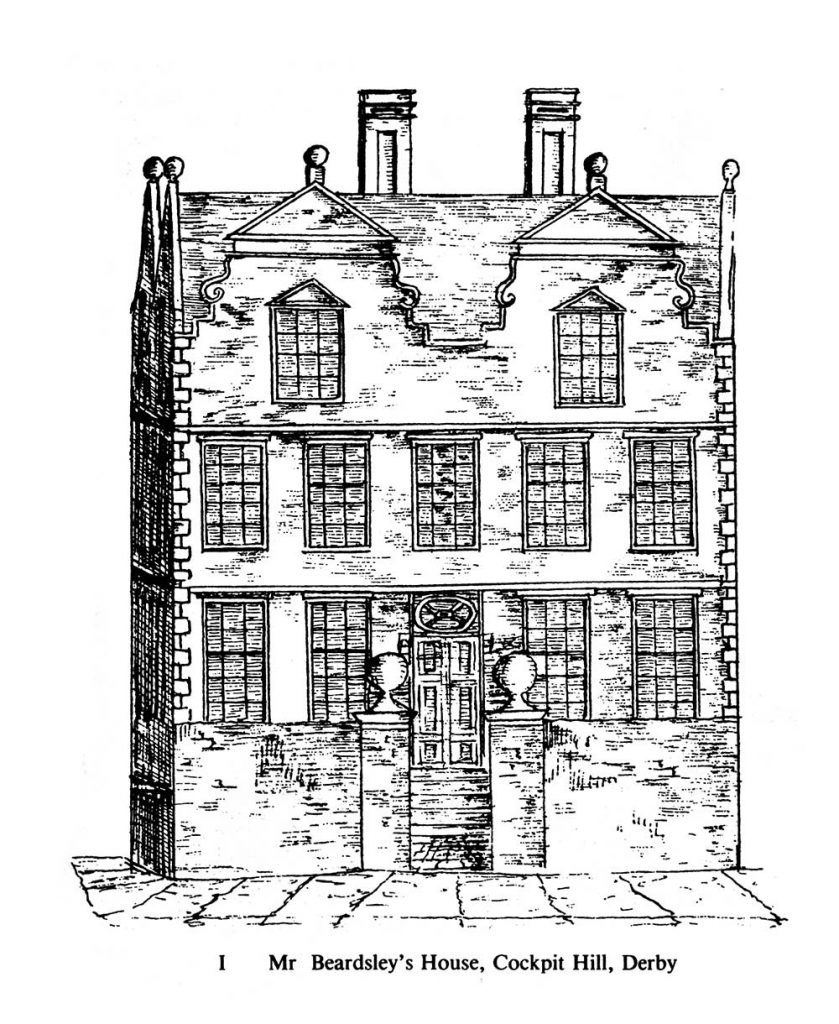
‘On the west side of the Mill Stream is a good house, built by Mr. Beardsley – on the side of a hill on which was formerly a castle still called Castle Hill, but by others Cockpit Hill.’ Written in 1713, William Woolley, Derbyshire’s first historian, of Cockpit Hill House. This enigmatic building suffers from having been demolished before the era of photography, so our only record of it is a sketch made by Woolley himself (not a particularly accurate recorder in this medium), and views included incidentally amongst the plethora of East Prospects of Derby painted or drawn of the Borough between 1695 and 1735. The house also appears in Glover’s History and Gazetteer of Derbyshire as a woodcut by Orlando Jewitt, an excellent artist, but as the house had by the date of first publication been demolished almost a decade, one wonders why it was included at all. Worse, Jewett was unable to draw it from life, so merely made a more workmanlike copy of Woolley’s drawing, thus adding absolutely nothing to our knowledge of its appearance. For all the difficulty of trying to understand what it looked like, there is much we can say of it. It was, for instance, a classic example of the Dutch style of architecture imported into this country after the Restoration and which underwent a revival with the accession of Dutch King William III in 1688, thanks to the desire of the Whig élite to trip over themselves to ingratiate themselves with the new regime: tall, compact and classical. The house was tall and narrow, like an Elizabethan tower house – Wothorpe, just outside Stamford springs to mind, Lincolnshire, as does Tupton Hall, described here a couple of years ago. It was brick built with stone dressings, of three storeys, five close-set bays of windows being grouped together on each of its four sides in stone surrounds with brief entablatures above each and quoins at the angles. We know from two of the East Prospects that the windows were of the mullion and transom cross type, with iron casements (as survive at the Green Man St. Peter’s street), but Woolley wrongly shows it sashed with three over five pane glazing bars. As Woolley’s sketch was probably done in 1712 and the two East Prospects are c. 1730, we have to conclude that Woolley may have made a quick sketch on site and then worked it up at home, giving the house its rather more modern windows in the process. There was a horizontal band between the floors and the second storey was treated by the architect as an attic (despite being full-height) to allow for a parapet from which rose on each side a pair of Dutch gables and the windows here given pediments. Most people call any shaped gable ‘Dutch’ but strictly speaking, they have to be topped with a pediment, as at Cockpit Hill House, where the gables were so treated and supported on curved volutes and topped with ball finials: very correct. Even more true to the Dutch idiom (although not at all apparent in Woolley’s drawing) was a flat top to the roof with a timber balustrade between the panelled chimneys surrounding a tall central lantern or cupola enabling guests to emerge and safely take the air after supper on the roof. Similar ones in Derby surmounted the roof of 3, Market Place (Franceys’s House, where Kieran Mullin is) and Flamsteed’s House in Queen Street. The best surviving example in the Midlands, although on a much grander scale, is the roof of Belton Hall (Lincolnshire); another, part of a house of very similar form to Cockpit Hill, is Lord Craven’s lodge at Ashdown, Berks., intended for Elizabeth, Winter Queen of Bohemia. Woolley’s drawing (and hence Jewitt’s) also endows the side elevation with straight gables, more probably because Woolley had not the draughtsmanship to express them), but we know from the East Prospects (and a South prospect, too) that the gables were Dutch ones all round. The classic views show the entrance gates in Morledge, with ball finials to the gatepiers and a fine oval toplight above the front door, lighting the hall. We have no surviving account of the interior, but taking our cue from similar houses, like Ashdown Park, we may be sure that it boasted fielded oak panelling, at least in the dining room, quite possibly frescoed ceilings, as at Franceys’s House – and therefore likely to have been the work of Derby’s own fresco painter Francis Bassano (1675-1746). We might also suppose an oak staircase with bulgy balusters set upon a string, and a general ambience of understated luxury. The grounds boasted parterres and a small pavilion at the river bank: idyllic in 1692 when the house was built, but progressively less so in the decades that followed. The builder was William Beardsley, a lead merchant with connections in Wirksworth, who married Rebecca Richardson and bought the site of the house, previously part of the grounds of the house near The Spot, latterly called Babington House, from William Sacheverell of Morley (whose town residence it was) for £180. We do not know who the architect was, but it could have been a London man, for Beardsley had trading connections on the capital. However, Beardsley had died without issue by 1715, when it was in the hands of the Sitwells of Renishaw, no doubt intended by them as a town residence, but by 1722 they had sold to Coventry-born Thomas Bayly (1695-1734), who was Whig MP for Derby from that year until 1727, having stepped in for William Stanhope of Elvaston who was temporarily absent abroad. His period in residence had seen the Derwent canalised by engineer George Sorocold to enable loaded boats to reach the Trent, which made access to the house’s garden across the river more difficult. On 25th October 1734 the Derby paper reported: ‘Yesterday morning dyed at his house on Cockpit Hill in this town Thomas Bailey [sic] Esquire who some years