Lost Houses of Derbyshire The Hough, Hulland

by Maxwell Craven The standing remains of the moated secondary seat of the de Bradbourne family no longer exist for me to share with you, but, like Brizlincote Old Hall, the site is marked by a well-preserved moat, and moated sites are relatively rare in Derbyshire, although many more are recorded in the sources than survive. The site lies east of Brunswood Lane and south of the A517 at Hulland; the well-preserved moat measures 150 by 125 feet (45.7 x 38 m) and includes traces of the abutments of a bridge, although much less well preserved and far less discernable than that at Bearwardcote (see Country Images for August 2014). The name Hough has two old English derivations: either from hoh = ‘spur of a hill’ or from haga = ‘enclosure’. As The Hough is not in the spur of a hill, but in the valley by the immature Brailsford Brook, the latter derivation is probably the correct one, especially as the entire area north of the Ashbourne Road is full of ancient hunting parks. Hulland was owned by the aristocratic Danish settler Toki in 1066, along with much else in the area, but it was granted, as a manor which included Ednaston, before 1086 to Geoffrey Alselin. It descended in his family with Ockbrook, to the Bardolphs (as in Stoke Bardolph in Nottinghamshire) who seem to have had a seat there but who sold The Hough estate before 1250 to Sir Robert de Ashbourn of Ashbourne. He founded a chantry in a domestic chapel previously added to the building (which at that date would undoubtedly have been of timber). His heirs eventually sold the estate to Sir Roger de Bradbourne of Bradbourne, some time before 1296 This family descended from Gerard de Bradbourne, a follower of the de Ferrers Earls of Derby, who had been granted the tenancy of Bradbourne before about 1150 and his descendant, the Sir Roger who acquired the estate, soon afterwards built a house here. His first effort was fashionably moated and may well have been of timber, as was the norm in those days, but at some unknown date – probably around 1451, it was replaced by one of brick and stone, the builder being John Bradbourne, the first of the family to be specifically referred to as ‘of The Hough’. Previously, the junior branch of the family had been settled there, descendants of Sir Roger’s third son, another Roger, whose line ended with an eldest son, Henry. He came to a sticky end, having been executed at Pontefract in March 1322 for joining the rebellion of Thomas, Earl of Lancaster (who was also Earl of Derby), ignominiously defeated at the Battle of Boroughbridge. This was part of the long-running civil war waged between Edward II and various, really quite disparate elements, opposed to the King’s choice infelicitous of advisers. In this case it was the appointment, following the defeat at Bannockburn, of the Despenser family, which enraged the powerful Mortimer clan and, in due course, put out of joint the nose of Earl Thomas, too, for he had been in control of policy since the clear-out of advisers following the defeat by the Scots in 1314. John Borrowe’s late 17th century Hulland Old Hall, north front with the earlier (or re-constructed) portion to the left In the event, the much under-rated Edward II pursued a policy of dividing his opponents; he first disposed (temporarily as it turned out) of the Mortimers in a crushing defeat early in 1322, before turning his attention to Thomas of Lancaster. Unfortunately for the heir of the Bradbournes, Henry ended up on the wrong side! The Bradbourne dynasty, despite this setback, went on from strength to strength. Having rebuilt the house in stone, in 1463, John Bradbourne founded another chantry in the domestic chapel attached to the manor house (in manerio meo de Holendo – ‘in my manor of Hulland’), dedicated to Our Lady, which managed to survive the Reformation, when it became a chapel-of-ease of the parish of Ashbourne but, by the early 18th century it was ‘little used’ and indeed was completely gone by 1750 or thereabouts. The estate, with Lea Hall (see last month’s Country Images) and other nearby property, was inherited by William Bradbourne, on the death of his father Sir Humphrey in 1581. In 1594, however, beset by debts and childless, William sold it all to his brother-in-law, Humphrey Ferrers, who lived on the Bradbournes’ wider estate on a property at Boylestone, inherited from the Waldeschef family, whilst his father was alive and himself occupying the family seat at Tamworth Castle. This is despite William having a brother, Anthony, who was a prosperous London merchant with three sons; what happened to them and whether they had any descendants is not clear. Indeed, despite several other junior branches of the family, the Bradbourne name seems to die out at this juncture altogether. Humphrey Ferrers later inherited Tamworth Castle from his father and was knighted, but his son John (died 1633) lived at Lea Hall and consequently from this time the old house at The Hough appears to have been left empty; indeed it could well be that the Civil War accounted for its eventual destruction. Certainly, the Ferrers family were left in much reduced circumstances after the Restoration – the price of loyalty to the Crown – and in 1690 they sold the estate to the up-and-coming John Borowe of Castlefields, Derby a Nottingham-born former soap boiler. Both William Woolley and Dr. Pegge make clear that by then (the end of the 17th century) the house at The Hough had become a quarry for the convenience of any scavenging old villager wanting to effect an inexpensive home makeover, although Woolley adds that Hulland Old Hall, nearby, was ‘built out of the ruines’ of the Bradbournes’ old house by John Borowe. Examination of the earliest portion of the Old Hall house, which John Borowe had built in the village rather than out at
The Lost Houses of Derbyshire – Lea Hall, Tissington

by Maxwell Craven Lea Hall is a sequestered little paradise, half lost between the villages of Tissington and Bradbourne which, as readers will probably know, lie in the White Peak, almost east-west of each other, although the road between the two villages, south of which Lea Hall lies, is something of an adventure, taking one high over the intervening moor and down through the Bradbourne Brook via a ford, before gaining the main road from Ashbourne. Today all there is to see is an agreeable 17th century farmhouse (in which you can stay, should you feel motivated – see their website) with a late Regency hipped roof, all enlivened by original chamfered mullioned windows of millstone grit, contrasting well with the light grey carboniferous White Peak limestone from which the house was built. Nearby, however – surrounded by much newer such structures – is a large two storey barn of random rubble limestone with a tall gabled roof and with angles sporting almost cyclopean quoins, the walls penetrated here and there by inserted windows, interspersed with traces of others, long since blinded. Both gable ends have kneelers and coping, rising to stone finials, all very reminiscent of Dethick Manor Farm, which is a similar survival of a similar period, but less heavily disguised by centuries of agricultural use. Historic England’s list (on which it is listed grade II) claims that the barn at Lea Hall is 18th century, but even on a cursory examination (which I made about 40 years ago, I must admit) that is clearly quite wrong. However, it would take a detailed examination to be precise about its origin. Both, incidentally, are grade II listed. Lea Hall (which took its name from the hall which, from its name, must have been built prior to the scatter of other houses which make up the hamlet) was once an outlier of the Domesday manorial estate of Bradbourne and was long an extra parochial township, until tidy-minded bureaucrats in 1887 decided to transfer it to the parish of Tissington, on the eastern border of which parish it then lay. We know that from Domesday Book until 1268, Bradbourne was one of the 100 or so Derbyshire manors held by Henry de Ferrers and his heirs, the de Ferrers Earls of Derby, but the book fails to name Ferrers’ under-tenant. However, by about 1180, we become aware of Robert de Bradbourne and his brother Godard, both sons of Gerard de Bradbourne, who must have been in his prime about 1150 and, bearing in mind that Gerard took his surname from the place of which he was the Earl of Derby’s sub-tenant, the likelihood is that he was a direct descendant or heir of the Domesday holder of the manor. Lea Hall, The present farmhouse Godard de Bradbourne’s grandson, Sir Roger, before 1296, managed to purchase Hough Park, in Hulland (which we have yet to look at) and married Philippa, daughter of Thomas Ferrers of Loxley, Staffordshire, a member of the family of the recently disgraced Earls of Derby. He also had a house in Ashbourne and was father to six sons and three daughters, the eldest of whom married Henry de Meynell of Langley. Of the sons, the eldest, Henry, was executed at Pontefract in 1322 for having rather rashly backed Edward II’s cousin, Thomas, Earl of Lancaster’s rebellion, and having thus been on the losing side at the Battle of Boroughbridge. Mind you, it was fairly natural that Henry should have supported Thomas, for Thomas’s father had been granted all the de Ferrers family’s expropriated land by Edward I, his brother. This made Thomas of Lancaster Henry de Bradbourne’s feudal lord at Bradbourne: the latter was thus hardly in a position to refuse to support him in his bid for the throne against the unfortunate and unpopular Edward II. Neither of his two sons lived long enough to be disinherited as a result of their father’s treasonable activities, both having died relatively young. Sir Henry FitzHerbert, 3rd Bt., as painted by Ashbourne born William Corden (1797-1867) [Private Collection] Prior to this, the second brother of the unfortunate Henry was living at Lea Hall and was still there in 1331 when the attainder on Henry de Bradbourne was revoked and Bradbourne itself was returned to the family. Yet only the youngest of his three sons survived his father, and is recorded as having been as of Brassington at his death around 1383. It was the rebel’s third brother’s posterity who ended up with Bradbourne (having previously lived at Parwich), Roger Bradbourne being MP for Derbyshire 1397 to 1405, but Lea Hall only re-surfaces on the record in 1439. It was then home to one of this Henry’s younger sons, passing back in 1519 to his descendant Humphrey Bradbourne. It is not at all clear to what use Lea Hall was put during these years, as the family lived at Bradbourne Hall (which is still there), but one suspects that The Hough and Lea were granted to one or other of the plethora of younger sons produced by each generation of this family. However, in 1594, William Bradbourne sold all his estates to Sir Humphrey Ferrers of Tamworth Castle and, despite having married two wives, seems to have dropped from record. However, one can see the logic, as William’s youngest sister, Anne, was Sir Humphrey’s wife. The Ferrers family, apart from Tamworth Castle, also held the (old) Hall at Walton-on-Trent and cannot have had any use for Lea Hall, and if the ancient hall there had not decayed completely by the date of the sale, it must have done so soon thereafter. It was probably his descendant John Ferrers (or more probably his father) who built the present L-plan farm house, which would originally have been gabled. This John Ferrers also eventually sold Lea Hall and its modest estate (essentially two upland farms) to Samuel Swann of Hurdlow in 1679. The property was with the Swann family for three generations,
The Lost Houses of Derbyshire – Blackwall Hall

When one speaks of houses that are lost, one speaks of houses built, lived in and eventually discarded as redundant, too expensive, too damaged or too inconvenient to continue living in. With regard to the potentially spectacular house that Bess of Hardwick no less, built or intended to build at Blackwall-in-Peak, none of the above need apply, for it is by no means certain that Bess actually completed her new house there or, indeed, even began it. Blackwall-in-Peak is more generally spelt Blackwell these days, which is a reversion to the Blachewelle of Domesday Book (thus, ’dark well’), although by the early 14th century it was invariably spelt Blackwall, which usage continued until relatively recently. Blackwall was one of those manors in Derbyshire held in chief by William Peveril, and his tenants there seem to have taken their name from the place sometime in the late 12th century or a little later. By that time, however, Peveril had granted his estate there to Lenton Priory. Mind you, Lenton is a good way from Blackwall, which lies just north of the A6 west of Taddington, which meant that the prior and canons of Lenton were obliged to appoint a man on the spot to collect the rents and tithes in the township, and the evidence is that this was done by the leading free tenants, the Backwalls. Indeed, by the early Tudor period, Richard Blackwall of Blackwall had been appointed to the office of collector of rents and tithes on behalf of the Priory at an emolument of 40/- (£2) ‘and a gown’. Once dissolved, however, the manorial estate was in the hands of the Crown until 1552 when it was granted to Sir William Cavendish, then freshly arrived in Derbyshire as the second husband of Bess of Hardwick. Within a few years, the rent collecting proclivities of the Backwalls having been made redundant, the family migrated south to Kirk Ireton, where they built a new, still extant, manor house and from whom it took its name. Bess, meanwhile, two further hubands down the line, had turned herself in to something of a mega-builder, inspired in all probability by Sir William’s efforts in rebuilding Chatsworth, especially his use of the high house style, whereby the grandest reception rooms were placed in the uppermost storey (as in the east facing long gallery at Chatsworth) so that Derbyshire’s incomparable views might be best appreciated, inspired by Prior Overton’s tower at Repton and the high tower at Wingfield Manor. After her estrangement from her fourth husband, Lord Shrewsbury, Bess began to rebuild her ancestral home at Hardwick along similar lines, but without the benefit of much architectural discipline. Once widowed, she brought in Lord Shrewsbury’s architect, Robert Smythson, to build anew all over again a few hundred yard to the NE, to produce the spectacular Elizabethan ‘prodigy house’ of Hardwick Hall with its upper storey long gallery and state rooms, a flat roof peppered with banqueting houses in the towers on which to enjoy summer evenings, classical detailing, and an innovative through hall. Indeed halls, prior to this point, were invariably set longitudinally along the main façade of a great house with the main entrance at one end and a screen at the other through which access could be made to the services. At Hardwick, however, one goes up into a hall that runs away from you through a screen across with the width of the building. Nor did she stop there, for almost simultaneously, Bess began building another house of similar size at Oldcotes, Heath, for her son William Cavendish, which was very much in the Hardwick mould and which appeared in Country Images for November 2015. However, she wanted more. Between 1590 and 1600 (on the estimation of the late Mark Girouard) she commissioned Robert Smythson to design another house, plans for which remain in the Smythson collection of the RIBA now housed in the British Library. The plan for the principal floor (to be built, like Hardwick over a raised basement of lower ground floor) is headed, in Smythson’s witing, ‘A House for/Blackewall in the/Peacke.’ You might ask, why would Bess want another country house only 15 miles from Hardwick, and in an elevated (and frankly, very exposed) position, despite the views? The answer lies in the plan. Like Hardwick, it was rectangular in plan. With the hall running right through the principal storey. There were square towers inset from the corners of the building, but on the entrance side they were joined by the main wall, pushed forward flush with their outer sides, and not recessed as on the opposite side, a very similar effect as Hardwick, but much, much more compact. There were only two main rooms on either side of the hall, a parlour (with main stair alongside) and a great chamber. The hall was full-height, meaning that there was also space only for a pair of rooms on either side above, linked by a gallery over the hall screen (although no plan for the first floor survives, only one for the semi-basement). This lack of accommodation tells us clearly that this was not a permanent residence, but a lodge, for occasional use. In Elizabethan times there were two main types of grander lodge: either a retreat to which the family could repair once a year whilst the main house was cleaned from top to bottom, or as an occasional residence for either watching or indulging in the chase. A classic example of the former (of similar size and date) is Lord Burghley’s Wothorpe Lodge near Stamford, barely more than a mile from the main house and now a ruin. Yet the compact plan and notable tallness are very similar. As regards hunting lodges, a closely related building, although with a very much more compact in plan, is the hunting stand designed for Chatsworth by Smythson in about 1585; Wardour old castle a rebuilt Medeival keep, attributed by Girouard to Smythson c. 1570, is closer in scale,
Lost Houses of Derbyshire – Brizlincote Old Hall
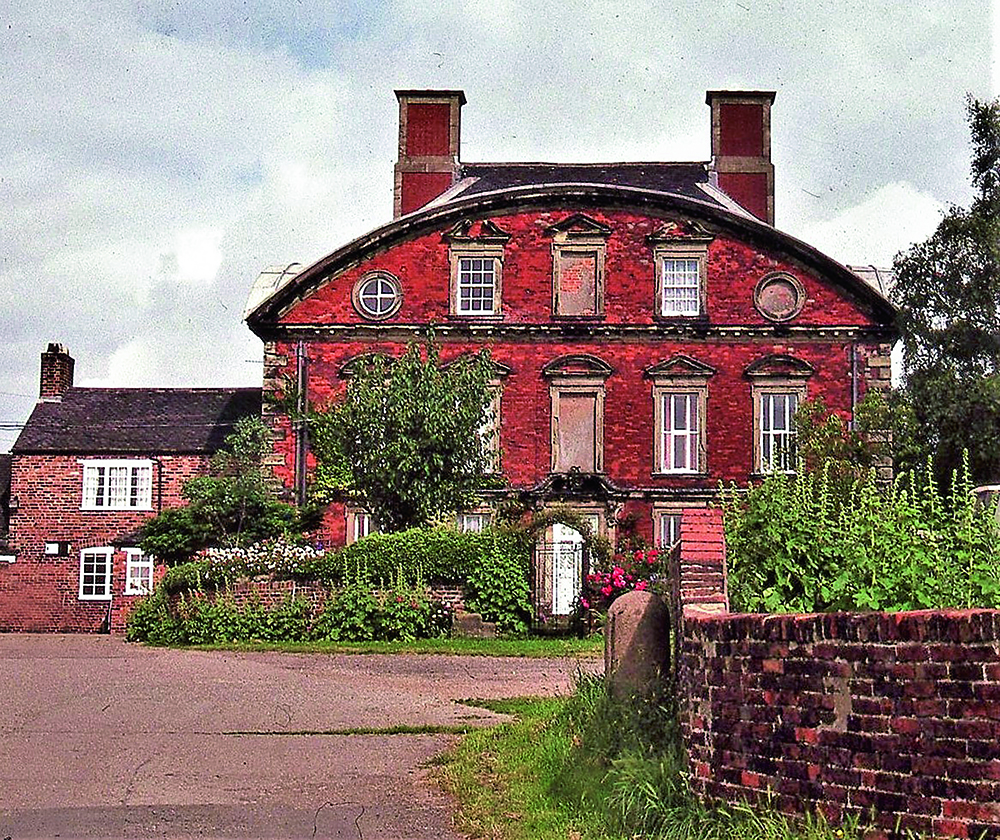
The present hall at Brizlincote is visible for miles around, set on its dominant hill and looking for all the world like an inverted helmet-type coal-scuttle with its legs in the air, represented, of course, by the chimneys and the giant segmental pediments which ensign the facades on all four sides. I have argued in the past that this extraordinary Baroque house was designed by Nottinghamshire’s famous ‘wrestling baronet’, Sir Thomas Parkyns of Bunny, for Lord Stanhope, eldest son of 2nd Earl of Chesterfield, and in the 22 years following, nobody has yet proved me wrong! Here, however, we have to consider the history of its long-vanished predecessor and although the parish (created from Winshill in 2003) is deemed to be in Staffordshire (since 1888) the hall still lies in Derbyshire. Originally, Brizlincote was part of the holdings of the great abbey of Burton, given as part of the foundation charter by the Saxon grandee Wulfric Spot in 1004. By the early twelfth century, the estate there was tenanted under the Abbot by one Mabon de Brizlincote, whose grandson Richard acquired the estate by grant of the Abbey c. 1175. The heiress of the Brizlincotes brought it to the Leicestershire family of Cuilly and the heiress of that family, Elizabeth, married John Stanhope of Rampton, newly arrived in Nottinghamshire from his native Northumberland in 1349. The de Brizlincote family probably built the first seat there, within a moat, substantial remains of which remain, slightly to the north of the present house, off Brizlincote Lane. These earthworks, which have never been investigated archaeologically, are said locally to hide vestiges of the house, too. The Stanhopes did not then have an interest in Derbyshire and thus they disposed of the estate to Robert Horton of Catton who died in 1423. Over a century later, his descendant Walter Horton sold it yet again to William, 1st Lord Paget of Beaudesert KG, an enormously rich courtier of Henry VIII, who had managed to engross almost all of Burton Abbey’s holdings at the Dissolution of the Monasteries in 1539. Paget clearly felt he needed a house near the epicentre of his extensive new holdings, Cannock Chase (in which Beaudesert lay) being some distance away, so having acquired the estate from Walter Horton, in January 1546 he obtained a licence from the king to ‘empark and crenellate’ the house. Thus, the land now lying between Ashby Road, the Beaufort Road/Violet Way estate, the A444 and the north west edge of Newhall (the clue is in the name: Park Road, Newhall) became Lord Paget’s parkland (something like 40 acres, if the size of the later farm is any guide) and his house, no doubt erected around a substantial courtyard, was suitably defensive in appearance, with plenty of – essentially ornamental – battlements, probably in the form of merlons. Although we have no illustration of the house (as we found with Bretby Castle: see March edition of Country Images) a 17th century writer said of it that it was ‘a large stone house that was set in its moat on a bleak ridge’ – probably cold and windy in winter but with incomparable views towards Needwood Forest and the Trent Valley! Lord Paget appears also to have walled the house round in stone, too, for we have 18th and earlier 19th century accounts of surviving stone walls but none remain today.. William Paget retired from state business in 1555, having survived his perhaps injudicious signing of Edward VI’s will – leaving the throne to the ill-starred Queen Jane – and the consequent obloquy heaped upon him by Queen Mary, to be re-instated by Elizabeth I. He died in 1563, having sold Brizlincote to a London merchant, John Merry in 1560. John Merry, of a Hertfordshire family, was a merchant tailor whose father had been clerk to the spicery of Henry VIII; he was a Roman Catholic, too. By 1560, recusancy was becoming an un-safe position, and expensive in fines, as well. His reason for buying in Derbyshire may have been influenced by Sir Christopher Alleyne, who had acquired the nearby estate of Gresley Old Hall only four years before. The fact that Merry’s wife Agnes was an Allsopp may also have been an influencing factor. Despite its prominent position, however, the recently rebuilt and fortified house may have enabled him to feel safe from the depredations of such as Lord Shrewsbury, bent on weeding out recalcitrant Catholics. Not that Brizlincote was his only acquisition. He also bought the estate of Barton Blount from the financially challenged Lord Mountjoy, as well as substantial land at Stanton-by-Bridge and at Sutton-on-the-Hill. John Merry appears to have lived at Barton, where he created a priests’ hole. His son John appears to have been settled at Brizlincote by about 1565. Meanwhile, his elder brother Henry of Barton Blount had four sons, of whom the third, Edmund left issue, settled at Radbourne where in 1670 his son Valentine paid tax on but two hearths, so was presumably farming as a tenant of the Pole family. The second son, John, succeeded his uncle at Brizlincote, but was a stout Royalist in the Civil War; he and his wife Anne found their estate sequestrated by the Commonwealth authorities in 1650 and he died not long afterwards. This Royalist left two sons and a daughter, the elder son, Gilbert, managing to recover Brizlincote Hall by compounding for his estate with Cromwell’s commissioners, but he then demised it to his younger brother, John Merry who was described as ‘late of Brisslincoate Esq.’ when he came into his brother’s other lands at Kniveton and Stanton-by-Bridge. John Merry left two sons, Gilbert of Stanton-by-Bridge, and George, the younger son, who had married Dorothy who, after his death in 1657 continued to live there with her second husband, William Dakin ‘of Brisslincoate, yeoman’ who seems to have farmed there. They were gone by about 1685, for we find it had a new tenant in the person of Worcestershire-born William Barnes,
The Lost Houses of Derbyshire – Nevill Old Hall, Ashford in the Water

By Maxwell Craven The history of Ashford-in-the-Water is both in places obscure and also generally complex; there are unhelpful gaps in our knowledge, too. It is also one of the few places in Derbyshire once lived in by a reigning sovereign prince, Melbourne Castle excepted. In reality, we are looking at two successive manor houses here, and the unlikely manifestation of the very grand Norman house of Nevill in this corner of England certainly demands explanation. Domesday Book accords Ashford considerable importance as, like Hope, it came with lots of berewicks (outliers) attached to it (no less than twelve in all), making it a prosperous entity. Whilst the church then fails to appear on the record (not always a guarantee that a church did not exist, just that it had no value to the crown), there was a mill and a lead mine – presumably a fore-runner of the Magpie Mine – and the whole lot was part of the King’s extensive holdings in Derbyshire. The crown retained control of the manorial estate until 1199, when it was granted by King John to no less a person than Gwenwynwyn, ruling prince of Powis, in Wales. From here in, however, it all gets a trifle complicated, for Gwenwynwyn was not, however, Prince of all Powis (central Wales), but of Powis Wenwynwyn, for the principality had been divided between him and his cousin Madoc (ruling Powis Fadog) by 1187. This had all come about because of Bleddyn ap Cynfyn, the first of his dynasty to rule Powis, which had once been reckoned as a kingdom and whose rulers claimed (on the testimony of the 8th century Pillar of Eliseg at Llangollen) descent from Vortigern via a daughter of the emperor Magnus Maximus. Bleddyn had fought alongside King Harold against William the Conqueror, with the result that the victorious conqueror, in revenge, let his land-hungry knights loose upon the Powis borders, breaking it up. Fortunately, Bleddyn’s sons spent the next three decades fighting back and, by 1096 had recovered most of it. Inevitably, however, internecine strife amongst the ruling princes of Wales eventually drove Gwenwynwyn to exile England in 1199, hence the grant of the manor of Ashford to him by King John. Whilst it seems quite possible that Gwenwynwyn did actually live in Ashford before his death in 1216, his son, Gruffydd (who came of age in 1232), certainly did. One or other of them built a moated manor house just north of the church. The moat was still visible in the mid-19th century but was barely by the early 20th century and only a crop mark in dry weather today. Moated manor houses began to become fashionable in the 12th century, elite nobles preferring them to the Normans’ motte-and-bailey castles and hence I rather think that Gruffydd was the builder here. Needless to say, in the early 19th century the site was called Ashford Castle. Gruffydd was only about five when his father died, but he continued in exile at Ashford until 1240, by which time he had married Hawise, the daughter of a marcher lord, John le Strange of Knockyn (Welsh Cnwcyn) in Shropshire, by whom he had an eldest son, Owain. He was granted the right of free warren at Ashford by the king in 1250. Having returned to Powis, he ruled successfully until 1274 when he fell out with Llewellyn ap Gruffydd, King of Gwynedd and was obliged to return to exile once again, but this time only for a few years, for his son Owain led the forces of Powis with Edward I against Llewellyn ap Gruffydd, ending Welsh independence. The following year Owain surrendered the principality of Powis to Edward I in 1283, received it back as an English barony, becoming Owain de la Pole – ‘Pool’ being the English name of the princely capital (now Welshpool). Ashford was surrendered to the Crown as part of the deal, for Gwenwynwyn had finally left there in 1282 and died in his native land about four years later. Ashford’s manorial estate was retained by the Crown and was leased to William de Birchall. In 1319, however, it was settled by Edward II on his younger brother Edmund, Earl of Kent when he came of age. It passed from his son, John, 3rd Earl, to Joan ‘the Fair Maid of Kent’ whom married Hon. Sir Thomas Holand, created Earl of Kent in 1360, at which date and for some time before, Ashford manor had been occupied by Otho de Holand a close kinsman. Later it was tenanted by a branch of the Dales of Chelmorton under the Earls of Kent until the death of Henry Holand, 4th Earl of Kent in 1408. The heiress was his fourth sister, Elizabeth, married to John Lord Nevill, son and heir of the 1st Earl of Westmorland, and it descended from them to Henry Nevill, 5th Earl, who died in 1563. At some time before this, however, the old 12th century house in the moat must have been abandoned as decayed, and probably because there was no room to expand it, as the moated area was by no means large. The family built a new mansion in the village called Nevill Hall (later Old Hall). The house they built, where Fennell street meets Church Street, is known only from a couple of old photographs and from a drawing by George Marsden, all done in the early 20th century. Built of stone, it was of three storeys in height, the surviving range gabled end-on to the road, with two and four-light mullioned windows, and a two-storey service range parallel to the street. It is reasonable to suppose that originally the house boasted two such wings, parallel, enclosing a courtyard (which would have included the small green which now graces the front of the site) with a main range between them containing the great hall. The probable size of the house rather suggests that at times it was inhabited by one or other of
The Lost Houses of Derbyshire – Hearthcote House, Swadlincote

by Maxwell Craven Hearthcote House was a deceptively ancient and complex building by the time of its demolition in 1980. At first glance, it appeared to be an eighteenth century two storey L-plan brick farmhouse, lit by sash windows both conventional and side opening (the latter usually called York sashes), under cambered heads and with brick string courses in between – all reminiscent of the later Georgian Era. In fact, this external fabric was dated 1793. The entrance looked plain, too, but showed signs of having once had a stone surround, but at the NW end, there rose a mighty stone built external chimney breast which once rose in stages and which was latterly topped by a brick chimney stack, also in two stages. This feature betokens an early Tudor date or even the mid-to late-fifteenth century and was clearly once attached to a much more ambitious house. Inside, all was not as it seemed, for it was actually box framed in timber, in the style of the mid-17th century, with a particularly interesting oak staircase with balusters tenoned into two posts which ran up the whole height of the house, a feature only paralleled to my knowledge by the 1640s staircase at (not lost!) Sturston Hall, near Ashbourne, also a timber framed house of similar size, later cased in brick (and stucco in this case). I might add that this important staircase was safely removed from the house prior to demolition in 1979 and stored dismantled with the County Council’s important collection of agricultural machinery at the excellent Working Estate Museum, Elvaston Castle, from which, needless to say, it was subsequently lost when the museum was suddenly closed by the County Council and the collections – including much agricultural material given by the late Lord Vernon – auctioned off. No one has been able to discover its fate, despite efforts by the South Derbyshire District Council heritage officer, Philip Heath. At the time Domesday Book was compiled, Drakelow and Hedcote are combined as one manorial estate, listed at the head of the list of those held directly from the King by Nigel de Stafford, whose posterity settled here and took the name of another manor, Gresley, as their surname, but they lived at Drakelow until 1933. The name Hearthcote is directly analogous to ‘Heathcote’, meaning the house or domestic property on the heath, and indeed the area is well scattered with names ending in ‘-cote’: Swadlincote, Brizlincote and Chilcote being further examples. The spelling varied wildly, but remained mainly as ‘Heathcote’ until the Stuart period but, by the time Peter Burdett drew his map of the County in 1767, he had labelled it ‘Hearthcote’ although 19th century directory compilers must have become confused on hearing the name spoken in the local argot, rendering it both as ‘Earthcote’ in 1846 and as ‘Arthcote’ in 1895! It was reckoned part of Stapenhill by 1185 when the place was granted to Burton Abbey, and it may well have had a capital mansion on the site, as the grant included a long vanished chapel, almost certainly a domestic one. Later though, it seems to have reverted to the Gresleys, for Sir John de Gresley granted it to Gresley Priory in 1363. It was leased by the Prior to the Verdons, one of whom appears to have had a capital mansion here – presumably on the site of Hearthcote House. By 1296, Hearthcote was held from Theobald de Verdon, with Newhall and Stanton (by Newhall), by Robert de la Warde of Upton, Leicestershire. Three years later he was summoned to Parliament as 1st Lord Warde of Alba Aula, which quaint Latin designation probably equated to the appearance of his newly built seat at Newhall and indeed, there was a Whitehouse Farm there until a century ago, having survived Lord Warde’s new seat by several centuries. Also, from that time and for many centuries, Hearthcote, Stanton and Newhall all had the name ‘Ward’ suffixed. The descent of the estate went from his son to Sir Hugo de Meynell and the evidence seems to be that he lived at New Hall and members of his family occupied the secondary houses at Stanton and Hearthcote, but after his male line failed, it passed to the Dethicks and thence through several successive heiress. When Gresley Priory was dissolved in 1536, the estate at Hearthcote was valued by the commissioners at £13 – 6s – 8d (£13.33) the same as Church Gresley, which they also held, suggesting both were then pretty small. The Commissioners sold Hearthcote to the Alleynes of The Mote in Kent, who built Gresley Old Hall, and the house became attached to their estate there, although Hearthcote itself seems to have become an extra parochial liberty of Church Gresley – that is, separate from the main parish and free from shrieval control. The Alleynes pulled down the old medieval Hearthcote House (probably built around a courtyard) and replaced it with a timber framed farmhouse attached to a stone chimney breast retained from the old house, being strongly built of ashlared stone – waste not, want not! This probably happened after 1597 when Hearthcote was still described in a document as ‘an old howse’. In 1730 John Alleyne sold the estate, including Hearthcote, to the somewhat egregious Littleton Poyntz Meynell of Bradley, who intended to use it as a shooting box, but his son decided to move to Leicestershire the better to hunt and, in 1775, the Meynells sold it all to the Gresleys, so Hearthcote thereby came full circle. It was without doubt the Drakelow estate that re-cased the old house in brick, and seems to have continued with the three-life tenancy of the Newbold family. However, change was again on the cards for, in 1828, Sir Roger Gresley, Bt. sold Gresley Old Hall and Hearthcote separately, the latter becoming the property (probably due to the lure of good quality coal being available on the estate) of Stanley Pipe-Wolferstan DL JP (1785-1867),
Lost Houses of Derbyshire – Stapenhill Hall
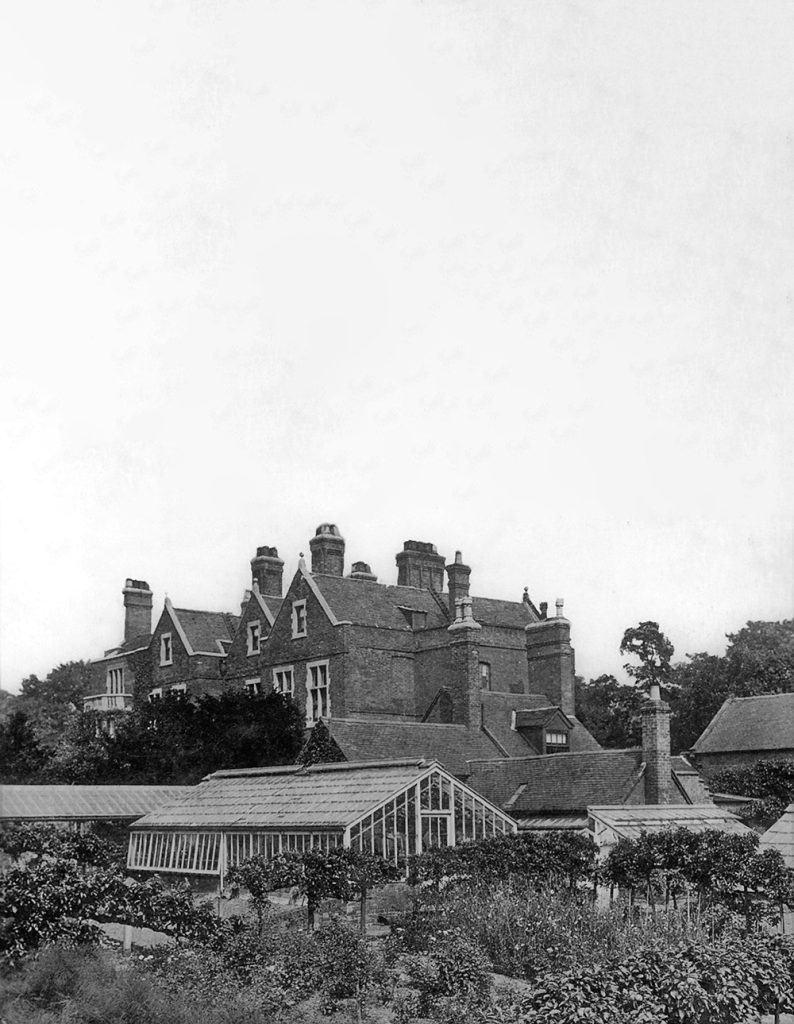
By Maxwell Craven Derbyshire lost more parishes to Staffordshire than it gained under the local government reforms of 1887 and thereafter: Clifton Campville, Croxall, Edingale, Winshill and Stapenhill among them. The desire of the Borough Burton-upon-Trent to increase rating revenue, for instance, added to a sort of municipal tidy mindedness, resulting in the transfer in 1894 of Stapenhill and Winshill to that Borough as well. There was some logic in this, as Stapenhill and Burton face each other across the Trent, the former on a bluff and the latter upon water-meadows prone, since the fourteenth century climate anomaly and the ‘little ice age’ which followed, to flooding. Even by 1894, the great and good of the Borough tended to build opulent villas there (mainly brewers or their well remunerated legal advisors), giving them splendid views west and south west over the river and town. Here, the brewers could keep an eye on their works from the comfort of their smoking room banquettes. Until 1538, Burton was dominated by its Abbey, founded by the Saxon grandee Wulfric Spot in 1004. Their land holdings grew to include part of Stapenhill, enhanced in 1192 by bequest on the death of its long-standing lord, Bertram de Verdon. According to the Staffordshire Victoria County History, there was a capital messuage at Stapenhill by the time the abbey was dissolved which, in 1546, was acquired with the rest of the abbey’s property, by William, 1st Lord Paget of Beaudesert, whose family were to dominate the history of Burton for the next four centuries, rising in eminence to become Marquesses of Anglesey. The Abbey’s leading tenants of the estate were the Abell family, originally recorded at Ticknall in the early 14th century, and who continued in occupation under the Pagets. John Abell was tenant at the dissolution, and his family must have built the first hall. His descendant, George Abell had his coat-of-arms confirmed in 1611, but his son Robert decided for reasons of religion (he was a Puritan) to migrate to America and settled in Massachusetts, where his family continued to flourish. The house as recorded on an early map and later in 1731 by Samuel and Nathaniel Buck, was a relatively simple L-plan brick house of two storeys and attics with an extension added to its rear. The only clue we have to the successors of the Abells as tenants is that Edward Hunt was taxed on nine hearths there in 1670, indicating that the house was of a pretty reasonable size. Nothing much can be discovered about Hunt, who was probably the person who married Dorothy Parker at Lichfield in 1659. It may be that he was steward to 6th Lord Paget, an eminent diplomat and consequently rarely in Staffordshire. However, thanks to Derbyshire historian William Woolley, we know that the house was renewed or replaced in the late 17th century by Hunt’s successor Charles Blount, who, he stated in 1713, ‘… had an estate here and not long since built a pretty good house on the banks of the Trent., which runs under it, who sold it to Paul Ballidon, Esq.’ Charles Blount was the younger son of Sir Henry Blount of Tittenhanger, descended from the Blounts of Blount’s Hall, a long-vanished house in Burton itself. The family, which also had Stenson House for a while, were a junior branch of the Medieval Blounts, Lords Mountjoy, of Barton Blount. The transaction implies, also, that the property had become detached from Lord Paget’s estate by that time, too. Ballidon married Sarah, daughter of Sir Thomas Gresley of Drakelow, Bt., at Stapenhill in 1715, suggesting he was already in residence by that date, but he died in 1729 without leaving any surviving issue, being followed by his widow in 1736, both being interred at Derby, where Paul’s grandfather (another Paul) had been a merchant and his great-grandfather, a mercer, had been Bailiff in 1574. The family took their name from Ballidon, in the White Peak, where one Peter de Ballidon was recorded as early as 1201. It has proved impossible to identify exactly what happened then. There was a cousin, Robert in London and others at Trusley, so one or other branch of the family probably inherited the estate, and perhaps sold it, but to whom is a mystery, although Paul’s will would no doubt make matters a little clearer. Stapenhill Hall next appears on record in 1833 when John Levett (of the family then living at Wychnor Hall) was the owner and also in residence, as a notice in the Derby Mercury assures those interested in the house and 15 acres of gardens, that he would be available to show them round. Clearly the Levetts had acquired the estate and John lived there while his father, Theophilus, was alive, moving to Wychnor once his Stapenhill residence was let. The new tenant was Thomas Allsopp of the brewing family, who later moved to The Mount at Newton Solney. Yet, ten years previously, the Levett family had sold the estate (but retained the house and gardens) to banker and brewer Joseph Clay in 1823. The Clays were directors of Bass, who had been building up a portfolio of property in Stapenhill from 1817 when Joseph had acquired the Stapenhill holdings of Thomas Lea, bankrupt, against a mortgage of £1,280 and, also through marriage with Sarah, only daughter of John Spender of Stapenhill. His eldest son Henry, soon afterwards bought the house as well into which he moved, although he much later settled grandly at now derelict Piercefield Park, on the edge of Chepstow racecourse. He thereupon rebuilt the house, subsequently re-named and described as ‘Stapenhill House…a handsome mansion’. The rebuilding, completed by 1857, was fairly drastic, providing the south (garden) front with three stone coped gables and fairly deep mullion and transom cross windows also in stone. To the west there was an extension of another wide bay, carried towards the rear by a further four bays, the central pair, like the central bay of
Lost Houses of Derbyshire – The New Inn Derby
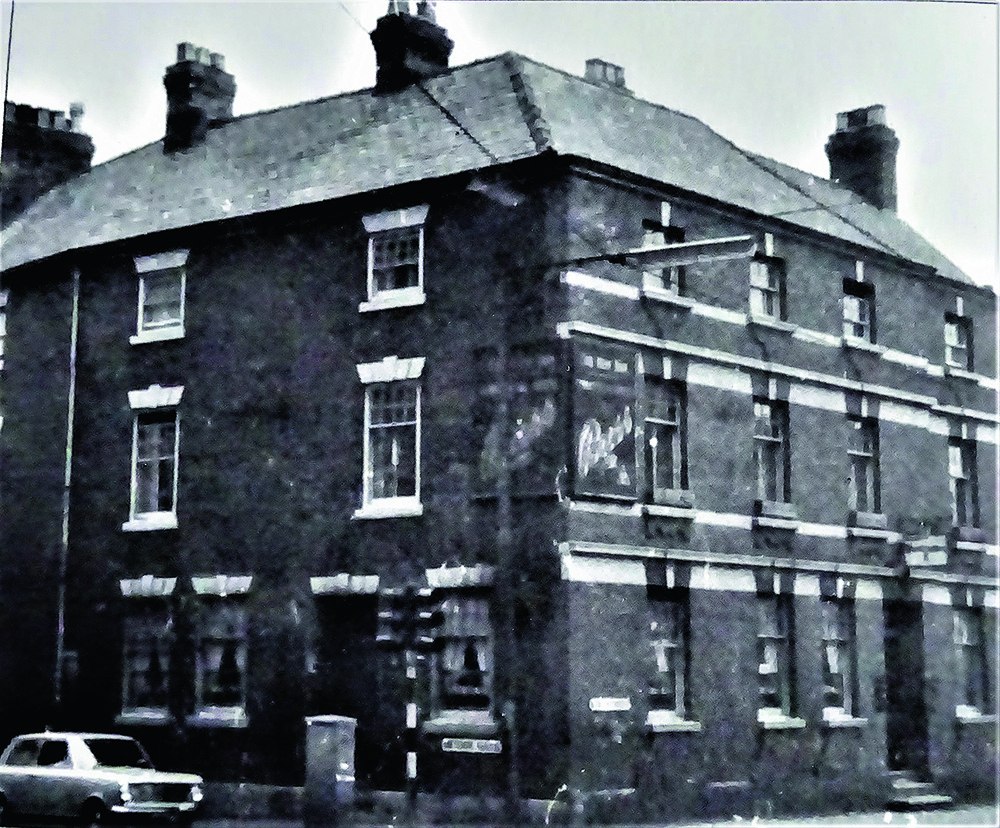
by Maxwell Craven I decided to take a break from country houses this month and mention a licensed house – not that I have run out of the former, but I felt a building as substantial as this merited inclusion, especially as it had a notable place in the history of local coaching and for its connections with the great and good of Derby. As one travels about and, from time to time, calls at inns for refreshment, one is often amazed by the number which style themselves coaching inns without the slightest justification. The coaching inn was, after all, effectively home from home for the well-heeled traveller, aiming to provide the sort of accommodation as a modest country house for the convenience of the inside passengers, extensive stabling for teams of horses, and accommodation for the crews as well. Frequently, the stops en route, rather than overnight ones, were done with enormous speed, such was the competition and tight scheduling on the turnpike roads of the 18th and 19th centuries. Hence, they tended to be spaced at approximately a half-day’s drive between each other on major routes and were mainly in towns and always in the turnpike roads rather than down narrow lanes. One of the last of the celebrated coaching inns in Derby to be built, between 1761 and 1766, was the appropriately named New Inn at the corner of Bridge Gate and King Street and opposite St. Helen’s House. Like the latter, it was probably designed by Joseph Pickford of Derby (1734-1782), although stylistic confirmation is not possible due to a thorough rebuilding some-time after 1873, when a part of it had been lost to street widening and a new façade was put onto the original two and a half storey brick building – and rather awkwardly, to boot, as its cornice stood forward of the roof eaves by a foot. The new King Street front, however, was handsome enough, the window openings almost certainly corresponding to those originally existing, although the sashes were of the upper leaf with glazing bars over plate glass type. Below, the sills were shaped aprons of rubbed brick which, with the playful interplay of string courses, banding and keyblocks, evoked the style of the young Alexander MacPherson (who was a Nottingham man with a busy Derby office) as having been the architect for the alterations. The side elevation was also re-fenestrated at the same time, but within the old openings with their rusticated lintels retained. The inn was built for George Wallis, a relative of Joseph Wright and of the Gells of Hopton; indeed, Sir William Gell is known to have stayed there when in Derby in 1793, on the occasion on which he painted old St Helen’s House from an upper window, giving us a vital record of its appearance seven years prior to its demise. The Wallises were probably the single most important inn-holding family in Derby’s history, and the New Inn remained in their family through three generations and four proprietorships. George Wallis (1694-1780) was the son of a John Wallis, both blacksmiths in King Street, the site of their works – almost opposite the site of the inn – being so occupied until the later 1960s. George’s son, George Wallis I (1731-1786) was a born entrepreneur, and probably had access to the funds he needed through his marriage in 1753 to Rebecca, daughter of John Clarke, a Nottingham Road maltster, whose family ran the Derby Brewery right through the 19th century. George had, though, been apprenticed to his father, becoming a freeman of the Borough in 1754, and initiated a series of stage coach and mail services from his newly founded inn from the start, buying up others’ routes and consolidating his hold both regionally and nationally in a remarkably short period of time. Notable amongst these coaches was the Derby Diligence (‘Dilly’), a service which, amongst others, he later franchised out (to the Bell in this case) simply because the New Inn could not alone cope by the dawn of the following century, with the pressure of all the Wallis services running through Derby. The ‘Dilly’ ran from Derby to Nottingham on Mondays, Wednesdays and Fridays at a fare for inside passengers of 4/- (20p). Wallis also had, by 1773, a mourning coach and hearse for hire and did a roaring trade in funerals and wakes. His sister, Sarah married Dr. Richard Wright, the painter Joseph’s older brother, in 1774 but the absence of any known portrait of a Wallis by the artist seems strange: perhaps they are out there still, but the identity of their sitters has got lost. On George Wallis’s death, he was succeeded by his eldest son William Wallis I (1763-1791). His wife was a cousin of Alderman Samuel Rowland, the co-proprietor of the Derby Mercury, and his elder sister, Sarah married Alderman Dr. Thomas Haden, Richard Wright’s young partner, later father-in-law of Kirk Boott, the founder of Lowell, Massachusetts, USA. Although Wallis died young, like his father, he left three children, of whom the only son, George Wallis II (1788-1834) was too young to succeed him at the New Inn but later married the widowed Mrs. Hoare and through this astute move became also the proprietor of the King’s Head in Corn Market, another much more venerable coaching inn. One of William’s daughters, Sarah, became related by marriage to William Billingsley, the celebrated Derby China painter, and through him to William Wheeldon, another China painter, whilst the other daughter, Anne, married one of Billingsley’s former colleagues, the talented George Robertson. In 1791, therefore, William Wallis’s widow Felicia took the inn over, but was quickly supplanted by her brother-in-law, Alderman John Wallis (1776-1821). He was a prominent Tory, the founder of the Derby True Blue Club (which, inevitably, met at the inn, but later at the King’s Head). He was also the All Saints’ team leader in the Derby Shrovetide football. He, too, ran a tavern, the Black Boy, St.
The Lost Houses of Derbyshire – Old Kedleston Hall by Maxwell Craven

No-one knows what the ancient hall at Kedleston looked like, except that it was built before 1198 by one the earlier Curzons, which family had inherited the estate by 1100 probably through marriage from the Domesday Book holder, Wulfbert, who held it from Henry de Ferrers. We do know, however, that a new house had been built by about 1600, but whether it was an Elizabethan prodigy house, or a late Medieval pile, we do not know, only that by 1664 it was taxed on a pretty substantial 22 hearths, making it about the same size as Calke Abbey and Drakelow then, both of which were taxed on 23 and both of which have either gone or been rebuilt entirely. Barlborough Hall, a miniature version of Hardwick is the only house in the county to survive of equivalent size, having been taxed on 21 hearths. However, the Curzons, by 1641 honoured with a baronetcy, decided to replace the house entirely around 1700, and the resulting very handsome house had been completed before the end of the decade, for it was described by county historian William Woolley in 1713 as having been ‘built a few years ago’. He then goes on to describe it as ‘a very useful noble pile of building of brick and stone on a little eminence which is pretty conspicuous,two of the fronts are to be good building.’ A painting fortunately survives, showing the house as it was about 1750, surrounded by its brick stables and late Medieval or early Tudor outbuildings, the latter closely resembling those once at Markeaton Hall, being of box-frame timber on a buttressed stone plinth. The house was of two storeys and attics, with hipped roofs punctuated by dormers, and with projecting full height pavilions at the angles. One or two windows appear to have crossed mullions and transoms, and most have pediments, possibly added later. As the family would have had to reside in the house’s predecessor during building, we presume that it was erected on a new site, probably slightly to the west of the old one, hence the proximity of the church to the present house, a similar situation to that prevailing at Sutton Scarsdale, where the parish church (which after all originated as a domestic chapel) was perilously close to the south front. Perhaps the National Trust should have taken advantage of the dry summer to fly a drone over the site to see if any vestiges were showing up under the parched grass – but then again, they were probably too busy fighting their culture wars. Fortunately, a plan also survives, confirming the existence of the two bay pavilions at the angles, much like those at Calke Abbey, built at a similar date, and establishing that each symmetrical front was nine bays wide. The real prototype of this plan lies with Robert Hooke’s Ragley Hall, Warwickshire of the 1680s, and William Smith had used a variant of it already at Umberslade, in the same county. The entrance, to the south, gave into a spacious hall with a second large room, the saloon, beyond which was a lobby from which steps led down to the north terrace, where today’s main entrance is. Three of the pavilions contain a staircase, whilst the SE one merely houses the breakfast room. The west front, facing the church, consisted of a columned loggia. We know the architect was either William or Francis Smith of Warwick (probably the two working together, as at St. Modwen’s church, Burton), because the painting, which hangs in the SE quadrant corridor of the present house, is so titled, but we do not know of the precise date of building nor which Smith designed it. Two celebrated craftsmen worked on the house, the Derby plasterer Joshua Needham and joiner Thomas Eborall, the latter charging a considerable £63 – 10s – 6d (£63.521/2). This building is usually assigned to Sir Nathaniel Curzon 2nd Bt. (1635-1719) who in 1671 had married Sarah, daughter of William Penn, whose kinsman gave his name to the American state. Yet he was already 51 by the time he inherited, and a dizzying 65 (for the time) when the house was probably started. Why would he go through all the upheavals of building a whole new and very grand house at that age? His two sons John and Nathaniel, though, were 26 and 24 respectively, and the elder, a barrister, was elected Tory MP for Derbyshire in 1701, and one suspects was the driving force behind the move, no doubt supported by his brother, who entered Parliament for Derby just when Woolley was writing about the house, in 1713 and whose Parliamentary career continued until 1754. Woolley, in his account of the house includes an odd passage, writing, ‘There may be, perhaps, some deficiency in the roof as some critics have reported’ which is quite strong criticism for the time, but might well be the reason why Francis Smith had to return in 1724 and charged £54 – 1s – 0d (£54.05) for ‘alterations’. This visit may well have been to re-design whatever fault was found with the roof, at the behest of Sir John, 3rd Bt. Sir John also called in Charles Bridgman to design new park and gardens in 1724, and James Gibbs, fresh from designing Derby Cathedral, to design garden pavilions. Yet the house cannot still have been entirely satisfactory, for whilst Gibbs was there, he was asked to design a whole new house too, but Sir John died in 1727 and was succeeded by his brother, Sir Nathaniel, 4th Bt., whom he succeeded as MP for the county. Gibbs’s new house and the garden pavilions were set aside but instead, Francis Smith was called back again to re-design the interior of the house that same year, possibly on Gibbs’s recommendation, as the two frequently worked together (Smith as Gibbs’s contractor at Derby Cathedral, for instance). This must have been very drastic, for work did not conclude until 1734, which cost a
The Lost Houses of Derbyshire – The New Hall Buxton by Maxwell Craven

From considerable prominence during the Roman period as Aquae Arnemetiae, Buxton drops from record almost completely (avoiding an entry in Domesday Book) until it re-surfaces as Bawkestanes in a document of 1108. Yet the hot springs and associated bathing facilities may well have survived and in use, if only informally, throughout the 600 or so years intervening, for we find a few modern (that is, medieval and later) buildings in the town actually built directly onto the footings of their Roman predecessors; normally, there is a good thickness of what archaeologists call ‘dark earth’ and other debris between the remains of Roman buildings and those built thereon much later. The New Hall at Buxton was built on the initiative of the Elizabethan grandee George Talbot, 6th Earl of Shrewsbury KG, in 1572-1573. It was so called because there had been a previous hall there, latterly belonging to Henry Sacheverell of Ratcliffe-upon-Trent. It had probably been previously in the possession of the elder line of the Pole family (of Radbourne, Kirk Langley and Barlborough) for a considerable time before (hence, no doubt, Pole’s Cavern at Buxton, allegedly the refuge of a member of the family who had been an outlaw). The heiress, Lucy, daughter of John Pole of the eponymous Pool Hall, Hartington (now a farmhouse) had married Henry Sacheverell’s father. This previous house, called the Auld Hall, later Auld Hall Farm, was sold to Lord Shrewsbury in 1578, which is why much of the east side of the Dove north of Hartington became part of the Chatsworth estate, for in 1615, Auld Hall was granted to Bess of Hardwick’s son, Sir Charles Cavendish, his father’s widow and wife of the long-suffering Lord Shrewsbury. It lasted well into the 17th century, but was clearly inadequate for Shrewsbury’s purposes, which were twofold: to build a house sufficient to house Mary, Queen of Scots (of whom he was effectively gaoler) and to welcome in adequate style friends and relations from amongst the grandest families in the land to come and benefit from Buxton’s celebrated hot springs. Consequently, he erected a two pile (i.e. two parallel ranges longitudinally attached) four storey tower house topped with merlons (ornamental battlements) with his lordship’s arms in stucco high on the south front, complete by 1573. He already held some land at Buxton, but acquired more by sale from the Cotterells of Marple, including the well chapel (which may have been very ancient) and Bath Croft, which included the Roman baths. Dr. John Jones wrote of it when it was about finished: ‘…a very goodly howse, four square, four storeys hye, so well compact with houses of office beneath…[and] round about with a great chambre and other goodly lodgings to the number thirty.’ When you look at the best surviving illustration, done by John Speed in or just before 1610, it is difficult to conceive how all this was encompassed, but the diagrammatic treatment of the attached service and accommodation ranges is the key: they were clearly much more substantial than his drawing admits. Speed captures the tower-like appearance of the building, but shows four bays of windows on the east side (in shadow) whereas we know there were three with the central one horizontally off-alignment due to the windows there lighting the staircase. We also suspect that there were three little towers on the rood, rather than the one rather unsophisticated one shown, as a drawing of 1631 by William Senior shows three of them, probably with cupolas. Indeed, his plan, although but tiny, almost suggests a central courtyard, but what remains today does not support this. This building, which was taxed on 12 hearths in 1670 suggesting it was indeed of some size, was innovative. The desire to build upwards in Derbyshire seems to have begun with Prior Overton’s tower (1432), now part of Repton Hall and continued by the Reresby’s of Thrybergh at Eastwood Hall, Ashover (see Country Images in April). It set the standard, not only in height with skied reception rooms, but with a longitudinal hallway the substantial walls of which housed all the chimneys internally, instead of attaching them to the exterior, as was then much more normal. The almost contemporary Mary’s Tower, Sheffield Manor, also intended for the Scottish Queen’s house arrest, probably echoes New Hall in plainer guise. Others followed: the Hunting Stand at Chatsworth. Complete with domed cupolas (1580s), North Lees, Hathersage (1594), Stydd Hall, Yeaveley (c. 1610), Tupton Hall (1611), Bolsover’s Little Castle (1612) and Holme Hall, Bakewell (1636), whilst Wollaton Hall and Worksop Manor (both 1580s) and Hardwick Hall (1594) are much expanded versions. All hark back to Bess of Hardwick’s Chatsworth (1550s-1570s). Bearing in mind that Lord Shrewsbury was Bess’s fourth husband, one can see these architectural developments in terms of the personalities: all were built by people in Lord Shrewsbury’s circle, imitation being the sincerest form of flattery. In the event, the house was a success, harbouring Queen Mary at least five times, certainly in 1573, 1576, 1580, 1582 and 1584 (she suffered from rheumatism), and there are records of numerous other grandees staying to sample the waters. The bath house was next door to the north and interconnected. In the end it ceased to be a country house, but a very grand lodging, the running of which was eventually franchised out. Charles Cotton, however, in 1670 recorded the building in decay, but in that same year (following a fire and so dated on the fabric) it appears to have undergone a substantial refurbishment, costing the Earl of Devonshire £1,168 (paid six years later, needless to say!). Sometime before 1690 the lantern on the roof (possibly of 1670) put in to light the staircase, was removed and an inventory records the ‘Scotch Chamber’, which establishes that the room occupied by Mary Stuart was still known. However, after mixed reports over several decades as to its standards of cuisine and comforts, it was decided to totally rebuild the edifice with a view to providing up-to-date