Modern Collectibles – Station Name Signs

So often one can awake from a reverie in the corner seat of a railway carriage when the train stops and look out through a grimy window to see where one is: a helpful sign on the platform, lamp standard or station building quickly puts one right and allows one to slip back into the arms of Morpheus. Such signs go back to the earliest days of railways and stations. By the way, avoid the Americanism ‘train station’: in this country ‘station’ has always meant a railway station (the correct qualification), whereas it was fire, police, feeding and other stations that required qualification! Modern collectible station name signs really begin with the grouping of our railways into the ‘Big Four’ in 1923 and ends more recently with the denationalisation of the railways from 1996. Usually each station used to have a large board towards the ends of the platforms, sometimes two, mounted in a ‘V‘, with timber (occasionally cast iron) letters applied to a wooden board. These are now very rare, especially as, being outside, they tended to decay. Thus from 1923 each of the four companies: the Southern (SR), Great Western (GWR), London Midland & Scottish (LMS) and London & North Eastern (LNER) tended to replace such signs with enamelled metal ones in their own colours. The SR produced target signs, green background with the name horizontally across a central annulet with white centre. The LMS used a maroon background and similarly used a circular centre but it was integral with the banner part of the sign to make a solid effect, whilst the LNER used dark blue rectangular enamel with white lettering. The GWR as a rule used white letters on a black background. These signs can fetch from about £30 up to around £400, depending on condition and most especially, what place’s name they bore. Some places have resonance: large cities (obviously), long lost stations, places where a potential purchaser lives, and those with associations, like Adlestrop (GWR: Edward Thomas’s touching 1917 poem). These factors can push up the price enormously. A typical example of an ex-GWR platform lamp tablet is one for Horsehay & Dawley (Salop) which made £580 at auction last year, whilst a large wooden station sign for Park Hall Halt (GWR) made £750. A similar one for Adlestrop was rescued in 1965 upon closure and was re-erected under the ’bus stop shelter for the replacement ’bus service. Alnwick (LNER blue lamp tablet) made £520. But if one cannot source a sign from before the Railways were nationalised in 1948, there is plenty of scope over the ensuing 20 years (when a boring new corporate image began to eat into the colour) but, oddly, the price tends to rise. British Railways, as the system then became, evolved what is called the totem sign: the round-ended banner being placed across a round angled rectangle and edged in white, with white letters. These were applied universally, although less so on the former Southern, where that company’s rather similar target signs tended to survive in large numbers. What gave the totem signs their interest, apart from the places themselves (many of which ceased to have any function since the start of the slashing and burning régime of Lord Beeching of East Grinstead in the mid-1960s), was that the Nationalised concern split the network up into regions approximately based on the territories of the ‘Big Four’. Thus, the Southern’s signs remained green (albeit of a more virid shade), the GWRs were brown, the Midland (ex-LMS) region was still maroon (a distant echo of ‘Midland Red’ as applied to rolling stock and locomotives at Derby from the 1870s) and the LNER was a blue similar to that used previously. Added to that a region was created for the North East (orange) and another for Scotland (bleu de celeste). Although these signs are much more ubiquitous and prices for unremarkable places can start at £500, resonance again can inflate the cost of acquiring one considerably. Whilst Mablethorpe (Eastern Region) made £2,800 recently, Northampton Castle (Midland) made £6,100, Stourbridge Junction made £1000 whilst Overton (Southern), a measly £960. Waterloo, being common (from the sheer size of the station – 21 platforms) made but £820. Yet on an on-line auction site, Grove Park (Southern Railway target) had failed to make its reserve of £21 in January! Another subject of nostaligic poetry (this time John Betjeman) was totem (SR) for Dilton Marsh Halt, estimated at £2,000-2,500. The value of these later signs, though, have led to a burgeoning trade in replica ones, of the right size and colour. You can order one from any one of a number of firms who will make you one with whatever name you want on it. The problem is, how do you tell the difference? The answer (assuming the name borne is not obviously unlikely) is: wear. The originals were set up in stations either outside or, if under canopy cover, at least open to weather, smoke, steam, aerial pollution and casual vandalism. They will show signs of wear, and signs of fixing. Many were attached to lamp standards with brackets, and the brackets tended to rust whereas the signs, unless damaged, were protected by their enamel. Thus, whilst signs in generally tatty condition are likely to be genuine, those appearing to be in superb condition, need to be looked at much more closely for signs of attachment and wear if they are to pass muster as genuine. Later and post-BR signs tend to lack colour and interest and, although there are substantial numbers out there, they do not appear to be particularly collectible. Their sheer uniformity and lack of colour has militated against that! 00
Modern Collectibles – Motor Car Club Badges

Both my parents were keen motorists, and I was often as a child taken to events where like-minded people congregated. Whilst out driving with my mother, I was taught to recognise all the makes and models of cars on the road – this was early 1950s, I might add, when the roads were still littered with vehicles from well before the war. Consequently, I used to amuse myself by admiring cars, armed with some knowledge, when at some event I had quickly become bored with the main fare. This rapidly acquainted me with the tantalising array of bright metal and enamel badges sported on many cars. Most impressive were the sort of sports car, the front of which was embellished with a chrome-plated horizontal bar in front of the grille, mounted with an array of such badges. The most obvious ones were the yellow-backed AA ones and the blue-backed RAC examples. They remind one that the fitting of badges to motor vehicles goes back to the early 1900s. In 1897 Frederick Richard Simms, who is often referred to as the father of the British motor industry, founded the Automobile Club of Great Britain and Ireland. The Automobile Club soon started to attract some of the most influential people of the era. In 1907 Edward VII became its patron. Thereafter the club became known as The Royal Automobile Club, more commonly referred to by the initials RAC. The first brass badges were made by Elkingtons and in good order will cost you £100 or more. In June 1905 another major British motoring club was formed, this was The Automobile Association. Like the RAC, it is also more commonly referred to by its initials. In March 1906 the AA produced the very first motoring club badge. Earliest examples carried an impressed signature of the club’s first secretary, Stenson Cooke. A little later, the badges also featured the word secretary. The example shown, on offer at £40, looks a bit too good to be true to my eye; the engraving looks machine cut as well; hand engraving always has trailed-off ends. The RAC soon acquired an impressive club in Pall Mall which still exists although, like the RAC, the badge represents what is essentially an insurance organisation which today has no connection whatever with the London clubs. Both AA and RAC badges are datable from the numbers stamped upon them. For instance, early AA ones run from 1 to 999,999 (1906-1930). More modern versions of both can go for between £5 and £20 depending on condition. At Bamfords we occasionally get pre-Great War AA and RAC badges (upwards of £40), but rarely others. My father latterly sported one familiar to me, the Veteran drivers’ club: a ‘V’ with a central button denoting the number of years over which the member had been driving; a post-war example should cost in the £20-£30 bracket. Father also passed the Advanced Motorists’ Club exam, and bore their red, white and silver badge (earlier examples about £20), not to mention the Baltic Exchange Motoring Club! The latter would be very rare today, and command upwards of £80, but a Liverpool example was recently on offer for £70; the smaller the club, though, the rarer the badge and the higher the price; yet some go for less than £20. Civil Service Motoring Club badges, quite well cast, are surprisingly common, for instance. There are also owner’s clubs for most significant marques, especially sports car marques. A common post-war MG one is likely to be £10-£20 only, although others carry a premium. Father belonged to the Packard Register, but I cannot recall there being a badge. The most expensive one I have come across recently is a Lancia Owner’s Club badge in only passable condition for £150. Vehicle badges of course are not restricted to motoring clubs. They can, and often do, represent a wide range of hobbies and interests; regimental ones used to be very popular when the army was much larger. Being stuck on the front of a car, most tend to look aged, with chrome or brass oxidised or discoloured, and enamel chipped, and these are the ones to avoid unless you spot a real rarity. As ever, always go for those in the best condition and there are a lot out there – numerous car owners got their badges and never got round to having them put on (or didn’t particularly want to). Again, smaller, long-since amalgamated regiments are the most sought after, along with guards regimental badges and those of the Parachute Regiment, although the latter are surprisingly common yet can go for more than £50. Yet if you had an RAC or AA badge showing, their respective road scouts would always salute you, and the badge came with a key (sometimes for sale with the relevant badge) to give access to the roadside boxes, of which a superbly restored (and listed) example – box No. 530 – survives in a lay-by near Brancaster Staithe in North Norfolk. Those were the days! Indeed, the car badge is the longest living vehicle accessory, and many badges are still produced today. But beware: some collectible ones are re-produced today and end up being sold as the real McCoy. Check wear and finish. 00
Modern Collectibles – Wade Whimsies

Wade is a manufacturer of porcelain and earthenware originally with its headquarters in Burslem, part of what is now Stoke-on-Trent. Its history is complex and tortuous, but goes back to 1867 when three family firms were set up by various Wades in the potteries, now Stoke-on-Trent. The firm which nearly a century later introduced these tiny solid porcelain figures was George Wade & Son, originally Wade & Myatt. A contemporarily founded firm, John Wade & Co. (later Wade, Heath) became famous for making the tiles for the London Underground for many decades. George Wade (1864-1938), was born in Tunstall, Stoke-on-Trent. Son of a potter’s thrower and later manager who founded the business, he was educated at Nottingham College and eventually became Chairman of George Wade & Son Ltd. The firm originally manufactured ceramic products for the cotton industry as well as porcelain figures and groups. The Wade family eventually moved to Watlands Hall in Porthill, Burslem and in 1905, George’s son George junior, left school and joined the family business at their new Manchester Pottery nearby. The younger George, later Sir George (1891-1986), was the driving force throughout much of the twentieth century, latterly in partnership with his son Tony, who unfortunately outlived his father by only a year. One of the firms the entrepreneurial Sir George’s father had taken over had a foundation date way back in 1810, enabling the Wade firms, all brought together by Sir George in 1958, to claim considerable antiquity. Wade products included animal figures for its Collectors Club, whisky flagons, and a variety of industrial ceramics. Needless to say, I have yet to discover a collector of the firm’s industrial ceramics! The whisky flagons form a separate branch of modern collectibles to which, if my constitution will withstand the sampling process, I shall return in due course! The beginning of figure making began in 1954, when Wade introduced what some marketing expert decided should be called ‘Whimsies’. These are very small solid porcelain animal figures first developed by Sir George, which became very popular and caught the imagination of collectors both here and in the USA. Because they are so small, the modelling is just a little less sharp than one might hope for, and a treacly glaze appears on some types which to my mind looks unattractive, but I am sure must have its adherents. They were made continuously from then until the 1980s. One could even obtain a Whimsy free with (now defunct) Red Rose tea from 1967 (in USA from 1983). The first series of Whimsies were a set of animals that included a leaping fawn, a horse, a spaniel with a ball, a poodle and a squirrel. A collectors’ club was founded in 1994 and is currently celebrating its silver jubilee. There are several paperback guides to collecting these items, too, which can be a great help if one is to avoid pitfalls. Wade also produced other lines, also of inexpensive collectable porcelain figures including TV Pets, Whoppas, and Minikins, the inspiration for which was, needless to say, TV shows, comic books, and Disney films, for which they had to obtain a licence, an expensive undertaking even in those days! Following the death of Sir George Wade and then of Tony Wade, their potteries were sold to Beauford Ltd. in 1998 and renamed Wade Ceramics Ltd. This situation did not last long, and became the subject of a management buy-out in 1999,becoming a wholly owned subsidiary of Wade Allied Holdings Ltd. In 2009, they invested £7.9m in a new factory with the latest robotic manufacturing equipment to make ceramic flagons for the whisky industry, but alas, the last Wade factory in Stoke was closed in 2010, and sold for housing development, although the company HQ is still in Etruria but the figures are still made elsewhere. I am afraid that where I work at Bamfords, these little figures tend to get sold in groups in general sales. This doesn’t sound very earth shattering, but is good news for the collector, for it means that to collect these items, you do not need deep pockets. Early figures, from the 1950s up to Set 10 go for quite impressive money. A swan was recently on offer for £60, but then paradoxically, a large group of early ones appeared in an auction catalogue with an estimate of £10-15. The most expensive I have come across was a boxed set (no. 10) of farm animals from c. 1960 offered for £325 which for such miniscule porcelain creatures, is going some. At home we have a 1970s turtle, but so modest in size that we couldn’t find it to photograph it! Those made under a franchise licence, like Bambi (which I spotted for sale at £20) also make more than the standard ones. Needless to say, modern Whimsies are far less collectible, and although they mainly retail on the right side of £10, they are no longer products of the Potteries and will take a lifetime to become desirable elements in anyone’s collection. I might add that car boots are still fruitful ground for acquiring these little items at an affordable price. 00
Modern Collectibles – Shell Guides
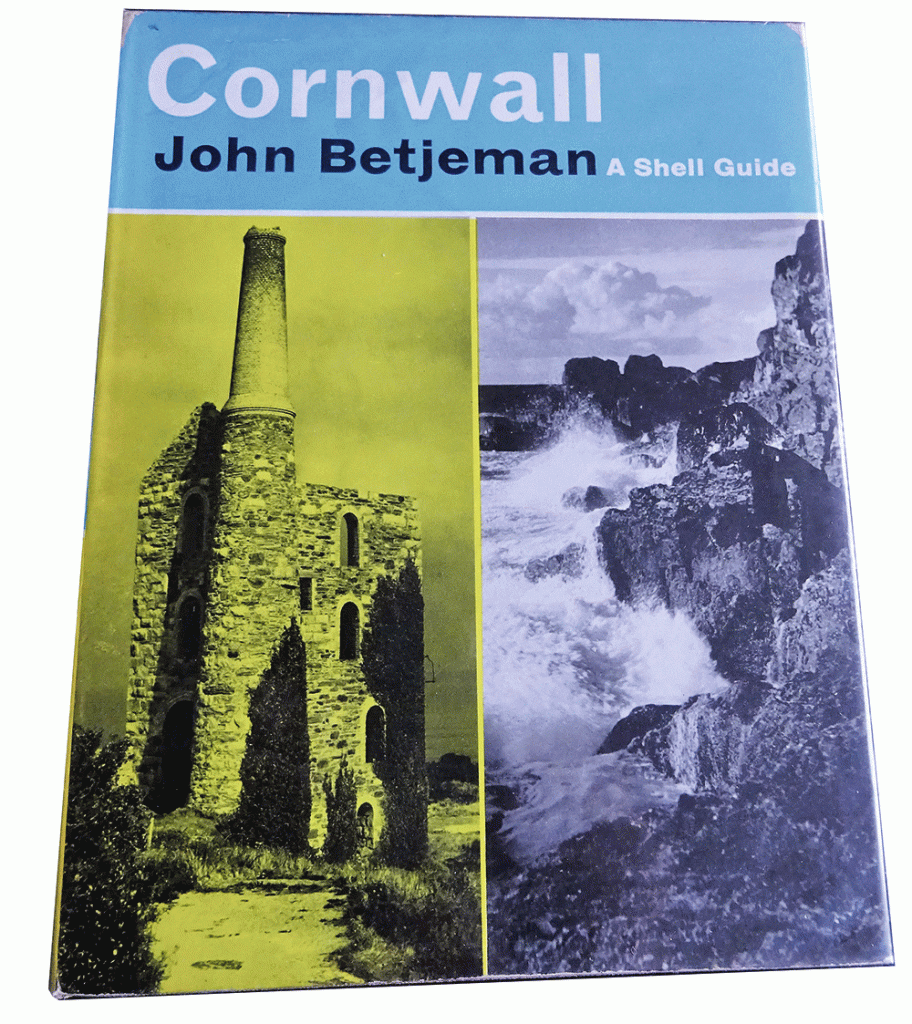
Being the sort of universal hack that I am (when it comes to writing history), in the days before the internet I always needed a handy guide to various counties which would give me a little local colour combined with compressed highly reliable fact. I always found Arthur Mee too cumbersome and The King’s England series likewise. Instead at an early age (by liberating a couple of volumes from the shelves of a relative) I came to realise that the perfect combination was to be met with in Shell Guides. The series began in June 1934 with Cornwall, which the publishers, the Architecture Press, selected John Betjeman to write. The sponsor was the oil company Shell; whose slogan then was ‘Shell: the Key to the Countryside’, in essence explains their willingness to under-write the series. Although the 1934 Cornwall was pretty simple: spiral bound, 62 pages, and not a few errors and omissions, the format stabilised the following year with its revised edition as hard backed 7×91/4 inches with colourful dust-wrapper, glossy paper, an introduction, pace-by-place gazetteer and a lot of excellent black & white photographs. The series was continued until 1984, by which time about half the country had been covered. The series was sponsored by the oil company Shell. The original guides were published on a county-by-county basis, under the editorial control of the poet John Betjeman and (later) his friend the artist John Piper. There were 13 pre-war titles, the publisher changing fairly soon to B T Batsford and then in 1939 to Faber & Faber who continued until 1984. In 1939 all the previous twelve titles were re-issued and one new one in the same format: David Verey’s Gloucestershire. The next one planned was Shropshire to be co-written by Betjeman and Piper. However, the Second World War intervened. Post-war, every bit of Wales was covered in five different titles. But it was not until 1951 that the series re-started with Shropshire. Jack Beddington, Shell’s advertising manager, was long involved with the Shell Guides and his influence led to the employment of so many artists: John and Edward Piper, John and Paul Nash and so on. From the late 1950s to the early 1970s, a series of general titles under the Shell Guide banner were also produced, covering most of the countries in northwest Europe. Guides to subjects such as rivers, islands, viewpoints, archaeology, gardens, flowers, history, wildlife and museums were also published, but these rather lie outside the collectors’ ambit. In 1987, Shell issued a final series of New Shell Guides, published by Michael Joseph and generally covering rather larger areas (e.g. Northern Scotland and the Islands) than in the earlier series. Whilst the original Shell County Guides are now highly collectible, the later titles (published by Faber & Faber, Ebury Press or Michael Joseph) tend to be shunned by collectors and book dealers alike, as supply exceeds demand. Also, since 2012 the Heritage Shell Guide Trust has been set up to re-start the series, beginning with West Yorkshire by William Glossop in 2012, a complete revision (due to boundary changes of the 1974 West Riding volume. It is too early to say whether these will become collectible, but all those I have seen are in paperback, are unlikely to be much sought after. The real joy of the original series, apart from the photographs, are the authors. You can see John Betjeman clambering on and off various hobbyhorses as he takes you, in the most gentle and civilised way, round his beloved Cornwall. As editor, his view was that the guides were all about ‘Readers will want to know what a place looks like now. Is it ruined with poles and wires? Has an old bridge been destroyed and a concrete one put in its place?’” Another regular author of the guides was the late Revd. Henry Thorold, whom Carole and I got to know well. He, too was a friend of John Piper (who landscaped his garden at Marston Hall, Lincolnshire) and of Betjeman, although his circle of acquaintances was staggeringly wide. He too, writes like Betjeman, amusingly, perceptibly, heart on sleeve and, like Sir John, his intimate knowledge of the five counties he wrote up was astonishing. Henry’s first effort was (with Jack Yates) Lincolnshire; on seeing which Betjeman wrote gleefully: ‘It is far the best of the Shell Guides so far and the text is really good too. We have got Pevsner on the run.’ He also wrote, Derbyshire, Durham, Staffordshire and Nottinghamshire (the last of the original series published), photographs mainly by Piper. The series was pulled by Shell in 1984 with Bedfordshire not quite ready for the press: it never appeared. Although many were reprinted in paperback, the original spiral bound card or hardback ones are those that are collectible. Even more so if you were lucky enough the get the author to sign you copies; I have never been pushy like that, but on a visit to Marston I later discovered that he had signed the two I’d brought and given us three others I had not even got round to buying! Likewise, when I lived in London, a friend who knew Betjeman well got Cornwall (1964 revision) signed. These signatures are the key to value, as some authors like Betjeman, Piper, Thorold, David Verey, Professor W G Hoskins, and so on were very well known in their own right. A Piper or Betjeman-signed pre-war edition is going to soar past £300 and do almost as well if it is a later edition (condition being right). The lesser, but still well-known, authors are probably going to command a premium of £30-40 over the value of an unsigned one. Largely speaking, signed copies are extremely rare. Prices for the unsigned pre-war spiral or comb-bound card covered editions (which frequently fail to survive) are upwards of £50 today, but a really good one could go for over £300, but the hard bound copies can still be had for around
Modern Collectibles – Teddy Bear

Toy animals have been around since the days of Ancient Egypt, but bears only since the 18th century, and genuinely cuddly ones, made of plush stuffed with something that will take a squeeze, only became available as a manufactured item in the 19th century. However, the all-encompassing soubriquet’ Teddy’ owes its origins in this context to the 20th century. ‘Teddy’ has been around as an abbreviation for Edward since the 17th century but it saw the early 20th century before the word became attached to bears. Nor was it in this context, – short for Edward – but for Theodore, the culprit being US President Theodore Roosevelt. On 16th November 1902 the Washington Post ran a cartoon of President Theodore Roosevelt refusing to shoot a bear. He had been part of a hunting party in Mississippi but in three days was the only member of the party not to have had a shot at a bear. Not wishing to lose face the organiser, the state governor, ran to earth an old injured bear, tied it to a tree and invited the President to shoot it, to which, he replied ‘Spare the bear! I will not shoot a tethered animal.’ The incident soon got out and to connect his reluctance with current politics led to the cartoon being published. Not only that, but the cartoonist, Clifford Berryman, never failed to include a ridiculous looking bear in any subsequent cartoon of the president! Yet the Teddy Bear connection came about through a New York sweet shop owner who saw the cartoon and put in his shop window two stuffed toy bears his wife had made, but perspicaciously first asked Roosevelt’s permission to call these toy bears ‘Teddy’s bears’. Their unexpected success led him to mass-produce them, eventually forming the Ideal Novelty and Toy Company. Steiff Bears Almost simultaneously, a Germany company, started making stuffed bears too. Margaret Steiff was a seamstress but with the help of her nephew Richard, diversified into making soft toys. In 1903, an American saw one of her toys at the Leipzig toy fair – a bear, needless to say but one which went a stage further with jointed arms and legs – and bulk-ordered them for re-sale. These also came to be called Teddy Bears. These early ones are beautifully made usually covered in plush or mohair and tend to have slightly humped backs and longish, more realistic, snouts. Steiff bears can be very valuable, as can other German makes such as Bing, Sussenguth Brothers and Schuco. Such was their popularity that, with the first war, German imports to the UK dried up and several British companies rushed to fill the gap, Chiltern, Dean, JK Farnell, Merrythought and Chad Valley being amongst those that began to manufacture Teddies. Because no two Steiff bears are exactly alike, prices can vary, but the early date and sheer quality can lift prices of examples in good condition to as much as £30,000 retail – this for a black coloured one made for the British market in memory of the Titanic disaster of 1912 and in superb condition. And of course, one should always buy bears in the best possible condition; they have to have been expertly repaired and more importantly professionally cleaned for a dirty bear can spread mites and moth which can spread to other soft toys and indeed us. If the price is high, try and establish provenance, like a good work of art. If they’re ‘well-loved’ they will be less collectible and hence less valuable, even though perhaps all the more endearing! Rupert Bear and Winnie-the-Pooh In 1920 the strip cartoon featuring Rupert Bear in the Daily Express revived the boom, followed hard on its heels by Winnie-the-Pooh in 1926, the original of which was a Teddy made by the firm of J K Farnell and bought for his son by A A Milne in 1921. Paddington came along in the 1970s, and early ones are highly collectible: a group of three by Gabrielle Designs made over £100 at Bamford’s in August. Yet bears in character are really a distinct sub-division of Teddy bear collecting, not being Teddy bears at all! Teddies can also have other, bolt-on characteristics which in earlier models can make them more desirable and hence more expensive. Some growl when rocked, others have a musical function: the possibilities are fairly wide. Although Steiff bears, identifiable by their distinctive trademark button in one ear, resumed production in 1947, the present boom in collecting Teddies is traceable to 1969 when character actor Peter Bull wrote a book entitled Bear With Me (later re-titled The Teddy Bear Book) about his collection and affection for the toy. This led to a revival on the making of Teddy Bears, often individually made and in 1985 the Teddy Bear Artists’ Guild was formed; also, Christie’s held their first auction dedicated to the sale of antique bears. Yet during the 1960s the traditional manufacturers lost ground to Teddies produced in China and Indonesia, as cheaper mass-produced bears took over the market. Nevertheless, there are still several companies that produce high-quality collectible bears around the world and in addition there are many ‘bear artists’ producing individual, hand-made collectors’ bears. Prices levelled out a few years ago with the recession but now they are steadily on the rise again A recent Bamfords toy and juvenilia sale included no less than twenty-one collectible Teddy Bears, some by important makers, and although the majority were estimated at £40-60, most did much better than that. Modern ones are much less expensive, although very large ones tend to be (unnecessarily) pricey, but keep an eye out for quality and eschew artificial fibres Bears come, like Antony’s Cleopatra, in infinite variety, and it is easy to adapt one’s collecting to what you like and maintain consistency as well as suit your pocket. Then of course, you just might want to buy one for an actual infant to cuddle up to! 00