Walk Derbyshire Cromford Meadows & Black Rocks

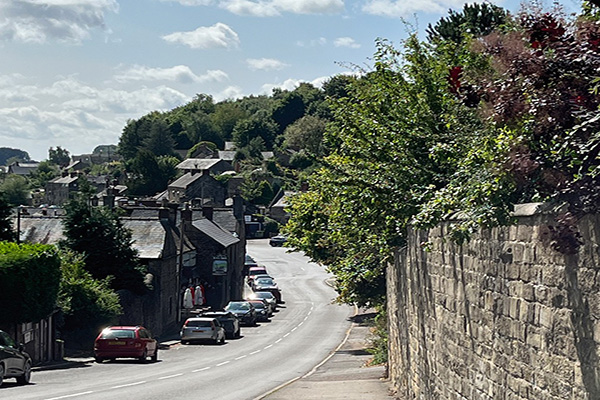
Cromford owes its birth to Richard Arkwright, founder of the water-driven cotton spinning frame, one of the leading inventions of the Industrial Revolution. Harassed by home-based cotton spinners and weavers in his native Lancashire, in 1771 he opened his first mill, using the convenient power of the nearby River Derwent, close to the Crom Ford, a name that was taken by the factory village he built to accommodate his operatives. Later on he was awarded a knighthood and died an extremely wealthy man – a man who once offered to pay-off Britain’s national debt from what he claimed was ’petty cash’. Developed as aself-contained village, Cromford provided all the amenities necessary for life in what was then a remote corner of Derbyshire. It had every available kind of shop, ranging from the proverbial butcher and baker, to haberdashery and even traditional blacksmiths and leather workers to cater for the day to day needs of the village and surrounding farms. Health problems were also catered for by an early version of the chemist’s dispensary. In order to protect it from unwelcome disturbance, the mill became more like a fortress when viewed from outside; guarded by narrow windows rather like gun-slits, and certainly no windows or unlocked doors were accessible from street level. A reasonably benevolent employer, at least by the standards of the time, Sir Richard as he became, and his later sons, gave Cromford its church and founded a school teaching the basic three r’s. North Street, part way up the hill towards Wirksworth was built to both accommodate textile workers, but also provide space for traditional stocking-frame knitters of the fashionably Derby-ribbed stockings. Stocking frame knitters traditionally required the best possible light for their work. To suit all needs, the knitters worked in specially adapted upper rooms, each house connected to its neighbour by an opening in the adjoining walls. North Street runs roughly east-west, giving opposite sides of the street a fair share of available sunlight, morning and afternoon. As the fame of Arkwright’s invention spread far and wide, studied by visitors from all over Britain and Europe, it became necessary to provide some form of high-class accommodation. His answer was to build what became the Greyhound Inn beside Cromford’s market square. In later years Cromford was linked to the countrywide canal network, when a branch of the Trent and Mersey Canal reached the village. There was also an ill-fated attempt to take this canal over the limestone moors to Whaley Bridge, but lack of a reliable water supply doomed the plan. However, by using canal engineering techniques in the design, one of the earliest railways connected the Derwent Valley to Manchester, the leading light of the burgeoning cotton empires. This walk starts by exploring the narrow back streets of Cromford, before climbing across flower-filled meadows to reach the first of the inclines lifting the railway high above the surrounding countryside. Dominated by Black Rocks, a rugged gritstone outcrop above Sheep Pasture Incline, which is the first section of the High Peak Railway, connects it to the Midland Main Line. The path across Cromford Meadows follows part of High Peak Trail and also the Midshires Way long distance path. Hereabouts, our path route goes under Sheep Pasture Incline about half way between High Peak Junction and the stone tower that once held the first of the series of winding engines along the High Peak Railway. A forest track is followed across the wooded hillside as far as a footpath junction off to the right. This is followed as far as another path junction where a right turn leads to delightfully named Wigwellnook Farm. Its access drive is followed beyond the farm, down to a minor road with wide ranging views. A right turn here for a couple of hundred yards or so, reaches a footpath climbing to the right, up into woods surrounding the gritstone outcrop of Black Rocks. Here a nature trail is followed, winding below the crags and down to the car park for a section of the High Peak Line. A path on the opposite side of the car park drops down to the Cromford to Wirksworth road where a right turn leads back into Cromford. THE WALK :: THE WALK :: THE WALK :: The walk starts and finishes opposite the Greyhound Inn beside Cromford Market Place. It is easily reached from the canal terminus wharf car park beyond Arkwright’s Mill. Walk up the Cromford Hill road as if heading towards Wirksworth, heading for North Street. Wander the twisting route of the head of a series of streets, always avoiding the main road and its traffic. Continue as far as Baker’s Lane and turn left, following the lane to its end. Leave the lane and join a field path crossing the broad grassy slopes of Cromford Meadows. Pause now and then to admire the views along the Derwent Valley. Sir Richard Arkwright’s Willersley Castle stands proudly at the foot of a limestone crag. He had had it built for his retirement, but unfortunately it was badly damaged by fire and he died of old age before it was completed. High Tor stands proudly near the head of the gorge and the Heights of Abraham are opposite – you can reach it by cable car from the bottom station close to Matlock Bath Station on the Derby/Matlock railway line. Ignoring any side paths to the left or right, go forwards towards the High Peak Railway’s Sheepwash incline. The line was opened in 1831 and the winding house is just about visible at the top of the incline to your right. Follow the path, going under the incline and then out into mature pine woods. Climb for about 150 yds up to a forest drive and turn left along it. After roughly a quarter of a mile look out for footpaths on either side of the drive. Turn right on to the uphill path. Walk as far as a crossing of two paths
St Kilda – An Enchanting Island In The West

A few years ago while I was exploring the Hebrides, I stood on top of a small west facing hill. The weather was unusually calm and sunny, with a low mist skimming the sea. As I gazed out over the Atlantic, a sudden clearing in the mist revealed what I can only describe as a fairy king’s castle. Peak upon peak seemed to rise from the sea, seeming to float on the air. This could only be the mythical island of St Kilda and its sea stacks that rise from the depths of the ocean to offer breeding space for countless sea birds. Then and there I vowed that one day I would reach uninhabited St Kilda, a vow I have twice managed, once on a fortnight’s National Trust for Scotland working party, and once on a day trip in a small boat from Harris. This account is mainly based on the latter. Gradually a group of shattered peaks rose from the sea ahead of us as we butted our way through the ten-foot high north Atlantic swell. The day was perfect for a trip which started an hour or so before from Leverburgh at the southern end of the Hebridean island of Harris. We were travelling on Orca II, a state of the art boat capable of 29knotts, but then cruising at a steady 19knotts to help make life a little more bearable for those in our group of twelve who were already suffering from ‘mal de mer’. Overhead the cloudless sky was cerulean blue, while at sea-level a light mist added to the mystery of our destination. Eventually the peaks resolved themselves into a group of sea-stacks, rocks reaching almost a thousand feet directly from the sea, and on whose ledges tens of thousands of gannets, fulmars, kittiwakes and guillemots make their precarious nests, while tiny shearwaters and petrels who fish far out on the edge of the Continental Shelf make their nests in burrows alongside clown-like puffins whose tiny wings are more suited to swimming beneath the waves. We sailed into the sparse shelter of Village Bay to land on Hirta, the main island, passing the tiny outlying island of Boreray and its attendant Stac Lee and the highest sea stack in Britain, Stac an Armin (average height above sea level 662ft). Swarming with birds and covered by centuries of their guano, landing on any of them seems impossible, especially when one learns that St Kildans frequently visited them to catch sea birds, the islanders’ staple diet. The story of a group stranded on Stac an Armin for several months when an epidemic broke out in their absence borders on the edge of incredulity. Disembarking for us was not without its excitement, climbing down into the pitching dinghy that took us on to the island’s tiny jetty. Uninhabited except for a small permanent garrison of army technicians manning the radar station which monitors test rockets fired from the island of Benbecula to the east and snooping Russian spy ships; the island’s summer population is increased by a Nature Conservancy Warden and N.T.S working parties. A haven for wildlife, the archipelago of St Kilda is all that remains of a volcanic complex erupting millions of years ago. Its oceanic isolation and the fact that it was not covered by the ice-sheet which smothered most of the rest of Britain make it unique among the Hebridean islands. Classed as a National Nature Reserve, along with the thousands of sea birds, it supports a distinctly unique wren and field mouse. Scraggy Soay sheep which roam over Hirta and some of the larger outlying stacks are a primitive breed that has probably existed for many hundreds – perhaps thousands of years. Minerals in the soil and the moist Atlantic winds dictate the low growing plant species, modified by wind, grazing, and salt spray in winter and huge quantities of bird droppings. Not only are the flowering plants of interest to botanists, but the fungi and lichens are also important. In summer the cliffs are alive with immense teeming colonies of breeding sea-birds, and the gannetry on Boreray is the largest in the world. No one knows when the first people settled here, but there is history in every stone: some structures date from the Stone Age while others are probably from Dark Age, Viking or Medieval periods. It can be said with reasonable certainty that humans lived on St Kilda continuously over the past thousand years, and probably much longer. For centuries a small community existed here, isolated from the outside world but almost as well adapted to its environment as the seabirds forming a major part of their diet. Where the title of St Kilda came from is unknown, for while there are archaeological relics of early missionaries’ cells and the Irish St Brendan the Navigator’s saga speaks of a visit to the ‘Island of Birds’, there is no record of anyone by the name of St Kilda ever living here. The first thing confronting a visitor is the group of army buildings that sit uncomfortably next to the old chapel, school room and factor’s house. Aware of its intrusion, the military does try to help keep the purity of the island intact and visiting N.T.S working parties can enjoy hot showers. Supplies of perishable food is also stored in the army’s massive refrigerators. Beyond this complex is the real St Kilda, a long row of mostly single-storied cottages at right-angles to earlier ‘blackhouses’, the primitive single-windowed and skin-doored, turf-roofed cottages that once provided accommodation throughout the Highlands and Islands of Scotland. The houses date from the 1860s, replacing the blackhouses and were once the most modern houses in the Western Isles. Six of these have been re-roofed to provide simple accommodation for visiting working parties. Organised on the crofting system, each house had its own strip of surprisingly good land running down to the sea, while behind the ‘street’, further ‘quality’ land was
Changing Landscapes
The change in season brings with it many delights and yet there are some areas that on occasion turn from foreboding landscapes into fascinating scenes of vibrant colour and light. On a summers evening in August the Cat and Fiddle road that connects Buxton to Macclesfield was a delight to traverse necessitating a stop just opposite the now closed Cat and Fiddle public house to take in the most wonderful views. It all looks so inviting as the sun starts to dip over the hills, but this ever changing landscape makes this area on a winters day, or summer for that matter, fraught with danger. I have travelled this road in a pea- souper of fog as the headlights desperately fought to pick out the cats eyes on the road , and in a blizzard with the wipers straining hard against the fast falling snow. The black ice, hidden from view, suddenly causing the tyres to loose their grip and manically trying to avoid going off the edge of the road. Throwing everything into the mix it’s a pretty deceptive landscape that has seen its fair share of fatalities, but it is one of outstanding beauty when the soft colours of heather outline the moors with their fingers. The road now is subject to average speed cameras. This decision is mainly due to those who attempt to overtake in the wrong place and cause enormous problems. It’s a great road if used properly but sadly many don’t seem to have grasped that and so take risks and pay the price. Reports show that of the 264 casualties on the road since 2001, approximately 70% of those killed or seriously injured were motorcyclists. I suppose for all who enjoy driving it’s a drivers road and brings with it an elements of excitement but needs treating with respect. Whilst the Cat and Fiddle area can be a very inhospitable place you only have to travel a mile or two in each direction to be in areas of outstanding natural beauty with country walks. Dropping from the Cat towards Macclesfield near the village of Wildboarclough (Wilbercluff if you’re a local! ), the area of Maccclesfield Forest is rich in beautiful country walks. The Cat and Fiddle Inn is the second-highest inn or public house in England at 1,689 feet or 515m, Having been closed as a pub for a few years it is now occupied by The Forest Distillery where its cellars, that are 1600 above sea level provide perfect conditions for whisky to mature. Tha Cat and Fiddle is currently open for coffee and take outs, and if you fancy a tour they can be booked on line. There are four reservoirs in the vicinity, Ridgegate and Trentabank reservoirs provide Macclesfield with drinking water. Trentabank is home to the largest heronry in the Peak District. The forest timber is regularly felled and replanted so the woodland scenery is always changing . Pay and display parking is available at the Visitor Centre near Trentabank Reservoir and at another small car park at Standing Stone. There are also other minor car parking areas in lay-bys in the forest. Travel back from the Cat towards Buxton to visit Derbyshire Bridge, originally the county boundary between Derbyshire and Cheshire. It nestles in The Goyt Valley which was once the home of a thriving coal mining industry. Remnants of mine shafts can still be seen dotted around. There is a car park and picnic site which offer some stunning scenery and walks across the moors. Sadly there’s no access to Goyt valley by car as there is a one way system in operation so you will need to attack the rest of the valley by taking the A5004 Buxton to Whaley Bridge Road. From Derbyshire Bridge a lovely walk takes you alongside the River Goyt down to Packhorse Bridge and back taking approximately one and a half hours. Wildboarclough, nestled in a valley in Macclesfield Forest, Cheshire is such a fascinating little village steeped in history. It was an area of industry with two mills linked in with the carpet industry which used Clough Brook as its power source to run the machinery. The bridge over the river has a plaque on it to commemorate the loss of life after a flash flood in 1989. It is also reputedly the place where the last wild boar in England was killed although that fact is a little disputed! The nearby summit of Shutlingsloe gives outstanding views of the Cheshire Plains and on a clear day you can see the Mersey Estuary and the Welsh Clwydian Hills 40 miles away. We sawJodrel Bank clearly in the distance as we drove along. Whatever your preference, sitting on the top of the Cat and Fiddle is a great place to take a coffee and cake and just soak in the atmosphere come rain or shine. You may even get to see the planes taking off and landing at Manchester airport if it’s clear. All in all a great day out and only a hop skip and a jump from home. 00
Lost Houses of Derbyshire – Breadsall Mount

Breadsall was one of the villages immediately surrounding Derby that so far has escaped being absorbed by the ever-expanding city below it and to the south, although a considerable amount of land on the southern edge of the parish was absorbed in 1921 and is now host to the Breadsall Hill Top estate, created through the sale and destruction of two of several country houses and gentleman’s villas in the parish, Breadsall Hill Top and Breadsall Mount. Indeed, Breadsall’s history was always chequered, the parish having been divided by its first feudal lords, the de Dunes, into two separate manorial estates. There were also two settlements: the present village, originally Breadsall Nether Hall, and another on the ridge to the SE called Breadsall Upper Hall. I became acquainted with the latter when, as Assistant Keeper of Archaeology at the Museum, I was invited in 1980 to the site by the late Maurice Brassington to see what was there, the City Council having then just decided to sell the entire area for housing. What we found was a moated site, presumably the site of the de Dune family’s Upper Hall, and numerous sunken lanes and grassy house platforms: the place was a hitherto unrecorded deserted Medieval village (DMV). Had we discovered all this before, English Heritage (as it then was) could have been alerted and, even had they failed to stop Derby expanding onto the site, could at least have insisted on an archaeological investigation, although, in truth, the requirement for a developer to fund an excavation in the circumstances was then still a decade and a half off. Down the hill, Breadsall Nether Hall is now Breadsall Old Hall, a much-rebuilt Medieval remnant in the middle of the village, once the property of the Harpurs and previously of the Curzons. To the north, once stood Breadsall Priory, which was replaced by the Cutler family’s new house around 1600. This Jacobean mansion, much rebuilt for Sir Alfred Haslam by Scrivener of Stoke and extended in the Edwardian period by Percy Currey, eventually became an hotel. On the Hill Top, things were different. Just SE of the DMV once stood Breadsall Mount, on land owned by the Bateman family of Derby and Hartington Hall as part of the large estate centered on Morley which they had inherited from the Sacheverels. They had numerous interests in Derby, and in 1731 built 36, St. Mary’s Gate as their town house – until they inherited the much grander St. Mary’s Gate House a generation later. One, Sir Hugh Bateman MP, was raised to a baronetcy in 1806, but failed to leave any sons, the title going via a daughter (a most unusual arrangement for a baronet) to the Scotts of Great Barr and eventually to the Hoods. Yet by the Regency period the centre of Derby was getting polluted and noisy. The elite were minded to move into the suburbs, and in this series we have looked at several of the opulent villas built by the Bateman’s contemporaries. Their own first suburban house was Litchurch Villa, of c. 1828, now the Rolls-Rovce club on Osmaston Road. Yet a generation down the line again it turned out to be too close the foundries of Litchurch, the smoke, smells and racket of which made the place difficult to live in. Therefore, Sir Hugh’s nephew, Thomas Osborne Bateman (fifth son of the Baronet’s brother Richard) decided in 1863 to move yet again, this time choosing the high ground to the north of the town, clear of what the prevailing wind might bring from the foundries. Here he decided to build a new house entirely, and spare no expense whilst doing so. The site was on land once part of Breadsall Upper Hall but it was on the family’s ancient Morley estate, which supported the house, for Morley Hall was demolished by the 1750s and a successor house rented out. Called Breadsall Mount, the house was begun in 1863, the architect being Henry Isaac Stevens of Friar Gate (1806-1873), then in partnership with Lancashire gentleman-architect Frederick Josias Robinson. Stevens was Derbyshire’s best known, most prolific and accomplished Victorian architect, if not perhaps the most imaginative. Second son of Isaac Nehemiah Stevens of Pimlico (later of Ockbrook), Steward to the Earl of Chesterfield, his mother was Londoner Elizabeth Young. Henry (as he was originally baptised on 15 November 1806 at St. George’s, Hanover Square) was trained under William Martin, Lord Chesterfield’s agent and architect at Bretby and the family seem to have had close connections with Lord Chesterfield’s household in London as well as in Derbyshire. He also studied in the office of Sir Jeffrey Wyatville whilst the latter was working at Windsor Castle. Sir Jeffrey had designed Bretby Castle with Martin, and Stevens married Martin’s daughter Anne in 1832, settling and beginning work at Hartshorne, also on the Chesterfield estate. They had four children of whom only the youngest outlived her parents. Through his wife, he was also uncle to another prolific Derby architect, George Henry Sheffield, whom he trained. Stevens was Churchwarden of All Saints’ 1842-3, but by 1852 (when he was elected FRIBA) the family was living at Mackworth. At just about the time he was completing Breadsall Mount (and perhaps thanks to the fee!) he built himself The Hollies, 20 Pear Tree Road, Pear Tree, a new Derby suburb. He served as a Conservative Councillor 1862-64 and 1866-69, and his will is dated 18th November 1872. He died at home 30th April 1873. The house Stevens built was fairly standard fare for him. It was ‘Jacobethan’ that is, a combination of classic Elizabethan and Jacobean features, then very popular with the elite. The entrance was on the three gabled west front, and was through a Gothic doorcase above which was carved, by Derby sculptor Joseph Barlow Robinson, the Bateman arms, quartering Sacheverell and Osborne. The gables were straight and coped, the house of two lofty storeys and attics and built of fine ashlar, squared from
Places of Interest on Either Side of The Lower Wye & Severn Valleys

Beyond Birmingham and before reaching Bristol on the way to the south west, travellers using the M5 gateway to the sun often find themselves in one of the all too frequent bottlenecks, especially around the M5/M60 junction. If they give up and decide to call it a day around Junction 9 (Tewksbury), then the possibility of a completely new experience will make itself known. Assuming the tired motorist has left the motorway at Junction 9 on the M5, it will be a matter moments for him or her to reach Tewkesbury, a town on the Severn steeped in medieval history. In pre-motorway days the journey through this ancient place could be a nightmare of cars and lorries crawling like noisy, fume-spewing snails along the A38. How the half-timbered houses stood up to the vibration is a miracle, but they did and we must be more the grateful for it. One of the fifteenth-century houses has been converted into a Baptist chapel. It hides down a narrow alley near the abbey church, safe from the noise of traffic still using the A38, making it a haven of tranquility on even busy market days. On a sunny day in May 1471, the Battle of Bloody Meadow, part of the Wars of the Roses took place a couple of hundred yards from Tewksbury abbey. The last of the battles between the warring houses, it was won by the Yorkists who pursued the defeated Lancastrians along what became the A38. Many of the survivors took sanctuary inside the abbey, but were dragged out and publicly executed in the main street. While the abbey church is much changed from that awful time, it managed a century or so later to withstand the officials of Henry VIII who had come to close the place down as part of the Dissolution. Today, because the abbey was part parish church it was allowed to survive, one of the few buildings to remain from the conflict between monarch and church. Further along the M5 turning off at Junction 11 will give the opportunity of visiting two attractive places. Gloucester is, as the name suggests, a Roman town, just one of the in-places popular with our sophisticated invaders. This part of the Severn valley and the nearby Cotswolds’ gentle hills had as its residents the early equivalent to early retired Prime Ministers and sacked petrol heads. For centuries the city guarded the lowest crossing of the Severn and routes into South Wales. It became the Roman fortified town of Glevum after taking over the British Caer Glowe; the Normans walled it and built a castle (destroyed in the 17th century). A busy coaching stop in Regency times, the glory of today’s city are its inns and the Cathedral; built mainly in the 12th century as a monastic church, but refounded by Henry VIII as a cathedral. As a hint of its age, the pillars supporting the main fabric, are all of 900 years old, and the glass of its huge east window has seen the dawn and dusk of over six hundred years. In Northgate Street, the 15th century ‘New Inn’ has a galleried courtyard where crowds could safely watch coach-horses being changed. Until quite recently, Gloucester was a busy inland port and the riverside wharfs can still be explored. On the opposite side of the motorway, the A40 leads into Cheltenham. What was once a small village quickly became a popular Regency spa when heavily charged water was found in a farmer’s field. The water is still dispensed in the Town Hall. Well known for its Gold Cup steeplechase horse racing every March and the home of an important girls’ public school, Cheltenham’s town centre is still lined with exquisite Regency buildings on either side of its wide streets. A wealth of trees preserves the character of this beautiful town despite the pressure of modern commerce. No shopping street in England can compare with the Promenade for beauty. The town has many links with music festivals – Gustav Holst was born here; concerts are given in halls around the town as well as St Mary’s Parish Church where its magnificent Rose Window is an attractive distraction. Part of the small garden in front of Cheltenham’s Town Hall has at its centerpiece an Italianate fountain that never fails to delight passers-by of all ages. Behind and to one side, stands the statue of Edward Wilson who died on the return from the South Pole along with Captain Scott and the rest of the polar group. Touchingly, the statue of this Cheltenham man was made by Scott’s widow. Inside a small museum and art gallery close by the Town Hall, a small piece of notepaper within a display cabinet is often overlooked. Grubby it might be, it was found on Wilson’s body and was the last message he wrote to his wife. Still legible, it was obviously written in the knowledge that Wilson was dying, and from its phrases it was likely that his brave colleagues were already dead. Moving across the Severn Valley and into that of the Wye, two features are worth discovering by a first-time visitor. The first and arguably the most attractive is Tintern Abbey, one of the most beautiful Cistercian ruins in Britain. With the wooded hills of the lower Wye Valley all around, it gives an aura of tranquility unspoiled by the vandalism of Henry VIII’s struggle with the church. A much larger structure than at first glance on driving along the valley road, the abbey in its hey-day held hundreds of monks and pilgrims as well as those in need of hospitalization. Careful excavation over recent years has unearthed the ground-plan of many of the rooms needed to support ecclesiastical activity in the main section. The beautifully preserved ruins of Chepstow Castle still seems to guard access to the open Bristol Channel. In fact until the first Severn crossing bridge was built, Chepstow was the first town in Wales accessible to the
Yorkshire’s Dangerous Coast

Most of the visitors who flock to Yorkshire’s coast every summer, do so without realising that it has a history of marine tragedy reaching back over the centuries and it is hard to realise that an average of two shipwrecks a week have taken place along the North East coast since records began in the 1500s. Brian Spencer investigates the sinking of just a few of these ships, ranging from a First World War hospital ship, to the wholesale sinking of a fleet of colliers, whose wrecking led to a major safety device designed by a Derby M.P. Nature has decreed that Yorkshire’s coast will provide few, if any natural harbours, lining it instead with jagged rocks waiting for unwary craft. Bridlington, Scarborough and Whitby are the only places where it has been possible to build safe anchorage. In other places, only small inshore craft can be used and they must be drawn up on to local beaches, well above the high tide mark. Robin Hood’s Bay is unique, because here fishing boats, the traditionally designed cobbles, rest at the bottom of the village street. The best known wreck was fictional and featured the way novelist Bram Stoker’s Count Dracula came ashore at Whitby, in the shape of a huge black dog. As the story goes, Dracula reached England from Eastern Europe on the ship Demeter that foundered on rocks outside Whitby harbour, which only Dracula survived. Due to stormy weather or engine failure, many ships have failed to gain the safety of Whitby’s harbour. One of them was the Rohila, a WW1 hospital ship that was on its way south to collect wounded. Due to engine failure it missed the entrance to the harbour and drifted on to the rocks at Saltwick Nab below the abbey. Even though it was a matter of yards from the harbour, violent seas prevented the Whitby lifeboat rescuing more than a handful of survivors. Due to the strength of the gale, many of the rockets fired from the tantalisingly close beach, failed to reach their mark, but eventually rescue from the land did take place once the tide had dropped sufficiently. More recently, in 1976 a trawler, the Admiral von Tromp ran aground in a thick fog and heavy seas not all that far from where the Rohila foundered. Here again the Whitby lifeboat tried to rescue its crew and in fact came within touching distance of the vessel, but the rescue proved too difficult and two men drowned. At low tide the jagged remains of the once proud ship are exposed like some futuristic artwork. St Mary’s church stands against the elements high above Whitby harbour and within its walls there is a memorial to a lifeboat tragedy in 1861. During a severe storm, and after saving many lives in full view of a crowd watching from the pier, the Whitby lifeboat was flipped over and 12 men were drowned. Henry Freeman, the only crew member to survive did so because he was the only one wearing the then experimental cork life jacket. Moving northwards away from Whitby, the coast is littered with the poignant remains of shipping that never reached safe harbour. A little way off the shore at Kettleness, between Whitby and Runswick Bay, the boiler of the Wolfhound a Humber trawler that ran aground in 1896 can still be seen, kelp covered and colonised by limpets and mussels. Another wreck is of the 1932 sinking of the Belgian trawler Jeanne, and it is commemorated in the clifftop churchyard at Lythe, where three of its crew are buried. Southwards from Whitby along Yorkshire’s all too frequently tragic coast, Robin Hood’s Bay and its street-end beached cobles, high ended like Viking ships to cope with rough waves, marks the start of a line of high cliffs with limited sea access. It was around here that in early geological times, rocky strata was twisted throughout ninety degrees, leaving long jagged fang like dykes that run far out into the bay. The parent rocks of these dykes are rich in alum, a chemical used to ‘fix’ red dyes once popular in Tudor times. Small coasters laden with barrels of human urine would carefully thread their way between the dykes, using them as a ready-made natural harbour, to unload on what passes as a beach. The urine was used as a chemical in the process of separating the alum from its parent rock which would be carried back to London dyeworks. As navigation was a rather hit-and-miss affair, it is quite likely that many of the chemical-carrying coasters foundered amongst the maze of sharp rocks running out to sea from the foot of places like Ravenscar where alum processing was a major industry. The remains of a modern vessel which came to grief on these fangs still lie out to sea about half way along the rocky shoreline between Robin Hood’s Bay and Ravenscar. This was the Sarb-J, a Grimsby trawler that ran aground in 1994 after its propeller got tangled with a rope. The successful rescue of all its crew became a major operation involving a helicopter. The hulk now sits forlornly upright on its keel hard beneath the cliffs. Scarborough has an all-weather harbour. It stands at the foot of the castle and probably owes much of its origins to the time when the castle and the expanding town was the major port on this part of the coast. While the harbour has offered safe refuge to both inshore and small coastal traffic, the town, along with Hartlepool and Whitby was severely damaged by bombardment from the sea during the Great War. On 16th December 1914 a battle-cruiser squadron under the command of Rear Admiral von Hipper systematically shelled the totally unprepared North East coastal towns, causing great loss of civilian life and extensive damage to property. For many years after the end of that war, a German cruiser, held as part of post war reparations, became a tourist attraction while