Walk Derbyshire – Following the Magpie Sough

By Rambler ‘Sough’ is the lead miner’s term for the method of draining water from a mine. One of the most attractive roads through the Peak District, the one between Bakewell and the A515 Buxton/Ashbourne road takes some beating. Around a mile beyond the cut-off for Monyash, to the right two small chimneys indicate the presence of a major relic of local industrial heritage. The chimneys and ancillary buildings, plus an old stone cottage are all that is left of boom to bust underground activity in the search for lead. This is the site of Magpie Mine where fortunes were made by intense inter-companies rivalry that even lead to murder. While lead ore mining may have been active in small near-surface activity for hundreds of years, the earliest recorded evidence of miners beginning to explore ever-more deeply came in a report dating from 1740, the start of upwards of a dozen small lead mines that developed as time went by. Local and even itinerant Cornish miners, searched for the riches available in upwards of eight major veins running roughly east/west ever deeper beneath the site. It was also quite normal for abandoned mines to be re-opened by other companies, simply by asking permission from the local Barmote Court, the traditional means of controlling lead mining activities in the Peak. Due to the proximity of adjacent veins, two or more mines could be operating within only a few feet of rock between them. This was the case in 1833 when teams of Magpie miners from Maypit and Great Redsoil mines came into dispute over the right of Maypit miners to open a side passage, inevitably connecting to Redsoil. Appeals to the local Barmote seemed to be getting nowhere and arguments, sometimes verging on violence, broke out from time to time. All this came to a head when Magpie miners lit a fire in the connecting Maypit passage. Regrettably this led to a number of Redsoil miners being suffocated by the fumes. Twenty-four Magpie miners were accused of murder and taken for trial at Derby Assizes. Luckily for them their counsel was the wily William Brittlebank of Winster who argued that the Magpie/Maypit miners were carrying out a traditional method of breaking down the rock within the passage. Unfortunately, or so Brittlebank claimed, the wind direction changed, blowing smoke into Redsoil, rather than into the Maypit workings. With this evidence, the Jury acquitted the 24 Magpie/Maypit miners, but they left the court with the widows’ curses ringing in their ears; learning all too soon that their mine would never again make a profit. A boundary wall to the east (right hand) side of the field beyond the cottage and the prominent chimneys leads to the capped-off shaft into Redsoil and Maypit Mines. A few yards away there is the reproduction of a horse-drawn gin, a system operating the lifting of ore to the surface. The gin is just one of the many features to be seen when passing through the Magpie Mine site. Starting with the cottage, a combination of the mine agent or captain’s house and smithy, it sits within the shade of two chimneys, both part of steam engines that once drew ore to the surface and lowered men to their work. The chimneys give a clue of where their builders came from; the round one was built by Cornish miners trying their luck in the north, they built it in the style they were accustomed to. The square profiled chimney was made by Derbyshire Miners. Various small buildings dot the area around both engine houses. There is an ore store, or coe, not far from the square chimney. This was climbed recently by a courageous Duchess of Devonshire while it was being repointed. Apart from Britain’s only Grade II Listed corrugated iron hut near the round chimney, the final building of note while at the site, is another of Cornish design. This is where explosives were stored and the idea behind the stone hut, or powder house design is for the effect of any accidental explosion to travel upwards, not outwards. Passages within the Magpie complex were frequently flooded and in 1873 work began on digging a tunnel, or sough in order to drain the mine. Due to difficult conditions, mainly with very hard rock, and driving the shaft downwards for about 575 feet before it could make contact with the level of the River Wye; all this took until 1881 before it could carry water away from the workings, but the sough did have one extra advantage when small boats could carry ore to the surface, rather than being manhandled along difficult underground passages and then winched by horsepower into daylight. The sough, starting beneath the round chimney engine house follows a route flowing below the village of Sheldon. The walk as described below follows a surface route above the sough all the way to its confluence with the river. In 1973 the sough became blocked which members of the Peak District Historical Mines Association managed to clear. The story goes that when a huge body of withheld water was expected, an angler was spotted tranquilly fishing in the Wye, more or less opposite the sough. Despite being warned, the angler continued to fish, that is until the inevitable happened and a wall of water hurtled towards him. Fortunately he managed to escape in time and in any case, the water level very soon went down to normal. Traditional lead mining was carried on until as recently as the 1950s, or whenever prices became attractive, but that hasn’t happened for a long time now. USEFUL INFORMATION: A moderate walk covering 5 miles (8km) of field paths and woodland tracks. 575feet, (175.09metres) down along Deepdale and then uphill through Great Shaklow Woods. RECOMMENDED MAP: Ordnance Survey Outdoor Leisure Map Number 1, Sheet OL 24; the Peak District, White Peak Area. PARKING: Roadside near Sheldon, but please keep well away from field access gates. Alternately use the roadside car park
Walk Derbyshire – Toad’s Mouth, Carl Wark & The Upper Reach of Burbage Brook
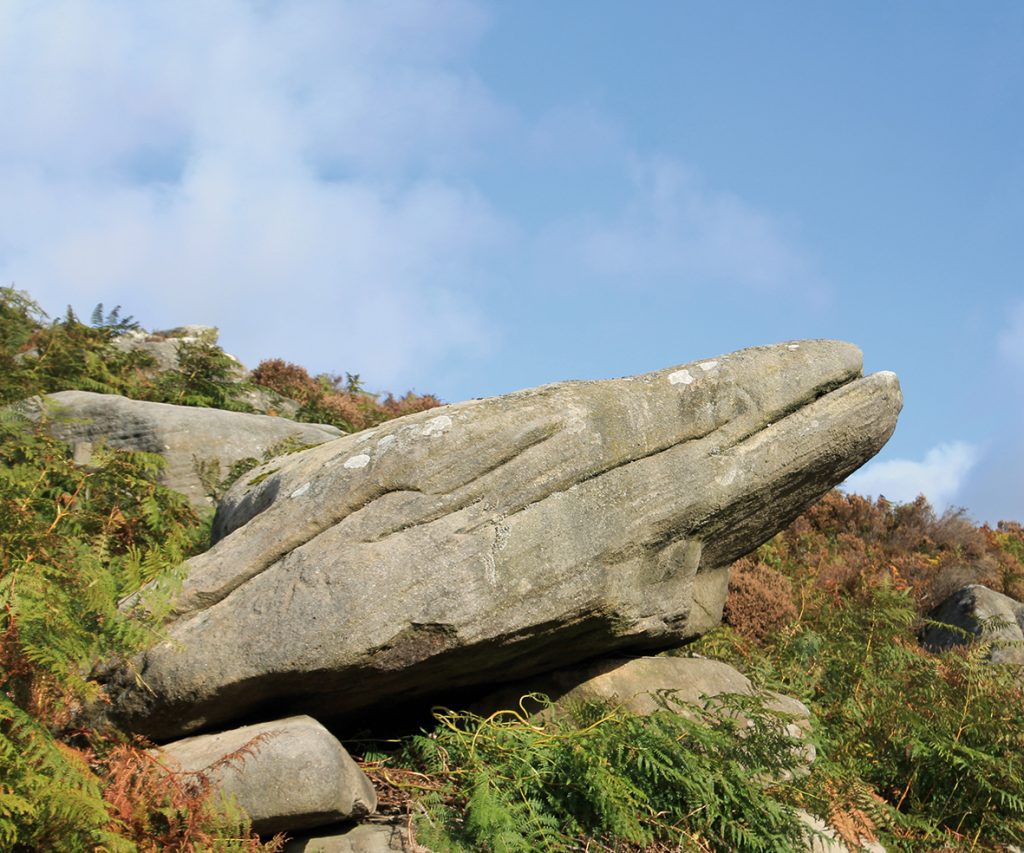
There are many enigmatic remains throughout the Peak District; stone circles, cairns and burial mounds were left by people who did not tell us who they were. Carl Wark the focal point of this walk is one such relic, but we have no way of telling if it was Iron Age or post-Roman, but it tells us that the people who used it had to protect themselves from attack by unfriendly others. When gentlemen took their ease by squinting along the barrel of an expensive shot gun aimed at some innocent moorland grouse, or semi-wild deer, chances are that many of them would have used nearby Longshaw Lodge for their accommodation. During the Great War, the lodge was used as a convalescence hospital for wounded Canadian Soldiers; there is a photograph of a group of them in the snow below the house; it stands beside the path in front of the lodge. With the decline of moorland shooting for so-called pleasure, the moors over which the hunters stalked has been handed over to the National Trust where anyone can wander freely along footpaths crossing the unspoilt moors and wild oak woods covering the valley sides of the lower Burbage River, all the way down to Grindleford. This walk starting from Longshaw joins a roadside path beside the aptly named Toad’s Mouth rock, before wandering out on to Hathersage Moor. At its centre the well-preserved prehistoric fort of Carl Wark sits enigmatically below the wild rocks of Higger Tor. Despite its condition, little is known about the fort’s history, remaining as a potential site for some future teams of archaeologists to work on. A path climbs directly across the moor to reach the massive stone defending walls of Carl Wark fort, by one of its two entrances. At this point the walls make an inward curve, creating overhangs from which defenders using crude bows and arrows could fire down on attackers trapped in the narrow gaps rising to the dual entrances. Today’s visitors can explore the site in total safety, while searching for the enigmatic rocking stone hidden amongst the remains of long abandoned hut circles. The fort is well-sited, at the centre of a nearby series of tracks leading the eye along a path climbing to the summit rocks of Higger Tor, the potential route of an extension to the walk. Our route turns immediately right at the foot of the fort’s rear walls. Here it follows an ancient pack horse track, down to a stone clapper bridge across one of Burbage Brook’s tributaries. On the far side of the bridge, the path climbs steadily uphill to join a path, part of Sheffield Country Walk, one of the long distance routes in this part of the Peak District. A right turn follows this path, later passing an abandoned large stone water trough. Unfortunately it was cracked by an ill-judged final chisel. From the path end beyond the ruined trough, another path starting beside the stream a little way before the Toad’s Mouth bend in the main road, to your right joins the brook which is then followed, past a small weir to a narrow footbridge. Crossing this, the way is gently uphill, past a small lake and then onwards to the lodge where refreshments are on sale. For something stronger there is always the Fox house Inn nearby where Jane Eyre descended from her coach. 00
Walk Derbyshire – Around Kedleston, Woods & Parkland

Opening my latest copy of WALK DERBYSHIRE the seventh no less, I realised that the first walk in the guide took in much of Kedleston’s parkland, but less than half of its beautiful woods and plantations. As enjoyable as the walk maybe, it would be a great pity to exclude the extensive woodlands covering North Park and Hay Wood just across the ponds in front of the hall. A signposted path starting near North Lodge on the back road from Derby, winds its way in and out of woodlands. This is where mature oaks have grown for so long that the Ordnance Survey has confidently marked them on its maps covering the area between Quarndon and Kedleston. Starting from the National Trust car park to the rear of Kedleston Hall, at first the walk follows the hall’s access drive, round the front of the hall, and then down to the graceful bridge designed by Robert Adam to make a perfect foil for the view of the hall built to architect Paine’s plans. A long stretch of narrow lakes created by damming Blind Brook reach out on either side of the bridge, with the drive continuing, past a golf course before joining the main road at North Lodge, the main entrance to Kedleston Park. A path starting on the edge of woodland enclosing North Lodge, bears left along the edge of the wood before swinging left to follow the boundary of Bracken Wood. A narrow belt of trees shelter a side track which is crossed, (it leads to the estate‘s saw mill). On the far side of the track, the path continues, slightly uphill through Hay Wood for about three quarters of a mile in order to reach the head of the long line of narrow ponds. At this point the walk ignores a footbridge and bears left along the side of Upper Lake, where a seat offers both a resting place and a view opposite an attractive old boat house. Continuing beside the ponds, the bankside path reaches the Adam Bridge, and then crossing it to continue along the opposite side of the lower pond, as far as woodland sheltering the park. Entering Shady Oaks Wood, the way continues through what has been called Derby Screen and then winds its way upwards towards Vicar Wood with its attractively screened views of the south side of Kedleston Hall, continuing above its Pleasure Grounds where the privileged once took their ease. From here the path continues all the way back to the car park. Kedleston is one of the oldest stately homes in Derbyshire. Its founding was created by generations of Curzons who began to build in 1215, but only the Norman-style doorway into the church remains from that time. Loyal to King Charles 1st, John Curzon still managed to be made a baron. Under the family name of Scarsdale, the first Lord Scarsdale set about building what we see today after his elevation in 1761. Paine a prominent eighteenth century architect was employed to design the exterior and general layout of the rooms, and Robert Adam for the interior. In the manner of the time Lord Curzon had the old village of Kedleston moved away from the hall, only leaving the church door in memory of the old settlement. George Nathanial Curzon is the most distinguished member of the Curzons. He is best known as the Viceroy of India where he acquired many fabulous treasures such as the silver and ivory howdah and Lady Curzon’s fabulous Peacock Dress embellished with thousands of glittering beetle wings. It was designed for a special durbar held at Delhi in honour of the Viceroy. Normally these treasures are on display in the hall, but currently the National Trust has removed them for restoration. Lord Curzon was a keen supporter of the National Trust – he even bought an ancient castle in Sussex just to please his wife. Time should be allowed on this walk, in order to visit the magnificent stately home, one of Derbyshire’s finest. Please note that the museum is temporarily closed while many of its treasures, including the Peacock Dress, are being restored. USEFUL INFORMATION: A 5½mile (8.8km) of easy woodland and riverside walk on well-maintained paths. Chance of muddy sections around Vicar Wood after heavy rain. RECOMMENDED MAP: Ordnance Survey 1:50,000 scale, Landranger Sheet 128: Derby and Burton upon Trent. The National Trust also have a free map of Kedleston Park’s walks available at the Visitor Centre near the main car park. This walk combines parts of two of them. PARKING: Next to the Visitor Centre. National Trust members have free parking and entry into the hall, ACCESS: Minor side roads from Belper or Derby via Mackworth are signposted ‘To Kedleston’. REFRESHMENTS: National Trust café in Kedleston Hall close to the car park and Visitor Centre. THE WALK STEP BY STEP From the car park walk back towards the hall and then bear left down its access drive. Go past Bentley’s well in its surrounding iron fence, the last remnant of a failed attempt to create a fashionable spa at Kedleston. Cross the attractive bridge and admire the views up and downstream, plus the great hall topping the gently rising grassland grazed by the estate’s sheep. Walk on down the drive, with the estate golf course on your right – please note there is no access to the golf course, however tempting it might look. Within sight of the North Lodge entrance to Kedleston, look out for a footpath on the left, following the boundary of a small wood. Keeping with the path, bear left and leave the wooded boundary to cross an open field. Continue as far as a second wood and, on reaching it, turn left along its edge. Cross a minor side track and go forwards into Hay Wood. A reasonably straight path continues forward for about a quarter of a mile in order to reach the northern bank of the upper pond. Do
Walk Derbyshire – Bretton Clough

Starting from a popular pub, the Barrel Inn, which is the focal point of the hamlet of Bretton, a small hamlet high on Eyam Edge, the walk enjoys delightful views over the surrounding countryside. Wooded valleys, one of which, Bretton Clough, is the focal point of this walk. By tradition Bretton Clough is where the last Britons lived. Unfortunately there is no evidence to support this story, but it is good to imagine these ancient Britons holding out against the invading Roman legions, invaders who came this way in search of lead, for which they planned to use local tribesmen as slave labour. The only proof backing this legend are the remains of a Roman fort called NAVIO near Bradwell, an ancient lead mining settlement. Two historic small towns or villages lie close to Bretton Clough. Eyam to its south east has gone down in history as the village which managed to stave off the worst rigours of an outbreak of the dreaded plague by isolating itself for over two years. Bretton Clough points the way to a much larger village, Hathersage. It became Morton in Charlotte Brontë’s Jane Eyre. She also used places such as North Lees Hall as settings for much of the ever popular story-line. Earlier still, Hathersage is said to have been the home of Little John, Robin Hood’s friend and right-hand man. Who this man as is uncertain, but a grave close to Hathersage church door, when it was excavated, proved to contain the skeleton of a very tall man, as confirmed by his 32 inch thigh-bone. Both these villages can be seen from views over the northern portion of the White Peak, together with the gritstone outcrop of Stanage Edge escarpment filling the eastern distance beyond the walk. Gliders soaring gently on thermals above Bretton Clough and Hucklow Edge are from the local gliding club. Many by skilful use of updrafts manage to circle Mam Tor at the head of the Hope Valley before returning to their hilltop landing field. Bretton Clough itself is too steep to farm and, as a result the land is given over to natural scrubland favoured by a wide range of birdlife. To reach this attractive area, the way from the main roads is via the almost hidden side road through Eyam and then up on to Eyam Edge by way of Mompesson’s Well, one of the places where money was left in return for essential goods by the brave young parson who kept his flock together throughout the horrors of what could have ended in total disaster. A left turn near the well joins a narrow road just waiting to be followed all the way to the Barrel. The walk turns back along the edge-top road, before swinging left to descend into Bretton Clough. It follows farm tracks and moorland paths, downhill into the bottom of the Clough. From here a wide path climbs alongside Abney Clough as far as its namesake hamlet. A left turn here for about 220 yards joins a field path going back downhill into Bretton Clough. By crossing the valley bottom stream, where the start of the last climb begins, it rises by a meandering path as far as a remote cottage whose driveway joins a narrow lane. A right turn along this lane passes the now privately run Bretton Youth Hostel on your right. This is a pleasant spot, ideal for families and small groups enjoying a break in these delightful surroundings. The Barrel Inn stands beside the junction of the lane and the road along Eyam Edge, the perfect place to finish this perfect walk. USEFUL INFORMATION: A moderate walk over 5 miles (8km) of moorland paths with two fairly steep climbs. RECOMMENDED MAP: Ordnance Survey Outdoor Leisure 1: Sheet OL24; The Peak District, White Peak Area. CAR PARKING: Barrel Inn, or nearby roadside if not planning to visit the pub. PUBLIC TRANSPORT: Busses from Sheffield and Chesterfield. REFRESHMENTS: Barrel Inn at the start and end of the walk. THE WALK – STEP BY STEP Follow the edge-top road uphill and away from the Barrel Inn for a little under half a mile in order to reach a side track on your left. Turn left on to the track and follow the walled, grassy way, keeping ahead at a track crossing. Go past a small wood and out into open fields. Keep well to the left of an old farmhouse. Follow a grassy path on the right of the first of a trio of pine plantations and go through the second, and then right again at the third. After half of a mile, bear left at a path junction and go over a stile, then turn to the right along a grass-topped, rocky terrace in order to walk down into the valley bottom at Stoke Ford, which is where Abney and Bretton Cloughs join. Cross Bretton Clough and follow a field path beside Abney Clough, going steeply uphill until the stream makes a sharp left turn. Take the streamside path uphill, bearing right in its final stages in order to reach Abney hamlet. Turn left and walk along the village street for a little over 200 yards. Beyond the last houses, turn left over a stile signposted to Nether Bretton. Walk steeply downhill, keeping left past Cockley Farm and out into the valley bottom, following waymarks over a series of meadows. Cross two plank bridges and follow the path steeply uphill through unspoilt scrub. At the top of the hill go to the left of the cottage, keeping between it and an old barn. Reaching the surfaced lane, turn left to walk uphill, past the hostel and turn left at the road junction, directly next to the Barrel Inn. 00
Walk Derbyshire – Historic Deepdale – A walk back into history

Deepdale you may ask, for the name doesn’t appear on any Ordnance Survey map? Now better known as Dale Abbey, the village was once called Depedale, then Deepdale and eventually the modern name, Dale Abbey in remembrance of the abbey that flourished here from 1162 until Henry VIII’s quarrel with Rome in 1536. A lonely stone arch that once framed a glorious east widow, is all that is left of a Premonstratensian abbey taken over from Augustinian monks who came to this spot from Calke Abbey in 1162. They managed to begin building, but lack of funds led to the work being transferred in 1204 to an off-shoot of the wealthier Premonstratensian French foundation based in Lincolnshire. Small by monastic standards, their work led to the draining of surrounding boggy land and the expansion of farming began alongside iron production using raw materials dug from the local countryside. All went well until the Dissolution when the governing abbot managed to stave off the abbey’s closure by payment of a fine. Unfortunately this was wishful thinking and gradually the abbey fell into disuse. Stones from the abandoned abbey found its way into the walls of surrounding cottages and local churches. It is still possible to trace the use of these stones in some of Dale Abbey village’s older houses. The best example is in a cottage close to the village green. Its foundations and the lower walls support attractive half-timbered main walls. Apart from the lonely arch of the east window, a section of the abbey, in this case part of the kitchen, has been incorporated within a cottage close to the field containing the grassed over remains of the rest of the abbey. Unlike other and more extensive monastic relics, the abbey ruins stand on private land, but permission to get closer to the ruins is usually given by the owner of the nearby cottage. Carved stones discovered by occasional excavations are stored in the shed situated in the bottom corner of the site. A short distance along the road leading from the abbey, there stands what is probably one of, if not the most unique churches in the land. Tiny All Saints the Grade I Listed Parish Church is thought to be part of the abbey infirmary, where the local sick and infirm were cared for. It is a strange combination of house and church all under the same roof. The two-roomed half-timbered medieval house used by the verger, was improved in the nineteenth century, but the church is almost untouched. A mere twenty-six feet by twenty-five feet, inside it is a wonderful jumble of props and posts, all set at strange angles; the oak pulpit leans sideways due to the passage of over 300 years since it was made and the only space for worshippers is in one of the 17th century box-pews. But the oddest seating arrangement is on the massive, uncomfortable-looking chair donated in 1824 by an Earl Stanhope who fell in love with the idiosyncratic church. Despite its discomfort, it became known as the Bishop’ Chair, although it is doubtful if one ever sat there. By strange chance the tiniest church in the land, produced one of the largest chalices. Made in 1701, it measures 9 inches high and 15 inches round. The 15th century font is here with worn carvings of the Madonna and Child and the Crucifixion; fragments of coloured glass rescued from the abbey and the remains of wall paintings reward a careful search. A path winds away from the church around the back of a modern house, then on and into Hermit’s Wood. It covers an escarpment composed of easily worked red sandstone. This was used to full advantage by the man who built his home and hermit’s cell, and became known in myth and legend simply as ‘Thomas the hermit’ of Depedale. Before cutting himself off from society, he lived in Derby where in the early thirteenth century, he carried out his profession as a baker. A kind hearted man, he frequently gave away his bread to many who were unable to pay for his produce. One day he had a vision of setting himself apart from the rest of his fellow tradesmen. A few years before building work began on the nearby abbey, somehow or other he was drawn to the spot where easily worked red sandstone lined the edge of a wooded escarpment. Here he carved out a series of rooms for himself and his animals, welcoming passers-by who knelt with him in prayer. Even now it is easy to seek comfort in his hideaway. As the rock was so easy to work he managed to fit a door and two windows to keep out the draft on cold days. He even made a kind of lean-to conservatory, supported by planks set into post holes that still survive. Thomas the Hermit even had a benefactor, Ralph Fitz Geremund, who came across the hermit while out on a hunting trip. Industry developed over time, first mining ironstone and coal, industry that lead to the founding of the Stanton Ironworks. Narrow gauge railways, some of which are covered on this walk, criss-cross the fields between Dale Abbey and Kirk Hallam. There are also traces of small-scale foundries, such as at Furnace Pond Farm beyond Hermit’s Wood; it is likely the name comes from a nearby pond used to provide power for bellows used to melt iron ore in the production of iron. THE WALK STEP BY STEP From Pioneer Meadows car park, turn left along the curving road around the limits of Kirk Hallam, going past houses for about a quarter of a mile. Look out for a footpath sign on your left pointing to Dale Abbey. Follow field boundaries across four fields, passing well to the right of Ladywood Farm. Cross a deep gulley by means of a footbridge and, bearing very slightly left, cross the field beyond the gulley. In the far corner
Walk Derbyshire – The Roaches

As a few members of my brood have a nought at the end of their birthdates this year, we decided to celebrate by holding a family get-together. The venue decided upon was the Mermaid Inn, an old drovers’ pub high on Morridge Ridge above Leek. Due to the change in drinking habits following the ‘drink/drive’ regulations, the pub was fast losing its traditional clientele and either had to close, or change to something better than simply being a supplier of alcoholic drinks. The scheme a developer came up with was to improve the place by changing it into a high class self-service guest house, something that was perfect to our requirements as it easily covered the demands of a family group whose ages ranged from a few months to ninety. By some miracle of organisation, everyone was free for the chosen weekend and travelled safely from points north, south, east and west without too much difficulty. The Mermaid by the way, takes its name from a nearby moorland pool, the haunt of a mermaid who is supposed to snare unwary travellers. Overlooking the head waters of the River Trent’s highest tributaries and on high ground opposite the long ridge known as the Roaches, it makes an ideal base for anyone wishing to explore both the Roaches and Dane Valley as well as the little known areas above the headwaters of the Manifold Valley. It was the Roaches which attracted me most strongly. As an area I have neglected as of late, I decided to take time off and re-explore this long sinuous arm of gritstone, the last fling of that rough stone marking the southern end of the Pennines. The name ‘Roaches’ is supposed to have been conjured up by French monks based on their now ruined Dieulacress Cistercian Abbey to the south of Tittesworth Reservoir. One can imagine that when asked about the name of the line of rocks cresting the skyline at the valley’s head, the questioned monk would simply give a Gallick shrug and maybe said ‘we call them les Rochers’ – the Rocks. As a result and over the years the name stuck, and became anglicised to Roaches. The Roaches offer some of the finest gritstone climbs in the Peak District. This is where many of the top Manchester climbers such as Joe Brown and Don Whillans first developed their skills. Routes of everyday standard can also be found on these crags, along with those that might seem to a novice, as appearing to require the most acrobatic moves. Originally the whole area was private land where animals such as wallabies and a single yack once roamed. Nowadays we have free access to the moors and rocks, which this walk enjoys to the full. During its early stages, the walk passes past an attractive cottage tucked into the lower tier of rocks lining this long gritstone ridge. Called Rockhall Cottage, it is now a comfortable climbers’ hut, but was inhabited until his death a decade or so ago, by the self-styled ‘King of the Roaches’. A constant harrier of walkers and climbers alike, he scoured the local moors for bog oak and other firewood to keep him and his ailing wife warm. The walk starts from roadside parking beneath the sharp peak of Hen Cloud to the south east. It then follows an elongated figure of eight route along the ridge crest as far as the Dane Valley, before returning by the road winding along the foot of the Roaches, and also allowing the tiring walker to enjoy far ranging views across the North Staffordshire Plain; on a clear day it is possible to see as far as the outliers of Snowdonia. Other interesting views will be of Shutlingsloe, Cheshire’s Matterhorn and to the west above Rudyard Lake is The Cloud where because of the mountain’s conical shape, the sun appears to set twice around mid-summer. Another pond, Doxey Pool where another water-sprite is supposed to live, is passed during the walk: strangely the pool does not appear to have any entry or exit, yet it never overflows. At the walk’s turning point in the wooded Dane Valley, the main feature apart from the scenery, is Lud’s Church, a natural ravine cutting deeply into the rocky hillside. This is where Walter de Ludbank, a follower of Wycliffe held dissenting religious services in the 14th century. A more recent legend links the cave with the medieval poem to ‘Sir Gawain and the Green Knight’. If this is correct, then it was upon this spot that King Arthur’s champion met and fought the Green Knight. THE WALK – STEP BY STEP Either take the courtesy bus along the foot of the Roaches, or park in a convenient lay-by along the road. Go through the narrow stone stile on your right of the road to follow the signposted path climbing upwards to the col between Hen Cloud and the Roaches. Walk past Rockhall Cottage and as far as the first rocks on your left. Turn left and scramble through the rocks lining the crag’s upper tier. Turn left at the top and follow the ridge crest. Continue along the airy ridge for around three miles. Go past the mysterious tiny pool where the sprite called Doxey is said to reside. Cross the road where it cuts through the gap at the end of the Roaches. On the far side of the gap, turn right along an access track for about 50yards and then go to the left through a narrow stile, continuing downhill over the rough moor by following the direction of a line of yellow waymark arrows. Use the boundary wall to continue along the way, by keeping it on your right. Follow the heather-clad moorland path for about a mile, then go down into the Dane Valley. Approaching the densest part of the tree-line, turn left away from a more distinct path joining from your right. Continue to follow the pine wood’s upper edge for
Walk Derbyshire – Walking from Golden Valley to Codnor Castle

Here is a walk through history – from medieval times through the industrial revolution to the present day. Starting at the quaintly named Golden Valley, it passes the monument to a Victorian ironmaster and civil engineer, before crossing farmland slowly recovering from the depredation of open-cast coal mining in order. From here farm lanes reach a castle built by one of William the Conqueror’s knights. On the way back the walk follows the line of an abandoned section of the Cromford Canal. When the tunnel taking the Cromford Canal was dug beneath Butterley Park near Ripley, extensive amounts of ironstone and lime were discovered, making the raw materials founding the Butterley Ironworks. Specialising in large innovative projects, the company is best known for its construction of the Falkirk Wheel in recent times, to the famous pillars that still support St Pancras Station roof. What is not so well known is that the company made the cast-iron ‘trough’ carrying the Llangollen Canal over the river Dee. Such was the value and range of useful ores found during the canal tunnel’s construction that gave the name to Golden Valley. Although later roof falls made it necessary to close Butterley Tunnel, a long narrow lake that once held water to top up canal locks lower downstream, has settled into the countryside. It is popular with both walkers and anglers, some of whom were startled when their hook snagged an unexploded German bomb. Cottages, many of them once the homes of ironstone or coal miners exploiting the mineral wealth of Golden Valley. Codnor and Ironville are relics of that industrial past, but now mainly offer accommodation to those working in nearby factories dotted around the modern industrial estates. The walk starts from any one of the car parking spaces dotted around the valley road alongside Codnor Park Reservoir. Actual walking starts a few yards below the dam and follows a village street through Codnor, climbing out into open fields. Very soon a 70 foot high pillar comes into view; this is a memorial to William Jessop, civil engineer and canal builder, one of the founders of Butterley ironworks. An attractive feature for today’s visitor, it created great controversy when it was first proposed. Although it may not have pleased the pundits, it did however, soon become a popular attraction, with parties of school children coming out into the countryside and even train loads of visitors from as far afield as Sheffield. Following a farm lane, the way carries on beyond the pillar, past a farmhouse, until it reaches a crossing of four tracks where Codnor Castle’s ruins are a hundred yards or so further on, half right across a rough field. From the castle, another track to the left of the crossing, drops down towards the valley bottom and the railway line. This is crossed by way of a footbridge and the path now descends further through woodland until it reaches a dried up section of the canal. The towpath runs to the right towards Langley Mill; and to the left back to Codnor: this is the one we must follow. After passing beneath the railway line, the path swings to the left and then follows a straight track all the way back to the reservoir, where if luck is with you, there will be a portable refreshment cabin offering all things necessary to slake your thirst, or fill an empty gap in your stomach. The Walk : From the car park walk along the road towards the reservoir dam. Continue further for about 200 yards and turn right, uphill, along a side road through the built-up part of Codnor village. At the top of the village road, turn right at the junction with another road. Follow this as it swings left, uphill as a farm lane into lightly spaced trees. Lookout for the tall pillar of Jessop’s Monument. Also look out for a large circular concrete water tank above and to your left. Continue forwards to a four-way track junction and turn hard right. After a quick look at the monument and making the right hand turn, continue as far as a ‘T’ junction. Turn left here and follow the track, over a low rise for about half a mile to another four way track junction. Turn left here and begin to go downhill. Codnor Castle is directly to your front on the far side of a meadow reached by a stile. On the left of the track it is possible to get closer to the castle, but only as far as the surrounding fence. Continue down the track and then cross the footbridge over the railway line. Almost immediately cross a narrow footbridge over a drainage ditch. Walk on, past a narrow wood until you reach the abandoned canal. Follow the remnant of a towpath for a little over a mile alongside woodland covering the far side of the old canal. Bearing left, go under the railway and follow the towpath for a little under half a mile, past Codnor village on your left and Ironville to your right, as far as the canal’s dam wall. Continue along the road and back to your parked car. USEFUL INFORMATION An easy 4 mile (6.4km) rural walk along farm tracks and old canal tow paths. RECOMMENDED MAP Ordnance Survey 1:25,000 scale Outdoor Leisure Explorer Sheet 269. Chesterfield and Alfreton. PUBLIC TRANSPORT Busses between Ripley and Alfreton via Leabrooks stop near the turning for Codnor. REFRESHMENTS Mobile kiosk usually parked above the reservoir. CAR PARKING Roadside along the south bank of Codnor Park Reservoir. 00
Walk Derbyshire – Combs Reservoir

Combs Moss is an outlier of the higher moors of the Daark Peak. It sits between Buxton and Chapel-en-le-Frith, mainly overlooking the latter. Looking upwards from Chapel, a long escarpment dominates the skyline, marked by two protruding side ridges radiating from its eastern edge. The further of the two, between Combs and Short Edges, is the site of a pre-historic fortress. Using the steep drop on its northern side a double defensive series of ditches at its back, made it an almost impregnable outpost. Using the steep slope of the escarpment, enemy attackers coming from the north would be seen long before they reached the difficult slope rising beneath the fort. With rough moorland slowing attackers from the south and east, whoever held the fortress would have plenty of time to prepare themselves from anyone wanting to use surprise in their favour. Combs is an anglicised version of the Welsh word ‘cwm’, meaning a mountain hollow. This hollow became an ideal place to build a reservoir supplying water for the Peak Forest Canal, the northern arm of a canal network linking Trent and Derwent Valley waterways to the North West by way of a railway across the dry limestone countryside of the White Peak. Peak Forest Canal runs west from Whaley Bridge joining the north western network at Marple where it links the industrial Midlands with Lancashire. I have a special interest in this walk around the upper reaches of the Combs Valley. During my first camp with a scout troop, we pitched our tents in a farmer’s field just outside Combs village. One of our walks followed a rough path up on to the escarpment, the route following one of the side streams. The sight of what seemed endless miles of rough moorland stretching south when we crested the escarpment lip has never left me, and I am sure it formed the start of my love of wild places and high mountains. The walk starts and ends at the car park below Combs Reservoir, a popular sailing spot. Next it follows the reservoir’s western bank to its end before turning along a country lane into Combs village and its friendly Beehive Inn. A winding field track climbs up to a point close to Chapel-en-le-Frith station, before dropping down to Chapel Golf Course and the side of the main road back to the car park. USEFUL INFORMATION 3 miles (4.8km) of frequently rough waterside paths and across fields. Maximum ascent 164ft (50m). Many stiles in field boundaries. Muddy after rain. RECOMMENDED MAP Ordnance Survey 1:25,000 scale, Sheet OL24; White Peak Area. PUBLIC TRANSPORT Bus services and trains from Buxton. CAR PARKING Car Park below Combs Reservoir dam. REFRESHMENTS Beehive Inn at the centre of Combs village and the Gate Inn on the village access road junction with the B5470. THE WALK From the car park below Combs Reservoir, and keeping the reservoir on your left, follow the path climbing beside the dam and turn left to follow the western bank of Combs Reservoir. Follow the course of Meveril Brook as it runs parallel to the reservoir. Ignore the first footbridge on your right after a little under half a mile. At the four-way path junction at the narrow far end of the reservoir, turn sharp right, go over the footbridge beside the path junction and cross to follow a field path. Go under the railway bridge and then follow the path up to a minor country lane. Turn left along this lane which leads directly into Combs village. Bear left beyond the Beehive Inn, then follow a side lane for about 100yards until it joins another lane, signposted to Dove Holes and again bearing left. Turn left and climb this lane for a little over a quarter of a mile as far as Rye Flatt Farm. Turn left opposite the farm, on to a field path winding its way around the curving hillside. Take the left hand path after a little over 200 yards. Keeping beneath the access drive to The Lodge, which will be on your right, follow the path as it descends towards the railway. Join the access drive away from The Lodge (a one-time sporting retreat). Go under the railway bridge and follow the Lodge drive downhill as far as Down Lea Farm. N.B. Many of the footpaths on the next half mile have a reputation for being some of the muddiest in the district, especially after a prolonged period of rain. About 100 yards beyond the farm look out for a footpath on your left. Join this and walk towards Marsh Hall Farm, about a quarter of a mile distant. Bear right away from the farm for about 120 yards as far as a footpath junction where you should take the path bearing left. Walk downstream above a deep-cut stream and then in a couple of hundred yards and at the next footpath junction, bear right to cross the golf course. Take care to follow the waymarks across the links. Reaching the road, the B5470 turn left and using the pavement on the far side, follow past the road junction for Combs village. Continue along the main road towards the dam end of the reservoir, cross over and then turn left for the car park. For anyone relying on public transport, there is a bus stop close to the junction with the village road. There is another pub, the Hanging Gate on the opposite side of the road, conveniently close to the end of the walk. 00
Walk Derbyshire – Around Matlock Moor

A short 4 mile (6.4km) easy walk along clear paths and a quiet upland road. One steady climb of 220ft (67m). Muddy sections near both farms and woodland passed along the way. Recommended Map: Outdoor Leisure Map Sheet 24 The Peak District – White Peak Area. Transport: The X17 Chesterfield service leaves Matlock bus station (M&S) at ten minutes past every hour. Refreshments: Nothing en-route, but several pubs and cafes in and around Matlock town centre. Car Parking: Roadside opposite Highfields School on Lumsdale Road, or layby opposite Matlock Golf Club. New houses are being built on either side of the Matlock/Chesterfield road, the A632 on the town side of Matlock Golf Club. With starter homes on one side of the road, and an estate of larger properties opposite, they are fulfilling at least part of Matlock’s obligations to build much needed homes within its boundaries. Despite this development, Matlock’s eastern built-up limits soon come to an end, with the golf club on one side of the Chesterfield road, and farmland filling the other. Backing all this is the long line of mature forestry trees stretching for a good four miles across the skyline on either side of Matlock Moor. This walk touches just one corner of the moor, following a route around the golf course on one side and crossing farmland on the opposite side of the A632. The walk pivots around a huge boulder, the Cuckoo Stone, a mysterious looking rock standing in the middle of one of the fair-ways. Maybe it was brought here by ancient people as a form of pagan ritual, or possibly by way of the last ice sheet to cover Derbyshire. All this is unknown, but it certainly adds an aura of mystery to the walk. While there is a right of way passing close to the stone, this footpath’s potentially dangerous way is avoided for safety reasons. The alternative in any case is arguably more attractive and only extends the walk by about a quarter of a mile. The walk starts and finishes on the road beside Highfields School. Crossing the main Matlock/Chesterfield road, it then follows a side road lined with properties before linking with an unsurfaced track. This is followed, past Sandy Lane Farm and an abandoned quarry hiding in mature trees,. Soon the walk makes a change in direction by leaving the track at a narrow wooden gate. Here a footpath leads down to the upper reaches of Bentley Brook, a watercourse that once powered Matlock’s first industrial estate. Crossing the stream, the path climbs up to a second path and a right turn follows it all the way to the main road. This is crossed in order to reach the access to Wayside Farm and then field paths are used to reach a second farm whose name indicates its links with packhorse trains in time gone by. A quiet back lane runs between grazing on one side and mixed rhododendron and scrub woodland. At a sharp left-hand turn, the way is forward, past the remains of three of the many gritstone quarries once active around this Matlock hillside. A sharp descent leads down to the top of Lumsdale and the silted remains of the upper reservoir where the penned-up waters of Bentley Brook waited to power small mills in the lower valley. 1. From the car park opposite Highfields School, walk up to the main road and turn left. (Or walk to this point if parking in the layby opposite Matlock Golf Club). 2. Cross over and follow the pavement for about 200 yards in order to reach Sandy Lane which will be on your right, pointing away from the main road. 3. Turn right along Sandy Lane and follow it until its surfaced part turns left. 4. Continue forwards, climbing steadily uphill on a rough surfaced lane, going to the right with it on reaching Sandy Lane Farm. 5. Follow this now the highest part of the walk, for about half a mile between grazed fields on your right and rough woodland and long abandoned quarries to your left. 6. When Cuckoostone House comes into view, go half right, leaving the access lane and go through a narrow wooden gate. 7. A walled path descends towards the golf course where the Cuckoostone stands proud. A right of way crosses the links at this point, but for safety’s sake it is not recommended without a hard hat! 8. Follow the gently descending path, through a muddy section as far as Bentley Brook. 9. Cross the stream by a footbridge and then at a stile to bear left to start the short climb up the opposite hillside. 10. Go through a stile at the corner of a stone wall in order to climb steeply up to unmade Cuckoostone Lane, and turn right. 11. Follow the rough lane for a little under a mile, high above the golf course on your right and the mature trees of Bottom Wood forestry plantation to your left. 12. Go through the gate next to a house and continue forwards, now along a surfaced way. As you walk along Cuckoostone Lane, pause now and then to admire the view down the Derwent Valley. John Smedley’s Riber Castle dominates the near skyline with Crich Stand over to its left. 13. On reaching the main road, turn left and follow the pavement for about 150 yards as far as a bus stop sign. 14. Cross over and go down the access lane to Wayside Farm. 15. Skirting the farmyard, go through two adjacent field gates in order to follow the line of a dry-stone wall on your left. 16. Go through a stile at the end of the field and cross the next field. 17. Aim towards a stone house, passing it on your left and then go through a squeezer stile. Follow a wall cut by two more stiles, with a ditch separating your path from a caravan site. 18. Beyond the second
Walk Derbyshire – Through Elton’s Gritstone Countryside

3miles (4,8km): easy/moderate walking. Two short climbs on easy gradients RECOMMENDED MAP: Ordnance Survey 1:25,000 scale, Outdoor Leisure map Sheet 2, The White Peak. BUS SERVICES: Hulleys’ 172 runs at 38 minutes past the hour from Matlock, Monday to Saturday. CAR PARKING: on the village main street – please make sure you do not interfere with private access. The tiny upland village of Elton sits more or less on the junction of the White Peak limestone and a southern outlier of the outlying stretch of gritstone tacked on to the bottom of the Dark Peak. The village has a long history, as far back as the Iron Age when the first settlers built simple farmsteads on the surrounding moors. For possibly ceremonial reasons not yet discerned, they built stone circles on remote places like Harthill Moor and Stanton Moor; there is also a chambered cairn possibly once the burial place of a Neolithic chieftain which seems to have links with nearby Arbor Low, Derbyshire’s Stonehenge. A gold cross found within a Saxon burial near Elton gives rise to the theory that Christianity came to the area as far back as AD700. Travellers along the ancient moorland tracks would stop and pray with the hermit who lived in simple conditions in a small cave beneath Cratcliffe Tor, alongside which the prehistoric Portway can still be traced. Slightly off route for this walk, nevertheless it is worthwhile making a diversion from the main path when passing below Robin Hood’s Stride rocks. A simple 14th century crucifix is carved on the wall above a narrow stone bench, the only passable comfort the hermit could expect. In keeping with the rest of the White Peakland dwellers, many of the locals found meagre employment delving for lead beneath the surrounding fields. While most of the profitable mines worked veins around nearby Winster, Elton’s operated on a far smaller scale. There is a local story of miners digging, contrary to mining law, beneath the local graveyard and almost undermining the church. Apart from hollows in surrounding fields, only the names of these old mines remain; names like the Portway Mine indicate its position next to the ancient way from the river Trent to a sacred site on Mam Tor. The walk starts from the west end of Elton, close by the church. Using ancient tracks and field paths across the gritstone moors, it then moves in a northerly direction to woodland at the back of Harthill Moor Farm, before swinging roughly south east, past Robin Hood’s Stride to the site of the Portway Mine. Here a right turn links to an uphill climb across the village sports field, back into Elton. During the earlier stages of the walk do not be surprised if you come across a flock of llamas; they and a group of Southern Beech lining a private drive are the property of the owner of nearby Rock Farm who has brought a little bit of Patagonia to the Peak District. There are also rare black fallow deer occasionally to be seen on Elton Moor across the dry valley to the north of Elton church. Elton’s church has an unusual history. When it was rebuilt during Victorian times, the original Saxon font was thrown out and dumped in the churchyard along with builder’s rubble. Soon afterwards it found its way to nearby Youlgreave where it remains to this day with Elton eventually having to make-do with a copy. THE WALK : 1. The walk starts by the church at the west end of Elton village. Turn right along the track on the far side of the church and follow it for about 100 yards (91m). Go through a gate and into a field. 2. Follow the path for about a quarter of a mile downhill, in order to cross the dry shallow valley. Go through a stone stile and on to a side road. 3. Cross the narrow road. Go through another stile and follow a field path uphill, for another quarter of a mile, crossing a farm access drive along the way. 4. Keep to the left of a prominent knoll and then skirt Tomlinson Wood by following its stone boundary wall to the left and then a line of telegraph poles. The large village across the wide valley on your left as you skirt Tomlinson Wood is Youlgreave, famous for its annual Well Dressing ceremony. 5. Look out for but do not go up to Harthill Moor Farm on your right. Cross a rough cart track in order to pass a ditch marked by a waymark signpost, and then go through the nearby gate. 6. Bear left climbing up the field and then climb over a stile in order to enter mixed woodland. 7. Follow the woodland track as it bears right within the wood, until it meets a minor road. 8. Turn right, uphill along the road for about 350 yards. Look out for a fingerpost beside a field gate on your left. 9. Go left here and aiming ahead for the prominent rocks of Robin Hood’s Stride, aim towards a gap on their left. If the eponymous outlaw actually jumped the rather long distance between the twin towers, his feat has never been equalled. Locally the rocks are also known as Mock Beggar Hall, because in poor light the outcrop can look like a large house. It was that which attracted wandering beggars looking for somewhere to sleep for the night. In the field to your left over the stone boundary wall, four enigmatic standing stones are all that remains of what was once a circle of nine. 10. Follow the rocky path to your left of Robin Hood’s Stride, downhill to the wooded lower reaches of Cratcliffe Rocks. Continue until the path joins the driveway to an attractive cottage. Use the drive as far as the main road. As you start to descend, a short path to the left leads through mature pines, to the