

A large number of meretricious post war buildings have been pulled down well before their intended sell-by date, notably system-built London tower blocks and high rise soulless ‘streets in the sky’ blocks of the sort built in the North East and subsequently removed by more enlightened councils as utterly unsuited to civilised life. In Derby we had the windswept and uninviting Main Centre, built off London Road, Derby in 1962, which had been replaced by Messrs. Westfield within thirty years and one could cite other examples, too.
In the 19th century there were other problems for those wishing to put up buildings to contend with – not concepts deriving from the anarcho-syndicalism of the late Modernist Le Corbusier – but purely environmental, hence proving that nothing is new. One of the most notable is the lost house of the Nunnery on Nottingham Road, a truly epic building in its way, built 1846-47 but which had a life of but 16 years.
In 1836-1838 John, 16th Earl of Shrewsbury, Britain’s leading Roman Catholic peer, funded the building of a new parish church for Derby, enabled by the Duke of Wellington’s enlightened 1829 Catholic Emancipation Act, which allowed the Derby Catholics to move from a cramped little chapel in Chapel Street into one of the finest new churches of its age.
The architect of this new church was none other than Augustus Welby Northmore Pugin (1812-1852) the brilliant but fanatical promoter of ‘scholarly’ Gothic revival architecture and a leading member of the Catholic revival in England. Not only did he design our church of St. Mary, Bridge Gate, but the associated presbytery in Darley Lane – unforgivably replaced by a poor echo of its predecessor by the Diocese of Nottingham after the Second World War.
The Catholic church was gaining an unprecedented number of converts locally and this revealed a need for a linked charitable organisation to work with the parish to attend to the needs of poor girls and young women especially to be educated, protected and, where necessary, housed. To this end a wealthy American lady, Cornelia Connelly, arrived in Derby in summer 1846, just as Pugin’s son Edward was extending St. Mary’s church, directed there by the church itself. On 13th October, with papal blessing and sponsored by Cardinal Wiseman she founded the Society of the Holy Child Jesus.
Then the plot thickens, for 25 years ago, Christie’s sold for £260 a Derby porcelain plaque showing a wonderfully over-the-top Gothic building on Nottingham Road, by the canal and opposite the Phoenix Foundry. The description below the illustration read:
Convent of St. Joseph Derby and First Convent of the S.H.C.J. From Oct, 13, 1846 to Dec.23, 1848, then called St. Mary’s.
This plaque, made at the King Street factory before 1863, clearly tells us (from contemporary knowledge) that the convent was built for Miss Connelley’s new order and was dedicated to St. Mary, before later becoming St. Joseph’s. Just to complicate matters, a version of the picture in the Derby Museums’ Goodey Collection informs us that the Convent was dedicated to the Society of St. Vincent de Paul which, as it turns out, is a complete red herring.
The clue is the second date on the plaque: 23rd December 1848, for this is the date on which the Society of the Holy Child Jesus decided that instead of pioneering their English mission in Derby, they would move to St. Leonards, Sussex, where indeed, their convent survives.
The convent was then transferred to the Sisters of Mercy, founded in Ireland by the Ven. Catherine McAuley (1778-1841) and which established itself in England in 1849. With the sponsorship of Mary Elizabeth, Hon. Mrs. John Beaumont (née Curzon) of Barrow-on-Trent Hall – and a Catholic, being a daughter of 2nd Lord Scarsdale’s second marriage with a French lady, Félicité de Wattines – they established themselves in Derby, with six sisters taking over the newly built convent on Nottingham Road.
The convent, in the spikiest Gothic, boasted a frontage of 300 ft. and contained a fine chapel with stained glass windows, a chaplain’s residence, accommodation and refectory for the nuns, reception and chapter rooms, the school and training rooms, all set in spacious grounds. It was built in diapered brickwork with stone dressings and the chapel boasted a flèche rather than a tower, matched by a lesser one topping a bellcote for the school at the east end of the site. The chaplain lived in the tall narrow building at the end nearest St. Mary’s bridge.
The cost is generally agreed to have been £10,000 and to have come from the Hon. Mrs. Beaumont, so her premier aim must have been to provide premises for an order to carry out the mission which both she and they believed essential. It was certainly sufficient, for little expense appeared to have been spared on the building, or in furnishings, with ironwork, stained glass and other items, probably supplied by Pugin’s collaborator John Hardman of Birmingham. It is all recorded as ‘now building’ in Bagshaw’s Directory of 1846, although the sale of the lease of the site (formerly occupied by the Joseph Pickford-designed residence of William Duesbury beside the China factory) from the Liversage charity for £1,950, was not finalised until March 1847.
The Sisters of Mercy took over from the SHCJ and re-dedicated the building to St. Joseph in 1849, running the school and caring for the sick women and poor girls previously in the care of their predecessors. On 30th May 1850 the first public ceremony of a nun entering the novitiate and receiving her habit took place in the convent chapel and, by the following year, the establishment has risen to 27 sisters with 18 private scholars and 12 domestic staff.
One much neglected and totally unsung achievement was that the Reverend Mother with 15 of the nuns of the convent travelled to the Crimea to minister to the wounded at Scutari – under Florence Nightingale’s direction presumably – during the war with Russia, returning to Derby and a hero’s welcome on 26th May 1858.
The fly in the ointment was the building itself. It had become damp and its proximity to a minor tributary of the Derwent and the canal, both of which operated unofficially as sewers and carriers of industrial waste, led to the place becoming infested with rats and generally unhealthy. By the beginning of the 1860s the problem was also beginning to cause structural problems, despite the robustness of the building and, in 1862, Mrs. Beaumont, whose large Regency town house lay adjacent to St. Mary’s church, invited the sisters to share it with her, donating the entire house to them four years later. She retired to Hathersage and died in 1870. A new school was built close by. The nuns having departed, the entire building was thereupon demolished in 1863 and the site sold for re-development.
The building appears to have been universally known locally as ’Pugin’s Nunnery’, a designation reinforced by the captioning of the views of it in the Goodey collection. Unfortunately, no building records survive, and hence the attribution to A W N Pugin is impossible to substantiate.
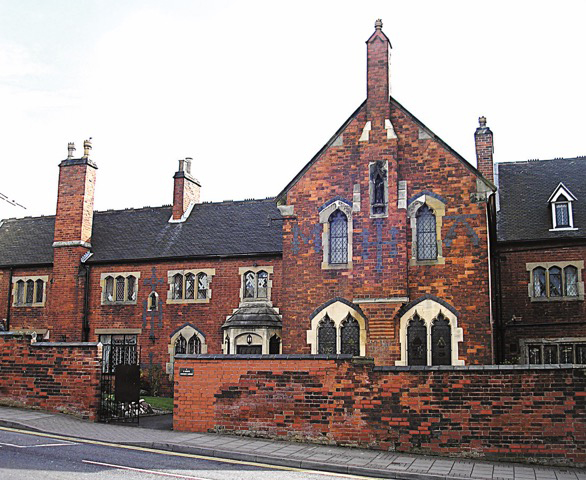
As Pugin had designed the church in Bridge Gate, it may have just been a lazy assumption, but it is worth noting that the SHCJ’s new premises in St. Leonards were designed by Pugin’s son, Edward, whilst the Sisters of Mercy’s second convent in Lozells, Birmingham was designed by Augustus Pugin. This survives and bears an uncanny but simplified resemblance to the Nottingham Road convent.
It would by lovely if positive evidence were to turn up but, in the meantime, the various objects which were saved from it all – candlesticks, ceramics and so on – certainly look like possible Pugin designs. Nor were odd items of the furnishings all that was sold. The cast iron railings on the frontage with Nottingham Road were snapped up by Derby architect Henry Stevens and re-positioned in front of his Derby College for the Training of Schoolmistresses in Uttoxeter New Road, whilst two arches were incorporated by him in the Corporation Hotel which he was then building by the cattle market, which opened in 1868.
Unfortunately, the railings were commandeered to go to make cast iron Spitfires in 1942 and the arches went with the hotel’s demolition in 1970, although part of one appears to feature on the angle of the Smithfield Tavern, Meadow Road, it once a close neighbour of the Corporation Hotel.
Hence, the entire building disappeared without leaving a trace surviving today – including the name of the architect, In my view he could be either of the two Pugins, bearing in mind their association with the two religious orders involved. No local architect could have designed such a grand high Gothic structure at that early-ish date, either.
In the end, we shall probably never know the answer.