







Wingfield Manor
Distance: 3.8 miles
Time: 1.20hr
Difficulty: Easy
Parking: On a pull in along Inns Lane
Elevation: 420ft
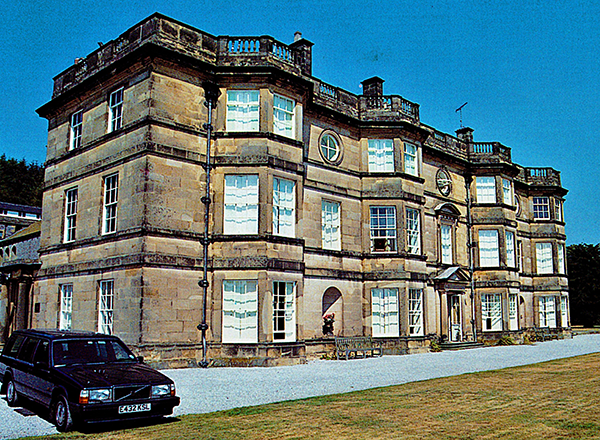
Perched above the village of South Wingfield, Wingfield Manor stands as one of Derbyshire’s most impressive medieval ruins — a vast 15th‑century great house whose broken towers and courtyards still dominate the surrounding hills. Built in the 1440s for Ralph, Lord Cromwell, Treasurer of England, the manor was conceived as a statement of wealth and power, combining luxurious domestic spaces with fortified features typical of the late medieval elite.
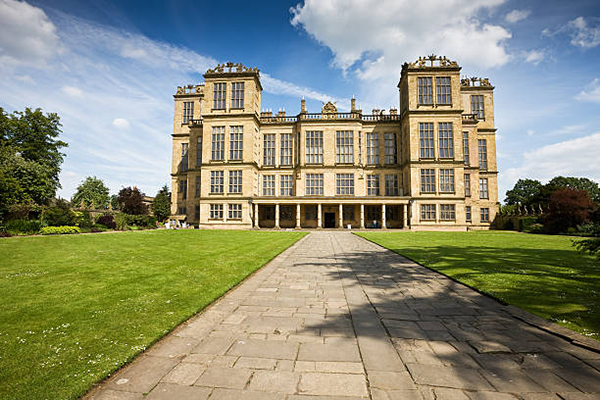
As you begin your walk, you’ll notice how the manor’s elevated position was carefully chosen. From here, Cromwell could oversee his estates while enjoying a residence that reflected his status. The layout — with its double courtyards, great hall, gatehouses, and high tower — became influential in later aristocratic architecture, inspiring designs at places such as Haddon Hall and even Hampton Court.
After Cromwell’s death, the manor passed to the Talbot family, Earls of Shrewsbury, who held it for nearly two centuries. Under their stewardship, Wingfield became entangled in national events. Most famously, it served as a place of confinement for Mary, Queen of Scots, who stayed here during her English captivity in 1569 and again in the 1580s. Her presence brought political tension, rumours of escape plots, and a household so crowded — more than 200 people at times — that the Earl complained the manor had become “unsavoury.”
The manor’s fortunes declined during the English Civil War, when it was held by Royalist forces, besieged, and later deliberately damaged (“slighted”) to prevent further military use. By the 1770s it was abandoned, leaving the dramatic ruins that now rise above the fields.
Today, Wingfield Manor is closed to the public due to structural instability, though it remains a striking landmark visible from surrounding footpaths. As you walk the lanes and farmland around South Wingfield, the manor’s towers appear and disappear between hedgerows — a reminder of the area’s deep medieval roots and its role in Tudor intrigue.
Step‑by‑Step Walk Guide
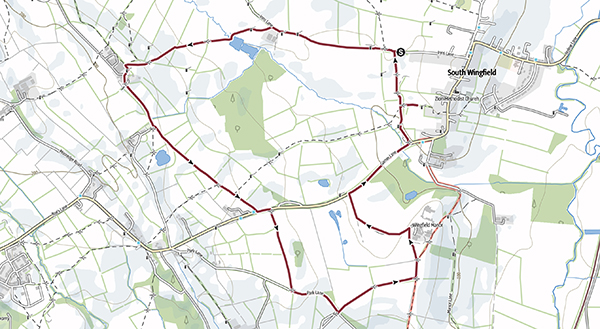
We parked on Inns Lane South Wingfield just where the houses are on your left-hand side, making sure not to block anybody’s drive, and then we go straight ahead down the lane.
When you get to the end of the houses, we cross the road so that we are staying on the footpath which is on your right – you’ll come to a 60 limit sign and there is a footpath on your left but we’re not taking that one. We are carrying straight down the road for a little bit longer.
After a few minutes walk, there’s a farm on your left-hand side and a couple of houses called Riley’s AC – the footpath is on your left.
You’ll see the footpath we walk through the farmers field.
Here you will see a couple of ponds in front of you so we head to the corner gate on the right hand side of the pond.
We head through the gate of a fishing pond and then up to the right you’ll see a little gap in the hedge. This part was very muddy just through the gateway so be careful – the hedge in front of you has a little gate which you will see, we’re heading for that.
The little gate in that field has a very strong spring on it so you will need a little bit of brawn to get through.
Head diagonally again up to the left hand metal gate where you will see a post which has a little footpath sign on it, not the one directly opposite the way you’ve just come.
Go through the gap, and the footpath sign is pointing up left towards the farm – now this is a steep hill take your time.
When you get just over the brow of the hill, you’ll see a farm gate in front of you and then a little gap to the left. Get to the big tree before you go through the gate – take a moment to turn back round down to those fishing ponds – the view is fantastic. I’m not even sure where you can see too but it is very far.
Follow the footpath to the right. Where you’ll get to the big metal gate in the far right hand corner, and there’s a little metal gate to get through and then we’re heading left.
So we head left on the farmers track and then you go past the farmer house. So come out into the farm yard and then head straight left onto the roadway. Go through the gateway and we head all the way down the farmers track.
From here we head left down the track – go down to the end of that lane and you’ll see a brown gate. Here we head straight down the fields a keep going along the track.
There were some horses in this field, but they were more interested in the grass than us.
Now we walk to the right hand side of the ploughed field – so keep going all the way to the end where we head past the large house on the right which has a big field and some large garages.
Here we have to head out onto the road and turn left, and we’re looking for a footpath just a few yards down on your right hand side with a green footpath sign. Be careful crossing the road as it is a 60 MPH but isn’t usually too busy.
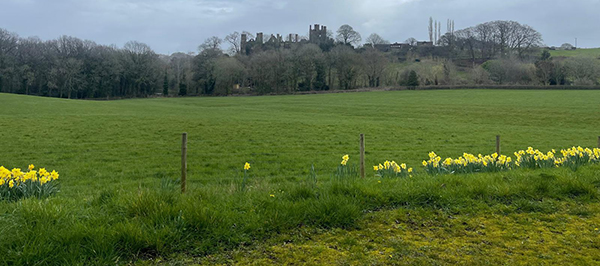
Then we head across the field keeping to the right hand tree line, and then you’ll start to see the ruins of Wingfield Manor on your left.
In the right hand corner of that field is a little style we’re going to head over there and then we’re turning left onto the road. We are now heading into Wingfield Park. If you want to take a short cut there’s a lay-by here where you can park, and just do a little circular walk around the Manor and then come back.
Opposite the driveway on your right, there’s a little gap in the hedge on the left hand side with a few steps up into the hedge and here the path goes straight across the field. Head straight across the field with the farm buildings in front of you.
Follow the path through the second field all the way to the three trees in the far right corner. From here we head left on the track where you’ll see the start of the ruins on the left. We are heading past Wingfield Manor now. This is a working farm so be mindful.
Go through the farm gate and then we won’t follow it to the left of the big barn. Instead go past the ruins all the way down the track and you’ll see a sign for Wingfield Manor where we go left now down past the ponds and out onto the main road.
Head onto the main road, turn right and stick to the grass verge till you get to the bottom of the hill.
There is a footpath all the way down the road. When you get to the bottom of the hill where the 30 sign is there is a footpath on your left-hand side just before the 30 sign.
Follow the path down to the left-hand side of the field and then it will bend to the right where we go over a little Brook.
We go through a metal gate but there were cows in this field but it is quite a big field so we were ok. Head straight to the right hand side.
Part way up the field you will see a little sign on the gate to the right but we don’t want to take that one, we are to carry straight ahead into the hedgeline in front of you where there’s a large piece of stone and a little gap.
Go through the field and then we’re back on Inns Lane where we started. Head right, out of the field and you will be back on Inns Lane.
If you fancy a pint, get back into your car and head to the end of Inns Lane the way you walked – you will find the White Hart on your left which serves food too. In the centre of the village on Manor Road is the Old Yew Tree Inn, a traditional village pub. Going down Church Lane there’s the The Bleubell. Choices! Choices!