
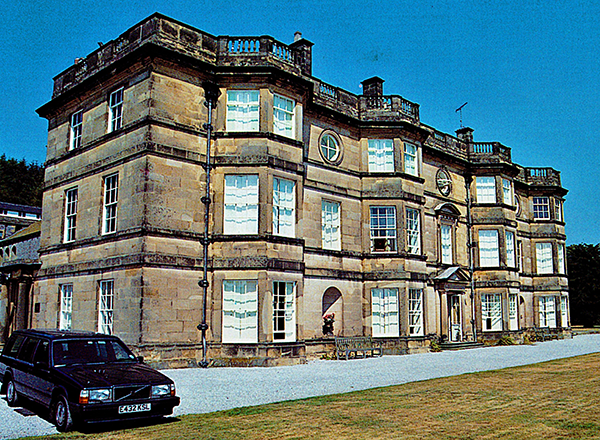
Hassop is a delightful place to visit and was always an upland estate, but a very rich one, having numerous veins and rakes of lead in the limestone beneath, shafts leading to some of which were revealed when the Stephensons – last domestic owners of the estate – were making alterations to the hall a century or so ago.
This abundance of lead attracted a series of grand owners, from the Daniels and Foljambes of Tideswell, through the Yorkshire Plumptons, of which family Robert Plumpton sold the estate to Catherine, widow of Stephen, 11th son of the generationally prolific Robert Eyre of Padley, this Stephen having been Plumpton’s tenant at Hassop, busy mining and trading the lead. That the family had held the tenancy as far back as the time of the Foljambes is apparent from the Eyres bearing the Foljambe family’s ‘severed leg’ heraldic crest, indicating a grant by them to the Eyres pre-dating the regulation of arms by the crown in the early 15th century.
Whilst the Eyres doubtless had a manor house at Hassop from at least the time of their lease in 1480, the estate – at its peak of 20,000 acres – was only consolidated in 1584-90, aided by the marriage of Rowland Eyre (1533-1624) to Gertrude, daughter and heiress of Humphrey Stafford of Eyam, another lead-rich landowner. The accumulated wealth thus allowed them to build a new house.
This house, was allegedly started in 1594 and apparently took four years to build. This date is called slightly into question by a stone discovered when the west wing of the present house was being demolished in 1955, bearing a crudely carved crucifixion with figures either side in Elizabethan costume, below which is the date 158[ ]. This either commemorates the tragedy of the Padley Martyrs – bearing in mind that the Eyres were recusant Roman Catholics in an age of relentless persecution – or was a datestone for the new house, but no doubt carrying the same or similar message, too. It was, however, found facing inwards, as one might expect in the circumstances of the age.
The house reputedly consisted of (here I translate from the slightly opaque English of the original 17th century inventory):
A portico containing four rooms: a hall, a parlour (panelled), a buttery and two cellars; a kitchen, larder and pantry below stairs, [on the first floor] a small dining room (panelled), a two room nursery and 21 panelled bedrooms with three closets all built of stone; a bakehouse, brewhouse with store chamber, servants’ hall over, dairy and several rooms for servants and conveniences.
This description is backed up by the 1670 hearth tax return, which tells us that the house was assessed for tax on a generous 20 hearths and the elevation on the map of the estate drawn by William Senior in 1618.
This tells us that the two storey stone house had a south front consisting of a western part of thee gables containing attics and a further section, to the east, with the entrance in a decorative surround (perhaps the ‘portico’ mentioned above) and two or three further bays, all lit by mullioned (and possibly transomed) windows. What looks at first sight like a pyramidal roof, is in fact Senior’s attempt at foreshortening from an elevated perspective of a wing facing west (where the crucifixion stone was later found) and running north towards the rising ground.
Very often with recusant families, the fines imposed upon them by the Crown in the 17th and eighteenth centuries, frequently precluded the luxury and expense of building, but clearly the lead-derived wealth of the Eyres allowed them to overcome such constraints, aided by their habit of marrying heiresses fairly regularly.
Rowland Eyre’s son Thomas died in 1637 and was succeeded by his son, Rowland, who faced not only recusancy fines but a civil war that forced him to take sides. As Charles I offered the best hope to Catholics, he raised a Regiment for the king (of which he was colonel) but, in the disastrous outcome of the war (from the Royalist viewpoint at least), he was also on the losing side and had to compound for his estates to Parliament for £20,000 in order to retrieve them from sale and dispersal to cronies of Cromwell’s supporters.
The colonel’s son, Thomas died in 1685, having not long outlived his father but the next generation, in the person of another Rowland (1657-1729) appears to have modernised the house, but lack of any illustration of it between 1618 and the completion of its replacement makes understanding what he achieved somewhat difficult. The presence of a number of bolection moulded chimneypieces (some in locally sourced polished limestones) suggests such work was undertaken.
It was only from the fabric of the replacement house, that further evidence of the old one could be adduced. Crucially, all the archival evidence for the house omits anything prior to the beginning of the 19th century, after which it is relatively abundant.
From this, though, it is possible to say that the footprint of the main south front and a small area of the west included the retention of the old outer walls and that the presence of one late Elizabethan chimneypiece with plaster overmantel and a mullioned window in the top floor suggest that what happened was a partial demolition only and a grand re-fronting to the south, the date of which has never been completely cleared up. On the east wall, too, the parapet is marked, instead of balustrading, by a row of eight merlons – decorative cresting – as decorate the parapets of Barlborough and North Lees Halls, both late Elizabethan houses attributable to Robert Smythson, designer of Hardwick. This suggests that, contrary to a professional report of 2019, the original house almost certainly extended the far east end of the façade and that the present east wall, suitably adapted, was part of the original fabric too.
Older local sources always say that the replacement house was put up in the ‘early 1820s’ but this date actually represents a later rebuilding of the new house. The present façade itself is seven bays wide, marked by a central pedimented entrance flanked by two full height canted bays on either side. It looks uncannily like Joseph Pickford’s new façade of 1763 of the Grey House, Church Street Ashbourne, with matching extensions, although there are no grounds for connecting Pickford with it otherwise. It does, however suggest that 1763-1774 might about confirm the correct date – probably nearer the latter, as the interiors have good neo-classical plasterwork – shades of Kedleston, where Pickford worked 1774-1782 – in the main rooms.
Yet whoever designed the new house for Rowland Eyre (1712-1777), saw fit (or was asked), to retain a part of the original cresting on the shorter, east front, probably at the behest of Rowland. It was his brother, Francis (1732-1804), who inherited from Rowland’s eldest son in 1792 and later his son Francis, styling himself (erroneously as it turned out) Earl of Newburgh, called in Catholic architect Joseph Ireland in 1816 to build the Catholic church of St. Mary, in the style of Inigo Jones’s St. Paul, Covent Garden, set above the house on the edge of the village. The same man returned in 1820 to add the west wing (reduced to ground floor level in 1952) and in 1827 to add the spectacular ballroom to the north, along with other estate buildings.
When the Eyre line failed, the estate came to Col. Charles Leslie, 26th of Balquhain Castle, Aberdeenshire, whose family sold up in 1919 to Col. Sir Henry Stephenson, 1st Bt. MP, a Sheffield grandee.
Hence our lost house may not be completely lost, but only in part; the remains are clearly embedded for posterity in the fabric of the present, very grand 18th century house now, after 45 years as a superb hotel, back in private domestic ownership – the role, indeed, for which it was originally built.