The Lost Houses of Derbyshire – Blackwall Hall

When one speaks of houses that are lost, one speaks of houses built, lived in and eventually discarded as redundant, too expensive, too damaged or too inconvenient to continue living in. With regard to the potentially spectacular house that Bess of Hardwick no less, built or intended to build at Blackwall-in-Peak, none of the above need apply, for it is by no means certain that Bess actually completed her new house there or, indeed, even began it. Blackwall-in-Peak is more generally spelt Blackwell these days, which is a reversion to the Blachewelle of Domesday Book (thus, ’dark well’), although by the early 14th century it was invariably spelt Blackwall, which usage continued until relatively recently. Blackwall was one of those manors in Derbyshire held in chief by William Peveril, and his tenants there seem to have taken their name from the place sometime in the late 12th century or a little later. By that time, however, Peveril had granted his estate there to Lenton Priory. Mind you, Lenton is a good way from Blackwall, which lies just north of the A6 west of Taddington, which meant that the prior and canons of Lenton were obliged to appoint a man on the spot to collect the rents and tithes in the township, and the evidence is that this was done by the leading free tenants, the Backwalls. Indeed, by the early Tudor period, Richard Blackwall of Blackwall had been appointed to the office of collector of rents and tithes on behalf of the Priory at an emolument of 40/- (£2) ‘and a gown’. Once dissolved, however, the manorial estate was in the hands of the Crown until 1552 when it was granted to Sir William Cavendish, then freshly arrived in Derbyshire as the second husband of Bess of Hardwick. Within a few years, the rent collecting proclivities of the Backwalls having been made redundant, the family migrated south to Kirk Ireton, where they built a new, still extant, manor house and from whom it took its name. Bess, meanwhile, two further hubands down the line, had turned herself in to something of a mega-builder, inspired in all probability by Sir William’s efforts in rebuilding Chatsworth, especially his use of the high house style, whereby the grandest reception rooms were placed in the uppermost storey (as in the east facing long gallery at Chatsworth) so that Derbyshire’s incomparable views might be best appreciated, inspired by Prior Overton’s tower at Repton and the high tower at Wingfield Manor. After her estrangement from her fourth husband, Lord Shrewsbury, Bess began to rebuild her ancestral home at Hardwick along similar lines, but without the benefit of much architectural discipline. Once widowed, she brought in Lord Shrewsbury’s architect, Robert Smythson, to build anew all over again a few hundred yard to the NE, to produce the spectacular Elizabethan ‘prodigy house’ of Hardwick Hall with its upper storey long gallery and state rooms, a flat roof peppered with banqueting houses in the towers on which to enjoy summer evenings, classical detailing, and an innovative through hall. Indeed halls, prior to this point, were invariably set longitudinally along the main façade of a great house with the main entrance at one end and a screen at the other through which access could be made to the services. At Hardwick, however, one goes up into a hall that runs away from you through a screen across with the width of the building. Nor did she stop there, for almost simultaneously, Bess began building another house of similar size at Oldcotes, Heath, for her son William Cavendish, which was very much in the Hardwick mould and which appeared in Country Images for November 2015. However, she wanted more. Between 1590 and 1600 (on the estimation of the late Mark Girouard) she commissioned Robert Smythson to design another house, plans for which remain in the Smythson collection of the RIBA now housed in the British Library. The plan for the principal floor (to be built, like Hardwick over a raised basement of lower ground floor) is headed, in Smythson’s witing, ‘A House for/Blackewall in the/Peacke.’ You might ask, why would Bess want another country house only 15 miles from Hardwick, and in an elevated (and frankly, very exposed) position, despite the views? The answer lies in the plan. Like Hardwick, it was rectangular in plan. With the hall running right through the principal storey. There were square towers inset from the corners of the building, but on the entrance side they were joined by the main wall, pushed forward flush with their outer sides, and not recessed as on the opposite side, a very similar effect as Hardwick, but much, much more compact. There were only two main rooms on either side of the hall, a parlour (with main stair alongside) and a great chamber. The hall was full-height, meaning that there was also space only for a pair of rooms on either side above, linked by a gallery over the hall screen (although no plan for the first floor survives, only one for the semi-basement). This lack of accommodation tells us clearly that this was not a permanent residence, but a lodge, for occasional use. In Elizabethan times there were two main types of grander lodge: either a retreat to which the family could repair once a year whilst the main house was cleaned from top to bottom, or as an occasional residence for either watching or indulging in the chase. A classic example of the former (of similar size and date) is Lord Burghley’s Wothorpe Lodge near Stamford, barely more than a mile from the main house and now a ruin. Yet the compact plan and notable tallness are very similar. As regards hunting lodges, a closely related building, although with a very much more compact in plan, is the hunting stand designed for Chatsworth by Smythson in about 1585; Wardour old castle a rebuilt Medeival keep, attributed by Girouard to Smythson c. 1570, is closer in scale,
Walk Derbyshire – Along Lover’s Walk – Ilam

The popular village and National Trust property of Ilam and its hall, are based on a Saxon settlement, later expanded in Victorian times. In its early days it was where the early Celtic Christian missionary St Bertram baptised his flock, using a well on the slopes of Bunster Hill to the north of the village for that purpose. The Saxon villagers took advantage of the comparative safety offered by the sheltered hollow created by the joining of the rivers Dove and Manifold. In the mid1800s Jesse Watts-Russell a shipping magnate and industrialist, employed the services of the Victorian architect James Trubshaw to replace the Elizabethan mansion and farmhouse with the picturesque Gothic palace with its fairy-tale embellishments. As part of Watts-Russell’s grandiose scheme, the old village, a mixture of cottages hundreds of years-old, he employed George Gilbert Scott to design the alpine style cottages which, complete with their attractive gardens, are a never ending delight for today’s visitors. He is often confused with his ennobled son of the same name, who moved on from designing pretty cottages, to being responsible for grandiose schemes such as the design for the rebuilt House of Commons, Battersea Power Station and Liverpool Anglican Cathedral, along with the now fast disappearing GPO red telephone boxes. Jesse Watts-Russell erected the Eleanor-style cross at the road junction beside the pretty cottages of Ilam village. Meant as a memorial to his first wife unfortunately if historical folk-lore tales are right, she was never popular with his estate workers. Intended as a competitor to the standards of the Earl of Shrewsbury’s estate at Alton Towers, the Watts-Russell family despite the expense and upheaval only lived at Ilam for a couple of generations. Since then the hall had a short life as a country hotel, then having been gifted to the National Trust, it became a popular venue for youth hostellers. Despite the current slimming down of YHA’s property portfolio, Ilam will be one of YHA’s four Peak District hostels, making it an ideal base for school parties and family groups exploring Dove Dale and the surrounding area. While the walk does not visit the popular Dove Dale Stepping Stones and manages to keep well and truly inside the Staffordshire section of the Peak District National Park, it does, however visit the Manifold Valley, the lesser known dale within the south-eastern section of the national park. Not only is the Manifold an attractive dale steeped in history both archaeological and political, it once had a light railway, designed to serve the needs of dairy farms and cheese factories based on the lush pasture offered by the underlying limestone rocks. It is this limestone that gives the Manifold another unique feature, which together with its tributary the Hamps is its most unusual feature. In dry weather long sections of both rivers seem to dry up. This apparent ‘drying up’ is not actually correct, because the rivers still flow, but are underground from near Wetton Mill in the Manifold, emerging rather coyly in dribs and drabs along a section of the Manifold half a mile upstream of Ilam Park and Lover’s Walk. This walk is an ideal way to explore the western bank of the Manifold Valley, well away from crowds flocking to the magnetism of Dove Dale’s Stepping Stones. Climbing the steep by-road winding above the wooded slopes of Hinkley Woods to the tiny hamlet of Blore, a view of the little known Weaver Hills opens to the west, across the Churnet Valley to Alton Tower’s mechanical amusements. The walk, however does not go so far, but turns right and then goes downhill to cross the maybe dry River Manifold in order to join a woodland path, back to Ilam Hall and its ever welcoming tea rooms and the dramatic view of Bunster Hill, guardian along with Thorpe Cloud of the famous Dove Dale Stepping Stones. THE WALK :: THE WALK :: THE WALK :: From Ilam Park National Trust car park, walk with the hall on your right, cross the grassy playing field between the hall and St Bertram’s church. Go down to the river and cross the hump-backed ancient stone bridge. Climb the wooded slope for about fifty or sixty yards, until you reach an open field. Follow the faint path as it curves to the right, uphill until it reaches the unfenced road. Cross over the road and follow a faint path, gently curving, still uphill, past a narrow belt of trees, keeping to their right for about a quarter of a mile until you reach the cross roads outside the tiny village of Blore. Turn right at the cross roads and follow this road for about half a mile until it starts to bend left where there is no enclosing wall on your left. N.B. If using the 1:25,000 scale OS map as an alternative, you will be off the map for a few yards at this point, but the way is clearly marked on the Images map attached to this article, or on the Ordnance Survey 1:50,000 scale Landranger map as recommended in the introduction. Turn right just before the bend and follow a grassy path towards, then to right of a small hill topped by a clump of trees (Hazelton Clump). Begin to go downhill towards a larger stretch of woodland on your right (Hinkley Wood), but do not enter. Cross a shallow dip and descend towards Upper Musden Farm. Reaching the farm, but not entering its yard, turn right and go downhill again for about three quarters of a mile. Cross a series of six small fields, following their boundaries by stiles and gates. Go past Musden Grange Farm and then walk through woodland, downhill to a path coming from your right. Turn left on the path and follow it for about 100yards as far as a minor rod. Turn right and follow the road downhill to Rushley Bridge. Pause and look over the side of the bridge and see if
Dining Out – Meynell Langley Gardens & Tea Rooms

Which ever way your journey takes you, the approach to Meynell Langley Nursery is through the most pleasant, verdant, typically English countryside that you could wish for. Meandering down twisting country lanes you could imagine yourself back in the days of the grand country house, where kitchens were supplied with produce, lovingly cultivated in the shelter of walled gardens run by gardeners with years of experience at their fingertips. It’s no surprise therefore that when you drive down the lane to Meynell Langley Nursery that you are already feeling more relaxed. The pine wood lodge of the Tea Rooms is warm and inviting and on cooler days the log burning stove provides a welcome warmth. Friendly staff are soon on hand to help, and once you have chosen your table you can look through their varied menu. Lunches range from sandwiches and toasties to hot food and are served to your table. As a regular visitor here I always enjoy the home-made quiche served with a fresh salad, crisps and coleslaw, although this particular day I decided to try the fish platter. This had generous portions of smoked salmon, prawns and mackerel. Served with gherkins, salad and chunks of bread it was a lovely summer lunch. My husband chose the home-made lasagne, served in an individual dish with salad, crisps and coleslaw, this seems to be his favourite which I think speaks for itself. You can also enjoy an ‘afternoon tea’ of finger sandwiches, a selection of hand-made cakes, fruit scone with jam and clotted cream all served freshly with tea or filter coffee (but you’ll need to book). At the bar there are a delicious array of home-made cakes including many gluten free (which makes a refreshing change) to choose from. These include old favourites along with some interesting new ones. Taking our time over a cake, fresh coffee and cup of tea, we saw some friends whom we hadn’t seen for 6 years, so it was an added treat to catch up with their news. There is such a lovely atmosphere here, it’s difficult to put into words but it draws me back time and time again……..oh, and the nursery too where you can still get proper horticultural advice which is priceless. I’m off to choose a tree now, ‘another says my husband’ but I’m only doing my bit for the environment!!! My thanks to Karen and her staff for another lovely lunch; always consistent, always relaxing. Tea Room open times are weekdays10-4.30 (summer), 10-4 (winter) Sundays 10-4. Nursery open times are weekdays 9-5 (Sunday 10-4) 00
Dining Out – The Machine Inn, Ashbourne

You may, like me, wonder what the Machine Inn in Ashbourne and a corset have in common, and your interest may be further piqued when you see the simple line drawing that identifies one of Ashbourne’s newest restaurant and boutique hotels. But looking into the history all becomes clear as for 125 years Ashbourne was home to local corset makers Richard Cooper & Company. In 1855 a successful partnership with Charles Smith flourished and by 1898 they had 500 employees. Such an industry no longer exists in Ashbourne, but new life has been breathed into the town by Henfox, a company with its finger firmly on the beating pulse of Ashbourne. On a beautiful sunny August day, we were invited to lunch at the Machine Inn and enjoy this lovely venue. Immediately the friendly atmosphere told us that we were going to have a relaxed lunchtime experience. The décor is clean, contemporary and uncluttered, with well-spaced tables and comfortable seating. The menu too is well considered with a selection of sandwiches served with salad garnish and chips, and salad options, but what caught my eye was the ‘Small Plates’ menu. I really love this way to lunch and was so glad to see it introduced here. Choosing from either 2 or 3 plates, the focus clearly is on classic dishes with a modern twist. A highlight for me was the roasted trout fillet, the skin crisp and well-seasoned, the flesh pink and moist, sitting on a bed of dressed lettuce, the addition of a potato salad and heritage beetroot were all that was needed. Sharing the plate of Tempura vegetables, the batter was light and crisp while the vegetables within retained their shape and flavour. Similarly, the mini sausages were roasted in honey with a mustard and parsley glaze, the Caesar salad and Heritage tomato salad all had expertly balanced dressing to lift and add interest. Desserts came with the same attention to detail; homemade vanilla shortbread, but not overly sweet, served with the spiced coffee crème brulee, and Poached summer berries with crushed meringue and Chantilly cream. Then to finish a coffee that for once was served piping hot. This was a menu that had been put together with obvious care using the best of ingredients, seasonal and locally sourced, simply presented with care and understanding, all a fitting accolade to the experience of Executive Chef Dan Fincher who has worked previously in Michelin Star and AA rosette restaurants including Gordon Ramsey’s at Claridges and the Waldorf Astoria Versailles. The Machine also has 4 luxury, boutique style rooms above the restaurant which all showcase the same attention to detail. The parent company, Henfox will be opening new venues in the old Nat West and Swiss Cottage buildings while refurbishing the historical Horns pub on Victoria Square. Their aim is to revive these venues whilst preserving their original historic features with care and consideration. We met with Henfox Owners Chris and Andi Harvey who a few years ago moved to Derbyshire from Florida, having sold an extremely successful business and wanted to invest in real estate locally, putting something back into the community here in Derbyshire. I must add that Chris is from Derbyshire originally and Andi from West Virginia. Their professional and yet relaxed approach to business was refreshing as they explained their vision to us. Town centres over the years have taken rather a beating and Chris and Andi want to play a big part in breathing life into Ashbourne. They are both very down-to-earth people with a passion for making sure that all who work for them are happy in their work, ensuring that this feeling is passed down the line to their customers. We can’t argue with that as our experience at the Machine Inn lived up to all expectations. Our thanks to our hosts for a truly refreshing lunchtime experience. Machine Inn, 6 St John Street, Ashbourne. DE6 1GH t.01335 682380 00
Celebrity Interview – Mark Thomas
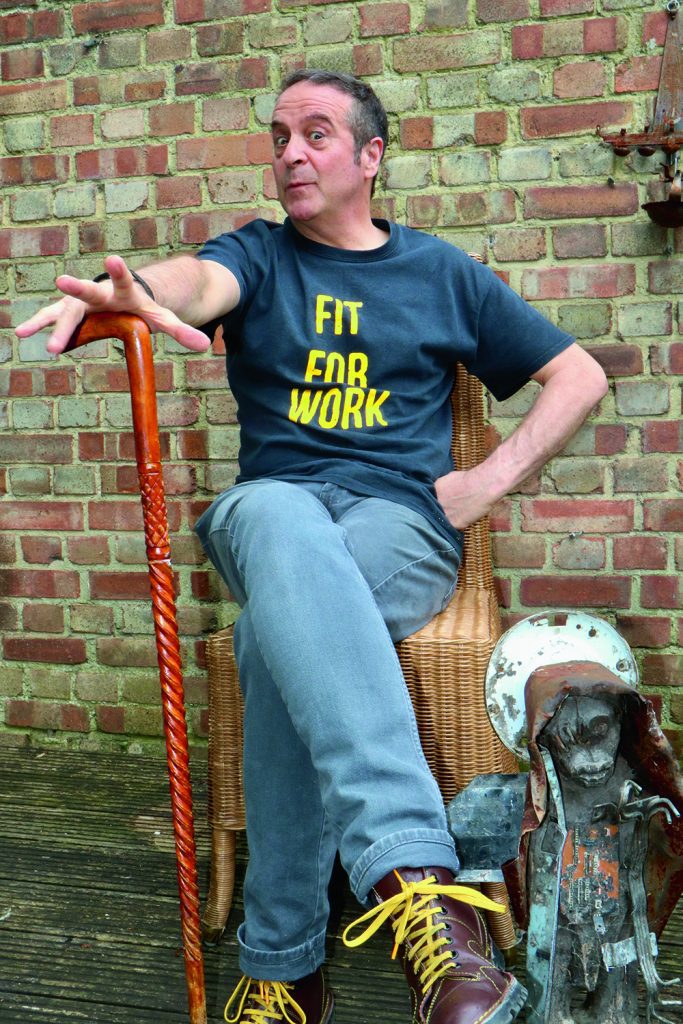
Mark Thomas is exhausted – he uses a more colloquial term – yet exhilarated. The comedian, writer, presenter, journalist and activist has just completed another one-man show at the Edinburgh Fringe, “the world’s largest performance arts festival”, that he’s been attending for the past 41 years. An hour later he’s telling me why for the first time he’s performing a play he didn’t write: England & Son by Ed Edwards. He must enjoy it because he was scheduled to present the play 23 times north of the border and then has 54 shows lined up including a couple in Nottingham up to the beginning of December. Mark first met Edwards in 2018 after seeing the Manchester playwright’s show The Political History of Smack and Crack. “I said to my partner ‘that was brilliant’ and a voice behind me went ‘I wrote that’. “We got on like a house on fire. I loved his show and we said we’d work together. We were both up in Newcastle doing some work and kept meeting up. “The play started in a very organic way where we were just talking about upbringing and attitudes. All the stuff in the show is true. There’s part of my life in it and there’s part of his life in it. “Ed doesn’t shy away from the fact that he’s an addict and he did three-and-a-half years in jail for drug dealing. He’s clean now. That experience and the experience of trauma and trying to break through trauma is a fascinating thing to look at.” England & Son picked up several five-star reviews and Mark admits he comes alive on stage. “I love it. I feel happiest performing. It gives me enormous pleasure to perform. It’s where I feel freest, it’s where I feel I can be most inventive in stand-up and in my own shows, and most expressive in other people’s. It’s great. I adore it.” Mark Thomas was born on 11th April 1963 in south London. His mother was a midwife and his father a self-employed builder. He developed an interest in politics during his teenage years – his views are definitely left-wing – before being awarded a degree in theatre arts at Bretton Hall College, Yorkshire. After guesting on radio and television shows, his big break came when he was given his own political comedy show, The Mark Thomas Comedy Product, by Channel 4. It ran for 45 episodes from 1996 to 2002. In one episode Mark investigated the practice of avoiding inheritance tax by declaring art, furniture, homes and land available for public viewing. It led to then Chancellor of the Exchequer Gordon Brown changing the law. Mark has been credited with bringing in millions of pounds for HM Revenue and Customs. He’s taken the police to court three times and won twice; he’s given evidence to Parliamentary select committees on two occasions; he cost a councillor and a government minister their jobs; and he tried to get the government in court over the Iraq war. He actually stood for Parliament in a 1996 by-election – but it was part of a television series and Mark was an independent in the safe Labour seat of Hemsworth. He came eighth out of 10 candidates. Would he stand again? “No, I’m not interested. I’d steal all the money and spend it on sweets!” he jokes. But he’ll continue to protest. He once held the Guinness world record for holding 20 protests in 24 hours. He says these days there’s plenty to protest about. “We’ve got 70% of recipients of foodbanks who are in full-time employment. That’s insane. And we’ve got a massive cost-of-living crisis.” Mark who has two grown-up children continues: “We’ve got culture wars where people are being attacked” “We can’t have this level of violence towards minorities, towards people who are asylum seekers. You get people trying to burn hotels, trying to stop lifeboats being launched. All of this has got to stop. So there’s a lot to protest about.” What should people do to make their voice heard? “Whatever they’re comfortable with and whatever they’re able to, whether it’s through trade unions, campaigning groups, direct action – I don’t have a silver bullet, I don’t have a panacea for that. I just say ‘look, do whatever you can and every bit counts’,” says Mark. He endorsed Jeremy Corbyn before the 2019 general election but is not a fan of Sir Keir Starmer who Mark thinks is a “complete waste of space”. He thinks the problem with politics in this country is the first-past-the-post voting system: “You’re appealing to a very small number of people in each constituency to swing the vote. That means you’re skewing your electoral process towards that. If we had proportional representation the policies would be different. Obviously the system is broken.” We go back to talking about the Edinburgh Fringe, a topic which has caused controversy because of the huge increase in the cost of accommodation. Many artists lose money going to Edinburgh, taking months or even years to clear their debts. Mark stays out of town to save money because “the Airbnb business is nuts!” He suggests improvements: “There should be pressure on Edinburgh university as a landlord of a huge number of venues to bring down the rent so that people don’t have to pay as much to go and perform. And that means ticket prices can come down which means it becomes more accessible. “You can get the Fringe Society to put pressure on venues to pay all their staff the living wage. Edinburgh is still brilliant but there are things you can do to improve it.” Despite that some artists feel they have to go to Edinburgh: “It’s essential for me because I really like it. I completely love the place. It’s still one of the most exciting places to be. “You can see anything you want. I saw a Korean company do Euripides’ The Trojan Women in the style of pansori (in which
Celebrity Interview – Neil Smith

Co-Founder of the International Gilbert & Sullivan Festival Thirty years after the festival was first staged at Buxton Opera House it’s back at the Derbyshire town in its entirety, with professional productions, a competition for amateurs and performances by mature performers as well as youth groups. The International Gilbert and Sullivan Festival was founded in 1994 by Ian Smith and his son Neil who were both fans of the dramatist W S Gilbert and the composer Arthur Sullivan. “My father was the Drummer Boy in The Gondoliers when he was about 15 for the local church society,” says Neil. “It was a huge part of his life and then of course I got involved as well.” They became members of a West Yorkshire arts appreciation society which toured to the United States and went to the Waterford International Festival, a competition for amateurs in Ireland. “I remember having a conversation and saying to dad ‘wouldn’t it be interesting to do Gilbert and Sullivan on its own?’ and thought no more of it. “Dad obviously thought a lot more about it and said we should look at doing it somewhere in the UK. And we ended up in Buxton. “As we were driving there, I said ‘where’s Buxton?’ I’d never heard of it. We dropped down into this magical little place and right in the centre was this amazing Opera House.” The theatre director at that time thought the G&S Festival was a good idea. “He wouldn’t let us leave until we’d signed a contract,” Neil states. The first festival was staged in 1994 by Neil and Ian who died in 2019 at the age of 80. It is now produced by Ian’s wife Janet and 56-year-old Neil “to preserve and enhance the knowledge, understanding and appreciation of the works of Gilbert and Sullivan”. It’s still a family affair: Neil’s brothers Oliver and Charles work in the office while Neil’s daughter Phoebe performs in the Opera Company. From the beginning the festival was able to attract the finest exponents of G&S. The family were good friends with John Reed who was with the legendary D’Oyly Carte Opera Company which staged G&S operas until it closed in 1982. “He agreed to be the festival president in year one and because of his contacts he was able to bring in all these other big names from D’Oyly Carte. “For keen fans who only ever go to see these people at the stage door, suddenly they were walking around the town and you can’t really hide in Buxton. They were having breakfast with them or whatever. It was terrific,” says Neil. During the first year the Smiths brought in three groups from America who gave the festival credibility. “At that point it was an amateur-only competition. You did your performance and as the curtain came down an adjudicator came out, stood on the stage and gave a 20-minute crit of what he’d seen. A lot of people in the UK were used to this – the Americans were horrified!” Ticket sales were low at the start of the first year but increased to such an extent that the Smiths decided to continue with the festival. Now the professional National Gilbert and Sullivan Opera Company performs three productions each year. The main part of the festival relocated to Harrogate in 2014, with a week of mostly professional shows in Buxton preceding it. But last year the Harrogate venue was losing money and put its prices up by so much that the festival couldn’t afford to stay there. Fortunately Buxton Opera House was able to accommodate its return. The 2023 festival will feature new productions of three ever-popular G&S operas, The Yeomen Of The Guard, The Mikado and The Pirates Of Penzance. Last year Utopia Limited, one of the least performed G&S operas, didn’t sell as well as the organisers would have liked, especially as there was still reluctance on some people’s part to return to live shows after Covid. The festival doesn’t get any money from the Arts Council although in 2020 it received £120,000 from the government’s culture recovery fund – a “godsend”, according to Neil. Staging the festival is a massive operation because during the summer the producers employ two orchestras with more than 40 musicians, an opera company with another 40 people along with creative and administrative teams. “We have to be really careful – everything we do is costed to the last penny. If we don’t cover the costs we foot the bill. My parents poured thousands of pounds into what was effectively a labour of love.” Ticket sales for this year are going well despite Neil’s being nervous about returning to Buxton. “People in north Yorkshire and Leeds were saying ‘I’m not going all the way to Buxton- I can’t get there and back in a night’ but we clearly have attracted audiences. “It seems to have been received very well and people are coming back to what many believe is the spiritual home of G&S.” So what is the enduring appeal of Gilbert and Sullivan? “The fact that there are still so many societies scattered around the world performing G&S suggests they did something right when they wrote these operas, didn’t they?” Neil continues: “Gilbert was an absolute master wordsmith. You read a libretto and there’s hardly a wasted word. His language is so rich and interesting. If you’re in a production you’ll come across words that you wouldn’t normally use in everyday language. They’re absolutely perfect for the rhyme and meaning of a song or a passage of dialogue. “Coupled with that you’ve got Sullivan. My goodness me, he knew how to bang out a tune, didn’t he? They complemented each other perfectly. Put it together and you’ve got this wonderful package of humour and a little bit of pathos with this wonderful music running alongside it. Never think G&S is easy because it isn’t. “What we find is if we can get youngsters involved early they
Lost Houses of Derbyshire – Morley Old Hall

For somewhere so close to Derby, and somewhere which was once on the very edge of a coal-mining area, Morley is today a remarkably sequestered spot. The village is discrete, as the archaeologists say – not nucleated, but scattered around its parish – but with a magnificent parish church, a very grand Georgian rectory and two country houses – both Victorian: the present Morley Hall from the beginning of the old queen’s reign, and Morley Manor from her last years. One would, therefore, assume that there was very little room for an old hall as well, but in that one would be wrong, for both the Victorian buildings are, essentially, replacements for what had gone before. Indeed, Morley Manor, a fine Arts-and-Crafts mansion in red Warrington sandstone by G. F. Bodley, was built for the Bateman family – the very same family which had destroyed the great late medieval manor house their ancestors had inherited in the 18th century from the Sacheverells. If one seeks any vestige of this house, it is necessary to go to the church and seek out a separate building in the western extremity of the church yard, the Bateman Mausoleum – also by G. F. Bodley – and built in 1897 out of the same red sandstone as the Manor. Standing against this structure’s decorative entrance – with its geometrical wrought iron and Bateman armorial above – is a rather ragged fragment of wall and greyer, being of millstone grit sandstone (from Coxbench quarry in all probability). The relic is called the Loaf Gate, and once saw the distribution of alms (in the form of bread) to the needy of the parish and is part of the original hall at Morley and as such it was probably a subsidiary entrance to the manor house itself. Nor is this the only fragment of a once great house for, slightly east of north from the Grade II* listed Mausoleum, stands the former tithe barn, also listed II*. It appears largely of 17th century date, but its basic structure may be earlier – it is the stone mouldings on the three light mullioned windows that suggest the date. That such domestic looking windows were added rather suggests that the structure was always part of the original main house, but had been adapted as additional accommodation in the early 17th century, possibly as a service wing. The earliest family at Morley took their name from the place – the de Morleys – and they seem to have lived in a house within a moat, the latter feature still to some extent surviving south west of Morley House Farm. Their line eventually became extinct and the heiress married a Cheshire Massey and the heiress of that marriage married a Statham of Lymm, also in Cheshire. Henry Statham, like his Massey predecessors, had a considerable estate in Cheshire and neither family seem to have lived at Morley and we may assume that the old moated (and probably timber framed) house eventually mouldered into ruin. However, there is evidence that this Henry or his father did build a new house, probably on the approximate site of its successor, early in the fifteenth century, for the family obtained an episcopal licence to have a domestic chapel in 1405. All this changed however, when Henry died, for his only child, Joan, had married a Derbyshire gentleman called John Sacheverell. He was very much in the ascendant, for while his earliest ancestor, John de Salta Caprio, had around 1130 inherited in the right of his wife a small estate at Hopwell, a descendant had acquired the remainder through marriage with Roger Hopwell of Hopwell and Wilsthorpe, whose coat-of-arms amusingly bore three conies playing on the bagpipes – ‘hopping well to their own music’ – a typical Medieval heraldic pun! John Sacheverell also held the manorial estate of Boulton and part of that of Snitterton – all accomplished through marrying heiresses. However, he clearly felt that none of these seems to have wholly suited his aspirations, for as soon as Henry Statham had died, he had sold up in Cheshire and in 1480 concentrated on building a ‘very large old building, adjoining the church…of considerable magnitude’, which we presume was an enlargement of the Stathams’ house, and was built of good quality ashlared stone, to judge from the Loaf Gate, although the tithe barn is of slightly coarser work. It is not easy to envisage the extent of the building, upon which hearth tax was paid for 16 hearths in 1670 but, if one assumes that the Loaf Gate was at the SE end of the main front (which faced SSW), and that the tithe barn was attached to the NE angle, then what lay between must have been fairly extensive, probably including a substantial courtyard, and that its western extremity lay in the field to the west of the church yard. Indeed, when the weather is dry, the footprint of the building is relatively easy to see – especially on satellite view. Not that life there was dull, not for one moment. John Sacheverell himself was killed in action at Bosworth Field in support of his king (Richard III) only five years after building his new house. His descendants thereafter kept out of politics (thus accumulating neither honours nor titles) but were drawn back into events through having remained Roman Catholic after Henry VIII’s break with Rome in 1536. Consequently, in the next generation, when Queen Elizabeth I was threatened by the Spanish, a certain amount of paranoia manifested itself. With Mary, Queen of Scots in custody of the Earl of Shrewsbury, Catholic recusants found themselves being harried by the crown’s agents, in Derbyshire heralded by Shrewsbury’s fixers. Hence it was that Morley Hall was raided in August 1581 and Henry Sacheverell briefly arrested before buying his freedom (called paying a fine!) At the time, he had as a guest a Mr. Green, ‘…said to have made all the secret places in Derbyshire’ in
Dining in Derbyshire – Taj, Alfreton

The newly opened Taj Indian Restaurant on King Street, Alfreton provided us with the opportunity to meet and share a unique dining experience, I’ll explain… Owner Vir Chijar is an experienced pizza chef of many years! That’s a twist we weren’t expecting and that’s not all as he has a vast experience in the food industry spanning a few countries and continents. Then into the equation comes Mr Asha Ran, a 5 star Indian hotel trained chef, formerly of two very well known established Derby restaurants, and curry chef Mr Rawat. You can watch Asha cooking your meal too as the Tandoor is in the restaurant area. Putting all that together and reading the menu we knew we were in for a good evening. We were greeted on arrival by Virs daughter Simran, a very communicative individual who really put us at ease with her lively chat about the restaurant and their goals for it. They all have a very down to earth view of things and it was refreshing to hear someone who doesn’t want to take over the world of dining out by next Saturday. Getting the quality ingredients comes first for them and giving the customer a good dining experience. Whether it’s by a takeaway or dining in the restaurant, they feel that their client base will grow naturally. Simran explained ‘We would love people to experience a takeaway first and judge us on that. We are confident that once they’ve done that they will be happy to dine in the restaurant’. I would agree with that because the 14th century proverb, ‘the proof of the pudding is in the eating’ comes very much into play here. Now we were ready to eat, with a pint of Cobra in hand (in proper Cobra glasses), Simran made a few recommendations that she felt we would enjoy. We chose a couple of these because lots of things caught our eye that aren’t on your regular Indian restaurant menu. For instance there are small plates either meat or vegetarian, they also do a ‘Naanwich’ with various fillings, which is a nice change if you’re in a rush. There are kids meals too which include chicken nuggets and chips, fish fingers and chips or chicken Tikka and chips all at £6. We decided to have two from the small plates section between the three of us. Chicken Momo, a Tibetan delicacy of fried dumplings stuffed with chicken mince, spring onion and served with tomato and sesame chutney. One each of these! This was a great start for us and the portions were generous. Secondly, chilli chicken Tikka, an Indo Chinese appetiser with peppers and onions. The onions and peppers weren’t over cooked, just nice and crunchy .This was a most popular dish and it was a case of first come first served. ( I do hope that the picture does it justice.) Moving onto the mains, the first choice was Handi Gosht. This simple nomadic recipe is very popular as it is easily prepared in a single pot. Essentially it’s a lamb stew cooked with tomatoes, onions and spices. I personally didn’t try this but I was assured that it was very tasty. I picked the Chicken Tikka Masala as I wanted to make comparison to other places I’ve tried. It wasn’t too sweet and the coconut flavour came through handsomely. It was nicely finished with a swirl of cream on top. A traditional dish I know but one that needed to be tried and with plain and peshwari naans in hand this completed the dish. One more dish was added to complete our dining experience, Taj Tawa Lamb, this is a special Indian restaurant and roadside dish, cooked on an Iron griddle with capsicum, onions and coriander to impart special flavours. The curry chef’s experience in balancing traditional spices really shone through here. If you love a fish dish then the Tandoori seabass comes highly recommended. Marinated in cracked coriander, chilli, mustard and lime it is served with Bombay potatoes and salad. Conveniently the Taj Restaurant opens at 4pm on Monday, Wednesday, Thurday, Friday, Saturday, and Sunday, so you can go straight after work which is very hand. Our thanks to all at Taj for a super meal. Open every day except Tuesday. 00
Walk Derbyshire Cromford Meadows & Black Rocks

Cromford owes its birth to Richard Arkwright, founder of the water-driven cotton spinning frame, one of the leading inventions of the Industrial Revolution. Harassed by home-based cotton spinners and weavers in his native Lancashire, in 1771 he opened his first mill, using the convenient power of the nearby River Derwent, close to the Crom Ford, a name that was taken by the factory village he built to accommodate his operatives. Later on he was awarded a knighthood and died an extremely wealthy man – a man who once offered to pay-off Britain’s national debt from what he claimed was ’petty cash’. Developed as aself-contained village, Cromford provided all the amenities necessary for life in what was then a remote corner of Derbyshire. It had every available kind of shop, ranging from the proverbial butcher and baker, to haberdashery and even traditional blacksmiths and leather workers to cater for the day to day needs of the village and surrounding farms. Health problems were also catered for by an early version of the chemist’s dispensary. In order to protect it from unwelcome disturbance, the mill became more like a fortress when viewed from outside; guarded by narrow windows rather like gun-slits, and certainly no windows or unlocked doors were accessible from street level. A reasonably benevolent employer, at least by the standards of the time, Sir Richard as he became, and his later sons, gave Cromford its church and founded a school teaching the basic three r’s. North Street, part way up the hill towards Wirksworth was built to both accommodate textile workers, but also provide space for traditional stocking-frame knitters of the fashionably Derby-ribbed stockings. Stocking frame knitters traditionally required the best possible light for their work. To suit all needs, the knitters worked in specially adapted upper rooms, each house connected to its neighbour by an opening in the adjoining walls. North Street runs roughly east-west, giving opposite sides of the street a fair share of available sunlight, morning and afternoon. As the fame of Arkwright’s invention spread far and wide, studied by visitors from all over Britain and Europe, it became necessary to provide some form of high-class accommodation. His answer was to build what became the Greyhound Inn beside Cromford’s market square. In later years Cromford was linked to the countrywide canal network, when a branch of the Trent and Mersey Canal reached the village. There was also an ill-fated attempt to take this canal over the limestone moors to Whaley Bridge, but lack of a reliable water supply doomed the plan. However, by using canal engineering techniques in the design, one of the earliest railways connected the Derwent Valley to Manchester, the leading light of the burgeoning cotton empires. This walk starts by exploring the narrow back streets of Cromford, before climbing across flower-filled meadows to reach the first of the inclines lifting the railway high above the surrounding countryside. Dominated by Black Rocks, a rugged gritstone outcrop above Sheep Pasture Incline, which is the first section of the High Peak Railway, connects it to the Midland Main Line. The path across Cromford Meadows follows part of High Peak Trail and also the Midshires Way long distance path. Hereabouts, our path route goes under Sheep Pasture Incline about half way between High Peak Junction and the stone tower that once held the first of the series of winding engines along the High Peak Railway. A forest track is followed across the wooded hillside as far as a footpath junction off to the right. This is followed as far as another path junction where a right turn leads to delightfully named Wigwellnook Farm. Its access drive is followed beyond the farm, down to a minor road with wide ranging views. A right turn here for a couple of hundred yards or so, reaches a footpath climbing to the right, up into woods surrounding the gritstone outcrop of Black Rocks. Here a nature trail is followed, winding below the crags and down to the car park for a section of the High Peak Line. A path on the opposite side of the car park drops down to the Cromford to Wirksworth road where a right turn leads back into Cromford. THE WALK :: THE WALK :: THE WALK :: The walk starts and finishes opposite the Greyhound Inn beside Cromford Market Place. It is easily reached from the canal terminus wharf car park beyond Arkwright’s Mill. Walk up the Cromford Hill road as if heading towards Wirksworth, heading for North Street. Wander the twisting route of the head of a series of streets, always avoiding the main road and its traffic. Continue as far as Baker’s Lane and turn left, following the lane to its end. Leave the lane and join a field path crossing the broad grassy slopes of Cromford Meadows. Pause now and then to admire the views along the Derwent Valley. Sir Richard Arkwright’s Willersley Castle stands proudly at the foot of a limestone crag. He had had it built for his retirement, but unfortunately it was badly damaged by fire and he died of old age before it was completed. High Tor stands proudly near the head of the gorge and the Heights of Abraham are opposite – you can reach it by cable car from the bottom station close to Matlock Bath Station on the Derby/Matlock railway line. Ignoring any side paths to the left or right, go forwards towards the High Peak Railway’s Sheepwash incline. The line was opened in 1831 and the winding house is just about visible at the top of the incline to your right. Follow the path, going under the incline and then out into mature pine woods. Climb for about 150 yds up to a forest drive and turn left along it. After roughly a quarter of a mile look out for footpaths on either side of the drive. Turn right on to the uphill path. Walk as far as a crossing of two paths
Win A Family ticket to Maze 52!

00