Dining In Derbyshire – Darley’s
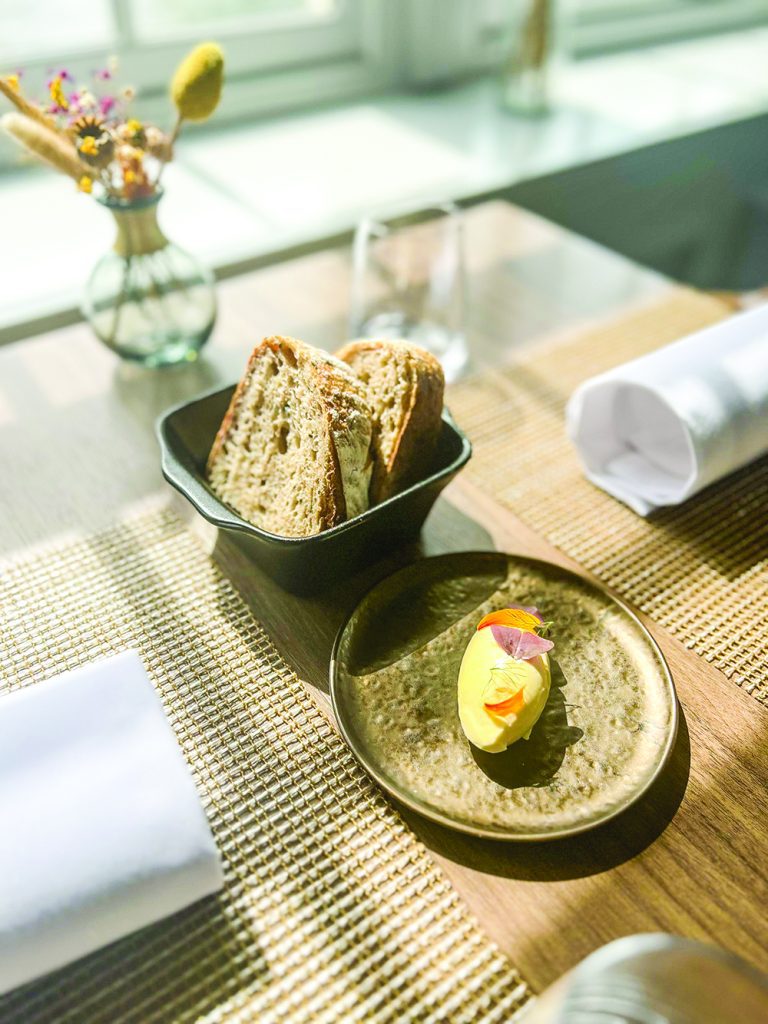
Darley Abbey is a mill village just over a mile from the centre of Derby, on the bank of the river Derwent. On the other bank sits an area of historic, industrial heritage now part of the Derwent Valley Mills World Heritage site. Approached from Alfreton Road, you turn along Haslams Lane and pass the Derby Rugby ground on your left before entering the heart of the mills area. The well-preserved buildings have changed little since the 1800s and so the sense of history here is palpable. Today many of the buildings have been re-purposed to focus on retail and relaxation. It was a beautiful summer evening and we were here to enjoy the pleasures of dining at Darleys Fine Dining Restaurant. With a great reputation, Darleys are in the 2022 Michelin Guide, have AA Rosette Award for Culinary Excellence 2022 and Tripadvisor Traveller’s choice Award 2022. The restaurant has views over the river and weir, and most of the tables enjoy this aspect. Taking advantage of its position, a decked area is perfectly situated to make the most of cocktails on a warm evening. The decor is modern but tasteful giving diners plenty of room. We received a friendly greeting and were quickly seated so that with chilled, crisp Chardonnay in hand we could take our time over the menu. My husband and I have very different tastes and yet I could easily predict his order, and knowing my love of fish, he could predict mine. Thankfully the menu isn’t extensive so you can have confidence that everything is freshly prepared, and ingredients are genuinely seasonal. They also care well for vegetarians. Chef’s amuse-bouche was served with butter and freshly baked sourdough and I detected a hint of caraway from the mix of seeds, this accompanied a tartlet filled with Ox tongue , peas and horseradish, a nice appetiser. The chalk stream trout, my choice for starter, was cubes of cured pink trout, delicately flavoured in a rich crab bisque with portions of melon and caviar. The hit of tangy lemon came through the fresh, clean flavours. My husband chose the Isle of Wight Tomatoes, in a ricotta sauce with slices of young courgette, baby basil leaves and crunchy smoked almond which added texture. Perfect for a warm evening. Pan-fried Cornish cod followed for me. It’s ages since I enjoyed such a beautiful piece of fish. White, fresh and perfectly cooked. The crisp samphire added a saltiness to the small potatoes and kohlrabi, and the mussel velouté had me reaching for my spoon to savour every drop. My husband preferring beef, ordered the short rib of beef. Although the waitress said this would be slightly rare, it was tender and moist without being pink. Served with layers of potato, a healthy portion of kimchi ketchup, kale and in its own juice, the beef really stood out as hero. Desserts were easy to choose from, and to be honest I could have had any… or even all of them! But the honey panna cotta won out, with a hint of lemon and spoonful of caramel buried within, it was picture perfect, a clean not overly sweet end to our meal. With a hot cup of fresh coffee, we drifted our way to the end of the evening. Darleys describe themselves as a fine dining restaurant, serving modern and European dishes. The chef and his team clearly have a set vision for the food on offer here which would sit equally well amongst some of London’s best restaurants. The setting is lovely and adds to the ambiance. The service is both friendly, efficient and courteous. The wine list is reasonably priced, with a good choice of cocktails… and the food, well it speaks for itself, beautifully presented using interesting seasonal ingredients, but not so unusual that it takes you out of your comfort zone. We thoroughly enjoyed our evening and look forward to returning soon. 00
Dining In Derbyshire – Seafood Cave & Grill, Matlock
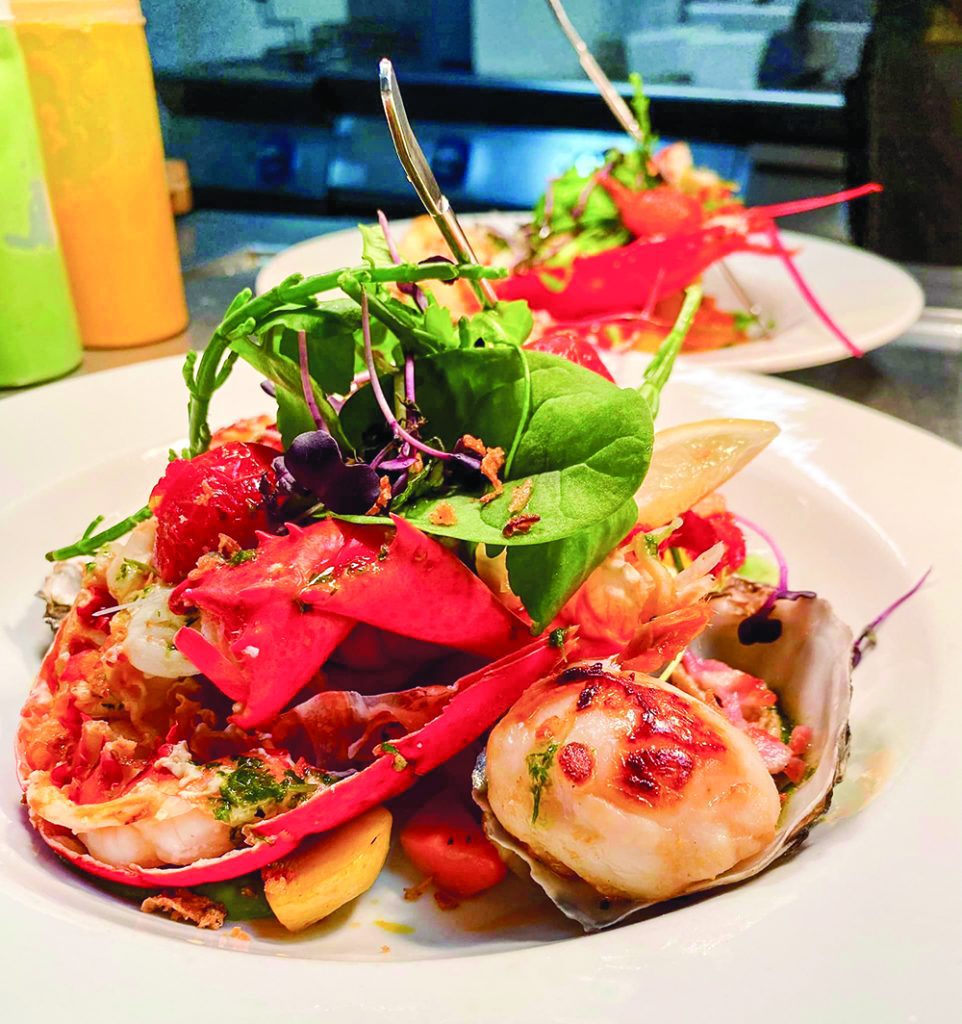
It felt a little surreal as Susan and I drove into Matlock Bath, late on a sunny, mid-week afternoon. Most of the traffic was heading in the opposite direction; office workers in a rush to get home. We weren’t in a hurry and our route wasn’t busy. It felt like one of those summer evenings, back in the late 70s when you just went ‘out for a drive’. Our destination was the Seafood Cave and Grill for an early dinner. We parked in the Matlock Bath Station car park: deserted apart from a hand full of cars and an ice cream van, sales window closed and the driver already behind the wheel. Perhaps it’s because Matlock Bath is on our doorstep that we have a tendency to forget that, for many, it’s a tourist destination. It’s been one for more than a century. Holiday makers and the casual visitor have wandered through the gorge, cut by the river Derwent, admiring the scenery. We also admired those same views as we strolled over the Derwent and crossed the main road. A two minute walk and we were outside the stone arch that leads onto the covered courtyard in front of the seafood restaurant. We were greeted warmly by Ian, chef patron, who invited us to take a seat at a table in the flag-stoned courtyard. The interior of the restaurant is uncluttered: with white painted walls and solid furniture. The festoons of bare light bulbs, with their exaggerated filaments, are quirky, but the most striking feature is the open kitchen and grill. You can see the chefs at work, and everything is on show. Ian explained that the ethos of the restaurant, with its daily deliveries of fresh fish and shellfish, had not changed and he was now spending all his time concentrating on the Matlock Bath venue. A warm summer evening calls for a long cool drink. I asked Ian if he had any alcohol-free beers. ‘Yes’ he said: ‘Ales, cider, lager and stout.’ I chose a glass of Heineken. I didn’t want anything too heavy to mask the taste of the food. Susan, as constant as the Northern Star, asked for a glass of Sauvignon Blanc. Ian has devised a lunch menu with two and three course options all at fixed prices. In the evening the a la carte menu takes over. Most of the dishes are also available as a takeaway. On the evening menu there are nibbles of potted crab, shrimp and crayfish on a herb crostini, or roasted garlic marinated olives with rosemary focaccia, plus a whipped goats cheese with Highland oaties. The starters or wee plates as they are called on the menu include a crispy belly pork with salt and pepper squid. The Cave Cocktail: prawn and crayfish in a bloody Marie Rose sauce along with smoked salmon and samphire. There’s also a grazing board and goat’s cheese. And the one we were having: the hot and cold taste of the sea sharing platter. As Susan and I chattered over our drinks Ian brought us an amuse-bouche: two bite size hors d’oeuvre to whet our appetite. One was a shot glass of crab and rice soup topped with a crab claw tip. The rice had been blended to a silky-smooth paste with the sweet crab flavour holding its own. The second was a dice of Ian’s own sea trout pastrami topped with a dash of sauce and samphire. It’s cured similar to gravadlax but with dark sugar and coriander. The fish was firm, full of flavour and enhanced by the salty samphire. Our sharing starter arrived. A colourful palette of exciting nibbles. There were mussels and whelks in their shells, small cubes of the sea trout pastrami and two crab claws all on a bed of lettuce. Two crab and sweetcorn bon-bons, with a crispy coating of deep-fried bread crumb, jostled for position in a dish of Marie Rose sauce. A bowl of potted shrimp and crayfish was topped with a disc of whipped caper butter. On top of that sat a small mound of caviar, and all topped with a scattering of samphire. There was sliced focaccia, oat cakes and crostini tucked in amongst the fish. The mussels were succulent, the crab claws sweet, the dressing spot on and the salty samphire and caviar enhanced the delicate shellfish flavours. The platter for two has many rewards. One being that you can exchange ideas and thoughts about the food you are both sharing; a conversation over dinner. And the sharing continued. The mains on the restaurant menu contain a mix of fish and meat. There’s Moray Firth monk fish, battered haddock and a posh Kiev (breaded hake stuffed with garlic, crab, shrimp and crayfish butter). There’s haunch of lamb and Sirloin steak, plus, a surf and turf. But we maintained our sharing evening with a lobster and crab celebration. Ian had devised a special menu, for one month, devoted to these tasty crustaceans. The platter was a visual delight. It was dominated in the centre, by two huge crab claws. To one side was a lobster Thermidor, topped with a lobster claw, and to the other side a pile of king prawns dressed with samphire. We’d been provided with two crab forks to pick the flavoursome white crab meat from the claws. A task we shared with some amusement. The tender sweetness of the lobster meat had been blended into the not too heavy cream and white wine sauce for the Thermidor. It was a delight to eat. I also nibbled on the lobster legs. The prawns had been dusted with a little cayenne to add warmth, each one a juicy mouthful. A small dish of dauphinoise potatoes accompanied the platter. The smooth, starchy nature of the potatoes offset the richness of the shellfish. As we drove home we reflected on our delightful evening: our shared experience of delicious food and the attentive service. The Seafood Cave and Grill is somewhere to make
Walk Derbyshire – High Peak Trail Across Middleton Moor

When the civil engineer William Jessop and his associate Benjamin Outram finished building the Cromford Canal. While they were linking the expanding industries of the Derwent Valley to the Midlands, it was soon realised that if the canal was continued in a northerly direction, it would open the burgeoning new cotton industry to markets around and beyond the Trent Valley, and vice versa for mutual growth. The original idea of continuing the canal across the limestone moors and linking with the Peak Forest Canal at Whalley Bridge, was soon dropped for the simple reason that the linking canal north from Cromford would have to climb almost 1000 feet across the comparatively waterless limestone uplands of the White Peak. Even then the canal mentality still held sway and following an Act of Parliament dated 2nd May 1825, permission was granted to build a 33mile long railway, still following the canal pattern, costing an estimated £32,880, one of the earliest railways built soon after the opening of the Stockton and Darlington Railway. Permission to build what became known as the Cromford and High Peak Railway, was awarded to Josias Jessop, the second son of William Jessop, the canal engineer responsible for the design and building of the Cromford Canal. As Josias Jessop had been trained in canal engineering, it is hardly surprising that his railway was designed as though it was a dry canal. Rather than go round or underneath hills, the route climbed on steep gradients, with trains hauled up and down by cables powered by stationary steam engines. Still thinking in canal terminology, stations were called wharfs and the inclines took the place of canal locks. There are several sharp bends such as the one at Gotham where the track turns through ninety degrees in less than a hundred yards. Side branches served the small quarries dotted along the line’s route. One of the inclines, that at Middleton Top where this walk starts, has a well preserved winding engine which is frequently ‘steamed’ on advertised holiday dates. Although rolling stock is no longer hauled up and down the incline, there is sufficient track still giving a clear indication of the mechanics of this method of climbing the local hills. It is also possible to admire the handiwork of local stone masons who laboriously created the stone sleepers which carried the original track before being replaced by timber. There is a section of the original track and its original stone sleepers on display outside the Information Centre at Middleton Top car park where the walk starts. While Middleton Top Incline is well known, there were others along the way. Hopton was the next incline, but its winding gear was removed when locomotives became powerful enough to climb the gradient without assistance. In later years the Cromford and High Peak Railway made a link with the mainline by way of a side track into Buxton from Harpur Hill. This diversion removed the need for an incline down to Bunsall Cob and the Goyt Valley from the top of Long Hill. Two other inclines on either side of Whaley Bridge station were abandoned. This is an easy walk with wide ranging views across the local countryside. On the first leg of the walk, the view to your front across Middleton Moor looks along the Derwent Valley and across the Via Gellia towards Bonsall and Matlock’s limestone crags of High Tor. When the path across the grassy moor reaches a side track where the route turns left, the strange looking green fencing opposite, with its stern notices to keep out, is thought locally to be a long-term trial of fencing used to surround open prisons. The structure is even illuminated at night, making an eerie glow that has led to talk of UFOs flying nearby. So, the best advice is to obey the warning, and Keep Out! From the turning, the way follows a partly trackless way over pasture enjoyed by dairy cows. Bearing left, a cart track soon develops, swinging downhill to the left as far as an abandoned dairy farm. A gate marks access to the High Peak Trail. Turning left here the way back to the Information Centre and Car Park is one of ever widening views south into Leicestershire and beyond. Wirksworth parish church spire is visible below and slightly to your left, while beyond and marked by radio masts, is the last fling of Pennine Gritstone at Alport Height. USEFUL INFORMATION: A 2½mile (4km) easy walk with little or no steep ascent, over grassy meadows well known for their wild flowers including orchids. Suitable for young children. One slightly difficult stile. RECOMMENDED MAP: 1:25,000 Ordnance Survey Outdoor Leisure Map – White Peak, Sheet OL24 PUBLIC TRANSPORT:6.1 Derby to Matlock service as far as Rise End, Middleton-by-Wirksworth. Walk uphill past the Rising Sun Pub on the Ashbourne Road. Go under the railway bridge and then turn right along the lane signposted to Middleton Top. PARKING:Beside Middleton Top Information Centre or on its nearby field. REFRESHMENTS:Tea and coffee at the Information Centre. The Rising Sun back down the Ashbourne/Cromford road has a good range of real ales. Home cooked food a speciality – all at reasonable prices. THE WALK :: THE WALK :: THE WALK :: Level with the cycle hire office, cross the trail and climb the short flight of stone steps and then bear right at the top. The engine house and driving wheel for the cable, once capable of hauling trains up and down Middleton Incline. After a yard or two, bear left beside a part ruined limestone wall and follow it gently uphill on to the grassy moor’. Continue to walk, still uphill until you reach a horse rider and pedestrian stile. Cross by striding over the anti-motor cycle barrier. Turn left on to a rough farm track. The depression below and to your right was caused when the roof of a limestone quarry gave way. Much of the stone quarried below ground was valued for War Grave
Celebrity Interview – Peter Andre

The Darley Park Weekender, “a highlight of the Derby events calendar”, is to return this summer – and there’s sure to be a bout of insania when Peter Andre takes to the stage. This won’t just be the Peter Andre who became the sixth highest-selling artist in the UK in the 1990s. This will also be a thespian nominated for best actor in a short film and an author with two books which have just found their way into the shops. For the third year the Darley Park Weekender will feature three days of entertainment. As well as the returning ‘80s Mix Tape and the classical music concert, the event will feature for the first time Ultimate ‘90s. East 17, Liberty X and Five will perform on Friday 25 August, with Peter Andre topping the bill and hopefully getting the Bank Holiday weekend off to an exciting start. “It’s going to be fantastic,” says Peter. “I started entering talent competitions from 13 years old. So for me being 50 now and being able to be on stage for all these years is just a joy.” Surprisingly Peter admits that his favourite era of music was the 1980s. “Isn’t that strange? Superstars were superstars then. You had Michael Jackson, Prince, Madonna, Guns N’ Roses. “But the ‘90s was great because it was distinctive in so many ways: you had Britpop, R&B, then you had Take That and Boyzone – you had a very diverse sound. We’re going to have a great time (at Darley Park).” What is it about ‘90s music that makes it so popular these days? “I just think people like nostalgia. There were a lot of great melodies in the ‘90s. That’s what the ‘90s were best for and that’s what people miss.” Peter James Andrea was born on 27 February 1973 in Harrow, London to Greek Cypriot parents. When he was six his family moved to Sydney, Australia. Peter entered the Australian talent show New Faces in 1989 and was offered a recording contract. He was sent back to the UK to work with a couple of producers. Between 1995 and 2004 he had three number one singles in the UK, Flava, I Feel You and his biggest success Mysterious Girl. He’s also known for Insania, the song he wrote in 2004 while a contestant on I’m a Celebrity . . . Get Me Out of Here! It peaked at number three on the UK singles chart. Although he made his name as a singer, Peter was determined to do other things. “I studied acting as a kid and I always said that when I got into my forties I was going to move into acting which is exactly what I’ve been doing. I’ve just finished my first feature film which should be released later this year which is amazing. Music and film: that’s what I like the most.” The film is called Jafaican which means a fake Jamaican. Peter plays Gary Buckle, “a likeable rogue who’s up to all sorts of mischief. Gary’s brilliant because I can relate to parts of his character – there are elements of me there. It’s very funny.” The creator of the film, Fredi Nwaka, is an award-winning director who also wrote the script. “He’s a genius,” says Peter. “He said to me ‘I want to make a film that all people from different cultures can watch in a cinema together and laugh.’ I think that’s exactly what’s going to happen.” Peter who’s also an executive producer of the film likens it to Cool Runnings, the 1993 sports comedy about the Jamaican national bobsleigh team making their debut at the 1988 Winter Olympics. “It’s a really fun comedy,” says Peter who is glad that cinemagoers will be able to see it, unlike his 2019 picture The Inheritance. That was a short film, so it wasn’t on general release. A pity because Peter was nominated for best actor in a short film at the North Hollywood Film Festival, losing out to experienced American Billy Zane. Peter played Harry, a recovering heroin addict in The Inheritance, so-called because the character inherits a second chance to clean up his act and change his life. Peter went to extraordinary lengths to prepare for the film: “I’ve never in my life done heroin or anything like that. I had to go and speak to people who were recovering from it, speaking to them about what the come-down is like, even researching things like how many times you cough when you’re coming down, how your breathing is. All these things are very important. “I went to Los Angeles a week before the shoot. I put on the clothes I was going to wear as Harry and I stayed in them day and night. I didn’t shower, which was a first for me. I tried not to sleep so that when I went on set I could genuinely feel exhausted. There’s a lot of research involved. “When I was nominated for best actor in a short film you can imagine how happy I was that the research had paid off.” While he was on I’m A Celebrity . . . Get Me Out of Here! he met the former glamour model Katie Price. They married the following year but divorced in 2009. They have two children, 18-year-old son Junior Savva and daughter Princess Tiaamii Crystal Esther who’s 16. He walked down the aisle again in 2015, marrying Dr Emily MacDonagh. They have a daughter Amelia who is nine and a six-year-old son, Theodore James. Stories he told his kids when they were younger are included in his first book for children aged three and above, Super Space Kids! Save Planet Drizzlebottom. “It’s about intergalactic adventures, with kids becoming superheroes because they’re discovering about other worlds and how scientists can’t figure it out. Sometimes it just takes kids to think simply about these problems. So there’s always a good little message in these books,” says Peter who reckons
Dining Out – The Cobbled Street Cafe, Belper
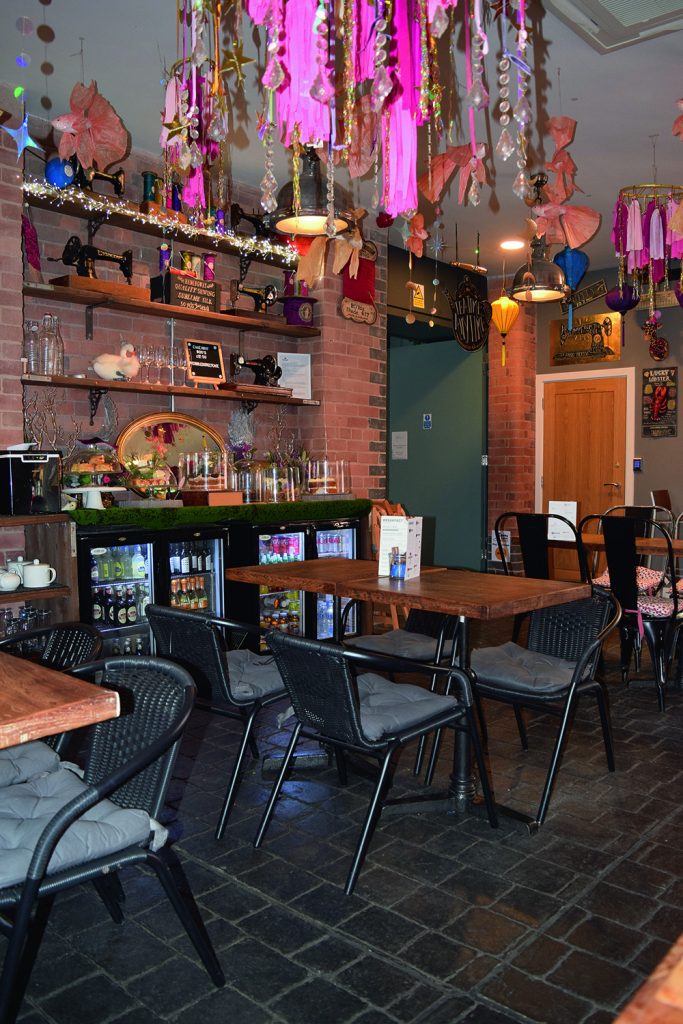
One of my lasting childhood memories is of me and my mum, meeting my grandmother every Saturday morning in an upstairs cafe in Chesterfield. We would happily queue on the stairs until a table became available and order our milky coffee and delicious toasted teacake. Time has moved on and the smell of freshly roasted beans and smooth rich flavours of quality ground coffee have become the order of the day. To your toasted teacake now add fresh scones and gateaux tiered with butter cream. These lovely memories came flooding back as we entered ‘1924’, the new gallery hosting independent craft shops on Campbell Street, Belper. At its centre sits the Cobbled Street Cafe, which as its name suggests evokes the feel of a street cafe. The walls are decorated with plenty of interesting artefacts giving Cobbled Street Cafe real atmosphere and oodles of character. It was a baking hot summer day, middle of the week and we decided a break in our day for lunch would be a very pleasant thing, and ‘1924’ was literally 2 minutes gentle stroll from Belper’s main shopping street. Cobbled Street Cafe serves chilled Fentimans old-fashioned lemonade, perfect on this hot afternoon, and there was a great choice of panini and toasted sandwiches. My panini arrived with a portion of chips, and coleslaw with fine slices of red onion, the perfect light lunch. My friend, calmed by the air conditioning, chose the large breakfast (served all day). Cooked to order, it arrived with doorstep size slices of fresh bread, and equally impressive large sausage, egg, bacon, beans, tomato and mushrooms. Suitably refreshed but not wanting to miss out on a portion of delicious cake, we each chose one to take home and enjoy later. Daniel and Beth who run Cobbled Street Café pride themselves on sourcing quality ingredients locally, then using these to produce a simple but tempting menu. Jerry Howarth Pork Butcher features high on the list of quality suppliers along with cakes from a Bakewell bakery and bread from a Chesterfield bakery. It all goes to set a good standard for this little café.So in a pensive mood I reflected on why I remember those times so clearly, meeting up with my grandmother in a cafe in Chesterfield. It was those small treats, nothing spectacular, but it became part of our weekly routine and something to look forward to. And I think we still need places like this, that we can make our ‘go to’ cafe, where we feel comfortable, we can just pop in, meet friends and family or just take a brief break from routine. Cobbled Street Café is disabled friendly as it is on the level. Dogs are also welcome. 1924 Still have a limited number of newly renovated COMMERCIAL UNITS AVAILABLE to rent. 00
Dining Out – Bang In Belper

I used to have a ‘local’. Somewhere I could walk to for a pint with our dachshund, Rupert. When I walked through the door I’d be greeted with a one word question: ‘Usual?’ And the dog would be allowed to sit on my knee at the bar. He’d size-up everyone who walked in from the car park and pass his opinion with either a wag of his tail or a killer stare accompanied by a low, throaty growl. Not many people in the pub knew my real name. I was often referred to as Rupert’s dad. Time rolls on and we now have a different dog but the same cannot be said about the local; they’re vanishing. In England and Wales over 30 pubs close each month. Victim to energy bills, staffing pressures and the breweries who concentrate on their big profit-making outlets. But all is not lost. With a back to basics attitude; the micro pub is on the rise. Some are just bars and some, like the Bang in Belper are a well balanced mix of bar, cafe and exciting street food. Anxious to sample what the owner of Bang, Andrew, describes as bangin’ street food, bangin’ boozer, bangin’ atmosphere, Susan and myself made our way to Belper on a scorching afternoon when the BBC News had reported that it was too hot for solar panels to work properly. Bang in Belper is on Bridge Street (the A6); close to the large Field Lane car park and has been at its current location for just over a year. The premises used to be an ironmongers and the bar retains the original shop front, albeit decorated and re-branded. Despite the warm afternoon the interior was cool. The decor is eclectic; a collection of miss-matched chairs, tables of all shapes and sizes – the one we sat at was part of a discarded cable drum – and a gallery. The bar had been part of the recent Belper Arts Trail, and still on display were many of the striking and imaginative portraits contributed by colleagues, friends and family. We were greeted by the friendly bar staff and introduced to Andrew. He explained how he’d left a job in engineering – that had taken him around the globe – to start his new venture just as the lockdowns began. As a result he’d concentrated on pre-ordered, take-out dishes before moving to the new venue. Craft beers are the bar’s main offering. A chalkboard behind the bar described the diverse16 keg and cask ales, ciders and lagers available including their specific gravity. If you’re as unfamiliar as I am with some of the brews on offer, don’t worry, help is at hand. Chalked on the wall is a simple instruction: ‘Wanna taste – ask for a sip’. I asked and tried a couple before deciding on a half of, the very local, To Many Andy’s from the Campbell Street Brewing Company, in Belper. It’s an American style pale ale. It has a fruity aroma that follows through to the taste with a hint of herbs. The bar’s relaxed atmosphere was reminiscent of a friendly local. We sat and chatted as the late afternoon moved on and we eventually decided it was time to order something to eat. The menu is street food with a variety of filling, like the gyoza bento bowl. It consists of five steamed dumplings with a choice of fillings – chicken, beef or vegetable – with all the trimmings. Likewise the Cuban tacos, the Bangin’ burgers and the kebab all have a variety of fillings and along with the loaded fries with cheese, a rich assortment of sauces. I selected an open burrito wrap. The open wrap filled the plate and had a base of spicy rice topped with two cheeses; mozzarella and Cheddar and a generous helping of slow cooked salt beef enhanced by a portion of pickled red cabbage. The whole dish was drizzled with an American burger sauce and surrounded by a salad. The salt beef was the star of the show; succulent and spicy. The cheese was melting and the sharp note from the cabbage and sauce cut through the rich beef and enhanced the flavour. Susan chose the week’s special: Moroccan lamb. The base of the dish was a soft, pillow like naan. Half of it was topped with zingy couscous and chickpea and the other half was covered by the spicy minced lamb. The warm North African spices shone through both portions that were finished with a scattering of spring onion and a hint of fresh chilli. A fresh salad and a pot of chilli sauce filled the rest of the plate. The whole dish was drizzled with a refreshing mint and yoghurt dressing. There was a wedge of lime to add a sharp citrus note. At Bang in Belper Andrew and his team have taken the popular street food snack and elevated it to a meal without taking away its identity. With the exciting food and variety of beers it begs the question: Is it a bar, is it a micro pub or is it a cafe? It’s probably a combination of all three. And to enhance the cafe culture, there’s live music every Sunday evening. We’d enjoyed our time in Bang in Belper and eaten two delicious dishes: one from North Africa and one from Mexico. But I couldn’t leave without a drop more of one of the craft ales. And so we set off home with, in a milk carton style bottle, two pints of Lightbulb extra pale ale produced by the Verdant Brewing Company from Falmouth in Cornwall. 00
Walk Derbyshire – Riber Via the Front Door

Standing at 850 feet above sea level on an isolated hilltop, Riber Castle, to give it its acknowledged title, has dominated Matlock’s eastern skyline ever since John Smedley built it in 1862. His idea was to make it the de-lux version of the spa hotels springing up around the town, venues of places offering accommodation for those taking part in his ‘water cure’. Visitors from all stations of society came to this attempt to copy a European spa such as Baden Baden in order not simply to drink the waters, but to be subjected to high pressure hosepipes blasted by evil-minded operatives, wielding hoses aimed at various parts of the victim’s anatomy. This rather curious method of health improvement, enjoyed a short-lived popularity until changes in attitude and two world wars brought about its demise. With its departure, Matlock took advantage of the spas. Some became nursing homes and others developed as apartments; the main one found a use as the headquarters of Derbyshire County Council. Smedley first had the idea of his ‘water cure’ when he was in recovery following a nervous breakdown. Part of his cure was time spent at one of the European spas. Feeling much better after the spell of being sluiced by the Germanic system of being mauled with powerful jets of water, he came home with the idea of turning the tiny market town of Matlock into the spa of dreams. Already a successful businessman, owning a garment knitting factory in Lea Mill that still flourishes, he decided to use his captive team of employees as guinea pigs in order to try out his new cure-all ideas. There is no record of his employees’ willingness or otherwise to take part in his experiments, but, as none of them appear to have suffered more than a loss of their dignity, they did at least form the basis of those who came for this so-called cure. Smedley was so successful that his fortunes grew and he was able to encourage his senior management to open subsidiary branches around the town, and even sponsor the building of a cable-hauled tram that climbed Bank Road from Crown Square in the centre of Matlock, conveniently near the railway station serving trains on the London to Manchester main line. All that is left of the long-abandoned cable car, is the slight widening of the street about half way up the hill, where trams could pass; the steam engine powering the cable was housed in the building now used as a car workshop at the top of Bank Road where it joins Wellington Street. He persuaded his senior employees to open satellite establishment. All of those satellites together with the main which is now DCC’s headquarters, have been put to other uses in recent times, ranging from care-homes, to luxury apartments. John Smedley decided to build his main feature Riber Castle, not just as a luxury spa hotel, but as his home. Although the pretentious towers of this mock-citadel act as vantage points for views along the valley and, one must suspect, it was where he could keep an eye on the activities of his workforce in Matlock and Lea, both of which can be clearly seen from Smedley’s eerie. It was to become the major building in a substantial group of medieval buildings which had stood there and in fact still do, since before the 17th century. Unfortunately his plan to build Riber Castle as a super hydro came to nothing, due to one simple yet overlooked fault – the builders couldn’t find sufficient water needed for the complex equipment his plan envisaged. As a result it became where Smedley spent his last days. The place seems to have been dogged by bad luck ever since; it became a minor public school for boys, then during World War 2 large quantities of sugar were stored in rooms where Victorian ladies and gentlemen once took their ease. In more recent times its ruins became a European wildlife zoo, where locally bred European lynx were exported to a Spanish national park. Their transfer was carried out by the RAF, using lynx helicopters! The latest scheme intended to preserve the future of the castle is to develop it as a luxury set of apartments, complete with a helicopter landing pad. Only time will tell if this scheme will be the success its planners envisage. This short walk in the brief but steep climb up to Riber passes through much of Matlock’s history. Starting at the medieval bridge, then moving on past the shelter that once stood at the tram terminus, the walk moves on by way of award winning Hall Leys Park that still holds the ambience needed for gentle exercise, or admiring the flower beds full of colour each summer. Where there was once a cycle race-track, youngsters can enjoy the thrills of the new track. Following jitties through Knowleston Place, the walk passes one of Matlock’s two flour mills now finding fresh uses. The mill stream that once powered their grind-wheels is followed as far as the cluster of buildings at the foot of Lumsdale. Next and after crossing the Alfreton road, a steep path climbs up to Riber’s cluster of medieval stone houses; its castle dominates the view along the Derwent valley, from a glimpse of High Tor’s limestone crags, to Masson Hill across the gorge. The walk leaves this ancient view by dropping steeply down to Starkholmes and then a riverside track will take us back into Hall Leys Park and the centre of Matlock. THE WALK From Crown Square in the centre of Matlock, follow the riverside track through Hall Leys Park as far as the side road beyond the children’s play area. Following Bentley Brook, go past the houses of Old Matlock and turn right along the main road. Cross over at the pedestrian crossing and turn right. Follow the main road, over the turning for Chesterfield and continue as far as the last houses.
Celebrity Interview – Chris Hadfield
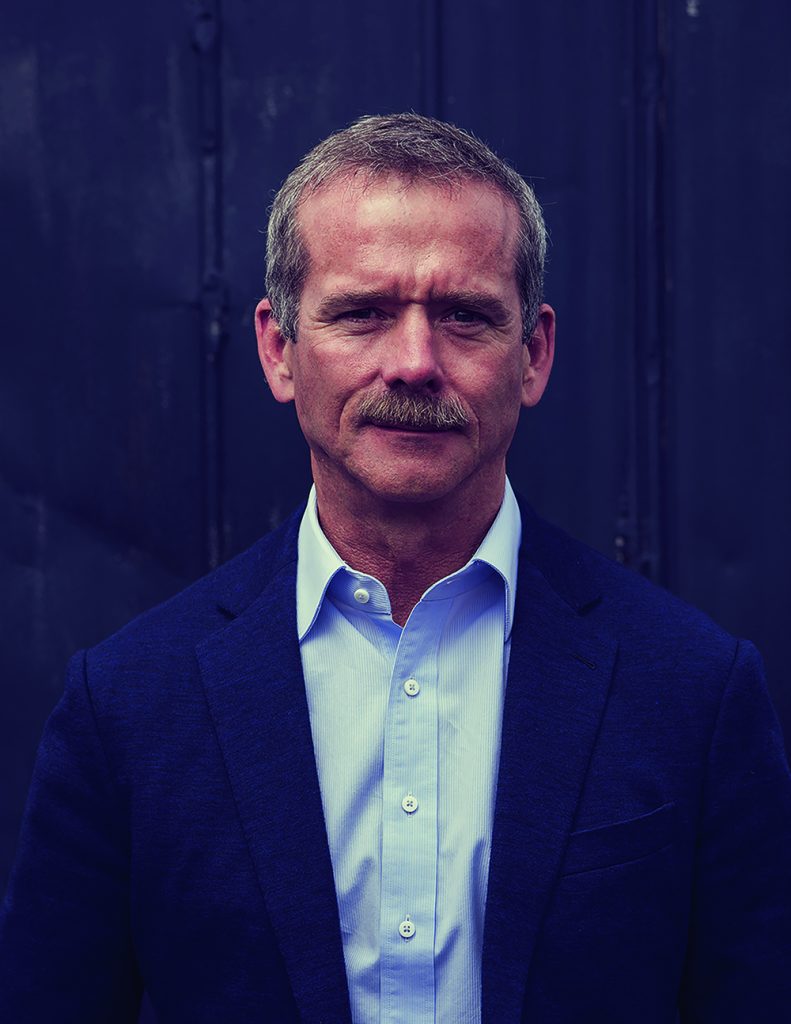
On Earth And Space – Chris Hadfield’s Guide To The Cosmos will feature the Canadian astronaut and former commander of the International Space Station sharing his thoughts on the new age of space travel and what it will mean for life on earth. Moustachioed Chris was the first Canadian to walk in space. Not only that, he’s in the extraordinarily rare position of having spent 15 hours in space – not in a rocket or on board a space station but on space walks during his 21-year career as an astronaut for NASA and the Canadian Space Agency. He says he’s looking forward to his new show which he’ll deliver 11 times in nine different cities. “I’ve previously toured across the UK, Australia, Germany, the US and Canada and sold out wherever we’ve gone. It’s such a joy to connect and share ideas with so many people. “It’ll be an evening of discovery and digging into many ideas about space, of where we’ve come from, where we are and where it’s leading to, helping us to understand more about where space exploration is heading with the technological advancements like today’s rockets and the James Webb telescope.” The James Webb Space Telescope is conducting infrared astronomy. As the largest optical telescope in space, it’s equipped with high-sensitivity instruments, allowing it to view objects that are too old, distant or faint for the Hubble Space Telescope which was launched more than 30 years ago. Chris Austin Hadfield was born on 29 August 1959 in Sarnia, Ontario. His journey to space began when he was nine: he recalls watching Armstrong and Aldrin take part in the first lunar landing and moon walk. He set his heart on following in their footsteps and made it his own mission to succeed. “What I saw was the most exciting thing human beings had ever done and I wanted to be part of that.” When he was 15 Chris learned to fly and enlisted with the Canadian Armed Forces where he eventually became a combat fighter pilot and test pilot. He spent time with both the US Navy and US Air Force, being recognised as their top test pilot, before he was accepted into the Canadian Space Agency’s astronaut programme when he was 33. He calls that an “amazing” moment: “To put it in context, a recent intake to NASA saw 18,300 applications for 11 places. When I applied to the Canadian Space Agency in 1992, there were 5,300 applicants for four places. “Gaining the qualifications to be selected is extremely difficult, but then it has to be combined with luck, hard work and being there at the right time. “To get that phone call to say Canada would like you to be an astronaut is incredible.” It took him four years to prepare for his first step into space which is “literally and figuratively an other-wordly experience”. He explains the gravity of it: “It’s very dangerous. There’s a huge number of things to squeeze in in a wildly different environment, at very high stakes. “The vast majority of what you’re thinking about is the life and death enormity of performing each step and paying attention to each minor detail as well as dealing with the things that can and do go wrong. “It’s also immensely exciting and the absolute personification of what I dreamed about as a nine-year-old boy. The physical experience of pulling yourself out of a small airlock on the International Space Station is so exhilarating. You’re no longer an earthling in that moment and it really strikes home. “It’s overwhelming. It gobsmacks you and stops thought. It’s an amazing time and place to be in your life.” Chris has orbited the earth 2,650 times and he says the last was even more enlightening and enriching than the first. “The earth is flashing by at 8km per second (almost 18,000mph) – you cross the UK in a matter of seconds. “You find yourself looking for things you know, for touchstones of familiarity, and you get better at looking. “Viewing earth from space is like watching the planet take a breath. You see winter and summer swap between the northern and southern hemispheres. Because the planet is on a tilt, and not all planets have that, we have our distinctive seasons. Seeing that unfold above you is extremely provocative.” Chris’s feat of being the first Canadian to spacewalk is commemorated on the Canadian five-dollar bill. But that isn’t his only claim to fame: when he was commander of the International Space Station he sang and played guitar on a version of David Bowie’s hit Space Oddity. It’s been viewed on YouTube no fewer than 52 million times. Entrepreneurs including Richard Branson and Elon Musk are gravitating towards conquering space and their plans have rocketed in the past few years. Chris believes the sky isn’t the limit. “When I was born, no one had flown in space. We reached space 62 years ago as part of that natural urge to explore which was previously limited by technology. Now we’re at a place where the technology is rapidly improving and opening many, many opportunities. “As humans, we’re explorers by nature. We’re looking imminently at a settlement on the moon, initially robotic, but then human settlement. The reality of getting people there is increasing. tChris has had many astronomical achievements in his career but he’s remarkably grounded about what he regards as his greatest moment in life. “Condensing 63 years of life into a few publicly shining moments, you trivialise it and miss so much of what is important to me. “I met my wife Helene in a high school play. She was turning 15, I was 16, and that’s probably the most significant moment in my life as we’ve been together ever since. That relationship has hugely influenced the life we’ve had together and all that we’ve accomplished.” Since retiring in 2013 Chris has written four best-selling books including his autobiography and a thriller set in
Dining in Derbyshire – The Curry Lounge, Somercotes

It was early on a Wednesday evening when we parked on the Market Place in Somercotes adjacent to the familiar restaurant entrance. The welcoming, contemporary designed foyer hadn’t changed but for one addition; in pride-of place, the wall facing the door was adorned with a large ceramic plaque. On it, in bold type, it reads Best Restaurant Awards 2022. The restaurant was awarded the prize for Best Indian & Bangladeshi Restaurant at the Curry Life awards in October last year. Curry Life is a British independent trade magazine for the Bangladeshi and Indian restaurants and takeaways in Great Britain. With over 300 reviews taken in to account the prestigious award was made for their top class food, excellent service and overall customer experience. We made our way into the restaurant and bumped in to Syed Hussain, owner of the Curry Lounge, and congratulated him on his fabulous achievement. Obviously proud of his award he showed us a video on his phone of the ceremony. We were shown to a table for two by the window and started to unpack our drinks. The Curry Lounge doesn’t have a licence to serve alcohol but there’s nothing to stop you bringing your own. There’s something a bit naughty about walking into a restaurant with your own favourite beer or wine clinking in a much used ‘bag for life’. Our waiter provided the appropriate glasses: one wine glass and one for beer. Plus a very essential bottle opener. The menu had several items ‘flagged’ as new and we decided to order one each of the kitchen’s latest creations. We started with pickles and poppadoms; part of the curry meal ritual. A smooth mango chutney, a refreshing chunky tomato salad and spicy dark amber tamarind dip accompanied the two huge poppadoms. Plus a smooth raita that was, at our request, to stay on the table. A platter of onion bhajis was the next course. So often with these little morsels of loveliness there’s too much gram flour and very little onion but these were full of sweet onion. Soft and pillowy in the middle and cracklingly crunchy on the outside. Accompanied with the sauce boat of raita I could have made a meal of them. From one of the new additions to the list of Curry Lounge signature dishes I chose the gulbahar lamb. It’s a mildly spicy dish that was loaded with succulent lamb. The mild sauce was studded with mushrooms, onion and green peppers and a sweet spicy note lingered on the palate. I ordered a bowl of pilau rice to go with the dish. However, when I saw the peshwari naan that Sue had ordered I was tempted to try it with the gulbahar. The naan was warm, soft and overflowed with coconut giving a lovely, slightly sweet flavour to the bread. As it turned out it was a different but perfect accompaniment to the spicy lamb. Susan had ordered special vegetable paneer korai; also on the list of new additions to the Curry Lounge signature dishes. It is a combination of fresh vegetables and paneer (cubed Indian cottage cheese) cooked in a tandoori sauce with onion, peppers and tomatoes and is served in a hot tandoor dish. It’s mid-range spicy and bursting with flavour. The fresh, green vegetables were tender and flavourful. The plain paneer is a perfect vehicle for any sauce but especially delicious when coated with a sauce of tandoor spices and yoghurt. The peshwari naan turned out to be equally delicious with the paneer korai. Next time we’ll skip the rice and order two naans. We’d had a wonderful evening with delicious food, attentive service and the pleasure of trying new dishes. The Curry Lounge, Market Place, Somercotes, Derbyshire. Tel 01773 528 588 00
Lost Houses of Derbyshire – Brizlincote Old Hall
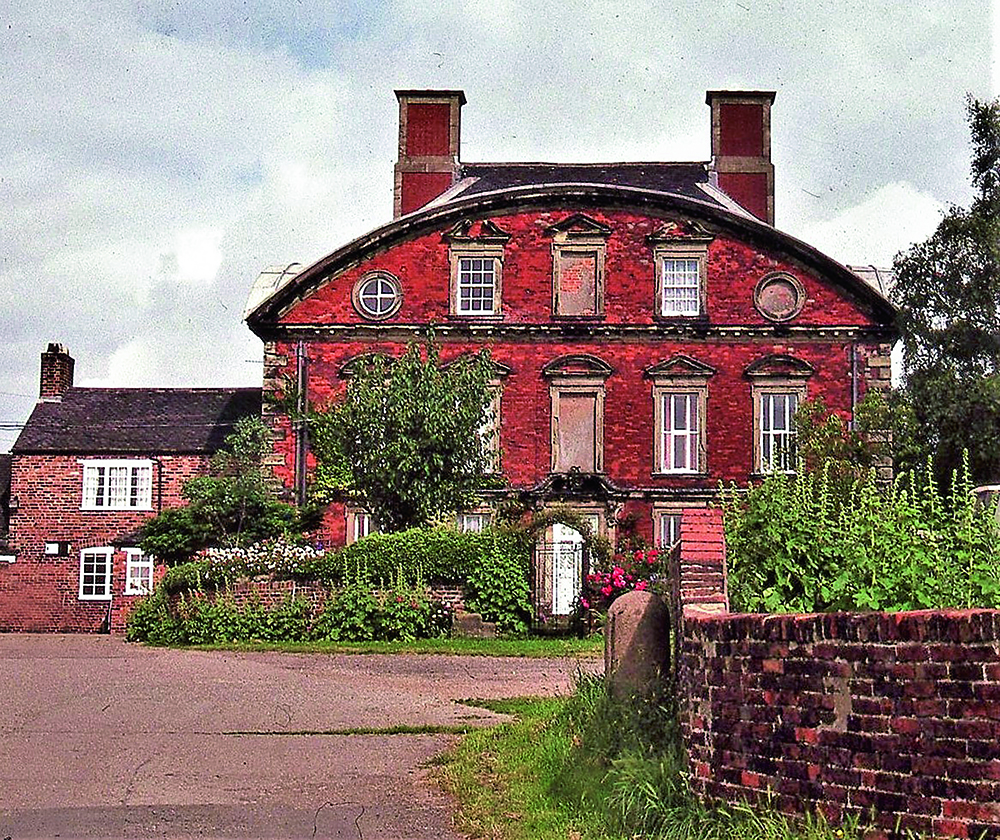
The present hall at Brizlincote is visible for miles around, set on its dominant hill and looking for all the world like an inverted helmet-type coal-scuttle with its legs in the air, represented, of course, by the chimneys and the giant segmental pediments which ensign the facades on all four sides. I have argued in the past that this extraordinary Baroque house was designed by Nottinghamshire’s famous ‘wrestling baronet’, Sir Thomas Parkyns of Bunny, for Lord Stanhope, eldest son of 2nd Earl of Chesterfield, and in the 22 years following, nobody has yet proved me wrong! Here, however, we have to consider the history of its long-vanished predecessor and although the parish (created from Winshill in 2003) is deemed to be in Staffordshire (since 1888) the hall still lies in Derbyshire. Originally, Brizlincote was part of the holdings of the great abbey of Burton, given as part of the foundation charter by the Saxon grandee Wulfric Spot in 1004. By the early twelfth century, the estate there was tenanted under the Abbot by one Mabon de Brizlincote, whose grandson Richard acquired the estate by grant of the Abbey c. 1175. The heiress of the Brizlincotes brought it to the Leicestershire family of Cuilly and the heiress of that family, Elizabeth, married John Stanhope of Rampton, newly arrived in Nottinghamshire from his native Northumberland in 1349. The de Brizlincote family probably built the first seat there, within a moat, substantial remains of which remain, slightly to the north of the present house, off Brizlincote Lane. These earthworks, which have never been investigated archaeologically, are said locally to hide vestiges of the house, too. The Stanhopes did not then have an interest in Derbyshire and thus they disposed of the estate to Robert Horton of Catton who died in 1423. Over a century later, his descendant Walter Horton sold it yet again to William, 1st Lord Paget of Beaudesert KG, an enormously rich courtier of Henry VIII, who had managed to engross almost all of Burton Abbey’s holdings at the Dissolution of the Monasteries in 1539. Paget clearly felt he needed a house near the epicentre of his extensive new holdings, Cannock Chase (in which Beaudesert lay) being some distance away, so having acquired the estate from Walter Horton, in January 1546 he obtained a licence from the king to ‘empark and crenellate’ the house. Thus, the land now lying between Ashby Road, the Beaufort Road/Violet Way estate, the A444 and the north west edge of Newhall (the clue is in the name: Park Road, Newhall) became Lord Paget’s parkland (something like 40 acres, if the size of the later farm is any guide) and his house, no doubt erected around a substantial courtyard, was suitably defensive in appearance, with plenty of – essentially ornamental – battlements, probably in the form of merlons. Although we have no illustration of the house (as we found with Bretby Castle: see March edition of Country Images) a 17th century writer said of it that it was ‘a large stone house that was set in its moat on a bleak ridge’ – probably cold and windy in winter but with incomparable views towards Needwood Forest and the Trent Valley! Lord Paget appears also to have walled the house round in stone, too, for we have 18th and earlier 19th century accounts of surviving stone walls but none remain today.. William Paget retired from state business in 1555, having survived his perhaps injudicious signing of Edward VI’s will – leaving the throne to the ill-starred Queen Jane – and the consequent obloquy heaped upon him by Queen Mary, to be re-instated by Elizabeth I. He died in 1563, having sold Brizlincote to a London merchant, John Merry in 1560. John Merry, of a Hertfordshire family, was a merchant tailor whose father had been clerk to the spicery of Henry VIII; he was a Roman Catholic, too. By 1560, recusancy was becoming an un-safe position, and expensive in fines, as well. His reason for buying in Derbyshire may have been influenced by Sir Christopher Alleyne, who had acquired the nearby estate of Gresley Old Hall only four years before. The fact that Merry’s wife Agnes was an Allsopp may also have been an influencing factor. Despite its prominent position, however, the recently rebuilt and fortified house may have enabled him to feel safe from the depredations of such as Lord Shrewsbury, bent on weeding out recalcitrant Catholics. Not that Brizlincote was his only acquisition. He also bought the estate of Barton Blount from the financially challenged Lord Mountjoy, as well as substantial land at Stanton-by-Bridge and at Sutton-on-the-Hill. John Merry appears to have lived at Barton, where he created a priests’ hole. His son John appears to have been settled at Brizlincote by about 1565. Meanwhile, his elder brother Henry of Barton Blount had four sons, of whom the third, Edmund left issue, settled at Radbourne where in 1670 his son Valentine paid tax on but two hearths, so was presumably farming as a tenant of the Pole family. The second son, John, succeeded his uncle at Brizlincote, but was a stout Royalist in the Civil War; he and his wife Anne found their estate sequestrated by the Commonwealth authorities in 1650 and he died not long afterwards. This Royalist left two sons and a daughter, the elder son, Gilbert, managing to recover Brizlincote Hall by compounding for his estate with Cromwell’s commissioners, but he then demised it to his younger brother, John Merry who was described as ‘late of Brisslincoate Esq.’ when he came into his brother’s other lands at Kniveton and Stanton-by-Bridge. John Merry left two sons, Gilbert of Stanton-by-Bridge, and George, the younger son, who had married Dorothy who, after his death in 1657 continued to live there with her second husband, William Dakin ‘of Brisslincoate, yeoman’ who seems to have farmed there. They were gone by about 1685, for we find it had a new tenant in the person of Worcestershire-born William Barnes,