Dining In Derbyshire – The Bulls Head, Holymoorside
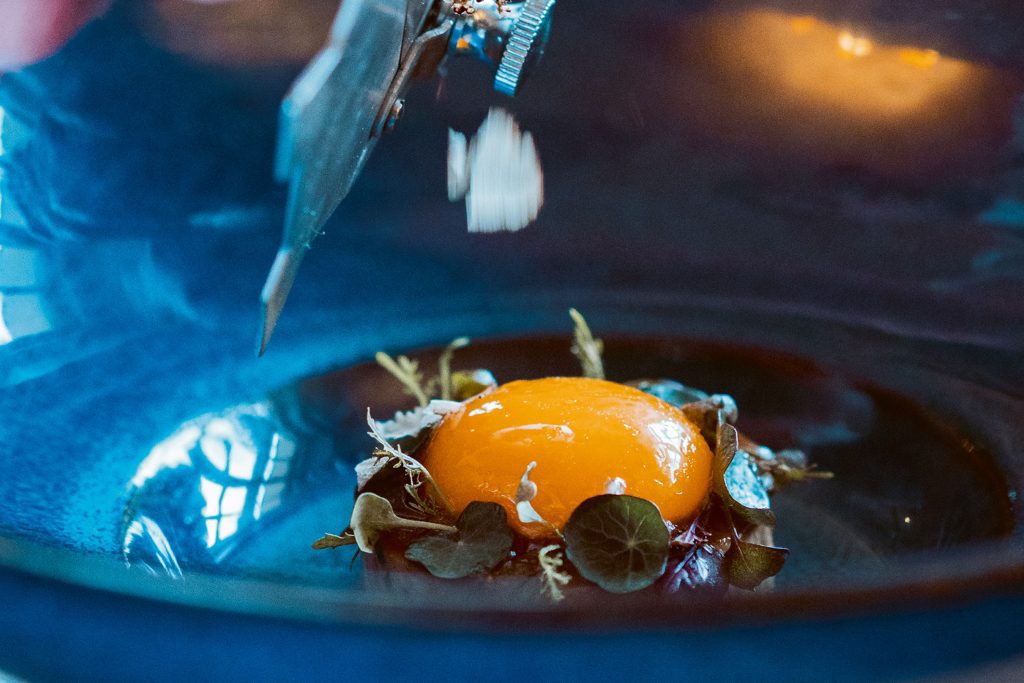
On first glance, The Bulls Head appears your typical, traditional pub; four square it hunkers down comfortably in the centre of Holymoorside, a delightful village on the moor-side of Chesterfield. Just a scenic 20 minutes or so away from the Amber Valley, it’s an area I’m well acquainted with from my childhood and easily accessible. Through the old door the general bar area belies the restaurant beyond and the food on offer here. Please don’t underestimate the experience you are about to embark on, as it truly is a remarkable journey and one that would comfortably sit in a high-end London restaurant, but which we were to enjoy much closer to home. The restaurant area has a simple decor in deep muted shades, with wooden tables well-spaced. Greeted by the friendly smile of Sharron Stone the sommelier, we were shown to our table and drinks order taken. From here we embarked on our epic journey through the 9 courses of the special taster menu, Mark Aisthorpe, head chef and owner truly at the helm in the kitchen. You’d be forgiven for thinking the name is familiar as Mark has appeared on BBC’s 2022 Great British menu as runner up in the northeast and Yorkshire heat. Mark has also worked with Gordon Ramsey and Marcus Wareing at Clivedon House and Petrus, so has an impressive pedigree. Beginning with a selection of Canapes, the deconstructed chicken wing coated with a sticky BBQ sauce and sesame seeds was soft, succulent and a gentle start to awaken our taste buds, the finely chopped venison tartare was richer with a tangy citrus flavour mellowed by the crunch of the diced turnip and served in its own pastry case, cheese and pickled walnut gougères, delivered by one of the chefs Joe Stubbs, completed a perfect trio. Amie Foster, restaurant manager, gave us an excellent description of each course as it arrived, and certainly had a great understanding of every dish. The most delicious, warm malted bread arrived with quenelles of salted butter and marmite butter, wow what a simple idea but inspired. Then a small but perfectly formed potato topped with sliced baby leeks, sprinkled with tiny crisp and airy pork puffs was surrounded in a deep flavoured dulse sauce. Dulse is both very healthy as it’s packed with Iron and proteins, but also adds a rich saltiness. The following course and perhaps my most favourite was the hand dived King scallop; cooked to perfection with tiny brown shrimps, roe which popped in your mouth and a beautifully balanced sabayon sauce. Next, the shredded ham, finished with a warm egg yolk and brioche served separately, was followed by another outstanding fish course. West coast Bass, with a crisp skin and firm flesh found its traditional complement in an asparagus spear, but with the clean taste of sea vegetable fingers, samphire and mussels the wild garlic sauce took it to another level. Spring lamb with its caramelised skin and juicy pink centre was served with a jus and a morel mushroom whose nutty flavour partnered the meat. Rounding out the dish was a carrot and a pea puree. Finishing with a spectacular flourish Mark arrived and set up a side table for his performance, juggling liquid nitrogen, to produce a desert fitting to crown our evening… but I think rather than trying the impossible task of describing it, I will leave it a secret for you to discover for yourselves!! …and just when we were ready for a little something sweet a clever selection of dark chocolate desserts arrived, crunchy, cooling, smooth, intense and spongy all not overly sweet and on one plate…. just desert heaven!! You may wonder what Mark’s ethos is behind this imaginative menu, simply put it is local produce, fresh and in season alongside foraged ingredients, to produce a refined modern British Cuisine. This is not an evening to rush, the relaxed atmosphere at the Bulls Head slowed us down to enjoy each step of this exceptional culinary experience. Tasting each nuance of flavour, some familiar and some not so brought a unique experience. We would like to thank Mark and all his staff for a most delightful evening, and the tour of the newly refurbished bedrooms afterwards. His hard work, enthusiasm and undoubted talents have rewarded Derbyshire with an outstanding venue. 00
Walk Derbyshire – Exploring Shipley Country Park

In 1086 when Duke William of Normandy’s monks were compiling the Domesday Book in order to record the value or otherwise, of the conquerors’ ‘new country’, in listing the wealth of lands in the north Midlands, they recorded details of a section of countryside close to what is now called Ilkeston which was a private hunting estate owned by the king. This became part of Shipley Park, land that was to enhance the wealth of subsequent owners down the succeeding centuries. This wealth came, not from hunting in the nearby forest, but from below ground covering large amounts of high quality coal, discovered and exploited from the sixteenth century and onwards.. The major benefactors of this wealth creating coal were the Miller-Mundeys, a nearby industrial-based family, who chose to live close to their collieries, giving them direct hands on control of their interests. They lived in a then comparatively small farm house and by using their growing wealth, in the eighteenth century, managed to build the first version of Shipley Hall, designed to stand proudly at the centre of their estate. In 1765 the Miller-Mundy family acquired the ownership of Shipley Colliery, developing its increased production by opening the Nutbrook Canal in order to move coal to fuel more rapidly to the burgeoning mills and factories of the Industrial Revolution. This canal, subsequently replaced by rail traffic, ran down to the Erewash Canal and then joined the Trent and Mersey Canal for onward transmission through the industrial Midlands. All that is left of the Nutbrook Canal is the name of a walking and riding trail that passes the delightfully named Swan Lake where, until the local council in its wisdom forced the closure of the entrepreneurial well-run mobile café, at one time the popular stopping place for lovers of the outdoors and all that it has to offer. With their steadily growing wealth, in 1799 the Miller-Mundy’s expanded their estate by building a palatial new house and farm buildings, alongside a water tower, the whole ensemble together with its Italianate pergola was designed by William Linley, a fashionable Doncaster based architect. Following the custom of grand house builders of the time, attractive flower gardens, set amidst semi-natural woodland running downhill from a mansion set on a slight rise. Due to subsequent mining operations, all that is left of this semi-regal splendour is the outline ground plan of the house, a few outbuildings and a lodge; together with the remains of gardens, now tended by the local council’s gardeners. Shipley Country Park, together with the grounds of Shipley Hall are open to the public and well worth spending time in their midst, especially in summer when all the carefully tended bedding plants are in full bloom. In 1887 scandal overtook the placid pace of life at the hall, when Ellen, the wife of Captain Miller-Mundy, ran off with the nineteen year-old Earl of Shrewsbury, Charles Chetwynd-Talbot. The elopement doesn’t appear to have upset Captain Miller-Mundy over much. On his death the house and colliery interests were held briefly by his descendants. The house and coalmining interests were sold to Shipley Colliery Company in 1922. The main purpose of the sale was to enable the new owners to extend their mine beneath the hall. Regrettably this led to pollution of local water courses and subsidence within the hall’s structure. In 1948 the now decrepit hall and surrounding estate were sold to the National Coal Board. With this state ownership, the surrounding farmland and nearby woods were restored, giving nature a chance to reclaim what was once its own. This policy has continued and as a result wildlife has colonised the ponds and surrounding woodlands. Derbyshire County Council took on the ownership of Shipley Estate in 1980, using the land to create the short-lived American Experience Adventure Park, surrounding Shipley Lake. Now only waterfowl enjoy the amenities where children once took advantage of the exciting rides. Part of the land has been built over for housing, but the rest and larger part of the once thriving colliery estate is open for walkers, cyclists and bird watcher’s enjoyment. The walk described below starts and finishes at the Visitor Centre, which is accessed by a side road from nearby Heanor. It then follows three medium sized ponds down to the head of Nutbrook Trail where a short section of path leads over a small wooded rise towards the ruins of Shipley Hall and its gardens. The hall drive is then followed by a field track, crossing the Heanor to Mapperley lane before turning right on to a side path across a couple of fields, back to the Visitor Centre and the chance of refreshment. USEFUL INFORMATION: A short easy walk of 2½miles (4km) on easy, well-made paths and tracks across gently undulating farmland and through deciduous woodland. The paths and tracks are mainly suitable for push chairs and similar. RECOMMENDED MAP: 1; 25,000 scale Ordnance Survey Explorer Map; Sheet 260, Nottingham & Vale of Belvoir. PARKING:Close to the Visitor Centre (pay & display), at the end of the access road into Shipley Country Park. PUBLIC TRANSPORT:Frequent buses to Heanor from Nottingham and Derby. REFRESHMENTS:Visitor Centre at the start of the walk. Also pubs and cafes in nearby Heanor. The Walk :: The Walk :: The Walk :: Following road signs into Shipley Country Park, drive along the side road from Heanor towards the start of the walk, which is next to the Visitor Centre. Turn left, away from the car park and walk down to a surfaced track following the route of an abandoned colliery railway. Turn right and walk along the track. Cross a narrow side road and then turn right on this for about three quarters of a mile until it reaches two narrow ponds. At the end of the second pond, turn right at a track junction and walk slightly downhill, and then up, through mature deciduous woodland for about a quarter of a mile until the track reaches the ruins and
Celebrity Interview – Henry Normal

It’s not normal for anyone to have a beer and a bus named after them in their home city. But not everyone can be like Henry Normal. He was the man behind hundreds of comedy programmes as a writer and producer, being honoured with a special BAFTA for services to television. He then went into semi-retirement and returned to his first love – poetry. Henry will perform his new show, Collected Poems and Other Landfill, in both Nottingham and Buxton this month. He took time off from preparing for the show to talk about being brought up in Nottingham, moving to Manchester where he set up a production company with Steve Coogan, the bereavement that encouraged him to spend more time with his family and why he can’t disguise his accent, even when he appears on BBC Radio 4. He’ll be going on the road at various times this year and explained that all the shows will be slightly different. “I like to experiment and enjoy meself. The trouble is if you do exactly the same thing all the time it becomes a bit like karaoke or you become a tribute band to yourself! “I’m doing bits from all my poems which I’ve written since I was about 14. I’ve written over 1,200 poems, I would say. There’ll be a few jokes, a few stories and a few poems – a mixture.” So as a performer what does he get out of doing live dates? “Lots of things. Just to be in the moment, to be with people and enjoy people’s company. I’m always exploring, so that brings new things and I have a laugh. I get to express myself. “For me, doing the gigs is great fun. Luckily they pay me. It’s lovely to be paid for something you enjoy doing. Usually I learn something and I try to apply that for the next gig.” When I ask him how he defines his poetry, he laughs. “To me it’s all about communicating my perception of the world. And that’s all it is really. “Essentially what you’re trying to communicate is that I see this particular part of the world and the universe in this way and I’m trying to say does that resonate with you or does that give you a different way of looking at it. “Very often people laugh because you’re telling them something they know – we’ve either forgotten it or we didn’t know we knew it.” Henry James Carroll was born on 15 August 1956 in St Ann’s, Nottingham. When he was 11 his mum died in a car crash. “There were lots of skinheads around at the time and disenfranchised youth. And for me getting into books was my escape. “I went to the library and I got out lots of comedy books, the Goon Show books and Monty Python. Then I saw a book by Spike Milligan called Small Dreams of a Scorpion. I thought it was a comedy book but it was a book of serious poems and they made me cry. I thought it was magical that somebody that’s so funny can touch me in such a way. I thought that’s what I want to do.” Henry, his dad and his four siblings moved to Bilborough, with Henry pursuing his interest in books by visiting Bracebridge Drive library and also going to the Angel Row library in Nottingham city centre. “I went to a writers’ group when I was about 19. That made me take myself seriously as a writer because I saw other working-class writers and I thought it’s not just for posh people in tweed jackets and (smoking) pipes – it’s something I can be involved in. “Luckily by doing that I’ve built a career and bought a house and made a living as a writer and a TV producer.” Henry moved to Hull and Chesterfield before settling in Manchester where he met comedy greats including Steve Coogan, Caroline Aherne, Frank Skinner and Linda Smith. “It was quite a hotbed and a brilliant place to be. A lot of bands used to do acoustic sets alongside poets. It was a fun time to be there.” Henry was the first of the Manchester crowd to get a television series. In 1991 he appeared in Channel 4’s late-night comedy series Packet of Three. He tried to get all his mates involved – and when they got their own shows, they asked Henry to help. He wrote the Mrs Merton Show and the first series of The Royle Family with Caroline Aherne as well as the Paul and Pauline Calf Video Diaries and Coogan’s Run for Steve Coogan. Writing took over from performing. That led to Henry and Coogan setting up the company Baby Cow. Among their successes were Red Dwarf as well as programmes by Coogan’s alter ego Alan Partridge. Henry said the company always looked for quality: “I would ‘ope that when you look at all the shows I’ve been involved with either as a writer or a producer, not only are they funny but there’s a certain poetry to them, a certain truth in there and a certain authenticity. “It was fun doing it but I was working very hard. We made 450 television programmes and a dozen films in 17-and-a-half years and I thought that was probably enough. “My dad gave me a very big work ethic so I was trying to obtain security as well as express myself.” When his brother died of cancer Henry decided to step back and enjoy himself more at his current home in Fairlight, East Sussex. “I get to enjoy the seaside and the countryside and I get to ‘ave fun with people doing gigs, so it’s not bad.” So what was the highlight of his time with Baby Cow? Henry cites a film he made with his wife, screenwriter Angela Pell, called Snow Cake. The romantic comedy starred Sigourney Weaver and Alan Rickman. “It’s based a little bit on my
The Lost Houses of Derbyshire – Netherthorpe Old Hall

Netherthorpe Old Hall was a stone built Elizabethan small manor house situated in Netherton, one of the group of modest hamlets which surround Staveley – Barrowhill, Mastin Moor, Norbriggs, Poolsbrook and Woodthorpe. Built of coarse ashlar of thin coal measures sandstone, there were hefty quoins and at one time dressings to the doorcases, windows and gables. The roof must once have been of stone slate too, but was latterly of Welsh slate, brought in by rail of the back of the rapid industrialisation of Staveley itself. When new, the house no doubt had a great hall set to one side of the central section, for the bold innovation of a through hall, being introduced by Robert Smythson at Wollaton, Worksop and Hardwick, were still in the future, and without doubt the house will have had all the accoutrements of that of a well-to-do minor gentleman: linenfold wainscotting, ribbed plaster Sheffield School ceilings, and a grand oak staircase. The hearth tax, however, tells us that it was taxed on a modest five hearths in 1670, probably because, with a great hall being the focus of domestic life, there were only four other heated rooms, one of which would have been the kitchen. In the only surviving view of the house, the chimney to the right probably served the great hall and that to the left the kitchen, with the other three sharing one or the other. Generally speaking, it probably looked like an expanded version of Staveley’s Furnace House, a building of similar vintage which ended up in the middle of the giant Staveley Works, surrounded by railway lines and which seems to have literally fallen to pieces around 1906. Yet over the centuries, Netherthorpe Old Hall managed to get modernised, losing its mullioned windows in favour of sashes and later casement openings. There had probably originally been stone copings to the gables with finials, and the great hall was later divided both horizontally and vertically from the seventeenth century to down-grade the accommodation quality in favour of extra space. The history of the place is a trifle complex, but readers of this element of Country Images will evince no surprise at that, one imagines. At Domesday, Staveley was held in chief by a Breton ‘baron’ called Hascoit or Acuit Musard, whose descendants held on there until 1294 when the dynasty ended somewhat chaotically. Ralph Musard who died in 1265 held two knight’s fees in Staveley, and his house was most likely on or near the site of the hall. His grandson John died without issue in 1294, leaving as heir an uncle, Nicholas, who was then rector of Staveley, who had children. At that time, parish priests were still allowed to marry, but that state was one that managed to pass Nicholas by, leaving his children illegitimate, although they were left in his will modest pieces of land locally and one sired the line of de Steynesbys from having acquired land at Stainsby. Therefore, when Nicholas died in 1301, his three sisters inherited the extensive estate in three portions. The eldest, Amicia married Anker de Frecheville, another man of Norman descent, whilst her sister Margaret married John de Hibernia (‘of Ireland’) and the youngest, Isabel, married William de Chellaston. The Frechevilles’ portion included the Musard seat. This three-way split soon reduced to two, though, for the Chellaston marriage left no issue and the Ireland portion, which included Netherthorpe, soon became forfeited to the Crown. In November 1308 as a sort of coronation present, Edward II granted this two thirds of Staveley to Robert de Clifford, 1st Lord Clifford, who was in attendance on the occasion. He immediately settled it, for life only, on the husband of his aunt, Idoine de Vipont, who was John, 1st Lord Cromwell, an old comrade-in-arms of Clifford’s from a campaign in France some years before. The quid pro quo was that Clifford in exchange took a portion of the manor of Appleby, Westmorland, giving him control over the whole Hundred of Appleby. Cromwell probably did not visit his two thirds of Staveley, and it is doubtful if there was at this time any house on it, as all the Musards’ successors had perfectly good houses elsewhere – the Cliffords at Skipton Castle and the Cromwells at Tattershall. On Cromwell’s death in 1335, however, the property reverted to the Cliffords, which family held on to it (presumably granting the manor house to a tenant or bailiff) until John, 9th Lord Clifford was killed in action during the Wars of the Roses fighting on the Lancastrian side in 1461. He was posthumously attainted and his lands once again reverted to the Crown and the estate was again tenanted under the Crown a situation which pertained until 1544. During this time, the Crown’s tenants at Netherthorpe in the later fifteenth century at least, appear to have been called Carter. Indeed, the Christian name of Anker Carter, who surrendered his lease in 1543, suggests that his father John, of Netherthorpe, must have been married to a daughter of one of the Frechevilles, for that family had enthusiastically adopted that distinctive name from their Musard ancestors. Thus in 1543, the new tenant was Robert Sitwell, from nearby Eckington. In 1544, Henry VIII granted the Crown’s two-thirds portion of Staveley to Francis Leake of Sutton Scarsdale, who within a year had sold his unexpected windfall to Sir Peter Frecheville of Staveley Hall, who was keen to re-unite the manorial estate. Needless to say, he also inherited Robert Sitwell, whose lease was almost certainly for ‘three lives’ a medieval system whereby a property could be held until the death of the third person to inherit it from the original grantee, when they could either pay to renew, extend, or merely surrender it. Sitwell was the descendant of a family much more famous now than then, although he was the founder of the family’s fortunes. The family’s origins are obscure. One Walter de Boys, or de Bosco (from French, bois = wood
The Beauty Report with Virtue

All virtue products are free of parabens, sulfates, pthalates, colors, and dyes, and are safe for color treated hair. Gluten free. Cruelty free. Vegan. FULLShampoo £15 &Conditioner £16 Fine, thin hair struggles to hold style. It suffers from breakage, appearing limp and lackluster. Virtue Full products dissolve excess oil and residue, then plump each strand for increased overall volume. RecoveryShampoo £15& Conditioner £16 Damaged hair gets dry and breaks. It loses its luster. It suffers from split ends from being overworked and overexposed – and damage is happening constantly, just from everyday wear. Virtue Recovery products are clinically proven to provide ongoing, daily repair with exclusive, multi-patented Alpha Keratin 60ku® technology. SmoothShampoo £15 & Conditioner £16 Virtue Smooth products are clinically proven to smooth cuticles and reduce frizz with exclusive, multi-patented Alpha Keratin 60ku® technology. Alpha Keratin 60ku® smooths and seals the hair shaft, making it more resistant to humidity and environmental factors. Fragrant notes of calming lavender, rejuvenating mint and creamy woods, coupled with a nourishing cocktail of pink pomelo, phospholipids and asiaticoside neutralize free radicals and provide essential vitamins and minerals. After 5 uses, Alpha Keratin 60ku® delivers up to: • 67% reduction in frizz Plus: • 138% increase in color vibrancy • 86% reduction in breakage • 64% increase in gloss area. PRODUCT TEST :: PRODUCT TEST :: PRODUCT TEST :: FULL You can tell it’s a premium brand. Such a lovely feeling on the hair and from the first wash instantly felt thicker and well looked after. VP SMOOTH A little goes a long way with this shampoo. It leaves your hair feeling soft and nourished without the greasy feeling. Perfect for heat damaged hair or hair that’s prone to go frizzy. CB RECOVERY As I’ve got older my hair has got finer and more fragile. This product helped my hair become more manageable especaily after regular use for a short time. JP For more information and to buy online visit virtuelabs.com 00
Three Cotswolds Gardens & A Country Park

By Brian Spencer Travelling south on a Slack’s Travel coach, we made a stop for our driver’s statutory break at the Georgian spa town of Royal Leamington Spa. Wide streets lined by pure white elegant Cotswolds stone terraces built in the Regency stile, made a perfect introduction to the countryside of our destination. We were dropped off directly opposite the gracefully colonnaded Royal Pump Rooms where in Regency times, attractively dressed ladies would dally with their squires, or chat to their friends while ‘taking the waters’. With changes of fashion, no longer are the Pump Rooms used for their original purpose, but nowadays have a second life housing the Leamington Spa Art Gallery and Museum, together with Royal Leamington Spa’s Information Centre. Directly opposite the Royal Pump Rooms a gateway opens on to the Grade II Listed Spa Gardens, a series of three winding gardens alongside the meandering River Leam. This attractive green space has become today’s equivalent of a place to gently exercise, or meet friends. With only an hour or so at our disposal, we chose to wander round Jephson Gardens that were laid out in 1846, allowing patrons of the Royal Pump Rooms across the road to take exercise after taking the spa waters. JEPHSON GARDENS The flower beds were just being laid with bedding plants, but their colour was already there, making itself felt as we made for what we thought was a large aviary, but it turned out to be a welcome café. A little further along the winding riverbank path we came to a large domed temple-like building named after Dr Henry Jephson, after whom the park is also named. Below Dr Jephson’s memorial a tiny rose garden is in memory of the people of Lidice, a small town near Prague. They were murdered on masse, or deported to concentration camps in revenge for the assassination of Reinhard Heydrich on 27 May 1942. He was responsible for the slaughter of thousands of innocent Czechs. The memorial garden also commemorates the Czech Special Forces soldiers who carried out the attack, after training near Royal Leamington Spa. From Leamington Spa we made our way to Shakespeare’s birthplace, Stratford upon Avon, our base for the next few days. SUDELEY CASTLE This our first garden was once the home of Tudor Queen Katherine Parr, the last and only surviving wife of King Henry VIII. She is buried in the castle’s Church of St Mary that stands within the castle making Sudeley the only castle with an English queen buried in its grounds. The gardens fill most of what are now the ancient ruins, with the Banqueting Hall forming a pleasing background to the formal flower beds. The castle has over 1,000 years of royal history. Over the millennia, many royal personality have stayed there, ranging from Richard III, to most of Henry VIII’s wives and the king himself. Henry’s daughter, Queen Elizabeth I also rested there, but neither she nor anyone until modern times, could possibly have come up against the sight of polar bears, or elephants apparently wandering freely around the garden, or on a small island in the mill pond. These are made of wicker twigs by a local artist. Sudeley Castle and its gardens have been home for its present owner, Elizabeth, Lady Ashcombe for fifty years. She can occasionally be met while strolling around the grounds, enjoying them just like any other visitor. Inside the castle where rooms can be explored, there is a small exhibition of the castle’s history. Outside, a playground and a pleasantry can occupy the energies of any child, or provide them with ice cream while parents enjoy a welcome cup of tea. The garden proper is laid out in small formal beds surrounding a fish pond where a carefully placed plank acts as a kind of ladder to help this year’s baby frogs enter their main world. It was whilst walking past the mill pond on our way up to the castle that my eye was caught by movement a little way beyond the pond. What appeared to be an un-manned lawn mower was steadily making its way down the steep hillside, towards the pond. As I watched in awe, it reached the pond, but rather than topple over into the water, it simply turned and began to cut another ruler stripe, this time going up to a man operating a hand-held transmitter – clever eh? HIDCOTE AND ITS GRADE II LISTED GARDEN The Arts and Crafts rooftop outline of an Edwardian manor house drew us forwards beyond Hidcote’s secluded car park, not far from Chipping Campden. This was to be our venue for the day, a place to explore at will. The 10 acre garden laid out by Major Lawrence Johnston in the early nineteen hundreds, is now owned by the National Trust. During his military service in India, he wandered far and wide in the Himalayas, becoming an avid plant collector. During his retirement, he developed skills as a garden designer, finding the right environments for plants he first came across on his travels throughout the Indian sub-continent. He was also responsible for several gardens around England, as well as his own at Hidcote. A small gate in a corner of the main courtyard leads off past a welcoming café and into a series of interlocking flower beds and borders. Being late spring, most of the daffodils had finished, but late flowering wild narcissi were in full bloom; open sections were all ready for bedding out colourful annuals in beds sheltered by sturdy, well-tended hedges. A left turn led to the aptly named Old Garden, a collection of small beds to the front of the main house. Next, and on returning to the main garden area, the raised circular pond known as the Bathing Pool, but to my mind only deep enough for paddling, had the by now ubiquitous ladder to help young frogs swap their environment from deep water to damp grass. Arrow-straight paths
The Jurassic Coast from the Sea

by Steve Belasco Former newspaper photographer and Derby resident Steve Belasco resettled to the beautiful county of Dorset many years ago. Still involved in the media business, he now splits his time between magazine production work and his career as an award-winning marine photographer, afloat on the waters off the Jurassic Coast and has recently had his third coffee-table book, The Jurassic Coast From The Sea, published. Featuring some 180 striking images, all shot from wave level, the book takes the form of a 95-mile boat tour, from east to west, along England’s only natural World Heritage site. Steve has captured the very essence of this celebrated coastline in this selection of stunning images. Not only the unrivalled coastscapes but the wide variety of maritime activity, from little fishing boats to large ships, many kinds of water sports and, of course, the wonderful wildlife. He said: “I wanted to create the first photobook to view the entire length of the Jurassic Coast from the sea. The sea created this coastline so what better viewpoint to enjoy it from? “I’m deeply fond of my adopted home waters and am keen to share the ‘out there looking in’ experience”. From the dazzling chalk stacks around Old Harry Rock, near Poole, to the bright red desert sandstone in East Devon, this book captures the length of the World Heritage Site in vivid colour. There are unusual views of the austere but engaging Purbeck coastline before passing well-known landmarks like Kimmeridge, Lulworth and Durdle Door before arriving in Weymouth Bay and Portland at the heart of the World Heritage Site. The harsh, industrial beauty of the Isle of Portland gives way to the 18-mile Chesil Bank and, after passing the striking cliffs of Burton Bradstock and West Bay, he sails towards the towering heights of West Dorset surrounding majestic Golden Cap, the highest point on England’s south coast. After crossing the county border into Devon we get a look into the lush greenery of the sub-tropical Undercliff, described by author John Fowles as the last true wilderness in Britain, before cruising past Axmouth, Seaton and Sidmouth. The red Triassic sandstone of Devon is now continuous to the western end of the World Heritage Site near Exmouth. Once desert, and much nearer the equator, this coastline is some 200 million years older than the Cretaceous chalk where this photographic voyage started. Steve and his family have lived near the coast in Dorset for more than 30 years and he is a volunteer ambassador for the Jurassic Coast Trust. Featuring plenty of local history and enlightening information, and with a foreword by TV’s Broadchurch creator Chris Chibnall, this book is a must for anyone interested in this unique and world-class location. It’s available (signed if requested), in a couple of clicks direct from the author at stevebelasco.net or good bookshops. Win a copy of ‘The Jurassic Coast From The Sea’ in this months prize crossword on page 74 The Jurassic Coast From The Sea £16.99. Halsgrove ISBN 978-0-85704-324-5 00
Dining Out at Nicco Restaurant & Bar

Nicco Restaurant and Cocktail Bar is contemporary Indian dining and it doesn’t shun the lime-light. Its stylish exterior and brightly lit foyer shines like a beacon among some of the faceless buildings in Pride Park. It’s easy to get to. The Derby main line railway station is less than a 10 minute walk and several bus routes run past the restaurant. And by car or taxi it’s just off the main road (A6) that runs through the business park. The restaurant with its unmissable entrance, is adjacent to the ample car park. Susan and myself had arrived for a mid-week lunch. We made our way through the double doors that separate the glazed foyer from the car park. The space then opens up into the dining area and the cocktail bar. From the large buff coloured floor tiles to the bespoke ceiling finish; there’s a sense of understated quality. A large olive tree takes centre stage, forming a canopy over the surrounding, purpose-built, seating booths. Once through the foyer the maitre d’ conducted us to our table. The dining area at Nicco is substantial and the seating is not congested. The generous space allows the cocktail bar to perform to its best advantage. The long, sleek bar displays a backdrop of multi-coloured liquor bottles. I have very little knowledge of cocktails – anything other than a gin and tonic and I have to Google it. Plus, my visits to cocktail bars are limited to what you can count on the fingers of one hand. My worst experience was in Amsterdam. My ‘name-dropper’ experience was an evening in the subtly lit, open-air roof terrace of the The Grand Hotel Cavour in Florence with its spectacular view of the illuminated Cathedral. My Derby experience was to be a professionally made mocktail, and so, with a flush of patriotism I chose the Derby Sling. It’s a combination of pineapple, grenadine and orange juice, topped up with lemonade and poured over crushed ice. It’s a long, slow and not too sweet drink that lasted me all through lunch. Susan’s choice of beverage was less complicated: a glass of sauvignon blanc! We sat at our table and, as we sipped our drinks, consulted the menu. I would describe the food at Nicco as modern Indian fusion. There are British, Continental and even Chinese influences running through the dishes on offer. Plus a high proportion of dishes described as vegetarian and vegan. There is a wide selection of ‘small plate’ dishes. Half of which are vegetarian. These are either starters or you could combine several and enjoy you meal tapas style. From the grill section, lamb, chicken, salmon and prawn dishes top the list but there are also avocado and paneer plus a mushroom dish and a broccoli dish; both finished in the tandoor. If you’re keeping it traditional the list of mains has many familiar dishes; again, half of which are vegetarian. There’s also the Bottomless Brunch. Priced per person, it’s available between 12 noon and 4 o’clock on Saturday and Sunday; With the added bonus of unlimited Prosecco. We were tempted by the small plates. There’s a spicy calamari; light and healthy. Another that caught my eye was the mango prawn cocktail. A twist on the classic starter. This French inspired delicacy is served tropical style. Black tiger prawns marinated in tropical spices, vinegar and garlic served with a mango salsa. We selected one small plate each. I chose the chicken momo; a filled dumpling, with origins from Tibet. The delicate dumpling were filled with minced chicken, spring onion and mild spice. Steamed to cook them and fried to finish, they were light, full of flavour and with just a hint of chilli. The accompanying dipping chutney of sesame paste and tomato was creamy and light. A ketchup but without the sharp vinegar taste and excessive sugar. “Susan’s small plate was the avocado bhel. A combination of puffed rice, cucumber, avocado, pomegranate and onion, tossed together with a tangy chutney and Bombay mix.” The texture contrast between the vegetables and the rice was a good balance. The Bombay mix and chutney gave the bland avocado warmth and flavour, and the pomegranate made every mouthful burst with freshness. In a corner of the Nicco menu is the Naanwich. It’s a classic naan served as a wrap with a choice of four fillings: chicken tikka, onion bhaji, paneer tikka or (the one we chose to share) meen masala fish pakora. Described as a fish finger sandwich with a twist. The name suggests that the subtle spices for this dish are from south west India. Chunks of flakey white fish coated in a crisp, spicy batter tucked into a naan along with iceberg lettuce and red onion. A winning combination. This came with a mayonnaise dip and spicy wedges. What better secret pleasure is there than dipping spicy, masala coated chips into minty mayonnaise? We skipped desserts although I was tempted by the gulab jamun: berry sized spheres dunked in rose flavoured sugar syrup served with vanilla ice cream. We finished with two espresso. Lunch had been memorable for all the right reasons. The food had been delicious and different. The service attentive. And the ambiance: vibrant. The restaurant and cocktail bar is capacious but not overwhelming. It makes an ideal ‘events’ space. Also, there’s some outside seating and, on sunnier days, the bi-fold windows at the front of the restaurant can be opened to create a terrace feel. 00
The Beauty Report – Osmo

X.POSED Daily Shampoo A gentle, yet effective daily cleanse 91% natural shampoo with a refreshing citrus fragrance. Infused with extracts of Basil, Thyme, and Mandarin, formulated to help stimulate and refresh the scalp, whilst promoting shine and vitality. Hair is left feeling light, energised, and refreshed day after day. Super Silver Styling Violet Miracle Treatment Nourish + Protect In addition to its violet pigments, OSMO® Super Silver Styling Violet Miracle Treatment is formulated with soy protein and Fibre Bond Technology to help strengthen and protect the hair cuticle. It’s an intensely nourishing leave-in treatment expertly designed to nourish blonde tones and replenish lost moisture so often related to salon lightened hair. This not only improves the overall condition of your clients’ hair but also helps to maintain their desired bright salon colour for longer. Detoxify Shampoo A deep clarifying cleanser designed to effectively remove product build-up and impurities whilst retaining the hair’s natural oils and moisture. Formulated with Rosemary and Tea Tree extract to help promote a healthy scalp, hair is left feeling refreshed and ready to style. Completely cruelty-free. TRIED & TESTED :: TRIED & TESTED :: TRIED & TESTED Super Silver Styling VioletMiracle Treatment A little messy to apply. I’d suggest standing in your shower & doing this as it can spray purple around the bathroom. A good product that does help minimise brassy tones. VP X. Posed Daily Shampoo A delicious fresh but not overpowering fragrance, suitable for everyday use, which is very useful. I also found that it gave my hair a good shine and nice bounce whilst still respecting coloured hair. JP Osmo Detoxifying Shampoo This shampoo smells amazing with Rosemary and Tea Tree Oil! Brilliant as a once a week deep cleanser but also gentle enough to use every day. It leaves your hair feeling wonderfully clean without leaving it dry. CB 00
Dining at Shirland Golf & Country Club

On Sunday March 5th we took the opportunity to go along to Shirland Golf Club for a carvery lunch. It’s years since I was there and was quite shocked and very pleasantly surprised to see how much work and effort has been put into what was a bit of a tired building. The quality of what has been done really is a credit to owner Colin Hancock who has a firm determination to put Shirland Golf Club firmly on the map for golf, weddings, parties, musical events and much, much more. The setting is absolutely beautiful for all of the aforementioned. We were greeted by Colin who is a most genial host and along with his partner Sarah made us really feel at home in the spacious dining area now called Fairways. Colin has a passion for sport in all its forms and he knows that having the correct facilities are paramount to an enjoyable game of whatever sport you choose. Football is his main interest, you can tell that by the way he talks about his local team Notts County whose games he goes to regularly. There is a good following of fellow fans at the golf club too as I found out as people came to chat to him about the game. It came therefore as no surprise to me that when he talked about the aspirations he has for Shirland Golf Club it encompasses more than just golf. The wedding side is well under way with a superb marquee situated just next to the trees a short walk from the main clubhouse. Named The Pines, it has already hosted many weddings and musical functions. Music and entertainment are also Colin’s passion and events are already planned for this summer with a number of tribute bands lined up (dates to be announced). We sat chatting to Colin and Sarah over a lunch of soup starter and main course, which is a traditional Sunday carvery reintroduced by popular demand after lockdown. We enjoyed a generous portion of beef and turkey, with all the trimmings; pigs in blankets, cranberry sauce and crispy Yorkshire puddings and roast potatoes. The chef Chris, has 45 years experience in catering and was hard at work in the kitchen for this 12 noon to 4 pm Sunday roast lunch which is a firm favourite. I had the opportunity to visit the kitchen and have a brief word with Chris who you can see has got things firmly under control. There are traditional puddings such as apple crumble and custard, and home-made cakes to finish on a sweet note. Dining in the large clubhouse, it was intriguing to see both families and couples, all there enjoying their Sunday together, looking out over the golf course, the golfers joining after they had finished their rounds. As summer comes, the large balcony with extensive views stretching over to Ashover and beyond will be a delightful place to sit, drink and dine. When I asked Colin ‘Why buy a golf club?’ He said ‘Why not?” He’s already spent a lot of money on rebuilding and renovating the clubhouse since taking over just before the pandemic and, as I mentioned at the beginning, it’s a very different place. Colin took me on a tour of every room including the new entrance area which is very plush and comes complete with a separate room where the registrar will be situated on wedding days. There’s a room for private functions and a separate spike bar area for golfers along with the revamped locker room, shower and toilets. Attracting future members shouldn’t be a problem as extensive work has, and is frequently carried out on the course without upsetting the regular golfers weekly routine. That’s a skill in itself as golfers like a nice course but don’t want anything to disrupt their regular playing days. But, the golf club is aware of that and works to keep things on an even keel. Finishing our meal with a helping of apple crumble, I felt we had covered every aspect of life including Colins’ background in dentistry, working in Harley Street and travelling the country setting up dental practices. Dentistry is something that he is still passionate about and keenly involved with. We even found we had a mutual love of certain areas of the country and their cosy pubs, as well as spending a little time with George Best, he even has a George Best corner in one of the rooms! Every room seems to be adorned with his footballing past including his involvement with the 1966 World Cup. What of the future? Well we’ve touched on most of it but there are plans afoot to look at putting residential units on site and why not? It’s the perfect situation to do it. He’s right to be proud of what has been accomplished up to now and he still has the drive to push on further which can only be good for Shirland Golf Club. There’s a good team spirit and plenty of support to go even further including family members. Colin’s daughter Honor lives on site and sees to it that everything goes to plan. The Sunday carvery is from 12noon to 4pm and it’s best to book in. You’ll enjoy the mix of company and hear the golfers regaling their successes too, but don’t believe all that you hear! Our thanks to Colin, Sarah and Chris, for welcoming us so warmly. 00