IMAGES BIG 2020 QUIZ

Answer Sheet Download the JPEG Download the PDF The person with the most correct entries will win the prize. Judges decision final. Send your entries by post to: Image 2020 QuizImages Publishing Ltd. Unit 5, Keypoint Village, Keys Road, Alfreton, Derbyshire DE55 7FQ or email competition@imagespublishing.co.uk.All entries to reach us by January 25th 2020 Download 1 JPEG Download 2 JPEG Download 3 JPEG Download 4 JPEG Download 5 JPEG Download 6 JPEG Download PDF 00
Tried & Tested – Dr. Hauschka

Natural Cosmetics with a difference. Our brand is much more than a chic logo – it denotes our cosmos. Our selected medicinal plants are certified organic and help the skin to help itself and to regenerate. We respect our inner beauty just as much as our outer beauty. We are obsessed with quality and have been manufacturing on the same Swabian site for over 50 years, using methods that are still largely manual. In a company that is a Foundation and has no need to think about shareholders. It needs only to respect itself, civil society and the natural environment. Colour Correcting Powder £25 Fresh and refined: Dr. Hauschka Colour Correcting Powder. This powder from Dr. Hauschka includes four different translucent shades to perfect and even out the complexion. The pistachio tone neutralises redness, apricot emphasises your natural skin tone, a hint of vanilla brightens shadows, and light brown combines all four shades in our beautifully balancing Colour Correcting Powder. Apply the powder directly to the skin or on top of your chosen foundation. It is suitable for all skin tones. Foundation £30, 30ml The natural make-up base. Dr. Hauschka Foundation provides lightweight, even coverage that blends seamlessly with your natural skin tone and luminosity. The mineral pigments contained in the formulation reliably cover up skin irregularities and redness. Use our Foundation as a natural base for your make-up or to balance parts of your complexion with the concealer brush. Discover the versatility of this Dr. Hauschka Make-up must-have. Allow your regular day cream to absorb before applying the Foundation. Loose Powder £27 The lightest touch: Dr. Hauschka Loose Powder. So delicate yet so effective – our Loose Powder perfects your complexion and sets your make-up. Apply the Loose Powder either with our Powder Brush or with the included powder puff. The transparent composition of mineral pigments blends naturally with the colour nuances of your skin or with previously applied tinted products. For more information visit www.drhauschka.co.uk Product Test Loose Powder This powder is very fine and leaves your skin with a lovely matt finish. Its natural ingredients mean that it doesn’t dry or irritate your skin but gives a lovely finish either straight on to your skin or on top of a foundation cream. A great product. JP Foundation A little goes a long way with this foundation. It smells lovely, sinks into the skin naturally and leaves skin looking fab. VP Colour Correcting Powder This pressed powder is great at colour correcting redness, dark circles and uneven skin tones. Its easy to use and is a light powder. It gives a matt finish. The only down side is there isn’t a brush to apply it with. CB 00
Celebrity Interview – Les Dennis

After an amazing year in which he made his Royal Shakespeare Company debutâ€, ‬the all-round entertainer is preparing for a season in panto and he can hardly wait to return to Nottinghamâ€, ‬a city that has so many fond memories for himâ€.‬ When we spoke on the phone Les held nothing back as he told me what made him go into the business in the first placeâ€, ‬how he credits Ricky Gervais with reviving his career and how he’s determined to return to Stratford to do more serious theatreâ€.‬ Les is relishing coming back to Nottingham where he will appear in the Theatre Royal’s festive feast Cinderellaâ€.‬ “I know Nottingham really wellâ€. ‬I did panto at the Theatre Royal in 1987â€, ‬Babes in the Woodâ€. ‬I was also there not long ago when we did The Addams Family musical and then of course I did Family Fortunes from Lenton Lane†(‬Central TV’s studiosâ€) ‬for many yearsâ€. ‬I used to spend at least three weeks a year in Nottinghamâ€. ‬ “I love the cityâ€. ‬I love the atmosphere thereâ€. ‬It’s a beautiful theatre to workâ€, ‬intimate and lovelyâ€.‬†In Cinderella Les will be reunited with his Coronation Street nemesis Connor McIntyreâ€. ‬In the soap Les played former convict Michael Rodwell while Connor was Pat Phelanâ€, ‬regarded by some people as†‬“the ultimate soap baddieâ€â€. ‬They will team up again in Cinderella as the Ugly Sistersâ€, ‬with their characters renamed Phelina and Michaelaâ€.‬ “It works greatâ€,‬â€â€ ‬says Lesâ€. ‬“The Uglies aren’t dames†‬‮–‬†‬it’s men in dresses but they’re the villainsâ€. ‬Of course when you get two villains there’s always one badder than the other one and that certainly has to be Phelinaâ€.‬†The pair were in Cinderella in Manchester last yearâ€. ‬Now the same show is coming to Nottinghamâ€. ‬The only difference is that Sooty and Richard Cadell who plays Buttons have been added to the billâ€.‬ Les can hardly wait to work with Connor againâ€: ‬“When we were in Corrie we shared a dressing room and when I knew that the end of Michael was going to be at Phelan’s handsâ€, ‬I was delightedâ€. ‬I thought I would rather that than go off in a taxi to the airportâ€. ‬ “Michael was his first victimâ€. ‬In a way it was crueller than the others because he didn’t kill me†‬‮–‬†‬he let me dieâ€, ‬which is in some ways sadistic and weirdâ€. ‬But it was great to work with himâ€.‬â€â€ ‬ Last year’s Cinderella was Connor’s first pantoâ€: ‬“He said†‬‘I’m completely in your hands’â€,‬â€â€ ‬says Lesâ€. ‬“He let me explain exactly how a gag will workâ€. ‬Once he started he took to it like a duck to waterâ€. ‬I should imagine this year he’ll be teaching me a few thingsâ€.‬†Les agrees with my assertion that panto is really hard workâ€: ‬“It’s two shows a day every dayâ€. ‬I’ll have a holiday in Januaryâ€.‬ “You have a responsibility in panto because the kids are seeing theatre for the first timeâ€. ‬You’ve got to get it right and you’ve got to make them want to come back againâ€.‬†Leslie Dennis Heseltine was born on 12†‬October 1953†‬in Garstonâ€, ‬Liverpoolâ€. ‬When he was 17†‬he went on a school trip to Stratford†‬to see Shakespeare’s Twelfth Night and thought†‬“Ohâ€, ‬I really want to do thisâ€.‬†But he’d already started playing working men’s clubs as a comedian and an actor’s life seemed out of reach when he won the ITV talent show New Facesâ€.‬ He joined Russ Abbot on his television show before forming a comedy partnership with fellow impressionist Dustin Gee which ended†‬with Gee’s unexpected death in 1986†‬at the age of 43â€.‬ Les then hosted Family Fortunes for 15†‬yearsâ€. ‬He’d been divorced from his first wife and during the quiz show’s run he married actress Amanda Holdenâ€.‬ While they were separated Les appeared on Celebrity Big Brotherâ€. ‬Although he finished runner-up he had what the press perceived†‬as a breakdown live on televisionâ€.‬ Afterwards the phone didn’t ring for a whileâ€. ‬Then Ricky Gervais offered him a part in his series Extras as a washed-upâ€, ‬middle-aged television star who is cuckolded by a younger manâ€.‬ “People kept saying it was a brave move but it gave me a chance to show that I’ve got a sense of humour about myselfâ€. ‬I took it with both hands and it’s opened me to a whole new demographicâ€. ‬ “There was a poll recently about which was the best episode of Extras and I’m in the finalâ€. ‬Which is amazing when you consider you’re knocking out Kate Winslettâ€, ‬Samuel L Jackson and people like thatâ€.‬†He worked with Gervais again on the series Life’s Too Short with Warwick Davisâ€, ‬Keith Chegwin and Shaun Williamsonâ€. ‬Thenâ€, ‬in 2014â€, ‬it was announced that Les was joining Coronation Street where he stayed for two-and-a-half yearsâ€.‬ “It was brilliant and I loved itâ€. ‬But it got to the stage where I wasn’t allowed to do other things that I wanted to do because you’ve got to commit to Corrieâ€. ‬In the end I thought it was time to move onâ€.‬ “When I did leave I went straight into The Addams Family and then into other theatre jobs that I really enjoyedâ€.‬ “I think if you’ve got a name before you go into a soapâ€, ‬you’re not defined by that soap when you come outâ€.‬†In 2014†‬Les showed his acting prowess at Derby Theatre when he played Victor Smiley in Peter James’†‬play The Perfect Murderâ€.‬ Then earlier this year Les was cast by the Royal Shakespeare Company in two Restoration plays in its smaller Swan Theatreâ€. ‬He played a corrupt senator in the tragedy Venice Preserved by Thomas Otwayâ€, ‬acting alongside his niece Jodie McNeeâ€. ‬He was also in John Vanbrugh’s comedy The Provoked Wifeâ€.‬ “It was a real bucket list jobâ€,‬â€â€ ‬says Lesâ€. ‬“I had a ball there and worked with some amazing directors and actorsâ€. ‬It’s like a kitemarkâ€
Lost Houses of Derbyshire – Measham Hall

â€W‬ell informed readers might be tempted to sayâ€, ‬on seeing the subject of this articleâ€, ‬that Measham is not in Derbyshire at allâ€, ‬which seems all wrong in view of the fact that we try to present histories of lost†‬Derbyshire†‬housesâ€. ‬All it not quite as it seemsâ€, ‬howeverâ€, ‬as Measham was until 1897†‬very definitely part of Derbyshireâ€, ‬one of a number of†‬enclaves entirely surrounded by Leicestershireâ€, ‬which tidy-minded legislation of 1889†‬set out to resolveâ€. ‬Furthermoreâ€, ‬the church of Measham was originally a chapel-of-ease of Repton parish churchâ€.‬ These enclaves were formed in the tenth and eleventh centuries by assarting†(‬clearing of woodland for cultivationâ€) ‬by Derbyshire†‬people in land that had not at that time been fully shired in the wake of the unification of re-conquered Mercia with Wessex to†‬form the Kingdom of Englandâ€. ‬The southernmost was Ravenstoneâ€; ‬others included Chilcoteâ€, ‬part of Donisthorpeâ€, ‬Oakthorpeâ€, ‬Packingtonâ€, ‬Snibstonâ€, ‬Appleby Parva and part of Magnaâ€, ‬Stretton-en-le-Field and Willesley†(‬the hall at which we have already dealt withâ€). ‬We lost Clifton Campville and part of Edingale to Staffordshire and received both Sealsâ€, ‬Over and Netherâ€, ‬in returnâ€.‬ The ancient manorial estate was from the Conquest with the de Measham familyâ€, ‬but in 1308†‬it passed via an heiress to the Bereforts and thence to the Blounts of Barton Blountâ€, ‬Lords Mountjoyâ€, ‬from whom it came in the Civil War to the Sheffieldsâ€, ‬Dukes of Buckingham and Normanbyâ€, ‬then the Wollastonsâ€, ‬who sold much of the landâ€, ‬long heavily mined for its coalâ€, ‬to Robert Abney in 1730â€. ‬ The Abneys probably originated from the village of that name in the Peakâ€, ‬the first known representative being William son of John Abney of Hopeâ€, ‬not so far awayâ€, ‬living 1310â€. ‬Just over a century later they inherited Willesleyâ€, ‬where they remained until 1858â€. ‬George Abney of Willesley who died in 1579†‬left three sonsâ€. ‬The eldest continued at Willesleyâ€, ‬whilst the second Edmund was†‬a Leicester merchantâ€, ‬married a daughter of a mayor of the place and their son Dannatt Abney was also mayor thereâ€. ‬A descendantâ€,‬†‬Paulâ€, ‬served in the navy on the frigate†‬HMS Josiah†‬and died in Virginiaâ€, ‬where his posterity remained and flourished mightily as prominent landowners and attorneysâ€.‬ The youngest son settled on an estate at Newton Burgolandâ€, ‬and his great grandson was Robertâ€, ‬whose elder surviving son became†‬a mill owner at Oldburyâ€, ‬Staffsâ€., ‬in the Black Country†(‬then a lot less blackâ€, ‬of courseâ€) ‬whilst the youngerâ€, ‬William†(‬1713-1800â€) ‬was given the land at Measham to develop the coalâ€.‬ This must have proved rewardingâ€, ‬for in 1767†‬he resolved to build a house on the landâ€, ‬and indeed seems to have spared little expense in so doingâ€, ‬being aided in this by his wifeâ€, ‬Catherinaâ€, ‬who he had married in 1743†‬and who later inherited an estate at Little Canonsâ€, ‬Hertsâ€. ‬from her fatherâ€, ‬Thomas Woottonâ€. ‬By 1767â€, ‬they had four young sons and two daughters and probably needed a†‬house of sufficient sizeâ€, ‬commensurate with their statusâ€, ‬and to build it at Measham was probably the ideal siteâ€.‬ The Palladian building which resulted is not fully understood as there seems to be no proper survey survivingâ€, ‬but it was a two†‬and a half storey brick houseâ€, ‬seven bays wide on the main†(‬southâ€) ‬front with the central three bays breaking slightly forward under a pedimentâ€. ‬This contained a round carved stone cartouche set unusually low down on the cornice containing the family crest†(‬a demi-lion issuant or holding between the paws an ogressâ€) ‬flanked with palm frondsâ€. ‬The ground floor end bays had each a tripartite window set in rusticated surroundsâ€, ‬whilst the rest†‬of the windows had gauged brick lintelsâ€. ‬There was a sill band at first floor level and a plat band between the first and second†‬floors with rusticated quoins at the anglesâ€, ‬all topped by a rather perfunctory cornice supporting a hipped roof with central light wellâ€. ‬The side elevations were of three baysâ€, ‬where the fenestration was set in stone surrounds and the windows on the first and ground floors were embellished with triangular pedimentsâ€, ‬whilst the central top-floor window was octagonalâ€. ‬The entrance†‬was to the eastâ€.‬ The interior was apparently of some pretensionâ€, ‬with a mahogany staircase rising through the height of the house in the central†‬well with three turned balusters per treadâ€. ‬Unfortunatelyâ€, ‬little detail has survived otherwiseâ€, ‬although the portrait of Jedediah Strutt by Joseph Wrightâ€, ‬now in Derby Museumâ€, ‬hung in the house from the mid nineteenth centuryâ€, ‬where it was recorded in 1907â€.‬ In true Palladian styleâ€, ‬the house was flanked by two smaller pavilions joined to the main building by short single storey linksâ€. ‬These were on one and a half storeys three bays wide under a pyramidal roofâ€. ‬The ground floor windows were set in a blind arcade and a first-floor sill band extended under a panelled parapet over the linksâ€. ‬In allâ€, ‬it made a very satisfying ensembleâ€. ‬The†‬well-wooded park extended to thirty acresâ€.‬ The architect of the house is not known for certainâ€, ‬but in the 2001†‬third edition of†‬The Derbyshire Country House†‬I opined that it might have been William Henderson of Loughboroughâ€, ‬a close contemporary of Joseph Pickfordâ€. ‬Now I know more about Hendersonâ€, ‬I do not think he was involvedâ€, ‬but instead would suggest William Harrison†(‬câ€. ‬1740-1794â€). ‬He started in Derbyâ€, ‬son of a joiner and was styled†‬‘architect and surveyor’†‬by the time that Measham Hall was begunâ€. ‬He was building the Clergy Widows’†‬Almshouses at Ashbourne at that same periodâ€. ‬It is possible that working for the Abneys brought him in contact with potential clients at Leicesterâ€, ‬for he settled there soon afterwardsâ€. ‬His magnificent Leicester Asylum has stylistically much in common with the somewhat more elaborate Measham Hall The eldest sonâ€, ‬Robert Abneyâ€, ‬died without surviving issueâ€, ‬when the estate was inherited by his next brotherâ€, ‬the Revdâ€. ‬Edward†‬Abney from whom it
Walk Derbyshire – Tegg’s Nose and the Upper Bollin Valley

5 miles (8km) of moderate to strenuous walking on well-defined footpaths and by-roads. 492-foot (150m) descent and ascent. Recommended map: Ordnance Survey 1:25,000 scale, Outdoor Leisure Map Sheet 2, The White Peak. Bus Services: High Peak number 58, hourly on weekdays and two-hourly on Sundays and Bank Holiday Mondays. Car Parking: Pay and Display Tegg’s Nose Country Park Refreshments: Tegg’s Nose Car Park Café and also Leather’s Smithy on the road between Langley and Macclesfield Forest. For this walk we are going over to the western edge of the Peak District, into the Cheshire Highlands. This region unexpectedly is one of the few places where a real peak can be found in the Peak District National Park. The district’s highest point is Shutlingsloe, the 1660 foot (506m) true peak whose graceful slopes can be seen over to the south west of the A537, Buxton to Macclesfield road. The area is quite historical in its way, as discovered for example, when exploring the footpaths on either side of Wildboarclough, one of the many places where the last wild boar was supposed to have been killed. There are several friendly pubs along the way, many of them gaining high renown for the standard of their catering. In fact, Leather’s Smithy the pub half way round this walk has gained several awards and acclaim. Another feature is Forest Chapel just a little way off the route of the walk. This tiny stone moorland place of worship is one of the few places in the British Isles where the floor is spread with fresh rushes on the nearest Sunday to the 12th August each year. The walk just touches a small part of an area better known by walkers and cyclists coming from east Cheshire and Greater Manchester. Having once lived in that area, we developed a love and knowledge of the moors and valleys surrounding Shutlingsloe, and are still tempted back every now and then to renew our memories of times past. This walk is just one of the many we know and have enjoyed. It starts and finishes at Tegg’s Nose Country Park; its car park is accessed from Buxton Old Road – leave the A537 at Walker Barn and turn left (if coming from Buxton) and drive down the old road; Tegg’s Nose Country Park car park is signposted about half a mile further along the narrow road. Tegg was a mythical giant who inhabited these high moors. The name is possibly a corruption of Tegga, a pre-historic local chieftain who was buried on the Naze, or Nose, again a corruption, in time gone-by. Early on in the walk allow time to explore the collection of restored old quarry machinery displayed in the hill-top sandstone quarry. From the quarry the walk follows part of the Gritstone Trail, a long distance footpath from Lyme Park near Stockport to Mow Cop on the outskirts of the Potteries. Dropping into the headwaters of the River Bollin, a left turn at the first of four reservoirs begins the climb back by way of Macclesfield Forest. The mature plantation of pine forest, along with the reservoirs has been claimed by wildlife, ranging from badgers and foxes, to semi-rare water fowl such as crested grebes. THE WALK 1. Leave the car park by walking back towards the road, but do not join it. Turn left along a wide well-made path leading by way of two kissing gates, to the rear of heather-covered quarry spoil heaps. 2. At the second gate, go through it and turn left to climb the stone-flagged steps, uphill. At the top of the climb, pause for breath in order to admire the view by way of Macclesfield Forest to Shutlingsloe and beyond. A nearby outdoor exhibition on the old quarry floor displays a collection of stone-cutting machinery, together with examples of stone walling and masonry techniques. A yellow boot waymark superimposed by a brown letter ‘G’ indicates that the path is part of the Gritstone Trail. 3. Turn left away from the main path and following Gritstone Trail waymarks, go down a flight of stone steps and follow the path steeply through woodland, downhill to Tegg’s Nose Reservoir. 4. Go through a kissing gate and bear right to cross two adjacent dam walls. Turn left on reaching the valley bottom road. 5. Walk along the road as far as Leather’s Smithy pub and then take the left fork in the road. Follow this side road for about a quarter of a mile. 6. At a small car park, turn left through a narrow belt of trees and then bearing right, walk uphill along a forest access track. 7. Follow a set of waymark arrows uphill and into the forest. 8. Turn left at a four-way signpost and go past an old barn. Follow the forest path downhill. 9. Look out for a sign pointing to Walker Barn, low down by a gap in the wall. Turn right here and follow the path uphill until you reach a wall crossed by a stile in order to reach the access lane to Ashtree Top, an old farm now restored as a modern house. 10. Climb over the stile and go diagonally left across the road to another stile on your left of the large house. Cross this and walk down the field, then across the heads of two shallow side valleys. Climb with the path, half right away from the second and furthest valley. Pause at the crest of the last valley and use it as an excuse to admire the view. Tegg’s Nose is in front and slightly to your right, with Langley Reservoirs in the valley bottom. Beyond and to your left is Sutton Common and its strangely adorned telecommunications tower. In the far distance you can probably make out Jodrell Bank telescope as well as Mow Cop further on into Staffordshire. The prominent little hill of Mow Cop is topped by a folly built in the shape of a ruined
On a Wick & a Prayer
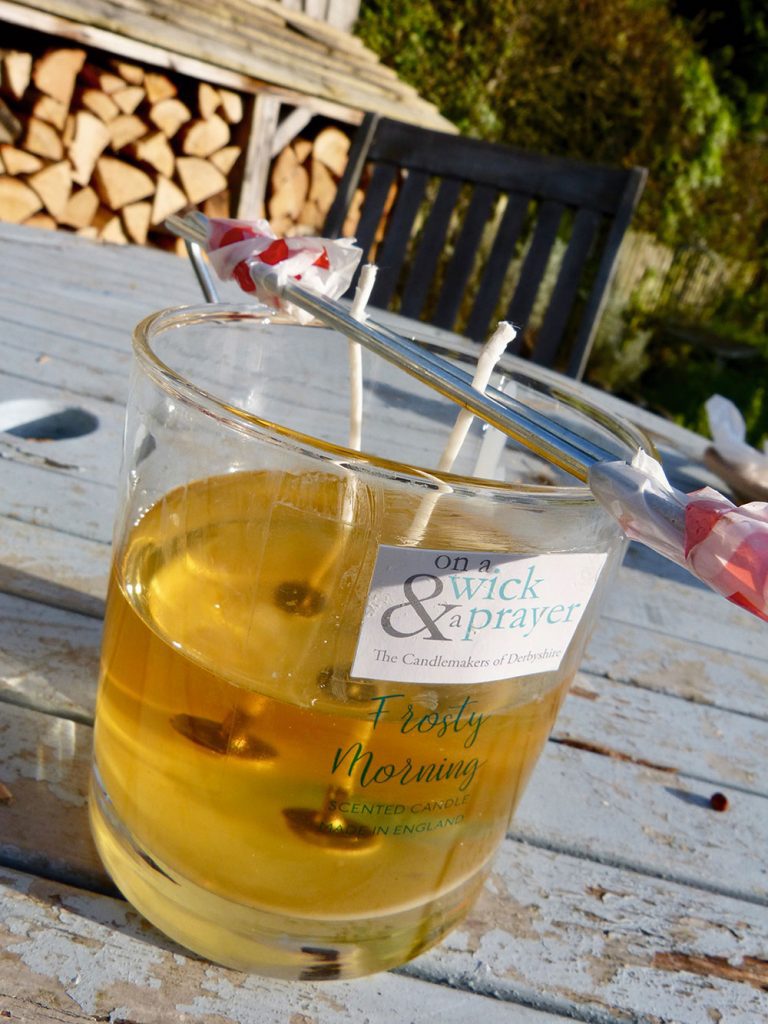
As places goâ€, ‬Tissington is a picture-perfect crowd-pleaserâ€. ‬From the minute you pass the towering lodge gates and meander along the lime tree lined avenueâ€, ‬there’s a sense you have discovered a magical village that time forgotâ€. ‬ Tissington’s popularity†(‬as many as 35,000†‬visitors during well dressing weekâ€) ‬explains why a village with around 120†‬inhabitants has a butcherâ€, ‬some bakers†(‬producing cracking cakes for Tissington Hall’s tearoomsâ€) ‬and a nationally renowned candle-makerâ€. ‬Follow your nose to the former village forge and Annie Maudlingâ€, ‬founder of†‬On a Wick and Prayerâ€, ‬offers the warmest of Tissington welcomesâ€. ‬In my case†– ‬a hugâ€, ‬a mug of coffee and the chance to warm cold hands over a pot of melted wax on the brazierâ€. ‬ This enthusiastic greeting is far more than I deserve because†‬‮–‬†‬after promising to stay in touch†‬‮–‬†‬it’s been 20-years since I last visited On a Wick and a Prayerâ€. ‬Back thenâ€, ‬Annie had just moved her candle-making from the kitchen†‬stove at Yew Tree cottage†(‬every inch as gorgeous as it soundsâ€) ‬to a converted pigsty in the gardenâ€.‬ “I’ve been very busyâ€,‬â€â€ ‬she laughs when I ask for a†‬‘quick’†‬catch-upâ€. ‬“It’s 22†‬years since I started making candles with my daughter’s unwanted kit and a grotty pan which I could never use again as it made the gravy taste of lavenderâ€.‬†I wonder what happened to the pigstyâ€. ‬“We needed more space soâ€, ‬with the blessing of my landlord Sir Richard FitzHerbertâ€, ‬we moved into the old blacksmith’s forge next-door to the cottageâ€,‬â€â€ ‬Annie saysâ€. ‬“We hand-pour around a thousand candles per day†‬‮–‬†‬sometimes more†– ‬and I have ten part-time members of staffâ€. ‬My husband Ed even†‬asked to join the team as he said it†‬‘looked like fun’â€. ‬It works wellâ€, ‬as long as he does what he’s toldâ€.‬†Annie says the turning point for her company came about after a chance meeting at a trade showâ€.‬ “Someone came to our stall and explained the National Trust shops were looking to stock more local products and asked if I would†‬be interestedâ€,‬â€â€ ‬Annie†(‬54â€), ‬recallsâ€. ‬“It was a case of†‬‘Erâ€, ‬give me half a second to think about it’†‬before saying yesâ€. ‬It proved a massive leap forwardâ€. ‬Before I knew itâ€, ‬we were supplying candles to 60†‬shops throughout the countryâ€.‬â€â€ ‬In 2005â€, ‬with orders coming in thick and fastâ€, ‬Annie took on another unit in nearby Ashbourneâ€. ‬Within a matter of two years†‬‮–‬†‬they’d outgrown itâ€. ‬“I have a friend whose husband worked from a base in Dovedaleâ€. ‬He was moving to larger premises and she asked if I’d be interested in his unitâ€,‬â€â€ ‬Annie saysâ€.‬ “It was perfect†‬‮–‬†‬offering four times the spaceâ€. ‬I’d finally found a place big enough to make custom candles for other businesses†(‬including some top London hotelsâ€), ‬store the packaging and do the product photographyâ€. ‬It also allowed me to achieve a life-long dream of buying a kiln and making a range of pottery called Dovedale Ceramicsâ€.‬â€â€ ‬ As Annie and I chatâ€, ‬there is a steady stream of people visiting the small but perfectly fragranced shop which is on the side of†‬her workshopâ€. ‬Even though most visitors are there by chance†– ‬hikersâ€, ‬cyclistsâ€, ‬tourists†‬‮–‬†‬they all leave with a candleâ€, ‬or twoâ€.‬ “The workshop is really popularâ€. ‬We often have people who come in†‬‮–‬†‬smell a few candles†‬‮–‬†‬and because they are out walking or cycling say they’ll come again with the car and fill their bootâ€. ‬I’m pleased to say most doâ€,‬â€â€ ‬she saysâ€. ‬“We did a survey recently and asked our customers†‬‘why usâ€?‬’†‬I was expecting a variety of answers but 95†‬per cent said they loved our fragrancesâ€. ‬I remember when I first started I was so desperate to please I’d find myself obliging all requests to make anything from Parma violet to roasted mushroom scented candlesâ€. ‬Then I learned to have faith in my own fragrances as each one can take weeks†‬‮–‬†‬even years†‬‮–‬†‬to perfectâ€.‬†Annie agrees there has been a craze for candles which evoke a favourite smell as opposed to a parfumier’s scentâ€. ‬Annie’s own collection includes Starched Linenâ€, ‬Vine Tomato and the best-selling Hot Toddyâ€.‬ “I try to avoid trends andâ€, ‬even when I’m developing something newâ€, ‬I ask if it fits in with our storyâ€,‬â€â€ ‬she saysâ€. ‬“For instanceâ€, ‬I’ve fallen in love with Norway and spent six years perfecting a blend which brought to mind the smell of a†‬‘Nordic Forest’†‬as opposed to a toilet cleanerâ€.‬†Annie is unperturbed if people don’t like the scent†(‬known in the trade as the throwâ€) ‬of a certain candleâ€. ‬ “Two girls came in the other day and one loved a candle but the other said†‬‘Ew†‬‮–‬†‬no’â€,‬â€â€ ‬she laughsâ€. ‬“We’ve all got a very different sense of smellâ€. ‬I test my fragrances on the ten members of staff and we’re all experienced enough to know when something is rightâ€. ‬The rest is down the to personal tasteâ€.‬†One trend Annie is happy to embrace is that of recyclingâ€; ‬“We tried launching a refillable eco candle†‬‮–‬†‬made from the bottom of wine bottles†– ‬15†‬years agoâ€. ‬It was just too far ahead of†‬its timeâ€,‬â€â€ ‬she recallsâ€. ‬ “I know a lot of my customers have cupboards full of spent candle containers they’d like to reuseâ€. ‬We do offer a popular refill service but I wanted to help those who’d prefer to make their own candlesâ€.‬†Annie wrestled with the idea of how to make candle-making accessible to allâ€; ‬doing away with the need for mouldsâ€, ‬thermometer and jugsâ€. ‬As usualâ€, ‬divine inspiration struckâ€. ‬“One night I went out to buy a pint of milkâ€. ‬The next morningâ€, ‬I woke up and had a light bulb moment†‬‮–‬†‬put the wax in the bottleâ€.‬†‬Milk bottles are one of the most re-cyclable of all plasticsâ€, ‬they
The Isles of Scilly

T‬he Isles of Scilly form an archipelago of five inhabited islands†(‬six if Gugh is counted separately from Saint Agnesâ€) ‬and numerous other rocky islets†(‬around 140†‬in totalâ€, ‬lying 45km†(‬28†‬milesâ€) ‬south west of Land’s Endâ€. ‬Access is by the Scillonian ferry from Penzance across a notoriously rough section of the North Atlanticâ€. ‬Before the discovery of the way Latitude and Longitude could be properly determinedâ€, ‬many proud ships came to grief by sailing too close to the Scilly’sâ€.‬ With a perennially mild climateâ€, ‬the Isles of Scilly were inhabited by pre-historic peopleâ€, ‬many of them building their round houses on land that is now under waterâ€, ‬following the end of the last Ice Ageâ€. ‬Since then the islands became home for small scale†‬farmers and fishermen who exploited the benefits of a mild climateâ€. ‬Until recently early daffodils and new potatoes and spring vegetables grown on the islands were brought to market weeks before the rest of the countryâ€.‬ The Penzance ferryâ€, ‬the Scillonianâ€, ‬picks its way carefully past the eastern islands and outcropping rocksâ€, ‬to berth at Hugh Town harbour on St Mary’s the largest and most populated islandâ€. ‬With plenty of accommodation on offerâ€, ‬St Mary’s is the busiest resort and it comes as a shock to have to deal with trafficâ€, ‬however light it might beâ€. ‬Access to the outlying†‬villages and beaches is easy as there is a fairly good bus service running throughout the yearâ€. ‬Please note that despite the volume of local trafficâ€, ‬it is virtually impossible to take your car on a holiday to the isles as all large freight must be craned on and off the Scillonian ferryâ€.‬ To explore St Mary’s we started in the westâ€, ‬high above Hugh Town where the extensive ramparts of the Garrisonâ€, ‬a fortress built to ward off Napoleonic forces has become something of a public park and resortâ€. ‬Below it and in the main town properâ€, ‬a wide range of shops and restaurantsâ€, ‬together with cycle hire are on offer and there is a small museum of the island’s historyâ€. ‬One of the items covered by the museum is the highly competitive sport of gig racingâ€. ‬This takes place throughout the summer and harks back to the days when experienced local sailors were rowed out to offer to pilot incoming vesselsâ€. ‬As there†‬was no way this could be planned in advanceâ€, ‬several fast rowing boats known as gigsâ€, ‬would set out at once and it became a race to be firstâ€. ‬The sport of gig racing has followers mainly from all over the south westâ€, ‬but competitors travel even from as far away as Hollandâ€. ‬The race is from Hugh Town harbour to Nut Rock near Tresco and backâ€: ‬a total distance of about 1½milesâ€.‬ The Labour Prime Minister Harold Wilson and his wife Mary had a holiday home in Hugh Townâ€. ‬Even though there is a rule that only†‬locals can be buried on the islandâ€, ‬special dispensation was given when the popular visitor diedâ€. ‬He is buried in the graveyard of the tiny medieval chapel at Old Town on St Mary’s south-facing coastâ€. ‬His wife’s ashes were later scattered on his grave when she diedâ€.‬ There are plenty of coastal footpaths on the islandâ€. ‬We followed the one going eastwards from Hugh Townâ€, ‬in and out of tiny coves and headlandsâ€, ‬past Old Town and its friendly caféâ€, ‬then inland to St Mary’s to the†‬‘main road’†‬that meanders in a tight circuit of the centre of the islandâ€. ‬About half a mile from Old Town we were puzzled by a notice warning us of low flying aircraftâ€. ‬The answer soon came when an outgoing plane took off a matter of feet directly†‬above our headsâ€.‬†‬This was the Isles of Scilly airportâ€.‬ There are regular boat trips going to the outlying islandsâ€, ‬not simply for touristsâ€, ‬but also as the main supply link with the regular ferryâ€, ‬the Scillonianâ€. ‬St Martin’s is the most easterly of the inhabited islandsâ€. ‬Its single road acts as a link between three hamlets whose names seem to be lacking in imagination†‬‮–‬†‬Higher Townâ€, ‬Lower Town and in the middle as you might guessâ€, ‬is Middle Townâ€. ‬The island is popular with†‬sailing enthusiasts and under water explorers who pick their way amongst the remains of countless vessels that came to grief on†‬the uncharted rocks littering the hazardous passage of any captain foolishly attempting to sail between the islandsâ€, ‬rather than round themâ€.‬ Trescoâ€, ‬owned by Robert and Lucy Dorrien-Smith is the jewel in the islands’†‬crownâ€. ‬A luxury holiday resortâ€, ‬it centres on a beautiful garden founded in the nineteenth century by Augustus Smithâ€. ‬Rare sub-tropical plants grow in pine sheltered sun-trapped gardensâ€, ‬enjoying the year-long mild weatherâ€. ‬Alongside the flowersâ€, ‬a small museum is devoted to a collection of exotic figureheads taken from wrecked shipping around the coasts of these tiny islandsâ€.‬ Tresco was first inhabited at least 3000†‬years ago by Neolithic farmers and during the English Civil Warâ€, ‬Cromwell’s Parliamentary forces built a fortress on the island’s most southerly point in order to control shipping through the narrow channel known as The Roadsâ€. ‬ Fishermen from the north of England used Tresco as a southern base when following the annual flood of herring†‬‮–‬†‬the silver darlingsâ€. ‬Possibly feeling homesickâ€, ‬they named their settlement New Grimsbyâ€.‬ About 1½miles long and†‬½mile wideâ€, ‬it is possible to reach Bryher at exceptionally low tides from Trescoâ€. ‬This is the smallest inhabited island in the archipelago and was called Brayer in 1336â€, ‬then Brear in 1500â€, ‬obviously the phonetical spelling of the spoken word as interpreted by some government clerk or otherâ€. ‬Hell Bay on the north western tip of Bryher was a notorious place for shipwrecks when violent Atlantic storms drove vessels into this remote spotâ€. ‬Bar Quayâ€, ‬the landing place for small ferriesâ€, ‬was first built by volunteers in the 1990†‬production of the TV
Cruising gently along the Rhone

Part One – Arles to Vienne â€T‬ravelling with Midland Mainlines meant we arrived at St Pancras in good time for the mid-morning Eurostar to Parisâ€, ‬Gare du Nordâ€. ‬What should then have been a quick ride to Gare de Lyon seemed to take an ageâ€; ‬Parisian traffic was as bad as I remembered it†‬from my last visit decades agoâ€. ‬What it did do was to give us plenty of time to spot†‬‘Frexit’†‬signs everywhereâ€! ‬What have we startedâ€?‬ I had never travelled on one of France’s TGV super-fast trains and I must say I was impressedâ€. ‬The only difference between them and our proposed HS2†‬trains is that the French system runs mostly through open countrysideâ€. ‬What seemed a blink of the eyeâ€, ‬or maybe because I slept most of the wayâ€,‬†‬the journey from Gare de Lyon to Avignon was the quickestâ€, ‬most comfortable train ride I have ever experiencedâ€.‬ Our water-borne home for the next weekâ€, ‬MV Lord Byronâ€, ‬was moored about a hundred yardsâ€, ‬or should I say metres downstream of Avignon’s famous broken bridge where for some reason†‬‘l’on y dense tout en rond’â€. (‬‘Everyone is dancing in a circle’â€). ‬The story behind this ancient bridge is that it was half demolished in a flood and when no one bothered to repair itâ€, ‬it became a tourist attractionâ€, ‬helped no doubt by a children’s songâ€. ‬Known officially as the Saint-Bénézet Bridge or Pont d’Avignonâ€, ‬originally the bridge was 899†‬metres long with 22†‬archesâ€; ‬but in 1226†‬it was almost totally destroyed by Louis VIIIâ€, ‬and many subsequent floodsâ€. ‬Attempts at restoration failed and the bridge has been a ruin since the 17th centuryâ€.‬ The city was by a Gallic tribe and later settled in turn by the Romansâ€, ‬Goths Saracensâ€, ‬Franks and the Holy Roman Empireâ€. ‬Avignon’s 15th century city wall still keeps traffic to a walking paceâ€, ‬protecting the sumptuous remains of the Papal Palaceâ€. ‬Commissioned during the so-called Avignon Papacy when a total of seven popes reigned from Avignonâ€, ‬far away from trouble in Romeâ€, ‬it combines two buildings†‬‮–‬†‬the old Palace of Benedict XII which sits on top of the impregnable Rocher des Domsâ€, ‬and the†‬‘New’†‬Palace of Clement VIâ€. ‬After the death of Clement VIâ€, ‬the papacy eventually after much argumentâ€, ‬reverted to Romeâ€. ‬Remains of brightly coloured frescos adorn the chapel walls where musicians and singers are still attracted by the perfect acousticsâ€. ‬The rest of the medieval city is immaculately preserved within the surrounding wallsâ€; ‬pavement cafesâ€, ‬restaurants and colourful shops†‬selling lavender-based products will tempt even the most blasé visitorâ€, ‬for here is a town designed for strollersâ€.‬ An evening cruise took us downstream to Arlesâ€. ‬Here we were following in the footsteps of Vincent van Goghâ€. ‬He came to this Provençal townâ€, ‬seeking its better light than Parisâ€, ‬using the region for many of his well-known worksâ€. ‬He started almost immediately with†‬‘Starry night’â€, ‬the riverside view he spotted on leaving the trainâ€. ‬All around Arles it is easy to imagine him sitting outside places like his favourite†‬‘yellow’†‬caféâ€, ‬or enjoying the tiny walled garden hidden away behind another of his watering holesâ€. ‬Hopefully he soon found the light he was afterâ€, ‬but he wouldn’t have been so lucky if he came with us†‬‮–‬†‬it rained cats and dogsâ€, ‬fortunately the only serious rain for the whole tripâ€.‬ Mental problems led to the eccentric ear-severing incident and he spent time in the local hospitalâ€. ‬Learning of plans to put him in an asylum he took himself off to nearby Saint-Rémy-de-Provence where he continued to paintâ€. ‬It was here that he produced some of his most renowned outdoor picturesâ€, ‬such as the†‬‘iris’â€, ‬or his sunflower studies and mountain views of les alpillesâ€, ‬the bauxite limestone ridge above St Rémyâ€.‬ Long before van Gogh came to Arlesâ€, ‬the Romans made it the administrative centre for the lower Rhône Valleyâ€. ‬The town has an open-air Roman theatre still capable of accommodating thousands of spectators in the remarkably well preserved auditoriumâ€, ‬and close by almost hidden amongst narrow back streetsâ€, ‬the arena can still be used for bull fightsâ€. ‬In the Provençal form of bull fightingâ€, ‬the bull is not killed and has a number of rosettes tied to various parts of his bodyâ€. ‬These must be snatched before the†‬bull can attack the participantsâ€, ‬who often come off rather badly for their effortsâ€. ‬ Coaches took us a few miles to the westâ€, ‬beyond the Rhône to the Pont du Gardâ€. ‬This amazing feat of Roman engineering carries water across the River Gard carrying water from the Fontaine d’Eure to the city of Nîmes 20†‬km awayâ€. ‬Although this city which had over 60,000†‬citizens was only 20†‬km awayâ€, ‬due to the rough terrain the aqueduct had to travel about 50kmâ€. ‬Even soâ€, ‬the difference between the start and finish was a mere 2.5†‬centimetresâ€, ‬in order to allow the water flow gradually into the wells and fountains of Nîmesâ€. ‬The three tiered aqueduct was built without mortar with each stone interlocking like pieces of Legoâ€, ‬miraculously without any significant loss of waterâ€.‬ From the Lord Byron moored overnight back at Avignonâ€, ‬coaches took us into the Ardèche Gorgesâ€, ‬a deep-cut ravine cut by a 30km meandering stretch of the River Doux to the west of Tournonâ€, ‬a small riverside town above Valenceâ€. ‬ The Doux has cut its way through massive layers of limestoneâ€, ‬not unlike a series of cliffs like our High Tor as it towers above†‬Matlockâ€. ‬Starting at the village of Lavas the river runs east in sharp twists and turnsâ€, ‬flowing downstream until it comes to†‬Aiguèzâ€. ‬A scenic motor road making even more torturous meandersâ€, ‬runs hundreds of feet above the riverâ€, ‬following the line of the gorgeâ€, ‬with view-points colonised by feral goats waiting for hand-outsâ€.‬ During the warâ€, ‬resistance groups created hideaways in the impenetrable shrub-covered moorland plateauâ€, ‬at one time hiding Jewsâ€
The Lost Houses of Derbyshire – Glapwell Hall

Glapwell Hall was a rather rambling stone house of later seventeenth century date, made more rambling by Georgian and Victorian additions, producing, as one former owner put it, ‘a house of comfort rather than conformity’. The rooves were a right jumble from above. It was built of coursed rubble with Permian magnesian Limestone/coal measures sandstone dressings, the earliest part being the west front, latterly stuccoed. This front consisted of two storeys with attics under three coped gables with ball finials, the wide centre one embracing all three bays of the seven bay façade, which was essentially flat. Whilst it no doubt originally had mullioned attic windows and mullion-and-transom ‘cross’ windows below, by the time it came to be photographed the windows had been replaced with glazing bar sashes of later eighteenth century type in the flat stone surrounds, those on the ground floor having been dropped to terrace level in the regency period. The central entrance was crowned by a segmental pediment, and latterly served as the access to the gardens. The general appearance of this façade was not unlike that of Carnfield Hall at Alfreton, which hides a much earlier core, and indeed, this may have been the case at Glapwell, too. The house was a double pile building, consisting of two parallel ranges, their ends facing north and south, the latter boasting a fine set of triple stacks with an original two light mullioned attic window below to show what the main front must have boasted originally. Below again a recessed reserve held a stone carved armorial shield with the arms of Hallowes, the family latterly most associated with the house. To the SE angler of this was added a mid-Victorian two storey range which ran round to the east from a full height canted bay with round arched plate glass windows. To this was added a new single storey entrance range of two arched Serliana or Venetian windows, that on the right included the new entrance door, all beneath a balustraded parapet with further ball finials. This was top lit, forming a bright space which partly masqueraded, aided by aspidistras and exotic plants, as a conservatory. Here with stone was ashlared, too and led to a south facing conservatory to the right of the door. Rising two storeys beyond this was a range of Queen Anne date of two storeys under a steeply pitched roof with attics dormers behind a parapet, and of three bays of sashes to the east, but continuing across the north end of the original house for form a west wing (facing north-south). This was topped be a tiny cupola and bell, marking the presence of a former domestic chapel, the origins of which went back to the twelfth century. There were extensive grounds including a small park, entered from the public road via a pair of Neo-Classical gate piers, today still surviving, listed grade two and supporting a pair of rather flimsy looking modern iron gates. The site’s history is very ancient, a capital mansion there being known since the twelfth century, built by the descendants of Serlo de Pleasley, who held it as feudal under-tenant from Hubert fitz Ralph, Lord of Crich, one of a small number of Domesday tantants. Serlo’s grandson was Simon fitz Serlo de Pleasley, who left three sons. The eldest, Serlo de Pleasley III inherited an estate at Ashover, whilst the third son William came into the manorial estate of Pleasley. His second son, Hugh, came into the manor of Glapwell c. 1180, and took his surname from the place (surnames still being rather fluid at that date and still confined to the upper crust). It was Hugh who probably built the first house on the site, and no doubt the domestic chapel, which needed re-roofing in c. 1260. The family continued there for two centuries, before in 1481 the heiress married into the family of Woolhouse, from whom it eventually passed to Samuel Hallowes of Dethick, by marriage with Elizabeth, daughter and sole heiress of Thomas Woolhouse of Glapwell. It was probably Thomas Woolhouse who built the earliest range, which was taxed in 1670 on nine hearths indicating that it was a house of relatively modest dimensions. His prosperity was, however, being increased by the discovery of coal on the estate. Samuel Hallowes, who no doubt added the Queen Anne range (perhaps on the site of a much earlier range) and probably re-ordered the original façade too, was the grandson of a Derby woollen draper, Nathaniel Hallowes, of a family from Youlgreave originally. He was a Presbyterian, keen supporter of the republican side in the Civil War, and was elected MP for Derby in the Long Parliament (sounds familiar!) replacing the deposed Cavalier MP William Allestrey, and served as Mayor of Derby in 1657. He was also a keen prosecutor of delinquents, as Parliament called the defeated Royalists, and his activities in this respect earned him three landed estates. So notorious was he that at the Restoration his Cromwellian grant of arms was annulled, albeit re-granted to his descendants in 1766. Nevertheless, his grandson was well endowed with property, to which the Glapwell estate no doubt made a happy addition. The family did well from exploiting their coal deposits, which doubtless explains the various additions. No doubt the domestic chapel was de-commissioned, although the land to the south of the house was always called Chapel Yard, as the family’s tradition for the knobblier forms of Anglicanism continued. Samuel’s eldest son, Thomas married well, his bride being Lady Catherine Brabazon, daughter of Chambré, 5th Earl of Meath, by a daughter of Viscount Chaworth, a Nottinghamshire grandee also boasting an Irish peerage. In 1861, Capt. Francis Hallowes, RN, inherited the estate from a cousin and, coming ashore, decided to make alterations. He it was who added the canted bay, the new entrance hall and the conservatory, probably to designs by the Derby partnership of William Giles and John Brookhouse, who were building a new house in Ashover
Taste Derbyshire – The Porcini Remained Elusive
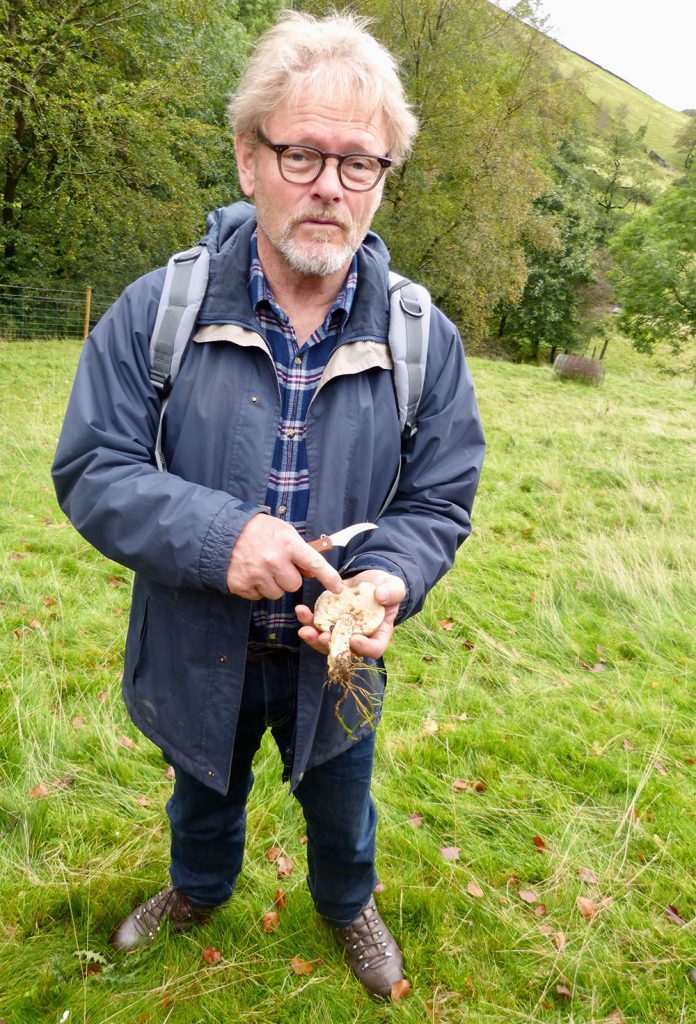
Foraging for food in the Derbyshire Peaks may sound idyllic but, when the clouds are ominously heavy with rain, there is only one thing in nature’s larder which could drag me from my bed on a Sunday morning. In short, you can leave sweet chestnuts and sloe berries to the birds and bees. I want mushrooms. In spite of severe weather warnings, it seems I am not the only one answering the magical, mystical call of the wild mushroom. It warms the cockles to see fellow hunters and gatherers shuffling along in head-to-toe waterproofs waiting at the designated meeting spot; a car-park in the High Peak village of Hayfield. A total of nine hardy souls have ventured to take part in a ‘Funghi Foray’ – a four-hour adventure combining fresh air, al fresco dining and fascinating facts with Bengt Saxmark and his wife Deb Hampson of New Mills; self-confessed fanatics who run a wild mushroom business called Get Funghi. The couple are eminently qualified to help people like Jayne Fowler and husband Rob find out how to spot the good (edible and delicious) from the bad (edible but tasteless) and the down-right ugly (poisonous enough to wage a deadly war on your internal organs). “Rob and I go walking a lot with our dog and we’ve seen loads of mushrooms and often wondered if they’re edible,†says Jayne, of Chapel-en-le-Frith. “Our daughter bought us the event as a Christmas present as she thought it would be a good starting point for us.†Fortunately, our little party could not be in safer hands. Bengt, who hails from Gothenburg, has been keen on foraging for mushrooms since he was a boy and qualified as a mushroom consultant from Sweden’s UmeÃ¥ University in 2006. “People are right to be cautious but it’s better if we encourage them to learn rather than scare them away,†he says. “Most of the ‘poisonous’ mushrooms aren’t fatal but will make you feel awful or give you dreadful stomach ache. If you are not 100 per cent sure, leave it for the maggots.†Two of the UK’s deadliest mushrooms belong to the amanita family; for this reason, Bengt begins every session by pointing out their common features which can include white gills below the cap, a ring on the stem and a sock or vulva at the base. “We will concentrate on beginner’s mushrooms which are almost impossible to mix up with anything else – unless you are colour blind,†Bengt explains while directing the group over a stile and into an open field. “A good beginner’s mushroom is the bright yellow chanterelle. Underneath the cap are ridges, not gills. There is no poisonous mushroom that looks like this.†My suggestion that poisonous mushrooms look dangerous – red and covered with white spots – is quickly dismissed. While there is a red, spotty mushroom (the fly agaric), Bengt insists nature’s warning signals don’t always help when it comes to mushrooms. “For instance, there is a mushroom with blood red sponge that turns blue when you cut it that is actually delicious,†Bengt says. “I took out a group of Italians who were convinced a mushroom is safe if it tastes good. Not true. The best way to start is to go out with an expert, do your homework, buy a book (Bengt and Deb recommend ‘Mushrooms’ by Roger Phillips) and make sure it is up-to-date. Mushrooms are often being re-classified.†It is only fitting that the first ‘spot’ of the day – a field mushroom on a field too far away to pick – belongs to Pete Camp and son Scott, of Congleton, who are attending their third foraying day. “My friends might say I’m becoming a mushroom bore,†Pete laughs. “Last year, I found a crop of porcini in Eyam, enough to make a nice starter for four on a crostini. Another time I came across what was almost certainly an edible scarletina bolete mushroom. I was 90 per cent sure but there was a ‘what if’ so I didn’t eat it.†At the start, our biggest problem seems to be distinguishing mushrooms from leaves. The first edible mushroom close enough to pick, a crop of waxcaps, are rejected as old and slimy. Undeterred, one of our intrepid bunch, Jameela Mian of Ashby, clambers over to a fallen log to investigate what looks to be brown ears growing on the bark. “Honey fungus – it is edible but not pleasant to eat,†says Bengt. “It’s often found at the base of trees and it attacks wood and plants so it’s not a friend to the gardener. It sounds sweet but the taste is slightly bitter and can upset the stomach.†Just when it looks like our baskets will remain empty, novice mushroom hunter Tara McGuirk strikes edible gold. “It’s called a hedgehog mushroom because it has soft spines under the cap,†says Bengt. “It has a firm texture, tastes slightly peppery and is very aromatic and it’s absolutely delicious. If it’s creamy white coloured and has spines instead of gills so it can’t be confused with anything else. It’s a beautiful mushroom.†Tara, who has travelled from Birmingham to take part, is clearly thrilled; “Do I get a certificate?†she laughs. Amazingly, the mushrooms, both edible and extra-ordinary, just keep on coming. In the next field along, Scott and Pete find a maitake; an edible mushroom also known as ‘hen of the woods’ because it resembles the feathers of a sitting hen. This find is followed by a flock of other mushrooms including one with the appearance of a filmy eye-ball. “A parrot waxcap,†Deb says. “Lovely to look at but far too slimy to eat.†As Bengt’s basket begins to fill, someone asks if there is a limit to the amount of mushrooms a forager can take. “Picking a mushroom does not damage it as 100 per cent of the mushroom’s mycelium (root-like fibres) is underground. We pick the fruiting body so it’s