Modern Collectables – Modern Glass Paperweights
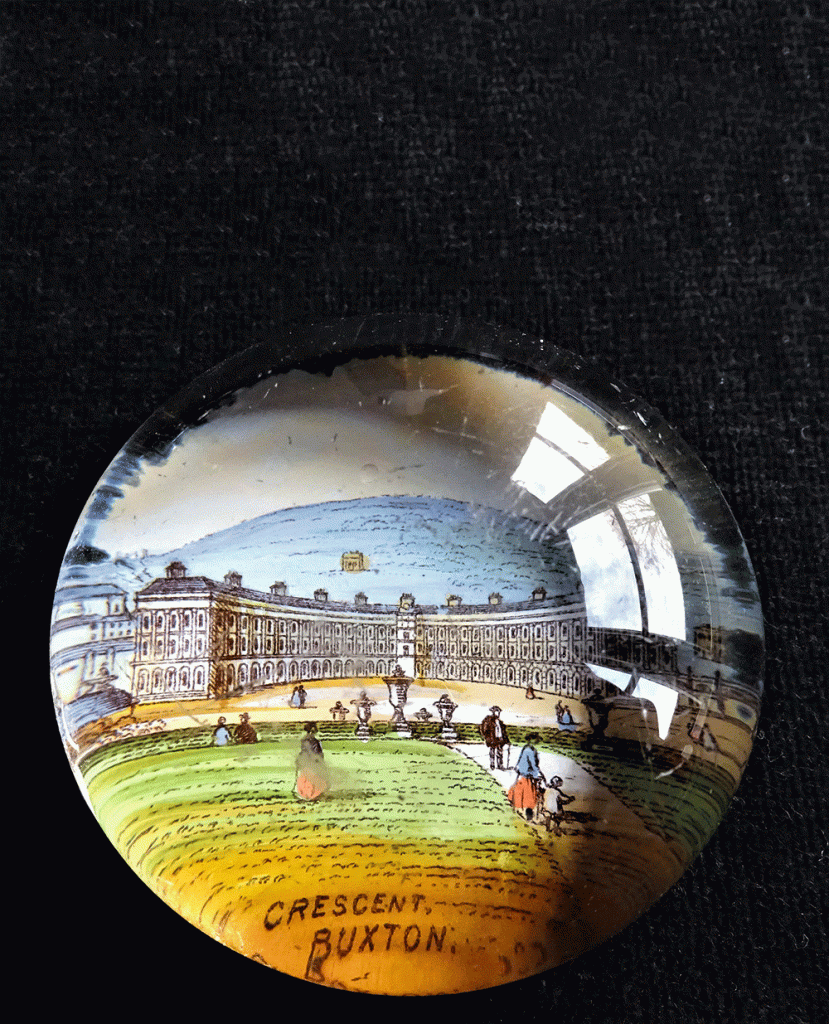
My daughter, although now 22, has gone through many enthusiasms in her short life: Barbie Dolls, Beanie Babies, My Little Pony and so on through Pokémon to soberer items. One of which was modern glass paperweights, of which we now have a considerable collection. On the whole, prices – mainly at fleamarkets and antique fairs – ranged from 50p to £25, certainly no more. Nevertheless, those made by established firms and artists, like Caithness Glass, Whitefriars, Perthshire, Selkirk (Scotland seems to specialise in this industry) and Langham (Norfolk) tend to start at our top price and can ascend (new) towards £200. Note that sometimes, you will never know the maker without the original box; this means that inexpensive anonymous ones are often by well-known makers but have been separated from their original boxes. Those prices, however, can come down sharply at auction. At Bamfords we usually sell unsigned or unprovenanced ones – grouped in any convenient box; if there’s a really desirable one amongst them that we have missed (a rare event!) the buyer will be delighted. A group of miscellaneous anonymous 20th century paperweights is usually estimated at £20-£30 or so. Historically, paperweights were made in the classic years between 1845 and 1860 primarily in French factories like Baccarat, St. Louis, and Clichy. Together, they made between 15,000 and 25,000 weights in this period. Bohemian paperweights were particularly popular in Victorian times. Large engraved or cut hollow spheres of ruby glass were a common form. Weights (mainly of lesser quality) were also made in the USA, Great Britain and elsewhere, but the fashion for them declined from the 1860s until revived in the aftermath of WW2. Indeed, in Scotland, still pre-eminent for paperweights in the UK, the pioneering work of Paul Ysart from the 1930s onward preceded a new generation of artists. A further impetus to reviving interest in paperweights was the publication of Evangeline Bergström’s book, Old Glass Paperweights. Starting in the late 1960s and early ’70s, artists began breaking new ground and were able to produce fine paperweights rivalling anything produced in the classic period. The classic type of paperweight is the millefiori (Italian for a thousand flowers) ones which contain thin cross-sections of cylindrical composite canes made from grouped coloured glass rods and usually resemble little flowers, although they can be designed after anything, even letters and dates. Lampwork paperweights have objects such as flowers, fruit, butterflies or animals constructed by shaping and working bits of coloured glass with a burner or torch and assembling them into attractive compositions, which are then encompassed in a dome of glass. The objects are often stylized, but may be highly realistic. Sulphide paperweights have an encased cameo-like medallion or portrait plaque made from a special ceramic that is able to reproduce very fine detail. These are known as incrustations, cameo incrustations, or sulphides. They often are produced to commemorate some person or event. From the late 1700s through the end of the 1900s, an amazing variety of glass objects, including paperweights, were made with incrustations. Although still produced today, their heyday was before the classic period. A fourth technique, a crimp flower, usually a rose, originated in the USA in the first decade of the twentieth century. These weights range from simple folksy items to fine works of art, depending on the maker. The sort we used to collect are those not made with any of the major techniques but which predominantly include swirls, marbries and crowns. Swirl paperweights have opaque rods of two or three colours radiating like a pinwheel from a central millefiori floret. A similar style, the marbrie, is a paperweight that has several bands of colour close to the surface that descend from the apex in a looping pattern to the bottom of the weight. Crown paperweights have twisted ribbons, alternately coloured and white filigree which radiate from a central millefiori floret at the top, down to converge again at the base. This was first devised in the Saint Louis factory and remains popular today. We also acquired dump paperweights: those made from end-of-day waste green glass at bottle plants etc., with a pattern blown in and often of elongated shape. Another type is the sort with a picture inside, on the base, magnified by the curve of the enfolding glass. Here I illustrate a rather small one (cost £6) with Buxton Crescent inside – not really a modern paperweight, but inexpensive and with local resonance. When we first started collecting, we went for anthropomorphic designs, although dealers tended to ask a little more for these. Most are smooth, tactile things, although you can buy cut glass creatures too, although these were less enticing to us. My daughter also liked a very modern variant, the clear glass shape with a lasered design inside. Charity shops seemed to be a good place to find these, often with the original box, at a reasonable price; we picked up one modelled as an Egyptian pyramid with what looked like Wilson, Keppel & Betty inside, for £8. Long after the event we picked up a London Olympics rectangular weight with the Union Flag and logo inside. These actually came in a variety of colours at some cost, but we paid £8. We also like a pair of engraved glass terrestrial globes and a Swarowski crystal one. Our best find was quite a large ship’s decanter-shaped one with semi opaque coloured body and clear glass knop. We had to drive a hard bargain with an eastern European dealer to get in down to a tenner, but I had noticed the artist had signed it (although I cannot read the signature!). It is almost certainly Bohemia (Czech) glass. In case you are curious, the world record price for a paperweight was set at about £221,000 in a 1990 Sotheby’s auction – an antique millefiori weight, produced in the mid-1850s by the French Clichy factory, known as the Basket of Flowers, albeit that the handle had long since broken off and
Lost Houses of Derbyshire – Little Chester Manor House, Derby

Readers will be well aware that Little Chester is a characterful Derby suburb which overlies the remains of the Roman small town of Derventio. What some may not know is that within its modest compass stands Derby’s oldest domestic residence: Stone House Prebend, on Old Chester Road, itself once the via principia of the military fort which preceded the town. The house, although rebuilt in the early 17th century and again in the late 18th, contains considerable medieval fabric. It is so named because when the College of All Saints with St. Alkmund’s was re-founded soon after Derby itself in 921, the six canons of St. Alkmund and the seven canons of All Saints’, were granted land recently seized from the Viking invaders at Little Chester (itself re-fortified by the Norse), Little Eaton and Quarndon upon which were established farms, each supplying the needs of a canon. This is why all the three settlements were all, until 1867 parts of the parish of St. Alkmund, Derby, despite being outside the ancient borough boundary. Unfortunately, no document survives to tell us where exactly they all were, but there were at least six in Little Chester. Unfortunately, again, with the dissolution of the chantries by Edward VI in 1549, the College was wound up and its property sold. In 1554 Queen Mary, anxious to undo some of the damage made by her father’s exactions, made some amends by re-acquiring as much of the College’s former land as possible which she gave to the Corporation of Derby as part of a charter, granted the following year, with a view to using the rental income to endow the incumbents of the main borough churches with a stipend. Not all the land in the township returned to the Corporation, however, and at least a third remained outside their control and constituted the Manor of Little Chester – mainly on the north of Old Chester Road. The College was run on behalf of the Dean (who was also Dean of Lincoln and invariably absent) by a sub-dean, and we are pretty certain that Stone House Prebend was his farm. This is re-inforced by the substantial nature of the house, although in all conscience, the other two we know of in Little Chester were well above the average for contemporary farmhouses, although in their case, the enhancement of their status may well have occurred after the Reformation. The other surviving one is Derwent House, lying immediately north of the sub-dean’s establishment on the opposite side of Old Chester Road. This is a brick building mainly of early 17th century date, with delightful blind brick arcading, impost band and an astonishingly wide staircase for a house of its size. The cellar was much earlier and stone lined, and was thought to be of Roman origin. We cannot check, because, despite its listed status, the Corporation of Derby shot two lorryloads of cement into it around 1980 when the tenant was having trouble with damp. The third house, Little Chester Manor, has now vanished. It was also largely brick and of 17th century date, less elaborate than Derwent House, albeit occupying a larger footprint, and stood on the south side of Old Chester Road, about 100 yards east of Stone House Prebend, and adjacent to the east gate of the walled Roman town, excavated in 1972. This was more recently called Manor House Farm, having been re-named after a new house was built opposite to it in the late 19th century (also now vanished) itself optimistically styled the Manor House. The Manor House (as we shall call it) was L-shaped in plan, two storeys, in brick with a tile roof. The range facing the road had coped end gables, once with finials on the kneelers, three- light mullioned windows and, when visited by the late Roy Hughes in June 1963, had a space within it subdivided horizontally, probably in the 18th century, which was probably its great hall. This was approached by a baffle entry, all suggesting that it had a medieval core and was probably a building of some status. The rear extension was added to considerably at the south end in Regency times, but was truncated when the railway was built in the 1870s and further some time later. A fourth farm lay immediately to its West (lost to a row of later 19th century cottages erected by Sir Alfred Haslam, who built good quality workers’ housing here, close to his large Union Foundry on City Road. This too was almost certainly a prebend, and certainly the surviving deeds imply a third farm. Each of these were let, and the tenants by the 16th century tended to be men of substance; after the Reformation their status increased to minor gentry: the Thacker, Lister, Haughton, Hope and Bate families amongst them. Working out which family occupied which prebendal farm is not easy due to the fragmentary nature of the surviving sources, but Thacker had the Stone House Prebend, in 1549, and the others were let, the tenancies being generally 25-year ones, although the Listers rented two in 1554, probably both vanished ones. One suspects that the Manor House, which was still timber framed in the mid-16th century, is probably the prebend called The White House (greying oak timbers and distempered render in between) which passed to the heirs of Humphrey Sutton. The Listers probably held Derwent House along with that immediately east of Stone house, and the 1623 inventory of another tenant of a Prebend, Richard Scattergood, clearly indicates a hall house and probably related to the Manor House. In 1648 Parliamentary Captain Robert Hope took the lease of ‘a messuage (house and surrounding land) in Little Chester called the Manor House with the croft adjoining called the Castle Yard’ – the latter designation suggesting proximity to the standing wall by the east Roman Gate. The Roman walls were not taken down until 1721. He probably rebuilt or re-cased it in brick. His family had previously
Celebrity Interview – Peter James

Three years ago crime fiction legend Peter James was in Nottingham to see his stage play, Dead Simple, performed on the Theatre Royal stage. In a question-and-answer session afterwards he slammed television producers who wanted to make big changes as a condition of transferring Peter’s police detective Roy Grace to the small screen. Now, as Peter is preparing to return to the East Midlands, his desire to retain control of how his principal character should be depicted is about to pay off. So what got Peter so hot under the collar? One TV company wanted to turn Roy Grace into a woman. Another wanted the location moved from Brighton, Peter’s home where all the Roy Grace books are set, to Aberdeen. Those producers didn’t realise who they were dealing with. Peter James is not only a best-selling author whose books have sold 19 million copies and been translated into 37 languages – he’s also been a scriptwriter for a children’s daily show in Canada and an executive producer on a number of major films. The last one was Shakespeare’s The Merchant of Venice starring Al Pacino and Jeremy Irons which was nominated for a BAFTA. So Peter should know how to get the best out of an adaptation. Peter will be back at the Theatre Royal later this month to see his fourth play, the stand-alone thriller The House on Cold Hill. It follows The Perfect Murder which featured Les Dennis when it visited Derby Theatre in 2014 and Not Dead Enough which bypassed the East Midlands on its 2017 tour. The creative team for The House on Cold Hill is the same: Sean McKenna is the stage adapter, Josh Andrews is the producer and Ian Talbot directs. So how did Peter come to write the book? In 1989 I had my first big writing success with a thriller called Possession and followed it with a book called Dreamer. “My first wife and I did pretty much what the characters in the book do – buy this big, beautiful wreck of a house in the countryside about eight miles out of Brighton. “It was a Georgian manor house that had a long history. There’d been a monastery on the site in the 14th century and before that there’d been a Roman villa there. Peter and his wife saw various things that couldn’t be explained. Then one day Peter took his dog for a walk and met an old man who used to house-sit for the previous owners when they spent the winter abroad. Peter believes everyone has risen to the challenge of putting The House on Cold Hill onto the stage. “I think a story works best when there’s a sense of claustrophobia by having everything take place inside one location. It’s a thriller and a chiller.” Peter even had a hand in choosing the cast which includes Joe McFadden, winner of BBC1’s Strictly Come Dancing in 2017, and Rita Simons who used to play Roxy Mitchell in EastEnders before going into the jungle in the recent series of I’m A Celebrity…Get Me Out of Here! Peter explains what he loves about theatre: “One is the danger of it. You can pick up a copy of my novel anywhere in the world and it’s going to be exactly the same. Not a single word will be different. But every time a play’s performed things can go wrong. “What I love most of all is sitting at the back of a theatre and watching the audience’s reaction. I’ve learned quite a lot as a writer from doing that.” Peter James was born on 22 August 1948 in Brighton. He is the son of Cornelia James, a former glovemaker to the Queen. He went to film school and then moved to Canada. At one point he was writing horror films for the drive-in cinema circuit. Later he produced a comedy with Terry-Thomas and Leslie Phillips called Spanish Fly which came out in 1976. Film critic Barry Norman called it “the worst British film since the Second World War”. In his twenties Peter had two spy thrillers published but they didn’t sell. Shortly afterwards burglars broke into Peter’s house. A policeman arrived to take fingerprints and saw Peter’s books. He told Peter he should call him if he ever wanted any help with his research. Peter became fascinated with the police’s job: “I realised that nobody sees more of human life in a 30-year career than a cop. That was the starting point and I began to write crime fiction.” Now Peter has 34 books to his name. The latest, Absolute Proof, is another stand-alone thriller. It began in 1989 when Peter had a phone call “out of the blue” from an elderly man. “He said: ‘I’ve been given absolute proof of God’s existence and you’re the man who will help me to get taken seriously’. What took me so long was that I first had to really learn and understand all the world’s religions before I could write the book.” There can be few writers as prolific as Peter James. He spoke to me from a hotel in New York where he was staying after he’d given a talk on a cruise ship. On his return he’ll follow The House on Cold Hill around the country before the next Roy Grace book, Dead at First Sight, comes out in May. In October he’ll publish the sequel to The House on Cold Hill called The Secret of Cold Hill. How does he keep coming up with ideas for his books? “My head’s constantly buzzing. I think it would be quite nice to take my foot of the pedal sometimes and have a fallow period. But I actually love writing. I really enjoy telling stories.” He praises his second wife Lara, who he married in 2015, for being a “wonderful help”. He says: “She’s got a very creative brain. When I’m writing she’ll make suggestions about characters. It’s not completely an isolated life.” There’s
Product Test – Crabtree & Evelyn

Nourish The Skin You’re In with Crabtree & Evelyn Rosewater & Pink Peppercorn Hydrating Body Gel 250ml £30 For a lighter moisturiser, try this hydrating gel. No cream or residue – just super soft skin. Want the intense, moisture-replenishing hydration that comes with a cream but don’t want the texture? This body gel is just that. Instantly absorbed, it has a cooling effect with no sticky residue. Infused with the scents of Middle Eastern rosewater and Peruvian pink peppercorn, the olive oil-rich formula is designed to leave skin super soft with a dewy glow all over. For normal and dry skin types. Pomegranate & Argan Oil Nourishing Body Cream 250ml £28 Give your body an intensive dose of moisture with this pot of hydrating goodness. Enriched with skin super moisturisers, this is a rich, intensive cream designed to banish dry skin and restore silky softness. Soybean oil and shea butter take centre stage, and are joined by a supporting cast of pomegranate seed, grapeseed, argan, pistachio and sweet almond oils. As it works to soften wayward skin, the sweet-with-an-edge scent will take your mind to sunnier climes while it nourishes. Dermatologist tested. Pear & Pink Magnolia Uplifting Body Lotion 250ml £19 Get your daily dose of moisture with our quick-fix lotion, enriched with pear and magnolia. If moisturising has been pushed far down your list of priorities, grab our Uplifting Body Lotion. This orchard-fresh mix of pear, magnolia and hydrating shea butter makes for a nourishing daily fix. Light and easily absorbed, it glides onto skin quickly and smoothly leaving nothing but softness in its wake. The subtle scent calms the senses – so you can start the day or slip between the sheets. Dermatologically tested. To buy online visit www.crabtree-evelyn.com Tried & Tested Body Lotion This glides on easily and is quickly absorbed. A lovely fragrance too. I love the pump style bottle. VP Body Cream This is the perfect product for this time of year, the rich cream is great for dry skin and leaves your skin soft and hydrated. Its beautiful sweet scent will remind you of summer!! CB Rose Water and Pink Peppercorn This lovely moisturiser has a beautifully scent of Middle Eastern rosewater and Peruvian pink peppercorn, which I found reminiscent of a more gentile society. Quickly absorbed it left my skin feeling smooth and luxurious. JP 00
Modern Collectibles – Teddy Bear

Toy animals have been around since the days of Ancient Egypt, but bears only since the 18th century, and genuinely cuddly ones, made of plush stuffed with something that will take a squeeze, only became available as a manufactured item in the 19th century. However, the all-encompassing soubriquet’ Teddy’ owes its origins in this context to the 20th century. ‘Teddy’ has been around as an abbreviation for Edward since the 17th century but it saw the early 20th century before the word became attached to bears. Nor was it in this context, – short for Edward – but for Theodore, the culprit being US President Theodore Roosevelt. On 16th November 1902 the Washington Post ran a cartoon of President Theodore Roosevelt refusing to shoot a bear. He had been part of a hunting party in Mississippi but in three days was the only member of the party not to have had a shot at a bear. Not wishing to lose face the organiser, the state governor, ran to earth an old injured bear, tied it to a tree and invited the President to shoot it, to which, he replied ‘Spare the bear! I will not shoot a tethered animal.’ The incident soon got out and to connect his reluctance with current politics led to the cartoon being published. Not only that, but the cartoonist, Clifford Berryman, never failed to include a ridiculous looking bear in any subsequent cartoon of the president! Yet the Teddy Bear connection came about through a New York sweet shop owner who saw the cartoon and put in his shop window two stuffed toy bears his wife had made, but perspicaciously first asked Roosevelt’s permission to call these toy bears ‘Teddy’s bears’. Their unexpected success led him to mass-produce them, eventually forming the Ideal Novelty and Toy Company. Steiff Bears Almost simultaneously, a Germany company, started making stuffed bears too. Margaret Steiff was a seamstress but with the help of her nephew Richard, diversified into making soft toys. In 1903, an American saw one of her toys at the Leipzig toy fair – a bear, needless to say but one which went a stage further with jointed arms and legs – and bulk-ordered them for re-sale. These also came to be called Teddy Bears. These early ones are beautifully made usually covered in plush or mohair and tend to have slightly humped backs and longish, more realistic, snouts. Steiff bears can be very valuable, as can other German makes such as Bing, Sussenguth Brothers and Schuco. Such was their popularity that, with the first war, German imports to the UK dried up and several British companies rushed to fill the gap, Chiltern, Dean, JK Farnell, Merrythought and Chad Valley being amongst those that began to manufacture Teddies. Because no two Steiff bears are exactly alike, prices can vary, but the early date and sheer quality can lift prices of examples in good condition to as much as £30,000 retail – this for a black coloured one made for the British market in memory of the Titanic disaster of 1912 and in superb condition. And of course, one should always buy bears in the best possible condition; they have to have been expertly repaired and more importantly professionally cleaned for a dirty bear can spread mites and moth which can spread to other soft toys and indeed us. If the price is high, try and establish provenance, like a good work of art. If they’re ‘well-loved’ they will be less collectible and hence less valuable, even though perhaps all the more endearing! Rupert Bear and Winnie-the-Pooh In 1920 the strip cartoon featuring Rupert Bear in the Daily Express revived the boom, followed hard on its heels by Winnie-the-Pooh in 1926, the original of which was a Teddy made by the firm of J K Farnell and bought for his son by A A Milne in 1921. Paddington came along in the 1970s, and early ones are highly collectible: a group of three by Gabrielle Designs made over £100 at Bamford’s in August. Yet bears in character are really a distinct sub-division of Teddy bear collecting, not being Teddy bears at all! Teddies can also have other, bolt-on characteristics which in earlier models can make them more desirable and hence more expensive. Some growl when rocked, others have a musical function: the possibilities are fairly wide. Although Steiff bears, identifiable by their distinctive trademark button in one ear, resumed production in 1947, the present boom in collecting Teddies is traceable to 1969 when character actor Peter Bull wrote a book entitled Bear With Me (later re-titled The Teddy Bear Book) about his collection and affection for the toy. This led to a revival on the making of Teddy Bears, often individually made and in 1985 the Teddy Bear Artists’ Guild was formed; also, Christie’s held their first auction dedicated to the sale of antique bears. Yet during the 1960s the traditional manufacturers lost ground to Teddies produced in China and Indonesia, as cheaper mass-produced bears took over the market. Nevertheless, there are still several companies that produce high-quality collectible bears around the world and in addition there are many ‘bear artists’ producing individual, hand-made collectors’ bears. Prices levelled out a few years ago with the recession but now they are steadily on the rise again A recent Bamfords toy and juvenilia sale included no less than twenty-one collectible Teddy Bears, some by important makers, and although the majority were estimated at £40-60, most did much better than that. Modern ones are much less expensive, although very large ones tend to be (unnecessarily) pricey, but keep an eye out for quality and eschew artificial fibres Bears come, like Antony’s Cleopatra, in infinite variety, and it is easy to adapt one’s collecting to what you like and maintain consistency as well as suit your pocket. Then of course, you just might want to buy one for an actual infant to cuddle up to! 00
Celebrity Interview – Sue Holderness

Should you find yourself in Mansfield over the winter season and you see Sue Holderness walking down the street, don’t be afraid to shout “Marlene!” at her. The actress who’s playing the Wicked Queen in the town’s pantomime Snow White and the Seven Dwarfs won’t be insulted that you still think of her as Marlene Boyce from Only Fools and Horses, described by Sue as “the biggest tart in south east London”. ue spoke to me as rehearsals were starting for the panto and told me how playing Marlene changed her life, how she’s frightened of getting dementia and what she’ll be doing next year on her 70th birthday. Sue and Marlene could hardly be different. Sue comes over as charming, educated and well-spoken, talking quickly and enthusiastically about life and her career. The character of Marlene was supposed to be in the television sitcom for only one episode. Del Boy and Rodney were to look after the Boyces’ dog while they were on holiday and Marlene delivered the animal to the two brothers. “John Sullivan wrote such a wonderful scene for my handing over the dog that a couple of weeks later he rang up and said ‘we’ve decided we like Marlene and she’s coming back’. So thank you John Sullivan because it’s been a joy.” Sue played Marlene from 1984 until the final episode of Only Fools and Horses in 2003. She and on-screen husband John Challis – dodgy second-hand car dealer Boycie – then starred in the spin-off ‘The Green Green Grass’ which ran for four series and three Christmas specials. Hardly surprising that people still address her as Marlene – yet she says she loves it. “If John Sullivan were still around and writing, I would like to be playing Marlene until I shuffle off this mortal coil or am staggering around on my zimmer frame because he wrote wonderful lines for us.” She explains the enduring popularity of Only Fools and Horses: “None of the characters swear, they don’t drink and drive, they don’t take drugs – it’s proper family viewing that’s just fun. There’s not very much of that about.” Only Fools and Horses was life-changing to such an extent that Sue never has to audition for a part. “Aren’t I lucky? I haven’t had to audition for many moons thanks to Marlene. When I got the role in 1984 I thought it was just going to be one day’s work. Now I seem to be able to do plays and pantomimes and not have to audition simply because they can say ‘Sue Marlene Holderness’ and think people might come along. “I’m going to be 70 next year, still working, and that can’t be said of an awful lot of actors my age because it’s hard out there. There are an awful lot of us who really don’t want to retire but there aren’t enough parts for us all, so I’m lucky that I keep getting offered them.” Susan Joan Pringle Holderness was born on 28 May 1949 in Hampstead. She trained at the Central School of Speech and Drama, London and has worked consistently in theatre, radio, film and television. Her first taste of pantomime came in 1974. She took a break for about 14 years while her children were growing up but couldn’t wait to return. “I came back with a vengeance and you can’t stop me now! I love it. Some people are scathing about pantomime and I don’t know why. You can’t get away with pantomime if you can’t do the work. You’ve got to be able to sing and dance and remember your lines. “The wonderful thing about pantomime is you get the reward all the time from the audience. If you don’t get it right it’s quiet. If you’re getting it right they’re booing and hissing.” Sue thinks Snow White is one of the best pantos. She’s appeared in it nine or ten times because the character she’s playing is “gloriously wicked”. She adds: “I think it’s a particularly good pantomime for little ones because the story’s so sweet. We’ve got a very adorable Snow White. I instantly hate her and decide to get rid of her. There’s a very handsome prince and I love him and decide I’m going to have him.” What can people expect from Sue’s Wicked Queen? “They can expect to be very, very scared. But I hope she’s a little bit funny too. I like Snow White because it’s a story that everyone knows. Obviously there’s going to be the odd double entendre in there for the grown-ups but basically the jokes and the fun are aimed at kids. “I just think it’s a terribly good way to get everybody into the holiday spirit. The kids have got to be frightened of me, they’ve got to know there’s a chance I’m going to kill Snow White. So you’ve got to have certain skills to get out there and do it.” Sue will appear at Mansfield Palace Theatre for the first time. The punishing schedule means she will perform 62 shows in just over a month. “I do a lot of stuff with Alzheimers for various reasons and I’m terrified that I’m going to lose my mental capacity. We’re all frightened of Alzheimers and dementia, aren’t we? So I think learning lines is very good for keeping that at bay. “My mum suffered from dementia and it’s quite a big part of my life now. The battle has to go on to raise more money to try to find a cure.” This year will be strange for Sue because it will be the first time she has not spent it with her children. Harriet is 33 and teaches yoga and massage on a beach in Ibiza. Freddie, 31, is head of history at a school in West Sussex. He and his wife have given Sue her first grandchild, eight-month-old Max. “They couldn’t be more different,” says Sue of her children. “One is bohemian,
The Lost Houses of Derbyshire – Temple House, Derby

If you go up Mill Hill Lane today, you might come away with the impression that Temple House is the house facing you end-wise as you link round towards the top of Renals Street. That, however, would be a mistake encouraged by the fact that the building in question, a brick villa of some size, is the Temple Clinic. In fact, this building was put up to the designs of architects Giles & Brookhouse in 1867 and then rebuilt by Edward Fryer (1852-1883) in 1882 as the vicarage of St. Chad’s church, further along in St. Chad’s Road. Even then, it was smaller than it is now, for it underwent a further enlargement (by about a third) in the 1980s at the hands of the Council, the job being done with amazing tact in matching style: red brick, sparing stone dressings, sashes with glazing bars, dog-tooth cornicing and so on. In fact that villa was built as a dower house for the owner of much larger Temple House, which nestled amongst the bocage on the slope to its right, half way between Mill Hill Lane and Burton Road. It was sold off for adaptation as a vicarage in 1881. Temple House itself, demolished in 1959, was built about 1825 for Joseph Woollatt (or Willott) nephew of William Woollatt, Jedediah Strutt’s original partner in his cotton spinning business. It was situated on a steeply sloping piece of land which descended to the Burton Road, and which had been part of the pleasure grounds of Mill Hill House, the residence of banker Thomas Swinburne but, being rather steep and north facing, was sold to Swinburne’s fellow banker Samuel Richardson (1741-1823) about 1816. He landscaped the plot and had ‘a very handsome summerhouse built’ which he called The Prospect. This was situated near the top of the slope, just below what is now Mill Hill Lane and which was then a footpath, with a circular walk embowered by trees. Richardson died in 1823 when his family sold the plot, along with surrounding land to the south, to Joseph Woollatt. Woollatt’s new house, which essentially replaced the summer house, was (naturally) called Prospect House, and not without reason, for anyone who has travelled up Mill Hill Lane will tell you that, where one can see northwards between the later houses, there are magnificent views to be had right across Derby to Drum Hill by Little Eaton. The house Joseph Woollatt built was a rectangular villa of Keuper sandstone ashlar blocks, situated towards the top of the slope on the south side of Burton Road. The house had main fronts facing NW and NE (due to the vagaries of the site). There were three storeys under a hipped slate roof supported upon a cornice and moulded entablature, there having been three widely spaced bays on each main front. The windows were protected by sliding cast iron jalousies those on the Burton Road (NW) side with moulded entablatures above. The angles were embellished with giant Doric pilasters. The entrance front faced Mill Hill Lane, and boasted a Doric portico, although a secondary approach was via a steeply inclined path from a lodge house on the Burton Road, more or less opposite the junction with Abbey Street which still survives, although today sealed off and very overgrown. This led to the other show front of the house, the entrance on this side being via a door set under a broken pediment in a canted ground floor bay, the top providing a balcony for the bedroom above and being protected by an attractive cast iron balustrade. There was a service wing to the west forming a court yard, and a conservatory. The plainer elevations of the house were very close in style to those of The Field, Osmaston Road, a villa which was described in Country Images in September 2014, which rather suggests that the architect was probably the ubiquitous and versatile Richard Leaper: alderman and serial Mayor of Derby, banker, collector of customs for the Borough and prolific amateur architect. This supposition is strengthened when we realise that he was also the architect of Mill Hill House (built c. 1812) and also of Corndean Hall. The ground floor windows on the two main fronts were sashes extended to terrace level, and in deed on the Burton Road side, the gardens were impressively terraced the house platform descending sharply to a semi-circular terrace below, a feature which began to give trouble post World war Two, as they began to slip partly due to lack of maintenance and partly due to the widening of Burton Road undercutting the bank. Much of the Swinburne’s landscaping was, however, retained. Joseph Woollatt died in about 1830 and his widow, Harriett, married Joseph Bailey, a landowner at Allestree and Breadsall and a wholesale grocer. It was a second marriage for Bailey, too, for he brought with him a teenage son John who took over the business in the 1840s when his father died. The estate that came with the house lay mainly to the south, and seems to have extended to about 60 acres, cheek-by-jowl with that of another lost house (of which a photograph has yet to emerge), Mount Carmel. Bailey was a councillor, chairman of the bench and a keen member of the Freemasonic Tyrian Lodge in Derby. Unfortunately, neither he nor his wife, Hannah had issue, and after she died in the 1870s, he decided to release about half the estate to build badly-needed houses, thus creating a block of streets south of Mill Hill Lane, by this time a fully metalled road: Bailey Street, Mill Hill Road, Western Road and Temple Street, all pitched 1875-1878; in 1881 there were 3,000 people living on what had been Bailey’s estate! Temple Street, of course, took its name from the Temple of Jerusalem, after which Bailey’s house had been re-named when he inherited it, thanks to his keenness for the arcana of freemasonry. The name remained with it for the remainder
Mysteries, Murder, Marple and More

From the days of ancient Greece right up to the present day, people all over the world have been fascinated by crime stories. Authors including Sophocles, Edgar Allan Poe and Arthur Conan Doyle are often cited as being among the finest writers of the genre – but none can match the best-selling novelist of all time, Agatha Christie. Her 66 detective novels and 14 collections of short stories have sold about two billion copies. She also penned The Mousetrap, the longest-running show in the world which has played continually in the West End for 66 years. Her estate claims that only the works of Shakespeare and the Bible have been published more widely. So it’s hardly surprising that an exhibition about the writer, Agatha Christie: Mysteries, Murder, Marple and More, at Pickford’s House in Derby has been extended until 26 January because it’s been so successful. The tribute to Dame Agatha has been put together by Gale Goddard, a retired civil servant from Langham in Rutland. In 2005 she was watching a Christie drama on television, Five Little Pigs, and an idea popped into her head that she should start collecting photos of actors involved in TV productions and films. Five years later she had her first exhibition, at the now closed Snibston Discovery Museum in Leicestershire. “I had quite a lot of photographs,” she told me when I met her at Pickford’s House. “I also had some items from Greenway (the Christie family’s holiday home in Devon) which belonged to Agatha that she actually used herself.” In 1926 Agatha Christie mysteriously disappeared after her husband Archie asked her for a divorce. She wasn’t found for ten days and two doctors diagnosed that she had been suffering from amnesia. “I also had a few things to do with her disappearance,” said Gale. “I think then I could see the potential of a different type of exhibition and it’s really grown from there. I have these ideas and I just follow them through.” Gale revealed that she was fascinated by Agatha’s plots and the suspense in her stories. “I once read that she leads you to the murderer at the very beginning of the story and then everybody is under suspicion. “I’m also interested in the psychology of murder, not the actual act of murder.” During World War I Agatha Christie volunteered as a nurse at Torquay hospital. She then moved into a dispensary. “I think she was in her element then because she learned a lot about poisons,” said Gale. “In her first book The Mysterious Affair At Styles, the way she described the poisons was so accurate that a pharmaceutical journal mentioned that she had a very good understanding of poisons and how they worked.” Go along to Pickford’s House and you can learn all about Agatha’s writing and some of the characters she created. There are rare books as well as oil paintings of actors including David Suchet, Joan Hickson, Albert Finney and Peter Ustinov. There are items that would be used by Agatha’s endearing Belgian detective Hercule Poirot including his black Russian cigarettes, cigarette case, hats and canes. “If you look into the Murder On The Orient Express exhibition it’s almost as if you’re standing there or sitting in the train going along the journey not realising that murder’s at the end of it.” The centenary of Agatha’s birth was celebrated with a bronze bust of her being erected in Torquay. A copy of the bust is in the Pickford’s House exhibition. “This is an identical copy,” said Gale. “It’s made of clay but if the bronze one in Torquay were to be damaged, this is the only other copy because the mould was broken after this one was made.” Many actors have portrayed Poirot on radio, television and film but Gale believes David Suchet was undoubtedly the best. “He read all the books because he wasn’t familiar with them and made notes about the character. “He played Poirot exactly how it should be. I’ve met David on a few occasions and when he’s in costume he doesn’t come out of the character until he’s finished filming.” Another of Agatha’s enchanting characters is Miss Marple, played by Margaret Rutherford, Angela Lansbury, Geraldine McEwan and Julia McKenzie among others. But Gale’s favourite is Joan Hickson who she said played the character as she was in the books. “If we go back to the very beginning, Miss Marple was a little old lady – she wasn’t particularly a nice person. But after a while Agatha Christie changed the character who becomes very observant. This is what Joan Hickson portrays.” Gale is negotiating where Agatha Christie: Mysteries, Murder, Marple and More will go next. She’s pleased that it’s been extended at Pickford’s House. “All I want is for people to come to the exhibition and enjoy it. Sometimes I just like to watch people’s faces. That’s all I want – I don’t want anything else from it.” So will Agatha Christie’s popularity continue? “Undoubtedly. We’ve had quite a few young people who’ve come to see the exhibition, so it’s nice that there’s another generation of people out there who are fascinated by her stories and her books.” There are some remarkable exhibits, none more so than a picture of the first actress to play Miss Marple on stage. Who was it? You’ll be intrigued. You’ll have to go and detect who it was yourself. 00
Restaurant Review – The Old Poet’s, Ashover

There are some pubs that claim to be what they’re not, and others who know exactly what they are and are happy being there, sticking to the time honoured script. Kim Beresford, owner of ‘The Old Poets Corner ‘Ashover for the past fifteen years, explained very clearly to me “We are first and foremost a traditional country pub renowned for our beers and rustic pub food”. No pretence here and that’s such a relief as at least I wouldn’t get a huge plate with just a dash of food posing ostentatiously in the middle. Having said that, since our last visit fourteen months ago a lot has changed at ‘The Old Poets Corner’, which is indicative of an industry where people move around, but at least Kim is still there overseeing a new era in this lovely old pub’s history. Approaching Ashover on a chilly November evening the heart beckons to be warmed as the welcoming lights guide us in. Very soon we were seated near the huge log fire, sipping on our beers, perusing the new winter menu. With new Manager Diane Wood and new Chef Jack Parkes now established, it was interesting to see that the menu still featured traditional pub food and hadn’t gone all ‘arty’! The market for good, old fashioned pub food, efficiently served in hearty portions is still very popular, in fact, over the last six months more than one pub and restaurant owner has told me that fine dining has taken a little dip with more people favouring going out more often but spending less each time, thereby making their budget go further. That puts the pressure on pubs then to do ‘pub food’ really well. Having a reduced choice on the menu is a huge benefit to the diner ensuring that food is freshly cooked. And that’s where Kim and his team at ‘The Old Poets Corner’ will be on a winner. My creamy garlic mushrooms served on toasted sour dough bread were very creamy and a generous portion. The pint of whitebait chosen by my companions was delicious, crispy in a scattering of breadcrumbs, sharpened with lemon and dipped in to a pot of dressing they were the perfect ‘sociable starter’. I followed with their ‘Famous Old Poets Meat and Potato Pie’. I was interested to see the new chefs’ way of doing this pub favourite as I had it a year ago. Would it be as good? Yes, it was, but if I’m honest there wasn’t as much pie as last time. Is that me being greedy and wanting a huge slab? Maybe. I mentioned that to Kim who immediately responded “I’m currently looking at that, it does need a little tweaking”, and that’s the beauty of the owner having total oversight. Of course, Kim was the original chef at ‘The Old Poets’ when he first bought it, so the present chef has to impress him too you see! Whilst I was busy eating and drinking Dave was tucking into his “Beef stew and herby dumplings” main and copious pints of ale. (I think he managed to sample most of the Ashover brewery beers on sale). For me the jam sponge pudding was absolutely delicious and came with lashings of custard, and the rest of our group couldn’t resist the freshly made Bakewell tart. All in all, a hearty meal. Everyone concerned agreed that it was a great night enjoyed in the special atmosphere of an old country pub, with rustic pub food as it should be. What more could we ask for? Later in the evening was ‘Open Mic night’ and some old country folk music could be heard wafting through the air from the opposite room. So, log fire, traditional live music, rustic food, real ale and great friendly service, all at prices that won’t break the bank, absolutely fantastic! Our thanks to Kim and the team for making us so welcome. GP In January (25-26) they will have their customary Burns Night event where George Cockburn and Sons (Scotlands first champion haggis makers) Haggis will once again grace the menu. It’s a night for wearing tartan too, and booking in is essential. Call 01246 590888 00
Taste Derbyshire – From Nut Sprinkled Discs to Chocolate Drenched Honeycombs

Two pints of lager and a cream truffle may not be the average round for most pub-goers but The Three Horseshoes Inn at Breedon on the Hill is not your average pub. Yes, it has the roaring fire, real ales and quarry-tiled floors – but they’ve also thrown in a chocolate shop for good measure. That’s right; a chocolate shop. And not just any old chocolate shop but one supplied with all manner of award-winning, artisan goodies. Moreover, re-stocking is never a problem. The Bittersweet Chocolate Co. – run by Nigel Holling and wife Dianne – is housed in nearby outbuildings; just a short stroll across the pub garden. In truth, I had been expecting the ‘shop’ to be little more than a shelf behind the bar. It turns out to be a gleaming, grandiose Victorian display counter straight from a chocoholic’s dream. It’s several feet long and decadently stuffed with all manner of moreish delights – from fruit-centred truffles to chocolate-dipped dates, nut-sprinkled discs to chocolate drenched honeycombs and fat caterpillars lying beside luscious lollipops. “The chocolate counter always stops people in their tracks,” says landlady Jenny Ison. “My business partner Ian Davison has owned it for more than forty years. We think it was a Victorian confectionary counter but Ian’s family used it to store boating paraphernalia at their chandlery at Sawley Marina. Ian was about 12 when he rescued it and it’s been moving around from garage to garage ever since. But when we bought the pub, Ian realised we’d got the perfect space for it.” Jenny says the counter – and its contents – attract people from all over the country; “People tell us it looks magnificent and it’s definitely a talking point when I tell them we have a real-life ‘chocolate factory’ in the pub garden,” she laughs. “We have a chocolate menu which is very popular as people have truffles instead of, or as well as, a desert. But we also get people having some chocolate with a bottle of wine or Prosecco. We can’t get our hands on enough salted caramel.” “We’ve been based at the pub for nine years and it works really well,” explains chocolate-maker Nigel as he shows me to the vanilla-scented workshop where his colleague, Kate Jackaman, is busy coating honeycomb with tempered chocolate. “When my wife Dianne and I first started we were working from our kitchen. We were trying to develop and manufacture hand-made chocolates all day, every day and turn it back into a family kitchen at night. It was quite a squeeze – we became very good at dancing. The Three Horseshoes were customers of ours and they offered us space in what used to be the motel rooms.” He laughs; “But having a shop in a pub is unusual. We might be in an exclusive club of one.” The Bittersweet Chocolate Co. may have started on the kitchen table but the team’s artistry with chocolate – and wizardry with flavour combinations – has earned them multiple Great Taste Awards including a prestigious two stars accolade for their cracked coffee bean in dark chocolate. “My background was in catering,” explains Nigel (54), of Chellaston, when asked how he came to master the art of chocolate-making. “I helped set up the restaurants and catering outlets for the American Adventure Theme Park. The role included involved managing stock and distribution and I ended up taking a sideways move into IT. But I loved working with food so much I’d take on part-time jobs providing cover for chefs.” Nigel realised he’d reached a crossroads when his children Charlie and Anna (now 18, 16) were born. “With two small children, I couldn’t go out and chef anymore but I wasn’t ready to ‘put up and shut-up’ until my retirement. I decided to resign in 2007 because I needed to work with food; it’s my passion.” “Chocolate was in the forefront of my mind as I was excited by the scope it would give to create new flavours and textures. I enrolled in some chocolate-making courses and began to develop a range of truffles to sell in restaurants as an alternative to a desert. I knew from the start that chocolate would be the perfect medium to express my identity and individuality. When you get it right, the sense of satisfaction is immense.” Nigel decided to bring his culinary expertise to the art of chocolate making. “I’m always thinking about flavours that will sit well on top of the chocolate,” he says. “It might be something I remember from a recipe, or a dish I’ve enjoyed in a restaurant that’s been stored in my memory and I instinctively know which flavours will work together. Popular combinations include lime and chilli, raspberry and almond and geranium rose which is our modern take on Turkish delight. We also sell a lot of chocolate flavoured with organic essential oils – our French lavender has been a huge hit.” Nigel also showcases local products in his creations; “We use sloe gin and whisky and wild damson liqueur from a brewery in nearby Rutland,” he explains. “Also, the honeycomb we make for Chatsworth Estate Farm Shop uses honey from bees on the estate.” Although there’s something a little ‘Willy Wonka meets Heston Blumenthal’ about these creations – they invariably work. Nigel can only remember one exception. “Grapefruit,” he recalls with a shudder. “We tried all different ways but it just didn’t work. Whatever we did – it still made your mouth pucker so we walked away.” The popularity of the company’s innovative flavour combinations led to an expansion of the business. “My plan had been to supply restaurants but we began to take our products to farmer’s markets and food fairs and the feed-back was incredible,” Nigel says. “We always gave people some samples and – even though the people at these markets are used to quality food and drink – a lot of customers said our chocolate was one of the best they’d