Celebrity Interview – Paul Carrack

He takes nothing for granted and continually strives to make “a great, great album – the next one will be better”. This is despite his latest one, ‘These Days’, being described by some people as “the finest album of his distinguished career”. Not sure who Paul Carrack is? He wrote and sang ‘How Long’ with Ace which has been covered by many artists since it was released in 1974. Later his soulful, instantly recognisable voice was on ‘Tempted’ which wasn’t a huge hit for Squeeze but was used for several commercials. He then joined the supergroup Mike + the Mechanics which had been formed by Genesis founder Mike Rutherford. Paul sang classics such as ‘The Living Years’ and wrote some of the band’s hits including ‘Over My Shoulder’. These days a huge number of people appreciate Paul’s talents. He does concerts with a German big band every Christmas and for the past five years has toured with Eric Clapton. During our conversation Paul eventually admitted that he thinks his latest album is the best he’s done for a number of reasons. “I think the songs are quite strong and there’s some fabulous playing with some top-flight musicians, people like Steve Gadd on drums who I met by playing in Eric Clapton’s band. Steve’s played with everybody from Paul Simon to James Taylor. He’s one of the greats.” Paul explains that he doesn’t feel compelled to write music every day but when he has an album to make, he’ll usually write it all in one go. “I only write about things I know about – there’s no political slant and probably no original thoughts whatsoever! It’s just about life in general and relationships.” Five of the songs on the new album are written with his old mate Chris Difford from Squeeze. “He’s a great lyricist. It’s just good to have another slant, otherwise I think 11 songs by me might get a bit samey. He brings another flavour to the table.” Paul Melvyn Carrack was born on 22 April 1951 in Sheffield. His musical vocation began with his playing a home-made drum kit in the attic. He also picked up his brother’s guitar and in his teens he started to teach himself the organ, seeing it as a way of joining a local soul band. “I have a natural instinct and musical gene, I guess, that helped me,” says Paul. “I don’t really have a lot of theory or technique but I get by on musical instincts and that’s stood me in good stead.” He admits he struggled academically and didn’t enjoy school. A trip down a pit concentrated his mind on his future career. “I had to go through the motions of pretending I might be interested in a proper job. There was a school outing with a careers master to go down the local colliery. It was pretty grim. I take my hat off to those guys – you got in a cage and went a long way down and got on a train on a track and went a long way again. And then you crawled to the coal face. That was a pretty hairy experience. “I don’t think there was any serious chance of me ever going down there and earning a living doing that because I’d have had a job picking up a shovel. I was a skinny little wimp back then. If I needed any confirmation that I wanted to make music work, that was it.” Paul did get a job in an office at the gas board for a short time. But he was also playing in a semi-pro band which passed an audition to go to Germany for a month’s residency in Hamburg. “I wasn’t really cut out for any kind of a proper job. I don’t mean that disrespectfully to people who are. To make matters worse I wasn’t very practical – I wasn’t very good at anything. If the sink gets blocked here it’s my missus that sorts it out!” Paul has lived in and around London for the past 30 years. He married a London girl and they’ve brought up four children. “I just had to make music work. Otherwise I don’t know what I would have done. I was fortunate. I had a bit of God-given musical talent.” Paul left school at 15. Eight years later ‘How Long’ reached number 20 in the UK singles chart and peaked at number three in the US and Canada. Paul describes those first few years as a “hand-to-mouth existence” and things didn’t change overnight. It was all an adventure to him and the band. “We were struggling but we were doing what we wanted to do. ‘How Long’ was the first glimmer of any kind of success. “Since then it’s been up and down, up and down until we’ve reached the point where we’ve established something of a niche. If it all turns pear-shaped tomorrow I’ll have to say ‘thank you, life’s been great’. It stills seems to be going okay.” With the sales of CDs falling over the past few years, promoting music through touring has taken on increased significance. “That’s fine because it’s all I’ve known. That’s where I came in. It’s a little more comfortable now – I go around in a nice car with a driver and we stay in a clean hotel whereas before it was all about sleeping on people’s floors and living in the van. “It was tough but we didn’t grumble – back then it was accepted. That’s what you had to do. The tougher it was the more you liked it in a perverse kind of way because you were doing it for the music.” The new tour comprises 30 dates over ten weeks, including one at Nottingham’s Royal Concert Hall which Paul has played several times. He says his seven-piece band isn’t just a greatest hits group and will feature half-a-dozen songs from the new album. But they daren’t leave out old
The City that Never Sleeps

Only ten minutes after my wife and I had settled into our hotel, we set off to explore a city we’d last been to 20 years ago. But the area was in lockdown. How could this be? This was the city that never sleeps, the one so good they named it twice. Yet we could go only a few yards in one direction and a few hundred more in the opposite one. This had the potential to ruin my wife’s birthday trip. I asked a shopkeeper what was going on. “There’s only one reason why they close the roads: the President.” “Really?” “Don’t you get that in England with Theresa May?” I told him we might do it for the Queen but the Prime Minister didn’t get such preferential treatment. We moved up to the next corner to see the biggest motorcade you could ever imagine. There must have been 50 motorbikes with lights dazzling everyone before armoured trucks announced the arrival of two limousines, one containing Trump himself. More armoured vans were followed by three television trucks – The Donald never misses an opportunity to put over his message – and another platoon of motorbikes. Nice of the President to give us a personal welcome, I thought… It was a surreal opening to a five-day break in the Big Apple which proved that New York is like no other city. It’s such a vast, diverse place that there’s something for everyone; it’s what you make it. It can be cultural, educational, manic, relaxing – whatever your taste, New York will satisfy it. As we’d been to New York before, we didn’t want to repeat what we‘d done two decades earlier – with one exception which I’ll come to later. So after our encounter with Trump we had a quick look at the Chrysler building from the outside, the tallest brick building with a steel framework in the world although there are five taller buildings made of a different construction in New York. Then we marvelled at the art deco magnificence of Grand Central Terminal, otherwise known as Grand Central Station. It’s one of the most visited tourist attractions in the world, with more than 20 million visitors a year checking out the 65 shops and 35 places to eat as well as gazing at the fabulous chandeliers in Vanderbilt Hall. More than 250,000 people commute through Grand Central every day on trains, the subway and buses. The best way to see New York is on foot. The open-top tourist buses and taxis get caught up in the horrendous traffic, so it’s quicker to walk everywhere. We headed towards Times Square, one of the world’s busiest pedestrian areas, and for our first evening meal settled on a place called the Brooklyn Diner which boasts that it serves the best burgers in New York. I can’t verify that because it was the only one I tasted. But it was delicious. We started day two with a walk to Central Park. It’s incredible that within such a bustling, frenetic city there’s this huge oasis of calm. Only cyclists and horse-drawn carriages are allowed in the park, so you can walk around without fear of being run over or suffering respiratory problems from suffocating traffic. A popular place in the park is Strawberry Fields, an area dedicated to John Lennon. Walk out of one of the nearby exits and you can see the apartment where Lennon lived and was shot dead. One of the customs you have to get used to in the States is tipping. A gratuity of between 10 and 20 per cent is expected. There was even a receptacle for tips at a Central Park stall where we bought a pretzel and water. Sue said to me afterwards: “I’ve got a tip for the stallholder: put a smile on your face when you serve people – then they might give you something!” A quick detour took us to department store Bloomingdales – a disappointing experience where nothing seems exclusive yet the prices are especially high – before we headed back to Times Square. The sales booth TKTS opens at 3pm and has seats for most major theatre shows on that evening. We decided to bypass a production which had just been nominated for 12 Tony Awards – Spongebob Squarepants the Musical – and queued up instead for 45 minutes for tickets for Phantom Of The Opera. Although we’d seen it on Broadway before as well as in the West End, the cast has changed several times and we took the opportunity to see one of our favourite shows again. One of the joys of New York is meeting many fascinating people who tell great stories. In Central Park we met a supposedly homeless man who told us about his deep, insurmountable problems with several wives and how he’d recently met Ozzie Osbourne. You couldn’t make it up. After we’d got our Phantom tickets a man presented us with a leaflet for a discount at a nearby upmarket restaurant. He claimed to be a retired scriptwriter for one of the top TV comedy shows in the States and was working a couple of days a week just to get out of the house. Our walk from our hotel, the DoubleTree by Hilton on Lexington Avenue, to the theatre and back meant on that day we clocked up an astonishing 15 miles. On the third day we decided to head downtown – too far to walk, so we used the subway, a clean, efficient train taking us to Fulton Street and Ground Zero. The monument to thousands of people who died when the Twin Towers were inconceivably reduced to rubble is a strange place: I expected it to be a peaceful, possibly eerie location where people silently paid their respects. But it was heaving with tourists, some of whom hurriedly snatched selfies without even looking at the engraved names of the victims before dashing off to the next tourist attraction. Heading
Product Test – Temple Spa

Time for luxury with Temple Spa Palm Balm £19 Our award-winning hand cream is very popular in the Autumn and Winter, as it protects and moisturises your hands when the seasons are changing and during cold and frosty weather. Luxurious skincare for your hands. More than just a handcream this luxurious skincare treatment fuses together extracts of aloe vera to soothe and moisturise dry chapped hands, jojoba oil to soften the skin and vitamin E to hydrate and diminish signs of ageing. The cream texture will sink quickly into skin leaving your hands softer, smoother, naturally fragranced and non-greasy. Sole Balm £19 Relaxation starts with the feet, so your soles and your soul are going to love, love, love some amazing SOLE BALM treatment. A powerful blend of 22 essential oils will help alleviate tension and tiredness, and a plethora of botanicals including cocoa butter, honey, wheat germ plus oils of olive, soy and avocado deeply moisturise. Clever salicylic acid, papaya and pro-vitamin B5 gently nibble away dead skin cells, so those rough bits will get softer and softer, whilst peppermint oil and menthol gently soothe and cool. A spa pedicure indeed! Sugar Buff £23 An all over anti-ageing body scrub that leaves your skin smooth, fragrant and buffed to perfection. Our best body scrub for all skin types. For all year round and top-to-toe sexy, soft skin that radiates with a healthy glow. SUGAR BUFF is a deliciously fragranced, Mediterranean inspired sugar exfoliator with the most luscious texture that removes dead skin cells and encourages cell renewal to reveal silky smooth skin. A gorgeous anti-ageing blend including hydrating olive and grape seed oil, fig, pomegranate, vitamin E plus a relaxing cocktail of essential oils including lavender, patchouli, clove, grapefruit, eucalyptus and rosemary. Treats your body from top to toe! Tried & Tested Sole Balm The cocoa butter, honey, wheat germ and oils make this a beautifully soothing product. I was especially surprised to see how after only a couple of days this really improved the skin on my feet. I use this straight after a shower, and will continue to use this regularly, an excellent cream. JP Palm Balm A little goes a long way with this hand cream. It melts in quickly and leaves skin feeling soft and nourished. VP Palm Balm A little goes a long way with this hand cream. It melts in quickly and leaves skin feeling soft and nourished. VP 00
Taste Derbyshire – Derby’s Bustler Market

Market food used to be all about simple, rib-sticking snacks like hot dogs piled with fried onions and thick wedges of cheese on toast. The height of sophistication was asking for a serviette with your bacon butty. But times have changed. Avocado is now our national fruit of choice; you can get liquorice in your gin and the pop-up street market is the place to find exciting young chefs producing daring, cutting-edge food. I’m ashamed to say – even though it was launched in May 2017 – I am a late-comer to Derby’s own Bustler Market; a monthly gathering of some of the best street food vendors in the country. Formed by four friends – Liv Pritchard of Hide Burger Bar, Stuart Costen, founder of Love Derby website, Ben Edmonds of Blok Knives and Tom Erskine from Marketing Derby – Bustler Market came about out of their mutual passion for the city and food. “We came together to create something fresh and less formal than the atmosphere in many pubs and restaurants,” explains Liv. We were all fans of street food events like Peddler Market in Sheffield and the Digbeth Dining Club in Birmingham and we wanted to create somewhere different for Derby people to come and eat, drink, socialise and relax.” The friends were thrilled with how well visitors embraced the concept; “I think we knew young people would love it but it appeals to all generations,” explains Liv. “We can get upwards of 5,000 visitors through the doors over the two days.” What adds to the excitement is the ‘pop-up’ nature of the market. It’s on for only two days (Friday and Saturday) on the last weekend of every month and there’s a rotating list of street food vendors. There’s always an air of anticipation to see which stall-holders will set up and, according to Liv, people like to ‘mix and match’ from all the different outlets. “Our visitors often sit together to socialise and share their plates,” Liv says. “Yes, we do get people asking if they can reserve their own table but generally most are happy to muck-in and have fun. For the visitors and traders alike, we’ve become a tight-knit community united by our love of good food.” Visitors Gemma Byrne and Chris Wilson, of Sinfin, are big fans of Bustler; “We’d been to lots of street food markets in places like Copenhagen and it was great when one opened in Derby,” says Chris. Gemma agrees; “We’ve attended nine Bustler markets since it opened and we’ve never had a bad thing to eat. Our daughter Sienna, who is one, really enjoyed the waffles.” ‘Taste Derbyshire’ writer Amanda Volley took a stroll down to Bustler Market to sample some of the food – and drink – highlights. Get Wurst There’s nothing like the aroma of sizzling hot dog sausage on a cold winter’s night to get people flocking Bisto-kid style around a stall. But forget flabby frankfurters. Get Wurst use Bratwursts from the Munsterland region of Germany, sourced by Paul and Lindsay Melbourne of Sheffield. “We had great holidays in Berlin and loved ‘Currywurst,” says Paul when asked what inspired him to put curry and pickles on a hot dog. “We couldn’t get anything like it at home so we launched the business three years ago.” Paul’s assembly of the ‘currywurst’ begins with a portion of rosemary salted fries, topped with his bespoke tomato-based curry sauce. He coats the food with a dusting of curry powder and sticks a few pickled gherkins on top. “I’ve never had anything like this before,” beams customer Will Hughes. “It’s ideal for street food. I love the curry powder – it’s like a massive sock of flavour at the end.” Paul says these reactions make sacrificing his weekends worthwhile. “I used to work as a charity fund-raiser. I don’t miss the office at all – except when it’s really cold.” Find more by visiting www.getwurst.co.uk The Italian Stallion Converted horse boxes are firm favourites of pop-up food companies – but odds are you’ve not seen one sporting a wood-fired pizza oven. “I love street food markets and Italian food and everyone loves pizza,” says Holly Beasley, owner of The Italian Stallion. “I’ve travelled a lot in Italy and wanted to start a career in food. Pizza was a perfect choice. You can put anything on top of it – like wild honey with a chilli infusion.” Small wonder people make a bee-line for her stall. “I always laugh when children run about because they’re so excited to see us,” Holly smiles. “Afterwards, people walk away with a glazed, happy expression we call the ‘pizza zombie’ look.” Holly, who comes from Hinckley in Leicestershire, has a Monday to Thursday job in therapy but doesn’t mind working on weekends. “We go to lots of fun places, meet nice people and make pizza for them – what’s not to like?” Contact Holly via theitalianstallionpizza@gmail.com The Kebab Cartel When two brothers with design back-grounds launch a street food brand – you just know it’s going to be a perfect fusion of on-trend style and yummy substance. Matt Zalepa, of Darley Abbey, left his job in fashion because he ‘had to’ work with street food. “My brother Jay and I asked ourselves what people like to eat – and came up with kebabs. We take our inspiration from the Middle East, Turkish and Lebanese food and they’re seriously addictive,” he laughs. Jay agrees; “Events like this make quality food accessible to all. We also love working in a busy, party atmosphere.” The brothers – self-styled kebab ‘gangstas’ – may have fashioned a brand which is cooler than a hipster’s beard but they become dewy-eyed when they talk about their food; especially their pillow-soft lamb and pomegranate molasses and tahini yoghurt. “And don’t forget to mention the Kurdish flatbreads,” adds Matt. Customer Martin Broadhurst, of Derby, was raving about the succulent lamb and the ‘duvet thick’ bread of his shawarma. “It was delightful
Walk Derbyshire – Kedleston’s Glorious Parkland

It is hard to believe that the ever constant bustle of Derby’s traffic is barely a couple of miles away at its closest point. Kedleston’s park is an oasis of tranquility, with now naturalised groves and plantations, set around hundreds of acres of green-sward and lakes. All this overlooks winding ponds separated by tinkling waterfalls, the breeding ground of visiting and permanent wildfowl, making a perfect foreground for the hall, ancestral home of the Curzons With only a quarter of its park turned over to the golfing fraternity, the rest of Kedleston Park is perfectly designed for enjoyable walking, be it on one of the graded woodland walks or beside attractive lakes made by damming Cutler Brook. Modern walkers seem to have more energy than the Regency ladies and their squires who contented themselves with a gentle stroll of say half a mile in the pleasure grounds. Even though none of the strolls available for today’s walkers is more than 3¼miles, it can be longer, and in fact the walk I describe here links two of the longer walks, covering an easy 5¼miles. There is also the possibility of a visit inside the hall to appreciate its treasure-trove of links to generations of Curzons. One of the finest of England’s stately homes, Kedleston Hall was built in the nine years between 1761 and 1770 by the great architects of the time, James Paine and Robert Adam for the first Lord Scarsdale, designed in the then popular classical style. Greek columns and classical statuary decorate exquisite rooms laid out in order to influence visiting royalty by their abundance of treasures. To improve the appearance of the finished house, the medieval estate village of Kedleston was demolished and rebuilt in its present position as a model village, partly hidden half a mile away to the north-west. Of that village only the ancient church remains as a fine example of Norman and later architecture. North and south sides of the house were the responsibility of each architect and as a result the building offers magnificent aspects of both sides. The most distinguished member of the Curzon dynasty was George Nathanial Curzon, Foreign Secretary and Leader of the House of Lords. He is however, best remembered as the Viceroy of India at the height of Britain’s expansion as a world power. As a result of the influence bestowed upon him as Viceroy, he was showered by expensive gifts from the maharajas of the multitude of states then filling the map of India. Amongst all the silver and ivory on show, there is an elaborately expensive howdah in which he was transported by a huge elephant during the Delhi Durbar. All these treasures are on display in the ground-floor rooms beyond the hall’s entrance, but the most amazing item is the Peacock Dress made for Lady Curzon and worn at the Durbar Ball. The result of hours of painstaking work by craftsmen, its magnificence still shines getting on for two hundred years after it was made. The Lady Curzon who wore the Peacock Dress died quite young and is buried in Kedleston’s church. Lord Curzon’s effigy lies beside her, but as he was still alive at the time, this is made apparent by the fact that his foot is shown kicking aside a corner of the couple’s winding sheet! The 5¼ mile walk even when taken at a leisurely pace should only take a little over two hours, leaving plenty of time to explore other features such as a visit to the magnificent hall. While the map attached to the walk’s description can be used to follow this easy walk, it might help if you pick up a copy of the leaflet on offer at the National Trust’s visitor reception office. The Walk : From the National Park Visitor Centre bear right and go through a metal gate beside a signpost ‘to the footpaths’. Turn right and go past two large stone gateposts and then on to a raised track entering mature woodland. The gateposts are said to have come from the old House of Lords when parliament was being rebuilt following a disastrous fire in the nineteenth century. Ignore the path descending to the left away from the track and continue to walk through the woods. In about a quarter of a mile you will come on an area of disturbed ground with deep wide holes. This is a badger sett, but do not expect to see any because being nocturnal, they will be fast asleep. A little further on a short side path swings to the left past the old stone building known as the Hermitage. In more leisurely times it would be where Regency ladies and gentlemen took their then fashionable (and expensive) tea. Going slightly uphill, continue along the forest track and into the denser woodland of the Pleasure Grounds. Bearing left with the track pause now and then to admire the wide ranging views sloping down towards the hall. A seat marks the highest but still easily accessible point on the walk. Continue to walk through the woods for about a mile and three quarters. Bearing left as the track turns. Go with it, now downhill through the woods in what is known as Derby Screen. In just over half a mile, the track splits three ways. It doesn’t matter which one you take, but the right bearing tracks reach the final dam marking the end of the lakes. Turn left along the lakeside and follow a now grassy path as far as the hall’s access drive. The lakes were dug by hand at the same time as the house was built. Weirs were added to hold back Cutler Brook and so create the attractive lakes. Islands on either side of the bridge offer secluded nesting for visiting and indigenous water fowl. Even though the lakes make a perfect foreground to Kedleston Hall, whoever named them showed little or no imagination by calling them Upper, Middle and
Places of Interest on Either Side of The Lower Wye & Severn Valleys

Beyond Birmingham and before reaching Bristol on the way to the south west, travellers using the M5 gateway to the sun often find themselves in one of the all too frequent bottlenecks, especially around the M5/M60 junction. If they give up and decide to call it a day around Junction 9 (Tewksbury), then the possibility of a completely new experience will make itself known. Assuming the tired motorist has left the motorway at Junction 9 on the M5, it will be a matter moments for him or her to reach Tewkesbury, a town on the Severn steeped in medieval history. In pre-motorway days the journey through this ancient place could be a nightmare of cars and lorries crawling like noisy, fume-spewing snails along the A38. How the half-timbered houses stood up to the vibration is a miracle, but they did and we must be more the grateful for it. One of the fifteenth-century houses has been converted into a Baptist chapel. It hides down a narrow alley near the abbey church, safe from the noise of traffic still using the A38, making it a haven of tranquility on even busy market days. On a sunny day in May 1471, the Battle of Bloody Meadow, part of the Wars of the Roses took place a couple of hundred yards from Tewksbury abbey. The last of the battles between the warring houses, it was won by the Yorkists who pursued the defeated Lancastrians along what became the A38. Many of the survivors took sanctuary inside the abbey, but were dragged out and publicly executed in the main street. While the abbey church is much changed from that awful time, it managed a century or so later to withstand the officials of Henry VIII who had come to close the place down as part of the Dissolution. Today, because the abbey was part parish church it was allowed to survive, one of the few buildings to remain from the conflict between monarch and church. Further along the M5 turning off at Junction 11 will give the opportunity of visiting two attractive places. Gloucester is, as the name suggests, a Roman town, just one of the in-places popular with our sophisticated invaders. This part of the Severn valley and the nearby Cotswolds’ gentle hills had as its residents the early equivalent to early retired Prime Ministers and sacked petrol heads. For centuries the city guarded the lowest crossing of the Severn and routes into South Wales. It became the Roman fortified town of Glevum after taking over the British Caer Glowe; the Normans walled it and built a castle (destroyed in the 17th century). A busy coaching stop in Regency times, the glory of today’s city are its inns and the Cathedral; built mainly in the 12th century as a monastic church, but refounded by Henry VIII as a cathedral. As a hint of its age, the pillars supporting the main fabric, are all of 900 years old, and the glass of its huge east window has seen the dawn and dusk of over six hundred years. In Northgate Street, the 15th century ‘New Inn’ has a galleried courtyard where crowds could safely watch coach-horses being changed. Until quite recently, Gloucester was a busy inland port and the riverside wharfs can still be explored. On the opposite side of the motorway, the A40 leads into Cheltenham. What was once a small village quickly became a popular Regency spa when heavily charged water was found in a farmer’s field. The water is still dispensed in the Town Hall. Well known for its Gold Cup steeplechase horse racing every March and the home of an important girls’ public school, Cheltenham’s town centre is still lined with exquisite Regency buildings on either side of its wide streets. A wealth of trees preserves the character of this beautiful town despite the pressure of modern commerce. No shopping street in England can compare with the Promenade for beauty. The town has many links with music festivals – Gustav Holst was born here; concerts are given in halls around the town as well as St Mary’s Parish Church where its magnificent Rose Window is an attractive distraction. Part of the small garden in front of Cheltenham’s Town Hall has at its centerpiece an Italianate fountain that never fails to delight passers-by of all ages. Behind and to one side, stands the statue of Edward Wilson who died on the return from the South Pole along with Captain Scott and the rest of the polar group. Touchingly, the statue of this Cheltenham man was made by Scott’s widow. Inside a small museum and art gallery close by the Town Hall, a small piece of notepaper within a display cabinet is often overlooked. Grubby it might be, it was found on Wilson’s body and was the last message he wrote to his wife. Still legible, it was obviously written in the knowledge that Wilson was dying, and from its phrases it was likely that his brave colleagues were already dead. Moving across the Severn Valley and into that of the Wye, two features are worth discovering by a first-time visitor. The first and arguably the most attractive is Tintern Abbey, one of the most beautiful Cistercian ruins in Britain. With the wooded hills of the lower Wye Valley all around, it gives an aura of tranquility unspoiled by the vandalism of Henry VIII’s struggle with the church. A much larger structure than at first glance on driving along the valley road, the abbey in its hey-day held hundreds of monks and pilgrims as well as those in need of hospitalization. Careful excavation over recent years has unearthed the ground-plan of many of the rooms needed to support ecclesiastical activity in the main section. The beautifully preserved ruins of Chepstow Castle still seems to guard access to the open Bristol Channel. In fact until the first Severn crossing bridge was built, Chepstow was the first town in Wales accessible to the
Modern Collectables – Modern Glass Paperweights
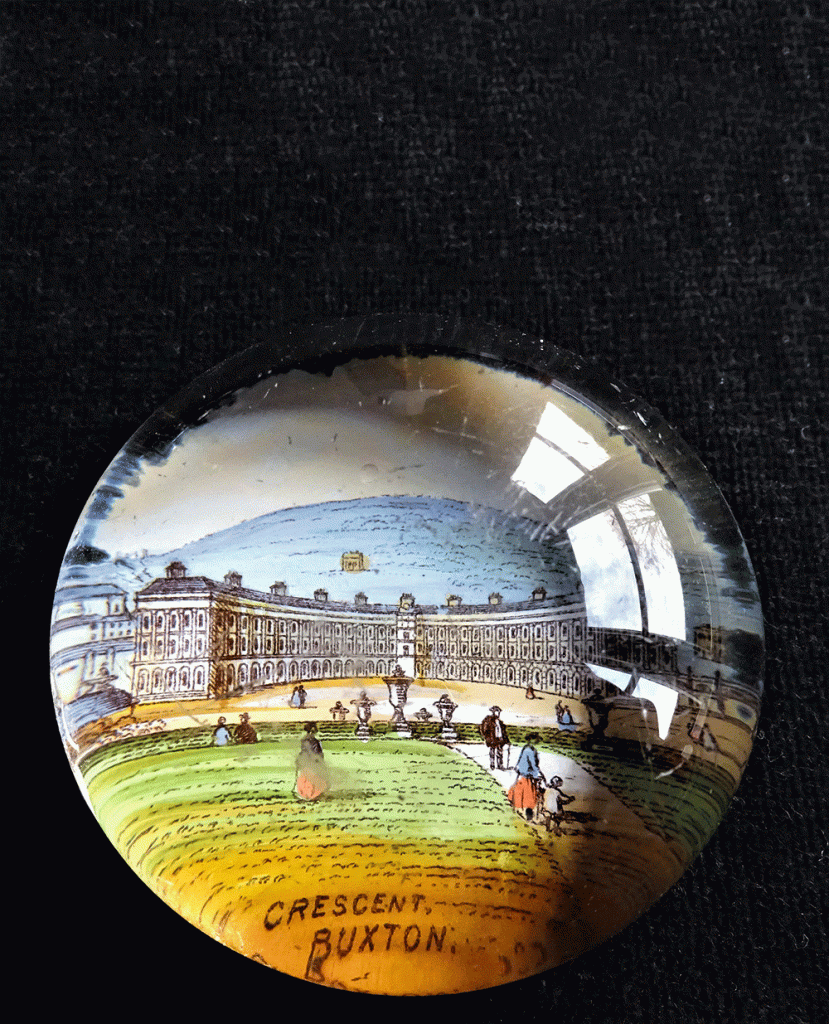
My daughter, although now 22, has gone through many enthusiasms in her short life: Barbie Dolls, Beanie Babies, My Little Pony and so on through Pokémon to soberer items. One of which was modern glass paperweights, of which we now have a considerable collection. On the whole, prices – mainly at fleamarkets and antique fairs – ranged from 50p to £25, certainly no more. Nevertheless, those made by established firms and artists, like Caithness Glass, Whitefriars, Perthshire, Selkirk (Scotland seems to specialise in this industry) and Langham (Norfolk) tend to start at our top price and can ascend (new) towards £200. Note that sometimes, you will never know the maker without the original box; this means that inexpensive anonymous ones are often by well-known makers but have been separated from their original boxes. Those prices, however, can come down sharply at auction. At Bamfords we usually sell unsigned or unprovenanced ones – grouped in any convenient box; if there’s a really desirable one amongst them that we have missed (a rare event!) the buyer will be delighted. A group of miscellaneous anonymous 20th century paperweights is usually estimated at £20-£30 or so. Historically, paperweights were made in the classic years between 1845 and 1860 primarily in French factories like Baccarat, St. Louis, and Clichy. Together, they made between 15,000 and 25,000 weights in this period. Bohemian paperweights were particularly popular in Victorian times. Large engraved or cut hollow spheres of ruby glass were a common form. Weights (mainly of lesser quality) were also made in the USA, Great Britain and elsewhere, but the fashion for them declined from the 1860s until revived in the aftermath of WW2. Indeed, in Scotland, still pre-eminent for paperweights in the UK, the pioneering work of Paul Ysart from the 1930s onward preceded a new generation of artists. A further impetus to reviving interest in paperweights was the publication of Evangeline Bergström’s book, Old Glass Paperweights. Starting in the late 1960s and early ’70s, artists began breaking new ground and were able to produce fine paperweights rivalling anything produced in the classic period. The classic type of paperweight is the millefiori (Italian for a thousand flowers) ones which contain thin cross-sections of cylindrical composite canes made from grouped coloured glass rods and usually resemble little flowers, although they can be designed after anything, even letters and dates. Lampwork paperweights have objects such as flowers, fruit, butterflies or animals constructed by shaping and working bits of coloured glass with a burner or torch and assembling them into attractive compositions, which are then encompassed in a dome of glass. The objects are often stylized, but may be highly realistic. Sulphide paperweights have an encased cameo-like medallion or portrait plaque made from a special ceramic that is able to reproduce very fine detail. These are known as incrustations, cameo incrustations, or sulphides. They often are produced to commemorate some person or event. From the late 1700s through the end of the 1900s, an amazing variety of glass objects, including paperweights, were made with incrustations. Although still produced today, their heyday was before the classic period. A fourth technique, a crimp flower, usually a rose, originated in the USA in the first decade of the twentieth century. These weights range from simple folksy items to fine works of art, depending on the maker. The sort we used to collect are those not made with any of the major techniques but which predominantly include swirls, marbries and crowns. Swirl paperweights have opaque rods of two or three colours radiating like a pinwheel from a central millefiori floret. A similar style, the marbrie, is a paperweight that has several bands of colour close to the surface that descend from the apex in a looping pattern to the bottom of the weight. Crown paperweights have twisted ribbons, alternately coloured and white filigree which radiate from a central millefiori floret at the top, down to converge again at the base. This was first devised in the Saint Louis factory and remains popular today. We also acquired dump paperweights: those made from end-of-day waste green glass at bottle plants etc., with a pattern blown in and often of elongated shape. Another type is the sort with a picture inside, on the base, magnified by the curve of the enfolding glass. Here I illustrate a rather small one (cost £6) with Buxton Crescent inside – not really a modern paperweight, but inexpensive and with local resonance. When we first started collecting, we went for anthropomorphic designs, although dealers tended to ask a little more for these. Most are smooth, tactile things, although you can buy cut glass creatures too, although these were less enticing to us. My daughter also liked a very modern variant, the clear glass shape with a lasered design inside. Charity shops seemed to be a good place to find these, often with the original box, at a reasonable price; we picked up one modelled as an Egyptian pyramid with what looked like Wilson, Keppel & Betty inside, for £8. Long after the event we picked up a London Olympics rectangular weight with the Union Flag and logo inside. These actually came in a variety of colours at some cost, but we paid £8. We also like a pair of engraved glass terrestrial globes and a Swarowski crystal one. Our best find was quite a large ship’s decanter-shaped one with semi opaque coloured body and clear glass knop. We had to drive a hard bargain with an eastern European dealer to get in down to a tenner, but I had noticed the artist had signed it (although I cannot read the signature!). It is almost certainly Bohemia (Czech) glass. In case you are curious, the world record price for a paperweight was set at about £221,000 in a 1990 Sotheby’s auction – an antique millefiori weight, produced in the mid-1850s by the French Clichy factory, known as the Basket of Flowers, albeit that the handle had long since broken off and
Lost Houses of Derbyshire – Little Chester Manor House, Derby

Readers will be well aware that Little Chester is a characterful Derby suburb which overlies the remains of the Roman small town of Derventio. What some may not know is that within its modest compass stands Derby’s oldest domestic residence: Stone House Prebend, on Old Chester Road, itself once the via principia of the military fort which preceded the town. The house, although rebuilt in the early 17th century and again in the late 18th, contains considerable medieval fabric. It is so named because when the College of All Saints with St. Alkmund’s was re-founded soon after Derby itself in 921, the six canons of St. Alkmund and the seven canons of All Saints’, were granted land recently seized from the Viking invaders at Little Chester (itself re-fortified by the Norse), Little Eaton and Quarndon upon which were established farms, each supplying the needs of a canon. This is why all the three settlements were all, until 1867 parts of the parish of St. Alkmund, Derby, despite being outside the ancient borough boundary. Unfortunately, no document survives to tell us where exactly they all were, but there were at least six in Little Chester. Unfortunately, again, with the dissolution of the chantries by Edward VI in 1549, the College was wound up and its property sold. In 1554 Queen Mary, anxious to undo some of the damage made by her father’s exactions, made some amends by re-acquiring as much of the College’s former land as possible which she gave to the Corporation of Derby as part of a charter, granted the following year, with a view to using the rental income to endow the incumbents of the main borough churches with a stipend. Not all the land in the township returned to the Corporation, however, and at least a third remained outside their control and constituted the Manor of Little Chester – mainly on the north of Old Chester Road. The College was run on behalf of the Dean (who was also Dean of Lincoln and invariably absent) by a sub-dean, and we are pretty certain that Stone House Prebend was his farm. This is re-inforced by the substantial nature of the house, although in all conscience, the other two we know of in Little Chester were well above the average for contemporary farmhouses, although in their case, the enhancement of their status may well have occurred after the Reformation. The other surviving one is Derwent House, lying immediately north of the sub-dean’s establishment on the opposite side of Old Chester Road. This is a brick building mainly of early 17th century date, with delightful blind brick arcading, impost band and an astonishingly wide staircase for a house of its size. The cellar was much earlier and stone lined, and was thought to be of Roman origin. We cannot check, because, despite its listed status, the Corporation of Derby shot two lorryloads of cement into it around 1980 when the tenant was having trouble with damp. The third house, Little Chester Manor, has now vanished. It was also largely brick and of 17th century date, less elaborate than Derwent House, albeit occupying a larger footprint, and stood on the south side of Old Chester Road, about 100 yards east of Stone House Prebend, and adjacent to the east gate of the walled Roman town, excavated in 1972. This was more recently called Manor House Farm, having been re-named after a new house was built opposite to it in the late 19th century (also now vanished) itself optimistically styled the Manor House. The Manor House (as we shall call it) was L-shaped in plan, two storeys, in brick with a tile roof. The range facing the road had coped end gables, once with finials on the kneelers, three- light mullioned windows and, when visited by the late Roy Hughes in June 1963, had a space within it subdivided horizontally, probably in the 18th century, which was probably its great hall. This was approached by a baffle entry, all suggesting that it had a medieval core and was probably a building of some status. The rear extension was added to considerably at the south end in Regency times, but was truncated when the railway was built in the 1870s and further some time later. A fourth farm lay immediately to its West (lost to a row of later 19th century cottages erected by Sir Alfred Haslam, who built good quality workers’ housing here, close to his large Union Foundry on City Road. This too was almost certainly a prebend, and certainly the surviving deeds imply a third farm. Each of these were let, and the tenants by the 16th century tended to be men of substance; after the Reformation their status increased to minor gentry: the Thacker, Lister, Haughton, Hope and Bate families amongst them. Working out which family occupied which prebendal farm is not easy due to the fragmentary nature of the surviving sources, but Thacker had the Stone House Prebend, in 1549, and the others were let, the tenancies being generally 25-year ones, although the Listers rented two in 1554, probably both vanished ones. One suspects that the Manor House, which was still timber framed in the mid-16th century, is probably the prebend called The White House (greying oak timbers and distempered render in between) which passed to the heirs of Humphrey Sutton. The Listers probably held Derwent House along with that immediately east of Stone house, and the 1623 inventory of another tenant of a Prebend, Richard Scattergood, clearly indicates a hall house and probably related to the Manor House. In 1648 Parliamentary Captain Robert Hope took the lease of ‘a messuage (house and surrounding land) in Little Chester called the Manor House with the croft adjoining called the Castle Yard’ – the latter designation suggesting proximity to the standing wall by the east Roman Gate. The Roman walls were not taken down until 1721. He probably rebuilt or re-cased it in brick. His family had previously
Celebrity Interview – Peter James

Three years ago crime fiction legend Peter James was in Nottingham to see his stage play, Dead Simple, performed on the Theatre Royal stage. In a question-and-answer session afterwards he slammed television producers who wanted to make big changes as a condition of transferring Peter’s police detective Roy Grace to the small screen. Now, as Peter is preparing to return to the East Midlands, his desire to retain control of how his principal character should be depicted is about to pay off. So what got Peter so hot under the collar? One TV company wanted to turn Roy Grace into a woman. Another wanted the location moved from Brighton, Peter’s home where all the Roy Grace books are set, to Aberdeen. Those producers didn’t realise who they were dealing with. Peter James is not only a best-selling author whose books have sold 19 million copies and been translated into 37 languages – he’s also been a scriptwriter for a children’s daily show in Canada and an executive producer on a number of major films. The last one was Shakespeare’s The Merchant of Venice starring Al Pacino and Jeremy Irons which was nominated for a BAFTA. So Peter should know how to get the best out of an adaptation. Peter will be back at the Theatre Royal later this month to see his fourth play, the stand-alone thriller The House on Cold Hill. It follows The Perfect Murder which featured Les Dennis when it visited Derby Theatre in 2014 and Not Dead Enough which bypassed the East Midlands on its 2017 tour. The creative team for The House on Cold Hill is the same: Sean McKenna is the stage adapter, Josh Andrews is the producer and Ian Talbot directs. So how did Peter come to write the book? In 1989 I had my first big writing success with a thriller called Possession and followed it with a book called Dreamer. “My first wife and I did pretty much what the characters in the book do – buy this big, beautiful wreck of a house in the countryside about eight miles out of Brighton. “It was a Georgian manor house that had a long history. There’d been a monastery on the site in the 14th century and before that there’d been a Roman villa there. Peter and his wife saw various things that couldn’t be explained. Then one day Peter took his dog for a walk and met an old man who used to house-sit for the previous owners when they spent the winter abroad. Peter believes everyone has risen to the challenge of putting The House on Cold Hill onto the stage. “I think a story works best when there’s a sense of claustrophobia by having everything take place inside one location. It’s a thriller and a chiller.” Peter even had a hand in choosing the cast which includes Joe McFadden, winner of BBC1’s Strictly Come Dancing in 2017, and Rita Simons who used to play Roxy Mitchell in EastEnders before going into the jungle in the recent series of I’m A Celebrity…Get Me Out of Here! Peter explains what he loves about theatre: “One is the danger of it. You can pick up a copy of my novel anywhere in the world and it’s going to be exactly the same. Not a single word will be different. But every time a play’s performed things can go wrong. “What I love most of all is sitting at the back of a theatre and watching the audience’s reaction. I’ve learned quite a lot as a writer from doing that.” Peter James was born on 22 August 1948 in Brighton. He is the son of Cornelia James, a former glovemaker to the Queen. He went to film school and then moved to Canada. At one point he was writing horror films for the drive-in cinema circuit. Later he produced a comedy with Terry-Thomas and Leslie Phillips called Spanish Fly which came out in 1976. Film critic Barry Norman called it “the worst British film since the Second World War”. In his twenties Peter had two spy thrillers published but they didn’t sell. Shortly afterwards burglars broke into Peter’s house. A policeman arrived to take fingerprints and saw Peter’s books. He told Peter he should call him if he ever wanted any help with his research. Peter became fascinated with the police’s job: “I realised that nobody sees more of human life in a 30-year career than a cop. That was the starting point and I began to write crime fiction.” Now Peter has 34 books to his name. The latest, Absolute Proof, is another stand-alone thriller. It began in 1989 when Peter had a phone call “out of the blue” from an elderly man. “He said: ‘I’ve been given absolute proof of God’s existence and you’re the man who will help me to get taken seriously’. What took me so long was that I first had to really learn and understand all the world’s religions before I could write the book.” There can be few writers as prolific as Peter James. He spoke to me from a hotel in New York where he was staying after he’d given a talk on a cruise ship. On his return he’ll follow The House on Cold Hill around the country before the next Roy Grace book, Dead at First Sight, comes out in May. In October he’ll publish the sequel to The House on Cold Hill called The Secret of Cold Hill. How does he keep coming up with ideas for his books? “My head’s constantly buzzing. I think it would be quite nice to take my foot of the pedal sometimes and have a fallow period. But I actually love writing. I really enjoy telling stories.” He praises his second wife Lara, who he married in 2015, for being a “wonderful help”. He says: “She’s got a very creative brain. When I’m writing she’ll make suggestions about characters. It’s not completely an isolated life.” There’s
Product Test – Crabtree & Evelyn

Nourish The Skin You’re In with Crabtree & Evelyn Rosewater & Pink Peppercorn Hydrating Body Gel 250ml £30 For a lighter moisturiser, try this hydrating gel. No cream or residue – just super soft skin. Want the intense, moisture-replenishing hydration that comes with a cream but don’t want the texture? This body gel is just that. Instantly absorbed, it has a cooling effect with no sticky residue. Infused with the scents of Middle Eastern rosewater and Peruvian pink peppercorn, the olive oil-rich formula is designed to leave skin super soft with a dewy glow all over. For normal and dry skin types. Pomegranate & Argan Oil Nourishing Body Cream 250ml £28 Give your body an intensive dose of moisture with this pot of hydrating goodness. Enriched with skin super moisturisers, this is a rich, intensive cream designed to banish dry skin and restore silky softness. Soybean oil and shea butter take centre stage, and are joined by a supporting cast of pomegranate seed, grapeseed, argan, pistachio and sweet almond oils. As it works to soften wayward skin, the sweet-with-an-edge scent will take your mind to sunnier climes while it nourishes. Dermatologist tested. Pear & Pink Magnolia Uplifting Body Lotion 250ml £19 Get your daily dose of moisture with our quick-fix lotion, enriched with pear and magnolia. If moisturising has been pushed far down your list of priorities, grab our Uplifting Body Lotion. This orchard-fresh mix of pear, magnolia and hydrating shea butter makes for a nourishing daily fix. Light and easily absorbed, it glides onto skin quickly and smoothly leaving nothing but softness in its wake. The subtle scent calms the senses – so you can start the day or slip between the sheets. Dermatologically tested. To buy online visit www.crabtree-evelyn.com Tried & Tested Body Lotion This glides on easily and is quickly absorbed. A lovely fragrance too. I love the pump style bottle. VP Body Cream This is the perfect product for this time of year, the rich cream is great for dry skin and leaves your skin soft and hydrated. Its beautiful sweet scent will remind you of summer!! CB Rose Water and Pink Peppercorn This lovely moisturiser has a beautifully scent of Middle Eastern rosewater and Peruvian pink peppercorn, which I found reminiscent of a more gentile society. Quickly absorbed it left my skin feeling smooth and luxurious. JP 00