Walk Derbyshire – Walking Above the Canal – Cromford

The car park at the Cromford end of its namesake canal is a popular starting point for at least five walks to my reckoning. Most weekends and days in between, well-clad walkers will be congregating, busily pulling on their boots and at the same time, chatting to their friends. This walk starts, like all the others at the Cromford Wharf car park, before making its way over the river and under the railway, to join a path climbing steeply left up on to Bilberry Knoll. Almost immediately pleasant woodland tracks lead down to Lea Mills, before joining the long abandoned Lea Mills arm of the Cromford Canal. Turning right where the arm joins the main canal, the tow-path leads back to the car park by way of the information centre and railway workshops that once serviced trains hauled up and down Sheepwash Incline, on their way across the limestone moors to Whalley Bridge. You can get a coffee at the information centre, or more filling meals at the canal’s end. Despite being short in length, this walk is long in interest, especially historical. Right at the start, the old buildings dotted around the wharf’s car park, once acted as warehouses and offices for the canal company. The canal itself once linked the growing commercial interests of Arkwright’s Cotton Mills to the outside world, carrying raw cotton in, and finished yarn out. Alongside this, limestone from nearby quarries was shipped out in horse-drawn barges and coal from Nottinghamshire carried back. The Cromford Canal drove its way eastwards, passing beneath Ripley through a now abandoned tunnel, before running south at Langley Mill to link with the Trent and Mersey Canal. Since its abandonment, the Cromford Canal has become a wildlife haven, one of the few places where you might find water voles ‘ratty’ of the Wind in the Willows. Pleasure trips, some horse drawn, can enjoy a gentle cruise along the water in summer. However the navigable section ends where it is joined with the remains of the Lea Mills arm. There is deep, but not dredged water for a mile or two as far as the outskirts of Ambergate, but beyond there will be impossible without major engineering work – the gas depot fills a massive hole cut into the line of the canal. Furthermore, the Butterley Tunnel became dangerous as far back as the 1920s, cutting off any route beneath Ripley. What is left of a navigable Cromford Canal remains as a wildlife sanctuary. The Lea Mills Branch serviced the mill and also a lead smelter owned by Florence Nightingale’s uncle. When the Derby/Rowsley section of the London/Manchester Railway was built in 1849, it cut through the Lea Mills canal, effectively closing it for evermore. There used to be a pretty, now ruined cottage at the junction. It probably housed the family of the man who stoked the boiler providing steam to power the massive pump that lifts water from the river, up into the canal in order to keep the level high enough for traffic. The pump, incidentally operates on advertised days (usually Bank Holidays), throughout the summer. Much of the history of both the canal and Cromford and High Peak Railway is displayed in a simple, but effective display at the High Peak Junction Information Centre at the foot of Sheepwash Incline. Even though the first part of the walk is along the road, it is full of interest. Look out for the Fishing Temple to your right of the bridge. Beyond and below it are the scant remains of the medieval chapel where pre-bridge travellers prayed before crossing the dangerous Crom Ford. Look also over the bridge parapet on your left for the sign briefly telling the story of a horse and rider who jumped into the river from this point. The entrance to Willersley Castle is to the left beyond the bridge. This was to be Sir Richard Arkwright’s manorial home, but building was delayed due to a fire and he died before it was finished. Continuing along the road in the direction of Crich, a narrow footpath leads under the railway and in about 60 yards, an awkwardly narrow stone stile climbs up into fields leading up to the ridge-top track across Billberry Knoll. On the way it crosses an unsurfaced track leading to two farms on your right. The first is Meadow Farm and the second is Castletop, one time home of Allison Uttley a famous children’s story writer in the 1920s. From the top of the hill, the track leads through woodland where bluebells will flower in spring, down to Lea Mills. Still manufacturing high quality knitwear, it is the last still operating mill in the Derwent Valley. A dog-leg will take you to the towpath of the abandoned canal. Follow it, over the railway as far as the main which will lead you back to the car park. The Walk with Rambler From the canal-end car park walk out on to the road and turn right. Cross over the river and go past the entrance to Willersley Castle. Continue ahead where a side road bears left. Go forwards to the railway bridge. After about 50 yards on the far side of the bridge look out for a narrow stone stile on your left. Climb through it and begin to walk directly up the steep hillside. Cross a farm track and continue on your way to the top of the hill, passing the boundaries of two stretches of woodland along the way. Go through a pair of old stone gateposts and then turn right to follow a woodland bridleway, downhill alongside the boundary of more woodland. In the corner between open fields and the woods, take the furthest left of a pair of footpaths and enter another section of woods. This is Coumbs Wood, famous along with its neighbour, Bow Wood for its bluebells in spring. Follow the path, winding downhill. Where there is a break in the woodland, take
The National Stone Centre

Travelling back in time a few millenia, Brian Spencer describes what the Peak District looked like when land that became the British Isles was part of a tropical island situated near the Equator. A series of small inter-connected abandoned limestone quarries off the road to Ashbourne, near the top of the hill marking the boundary between Wirksworth and Cromford, close to Steeplegrange miniature light railway, hold a unique record of the limestone rocks formed in an ancient sea, long, long ago. This record has been preserved as the National Stone Centre. Access is free and a short, easy walk of less than a mile, takes us back to a time before we humans walked on the earth. What eventually formed the Peak District would have looked not unlike today’s Bahamas. A shallow lagoon surrounded by jagged reefs and dotted by small active volcanos, stretched from what is now roughly on a line between Ashbourne, Wirksworth, Matlock and Ashover in the south and a similar line from Buxton to Castleton in the north; its other boundaries followed what is now the Derwent Valley and the Dove and lower Manifold Valleys. This is now called the White Peak in acknowledgement of the colour of limestone laid down millions of years ago. Standing in the Stone Centre, facing the direction of Wirksworth, to your front would have been a deep ocean, whilst to your rear would stretch a roughly oval shallow lagoon teeming with corals, shell-fish and creatures similar to water lilies. The one unique feature of all these plants and animals was that they had shell-like structures and when they died in their countless billions became limestone, the raw material of a major Peakland industry. rom the car park above the High Peak Trail walk down the Stone Centre access drive, past a restored limekiln on your left near the railway. Pass Geosteps an amphitheatre of stone benches, each level made of stones ranging from the oldest at the bottom, gradually moving in time to the youngest at the top. Although the trail proper starts at the Visitor Centre, the track passes the blocked-off top of a lead mine, a now dead Peak industry exploiting the result of minerals deposited during the time of volcanic activity. There is a small, but easy to understand set of details, mostly posters fixed around the walls of the Information Centre café, browse on them, building up your knowledge before setting out on our voyage back in geological time. Plaques on the site of features mentioned below also explain what you are looking at. Point 1. Looking out to sea. To the right outside the café entrance, a short hop past a line of parked cars leads to the first viewpoint. Here and with a little imagination, you are standing on a tropical island in mid ocean. This was a narrow strip of land forming a wave-washed reef, the edge of a shallow lagoon. Warm water was to the rear, fronting deep sea in front. Point 2. Rock shelves Moving on to the trail proper, the next feature is a series of rock shelves topped by a rock tower created by a local artist. What at first looks like nothing more than whitish rock is, after a closer look, made from the fossilised remains of billions of creatures that once lived on the surrounding sea bed. Most are easy to identify, from hollows made by the two halves of clam-like brachiopods. Once as plentiful as today’s mussels, they more or less died out. They lived on the muddy sea bed with their convex sides face-down. Nearby there is the circular top of a coral, a plant-like creature that thrived in water heated by strong sunshine. Looking at the lower sections of undamaged fossilised remains, it can be deduced that the sea bed was calm, but higher up the fossils are damaged and jumbled, a sure indication that this was where waves came crashing in from the deeper ocean. Point 3. Limestone beds above the lagoon Moving round to the left, following the quarry face, the path leads into a cul-de-sac above a worked-out part of the quarry. Here are limestone beds that were deposited in the bottom of the broad, shallow lagoon. The debris is composed of the remains of shells and even faecal pellets and parts of skeletons, suggesting that larger creatures fed on lagoon life. This was the lagoon that eventually became the White Peak of Derbyshire. If you look carefully, you may notice that the beds tilt very gently to the east, a feature caused by much later earth movements also left vertical fractures or joints between the beds. Point 4. A mineral vein and crinoid beds Turn back along the track leading to the limestone beds and go down a short flight of steps in order to stand beside a rock face to your right. You are now looking at the side wall of a fracture in the limestone face. These fractures were later filled by mineral rich, hot liquids that interacted chemically with the limestone to form lead-based compounds such as galena, barite, fluorspar and calcite. The vein you are looking at was once part of a worked out mine, but you can still see tiny grey flecks of galena (lead sulphide) and barite (barium sulphate). This vein, incidentally, is aligned east-west, a feature typically prevalent to Peak District veins or rakes. Turning round to face the other direction, you will see that instead of a vertical rock face you are now in front of a sloping mass of dark grey rock. This is all that remains of the back slope of the reef sheltering the lagoon, away from the open ocean. Towards the base there are the fossilised remains of creatures called crinoids which are related to modern starfish. They fed by filtering seawater through their frond-like arms to catch microscopic plankton, whilst attached to the seabed by long stems. The stems being the strongest part means
Taste Derbyshire – A Slice of Italy – Lambarelli’s

The outskirts of Chesterfield on a grey and dismal morning seems an unlikely place to find la dolce vita. But follow your nose into Lambarelli’s Italian Caffé and Pasta Bar on Chesterfield Road and you’ll be instantly transported from North Derbyshire to Southern Italy on an aromatic cloud of fresh herbs, strong coffee and sweet panettone. It’s also the place to learn the secrets of the perfect pasta sauce from café proprietor and award-winning food producer Teresa Lambarelli. But first, Teresa insists I meet her own food hero; her father Michele (79), who runs Chesterfield’s smallest delicatessen in a room at the back of the café. “It’s like stepping back in time,” Teresa says with obvious pride. “Our customers say they only have to walk into Lambarelli’s and they are on holiday in Italy.” Michele has been dealing with queues all morning but he still has the time to share with me the secret of a long and happy life. “Goat’s cheese,” he beams. “And pasta. It’s very healthy if you don’t eat too much of it. Add Italian coffee, sunshine and a glass of wine and you’ll live to be one hundred.” These days, Italian food may be one of the most popular cuisines in the UK but this was not the case in the 1960s when Michele and wife Susan decided to open a delicatessen followed, in 1975, by a pizzeria. “In those days, I’d be cooking garlic and people used to say ‘what is that smell?’ – they didn’t like it,” Michele laughs. “I used to slice the pizza and get them to take just a little bite. One taste and they were hooked. We used to have queues down the street. All my family helped out in the business because we were so busy.” According to Teresa, her childhood was all about food – especially when an Italian restaurant was added to the business in 1986. “My sisters Diane, Netta and I all had little jobs like stocking shelves in the shop, cleaning tables and serving customers – I even did my homework in the restaurant,” she laughs. “I loved it. I was born in England but I am Italian by blood; I am passionate about the people, the sun and, most of all, the food. My mum says I was six or seven when I started asking if I could cook the Sunday lunch.” Teresa admits she found it difficult to part from the family business even when she left school; “I became a window-dresser but I still worked at Lambarelli’s a few nights a week,” she smiles. “I wanted a car and to buy a house and my parents had instilled in me that you have to work hard to get things – so I was happy to work two jobs. When my dad stepped back from the restaurant, I helped him run the pizza take-away.” But Teresa had to re-think her busy life-style when her marriage broke down. Trying to work long hours – and look after her daughters Amelia and Sophia, then four and two-years-old – was impossible. “I had to walk away completely and devote my time to the girls,” she recalls. “Once they were both at school, I started on a beauty therapy course. One of my lecturers, Lisa Shannon, told me she would go to Lambarelli’s just to have my Bolognese. Lisa begged me to make her some pots of the sauce. She became my number one fan and, when I told her there was a gap in the market for an authentic pasta sauce, she encouraged me to set up a business from home.” Devising sauce recipes was easy for such a natural cook; the hard part – as for any novice – was finding packaging, designing the labels and complying with all the regulations laid down by the environmental health department. “It cost around £1,000 just to get my coal house converted into a store-room with separate hand-washing facilities,” she explained. “But it was worth the effort as I could fit the business around the girls. It became the lifeline I needed.” Teresa has continued to develop her range of sauces; “I learned the basics of Italian cookery from my grandma as we’d spend the six-week summer holidays in Accadia di Puglia,’ she explains. “That region of Southern Italy is famous for simple, rustic dishes. We never put preservatives or sugar in the tomatoes as they’re already acidic and self-preserving. But cooking is more than just food – it’s family, life-style and passion and I try to put all that in my sauces.” The sauce business was launched in 2005 – one of the first customers being the prestigious Chatsworth Farm Shop. Six years, and much critical acclaim later, Teresa was ready to expand into new premises, which led her back to Lambarelli’s. “My sister Netta and husband Neil were trying to run the restaurant and take-away but it was too much and so the restaurant went up for sale,” she recalls. “It was too dated to attract buyers but I realised it was ideal for my business. I transformed the floor below into a 20-seater café bar offering simple, fresh food and Italian coffee. I also modernised the upstairs restaurant and open every Saturday night.” In the remaining hours, Teresa makes her celebrated sauces and other Italian delicacies like salad dressings, olive pastes and biscotti. The hard work has certainly paid off. Teresa was pronounced Chesterfield Food Producer of the Year in 2017 – her third such title since 2013. “I put my success down to dedication; I live for what I do,” she says. “It helps that I have a great team behind me and loyal customers who come back time and time again.” Teresa still visits Puglia as often as her hectic schedule will allow. “My grandparents have passed away but I still visit family and friends once a year,” she says. “My eldest daughter Amelia, now 20, met her partner Biagio
Taste Derbyshire – Spotted Calf Cafe
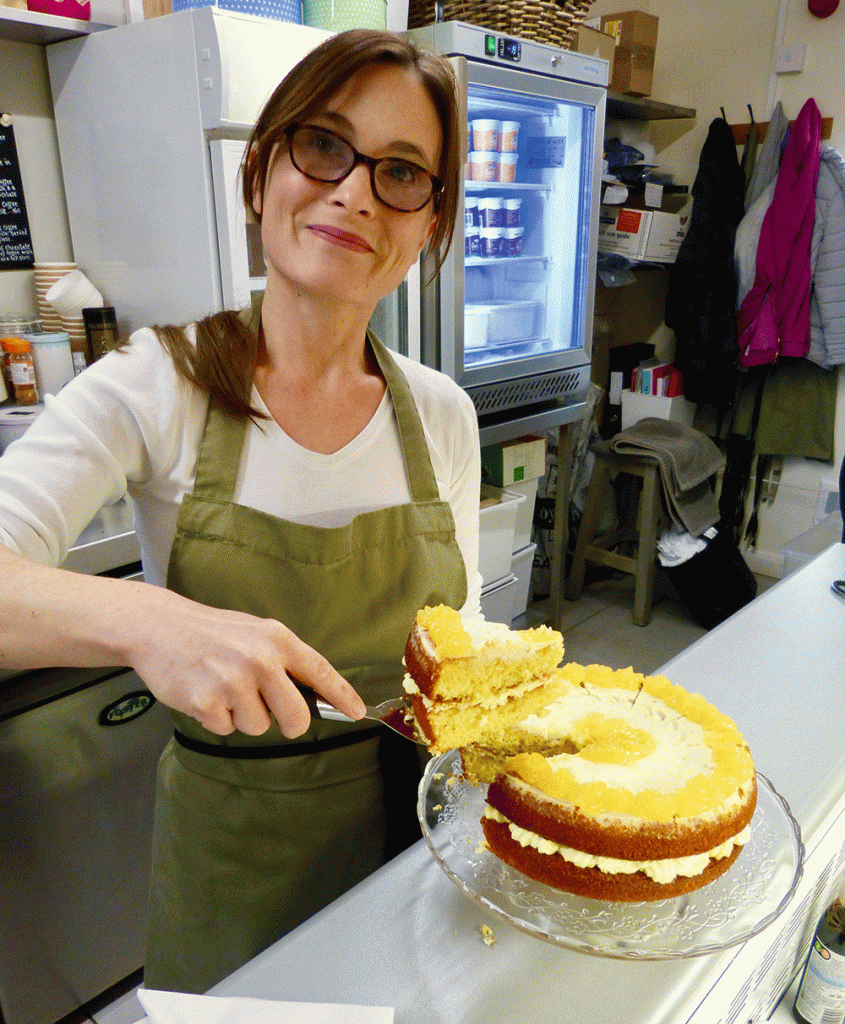
There’s something a bit magical about the Spotted Calf café – the small but perfectly formed off-spring of the Spotted Cow pub at Holbrook. It’s not just the quality of the coffee – roasted to perfection in the Derbyshire Peaks – or the tanginess of the home-made lemon polenta cake. It’s the cosy, welcoming nature of the place itself which, because it is run by the community for the community, represents everything good about village life. Even on a bitterly cold winter’s morning, the cafe is a magnet for hikers, cyclists, villagers and visitors alike chatting over bacon butties and thick slices of plum bread. If you should tire of eating home-baked panini bread oozing with melted cheese, you can always run next-door to the pub for home-made fish fingers and a pile of chips. The ‘Cow & Calf’ also cater for vegans, vegetarians, people with gluten intolerances and – since the addition of the post office with its banking service – those in need of a bit more cash to pay for another pint of hand-pumped ale. But the good news is that you can slurp, sup and snack away to your heart’s content because – as the Cow & Calf are owned by 225 residents (and counting) – you feel like you are doing your bit for the community. It’s no surprise to find journalists and TV crews have also been drawn to the pub-cum-cafe since the grand re-opening in July 2017. In fact, during my visit, a lady rushes in clutching a cutting from the financial pages of a national newspaper about ‘how to save your local’ citing the Cow & Calf as the blueprint. Not that anyone needs reminding of this fight. Most residents can still recall where they were when they discovered planning permission was being sought to knock down large parts of the historic building to build eight properties. The pub itself, which had been closed for more than two years, would also become a house. “It caused a lot of upset as the pub has been at the heart of the village for so long. The census shows a farmer and beer retailer living here in the 1840s,” explains Stephanie Limb, a former teacher who is now affectionately known as ‘the lady who saved the pub’. “My husband Christian and I moved here because of amenities like the pub. When I saw an application for planning permission on a lamppost, I was angry. I felt we should do something and talking to a councillor who said opposing the application was ‘a bit late now’ made me more determined.” Her co-worker Tracy Beardmore agrees. “I also felt really angry as the pub used to be the heart of the village,” she says. “I grew-up here and my mum Penny worked in the pub for forty years. It used to be very family oriented and the place where we’d get together to celebrate bonfire fire night and New Year’s Eve. Losing the Spotted Cow would have been like losing part of my childhood.” Over a cup of coffee, Stephanie and Tracy describe how this ‘anger’ galvanised the village into action. “I spoke to a member of CAMRA (Campaign for Real Ale) and was advised to declare the pub an Asset of Community Value, a status which allowed us six months for the residents to raise money to buy it,” explains Stephanie. “I also went to visit a community-owned pub called the Angler’s Rest in Bamford and they suggested talking to the Plunkett Foundation, a charity which supports rural communities. Their advisor not only helped with the practicalities like applying for a grant and setting up the community share offer, but she was the one who kept on telling us to ‘never give up’.” Tracy’s abiding memory of this time is attending the Amber Valley District Council which met to discuss change of use for the pub in November 2016. “We were all just waiting and waiting – I think we were the last item on the list,” she recalls. “It didn’t look good when a councillor said pubs close all the time and that we should ‘get over it’. Others were more supportive and one said we deserved a chance as ‘we’ve all got to have a bit of hope’.” In the event, the application was refused and the villagers faced the unenviable task of finding the best part of £500,000 by March 2017. Undaunted, they launched a crowdfunding campaign in January 2017 with the intention of selling shares in the pub with a minimum investment of £250. “We sent out the questionnaire to see if there was an appetite to save the pub as the Holly Bush and Dead Poets Inns are both nearby,” recalls Stephanie. “The overwhelming response was the Spotted Cow should remain a pub but become more family friendly and provide a hub for the community. Knowing so many people were behind it gave us all confidence but I didn’t believe we’d do it until the keys were in our hands.” Incredibly, the villagers raised a massive £193,000 within four months. This was matched by a further £100,000 grant from a social investment fund. By April 2017, when the original owner decided to retain the top of the car park to build three houses, the villagers were in a position to secure the pub for £275,000. But, getting the keys was only half the battle. The community had been awarded a loan towards the costs of the pub’s refurbishment, but the majority of the hard graft had to be done by an army of volunteers wielding spades, paint brushes and brooms. “We had to use experts for the job to be signed off by the council. Other than that, we relied on a wealth of talented people from in and around the village,” explains Stephanie. “People have asked since how we did it and my top tip would be ‘work with what you have’. We didn’t have all the skills
Images of The North

With an introductory splutter, the public address system announced, first in Norwegian, then in English and German, that we were summoned by King Neptune to assemble on the after-deck to receive our icy baptism. During the night a few hours previously we passed a small island at exactly 66°33’51’’ north, marked by a globe tilted on its axis. This indicates the position of the Arctic Circle where the sun doesn’t rise above the horizon for at least two months in winter, but makes up for it in summer. We were travelling by the Hurtigruten (‘coastal express ferry’), that links the coastal towns of northern Norway with the rest of the country, with two vessels, north and south, calling every day summer and winter at 34 ports along the way. Some stops are for only half an hour, or during the night, but others are longer, stopping for anything up to six hours and where shore excursions are possible. One of the interesting advantages of the trip is that the ferry is also used by locals making short journeys and as a result new faces appear all the time. Ports visited during the night in one direction are called at during daylight on the return journey, missing none of the fascinating towns and villages. Starting at Bergen, Norway’s second city, where North Sea oil activity has beaten deep sea fishing into second place, we had already called at the art nouveau town of Ålesund and Trondheim, once the capital of Norway and where its kings are still crowned in a dual ceremony with Oslo. There is a royal palace tucked away without fuss behind the main shopping streets. Our floating home for the two-week-long voyage was the MS Nordstjernen (North Star), a 2,196 tonne veteran built in 1956. Being so old and small means it doesn’t have the refinements found on its 15,000 tonne big sisters. Refinements such as stabilisers as we later discovered while crossing the Barents Sea, were not available in 1956, but what it lacks in modern amenities is certainly overcome by the friendly old-world atmosphere, and more than made up by the excellent standards of its on-board catering. Not only do the Hurtigruten ships carry passengers, but all carry goods such as the pallets of cement, rock wool and other bulk cargo we watched being loaded into the hold, plus six kayaks lashed down as deck cargo. Our worries that these were alternative travel arrangements disappeared when they were off-loaded one night. Unlike the bigger ships where cargo is loaded through a massive door in their sides, Nordstjernen does not carry cars, but it still serves as an essential link, the life-blood of towns along the way. In return ferries collect such things as the dried fish still popular with Italian and African markets. The Norwegian coast is lined by thousands of islands, some with fairly large towns, but others supporting only a handful of houses, or even none. As a result much of the voyage is along sheltered channels where the calm waters make it almost like sailing along a canal. Here the captain can show off his skills by navigating tricky sections such as the man-made Risøyrenna cut where the sea bottom is only a metre below the ship’s hull, or by making 90° turns through the seemingly impossibly narrow gap of the Stokksundet where German Kaiser Wilhelm II tried to grab control of his yacht. Not surprisingly this annoyed his pilot so much that he pushed the Kaiser aside saying ‘I’m in charge, so leave me alone!’ Realising his mistake the monarch apologised and afterwards gave the pilot a specially inscribed gold watch. Keeping well to the seaward of the awe-inspiring white mass of the Svartisen glacier, the second largest in Norway, we reached the important oil and gas servicing town of Bodø. Beyond is the first open water crossing where a line of jagged peaks make up the Lofoten Wall. The ‘capital’ of Lofoten is Svolvær where racks of cod dry beneath the towering craggy sides of the ‘goat mountain’, named from the twin horns of its summit. Beyond is narrow Raftsundet, lined by peaks rising to over 3,000 feet, it is the longest stretch of difficult water, but one the captain nonchalantly steamed through at a steady 15 knots. Snow down to sea level even in late March reminded us that we were now well into the arctic zone, sailing towards Tromsø, the largest city of the far north. With its evocatively designed Arctic Cathedral and memorial to the explorer Roald Amundsen it reminded us that we were entering latitudes level with the northern coast of mainland Canada and the top of Siberia; if it wasn’t for the warming effect of the Gulf Stream, the sea and land would be covered by ice a mile or so thick. Hammerfest is a few hours sailing further north and while a night stop is made, it is during daylight on the way south that gave us more time to explore its links with the other arctic explorer, Fridtjhof Nansen. A sculpture version of his sturdy cockle-shell of a boat the ‘Fram’ (Strong), stands as though fixed in ice as it was on his courageous attempt to drift with the ice across the North Pole; in theory it was possible and the Fram’s unique design withstood the massive pressure, but while currents at first took him well towards the pole, they changed direction and he ended in northern Siberia. We were now starting to sail east and into the Barents Sea, where the only land between northern Norway and the North Pole is the bleak isolated archipelago of Spitzbergen, home of polar bears and hardy Russian coal miners. It was about here that we passed our sister ship ‘Lofoten’, a mere 25 years old against our 54. Whenever Hurtigruten ships pass they always salute each other, a charming custom, but this time some younger members of Nordstjernen’s crew decided to attack it with
John Flamsteed England’s First Astronomer Royal
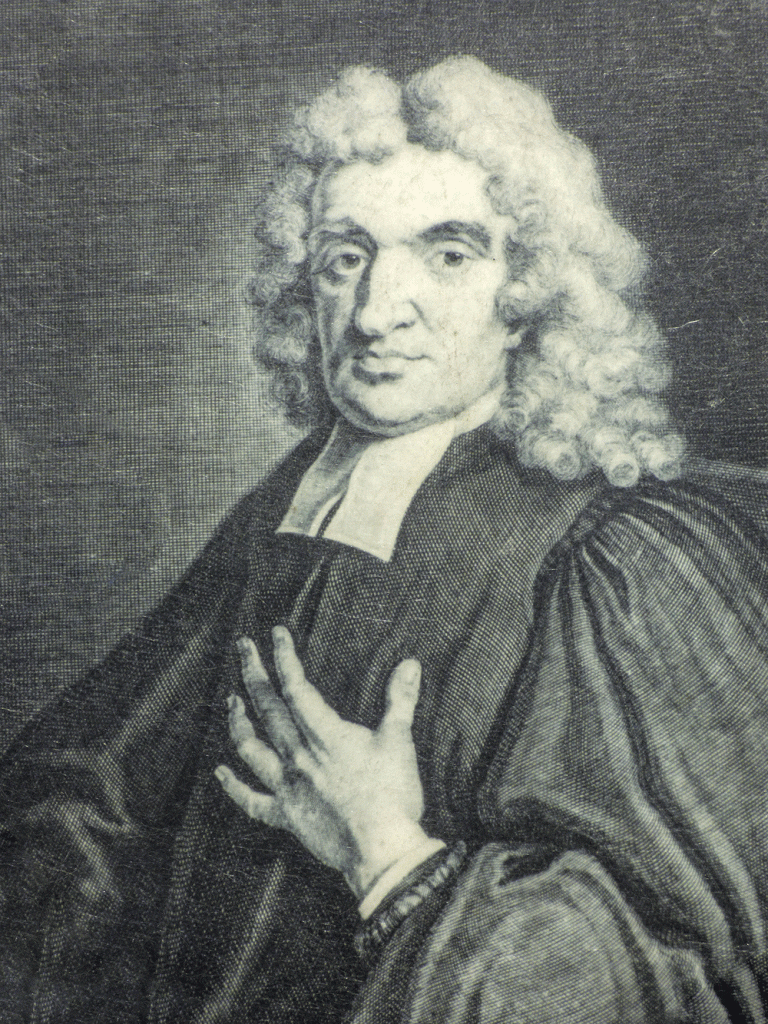
Brian Spencer follows the life of this Denby-born man who went on to be the first Astronomer Royal and set the stage for Greenwich to become the centre of time and space. John Flamsteed was a sickly child, being troubled by arthritic knees and ankles, weak legs, and frequent headaches – conditions that affected him throughout his life. Modern medical thinking suggests he was affected by rheumatic fever, a common illness in those days, tending to recur in different joints. Despite his poor health, Flamsteed went to Derby Free School in St Peter’s Churchyard, Derby. The school has disappeared under the foundations of a shop, but it was here that John gained a foundation into mathematics and science. Worried about his son’s ill health which he claimed was aggravated by conditions at the school, his father withdrew the 14 year-old, but despite his disappointment, John continued his studies at home, teaching himself Latin and reading mathematical treatises – both of which proved useful in his later career. With his understanding of mathematics, he was able to accurately calculate the solar eclipses of 22 June 1666 and 25 October 1668. He sent the data he collated, along with a paper to explain how the position of stars could be fixed by the moon, to the Royal Society, the national academy of science founded by Charles II in 1660. This led to Flamsteed being invited to London around Easter 1670, where he met and was befriended by Sir Jonas Moore, his Majesty’s Surveyor of Ordnance. This meeting and friendship was to influence Flamsteed and change his life for ever. The world was expanding rapidly by the late seventeenth century and with it, wealth from world trade. Britain and France being traditional rivals were competing with each other to expand their colonies, especially in the New World across the Atlantic. Ships sailing to and fro across the Atlantic frequently disappeared through errors in navigation. While it was possible to plot where a vessel was, north or south of a given point (latitude), it was impossible to know where the ship was east or west (longitude) and as a result shipping losses were horrendous, ships could be anything up to 200 miles out on longitude. The answer was to divide the world up into 360 degrees, starting at a given point. Charles II was horrified to discover that Louis XIV of France had stolen the lead by appointing the Italian astronomer G-D Cassini as Director of the Paris Observatory. Something had to be done, and done quickly if Britain was to have its own observatory and, more important, set the zero meridian in order to control ships’ clocks that in turn would identify longitude. The observatory had to be away from London’s polluted air. Fortunately there was crown land rising to a small hill at Greenwich, clearly visible to shipping leaving the Thames, and in addition, it would not cost the cash-strapped king a penny. On 5th June 1674, Flamsteed was awarded a degree at Cambridge, but despite being ordained as a deacon and take holy orders in Derbyshire, the practice at that time, Flamsteed accepted the invitation of Sir Jonas Moore to stay with him in London. Here on 4th March 1675 he was appointed by royal warrant to become ‘The King’s Astronomical Observator’, the first Astronomer Royal, with an allowance of £100 a year. A little over a year later a warrant for building an Observatory at Greenwich was issued, but the cash-strapped king could only allow £500 towards the cost, together with ‘spare bricks from the Tilbury Fort’; and some timber, iron and lead from a demolished gatehouse at the Tower of London. With the foundation stone laid a month later, the building was up to roof level by Christmas. Despite the king’s promise to provide more money, nothing extra was forthcoming, but fortunately the observatory came in at only £20.9s.1d over budget. The main part of the observatory was designed by Sir Christopher Wren, the architect of St Paul’s Cathedral. Flamsteed was given an apartment on the ground floor, designed as he put it, for his ‘habitation and a little for pompe’. This room was called the Great Star Room (now called the Octagon Room), but most of Flamsteed’s observations were carried out in a small sextant house in the garden. Appointed as a Fellow of the Royal Society, Flamsteed moved into the completed Observatory on 10th July 1676, aged only 28 years, along with two assistants, Smith and Denton. His job description was to ‘forthwith apply himself with the most exact care and diligence to the rectifying of the tables of motion of the heavens, and the places of the fixed stars, so as to find the so-much-desired longitude of places for the perfecting of the art of navigation’. Settled at Greenwich, he began work on measuring the distances between stars by using a sextant, the only equipment available at that time. Remarkably and despite using such a basic instrument, his measurements were reasonably accurate. On 12th December 1680 Flamsteed observed for the first time a great comet which was generally held by others – including Sir Isaac Newton, the scientist – to be two closely aligned comets. This difference of opinion over the so-called twin comets and other observations, led to a quarrel between Newton and Flamsteed, a quarrel that brought in Edmond Halley the predictor of a comet that regularly visits the earth. Recognised as the greatest scientist of the time, Newton, who it is said, developed his theory of gravity by watching an apple fall while resting in his Grantham orchard, was a difficult man to deal with socially. Irritable, spiteful and often paranoid, he was basically a lonely man who demanded rather than earned respect. His relationship with Flamsteed broke down when the latter refused to publish his astronomical observations, which Newton needed for a lunar theory he was working on. Flamsteed’s refusal to publish was reasonable as he wanted
Walk Derbyshire – Chatsworth to Haddon Hall

The two great houses visited on this walk are within four miles of each other as the crow flies, but each has made a unique impression on the face of the Peak District. Chatsworth, ancestral home of the Dukes of Devonshire has developed following the fashions of house-building nobles. Additions have been made since its first owner, the redoubtable Bess of Hardwick, founding matriarch of the Cavendish dynasty almost bankrupted her husband, the Earl of Shrewsbury. In its development, Chatsworth has grown to well deserve its unofficial accolade, as the ‘Palace of the Peak’. On the other side of a forested ridge, Haddon Hall the Duke of Rutland’s country seat has remained virtually unchanged since its Tudor founder Sir John Manners first developed the house above this secluded bend in the River Wye. Renowned as one of Thomas Hobbes ‘Seven Wonders of the Peak’, Chatsworth ranks in architectural merit alongside the finest of all Britain’s great houses. The original hall which once held the captive Mary Queen of Scots was a Tudor manor. It was built on the site of an older dwelling by the Countess of Shrewsbury, better known as Bess of Hardwick. All that is left of that house is a raised walled garden where the imprisoned Scots Queen took her ease; another remaining feature is the hunting tower overlooking the house from Stand Wood. The house we see today dates mostly from the late 17th century when the 4th Earl, later to become the 1st Duke of Devonshire. Apparently a man who was hard to please as he used several architects before he was satisfied with the resulting magnificent Palladian mansion. The last major changes were made by the 6th Duke of Devonshire, the Bachelor Duke who had Sir Jeffry Wyatville design the north, or Theatre Wing. This was when the awe-inspiring Painted Hall also came into being. It was this duke who employed as his head gardener, Joseph Paxton, the horticultural genius who designed what is still one of the finest attractions of a visit to Chatsworth. Children visiting Chatsworth automatically make for the adventure playground and farmyard, one of the late Duchess Deborah’s innovative schemes. Haddon Hall is hidden amongst trees, set away from the A6 south of Bakewell. Standing on a slight rise above the River Wye, the medieval manor house is a unique example of building styles from the 12th to the 17th centuries. Abandoned in 1640 by its owners the Manners family, Earls then later Dukes of Rutland, when they moved to Belvoir Castle in Rutland. Rather than pull down the neglected building, in the early 1900s the then Duke decided to scrupulously restore Haddon. The result of this careful work is there to see, ranging from the family chapel to the impressive Long Gallery and banqueting hall with its minstrels’ gallery beneath which Sir John Manners, self-styled King of the Peak held long and boisterous Christmas celebrations. The popular romantic story of Dorothy Vernon’s elopement with John Manners in 1563 tells of her crossing the terrace garden and meeting him by the low bridge below the hall. Unfortunately this story is pure myth as both garden and bridge along with the steps down which Dorothy is supposed to have fled, were not built until at least 26 years later. The medieval time capsule of Haddon Hall and its setting have been used several times by film makers. Large screen and TV productions ranging from ITV’s Moll Flanders, BBC’s Chronicles of Narnia and the Prince and the Pauper, together with Franco Zeferelli’s The Princess Bride and Jane Eyre have all used Haddon along with other locations around the Peak District. While this walk describes the route between these two great houses, it is accepted that to visit both or even one of them as well as following the walk, will be too much for one day. What the walk attempts, is to give an introduction to the houses and the countryside of their setting. Starting from Chatsworth, the route first goes through the estate village of Edensor, a village moved from its original setting because the then Duke felt it spoilt the view. A lane climbs through the village and then joins a minor road which is followed until it joins a path down towards Bakewell. Reaching the cattle market, the walk turns left along the valley almost to Haddon Hall; here tracks and woodland paths lead back over Lees Moor, first across Calton Pastures and then over Chatsworth Park and back to the great house itself. The Walk : From the car park walk past Queen Mary’s Bower (raised garden) and go down to the river. Cross the bridge and bear right on to a path climbing over the slight rise ahead. Go down to the road. Cross over, go through the gates and follow the side lane climbing through Edensor village. Edensor village replaced the old estate village which being closer to the main house was thought by the 6th Duke to rather spoil the view. Being shown a catalogue of house designs he could not decide on one in particular, so he is said to have asked for one of each. Climb out through the village, continuing ahead where a side track leaves on your right. Walk on until the lane reaches a minor road. Turn left and follow the road, gently uphill for little over a half mile. Where the road starts to descend steeply right at a sharp bend, go forwards on to a path descending into woodland. Cross the railway bridge and continue downhill to join a road. Go forwards down the road until it reaches a side turning into Bakewell cattle market. Follow the hard surface to your left around the perimeter of the market and turn left along its access track. Bakewell is a popular place for shopping or as in this case, a mid-morning coffee. The market café has excellent home-made food designed to satisfy the hungriest farmer (or walker).
Attracting Wildlife into your Garden
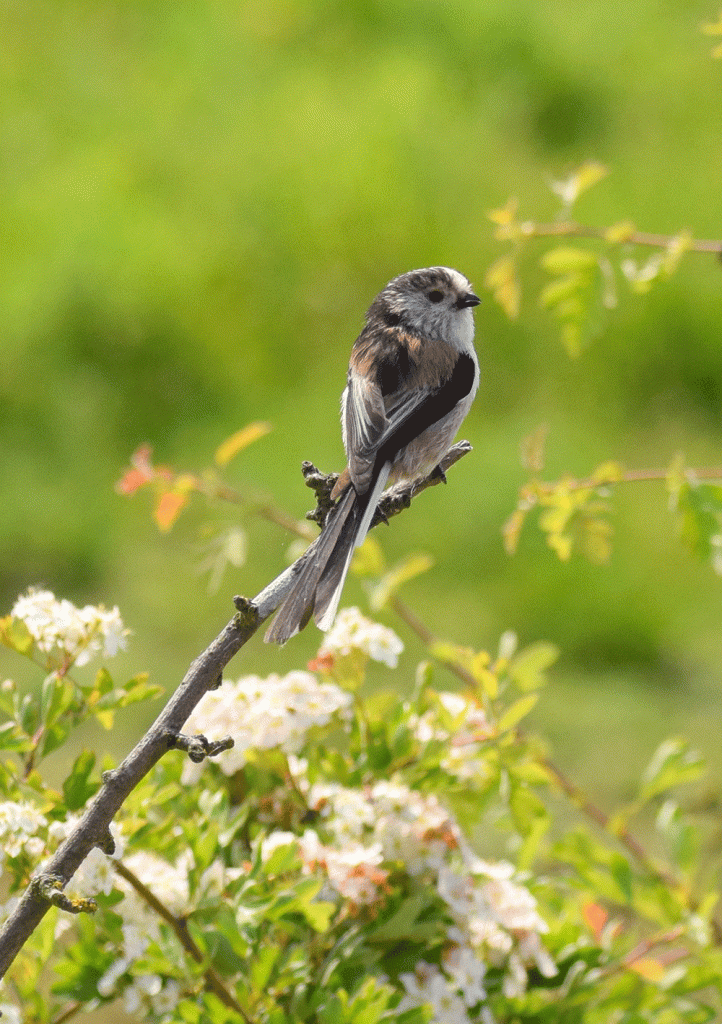
People often asked me “What can I do to attract wildlife into my garden?” I ask them what they already do to try; most often they tell me that they have bird feeders and put out bird food but not much seems to visit them. Firstly, we need to understand the needs of any visiting creatures, be they four legged or flying. Like us, they need to feel safe. It’s nice to be fed. It’s great to have something to wash it down with and if you can have a wash and brush up in the same spot, so much the better. In the 70s and 80s many hedgerows were taken out to make bigger fields for growing crops and allow use of larger machinery. This made many hedgerow birds homeless and numbers have plummeted. Not only have they been deprived of suitable nesting sites but have also lost a valuable food supply in the form of the spiders and insects living in those hedgerows, and the berries that grew on them too. Other creatures also lost their wildlife corridors and the safety to move around in the landscape. Many small ponds were filled in; again depriving creatures like frogs, toads and newts of vital habitat. We can all do something to help mitigate the loss of habitat and in doing so begin to encourage visitors to our backyards. Access can be an issue. Many gardens now have a wooden or concrete fence line which forms a barrier to four legged visitors. Hedgehogs are in trouble right across our island and I have to admit that I have not seen one in our garden in a long time. A hole the size of a drainage pipe in the bottom of the fence will give them a way in and a through route across the back gardens that they rely on to forage in safety at night . For birds to feel safe in a garden they need shelter before they will consider visiting a feeder or bird table. Put it into context… how would you feel sitting down to your tea on the patio and the local velociraptor catches you out with nowhere to dart for cover? Birds are acutely aware of the threat of predators in the form of either local cats or passing sparrowhawks and will not visit if they do not feel secure. To afford some shelter you could plant a few shrubs; the thicker a bush they form, the better . If you choose something like berberis, firethorn (pyracantha) or cotoneaster you will get the benefit of flowers to provide nectar for insects and also later on in the year, berries to feed the birds. Thick shrubs will also provide a nesting site for smaller birds. By providing something like a log pile habitat you will encourage a good selection of invertebrates to take up residence. You could introduce a bug hotel if you have not got the room for a log pile. Consider planting nectar rich flowers and shrubs to encourage bees and other pollinators and have a selection that will provide nectar from spring when they are emerging from hibernation, right through to autumn when they will be feeding up for the big sleep. One of the best nectar providers in the spring is pussy willow which will feed bumble bees and butterflies alike. Spring flowers such as snowdrops, crocus and lungwort will also be a magnet for insects as they wake up. Water in a garden is vital. Three years ago I installed a small pre-formed plastic pond, within days it was frog central! We always knew there were frogs in the garden, just not quite how many. Do remember to put a rock or ramp at the side of any pond you may have to allow hedgehogs to get out if they fall in. They are good swimmers and can climb but will need a little help. I now have another tiny water feature and a round pebble pond. Our resident sparrow flock, (making an almighty racket to announce their arrival!) soon took to the idea that there was a place to drink and bathe, they are now regularly joined by the blackbird family, dunnocks and resident robin. I recently invested in a Trail Cam to explore the nocturnal goings on in the garden. We have Urban foxes around and we were delighted to find that they too stop by for a drink. If you like the idea of providing water in the garden, have children and are worried about their safety, you don’t have to install a pond. We have a bowl that we use to soak potted plants in. We keep it full and the frogs and birds are not in the least bit fussy; they use that just as easily. We can all do our little bit to help the local wildlife by giving them what they need. The rewards can be staggering. I promise you will not be disappointed if you give it a go. I wish you good fortune in your own endeavours! 00
Modern Collectibles – Gentlemen’s Stickpins

Last year, I bought my wife a complete boxed set of The Avengers. So many episodes does it contain that we are still ploughing through them and, indeed, enjoying the kitsch nostalgia and humour of them enormously. The late actor Patrick McNee, as John Steed, the one constant protagonist of the series, was increasingly presented as an immaculate dandy in dress, despite his prowess in practically every other field of endeavour (the better to overcome a truly bizarre assemblage of enemies). This attire included racily cut three-piece suits by Pierre Cardin (as the credits aver), variously coloured bowler hats, outstandingly slim rolled cane-handled umbrellas (in varying hues – to match the suit and hat), such dandyism extending even to his appearing in the titles of the first colour series wearing a stick pin in his tie. Whilst I doubt if a true-bred English gentleman would have been seen dead in a Pierre Cardin three-piecer in those days, he certainly would neither have worn a brown or grey bowler, nor a stick pin in his tie, and even more certainly would have baulked at tying it in a Windsor knot (as Steed): frightfully non-U! The only acceptable place for a stick pin to be worn these days (and then) is with morning dress. Indeed, I inherited my father’s morning dress in my twenties and, from occasional formal wedding to occasional formal wedding, have been gradually growing into it ever since. He also left me his 14ct gold and pearl-headed stick pin, which I wear on such occasions with a light grey tie, although a cravat would be even more appropriate, but a trifle de trop for me. The jewelled stick pin, though, is essentially a thing of the past, having been brought to perfection in the Belle Epoque, when late Victorians like Oscar Wilde and eminent Edwardians like the King wore them as a matter of course in tie, stock or cravat. Indeed, they ranged from gem-set examples made for Tsar Nicholas II by Carl Fabergé, others by Lacloche Frères, Cartier and Tiffany, to simpler ones like mine, or another I inherited, of silver set with an abalone shell in a miniature oval of chip diamonds. Edward VII was a great wearer of stick pins and, as a leader a fashion was duly emulated at most levels of society. British made examples tended towards the sporting: examples may be found topped with fox heads, horseshoes, diamond-set racehorses with enamelled jockeys up, finishing posts, riding whips, playing cards, dice and cameos of the pin-ups of the day. Indeed, one could signal one’s predilections with them: a pin topped with Alexander the Great, or the Emperor Hadrian’s boyfriend Antinöus, sent out a very specific message at a time when being openly gay was essentially illegal. Likewise, an image of Bacchus would suggest the wearer was a person of convivial inclinations. Unfortunately, they fell out of fashion to some extent in the 1930s, when they were often re-made into brooches, and completely after the Second World War, when austerity impacted as much on fashion as on everything else. Stickpins and tiaras were most definitely passé. Yet these eclectic items are much collected, if not worn, and are available to suit all pockets. Indeed, even wearing them has undergone something of a revival, the lapel now being the favoured point of show for them, rather than a tie or cravat. Even so, it is hardly to everyone’s taste, especially in this age of studied informality, where ties seem to have given way to scraggy necks amongst the celebrities of the day. Yet it is this unfashionableness which keeps prices of the more ordinary examples low. Although a Fabergé, Wartski, Tiffany, Cartier or similar one from over a century ago will set you back a four- or even a five-figure sum, simpler ones, even with gold or silver shafts, can be picked up for less than £50, and ‘costume’ ones in non-precious metals with marcasite or enamel tops can be bought for a lot less. Many are nevertheless attractive and styles infinitely varied. My pearl topped pin has the obligatory twisted groove ascending the shaft, with the head tilted at 45˚ and a length of 21/2 inches – English ones always measure out in Imperial round figures; Continental ones generally are metric and the correct length should lie between 5.5cm and 6.5cm – anything longer is probably a hat-pin, an entirely different field of collecting. The use of 14ct. gold (or 9ct) was universal, even amongst the most expensive examples, as any higher purity would risk the shaft bending too easily. A similar pin to mine sold at Bamford’s recently for £44. The silver one, with its chip diamonds and abalone set head, might make £50 or £60. Base metal examples can range from £1 to £30 or £40, depending on the quality of their workmanship and general attractiveness. If you look for them at auction, the less exotic ones are usually sold in groups, or occasionally with mixed lots of other jewellery or costume jewellery. Yet with the current trend amongst the international set for wearing a stick pin in the lapel, the glitterati are probably rescuing an outdated piece of male jewellery from obscurity (John Steed excepted) and as James Sherwood has remarked, ‘re-opening the floodgates of fashion’ once more. Furthermore, Carole informs me that there seems to be a growing trend for ladies to wear them about their costumes when attending the glitzier occasions too, so we must assume that prices might well soon start to move up. In which case, aspiring collectors in this esoteric field ought to begin investing right away! 00
Lost Houses of Derbyshire – Knowle Hill, Ticknall, Derbyshire

Knowle Hill, which lies atop a sequestered valley west of Ticknall and just south of Ingleby, is really two lost houses, albeit that we have no idea of the appearance of the first, and only a limited idea of the appearance of the second. What is there today, are the sensitively restored remains of a Georgian Folly, now in the care of the Landmark Trust. The first family of note to have lived at Knowle Hill was that of Franceys, which had come by a portion of the manorial land at Ticknall, once held by the King with part of Ingleby, by inheritance from the de Ticknall family, via the Beaufoys of Trusley. They had a capital mansion on this land, and it is thought that it stood on the level ground on a ridge, to the immediate west of a bosky defile with a brook at the bottom. At the time of its destruction it was described as ‘very large and romantic.’ Timber framed and gables, suggesting that it had probably been rebuilt more than once and would have looked sixteenth century by that time. In the late sixteenth century the heiress of Franceys married the head of the distantly related family of Franceys of Foremark and their daughter, their only surviving child and heiress, married into the Warwickshire family of Burdett. At this stage, the new owners had no interest in moving to Derbyshire, and let the house at Knowle Hill to the Abells of Stapenhill. After the Civil War, however, they moved there, built a new seat at Foremark and installed a younger son of sir Thomas Burdett, 1st Bt., Robert in Knowle Hill, but in due course he pursued a successful career in London and eventually moved to Ireland. It was then settled on another younger son, Walter, third son of Sir Franceys Burdett, 2nd Bt. Walter Burdett demolished the ancient house and rebuilt it nearer the edge of the ravine in an ‘extraordinary mode of structure’ the result, which ran actually down the side of the slope in tiers, regarded by his contemporaries as a ‘curious house.’ Again, we have little clue as to its actual appearance, but a limited archaeological excavation carried out before the Landmark Trust restoration of its successor began confirmed that it must have indeed been curious in occupying a steep east facing slope! He also created exotic landscaped gardens, dammed the brook near its source at Seven Spouts farm (anciently Knowle Hill’s home farm) and created a lake and cascades, opening the view towards the NE and Swarkestone Bridge. William Woolley in 1713 wrote of it: Mr. Walter Burdett, an elderly bachelor….has made a very agreeable habitation….suitable to his humour and circumstances, where two Knowles or hills covered with woods and two pleasant valley on each side, with two murmuring rivulets running along them, to which natural disposition he has added a great deal of art which renders it a most delightful place which, with his kind of hospitality, causeth it to be much resorted to. Sic sciti laetantur Lares Oh quis me geldis submontibus Haemi Sistat et ingenti ramorum proteget umbra’ In the longer term, Walter, who was nothing if not personally eccentric, fell out with his family so that upon his death, unmarried, it was bought from his heir by a neighbour and drinking chum, Robert Hardinge, MP, a son of Gideon Hardinge of King’s Newton Hall (ancestor of the present Viscounts Hardinge). He also died without issue, in 1758. At this precise moment, Sir Robert Burdett, 4th Bt. was having a new house built for his family at Foremark, to a design by David Hiorne of Warwick and with the work being undertaken under the direction of the young Joseph Pickford. This had necessitated the family moving out, and to this end he rented Knowle Hill from the Hardinge family so that they would have a house nearby to live in until the much grander new Foremark Hall was completed. In 1761, the new house was able to be re-occupied, and after a gap of five years, Sir Robert managed to buy the Knowle Hill estate. The old house was thereupon demolished, and in its place a courtyard (once the stables) was created, with a long low range facing west, incorporating timber elements, possibly from the old Franceys family house. On the opposite side of the courtyard a bow-ended summerhouse range was built with a crenellated tower and Gothick windows, the main room boasting an Ashford black marble bolection chimneypiece from Walter Burdett’s old house, a stucco dado, frieze (of glyphs) and cavetto cornice, and was decorated in trompe l’oeuil, possibly by Nottingham artist Paul Sandby (1731-1809) who had done much the same for the dining room at Drakelow Hall (see Country Images May 2017). Beneath this were landscaped – probably by local Capability Brown follower William Emes, who had just finished landscaping the park at Foremark – a 44 acre series of monumental terraces with stone niches, ponds, cascades and a bosky chasm, whilst the landscape generally was re-engineered, waterworks and all, to become one of the very earliest Picturesque movement landscapes in the Midlands, making the place highly romantic and, in the catchphrase of the era, sublime. Only William Aislabie’s Hackfall in Yorkshire really rivals it. The courtyard itself was walled to the south where a fine lawn was laid out, once walled throughout in stone and possibly more ancient than the house. From the first terrace below the house, opened a narrow passage giving onto a brick lined domed cave beneath. Bottle shaped niches along the entry clearly indicate that this was designed for convivial occasions. The fact that Burdett, a Whig, was a close friend of Sir Francis Dashwood, Bt. of West Wycombe Park (later Lord Despencer), famed for his Hellfire Club, probably says it all! Antiquarian stone heads from the site survived until some 40 years ago in a garden at Repton. The one caveat that might be entered is that