Modern Collectibles – Teddy Bear

Toy animals have been around since the days of Ancient Egypt, but bears only since the 18th century, and genuinely cuddly ones, made of plush stuffed with something that will take a squeeze, only became available as a manufactured item in the 19th century. However, the all-encompassing soubriquet’ Teddy’ owes its origins in this context to the 20th century. ‘Teddy’ has been around as an abbreviation for Edward since the 17th century but it saw the early 20th century before the word became attached to bears. Nor was it in this context, – short for Edward – but for Theodore, the culprit being US President Theodore Roosevelt. On 16th November 1902 the Washington Post ran a cartoon of President Theodore Roosevelt refusing to shoot a bear. He had been part of a hunting party in Mississippi but in three days was the only member of the party not to have had a shot at a bear. Not wishing to lose face the organiser, the state governor, ran to earth an old injured bear, tied it to a tree and invited the President to shoot it, to which, he replied ‘Spare the bear! I will not shoot a tethered animal.’ The incident soon got out and to connect his reluctance with current politics led to the cartoon being published. Not only that, but the cartoonist, Clifford Berryman, never failed to include a ridiculous looking bear in any subsequent cartoon of the president! Yet the Teddy Bear connection came about through a New York sweet shop owner who saw the cartoon and put in his shop window two stuffed toy bears his wife had made, but perspicaciously first asked Roosevelt’s permission to call these toy bears ‘Teddy’s bears’. Their unexpected success led him to mass-produce them, eventually forming the Ideal Novelty and Toy Company. Steiff Bears Almost simultaneously, a Germany company, started making stuffed bears too. Margaret Steiff was a seamstress but with the help of her nephew Richard, diversified into making soft toys. In 1903, an American saw one of her toys at the Leipzig toy fair – a bear, needless to say but one which went a stage further with jointed arms and legs – and bulk-ordered them for re-sale. These also came to be called Teddy Bears. These early ones are beautifully made usually covered in plush or mohair and tend to have slightly humped backs and longish, more realistic, snouts. Steiff bears can be very valuable, as can other German makes such as Bing, Sussenguth Brothers and Schuco. Such was their popularity that, with the first war, German imports to the UK dried up and several British companies rushed to fill the gap, Chiltern, Dean, JK Farnell, Merrythought and Chad Valley being amongst those that began to manufacture Teddies. Because no two Steiff bears are exactly alike, prices can vary, but the early date and sheer quality can lift prices of examples in good condition to as much as £30,000 retail – this for a black coloured one made for the British market in memory of the Titanic disaster of 1912 and in superb condition. And of course, one should always buy bears in the best possible condition; they have to have been expertly repaired and more importantly professionally cleaned for a dirty bear can spread mites and moth which can spread to other soft toys and indeed us. If the price is high, try and establish provenance, like a good work of art. If they’re ‘well-loved’ they will be less collectible and hence less valuable, even though perhaps all the more endearing! Rupert Bear and Winnie-the-Pooh In 1920 the strip cartoon featuring Rupert Bear in the Daily Express revived the boom, followed hard on its heels by Winnie-the-Pooh in 1926, the original of which was a Teddy made by the firm of J K Farnell and bought for his son by A A Milne in 1921. Paddington came along in the 1970s, and early ones are highly collectible: a group of three by Gabrielle Designs made over £100 at Bamford’s in August. Yet bears in character are really a distinct sub-division of Teddy bear collecting, not being Teddy bears at all! Teddies can also have other, bolt-on characteristics which in earlier models can make them more desirable and hence more expensive. Some growl when rocked, others have a musical function: the possibilities are fairly wide. Although Steiff bears, identifiable by their distinctive trademark button in one ear, resumed production in 1947, the present boom in collecting Teddies is traceable to 1969 when character actor Peter Bull wrote a book entitled Bear With Me (later re-titled The Teddy Bear Book) about his collection and affection for the toy. This led to a revival on the making of Teddy Bears, often individually made and in 1985 the Teddy Bear Artists’ Guild was formed; also, Christie’s held their first auction dedicated to the sale of antique bears. Yet during the 1960s the traditional manufacturers lost ground to Teddies produced in China and Indonesia, as cheaper mass-produced bears took over the market. Nevertheless, there are still several companies that produce high-quality collectible bears around the world and in addition there are many ‘bear artists’ producing individual, hand-made collectors’ bears. Prices levelled out a few years ago with the recession but now they are steadily on the rise again A recent Bamfords toy and juvenilia sale included no less than twenty-one collectible Teddy Bears, some by important makers, and although the majority were estimated at £40-60, most did much better than that. Modern ones are much less expensive, although very large ones tend to be (unnecessarily) pricey, but keep an eye out for quality and eschew artificial fibres Bears come, like Antony’s Cleopatra, in infinite variety, and it is easy to adapt one’s collecting to what you like and maintain consistency as well as suit your pocket. Then of course, you just might want to buy one for an actual infant to cuddle up to! 00
Celebrity Interview – Sue Holderness

Should you find yourself in Mansfield over the winter season and you see Sue Holderness walking down the street, don’t be afraid to shout “Marlene!” at her. The actress who’s playing the Wicked Queen in the town’s pantomime Snow White and the Seven Dwarfs won’t be insulted that you still think of her as Marlene Boyce from Only Fools and Horses, described by Sue as “the biggest tart in south east London”. ue spoke to me as rehearsals were starting for the panto and told me how playing Marlene changed her life, how she’s frightened of getting dementia and what she’ll be doing next year on her 70th birthday. Sue and Marlene could hardly be different. Sue comes over as charming, educated and well-spoken, talking quickly and enthusiastically about life and her career. The character of Marlene was supposed to be in the television sitcom for only one episode. Del Boy and Rodney were to look after the Boyces’ dog while they were on holiday and Marlene delivered the animal to the two brothers. “John Sullivan wrote such a wonderful scene for my handing over the dog that a couple of weeks later he rang up and said ‘we’ve decided we like Marlene and she’s coming back’. So thank you John Sullivan because it’s been a joy.” Sue played Marlene from 1984 until the final episode of Only Fools and Horses in 2003. She and on-screen husband John Challis – dodgy second-hand car dealer Boycie – then starred in the spin-off ‘The Green Green Grass’ which ran for four series and three Christmas specials. Hardly surprising that people still address her as Marlene – yet she says she loves it. “If John Sullivan were still around and writing, I would like to be playing Marlene until I shuffle off this mortal coil or am staggering around on my zimmer frame because he wrote wonderful lines for us.” She explains the enduring popularity of Only Fools and Horses: “None of the characters swear, they don’t drink and drive, they don’t take drugs – it’s proper family viewing that’s just fun. There’s not very much of that about.” Only Fools and Horses was life-changing to such an extent that Sue never has to audition for a part. “Aren’t I lucky? I haven’t had to audition for many moons thanks to Marlene. When I got the role in 1984 I thought it was just going to be one day’s work. Now I seem to be able to do plays and pantomimes and not have to audition simply because they can say ‘Sue Marlene Holderness’ and think people might come along. “I’m going to be 70 next year, still working, and that can’t be said of an awful lot of actors my age because it’s hard out there. There are an awful lot of us who really don’t want to retire but there aren’t enough parts for us all, so I’m lucky that I keep getting offered them.” Susan Joan Pringle Holderness was born on 28 May 1949 in Hampstead. She trained at the Central School of Speech and Drama, London and has worked consistently in theatre, radio, film and television. Her first taste of pantomime came in 1974. She took a break for about 14 years while her children were growing up but couldn’t wait to return. “I came back with a vengeance and you can’t stop me now! I love it. Some people are scathing about pantomime and I don’t know why. You can’t get away with pantomime if you can’t do the work. You’ve got to be able to sing and dance and remember your lines. “The wonderful thing about pantomime is you get the reward all the time from the audience. If you don’t get it right it’s quiet. If you’re getting it right they’re booing and hissing.” Sue thinks Snow White is one of the best pantos. She’s appeared in it nine or ten times because the character she’s playing is “gloriously wicked”. She adds: “I think it’s a particularly good pantomime for little ones because the story’s so sweet. We’ve got a very adorable Snow White. I instantly hate her and decide to get rid of her. There’s a very handsome prince and I love him and decide I’m going to have him.” What can people expect from Sue’s Wicked Queen? “They can expect to be very, very scared. But I hope she’s a little bit funny too. I like Snow White because it’s a story that everyone knows. Obviously there’s going to be the odd double entendre in there for the grown-ups but basically the jokes and the fun are aimed at kids. “I just think it’s a terribly good way to get everybody into the holiday spirit. The kids have got to be frightened of me, they’ve got to know there’s a chance I’m going to kill Snow White. So you’ve got to have certain skills to get out there and do it.” Sue will appear at Mansfield Palace Theatre for the first time. The punishing schedule means she will perform 62 shows in just over a month. “I do a lot of stuff with Alzheimers for various reasons and I’m terrified that I’m going to lose my mental capacity. We’re all frightened of Alzheimers and dementia, aren’t we? So I think learning lines is very good for keeping that at bay. “My mum suffered from dementia and it’s quite a big part of my life now. The battle has to go on to raise more money to try to find a cure.” This year will be strange for Sue because it will be the first time she has not spent it with her children. Harriet is 33 and teaches yoga and massage on a beach in Ibiza. Freddie, 31, is head of history at a school in West Sussex. He and his wife have given Sue her first grandchild, eight-month-old Max. “They couldn’t be more different,” says Sue of her children. “One is bohemian,
The Lost Houses of Derbyshire – Temple House, Derby

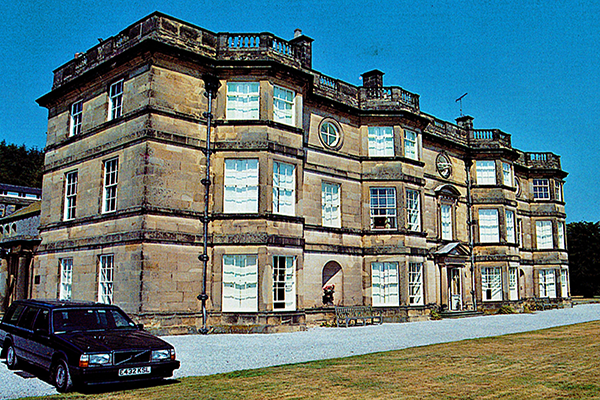
If you go up Mill Hill Lane today, you might come away with the impression that Temple House is the house facing you end-wise as you link round towards the top of Renals Street. That, however, would be a mistake encouraged by the fact that the building in question, a brick villa of some size, is the Temple Clinic. In fact, this building was put up to the designs of architects Giles & Brookhouse in 1867 and then rebuilt by Edward Fryer (1852-1883) in 1882 as the vicarage of St. Chad’s church, further along in St. Chad’s Road. Even then, it was smaller than it is now, for it underwent a further enlargement (by about a third) in the 1980s at the hands of the Council, the job being done with amazing tact in matching style: red brick, sparing stone dressings, sashes with glazing bars, dog-tooth cornicing and so on. In fact that villa was built as a dower house for the owner of much larger Temple House, which nestled amongst the bocage on the slope to its right, half way between Mill Hill Lane and Burton Road. It was sold off for adaptation as a vicarage in 1881. Temple House itself, demolished in 1959, was built about 1825 for Joseph Woollatt (or Willott) nephew of William Woollatt, Jedediah Strutt’s original partner in his cotton spinning business. It was situated on a steeply sloping piece of land which descended to the Burton Road, and which had been part of the pleasure grounds of Mill Hill House, the residence of banker Thomas Swinburne but, being rather steep and north facing, was sold to Swinburne’s fellow banker Samuel Richardson (1741-1823) about 1816. He landscaped the plot and had ‘a very handsome summerhouse built’ which he called The Prospect. This was situated near the top of the slope, just below what is now Mill Hill Lane and which was then a footpath, with a circular walk embowered by trees. Richardson died in 1823 when his family sold the plot, along with surrounding land to the south, to Joseph Woollatt. Woollatt’s new house, which essentially replaced the summer house, was (naturally) called Prospect House, and not without reason, for anyone who has travelled up Mill Hill Lane will tell you that, where one can see northwards between the later houses, there are magnificent views to be had right across Derby to Drum Hill by Little Eaton. The house Joseph Woollatt built was a rectangular villa of Keuper sandstone ashlar blocks, situated towards the top of the slope on the south side of Burton Road. The house had main fronts facing NW and NE (due to the vagaries of the site). There were three storeys under a hipped slate roof supported upon a cornice and moulded entablature, there having been three widely spaced bays on each main front. The windows were protected by sliding cast iron jalousies those on the Burton Road (NW) side with moulded entablatures above. The angles were embellished with giant Doric pilasters. The entrance front faced Mill Hill Lane, and boasted a Doric portico, although a secondary approach was via a steeply inclined path from a lodge house on the Burton Road, more or less opposite the junction with Abbey Street which still survives, although today sealed off and very overgrown. This led to the other show front of the house, the entrance on this side being via a door set under a broken pediment in a canted ground floor bay, the top providing a balcony for the bedroom above and being protected by an attractive cast iron balustrade. There was a service wing to the west forming a court yard, and a conservatory. The plainer elevations of the house were very close in style to those of The Field, Osmaston Road, a villa which was described in Country Images in September 2014, which rather suggests that the architect was probably the ubiquitous and versatile Richard Leaper: alderman and serial Mayor of Derby, banker, collector of customs for the Borough and prolific amateur architect. This supposition is strengthened when we realise that he was also the architect of Mill Hill House (built c. 1812) and also of Corndean Hall. The ground floor windows on the two main fronts were sashes extended to terrace level, and in deed on the Burton Road side, the gardens were impressively terraced the house platform descending sharply to a semi-circular terrace below, a feature which began to give trouble post World war Two, as they began to slip partly due to lack of maintenance and partly due to the widening of Burton Road undercutting the bank. Much of the Swinburne’s landscaping was, however, retained. Joseph Woollatt died in about 1830 and his widow, Harriett, married Joseph Bailey, a landowner at Allestree and Breadsall and a wholesale grocer. It was a second marriage for Bailey, too, for he brought with him a teenage son John who took over the business in the 1840s when his father died. The estate that came with the house lay mainly to the south, and seems to have extended to about 60 acres, cheek-by-jowl with that of another lost house (of which a photograph has yet to emerge), Mount Carmel. Bailey was a councillor, chairman of the bench and a keen member of the Freemasonic Tyrian Lodge in Derby. Unfortunately, neither he nor his wife, Hannah had issue, and after she died in the 1870s, he decided to release about half the estate to build badly-needed houses, thus creating a block of streets south of Mill Hill Lane, by this time a fully metalled road: Bailey Street, Mill Hill Road, Western Road and Temple Street, all pitched 1875-1878; in 1881 there were 3,000 people living on what had been Bailey’s estate! Temple Street, of course, took its name from the Temple of Jerusalem, after which Bailey’s house had been re-named when he inherited it, thanks to his keenness for the arcana of freemasonry. The name remained with it for the remainder
Mysteries, Murder, Marple and More

From the days of ancient Greece right up to the present day, people all over the world have been fascinated by crime stories. Authors including Sophocles, Edgar Allan Poe and Arthur Conan Doyle are often cited as being among the finest writers of the genre – but none can match the best-selling novelist of all time, Agatha Christie. Her 66 detective novels and 14 collections of short stories have sold about two billion copies. She also penned The Mousetrap, the longest-running show in the world which has played continually in the West End for 66 years. Her estate claims that only the works of Shakespeare and the Bible have been published more widely. So it’s hardly surprising that an exhibition about the writer, Agatha Christie: Mysteries, Murder, Marple and More, at Pickford’s House in Derby has been extended until 26 January because it’s been so successful. The tribute to Dame Agatha has been put together by Gale Goddard, a retired civil servant from Langham in Rutland. In 2005 she was watching a Christie drama on television, Five Little Pigs, and an idea popped into her head that she should start collecting photos of actors involved in TV productions and films. Five years later she had her first exhibition, at the now closed Snibston Discovery Museum in Leicestershire. “I had quite a lot of photographs,” she told me when I met her at Pickford’s House. “I also had some items from Greenway (the Christie family’s holiday home in Devon) which belonged to Agatha that she actually used herself.” In 1926 Agatha Christie mysteriously disappeared after her husband Archie asked her for a divorce. She wasn’t found for ten days and two doctors diagnosed that she had been suffering from amnesia. “I also had a few things to do with her disappearance,” said Gale. “I think then I could see the potential of a different type of exhibition and it’s really grown from there. I have these ideas and I just follow them through.” Gale revealed that she was fascinated by Agatha’s plots and the suspense in her stories. “I once read that she leads you to the murderer at the very beginning of the story and then everybody is under suspicion. “I’m also interested in the psychology of murder, not the actual act of murder.” During World War I Agatha Christie volunteered as a nurse at Torquay hospital. She then moved into a dispensary. “I think she was in her element then because she learned a lot about poisons,” said Gale. “In her first book The Mysterious Affair At Styles, the way she described the poisons was so accurate that a pharmaceutical journal mentioned that she had a very good understanding of poisons and how they worked.” Go along to Pickford’s House and you can learn all about Agatha’s writing and some of the characters she created. There are rare books as well as oil paintings of actors including David Suchet, Joan Hickson, Albert Finney and Peter Ustinov. There are items that would be used by Agatha’s endearing Belgian detective Hercule Poirot including his black Russian cigarettes, cigarette case, hats and canes. “If you look into the Murder On The Orient Express exhibition it’s almost as if you’re standing there or sitting in the train going along the journey not realising that murder’s at the end of it.” The centenary of Agatha’s birth was celebrated with a bronze bust of her being erected in Torquay. A copy of the bust is in the Pickford’s House exhibition. “This is an identical copy,” said Gale. “It’s made of clay but if the bronze one in Torquay were to be damaged, this is the only other copy because the mould was broken after this one was made.” Many actors have portrayed Poirot on radio, television and film but Gale believes David Suchet was undoubtedly the best. “He read all the books because he wasn’t familiar with them and made notes about the character. “He played Poirot exactly how it should be. I’ve met David on a few occasions and when he’s in costume he doesn’t come out of the character until he’s finished filming.” Another of Agatha’s enchanting characters is Miss Marple, played by Margaret Rutherford, Angela Lansbury, Geraldine McEwan and Julia McKenzie among others. But Gale’s favourite is Joan Hickson who she said played the character as she was in the books. “If we go back to the very beginning, Miss Marple was a little old lady – she wasn’t particularly a nice person. But after a while Agatha Christie changed the character who becomes very observant. This is what Joan Hickson portrays.” Gale is negotiating where Agatha Christie: Mysteries, Murder, Marple and More will go next. She’s pleased that it’s been extended at Pickford’s House. “All I want is for people to come to the exhibition and enjoy it. Sometimes I just like to watch people’s faces. That’s all I want – I don’t want anything else from it.” So will Agatha Christie’s popularity continue? “Undoubtedly. We’ve had quite a few young people who’ve come to see the exhibition, so it’s nice that there’s another generation of people out there who are fascinated by her stories and her books.” There are some remarkable exhibits, none more so than a picture of the first actress to play Miss Marple on stage. Who was it? You’ll be intrigued. You’ll have to go and detect who it was yourself. 00
Restaurant Review – The Old Poet’s, Ashover

There are some pubs that claim to be what they’re not, and others who know exactly what they are and are happy being there, sticking to the time honoured script. Kim Beresford, owner of ‘The Old Poets Corner ‘Ashover for the past fifteen years, explained very clearly to me “We are first and foremost a traditional country pub renowned for our beers and rustic pub food”. No pretence here and that’s such a relief as at least I wouldn’t get a huge plate with just a dash of food posing ostentatiously in the middle. Having said that, since our last visit fourteen months ago a lot has changed at ‘The Old Poets Corner’, which is indicative of an industry where people move around, but at least Kim is still there overseeing a new era in this lovely old pub’s history. Approaching Ashover on a chilly November evening the heart beckons to be warmed as the welcoming lights guide us in. Very soon we were seated near the huge log fire, sipping on our beers, perusing the new winter menu. With new Manager Diane Wood and new Chef Jack Parkes now established, it was interesting to see that the menu still featured traditional pub food and hadn’t gone all ‘arty’! The market for good, old fashioned pub food, efficiently served in hearty portions is still very popular, in fact, over the last six months more than one pub and restaurant owner has told me that fine dining has taken a little dip with more people favouring going out more often but spending less each time, thereby making their budget go further. That puts the pressure on pubs then to do ‘pub food’ really well. Having a reduced choice on the menu is a huge benefit to the diner ensuring that food is freshly cooked. And that’s where Kim and his team at ‘The Old Poets Corner’ will be on a winner. My creamy garlic mushrooms served on toasted sour dough bread were very creamy and a generous portion. The pint of whitebait chosen by my companions was delicious, crispy in a scattering of breadcrumbs, sharpened with lemon and dipped in to a pot of dressing they were the perfect ‘sociable starter’. I followed with their ‘Famous Old Poets Meat and Potato Pie’. I was interested to see the new chefs’ way of doing this pub favourite as I had it a year ago. Would it be as good? Yes, it was, but if I’m honest there wasn’t as much pie as last time. Is that me being greedy and wanting a huge slab? Maybe. I mentioned that to Kim who immediately responded “I’m currently looking at that, it does need a little tweaking”, and that’s the beauty of the owner having total oversight. Of course, Kim was the original chef at ‘The Old Poets’ when he first bought it, so the present chef has to impress him too you see! Whilst I was busy eating and drinking Dave was tucking into his “Beef stew and herby dumplings” main and copious pints of ale. (I think he managed to sample most of the Ashover brewery beers on sale). For me the jam sponge pudding was absolutely delicious and came with lashings of custard, and the rest of our group couldn’t resist the freshly made Bakewell tart. All in all, a hearty meal. Everyone concerned agreed that it was a great night enjoyed in the special atmosphere of an old country pub, with rustic pub food as it should be. What more could we ask for? Later in the evening was ‘Open Mic night’ and some old country folk music could be heard wafting through the air from the opposite room. So, log fire, traditional live music, rustic food, real ale and great friendly service, all at prices that won’t break the bank, absolutely fantastic! Our thanks to Kim and the team for making us so welcome. GP In January (25-26) they will have their customary Burns Night event where George Cockburn and Sons (Scotlands first champion haggis makers) Haggis will once again grace the menu. It’s a night for wearing tartan too, and booking in is essential. Call 01246 590888 00
Taste Derbyshire – From Nut Sprinkled Discs to Chocolate Drenched Honeycombs

Two pints of lager and a cream truffle may not be the average round for most pub-goers but The Three Horseshoes Inn at Breedon on the Hill is not your average pub. Yes, it has the roaring fire, real ales and quarry-tiled floors – but they’ve also thrown in a chocolate shop for good measure. That’s right; a chocolate shop. And not just any old chocolate shop but one supplied with all manner of award-winning, artisan goodies. Moreover, re-stocking is never a problem. The Bittersweet Chocolate Co. – run by Nigel Holling and wife Dianne – is housed in nearby outbuildings; just a short stroll across the pub garden. In truth, I had been expecting the ‘shop’ to be little more than a shelf behind the bar. It turns out to be a gleaming, grandiose Victorian display counter straight from a chocoholic’s dream. It’s several feet long and decadently stuffed with all manner of moreish delights – from fruit-centred truffles to chocolate-dipped dates, nut-sprinkled discs to chocolate drenched honeycombs and fat caterpillars lying beside luscious lollipops. “The chocolate counter always stops people in their tracks,” says landlady Jenny Ison. “My business partner Ian Davison has owned it for more than forty years. We think it was a Victorian confectionary counter but Ian’s family used it to store boating paraphernalia at their chandlery at Sawley Marina. Ian was about 12 when he rescued it and it’s been moving around from garage to garage ever since. But when we bought the pub, Ian realised we’d got the perfect space for it.” Jenny says the counter – and its contents – attract people from all over the country; “People tell us it looks magnificent and it’s definitely a talking point when I tell them we have a real-life ‘chocolate factory’ in the pub garden,” she laughs. “We have a chocolate menu which is very popular as people have truffles instead of, or as well as, a desert. But we also get people having some chocolate with a bottle of wine or Prosecco. We can’t get our hands on enough salted caramel.” “We’ve been based at the pub for nine years and it works really well,” explains chocolate-maker Nigel as he shows me to the vanilla-scented workshop where his colleague, Kate Jackaman, is busy coating honeycomb with tempered chocolate. “When my wife Dianne and I first started we were working from our kitchen. We were trying to develop and manufacture hand-made chocolates all day, every day and turn it back into a family kitchen at night. It was quite a squeeze – we became very good at dancing. The Three Horseshoes were customers of ours and they offered us space in what used to be the motel rooms.” He laughs; “But having a shop in a pub is unusual. We might be in an exclusive club of one.” The Bittersweet Chocolate Co. may have started on the kitchen table but the team’s artistry with chocolate – and wizardry with flavour combinations – has earned them multiple Great Taste Awards including a prestigious two stars accolade for their cracked coffee bean in dark chocolate. “My background was in catering,” explains Nigel (54), of Chellaston, when asked how he came to master the art of chocolate-making. “I helped set up the restaurants and catering outlets for the American Adventure Theme Park. The role included involved managing stock and distribution and I ended up taking a sideways move into IT. But I loved working with food so much I’d take on part-time jobs providing cover for chefs.” Nigel realised he’d reached a crossroads when his children Charlie and Anna (now 18, 16) were born. “With two small children, I couldn’t go out and chef anymore but I wasn’t ready to ‘put up and shut-up’ until my retirement. I decided to resign in 2007 because I needed to work with food; it’s my passion.” “Chocolate was in the forefront of my mind as I was excited by the scope it would give to create new flavours and textures. I enrolled in some chocolate-making courses and began to develop a range of truffles to sell in restaurants as an alternative to a desert. I knew from the start that chocolate would be the perfect medium to express my identity and individuality. When you get it right, the sense of satisfaction is immense.” Nigel decided to bring his culinary expertise to the art of chocolate making. “I’m always thinking about flavours that will sit well on top of the chocolate,” he says. “It might be something I remember from a recipe, or a dish I’ve enjoyed in a restaurant that’s been stored in my memory and I instinctively know which flavours will work together. Popular combinations include lime and chilli, raspberry and almond and geranium rose which is our modern take on Turkish delight. We also sell a lot of chocolate flavoured with organic essential oils – our French lavender has been a huge hit.” Nigel also showcases local products in his creations; “We use sloe gin and whisky and wild damson liqueur from a brewery in nearby Rutland,” he explains. “Also, the honeycomb we make for Chatsworth Estate Farm Shop uses honey from bees on the estate.” Although there’s something a little ‘Willy Wonka meets Heston Blumenthal’ about these creations – they invariably work. Nigel can only remember one exception. “Grapefruit,” he recalls with a shudder. “We tried all different ways but it just didn’t work. Whatever we did – it still made your mouth pucker so we walked away.” The popularity of the company’s innovative flavour combinations led to an expansion of the business. “My plan had been to supply restaurants but we began to take our products to farmer’s markets and food fairs and the feed-back was incredible,” Nigel says. “We always gave people some samples and – even though the people at these markets are used to quality food and drink – a lot of customers said our chocolate was one of the best they’d
Restaurant Review – Jeera, Codnor

The British love affair with ‘Indian’ cuisine has come a long way in the past 50 years. From the days when anything with a hint of chili and a whiff of cumin was called a curry, to today when we can dine on authentic regional variations from the subcontinent. For example Eastern Indian cuisine is primarily known for its desserts. Where as Vindaloo is a traditional Goan dish from western India; an Indian restaurant mainstay. The cuisine of the countries and regions in the north, including Bangladesh, reflect a strong Mughal influence. It is characterized by a high use of dairy: milk, paneer (an Indian mild cheese), ghee (clarified butter), and yogurt are all used regularly in Northern dishes. Samosas, fried pastries stuffed with potatoes and occasionally meat, are a distinctive Northern snack. Clay ovens known as tandoors are popular in the North, giving dishes like tandoori chicken and naan bread their distinctive charcoal flavour. A local exponent of this distinctive cuisine is Jeera in Codnor; an authentic Bangladeshi restaurant. It’s been a few months since we were last here and we had been told that the restaurant had undergone some changes. At first glance, the interior at Jeera, the soft lighting and the clever use of spotlights in the bar, appeared just as I remembered it. However, changes have been made. The dining area decor has been tweaked but the most noticeable change is the seating. Gone are the tall heavy, brown chairs replaced by comfortable, light coloured, fabric covered tub style chairs. As a result the area appears more spacious and warmer. We settled in to the comfortable surroundings and I ordered a tall glass of cold Cobra beer for myself and a chilled glass of Sauvignon Blanc for Susan. We sipped our drinks, chatted and nibbled on plain poppadoms accompanied by the usual dipping sauces and pickles: a smooth mango chutney, a hot green chili and lime sauce and a spicy diced red onion pickle. The service at Jeera is not hurried. It gives you time to read the menu and the extensive descriptions of the dozens of dishes on offer, from the simple vegetable samosa to the hearty mixed platter. For my starter I selected the fish shashlick. Fish is a staple in Bangladeshi cuisine and the shashlick is a traditional barbeque technique. The dish consisted of several portions of white fish cooked in a mild, slightly sweet marinated sauce with green peppers, tomatoes and onion, garnished with coriander. The fish was beautifully cooked and flaked apart when I cut in to it. The mildly spiced sauce had a smokey note but didn’t overpower the meaty fish making it a tasty, light starter. Susan opted for onion bhajis as her starter. A traditional mildly spiced first course; it consisted of 2 bhajis coated with chickpea batter, deep-fried to produce a light, crispy coat but retaining a soft and aromatic centre, served with salad and creamy mint and yogurt dip. The mild spices, the soft onions and the creamy sauce made it a light, savoury prelude to the main meal. Susan’s choice, from the long list of main course dishes, was the lamb pasanda; another traditional cooking style with its origins in the very north of the subcontinent. This pasanda was a mild, creamy curry with a hint of spice that set the taste buds tingling. It was cooked with sultanas and cashew nuts giving it added flavour and making it slightly sweet; a perfect counter point to the texture of the plentiful, tender lamb. Along with a choice of seafood mains the menu abounds with chicken and lamb dishes; ranging from the hot and spicy Naga Chicken to the tikka biryani; recommended for those who are new to Bangladeshi cuisine. The original driving force behind Jeera, Mr Rahman gained the notable accolade of Derbyshire Chef of the year and his renowned chicken Jalali dish is still on the menu today. A firm favourite with Jeera customers along with another favourite; the chicken chili ambari. Of the two, I went for the ambari. I now understand why it has gained it’s popularity. Marinated chicken breasts are cooked in the restaurant’s clay oven then blended with their home made chili sauce of green peppers, chopped onions and tomatoes. Although the chili sauce was bursting with warmth and flavour it didn’t mask the tender, tandoor cooked chicken which remained the star of the dish. The flavour balance was perfect and I would order chili ambari again. We shared a dish of plain boiled rice and, freshly cooked in their clay oven, one of the best garlic and coriander naans we have ever tasted. We had enjoyed such a relaxing evening at Jeera that we couldn’t stop talking about it in the taxi on our way home. Our thanks go to all the staff at Jeera for the attentive service and the amazing flavoursome food. 0-1
Walk Derbyshire – A Winter Warmer Around the Longshaw Estate

I have to make an apology before embarking on the text for this walk. In July I acquired a new hip, this was after upwards of ten years trying to ignore an ever growing problem. Fortunately I had the sense to build up a stock-pile of walks, which kept Garry and Alistair happy at Images HQ, making it possible for them to publish my walks as and when necessary. Feeling a lot better since my session with Mr Williams, one of the osteopath surgeons on the staff at Calow Hospital where, I must add, I didn’t feel a thing, and was much entertained by what sounded like the opening bars of Giuseppe Verdi’s Anvil Chorus from his opera il Travatore! Deciding it was time to put my boots on again, I chose this walk mainly because it is short and finishes with the alternative of a pub lunch or the excellent soup and sandwiches on offer at the National Trust tea-room next to Longshaw Lodge. Using easy to follow paths through what was once a sporting estate, the walk drops down into the upper valley of Burbage Brook. Here it joins one of the ancient Pack-horse tracks that once linked Sheffield to the salt wells of Cheshire, and carried finished metal goods such as scythes on the return trip. With far reaching views throughout, the walk starts by skirting the front of the lodge, along a path between it and the open moors now grazed by sheep, but once the realm of sportsmen and their guns in search of game. Going through a swing gate, the path splits with one going south towards Big Moor, and the other bearing right, drops down to the Grindleford road. This is the one we took, going past an attractive pond, the haunt of wild geese. The path crosses the road by way of a stone stile and then finds its way down to Burbage Brook. An ancient stone packhorse bridge crosses the brook which is followed upstream to another stone bridge. Here a right turn joins a cobbled track winding its way up to the Grindleford road again. Diagonally right across the road there is a gate house and behind it a footpath through woodland back to the car park. Longshaw Estate and its lodge was built in the early 1800s for the Duke of Rutland as a sporting estate. During the Great War of 1914-1918 it became a military hospital, mainly for Commonwealth soldiers. From old photographs it looks as though many of the fitter soldiers managed to enjoy the heavy snowfalls that seem to have been more regular then than now. In the 1920s Longshaw was bought by Sheffield Corporation as an amenity for the city whose boundary cuts through part of the estate. While the lodge has been turned into private residences, the rest of the estate having been gifted to the National Trust, is open to all. The now famous Longshaw Sheepdog Trials take place annually in the large field below the main house. The Walk : From the National Trust car park, follow the path down to the National Trust tea-room and Information Centre. Bear right and then left on to the path running between the lodge surrounds and open fields. Follow this path up to a swing gate next to wild rhododendrons. To your left as you walk along the first path, the raised wall apparently supporting the ground above it is called a ‘ha, ha’, or ‘haw, haw’. Its purpose is to prevent stock from encroaching the built-up area surrounding the lodge, but without spoiling the extensive moorland view. Reaching the gate, go through it, bearing right alongside rhododendron bushes, where pheasants are often sheltering. Wooden signs at the side of the path point to where children might find places where friendly boggarts live. Continue along this path until it reaches a large pond. Skirt round the pond with it on your right and then bear left past the second stone barn before you reach the road. It usefully serves as a shelter in wet weather, as well as offering information about the surrounding countryside and its wildlife. Cross the road and go through a stone stile and then drop down to a stone pack-horse bridge over the narrow brook. Cross the bridge and turn right, upstream for about a quarter of a mile, as far as the next bridge. Turn right and cross the narrow bridge. Follow a cobbled path, winding steeply uphill and through woodland as far as the road Go diagonally across the road, heading towards a gate house. Follow signs past the gate house and onto a woodland track. Continue along the track back to the National Trust car park Useful Information : 3miles (5km) of easy walking on well-maintained estate paths and riverside and woodland tracks. Recommended map: as the walk cuts through the northern and southern edges of both the OS White Peak (Sheet OL24) and OS Dark Peak (Sheet OL1) maps, it can make map oriented navigation rather difficult, but hopefully my poor quality sketch map and written instructions will be sufficient. Public transport: Regular service between Sheffield and Grindleford stop at the Fox House Inn a few yards from the entrance to Longshaw Estate. Parking: Inside estate (National Trust members free). Refreshments: Fox House Inn and Longshaw tea-room and Information Centre. Annual sheep dog trials as advertised. Guided walks and seasonal children’s events throughout the year. +10
Repton – Capital of The Kingdom of Mercia

The history of the North Midlands is writ large on this ancient town set high above the quiet meadows bordering the River Trent. Its history is traced from Saxon and Norman times, through Tudor to the present day. Even the Danes who came this far up the Trent in their longships, made it their winter base during their attempted expansion south from Northumbria into King Alfred’s Wessex. Repton’s parish church of St Wystan is built on Saxon foundations, part of the priory that brought Christianity to this part of the Midlands. Remains of the ruined 12th century ecclesiastical house are incorporated within the famous school, the most important remnants being Prior Overton’s Tower, now part of the Headmaster’s House. The school can trace its foundations back to the time when the earliest Saxons settled here; today it is the North Midland’s major centre of learning. The parish church, that most recognisable part of that monastery still stands, with a needle-like spire beckoning the faithful over miles of water-meadows. It shelters a rare old crypt as well as overlooking the fine school buildings old and new, with grey walls and red walls, gables and red roofs, green carpeted church yard sheltered by ancient trees, the whole overlooked by delightful cottages – along the road to Bretby there is even a rare example of a black and white house with a room that overhangs its porch. When those early Saxons erected their simple timber and mud-walled church some time around the middle of the 7th century, it began a thousand years of building, giving us one of the most noble of village shrines. They gave us a crypt which grew in fame until it became the northern equivalent of Westminster Abbey. Beginning with King Æthelbald (AD716-757) it became the final resting place of Mercian kings and queens including King Wiglaf and martyred Prince Wystan his grandson, who was murdered in AD849. For many years the crypt beneath the church sheltered the remains of the martyred prince who had been treacherously murdered by his cousin, but in 874 his remains were transferred to Evesham on the approach of invading Danes. By this time Wystan had been made a saint and his shrine a place of pilgrimage. Such was the popularity of a pilgrimage to St Wystan’s Repton tomb that the crypt was regularly dangerously overcrowded by devout pilgrims. As a result an extra set of stairs was made, creating an early example of a one-way system, which stands to this day. Around this time the Danes were for ever making a nuisance of themselves and after one particular foray in 850, they destroyed the monastery which had stood there for more than 200 years. When later Saxons built a church on the site of the old abbey, they laid its foundations on the remains of the old chancel walls, walls that are still standing to this day. Part of this rebuilding left us a crypt that has been called the most perfect example of Saxon architecture, certainly in this part of England. Only 17 feet square, it has a vaulted roof with small rounded arches resting on four spirally wreathed pillars, and eight extra half pillars on the walls. Modern windows have been cut into the walls to let light in and show us the crypt to its best advantage. There are still traces of an old altar, and an opening in the western wall which is believed to have been a peep-hole in by-gone days when lepers or the infirm could view the shrine without struggling up and down the steps. The crypt was desecrated during Henry VIII’s Act of Dissolution and forgotten until the end of the 18th century, when a workman accidentally fell into it while digging a grave. Near an entrance to the crypt from the outside, a holy-water stoup, made for the use of the priory can still be seen. Today’s visitors have none of the struggle early pilgrims experienced. Modern lighting allows access even though it must be remembered that the stone stairs both in and out are hundreds of years old. Today’s visitors to St Wystan’s, Repton’s parish church, can see the work of the 12th century and later builders who reshaped the Saxon church but the chancel walls are mostly as they were when the original 10th century craftsmen downed tools on their last day’s work. There are still the remains of two Saxon pillars with square capitals which were once part of the 13th century nave arcades, but now stand in the two-storied porch. Above its ancient door, St Wystan looks out from a small niche, watching visitors, old and young who come to see his wonderful Saxon church. Outside and on the side of the support tower of the slender spire is a clock, which prides itself as being half the size of Big Ben’s clock on the Houses of Parliament in Westminster. It comes as something of a shock when wandering around the churchyard, to see the number of Commonwealth War Graves tucked away in a secluded corner. With only the odd exception they hold the remains of trainee glider pilots killed during training flights from their school based on the site of what is now Toyota’s Burnaston factory off the A38 near Derby. Repton School celebrated its 400th Anniversary in 1957. Built on the site of the old priory church, its spacious main hall was designed in 1886 by Sir Arthur Blomfield, a major Victorian architect, in memory of Doctor Stuart Pears. It was under his rule that what was then a grammar school, became in the space of twenty years one of the great public schools in the country. The friendly local pub the Bull’s Head offered to look after our dog while using the inn’s toilets in a village without such public conveniences for visitors, rounded off a day visiting this one-time capital of Mercia, one of England’s original four kingdoms. A stroll around this attractive not-so-sleepy village
Travelling Through History – Where Our Forebears Trod 3

Having looked at Rykneild Street going South West, I felt it might risk any enthusiast rather hanging in the air if I did not continue the story of the same ancient road in its opposite direction. After all it was the Romans’ major SW to NE route, and it seems rather to have pivoted at Derventio. According to the plan drawn in 1721 by the antiquary William Stukeley, it seems to have had a sort of bypass around Little Chester (as Derventio ultimately became). Once one had crossed the Derwent, as described last week, one reached the settlement itself by turning immediately north up what is now City Road to enter the Roman small town. But if you wanted to reach Chesterfield, the next settlement on the route, one passed Derventio to the east, along the alignment of the present Mansfield Road. Essentially, the route went due north along much of what is in part the A61, leaving the County boundary somewhere just NE of Dronfield. From the junction with Old Chester Road, Rykneild Street runs north along what is from the Old Chester Road called Alfreton Road (and Mansfield Road diverges east over the railway line). From there it went through Breadsall village, but its course thence has been utterly lost through the building of the Derby Canal (Little Eaton Arm), the Great Northern Railway line to Heanor and Sir Frank Whittle Way. But leaving Breadsall, drive between the church and the former school (founded by the philanthropic Harpurs in the Regency period) and you are back on the alignment. From there it runs straight as a die up Moor Lane to the entrance to Breadsall Priory, the original monastic house no doubt founded there for that very reason: ease of communication. From there it backs more to the NNE as Quarry Road and you can follow it from the comfort of your car until the T-junction with Brackley Gate/Cloves Hill. From there the course is barely visible, but is helpfully marked on the 1:25,000 OS map, from which you can tell that Horsley Lodge (where acceptable refreshment may be obtained) sits right by it and one suspects that the drive overlies it to a large extent. Unfortunately, the construction of the golf course around it, without an archaeological assessment, has probably led to the loss of much potential information along with stretches of agger – the bank on which it was pitched – is visible in part in the fields to the north. From Golden Valley to Bottlebrook (which it jinks as it crosses) it follows part of the modern road on the east of Kilburn, helpfully named Rykneild Road until it jinks at the point where Denby Lane goes off to the right, but continues as Ticknall Lane, Rykneild Hill, Station Road and then Street Lane Marehay, right up to the point where the alignment it cut by the modern A38 just west of Ripley. The course then backed NNW to ascent the ridge to cross the B6374 Upper Hartshay to ascend Bridle Lane across the A610 and up onto Pentrich Common. Pentrich is one of a select few Derbyshire places with a fully British name rather than Anglo-Saxon or Danish. It derives from penn (=hill) and tirch, plural of twrch (=boars), thus Boars’ Hill. On the highest point, just short of Castle Hill (and hence the name) are the vestiges of a Roman fortlet , built as the temporary home of a cohort sized detachment of soldiers probably in the first stages of the conquest of Northern England around 47-50. That it may have found use later is possible, for it must long have been a feature in the landscape to name the accompanying summit. Descending from there it meets the alignment of the B6013 and runs through Oakerthorpe, Fourlane Ends to Toadhole Furnace where it parts company from the road and proceeds along the hillside below the road until the two re-combine at Higham, where there was once an ancient cross on the alignment. Strettea Lane is another Roman Road (as one might gather from its name) running from Higham eastwards to Stonebroom and Morton. Just north of Higham the alignment becomes the A61 and runs through the diagnostically named Stretton-in-Shirland. Thence it follows the A61 un-deviatingly, all the way through Clay Cross, Old Tupton, Birdholme and thence across the Hipper (where the discovery of a stone paved causeway was reported in the local paper in 1932) to Chesterfield, Old English caestra (from Latin castrum = fort) + feld (= field). Here there was a fort, in use from around 68 to 120 but later used as a store prior to abandonment, although the civilian vicus around Vicar Lane probably supported a small wayside settlement including a posting station or mansio. In fact the site of the fort – the famous parish church of St. Mary & All Saints sits within its former enclosure – is now believed to overlie an Iron Age hill fort on this spur of land above the valley of the Rother, crossed by Ryneild Street possibly north of the town presumably via a causeway and ford, although no-one is quite sure. The real problem at Chesterfield is that the Romans appear to have abandoned it relatively early, so that when a new settlement eventually came about, no vestige was left to inform the street pattern, unlike many other places; only the walls of the fort, inside which the church was founded, were probably obvious several hundred years later. That being so, there emerges a real problem when it comes to following Rykneild Street north out of the town. William Bennet, the antiquarian Bishop of Cloyne, wrote at the beginning of the 19th century, ‘The country people have a tradition of the road going on still further to the north, and that after crossing the Rother near Chesterfield, it proceeded on the east side of that brook, passing on the west of Killamarsh church, and through the parish of Beighton