
In 1826 a fine Regency villa was built amongst fields on the south side of Ashbourne Road, some way west of the junction with Uttoxeter Old Road and Brick Street. It was built by a maltster, Edward Fox (1756-1845), whose father, Samuel, had made his fortune in the same trade. He named it Whitecross Fields House.
The inspiration for the name was Whitecross Field, one of the early Medieval common fields of Derby, the name first appearing in a charter of the Abbey of Darley in 1261-75 in Latin as albam crucem de Derbeia iuxta regiam viam – ‘The white cross of Derby next to the King’s highway.’ Presumably, it took its name from a lost preaching cross on the west of north west side of the settlement and still standing, according to a charter of 1426. Conceivably it was the same cross as that later called the Headless Cross, since 1979 re-patriated to Friar Gate from the Arboretum. As a field name, it occurs in 1611 and a farm of this name survived to be recorded entire on the 1852 map, just north of Stepping Lane, in the New Zealand district of Derby.
The house itself was pretty standard fare for the period, although none the worse for that. It was of two storeys and three bays wide to the street, with a simple doric stone portico. There was a lower, two storey service court to the east side with a central arched entrance with stables behind, and both this and the main house were stuccoed with Brookhouse’s Roman cement, grooved and painted to resemble ashlar blocks. Brookhouse’s was a durable gypsum-based render made in the Morledge in Derby by J. J. Brookhouse & Co., using ground up alabaster mined at Chellaston. Joseph Cooper (1778-1835) was probably the architect.
This appears to have been sufficient for Mr. Fox, and he lived there with his wife and family, surrounded by agreeable pleasure grounds for fifteen years. He then decided to move on and sold to a business acquaintance Elijah Eyre (1799-1863) a brewer. His father, Mickleover-born Samuel Eyre, had been a tenant of the Radbourne estate, but Elijah had married Jane Slagg, daughter of a King’s Lynn brewer and son and father-in-law went into partnership art King’s Lynn.
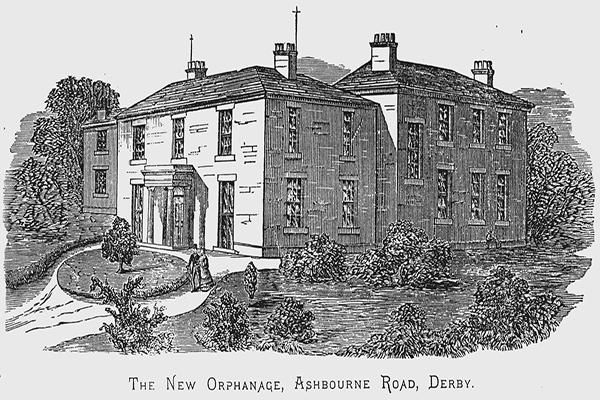
However, in 1843, Elijah and his daughter Sarah returned to Derby to set up in partnership as brewers, buying Whitecross Fields House, enlarging it with a taller three bay extension to the south joined by a new staircase and converted part of Mr. Fox’s stables into a brewery. Sarah was the eldest of his eight daughters and, in 1841, had married her namesake, Thomas Eyre, who ran the Liversage Brewery, Court No. 2, Nottingham Road. Widowed by 1861, she died not long after her father (who left £60,000) and the business was disposed of by her son-in-law, Thomas Blake, then the manager of the Royal Hotel. The house was then let for nearly a decade, to be inhabited by Mr. Wilkinson a local parson and his family.
Meanwhile, the railways, especially those centered upon Derby, had been expanding at dizzying speed, and safety gradually improved as unforeseen causes of fatal accidents led to developments of devices of increasing sophistication to improve train control. Yet this was achieved at a cost, of lives, of the various companies’ passengers but also of employees’ lives as well.
In 1874, therefore, a group of men employed in relatively low grade jobs on the railway in Manchester, had lost a fellow worker in an accident, leaving an orphaned daughter for whom they began hunting for a suitable orphanage in which she could be accommodated, her mother having pre-deceased their colleague. Having little success, they determined to club together to found such an institution specifically for the children of fellow railway workers killed in the course of their duties.
They recruited one of Derby’s two MPs, Michael Thomas Bass (1799-1884) who had already been instrumental in founding a home for ‘penitent females’ in the street that bears his name not far from Whitecross Fields House in 1866, opened in 1868. As a result, Bass encouraged the formation of a committee to make itself responsible for the establishment and maintenance of an orphanage and an appeal was launched aimed at the general public and other railway employees. This was based on the idea that if each railwayman were to volunteer to contribute two shillings (10p), a capital sum of £12,000 could be raised with match-funding.
After some discussion, it was decided that Derby would make the most ideal central location for such a venture, and a secretary was appointed in Carles Bassett Vincent, who acquired a semi-detached house on the corner of Bradshaw Street and London Road, which was duly adapted for its new purpose. This was opened as a temporary orphanage 11th January 1875 and housed eleven children initially – as many as funds could afford. Yet by the end of the year their number had increased to twenty and they spilled over into the other semi-next door, all under the car of a new-appointed matron, Miss Purnell, who was paid £40 per annum.
By 1877, £5,000 had been raised by two-shilling subscriptions, and Whitecross Fields House became available, and was purchased from the executors of the Eyres. This was subject to alterations to adapt and expand it for its new purpose and the orphans moved there from London Road in December 1877. Numbers greatly increased, and in 1881 the Railway Servants’ Orphanage (as it was by this time styled) amalgamated with the grant-giving Railway Benevolent Institution and the criteria for admission was extended beyond the orphans of men who had paid their 2/- subscription to all railway employees’ children, even if they had died of natural causes, in the employment of the railway companies.
It was also clearly necessary to expand the premises and an ambitious set of requirements was published. The publicity at the time gave the impression that Whitecross Fields was to be greatly enlarged, but, if such was the case, I have seen very little evidence of it. What rose up on the site was, to all intents and purposes, a new building entirely.
The building was designed by civil engineer Alfred Andrew Langley (1840-1904) then of Littleover Hill, Derby, and Edward Fryer (1852-1883). Langley was the Repton-educated posthumous son of Benedict Langley, a Tutbury surgeon whose widow re-married the father of Derby grandee Sir Clement Bowring, whilst Fryer, who designed the architectural aspects of the new orphanage shortly before his death, was the son of a builder whose firm flourished in Derby into the 1980s. His mother was daughter of John Harpur, a Rowditch brick maker and sister of Samuel Harpur, an architect who eventually migrated to Wales. The contractor was Edward Wood of Park Street, another very long-lived Derby firm.
The building itself, opened on Wednesday 20th July, 1887 – by statesman the Rt. Hon. the Marquess of Hartington, PC, MP (later 8th Duke of Devonshire) – cost, including furnishings, £10,000 and £30,000 was invested in land, property and equipment to provide an income. A donation of £100 came from Thomas Cook, the Melbourne born travel entrepreneur, who under-wrote £25 per annum thereafter.
Designed in French château style, the resulting orphanage was really quite spectacular. Of two storeys, of brick with lavish stone dressings, the north, entrance, front stretched to 17 bays, the seven bay wings being centred by slightly projecting pavilions with steep roofs crowned with brattishing, echoing the much larger central part with was of three bays under a mansard roof, with a similar central tower-like element which included a tetrastyle projecting portico, a tripartite window above and an oculus set in a stone pedimented surround above that. Iron brattishing was extended along all the roof ridges, although the interiors were generally severely plain. It was set on fine ornamental gardens, however, with plenty of outside space for the orphans’ recreation.
This excellent institution – now called St. Christopher’s, rather than Whitecross Fields, after the patron saint of voyagers, including of course, those on our railways – continued until l977, when the diminishing number of orphans were moved into a new building (one with none of the charm of presence of its predecessor) and the site was sold to the County Council – notorious for their lack of regard for historic buildings in those days – and made available for re-development, which inevitably involved the immediate demolition of the venerable (and grade II listed) old building in the autumn of the same year. Needless to say, Derby City council, equally heedless of heritage, waved the application through.
The site is now covered with over-large student residences built in a feeble pastiche of Georgian, with no trace of the old building remaining. The institution, in its later years at least, was a happy place, veritably recorded by Barbara Musson in her 1996 book A Real Railway Child, a moving and delightful acoount and strongly recommended.