The Lost Houses of Derbyshire – Burdett’s House, Full Street, Derby
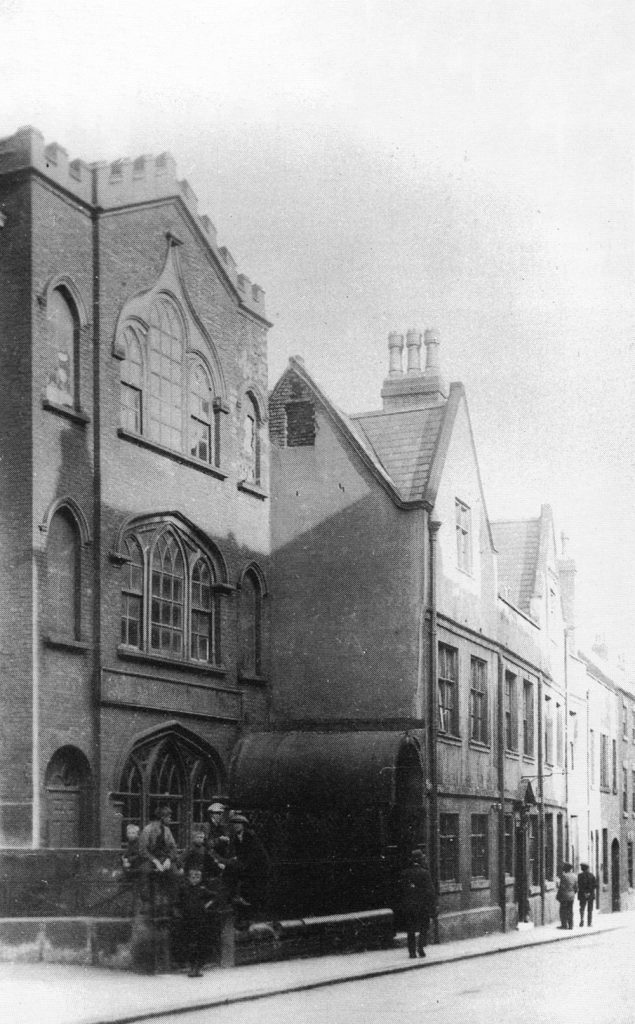
Peter Perez Burdett is an important, enigmatic and tantalizing figure. He is best remembered as a cartographer, having surveyed and drawn only the second one inch to one mile UK county map of Derbyshire and he repeated the exercise with Cheshire. He was also a talented artist, he claimed to have invented the mezzotint, and was an amateur astronomer, a talent that drew him into the circle of Washington Shirley 45th Earl Ferrers FRS. He appears to have been born in 1734 or 1735 — making him a contemporary of Joseph Wright — the son of William Burdett and his wife Elizabeth, younger daughter and sole heiress of the Revd. Peter Perez, vicar of Eastwood, Essex, who died in 1750. It is also unknown what his background was, for he moved in the highest circles throughout his life with the greatest ease. It seems clear that a double portrait of Peter Burdett and his wife Hannah by Wright was carefully posed at Knowle Hill, the (then) dismantled secondary seat of the Burdetts of Foremark, the background being the still stunning vista towards the north east — the topography is unmistakable. Yet, whilst staying with Earl Ferrers at Staunton Harold c. 1760-1764 and later, living in Derby he was never exposed as a fraud by the Burdetts or anyone else. Burdett may have been in the army, for he must have learnt his surveying skills somewhere, but the 1750s finds him in Manchester – doing precisely what has never been clear – where he married and had a family. Yet by the time he appeared in Derby, we hear no more of them and he re-marries the widow of a Leicester businessman and much later still, the daughter of a Bohemian count! He was certainly a very accomplished man; he even played the ’cello to a good enough standard to perform with the Derby Society of Musicians: a good quality education is implicit. Certainly, he and Ferrers were close enough to observe the Transit of Venus in 1761 and to write up their findings for the Transactions of the Royal Society and for the latter to lend him considerable sums of money. In 1763 Burdett had a bond from Lord Ferrers which allowed him to pay Joseph Wright – clearly by then a friend – £160 plus interest from the 200 guinea (£210) fee that Wright charged Lord Ferrers for painting A Philosopher Lecturing upon an Orrery in 1763. This sum, however, was thought by the late art historian Judy Egerton to have been in part a disguised loan to Burdett. Hence, Wright only received the first £50 of his fee and we find him chasing Burdett for the balance for years thereafter and right up until the ever-impecunious Burdett, hard pressed by creditors, left Derby in a hurry in 1768. He was still chasing some of the money when Peter Burdett left Liverpool for the Continent in 1774, when Wright was still £80 short! The original idea of the bond was for Lord Ferrers to pay Burdett the whole sum to pass on to Wright, deducting from it as a loan half to Burdett. The intention was to tide Burdett over whilst he built himself a house in Derby (and thus get Ferrers’ lodger out of Staunton Harold, then being extensively rebuilt to his own design). Once settled, the idea was for Burdett to pay the balance back to Wright when he had got established and recovered his financial position by publishing his map of Derbyshire, which happened in 1767. So where did the money go? What we strongly suspect is that it was spent on his new house in Derby’s Full Street, separated by one substantial building from Bess of Hardwick’s almshouses. Burdett’s house was later 11, Full Street, and was unique in Derby in being of brick with stone dressings and designed in Strawberry Hill Gothic – invariably termed ‘Gothick’ by architectural historians – the form of Gothic revival pioneered (indeed, trumpeted) by man of mode, the Hon. Horatio (‘Horace’) Walpole, later 4th Earl of Orford, 1717-1797) and much taken up amongst the cognoscenti in the middle years of the 18th century. As Burdett seems to have only paid £100 or a little more for his house, it also seem likely that it was an existing building which he merely re-fronted and internally up-dated before moving in early in 1764 (in which year he was first described as ‘of Derby, Gent.’) The house narrow end to the street, was of a full three storeys, with a wide central section breaking slightly forward under a crenellated parapet the middle section being a broken pediment, into which protruded the crocketed top floor window, a Gothicised Venetian window set in an ogee panel. The first floor central window was tripartite set in a Tudor-style four-centered arch as was that on the ground floor, which was flanked by a door on each side. The fact that the top floor was the tallest, suggests that the original building may well have been 16th century or early Jacobean in origin. The late Edward Saunders, Joseph Pickford’s biographer, has plausibly attributed this re-fronting to the Derby architect who is known to have been a close friend of both Wright and Burdett. Pickford is not notable for having worked in Gothick, but his Gothick Temple at Kedleston is closely related to 11, Full Street, as was Knowle Hill (since reduced) and the Chalybeate Well head at Quarndon, also attributed to Pickford by Edward. Pickford also competently restored parish churches at Coventry and Nottingham St. Mary. Regrettably, we have no record of the interior, although, like his neighbours, Burdett’s garden ran down to the bank of the Derwent and included a patch of ground on the bank opposite, too. Burdett was a Strict Observance Freemason – a continental and rather strange version of Freemasonry – and appears to have been fairly high up in its ranks, too, for he was visited at the house by a