Walk Derbyshire – Following the Magpie Sough

By Rambler ‘Sough’ is the lead miner’s term for the method of draining water from a mine. One of the most attractive roads through the Peak District, the one between Bakewell and the A515 Buxton/Ashbourne road takes some beating. Around a mile beyond the cut-off for Monyash, to the right two small chimneys indicate the presence of a major relic of local industrial heritage. The chimneys and ancillary buildings, plus an old stone cottage are all that is left of boom to bust underground activity in the search for lead. This is the site of Magpie Mine where fortunes were made by intense inter-companies rivalry that even lead to murder. While lead ore mining may have been active in small near-surface activity for hundreds of years, the earliest recorded evidence of miners beginning to explore ever-more deeply came in a report dating from 1740, the start of upwards of a dozen small lead mines that developed as time went by. Local and even itinerant Cornish miners, searched for the riches available in upwards of eight major veins running roughly east/west ever deeper beneath the site. It was also quite normal for abandoned mines to be re-opened by other companies, simply by asking permission from the local Barmote Court, the traditional means of controlling lead mining activities in the Peak. Due to the proximity of adjacent veins, two or more mines could be operating within only a few feet of rock between them. This was the case in 1833 when teams of Magpie miners from Maypit and Great Redsoil mines came into dispute over the right of Maypit miners to open a side passage, inevitably connecting to Redsoil. Appeals to the local Barmote seemed to be getting nowhere and arguments, sometimes verging on violence, broke out from time to time. All this came to a head when Magpie miners lit a fire in the connecting Maypit passage. Regrettably this led to a number of Redsoil miners being suffocated by the fumes. Twenty-four Magpie miners were accused of murder and taken for trial at Derby Assizes. Luckily for them their counsel was the wily William Brittlebank of Winster who argued that the Magpie/Maypit miners were carrying out a traditional method of breaking down the rock within the passage. Unfortunately, or so Brittlebank claimed, the wind direction changed, blowing smoke into Redsoil, rather than into the Maypit workings. With this evidence, the Jury acquitted the 24 Magpie/Maypit miners, but they left the court with the widows’ curses ringing in their ears; learning all too soon that their mine would never again make a profit. A boundary wall to the east (right hand) side of the field beyond the cottage and the prominent chimneys leads to the capped-off shaft into Redsoil and Maypit Mines. A few yards away there is the reproduction of a horse-drawn gin, a system operating the lifting of ore to the surface. The gin is just one of the many features to be seen when passing through the Magpie Mine site. Starting with the cottage, a combination of the mine agent or captain’s house and smithy, it sits within the shade of two chimneys, both part of steam engines that once drew ore to the surface and lowered men to their work. The chimneys give a clue of where their builders came from; the round one was built by Cornish miners trying their luck in the north, they built it in the style they were accustomed to. The square profiled chimney was made by Derbyshire Miners. Various small buildings dot the area around both engine houses. There is an ore store, or coe, not far from the square chimney. This was climbed recently by a courageous Duchess of Devonshire while it was being repointed. Apart from Britain’s only Grade II Listed corrugated iron hut near the round chimney, the final building of note while at the site, is another of Cornish design. This is where explosives were stored and the idea behind the stone hut, or powder house design is for the effect of any accidental explosion to travel upwards, not outwards. Passages within the Magpie complex were frequently flooded and in 1873 work began on digging a tunnel, or sough in order to drain the mine. Due to difficult conditions, mainly with very hard rock, and driving the shaft downwards for about 575 feet before it could make contact with the level of the River Wye; all this took until 1881 before it could carry water away from the workings, but the sough did have one extra advantage when small boats could carry ore to the surface, rather than being manhandled along difficult underground passages and then winched by horsepower into daylight. The sough, starting beneath the round chimney engine house follows a route flowing below the village of Sheldon. The walk as described below follows a surface route above the sough all the way to its confluence with the river. In 1973 the sough became blocked which members of the Peak District Historical Mines Association managed to clear. The story goes that when a huge body of withheld water was expected, an angler was spotted tranquilly fishing in the Wye, more or less opposite the sough. Despite being warned, the angler continued to fish, that is until the inevitable happened and a wall of water hurtled towards him. Fortunately he managed to escape in time and in any case, the water level very soon went down to normal. Traditional lead mining was carried on until as recently as the 1950s, or whenever prices became attractive, but that hasn’t happened for a long time now. USEFUL INFORMATION: A moderate walk covering 5 miles (8km) of field paths and woodland tracks. 575feet, (175.09metres) down along Deepdale and then uphill through Great Shaklow Woods. RECOMMENDED MAP: Ordnance Survey Outdoor Leisure Map Number 1, Sheet OL 24; the Peak District, White Peak Area. PARKING: Roadside near Sheldon, but please keep well away from field access gates. Alternately use the roadside car park
Walk Derbyshire – Toad’s Mouth, Carl Wark & The Upper Reach of Burbage Brook
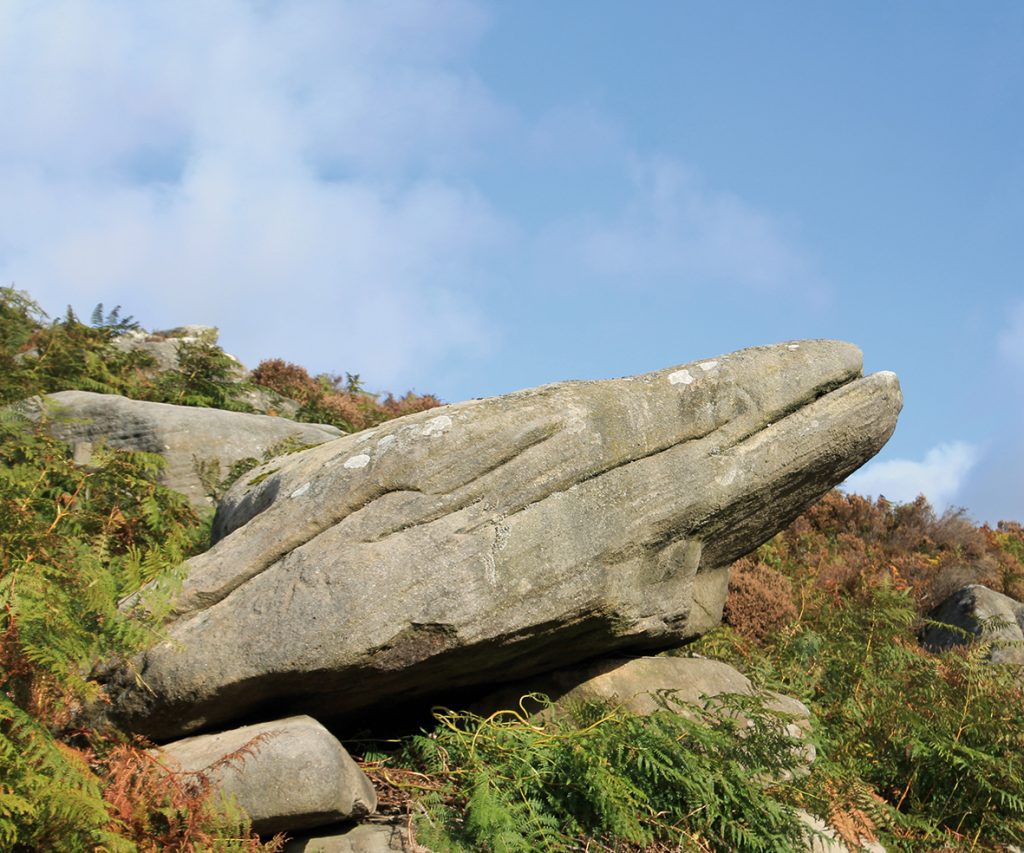
There are many enigmatic remains throughout the Peak District; stone circles, cairns and burial mounds were left by people who did not tell us who they were. Carl Wark the focal point of this walk is one such relic, but we have no way of telling if it was Iron Age or post-Roman, but it tells us that the people who used it had to protect themselves from attack by unfriendly others. When gentlemen took their ease by squinting along the barrel of an expensive shot gun aimed at some innocent moorland grouse, or semi-wild deer, chances are that many of them would have used nearby Longshaw Lodge for their accommodation. During the Great War, the lodge was used as a convalescence hospital for wounded Canadian Soldiers; there is a photograph of a group of them in the snow below the house; it stands beside the path in front of the lodge. With the decline of moorland shooting for so-called pleasure, the moors over which the hunters stalked has been handed over to the National Trust where anyone can wander freely along footpaths crossing the unspoilt moors and wild oak woods covering the valley sides of the lower Burbage River, all the way down to Grindleford. This walk starting from Longshaw joins a roadside path beside the aptly named Toad’s Mouth rock, before wandering out on to Hathersage Moor. At its centre the well-preserved prehistoric fort of Carl Wark sits enigmatically below the wild rocks of Higger Tor. Despite its condition, little is known about the fort’s history, remaining as a potential site for some future teams of archaeologists to work on. A path climbs directly across the moor to reach the massive stone defending walls of Carl Wark fort, by one of its two entrances. At this point the walls make an inward curve, creating overhangs from which defenders using crude bows and arrows could fire down on attackers trapped in the narrow gaps rising to the dual entrances. Today’s visitors can explore the site in total safety, while searching for the enigmatic rocking stone hidden amongst the remains of long abandoned hut circles. The fort is well-sited, at the centre of a nearby series of tracks leading the eye along a path climbing to the summit rocks of Higger Tor, the potential route of an extension to the walk. Our route turns immediately right at the foot of the fort’s rear walls. Here it follows an ancient pack horse track, down to a stone clapper bridge across one of Burbage Brook’s tributaries. On the far side of the bridge, the path climbs steadily uphill to join a path, part of Sheffield Country Walk, one of the long distance routes in this part of the Peak District. A right turn follows this path, later passing an abandoned large stone water trough. Unfortunately it was cracked by an ill-judged final chisel. From the path end beyond the ruined trough, another path starting beside the stream a little way before the Toad’s Mouth bend in the main road, to your right joins the brook which is then followed, past a small weir to a narrow footbridge. Crossing this, the way is gently uphill, past a small lake and then onwards to the lodge where refreshments are on sale. For something stronger there is always the Fox house Inn nearby where Jane Eyre descended from her coach. 00
Walk Derbyshire – Historic Deepdale – A walk back into history

Deepdale you may ask, for the name doesn’t appear on any Ordnance Survey map? Now better known as Dale Abbey, the village was once called Depedale, then Deepdale and eventually the modern name, Dale Abbey in remembrance of the abbey that flourished here from 1162 until Henry VIII’s quarrel with Rome in 1536. A lonely stone arch that once framed a glorious east widow, is all that is left of a Premonstratensian abbey taken over from Augustinian monks who came to this spot from Calke Abbey in 1162. They managed to begin building, but lack of funds led to the work being transferred in 1204 to an off-shoot of the wealthier Premonstratensian French foundation based in Lincolnshire. Small by monastic standards, their work led to the draining of surrounding boggy land and the expansion of farming began alongside iron production using raw materials dug from the local countryside. All went well until the Dissolution when the governing abbot managed to stave off the abbey’s closure by payment of a fine. Unfortunately this was wishful thinking and gradually the abbey fell into disuse. Stones from the abandoned abbey found its way into the walls of surrounding cottages and local churches. It is still possible to trace the use of these stones in some of Dale Abbey village’s older houses. The best example is in a cottage close to the village green. Its foundations and the lower walls support attractive half-timbered main walls. Apart from the lonely arch of the east window, a section of the abbey, in this case part of the kitchen, has been incorporated within a cottage close to the field containing the grassed over remains of the rest of the abbey. Unlike other and more extensive monastic relics, the abbey ruins stand on private land, but permission to get closer to the ruins is usually given by the owner of the nearby cottage. Carved stones discovered by occasional excavations are stored in the shed situated in the bottom corner of the site. A short distance along the road leading from the abbey, there stands what is probably one of, if not the most unique churches in the land. Tiny All Saints the Grade I Listed Parish Church is thought to be part of the abbey infirmary, where the local sick and infirm were cared for. It is a strange combination of house and church all under the same roof. The two-roomed half-timbered medieval house used by the verger, was improved in the nineteenth century, but the church is almost untouched. A mere twenty-six feet by twenty-five feet, inside it is a wonderful jumble of props and posts, all set at strange angles; the oak pulpit leans sideways due to the passage of over 300 years since it was made and the only space for worshippers is in one of the 17th century box-pews. But the oddest seating arrangement is on the massive, uncomfortable-looking chair donated in 1824 by an Earl Stanhope who fell in love with the idiosyncratic church. Despite its discomfort, it became known as the Bishop’ Chair, although it is doubtful if one ever sat there. By strange chance the tiniest church in the land, produced one of the largest chalices. Made in 1701, it measures 9 inches high and 15 inches round. The 15th century font is here with worn carvings of the Madonna and Child and the Crucifixion; fragments of coloured glass rescued from the abbey and the remains of wall paintings reward a careful search. A path winds away from the church around the back of a modern house, then on and into Hermit’s Wood. It covers an escarpment composed of easily worked red sandstone. This was used to full advantage by the man who built his home and hermit’s cell, and became known in myth and legend simply as ‘Thomas the hermit’ of Depedale. Before cutting himself off from society, he lived in Derby where in the early thirteenth century, he carried out his profession as a baker. A kind hearted man, he frequently gave away his bread to many who were unable to pay for his produce. One day he had a vision of setting himself apart from the rest of his fellow tradesmen. A few years before building work began on the nearby abbey, somehow or other he was drawn to the spot where easily worked red sandstone lined the edge of a wooded escarpment. Here he carved out a series of rooms for himself and his animals, welcoming passers-by who knelt with him in prayer. Even now it is easy to seek comfort in his hideaway. As the rock was so easy to work he managed to fit a door and two windows to keep out the draft on cold days. He even made a kind of lean-to conservatory, supported by planks set into post holes that still survive. Thomas the Hermit even had a benefactor, Ralph Fitz Geremund, who came across the hermit while out on a hunting trip. Industry developed over time, first mining ironstone and coal, industry that lead to the founding of the Stanton Ironworks. Narrow gauge railways, some of which are covered on this walk, criss-cross the fields between Dale Abbey and Kirk Hallam. There are also traces of small-scale foundries, such as at Furnace Pond Farm beyond Hermit’s Wood; it is likely the name comes from a nearby pond used to provide power for bellows used to melt iron ore in the production of iron. THE WALK STEP BY STEP From Pioneer Meadows car park, turn left along the curving road around the limits of Kirk Hallam, going past houses for about a quarter of a mile. Look out for a footpath sign on your left pointing to Dale Abbey. Follow field boundaries across four fields, passing well to the right of Ladywood Farm. Cross a deep gulley by means of a footbridge and, bearing very slightly left, cross the field beyond the gulley. In the far corner
Walk Derbyshire – Walking Eyam, Bretton Edge and Foolow
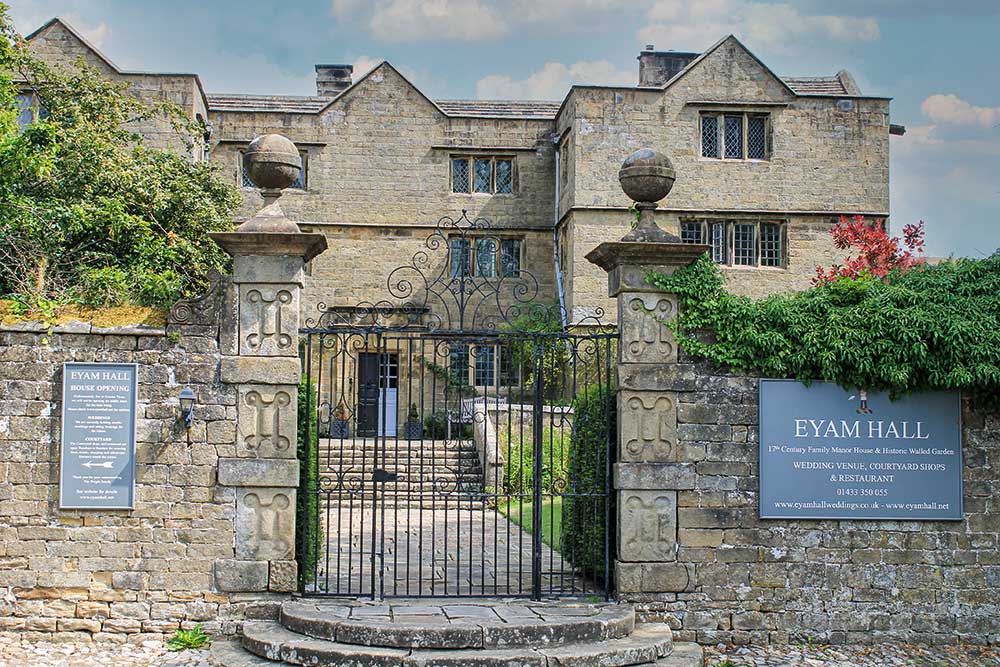
Here is a walk through some of the historical countryside surrounding the plague village of Eyam, a village where the Covid-19 pandemic must have jogged some deep folk memories from a time when the inhabitants of Eyam made a courageous stand against an outbreak far worse than that which beset them in more recent days. The walk starts logically one might say, from the car park directly opposite a small, but fascinating museum devoted to the stand made by those villagers in 1665/6, when led by a far sited young rector, the Reverent William Mompesson and assisted by his friend and predecessor, Puritan minister Thomas Stanley. Simply by what was surely firm and sensible leadership, they managed to persuade the people of Eyam to hold themselves in total isolation, despite more than half their number succumbing to the dreaded virus known as Bubonic Plague. All around Eyam village you can find relics of that terrible experience, from the natural pulpit in Cucklet Dell where Mompesson preached in the open air. Other relics are Mompesson’s Well high above the village on the edge of Eyam Moor where the far sighted vicar aided by the local landowner, the Earl of Devonshire, arranged for kind hearted suppliers to leave essential supplies, paid for by cash left in the purifying waters of the well. Another transfer point is the limestone boulder beside the path leading down to Stoney Middleton. Money dropped into holes filled with vinegar carved in its surface was rendered safe by the purifying action of the vinegar. Along with these exchange points are the number of simple graves dug into places well away from the village church; they were dug by survivors who had the onerous task of burying their nearest and dearest in places ranging from local fields and even gardens. This is a walk that starts by tasking the ability of all those who are prepared to make the steep climb up to the Sir William Hill road, high up on the edge of Eyam Moor. Fortunately this is the one and only climb, and a climb where the effort offers a reward of some of the finest views in the Peakland. Descending from Bretton Edge, the walk passes through Foolow followed by a mile or so of field paths leading all the way back to Eyam. USEFUL INFORMATION 6 miles (9.6km) of moderate walking , beginning with a steep climb from Eyam up a woodland path, followed by open fields leading to moorland road walking, then by a fairly level path across small fields, back into Eyam. Excellent wide-ranging views from Bretton Edge. RECOMMENDED MAP Ordnance Survey 1:25000 scale Explorer Map, Sheet OL24; The Peak District, White Peak Area. PUBLIC TRANSPORT Buses from Bakewell and Sheffield via Grindleford. REFRESHMENTS Eyam village. The Barrel at Bretton and the Bull’s Head in Foolow (open Sat & Sun from 12 noon) CAR PARKING On outskirts of Eyam village, opposite the village museum. Directions : From the car park opposite Eyam Museum, turn left and left again to follow the village’s main street, past the Jacobean hall and then the plague cottages where the dreadful virus first struck. Go through the church gates on your left and follow the path through the graveyard, past the church and then climb out into open fields. (Look out for the amusing memorial stone to a famous county cricketer). Cross the road and climb steeply up the woodland path a few yards uphill from the entrance to Beech Hurst Youth Hostel. Continue steadily uphill across three small fields above the wood, until the path reaches a side lane. (Mompesson’s Well is a little over a quarter of a mile to your right if you wish to make a diversion to this historical place). The walk turns left and crosses the lane for a couple of yards and then turns right to climb over a stone stile in the gritstone boundary wall. Keeping on the left of a boundary wall, climb steadily over Bole Hill which was the site of a small lead smelter for nearby Ladywash Mine. After a quarter of a mile of walking through pasture above Ladywash Mine whose chimney can be seen in trees over to the right, climb over a ladder stile and join the Sir William Hill road. Turn left and walk down the unsurfaced road until it joins a narrow lane at a sharp bend near the start of Bretton Edge. Spend time admiring the wide ranging views, both north and south across the Peak District moors and pastures. Walk along the road for about a hundred yards and then turn right along a descending rough track. The track becomes a narrow surfaced lane servicing the scattered cottages overlooking Bretton Clough. Keep with the lane as it climbs to the left past Bretton hostel in order to reach the ridge-top road once more. It is next to the Barrel Inn. (Food available, both inside the pub and out). Turn right on joining the top road beside the Barrel and begin to walk downhill. After about a quarter of a mile, take the left-hand fork and continue downhill along the road, past a small well and for about three quarters of a mile until it reaches Foolow. (There have never been any people who can be classed as foolish living in and around Foolow. The name actually means Foo’s Hill – Foo would have been the name of an early Saxon settler in these parts). Turn left beside the tiny non-conformist chapel on entering the village and walk past the duck pond overlooked by the village cross on your right and a bull ring almost lost in the grass. With the Bull’s Head pub on your left, follow the Bretton road, bearing left at the fork for about 150 yds. Look out for a stone stile in the wall on your right. Go through the stile and bear left to cross four narrow fields, using stiles in their boundary
Walk Derbyshire – Holymoorside

DISTANCE: 3½miles (5.6km) of easy walking along farm lanes and woodland, plus by-roads and side lanes. RECOMMENDED MAP: Ordnance Survey 1:25000 scale Explorer Map, Sheet 269, Chesterfield & Alfreton. PUBLIC TRANSPORT: Stagecoach X17 from Matlock. CAR PARKING: Roadside on Belland Lane, connecting the A632 Matlock/Chesterfield road to the B5057 Darley Dale /Two Dales road. REFRESHMENTS: Bull’s Head in Holymoorside and Peak Edge Hotel near Stone Edge. High fields Farm Shop and Restaurant about a quarter of a mile to the west (Darley Dale Side) of Belland Lane is highly recommended. This short walk visits Holymoorside, one of Chesterfield’s satellites, a little bit of rural attachment left behind when the Industrial Revolution swept across the north Midlands. Apart from a street name, nothing remains of the one cotton mill that was powered by water from what is now the local duck pond. There was even a short-lived silver mine, but this failed a long time ago. What we do have from time gone by, are a couple of strategically placed pubs and a popular farm café, all within striking distance of the walk, whether it be at the start, or around the half-way point. Holymoorside village lies below the eastern edge of Beeley moor. The village has many tales associated with its isolation. Local legend has it that there is a tunnel from Chander Hill Farm just off the Chatsworth Road, passing under Holy Moor to reach Harewood Grange, once a monastic farm. Despite all these myths and legends, there has never been an explanation of the term Holy Moor, or Holymoorside. There are two ways to start the walk, the first and the main one described in the text, starts and finishes on Belland Lane just off the Darley Dale road near Stone Edge. The alternative uses public transport; the X17 Stagecoach Matlock/Chesterfield/Sheffield service from Matlock. Ask to be dropped at the Stone Edge stop on the A632 and follow the woodland path starting directly from the bus stop up to and across the golf course. This path joins the walk near the club house. The return bus stops opposite the point where the Bage Hill/High Lane road meets the A632 Chesterfield road. Belland, or Belond is an old Derbyshire word for the disease cattle caught by grazing on grass contaminated by lead – there was a smelter nearby, its chimney still stands, a lonely sentinel on the adjacent skyline. The local pronunciation of Stone Edge is Stanage for some reason. THE WALK 1 From the car parked carefully on Belland Lane, walk down to the B5057 Darley Dale road and cross. The lone stone chimney over to your left on walking down the lane, is the tangible remains of a lead smelter that once stood here. The fumes would pollute the surrounding land, poisoning grazing cattle, giving them the Derbyshire disease called ‘belland’. 2 Follow the narrow lane opposite, down past a group of stone farm buildings and continue towards woodland to your front. 3 continue to follow it until it passes the club house of Stanage Golf Club. 4 The alternative route joins the main at this point (see end of main description). 5 Walk on past the club house, continuing forwards for about 100 yards when the lane turns left towards a group of farm buildings. Go forwards on a grassy path. 6 Look out for a sign post beside a small hut and turn left on a path leading towards woodland. Follow this along the edge of the trees and then into them. 7 At the far side of the woods, follow a track along the right hand side of them. 8 When the track reaches a farm lane, turn right along it and follow it up to the farm. 9 Reaching the farm, turn left on to a path and follow it with more woodland on your right. 10 When the path reaches a track, continue forwards, downhill to a pond. 11 Walk round the edge of the pond until the track reaches houses on the outskirts of Holymoorside village. 12 Turn left to reach the Bull’s Head. 13 With the pub on your left, walk back up the road and climb the section called Cotton Mill Hill. 14 Look out for an un-signposted road junction and turn right on to Bage Hill. Follow this for about a mile. There is no footpath, so walk on your right hand side of the road and take a careful look out for traffic. 15 In about three quarters of a mile, the road forks. Turn right and walk on until this road bears sharp right at a pair of houses. If using the bus ignore the next set of instructions and climb up to the main road. Cross over in order to stand at the stop for Matlock. The X17 Stagecoach service is hourly. 16 For the main walk, do not pass the houses, but turn right immediately before them and go through a wooden stile. 17 Walk forwards on a footpath towards the golf club, taking care not to encroach on the fairways. 18 Reaching the club house, walk on along the narrow lane back to the Darley Dale road and cross it to reach Belland Lane. 00
Walk Derbyshire – A walk around Ilam Hall

Tucked away on a bend of the Manifold river, Ilam Hall village was built in the 1820s on the instructions of Jesse Watts-Russell. The original Victorian houses of the village echo the fairy-tale image of the hall, built at a time when skilled labour was cheap. It was also a time when tenants could be moved at the whim of their landlords if, as in this case, he wanted more space or privacy. The Ilam Hall we see today, with its Tudor-style chimneys and mock Gothic architecture, is only part of the original building; the central tower and most of the formal rooms were demolished in the 1930s. The rest of the building was due to suffer the same fate when it was bought by Sir Robert McDougall, a Manchester businessman. He had the remaining parts of the hall made habitable and presented it, together with the grounds, to the National Trust, instructing that the hall be used as a youth hostel. Hall and village replaced dwellings of a much earlier vintage, whose history can be traced back to Saxon times. St Bertram, an early Christian missionary, hid himself in a cell near where the river bubbles to the surface below the hall. By his pious example, he persuaded the locals to abandon their pagan beliefs. It is possible he preached at the foot of the rough cross which now stands by his church. Carving on the cross is Viking, dating from around AD900-1000. The church was ‘improved’ by Watts-Russell and its original 17th – century lines are broken by an octagonal mausoleum. The shaft of another stone cross, known as the Battle Cross, was found in the foundations of a cottage during the rebuilding of the village. It now stands to one side of the riverside walk and is thought to commemorate a battle in AD1050 between local Saxons and invading Danes. The walk starts by following a riverside terrace where the 17th -century dramatist Congreve wrote part of his comedy ‘The Old Bachelor’, then climbs above Hinkley Wood on the opposite bank of the river. Crossing pasture, the walk then joins the abandoned turnpike road from Cheadle (Staffs) to South Yorkshire via Thorpe. The barely discernable line of the old road is followed to Coldwall Bridge where a left turn follows the river back to Ilam. The Walk : From the car park walk down steps towards the river and turn right along a terraced woodland and riverside path, passing St Bertram’s Well along the way. St Bertram lived in the little cave below which the river bubbles out from a rocky overhang. The water, part of the River Manifold, has travelled about 5 miles (8km) underground from Darfur Bridge near Wetton to emerge at this point. The trees being mostly beech are magnificent in their autumn colours. Battle Cross is a little further on along the path. Ignore the footbridge on the far side of a field as you pass, but turn left and cross the next and which starts almost next to the path you have followed. Go over the small field as far as a stile. Climb this and bear left, steeply uphill on a faint path close to the side of Hinkley Wood until the path joins a grassy track. Turn left along this and follow a boundary wall on your right. Pausing for breath, look back for the view of Ilam Hall seen through its sheltering trees. Beyond it rise Bunster Hill and Thorpe Cloud at the southern entrance to Dovedale. Cross the dip of a dry valley and aim for a broad track which curves uphill around wooded Hazelton Clump. Climb over an awkward stile and turn left along the metalled by-road. Follow it across Blore cross roads to Coldwall Farm. Turn left away from the road; go through the farmyard and into a field. Walk downhill, tracing the curving route of the abandoned turnpike road. The 16th-century farmhouse, which is set back from the road, was formerly Blore Hall. Walk down to the bridge, but do not cross and turn left keeping to the west (Blore side), of the river. At first follow a fence above the hawthorn-covered slopes until a gap gives access to the river bank. Follow the river upstream from Coldwall Bridge. Sturdy buttresses show how this long-abandoned bridge over the River Dove has outlasted its need. On reaching the road into Ilam village, climb the short flight of steps beside the bridge and turn right, past the memorial cross and into the village. Ilam village. The elaborate cross is a memorial to Mrs Watts-Russell, a constant reminder to the villagers of this not over-popular lady. Admire the attractive cottage gardens of the ‘ginger-bread’ styled cottages of Ilam Village. Turn left into the drive leading to Ilam Hall, then left again past Dovedale House and along a path to the church where a right turn reaches the hall. There is a National Trust shop and café in the grounds. [wpgmza id=”44″] Useful Information 4½ miles (7.2km). 393 feet (120 metres) of easy woodland ascent, with fieldpaths throughout. Refreshments at Ilam Hall. Nearest pubs at Thorpe and Alstonefield. Parking in the grounds of Ilam Hall near the youth hostel. 00
Walk Derbyshire – A Walk over 2 Dales

The dales this walk covers are within a mile or two of each other and even though they join later, both are entirely different in character. Their names are the Manifold and the Dove. Their character is mostly determined by the rocks over which their rivers flow; gritstone shales for the Manifold and carboniferous limestone for the Dove’s bedrock. Limestone being the main underlying rock of this part of the White Peak, manages to take over lower down the manifold where the river disappears temporarily through cavernous systems carved millennia ago. Starting in Longnor, an attractive one-time market town, the walk follows the broad, middle section of the Manifold before crossing over an airy grassy ridge in order to drop down into the valley of the River Dove. In this dale the scenery is entirely different; to the north beyond Crowdecote, dramatic limestone hills point skywards, looking for all the world like a row of shark’s teeth. In ancient geological times they marked the sea-washed edge of a tropical lagoon and, as a result are technically known as reef knolls. Longnor stands at the boundary of the Dark and White Peak and is also where several pack horse and drove roads meet. Until the beginning of the twentieth century it was an important meeting place for local farmers who came to this upland village in order to sell their produce and animals. The original owners of the village and lands round about, the Harpur Crewe family from Calke Abbey, built the market hall and cobbled its frontage. With the coming of efficient road transport, markets are no longer held there and cars park where cattle pens once stood, but it is easy to imagine the bustle and noise of a busy market. A list of tolls levied against animals sold there stands proudly above the entrance to the market hall. Where farmers’ wives once sold freshly plucked chickens and geese, cheese and eggs, it is now possible to buy light refreshments, or admire the work of local artists in an adjoining studio. There are still pubs where for centuries farmers met their friends and neighbours. Directly opposite the market hall, the Crewe and Harpur Inn was once where it was customary for those farmers to pay their rent to the estate. Further up the road, the Cheshire Cheese, a pub still renowned for its excellent cuisine, takes its name from its origins in 1464 when it was used as a cheese store. Being at the junction of so many ancient paths and trackways makes Longnor a popular venue for walkers and cyclists. In a village where many of its houses were built at least two centuries ago, narrow alleys lead towards the church, which although being ‘improved’ in Victorian times, is built on Saxon foundations. If one of the gravestones is anything to go by, Longnor is a place of longevity. William Billings who died aged 112, was born in a cornfield and became a soldier who took part in the capture of Gibraltar in 1704; he saw action at the Battle of Ramillies in 1706 and fought against the Stuarts in the Jacobite Risings of 1715 and 1745. Another hint of Longnor’s age can be seen by the number of narrow fields’ to the left and close to the paths used soon after the start of the walk beyond Longnor. Known as ‘strip system fields’, they are the width a plough hauled by a pair of oxen could cover in a day. No longer commercially viable for modern farming, they are still marked out by not quite so ancient stone walls, and are preserved for their historical importance. Useful Information 4 miles (6.4km) of moderate walking on field paths and farm tracks. Two moderate climbs and one descent. Muddy sections beyond the second crossing of the River Dove. Recommended map: Ordnance Survey Outdoor Leisure Sheet 24, The Peak District – White Peak Area. Public Transport: High Peak 442 service running daily every two hours between Ashbourne and Buxton calls at Longnor. Car parking in market place or roadside in Longnor village. Refreshments – village pubs and a café in Longnor where there is also a fish and chip café, but be warned – muddy boots and dogs are not welcome! The Pack Horse pub in Crowdicote makes an ideal stopping place half way round the walk. The Walk : Follow the road east for about 150yards away from the market place in Longnor. Turn right along the signposted farm lane to Folds End Farm. Go left through the farmyard and the climb over a stone stile. Turn half left beyond the stile and then right at a path junction to follow a grassy path downhill to the River Manifold. Follow the Manifold’s left bank, downstream. Go forwards where a wider track bears left and then cross three fields. At a four-way path junction, turn left and climb up to Over Boothlow Farm. Keep left through the farmyard and then right along a concrete track. Through a gate the track becomes rougher, follow it uphill to the ridge-top road. Pause on the way up to the road and admire the view. Longnor is to your right beyond the narrow strips of its Saxon fields. The wide basin of the Manifold was once considered suitable for flooding as a shallow reservoir, but as this would leave an ugly muddy scar during periods of drought, the plan was dropped in favour of the much more attractive Carsington Water. Turn right along the road for about 500yds (460m) and then cross a stone stile. Turn sharp left and begin to go steeply downhill across three fields. Turn right on joining the track down to Under Whitle Farm. Pause again to admire the view, this time along the valley of the River Dove. In the valley bottom, to your right, grassy mounds mark the motte and bailey of Pilsbury Castle. In its time it was a wooden-staked fortification built by the Norman overlords
Walk Derbyshire – Viator’s Bridge & The Dove Holes

This short walk can be fitted in with a trip exploring more of Dovedale or simply as a day out combined with lunch at one of the hospitable pubs in villages round and about the valley. It is over 300 years since Izaak Walton fished in the pure waters of the river Dove along with his impecunious friend Charles Cotton of Beresford Hall, near Hartington. Apart from light traffic along the short stretch of modern road through Milldale, the two friends would easily recognise this part of the dale. Dovedale and its famous trout stream have changed little since Walton and Cotton spent time along its banks, angling and philosophising. Walton referred to the Dove as being ‘The finest river that I ever saw and the fullest of fish’; a sentiment true even today. Many of the houses in this tiny hamlet are founded on dwellings that would have been standing in Walton and Cotton’s time. The village takes its name from two mills that once provided employment for people living there; remnants of both mills remain, still capable of taking power from the river. Lode Mill is higher up the valley; converted into a barn, it once ground and separated lead ore from the parent limestone. The mill closest to the village is Ochre Mill; powered by water from the leat which begins a few yards upstream of Viator’s Bridge, is also recognisable as a barn, but in its day it produced powder for making red lead paint. In his angling treatise The Compleat Angler, Izaak Walton refers to himself as ‘Viator’ (traveller), and addresses Cotton as ‘Piscator’. (angler). In the book Walton expresses amazement at the narrowness of the bridge which bears his nom-de-plume, ‘Viator’. The route followed by this walk follows the river downstream from Viator’s Bridge as far as the curious rock formation known as Dove Holes. A secluded dry dale to the left and a few yards prior to the holes, climbs up to Hanson Grange Farm where the walk joins an ancient packhorse way back down to Milldale. The Walk : From the car park walk down to the river and cross narrow Viator’s Bridge. Turn right to follow the riverside path for a little under a mile. The thin alkaline soil on the craggy valley sides, supports many semi-alpine plants such as thyme and dwarf cranesbill. Turn left at the finger post pointing to Alsop-en-le Dale and climb the tree-lined dry dale and go beneath the line of rocky crags known as The Nabs guarding the dale’s exit. Before turning left uphill, walk forwards for about 80yards to visit Dove Holes. These massive water-worn holes appear, at first glance to be the start of an extensive cave system but are, in fact only about 20ft (6m) deep. This is a good vantage point for views up and down the dale. Return to the finger post and turn right to re-join the described walk. Turn left though a stile at the dale head and follow a series of stiles leading to the right of Hanson Grange Farm. Join its exit lane about 100yds (91m) beyond the farm. Hanson Grange Farm. There were several extensive monastic sheep walks in the area, until the Dissolution. Hanson Grange was part of one. The farm house looks Jacobean, but is probably built on older foundations. At the end of the partly walled section of the farm lane, turn left as indicated by a signpost close to an underground reservoir. Follow the sign’s direction across a series of fields, downhill towards Milldale. Zigzag downhill on the ancient packhorse way back into Milldale. The George at nearby Alstonfield is a popular pub for travellers, either by car, on foot, riding or pedalling. The oldest relic in Alstonfield Church is the economically worded inscription on the double decker pulpit which states: ‘Be faithful and etc., and I will give thee a crown etc.’ No doubt the carpenter was in a hurry when he carved those words! Useful Information 2½miles (4km) of valley walking, with one steep climb through woodland beneath The Nabs. Level farm tracks followed by a narrow packhorse track back down to Milldale. Recommended map. Ordnance Survey 1:25,000 scale Outdoor Leisure Sheet 24; The White Peak Area. Car Park. About a quarter mile above the village, west along Hope Dale (free). Refreshments: a cottage in the centre of Milldale serves light refreshments over a half-door. Pubs in several nearby villages. [wpgmza id=”33″] 00
Derbyshire Walk – An Alpine-style walk around Matlock Bath

On a sunny weekend today’s Matlock Bath is popular with middle-aged motorcyclists whose expensive mounts line the riverside frontage. They are just the modern manifestation of the visitors who come to enjoy the local scenery. As far back as the Georgian era, people have come to admire the unique setting of this small village: at first it was only visited by those who could afford the expense of horse-drawn transport, but when the railway came, and with it cheaper transport, it opened up the place for those with lighter purses. Since then the coming of the motor car has spread the net and people flock from all over the north Midlands for a day out in this mini-holiday resort. Early visitors likened Matlock Bath to an alpine resort, and that cannot be far from the truth. Romantic poet Lord Byron described Matlock Bath as; ‘There are places in Derbyshire rivalling Switzerland and Greece’. A bit far fetched, but with the vertical limestone crag of High Tor and its continuing ridge opposite the main part of the village, the aspect is not far removed from some alpine village – admittedly not quite as high, but nevertheless the looks are there. The ambience is continued with the cable car up to the Heights of Abraham and its terraced woodland walks. There’s even a tiny chapel, St John’s, about half way between Matlock and Matlock Bath that could easily be mistaken for a miniature Alpine Schloss. Probably the closest to a truly alpine footpath is the path along what is known as ‘Giddy Edge’. This path, complete with a metal handrail crosses the upper face of High Tor and can truly be compared – again, in a small way, to Via Ferrate the iron ladders that criss-cross the Dolomites and other limestone mountains of the Alps. This walk uses many of the high-level and riverside paths that wander high and low around the village. Starting at Matlock Bath railway station the walk climbs up the side of High Tor into the outskirts of Snitterton. This linear satellite village follows what was once the only road south from Matlock until the line of the A6 was developed. Entering woodland, the path climbs to the summit of High Tor, where the exciting prospect of the Giddy Edge path begins its descent back into Matlock Bath. Here if you want, a truly alpine extension to the walk can be made by taking the cable car to the top of the Heights of Abraham and enjoy its woodland walks. (Visit www.heightsofabraham.com for opening times) Continuing towards the riverside section of the walk, a footpath leaving the car park climbs to the ridge-top continuation of High Tor, before dropping down to the river by a series of well-laid steps. A left turn at the river will follow the wooded path called ‘Lovers’ Walk’ until it reaches a modern footbridge. Over this are the Riverside Gardens and beyond is the Pavilion, the restored replica of an alpine Kursall, or spa. The fascinating Peak District Lead Mining Museum is here together with a friendly café dispensing home-made food. There are many alternatives for refreshments along the roadside, ranging from fish and chips to several excellent restaurants and pubs. A WORD OF CAUTION While the Giddy Edge section of the walk has a well-placed handrail, it should be approached with great care and certainly not in wet or icy conditions. For anyone not wishing to use the Giddy Edge path, there is an alternative route bearing left at the start of the edge path which crosses the highest point of High Tor. Children and dogs must be under close scrutiny at all times. The Walk Take the side road parallel to both the river and railway line, away from the car park. Turn right and go under the railway, uphill towards the entrance to the bottom station of the Heights of Abraham cable car. Do not bear left to the cable car entrance, but continue ahead and through a squeezer stile next to a metal gate. Climb the roughly surfaced track until it reaches an unmade road lined with houses. Turn left on this road and go through a gate opening on to a surfaced track leading into woodland. The track climbs steadily, bearing right in its upper reaches. Where the track on leaving the trees bears left, continue ahead until it peters out. (The track going left is heading for a radio mast). The woodland is part of the High Tor Recreation Grounds. There are several roofless old mines around the summit, often bearing fanciful names such as ‘Fern Cave’ or ‘Roman Cave’, but none are quite so ancient. It was once possible to enter the mines for self-exploration, but an over-cautious council has closed them off on Health and Safety grounds. There was once a café on the summit of High Tor, but it mysteriously burned down within a few days of its closure. Swing round to the left away from the mast compound and make for the summit of High Tor to admire the view. N.B. There is no barrier at the summit, so keep well away from the edge – there is a 190 foot drop straight down the tor face. Bear left away from the summit rocks and follow the signpost towards Giddy Edge, making use of the iron handrails as necessary. N.B. If it’s icy, raining or if you do not have a head for heights, bear left away from the start of the Giddy Edge path and go over the highest point of High Tor. This path joins the Giddy Edge path on the far side of the summit. Continue on the edge path, using a well-placed seat for a rest along the way. At the far end, join a rough path zig-zagging steeply downhill through mature woodland. Go to the left and then right around the perimeter fence of the cable car. Go under the railway bridge and turn left on to