Lost Houses of Derbyshire – Eaton Dovedale Hall
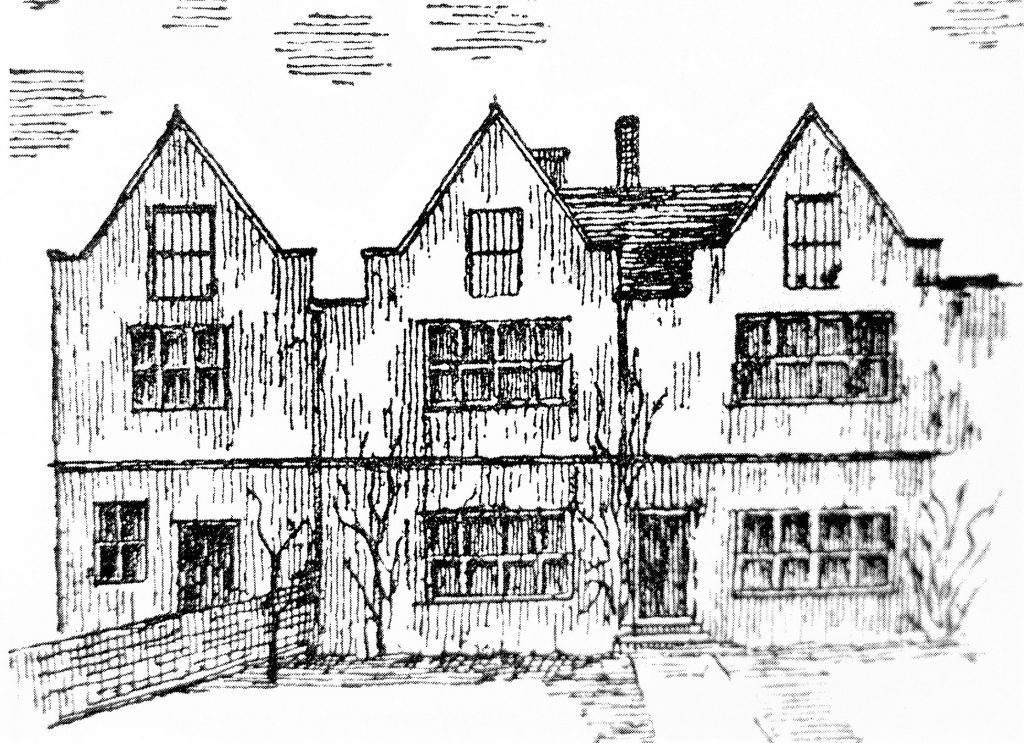
by Maxwell Craven Neither Eaton Dovedale, which sits adjacent to Sedsall, are exactly well known locales, even to keen followers of local history and topography, but they lie just north of the much better known village of Doveridge, in which parish they lie. About thirty years ago I visited to attend a clay shooting tournament, but a quick recce failed to discover any real traces of the old house, but confirmed the belief that Eaton was a deserted medieval village (DMV) as indeed is Sedsall to its north. Whilst Sedsall is only recorded from c. 1200 (the name means ‘Secq’s corner of land’) Eaton Dovedale is recorded in Domesday Book, wherein it was a portion of Doveridge held under Henry de Ferrers by one Alcher, displacing the Saxon Wulfric. Alcher is also known as the lord of Sudbury, and was the ancestor of a Shropshire family called FitzAer. Subsequent record of Eaton resurfaces when it was held in 1231 by the Norman, William de St. Pier(re), who was succeeded by his son Nicholas in 1251. Whether they had a house at Eaton is not clear, but it is possible. There were, however, two daughters and co-heiresses of Nicholas, and the estate was split between them, Sedsall going to the Marshall family of Upton whilst the Eaton part and the original St. Pier house went by marriage to the Cokesay family. They certainly did have a house at Eaton, and a small park by all accounts. In 1356, Sir Walter Cokesay was living there and his daughter and sole heiress eventually brought the estate to the Russel family. They had estates elsewhere, and it may be that the original house was, at this stage abandoned or cleared away. As it was undoubtedly of timber, the structure would have been re-used, as was then invariably the case. Sir John Russel died in 1556 and after an interval, the estate and lordship of the manor were bought by William Milward. He was already living in the locality, his father Robert having acquired land there in 1471. This Robert was fourth in descent from one Owen Milward, living in 1374, and one gets the impression that the family’s rise to the gentry was greatly helped by their having survived the Black Death (1347-1349 locally) when they doubtless bought up property being sold cheaply by the heirs of grander families decimated by the plague. The name Milward (mutated to Millard in their later US branch) means guardian of keeper of a mill, so they may have made their money in just such a manner, although we do not know where the family lived prior to buying land at Eaton-in-the-Dale as it was then sometimes called; circumstantial evidence suggests Staffordshire. The Milwards became very numerous and indeed successful, marring local heiresses: Palmer of West Broughton Hall, in Sudbury, Beresford of Alsop and Fleetwood of Calwich (Staffs.). Sir Thomas Milward (1575-1658) was a successful lawyer and served as Chief Justice of Chester 1638-1647, when the civil war cut his tenure short, for he was a staunch Royalist, in 1651 helping to rescue Charles II’s Garter regalia from falling into Commonwealth hands after the escape from the Battle of Worcester. Sir Thomas’s father William seems to have built the house – judging by a datestone of 1576 recorded as having been set above the door – probably at about the time he was born in 1575; perhaps his parents’ marriage was the spur. What we know of it from a drawing done by (or for) Joseph Tilley in the mid-19th century shows a typically Derbyshire manor house of three gabled bays, quite steep ones, with prominent kneelers, the house being of two storeys with attics. It was presumably of brick, had a string course between the main floors and eight-light mullioned and transomed windows on both main floors at the central bay and the right hand one, but the left bay boasted only a six light window above a rather inconsequential looking door. The engraving also suggests that this left bay was actually the end of a cross wing, perhaps added later, for no roof ridge appears between the left and central gables, which later seem to have acquired Georgian sashes. The first floor windows also appear deeper in the illustration, suggesting that the first floor included the loftier state rooms and that only family rooms inhabited the ground floor. That there were state rooms is reinforced by at least one visit by King Charles I, who left behind (or more likely gave Sir Thomas) a pair of embroidered doeskin gauntlets which have miraculously passed down amongst his descendants. In 1664, the family had to pay tax on no less than fifteen hearths, but what we see in Tilley’s woodcut suggests that the house had later been much reduced. What remained then much resembles contemporary Duffield Hall, which was only taxed on nine hearths. The suspicion is that it boasted a cross wing at either end of the façade, of which only part of one remained. Quite where the ceremonial entrance once was remains something of a mystery. That the house ended up being reduced so drastically was down to the implosion of the Milwards. Sir Thomas’s son Robert was equally successful as his father, despite being a second son, for the eldest William, was settled at the family’s estate at Chilcote, on the Staffordshire border. Robert was born in 1616, was called to the bar (being made a KC in 1668) and was appointed a Justice in the Chester circuit, like his father, in 1661 (probably as a reward for the family’s loyalty to the exiled Charles II during Cromwell’s ‘crowned republic’); he was also Recorder of Stafford and was elected MP for that borough in 1661, serving until his death in 1674. Unfortunately, his wife, Isabella, daughter and co-heiress of Sir John Zouche of Codnor Castle, died without having had children and Robert took up with another lady, unnamed, but called his wife in the