The Lost Houses of Derbyshire – Parkfields, Derby

by Maxwell Craven A notable surge in prosperity in Derby during the Napoleonic wars and afterwards, led to the building of nearly a dozen Regency villas on the fringes, in the suburbs and in the immediate area of the borough, of varying size and quality. Most were built by prosperous merchants and a few by landed gentlemen who, like the Batemans of Hartington Hall, found their town houses becoming unlivable, as the town infilled and industrialised. Unfortunately, many have been demolished, no less than three in the first decade of the millennium. The unfortunate demise of another casualty, Parkfield, occurred even earlier, in summer 1993, despite it being locally listed. Yet, although its merits were perhaps less than apparent in its later years, it was a villa of some style. Parkfield was originally one of the vast common fields belonging to the ancient borough of Derby, grazing and cultivation rents from which helped provide the town with income. However, this kind of income, along with fairs and tolls, did not bring in enough money for the corporation to spend on infrastructure, so in the 18th and early 19th century, improvement acts were obtained enabling parcels of it to be sold off so people build houses, great and small on the land thus released. Ironically, no less than four substantial villas were built on portions of the old Parkfield, three called Parkfield! One lay on the north side of Kedleston Road, called Parkfield House – still standing now on Park Grove, although divided into three dwellings now and listed grade II – another in 1818 just to the west of it, called Parkfield Cedars (lost, see Country Images June 2016) and the third, Parkfields, on the west side of Duffield Road, not far north of Five Lamps. Originally the plot was bought by a family called Bingham, who had iron founding interest in the town, but they later sold it to the Columbell family who were Derby’s fashionable tailors and drapers of the period. One of the improvement commissioners who had originally sold the land on behalf of the Corporation in 1812 was Alderman John Sandars JP (1782-1867). He was a scion of the gentry family long settled at Cauldwell in the south of the country, and of their most notorious son, Col. Thomas Sandars of Little Ireton, the fierce republican commander under Sir John Gell’s command on behalf of Parliament during the Civil War. John himself was a second generation bookseller, however, and he served as Mayor of Derby in 1839-40. Indeed, it was thanks to his fascination with the borough’s ancient records, that he had a considerable number of them at home with him in Parkfield for study when the 1828 Guildhall burnt down on the night of Trafalgar Day, 1841, when those that remained were irretrievably lost. Sandars built his house in 1833-34, although we are not clear who designed it; quite probably it was a fellow Alderman and prolific amateur architect, Richard Leaper (1759-1838), who had built Parkfield Cedars for himself in 1818. It was in brick under a low hipped roof, was sparing of stone dressings, with facades of varying dispositions. Yet it betrayed some sophistication, having brick Tuscan pilasters at the angles, with stone bases and capitals, a moulded frieze and cornice with stone lintels over the sash windows grooved in a Greek revival manner clearly derived from Sir John Soane’s confected Boetian Order, all similar except for a sarcophagus shaped one over the original front door set in its contemporary iron trellis portico. There was a curved bow on the west side, and a service wing adjacent; inside there was a good ironwork balustrade on the cantilevered Hoptonwood stone stair, mahogany doors, moulded plaster cornices, polished limestone chimney-pieces and one room was decorated in French revival neo-classical boiserie-style mouldings. This seems to have been something of a favourite with Richard Leaper, because his surviving (but much extended) villa which now houses the Boys’ Grammar School in Littleover has a similar room and there is another at Allestree Hall (another Derby building at risk!) which Leaper modified for J. C. Girardot. The grounds were landscaped by William Barron and at least one of the stone urns from the 1731 Derby Guildhall ended up being rescued by Sandars and used as garden features. John Sandars died at Parkfield 10th January 1867 at a great age and in 1869 his son sold it to Charles Henry Smith, one of the directors of Boden’s Castlefields Lace Mill. He was succeeded by his nephew, Alderman Sir John (‘Brassy’) Smith, who served as mayor of Derby in 1872 when he was knighted, as was the convention, for being en poste during the Prince of Wales’ visit on 17th December that year. He was also co-founder of Smith’s important white metal (essentially brass for railway rolling stock building) foundry in Cotton Lane which ultimately became a nation-wide concern. Brassy Smith was one of Derby’s super-rich and set about enlarging the house sparing no expense, with a westward extension, essentially a little taller than the original part, but in matching style, even down to the window lintels, and in so doing, he altered the way the interior plan worked. The new entrance had a stone portico with a fanlight resembling one in Becket Street (suggesting R. Ernest Ryley as the architect) and led into a new lobby and a new main stair was installed, lavishly panelled in mahogany, leading to luxuriously fitted out new bedrooms, and plenty of up-to-the-minute modern plumbing, furnished by Thomas Crump of Friar Gate. Needless to say, there was plenty of opulent looking brass fittings almost everywhere. Sir John died in 1909, when the house was sold to Thomas Carline Eastwood, a director of Eastwood and Swingler’s foundry (now the new HQ of Great Northern Classics). Eastwood, however, soon moved out to the country, and let the house to Capt. Lionel Morley but, when he left after the Great War, it was sold to Gerard Hamilton
Lost Houses of Derbyshire – Morley Old Hall

For somewhere so close to Derby, and somewhere which was once on the very edge of a coal-mining area, Morley is today a remarkably sequestered spot. The village is discrete, as the archaeologists say – not nucleated, but scattered around its parish – but with a magnificent parish church, a very grand Georgian rectory and two country houses – both Victorian: the present Morley Hall from the beginning of the old queen’s reign, and Morley Manor from her last years. One would, therefore, assume that there was very little room for an old hall as well, but in that one would be wrong, for both the Victorian buildings are, essentially, replacements for what had gone before. Indeed, Morley Manor, a fine Arts-and-Crafts mansion in red Warrington sandstone by G. F. Bodley, was built for the Bateman family – the very same family which had destroyed the great late medieval manor house their ancestors had inherited in the 18th century from the Sacheverells. If one seeks any vestige of this house, it is necessary to go to the church and seek out a separate building in the western extremity of the church yard, the Bateman Mausoleum – also by G. F. Bodley – and built in 1897 out of the same red sandstone as the Manor. Standing against this structure’s decorative entrance – with its geometrical wrought iron and Bateman armorial above – is a rather ragged fragment of wall and greyer, being of millstone grit sandstone (from Coxbench quarry in all probability). The relic is called the Loaf Gate, and once saw the distribution of alms (in the form of bread) to the needy of the parish and is part of the original hall at Morley and as such it was probably a subsidiary entrance to the manor house itself. Nor is this the only fragment of a once great house for, slightly east of north from the Grade II* listed Mausoleum, stands the former tithe barn, also listed II*. It appears largely of 17th century date, but its basic structure may be earlier – it is the stone mouldings on the three light mullioned windows that suggest the date. That such domestic looking windows were added rather suggests that the structure was always part of the original main house, but had been adapted as additional accommodation in the early 17th century, possibly as a service wing. The earliest family at Morley took their name from the place – the de Morleys – and they seem to have lived in a house within a moat, the latter feature still to some extent surviving south west of Morley House Farm. Their line eventually became extinct and the heiress married a Cheshire Massey and the heiress of that marriage married a Statham of Lymm, also in Cheshire. Henry Statham, like his Massey predecessors, had a considerable estate in Cheshire and neither family seem to have lived at Morley and we may assume that the old moated (and probably timber framed) house eventually mouldered into ruin. However, there is evidence that this Henry or his father did build a new house, probably on the approximate site of its successor, early in the fifteenth century, for the family obtained an episcopal licence to have a domestic chapel in 1405. All this changed however, when Henry died, for his only child, Joan, had married a Derbyshire gentleman called John Sacheverell. He was very much in the ascendant, for while his earliest ancestor, John de Salta Caprio, had around 1130 inherited in the right of his wife a small estate at Hopwell, a descendant had acquired the remainder through marriage with Roger Hopwell of Hopwell and Wilsthorpe, whose coat-of-arms amusingly bore three conies playing on the bagpipes – ‘hopping well to their own music’ – a typical Medieval heraldic pun! John Sacheverell also held the manorial estate of Boulton and part of that of Snitterton – all accomplished through marrying heiresses. However, he clearly felt that none of these seems to have wholly suited his aspirations, for as soon as Henry Statham had died, he had sold up in Cheshire and in 1480 concentrated on building a ‘very large old building, adjoining the church…of considerable magnitude’, which we presume was an enlargement of the Stathams’ house, and was built of good quality ashlared stone, to judge from the Loaf Gate, although the tithe barn is of slightly coarser work. It is not easy to envisage the extent of the building, upon which hearth tax was paid for 16 hearths in 1670 but, if one assumes that the Loaf Gate was at the SE end of the main front (which faced SSW), and that the tithe barn was attached to the NE angle, then what lay between must have been fairly extensive, probably including a substantial courtyard, and that its western extremity lay in the field to the west of the church yard. Indeed, when the weather is dry, the footprint of the building is relatively easy to see – especially on satellite view. Not that life there was dull, not for one moment. John Sacheverell himself was killed in action at Bosworth Field in support of his king (Richard III) only five years after building his new house. His descendants thereafter kept out of politics (thus accumulating neither honours nor titles) but were drawn back into events through having remained Roman Catholic after Henry VIII’s break with Rome in 1536. Consequently, in the next generation, when Queen Elizabeth I was threatened by the Spanish, a certain amount of paranoia manifested itself. With Mary, Queen of Scots in custody of the Earl of Shrewsbury, Catholic recusants found themselves being harried by the crown’s agents, in Derbyshire heralded by Shrewsbury’s fixers. Hence it was that Morley Hall was raided in August 1581 and Henry Sacheverell briefly arrested before buying his freedom (called paying a fine!) At the time, he had as a guest a Mr. Green, ‘…said to have made all the secret places in Derbyshire’ in
The Lost Houses of Derbyshire – Greenhill Hall, Norton
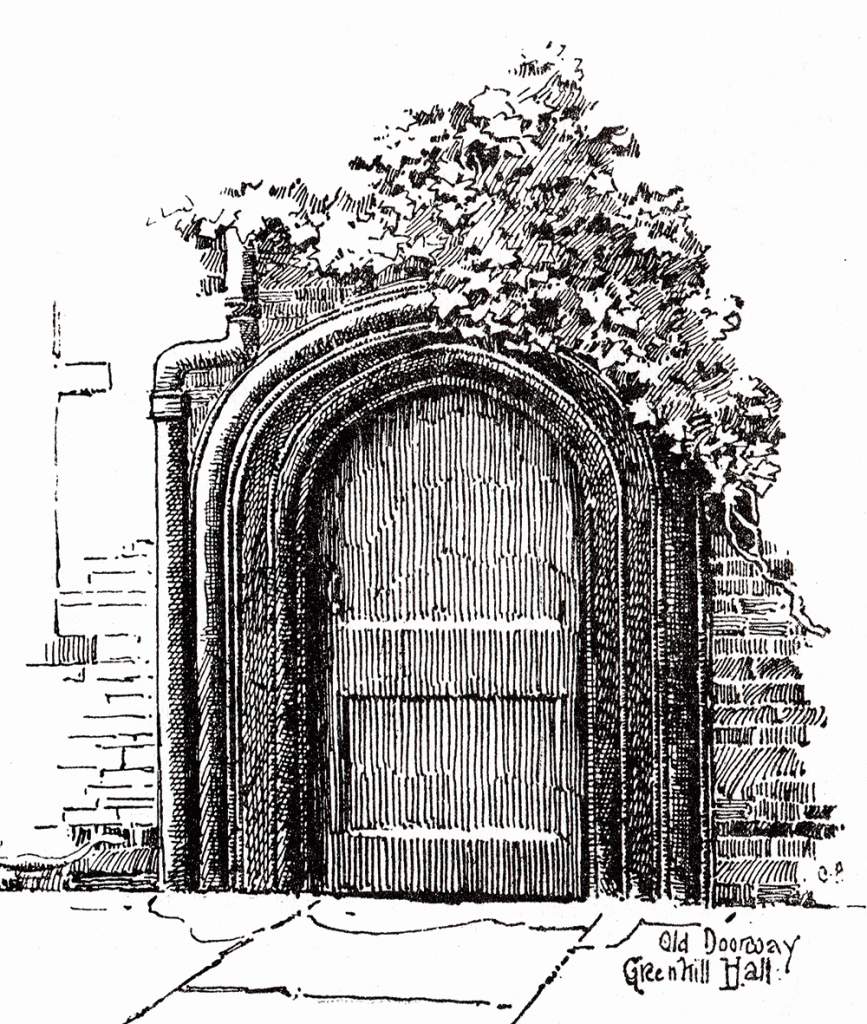
When I write about Derbyshire, I do tend to stick to the historic borders of the County, the land of which has been eroded (and less generously replenished) ever since County Councils were first formed in 1888. Although we have gained the Seals (Over and Nether) in the south and Fernilee to the north west, we lost all the ‘islands’ of Derbyshire that were once immured in Leicestershire: Measham, Ravenstone, Donisthorpe, Stretton-en-le-Field, Oakthorpe, Clifton Campville and Appleby Parva, not to mention Edingale, Chilcote and Croxall in Staffordshire. Since then, large settlements outside the county have hungrily seized parts of Derbyshire just to increase their rates income: Burton had Stapenhill and Winshill, for instance, and so in the same spirit, Sheffield gobbled up Beauchief and Norton, two of our most historic villages. They tried to get their hands on Dronfield, too, in 1974 but were successfully rebuffed! Thus, I make no excuses for writing about Greenhill, a township (hamlet) of Norton, in which until 1965 stood a most venerable small manor house called Greenhill Hall. Generally speaking, smaller manor houses which managed to survive the first three decades of the twentieth century have tended to enjoy relatively assured futures, but this has not been the case for those which have fallen within the destructive ambit of Sheffield City Council, as Norton did. Little Norton Hall, Norton Lees Hall and Norton House have all passed into oblivion. Of these, Greenhill was the most important, although its listing was never higher than II. Although the exterior dated from the later sixteenth century, the house had a much earlier core. This became only too clear as the house was demolished, revealing a three bay timber framed great hall of fourteenth century date, only matched in Derbyshire by West Broughton Hall in Sudbury. The Tudor exterior boasted a delightfully irregular gabled façade of coursed rubble of Grenoside sandstone from a local outcrop. The Tudor arched door is flush with a gable to the left, whilst two others were to the right, each slightly advanced from the main façade and with fine six-light stone mullion and transom lead paned windows under short hood-moulds. The gables were straight and un-coped, with the usual array of diamond-set stacks above the stone slate roof. The SE front was ungabled, and much plainer, built in two stages, the NE part being fractionally lower than the portion adjacent to the main front, the whole being of four bays with a second (garden) door at bay three and with fenestration all of three light mullions, the lower windows being noticeably deeper than those above and having similar short hood-moulds. The upper windows (or at least some of them) had flat mullions and surrounds instead of moulded ones, suggesting later alterations – perhaps the replacement of the original timber windows. It was within this that the substantial vestiges of the original timber framed house lurked. Inside there was a beautiful ‘Sheffield School’ ribbed and rosetted plaster ceiling in the parlour, called the ‘Oak Room’ from its lavish period panelling, which indeed stretched to other parts of the house. Indeed, the Oak Room ceiling went to Cartledge Hall not so far away in Holmesfield and can still be admired. There were also fine period over-mantels, one armorial. To the NW was a later, nineteenth century wing of no great pretension, but sufficient to make the house reasonably spacious and to afford an element into which modern (for the late 19th century!) plumbing could be inserted. The earliest certain family to have a capital mansion on the site was the Mowers, also of Barlow Woodseats, William de Mora (as the name was originally spelt) being in possession in 1384. He was a tenant of the Abbey of Beauchief, nearby. A descendant left a daughter and heiress, Joan, of Newbold, who married James Bullock of Unstone in 1586 as his second wife. James was a local man, his father John, living on The Green at Greenhill but, despite the Mowers actually having long held a lease on Greenhill Hall, John had actually acquired the lease (of twenty one years) from the Abbey in their stead in 1533. However, the Dissolution of the Abbey came about within three years, and he promptly bought the freehold as well. James Bullock’s father died in 1579 at a great age, and seems to have undertaken the first stone rebuilding in the 1560s. His son and heir, another James (1580-1632) inherited in 1598 and added the gabled front and also extended the SE side. On his death it passed to his son John and from him to another John, who died without issue in 1699. Yet the second James Bullock became involved in iron smelting at Staveley, where, on the death of his grandson, John Bullock (1627-1699) the enterprise passed to a cousin by marriage, Godfrey Froggatt. As a result, the hall at Greenhill was let to Thurstan, third son of Arnold Kirke of Whitehough Hall, Chapel-en-le-Frith, for he had married Francesca daughter of Jerome Blythe of Norton Hall, nearby and produced a large family, of whom Gervase, the eldest went to London and became a successful merchant of the Staple, trading at Calais. He married a French lady and had five sons, four of whom continued their father’s business whilst the youngest, James, ran the estate at Greenhill and occupied the Hall. The eldest three sons, David, Lewis and Thomas, led an expedition to Canada in 1628, in which they were up against the wily French leader Samuel de Champlain, eventually wresting Quebec from him and David receiving a personal grant of Newfoundland from the King. His relations with de Champlain, though were formidably courteous, de Champlain calling him ‘Capt. Quer’ and indeed, with the family being semi-domiciled in France, this is how they were spelt there, too, just like the Williamses who served the Kings of France in a later era, whose descendants are called Quilliams! This Canadian enterprise was later referred to as the ‘First British
Lost Houses of Derbyshire – Devonshire House, Derby

A great friend who is the senior caseworker for the Georgian Group, was asked by the City Council to comment on an application to convert the upper floors of 35, Cornmarket into flats. Our own Conservation Area Advisory committee, which until recently I chaired, had already questioned the applicant’s desire to remove the surviving staircase of a building which is the surviving portion of one of Derby’s greatest lost houses, Devonshire House, 34-36 Corn Market. This was where 18th century Dukes of Devonshire would reside when in Derby to preside over the three annual Race Balls and various civic business – bearing in mind that the Dukes were hereditary patrons of the Borough until 1974. In his report, in The Georgian, the house was described as ‘said to have been’ the town house of the Dukes of Devonshire. However, there is no doubt about the identification, for although little seems to have come to light at Chatsworth in the archive, other pieces of evidence confirm the identification of a building that was outwardly intact until 1969, when much of it was heedlessly destroyed in favour of an ugly brutalist Littlewood’s store (now Primark). The origin of the house goes back to the time following the death of Bess of Hardwick, whose last (fourth) husband, George, Talbot, Earl of Shrewsbury, was the builder of a grand house on the north side of the Market Place, which passed to his elder stepson Charles Cavendish, whose son William later rose to become 1st Duke of Newcastle. This house, Newcastle House was demolished to build Derby’s Assembly Rooms and its tale was recounted in Images for July 2014. The Dukes of Devonshire descend from Charles Cavendish’s younger brother, William, Lord Cavendish of Hardwick and later 1st Earl of Devonshire. A catalogue in Derby Museum asserts that the family town house was built in Corn Market in 1750 and although the catalogue was compiled in the late 19th century, the information was drawn from ‘jottings’ of John Ward FSA which include material dating back to the early 19th century. Tantalisingly, John Speed’s famous map of Derby, in showing the houses on the east side of Corn Market – then a bustling area funnelled out southwards towards St. Peter’s Bridge where grains were bought and sold from raised basins, set up on posts, called stoops – adds a number 25 just behind the position where we know the 1755 house stood. If you look up No. 25 in the key at the bottom, it says ‘Town House’. Could it be that Lord Cavendish even then had an important residence there? The house built in 1755 was in fact a re-fronting job, as early plans reveal three burgage plots on the site and later plans reveal a thoroughly irregular plan suggesting that the work was largely a re-fronting of more than one existing building. The resulting brick façade was very impressive, however, and very Palladian. There were three floors plus attics, and the building was nine bays wide. The ground floor was originally rusticated: that is faced in stone with prominent grooving between the blocks, a typically Palladian conceit, and traces of this appeared during demolition in 1969, as the later shop-fronts were being ripped away. The central three bays broke forward slightly under a pediment itself flanked by a stone coped parapet with recessed panels over the bays and originally without doubt embellished with urns. The bracket cornice below was deeply moulded and the windows on the first and second floors had bracketed entablatures over whereas on the central three bays, the middle windows had segmental pediments those flanking triangular ones. The attic windows were embellished with stone rusticated lintels, wavy along the bottom edge. Originally, the maps and plans inform us that there was a central carriage arch leading to a rather constricted courtyard behind, flanked by two non-matching rear extensions. No record seems to exist of the interior of the house, although there is a passing mention of fine plasterwork, earlier panelling and a fine oak staircase. At Chatsworth a bill survives dated 1777 from William Whitehurst, brother and works manager to John Whitehurst FRS, for a timepiece and case, which an attached voucher identifies as one installed in the kitchens at the Derby house. Probably it was a typical round dial oak cased long case clock, which are very rare as non-striking/chiming timepieces. A very similar one still stands in the almoner’s office at Chatsworth. There were also extensive gardens to the east, stretching to the Morledge and the Markeaton Brook as it swung NE through what is now Osnabruck Square. A stable block and carriage house were attached to close the rear courtyard off. The builder of this impressive occasional residence was William Cavendish, 3rd Duke of Devonshire who died in 1755. The identity of his architect for the house remains a mystery, for although James Paine was working at Chatsworth for the 4th Duke (from 1756), the façade in The Corn Market shows few of his usual conceits and if the 1750 date is correct, it is too early. William Kent had been employed by the same Duke to completely rebuild the fire-wrecked Devonshire House in Piccadilly, but apart from being severe and equally Palladian, there the resemblance ends. Personally, I suspect the house was built and the façade designed by the young James Denstone (five years later the architect of Markeaton Hall) perhaps working under his former master, Solomon Browne, but until some hitherto un-discovered payment vouchers appear in the Chatsworth archive, speculation will prevail. The curly lower edge of the attic story lintels, however, reappear on Leaper & Newton’s Bank (not the Thomas Leaper bar) in Iron Gate and once on the fenestration of the Babington Arms, Babington Lane, demolished in the 1920s. By about 1814, the area in front of the house had become too noisome and insalubrious for the 6th (Bachelor) Duke and, pulling rank as Lord Lieutenant of the County, he thenceforth requisitioned the 1811