Derbyshire Villages – Rodsley
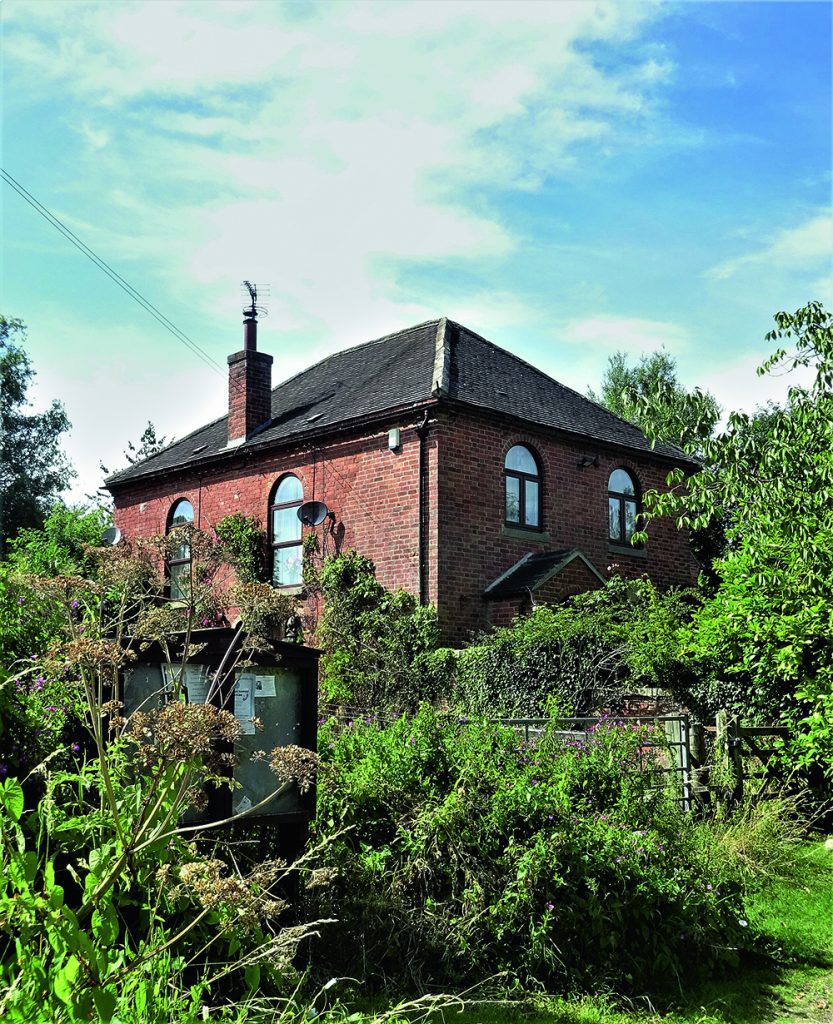
by Maxwell & Carole Craven Having basked in the remoteness and sequestered lanes of Harehill and Muselane, we were much tempted to stay in that wonderfully pastoral and semi-wooded landscape that lies well west of Derby but close to the south western edge of the county. Hence, last August, we ventured between Shirley and Yeaveley in order to re-acquaint ourselves with the delights of Rodsley which Pevsner appears to have forgotten entirely. I suppose that academic 1950s tourist probably got into mental over-load when it came to relatively unremarkable rural brick buildings, but they never cease to delight us and there are gems to be sought. We approached the hamlet from Yeaveley, where we had been doing some research for a privately commissioned history of the Meynells, and travelled east along Rodsley Lane. You should not be misled, however, for almost every road in Rodsley is called Rodsley Lane, for that upon which we were travelling eventually arrives at a cross-roads in the centre of the settlement, from which you can turn left (up Rodsley Lane) to end up in Wyaston, or right, (down Rodsley Lane) which will lead you to Park Lane and eventually to Long Lane, just east of Alkmonton. If you were to go straight across, however, you will actually be entering Shirely Lane which, needless to say, gets you, fairly rapidly, to Shirley. At this juncture a little background might be in order. In 1066, a Saxon freeholder called Brun (Brown in modern parlance) held what subsequently became the manorial estate at Rodsley, although a small portion of the land had earlier been bestowed on the Abbey of Burton as a parcel of the vast manor of Mickleover. Brun clearly failed to survive the Conquest as, in 1086, when Domesday Book was compiled, a Norman called John was holding it, lording it over no less than six villagers and a couple of smallholders. He also had land in Osleston further east. This John appears to be identifiable with (or possibly father of) the John de Turbeville of Rodsley who endowed both the Abbey of Burton and Tutbury Priory with parcels of his land during Henry I’s reign and held a knight’s fee there – that is, enough land to be able to equip and feed a mounted knight (probably himself) for service with the crown. His probable son, another John de Turbeville, died without any surviving children before 1166, when the estate passed to Robert son of William de Alfreton of Alfreton, from whose family it later passed to the Montgomerys of Cubley and thence to the Vernons of Sudbury, who held on to much of the estate until 5th Lord Vernon sold Rodsley to the Cokes of Longford, in which parish the village actually lay. Hence the lords of the manor always had a principal manor house elsewhere, so there was never such a thing in Rodsley, nor consequently, did these lords ever appear to have founded a church. We do not get much of a picture of Rodsley again until the 1664 hearth tax assessment, when we find that every householder – fourteen – in the village had only one (taxable) hearth except Christopher Pegge, who had three but was taxed on only two of them. Christopher Pegge is referred to as ‘Mister’ in the return, and was thus minor local gentry and indeed, was a member of the Pegge family of Yeldersley. Therefore, going towards the village, the first building we encountered was the charmingly named Three Pots Cottage, end-on to the road on the north side. It had been one of Rodsley’s two pubs in the 19th century (and before) – called the Three Pots – although the origin of name seemed to us impenetrable; it certainly was not heraldic, which was my first thought. It was run by a William Mansfield in 1827, but soon passed to the Ratcliff family, who obviously also had worries about the name for, between 1835 and 1846, they re-named it the New Inn, although it had reverted to the Three Pots by 1857, only to become the New Inn again by 1864 but, by the end of the century, it was calling itself the Old Three Pots. It seems not to have survived the first decade of the 20th century, however and was gone by 1908. As the delightful twin range 18th century brick cottage lies a good way outside the village centre and near nowhere in particular, I cannot say we were surprised! Three quarters of a mile further on and one once again encounters some buildings, part of the appropriately named Corner Farm, the entrance of which is set on the NW angle of the cross roads, which here manifests itself. As we approached the crossroads, we saw a long low brick barn on our left, to which is affixed, near its east end, a cast iron plaque erected by the Sherwin Society in 1976 to mark the canonisation of locally-born Catholic martyr, St. Ralph Sherwin in 1970. Ralph Sherwin was born in 1550, younger son of John Sherwin of Rodsley, farmer, and was educated at Eton as a scholar from 1563, which establishes that John Sherwin was no mere peasant farmer. His wife’s brother was John Woodward, rector of Ingatestone, Essex, who was the appointee of local grandee Sir William Petre and the latter clearly helped Ralph to obtain a fellowship at Exeter College, Oxford, after which he converted, went to Douai, was ordained and then on to Rome, after which he was one of a group of young missionary priests sent to re-evangelise England, but was arrested tried and executed in December 1580. His ministry had lasted hardly six months. We were by no means clear which of the farms clustered round the crossroads had been that worked by John Sherwin, but certainly the family was still in the village in 1666, when the saint’s great-nephew, another John died, leaving the poor of the parish £1 yearly out of