


Edit Template

Walks In Derbyshire

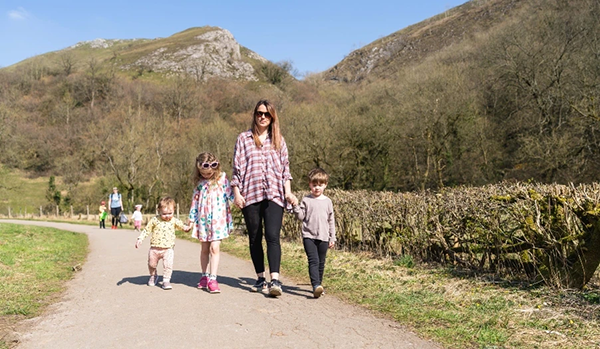
There really is no better way to see the beautiful area that we live in than to walk in Derbyshire. Over the years we have walked what feels like pretty much the entire of Derbyshire and Nottinghamshire and feel it only right to share those walks with you. In every edition of Country Images Magazine we feature a walk for you to follow and now we’ve put them online for you to read too. If you have a mobile or tablet, why not follow the walks on it, with a map and an explanation of where to go it’s ideal for you to follow so as not to get lost. We hope  you enjoy the selection below and check back regularly for new walks.

 
  • All Posts
  • Walks
Walk Derbyshire – Youlgreave & Its Two Dales

July 1, 2019

5 miles (8km): easy riverside walking along two attractive dales, linked by an interesting village street. RECOMMENDED MAP: Ordnance Survey 1:25,000 scale Outdoor Leisure Series; Sheet 24, The Peak District, White Peak Area. PUBLIC TRANSPORT: Hulley’s 171 hourly service from Bakewell (no Sunday service). CAR PARKING: laybys at roadside beyond River Lathkill bridge outside Alport. REFRESHMENTS: three walker friendly pubs in Youlgreave village. Here is a lovely walk following dales on either side of Youlgreave, one of the largest yet unspoilt village in the Peak.   To its north is Lathkill Dale which is the first dale to be followed; a short stroll along the village street leads to a woodland path into Bradford Dale which is followed back to the starting point of the walk, and also the point where streams flowing down the twin dales, meet. Although the Ordnance Survey and the County Council use the first letter ‘e’ in the ‘greave’ part of Youlgreave, the locals usually spell the name Youlgrave, but in any case prefer to call it ‘Pommy’ just to confuse visitors!   The village proudly maintains its independent water supply brought by pipeline from a source beneath gritstone moorland to the south.  Before this came about Youlgreave had a severe water problem, especially in dry summers when many of the village wells dried up.  The circular stone tank opposite the one-time co-op shop, now a youth hostel, was used to store piped water which first came to the village in 1829.  Now every house has piped water like the rest of us.  Although the custom is possibly much older, the five village wells have been dressed in floral motives since 1829 during the week following the Saturday nearest to St John the Baptist’s Day.   Youlgreave has several buildings worth more than a passing...

Walk Derbyshire – Through Elton’s  Gritstone Countryside

June 4, 2019

3miles (4,8km): easy/moderate walking. Two short climbs on easy gradients RECOMMENDED MAP: Ordnance Survey 1:25,000 scale, Outdoor Leisure map Sheet 2, The White Peak. BUS SERVICES: Hulleys’ 172 runs at 38 minutes past the hour from Matlock, Monday to Saturday. CAR PARKING: on the village main street – please make sure you do not interfere with private access. The tiny upland village of Elton sits more or less on the junction of the White Peak limestone and a southern outlier of the outlying stretch of gritstone tacked on to the bottom of the Dark Peak.  The village has a long history, as far back as the Iron Age when the first settlers built simple farmsteads on the surrounding moors.  For possibly ceremonial reasons not yet discerned, they built stone circles on remote places like Harthill Moor and Stanton Moor; there is also a chambered cairn possibly once the burial place of a Neolithic chieftain which seems to have links with nearby Arbor Low, Derbyshire’s Stonehenge. A gold cross found within a Saxon burial near Elton gives rise to the theory that Christianity came to the area as far back as AD700.   Travellers along the ancient moorland tracks would stop and pray with the hermit who lived in simple conditions in a small cave beneath Cratcliffe Tor, alongside which the prehistoric Portway can still be traced.  Slightly off route for this walk, nevertheless it is worthwhile making a diversion from the main path when passing below Robin Hood’s Stride rocks.  A simple 14th century crucifix is carved on the wall above a narrow stone bench, the only passable comfort the hermit could expect. In keeping with the rest of the White Peakland dwellers, many of the locals found meagre employment delving for lead beneath the surrounding fields.  While most of...

Walk Derbyshire – Pentrich to Crich

March 26, 2019

When Country Images magazine was first launched in 1994 we were pleased to be able to include walks from ‘not so’ Old Perce. Over the following months he traversed the Amber valley and provided delightful walks that, as all walks should, start and finish at the local pub. With many village pubs closing that has become harder to do but in true style for 2019 ‘a little older and wider!’ Old Perce is back. Yes, he’s still around and walks incessantly around Amber Valley which is great news for us. So this month he shares with us one of his favourite walks.  1. From The Dog Inn Pentrich go up the main road towards Swanwick, then turn left onto Riley Lane, signposted Fritchley and Crich.  2. At the bottom of Riley Lane cross Chesterfield Road onto Park Lane to Wingfield Park, past Weir Mill farm and eventually turn left onto Lynam Road signposted Fritchley and through the hamlet of Boden.  3. Go past Boden House and Boden Farm and straight up the steep lane that veers to the right. A short walk up the lane gives fine views of Wingfield Manor to the right. 4. Go to the top of the lane and follow the beaten path through the woods. At the stile follow the directions on the yellow arrow left as it marks a pathway through the second part of the woodland. 5. Eventually you will reach a stone stile to cross. Turn immediately left and go through the second stile. Turn right and walk to the end of the lane 6. At the end of the lane turn right. Fifty yards before the hat factory follow the footpath sign to the right and through the woodland for just a short distance and then cross the stile on the...

Walk Derbyshire – Walking Above the Canal – Cromford

February 27, 2019

The car park at the Cromford end of its namesake canal is a popular starting point for at least five walks to my reckoning. Most weekends and days in between, well-clad walkers will be congregating, busily pulling on their boots and at the same time, chatting to their friends. This walk starts, like all the others at the Cromford Wharf car park, before making its way over the river and under the railway, to join a path climbing steeply left up on to Bilberry Knoll.  Almost immediately pleasant woodland tracks lead down to Lea Mills, before joining the long abandoned Lea Mills arm of the Cromford Canal.  Turning right where the arm joins the main canal, the tow-path leads back to the car park by way of the information centre and railway workshops that once serviced trains hauled up and down Sheepwash Incline, on their way across the limestone moors to Whalley Bridge.  You can get a coffee at the information centre, or more filling meals at the canal’s end. Despite being short in length, this walk is long in interest, especially historical.  Right at the start, the old buildings dotted around the wharf’s car park, once acted as warehouses and offices for the canal company.  The canal itself once linked the growing commercial interests of Arkwright’s Cotton Mills to the outside world, carrying raw cotton in, and finished yarn out.  Alongside this, limestone from nearby quarries was shipped out in horse-drawn barges and coal from Nottinghamshire carried back.  The Cromford Canal drove its way eastwards, passing beneath Ripley through a now abandoned tunnel, before running south at Langley Mill to link with the Trent and Mersey Canal.  Since its abandonment, the Cromford Canal has become a wildlife haven, one of the few places where you might find water voles...

Walk Derbyshire – Chatsworth to Haddon Hall

February 5, 2019

The two great houses visited on this walk are within four miles of each other as the crow flies, but each has made a unique impression on the face of the Peak District.  Chatsworth, ancestral home of the Dukes of Devonshire has developed following the fashions of house-building nobles.  Additions have been made since its first owner, the redoubtable Bess of Hardwick, founding matriarch of the Cavendish dynasty almost bankrupted her husband, the Earl of Shrewsbury.  In its development, Chatsworth has grown to well deserve its unofficial accolade, as the ‘Palace of the Peak’.  On the other side of a forested ridge, Haddon Hall the Duke of Rutland’s country seat has remained virtually unchanged since its Tudor founder Sir John Manners first developed the house above this secluded bend in the River Wye. Renowned as one of Thomas Hobbes ‘Seven Wonders of the Peak’, Chatsworth ranks in architectural merit alongside the finest of all Britain’s great houses.  The original hall which once held the captive Mary Queen of Scots was a Tudor manor.  It was built on the site of an older dwelling by the Countess of Shrewsbury, better known as Bess of Hardwick.  All that is left of that house is a raised walled garden where the imprisoned Scots Queen took her ease; another remaining feature is the hunting tower overlooking the house from Stand Wood.  The house we see today dates mostly from the late 17th century when the 4th Earl, later to become the 1st Duke of Devonshire.  Apparently a man who was hard to please as he used several architects before he was satisfied with the resulting magnificent Palladian mansion.  The last major changes were made by the 6th Duke of Devonshire, the Bachelor Duke who had Sir Jeffry Wyatville design the north, or Theatre Wing....

Walk Derbyshire – Kedleston’s Glorious Parkland

January 3, 2019

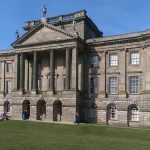
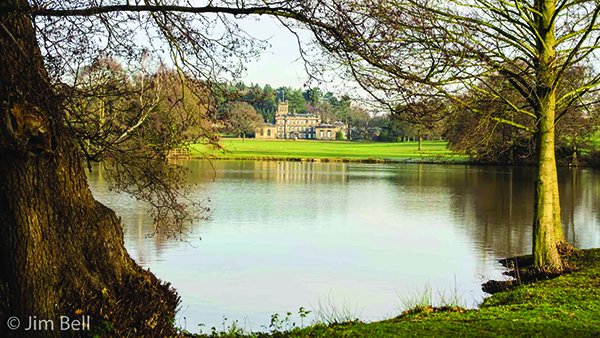
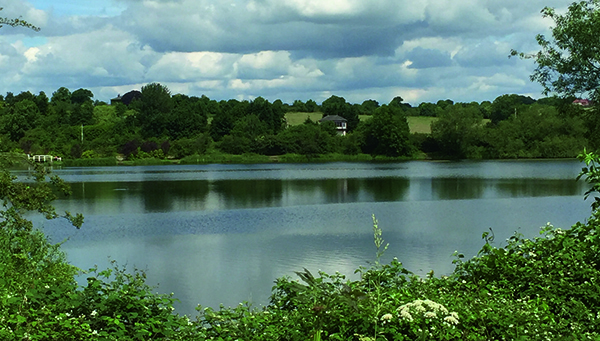
It is hard to believe that the ever constant bustle of Derby’s traffic is barely a couple of miles away at its closest point.  Kedleston’s park is an oasis of tranquility, with now naturalised groves and plantations, set around hundreds of acres of green-sward and lakes.  All this overlooks winding ponds separated by tinkling waterfalls, the breeding ground of visiting and permanent wildfowl, making a perfect foreground for the hall, ancestral home of the Curzons With only a quarter of its park turned over to the golfing fraternity, the rest of Kedleston Park is perfectly designed for enjoyable walking, be it on one of the graded woodland walks or beside attractive lakes made by damming Cutler Brook. Modern walkers seem to have more energy than the Regency ladies and their squires who contented themselves with a gentle stroll of say half a mile in the pleasure grounds. Even though none of the strolls available for today’s walkers is more than 3¼miles, it can be longer, and in fact the walk I describe here links two of the longer walks, covering an easy 5¼miles. There is also the possibility of a visit inside the hall to appreciate its treasure-trove of links to generations of Curzons. One of the finest of England’s stately homes, Kedleston Hall was built in the nine years between 1761 and 1770 by the great architects of the time, James Paine and Robert Adam for the first Lord Scarsdale, designed in the then popular classical style.  Greek columns and classical statuary decorate exquisite rooms laid out in order to influence visiting royalty by their abundance of treasures. To improve the appearance of the finished house, the medieval estate village of Kedleston was demolished and rebuilt in its present position as a model village, partly hidden half a mile...

Load More

End of Content.

We hope you enjoy the walks, but check back regularly for more walks in Derbyshire and walks in The Peak District as we are constantly adding new ones.

Country Images Magazine

Featured Posts

Euromedia Associates Ltd

Country Images Magazine is Derbyshire’s leading independent lifestyle magazine, proudly rooted in the heart of the county and dedicated to celebrating its rich heritage, natural beauty, and vibrant communities. Each issue features a carefully curated selection of articles exploring Derbyshire’s history and landscapes, alongside the latest home and interior design trends, local theatre productions, cultural events, dining destinations, and lifestyle inspiration.

In addition, Country Images provides a trusted platform for showcasing independent local businesses, highlighting those that offer outstanding products, personalised service, and a genuine commitment to quality. Through thoughtful editorial and strong community connections, the magazine continues to inform, inspire, and connect readers across Derbyshire.

Euromedia Associates Ltd Logo