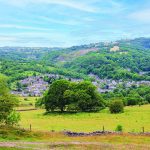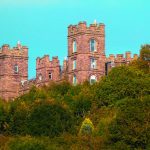

The popular village and National Trust property of Ilam and its hall, are based on a Saxon settlement, later expanded in Victorian times. In its early days it was where the early Celtic Christian missionary St Bertram baptised his flock, using a well on the slopes of Bunster Hill to the north of the village for that purpose. The Saxon villagers took advantage of the comparative safety offered by the sheltered hollow created by the joining of the rivers Dove and Manifold. In the mid1800s Jesse Watts-Russell a shipping magnate and industrialist, employed the services of the Victorian architect James Trubshaw to replace the Elizabethan mansion and farmhouse with the picturesque Gothic palace with its fairy-tale embellishments. As part of Watts-Russell’s grandiose scheme, the old village, a mixture of cottages hundreds of years-old, he employed George Gilbert Scott to design the alpine style cottages which, complete with their attractive gardens, are a never ending delight for today’s visitors. He is often confused with his ennobled son of the same name, who moved on from designing pretty cottages, to being responsible for grandiose schemes such as the design for the rebuilt House of Commons, Battersea Power Station and Liverpool Anglican Cathedral, along with the now fast disappearing GPO red telephone boxes. Jesse Watts-Russell erected the Eleanor-style cross at the road junction beside the pretty cottages of Ilam village. Meant as a memorial to his first wife unfortunately if historical folk-lore tales are right, she was never popular with his estate workers. Intended as a competitor to the standards of the Earl of Shrewsbury’s estate at Alton Towers, the Watts-Russell family despite the expense and upheaval only lived at Ilam for a couple of generations. Since then the hall had a short life as a country hotel, then having been gifted to...