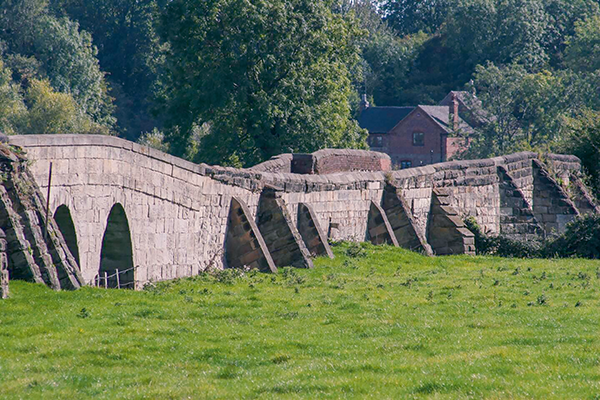

Distance: A 7½ mile (12km) moderate walk with mainly gentle gradients
Time: 2.5 hours approximately
Parking: Free, Market Square (free), or pay and display in the car park
next to the road towards the Manifold Valley.
Public Transport Links: Buses from Ashbourne and Buxton
Refreshments: The Charles Cotton or The Packhorse Inn at Crowdecote
Once Duke William was crowned as King of England following the Battle of Hastings, it took several years before the Normans could claim true domination of the country beyond the readily subservient south of England. Throughout the north and marshes of East Anglia, rebellious Saxons made it clear that they wanted nothing to do with these upstart French speaking incomers.
As attempts to pacify those who objected to this change of status failed miserably, King William, the Norman, had to resort to violence, instigating what became known as ‘the Harrying of the North’, when vast areas of Northern England were laid to waste, with the people either murdered or driven off the land they and their forebears had farmed for generations.
What became known as the Peak District although being comparatively uninhabited, didn’t escape the takeover, and to put his stamp on the region, King William divided the land amongst those knights who had served him well in battle. With William Peverel taking most of the land to the north and east of the Peak as his hunting preserve, the rest, mainly those lands to the east of what became Staffordshire and north Derbyshire were handed over to de Ferrier in order to expand his hunting estates further south in Leicestershire.
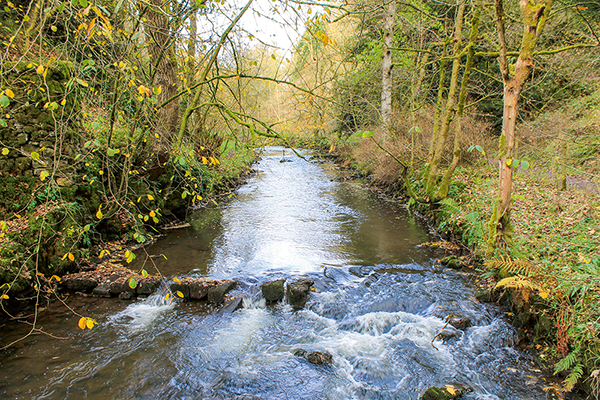
While we may be used to imagining castles as impregnable fortresses built of stone, many began life as man made hillocks protected not by stone but with rapidly thrown up timber palisades, a kind of quick-build system.
Generally they fitted a standard design with the strongest part being incorporated within, or on top of the high mound, or motte where the lord and his knights sheltered, and a lower much larger area or bailey protecting everything necessary for everyday living.
Here would be a noisy collection of everything from a blacksmith’s workshop to dairies and cloth weaver’s looms. It is uncertain who built the motte & bailey castle at Pilsbury a mile and a half up the valley of the Dove from Hartington, but although no record was made during its construction, or why it was never converted to a stone-built castle, it is quite possible that William de Ferrers built it more as a hunting lodge, rather than as a fortified base for his military excursions throughout the White Peak.
Whatever its ultimate need could possibly have been, it now stands as an enigmatic link with the turbulent time following the Norman invasion. The walk passes Pilsbury castle in the early stages, a walk that is never far away from the River Dove. It wanders along a fairly straight course almost to Crowdicote and then turning back to head down to Hartington
Step‑by‑Step Walk Guide
From the Leek road car park, walk back up to the old market place and continue forwards as far as the cross roads.
Turn left opposite the road for Hartington Hall youth hostel and walk up the hill towards and then past the village church.
Continue over the track crossing junction near Bank Top Farm and go forwards for a little over a quarter of a mile.
Still going forwards, cross a secondary path then climb over the western slopes of Carder Low which is on your right.
Walk on for another quarter mile, using gates to cross field boundary walls (please close all gates after you) Take the left turn at a signposted footpath crossing and walk down to a minor road which is crossed by stiles on either side.
Continue along a grassy high level path until it joins the valley bottom track close by Pilsbury Castle. (If you miss this crossing, don’t worry, but turn left to go down the rough road as far as the track turning right into Pilsbury village. Follow the grassy valley bottom track beyond the farm and houses).
Spend time exploring the mounds remaining from when Pilsbury Castle was a formidable defensive place, then go forwards for about half a mile as far as Bridge End Farm.
Go past the farm buildings for a few yards, in order to turn left and go down the field to a narrow footbridge crossing the river Dove.
Climb the steep field path, fortunately only for a little under a quarter of a mile, through scrubby undergrowth and gorse covered ground until it reaches a stile giving access on to the Longnor road opposite Edgetop Farm. (You could deviate here a little and get a swift drink at The Packhorse Inn at Crowdecote).
We now head back to Hartington
Turn left and walk along the straight open road for about a mile, all the while admiring the far reaching views up and down the valley of the Dove.
Where the ridge following road makes a sharp turn right, go forwards as far as Harris Close Farm.
Cross the stile next to one of the farm outbuildings and go forwards on grassy paths, descending as far as a footpath crossing marked by a finger post.
Turn left through a gate to follow the signposted path downhill towards Hartington. Cross the river and then follow the developing track up to and past the cheese factory. Bear right on entering Hartington’s old market square and follow the road, past the Charles Cotton Inn, for about 150 yards back to the car park.