
Borrowash, or Burrows Ash as it was once called, is a village full of interest, although often regarded as a poor relation of Ockbrook to its north. It grew up at an early date along the course of the Roman Road from Little Chester to the river crossing at Sawley, from whence it ran to a mansio or roadside settlement, near Willoughby-on-the-Wolds in Leicestershire. From the 1790s the Derby Canal branch to meet the Erewash paralleled it, although on lower ground further south, just north of the River Derwent; its course was also followed later by the Midland Counties Railway, squeezed in between from 1839, which ran from Nottingham to Derby (part of the Midland Railway from 1844).
The road from Ockbrook – now Victoria Avenue – intersected the ancient route at a junction in the middle of the village; another road runs south to Elvaston from an intersection slightly to the east. South of the old Roman Road (now Derby Road) and west of Mill Lane, the road to Elvaston (sometime after 1839 named Station Street) lay a pleasant parcel of arable land sloping down to the river. This, along with a related piece of land at Ockbrook, had once been part of the Elvaston estate of the Stanhopes, Earls of Harrington, but had been detached at some stage in the later 17th century (through a process that has eluded my research), becoming the property of an heiress called Ann, who was married to one Henry Swindell.
Mr. and Mrs. Swindell had two sons, Henry, a parson, who inherited the land at Borrowash and Ockbrook, and John who seems to gone to live at Chellaston, farming. Henry, in 1727, found himself well enough off to have been able to lend Charles Holden of Aston Hall some £300 to enable him to settle his inheritance; where exactly he then lived, however, is unclear. What we do know is that his son, also Henry, built the Manor House on the plot that, by the 1790s, lay undisturbed, south of Derby Road, north of the river and canal and west of Elvaston Lane.
Henry Swindell is something of an enigma. He was educated at Repton and Peterhouse, Cambridge, graduating MA in 1752. Thereafter he seems to have lived as a squarson, but was frequently described as ‘Minister of Ockbrook’, which is strange, as the vicar, inducted in 1765 was one Joseph Collier. Henry died unmarried in 1801, aged 74, to whom is dedicated a memorial in the parish church at Ockbrook, which bears his portrait and the lines:
‘So lowly he, neat benefice declined,
Genial friend, no slave to human kind,
Whilst his pure Soul on anchor Hope reclined.’
This rather suggest that the patron of the living (which went with ownership of Hopwell Hall), Lady Lake, had offered the incumbency to Henry but that he had declined it (for reasons lost to us), leaving Collier to accept in his place. Presumably, Henry took services from time to time, but otherwise devoted himself to leisure and the chase.
Hence, around 1793 he decided to build himself a house in Borrowash on the piece of ground mentioned. I suspect, too, that he was an investor in the Derby Canal, for it was being built bordering his small 30 acre park just at that time, with the bosky banks of the Derwent beyond, marking the limits. It even included a small lake, artfully fed by the canal itself.
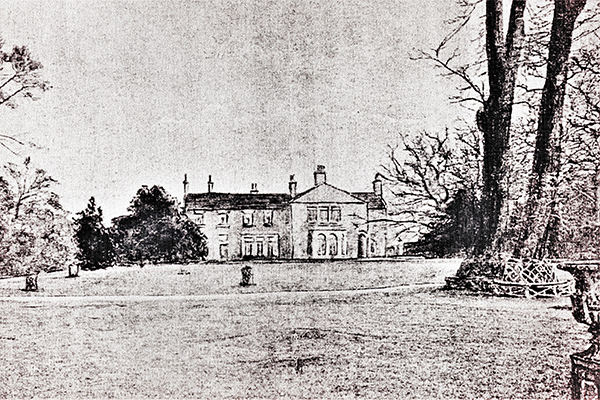
The house itself was of brick two storeys high and eight bays long, facing south, with a short service wing to the north west, on the main road which, to some extent, protected the entrance with its Tuscan portico. The sash windows were all topped by rusticated stone lintels and the roof was slated, all no doubt the work of a local builder.
The garden front of the house actually faced SSW and, to the left of it, was a curving orangery, ideally placed to get the most of the sun. Due west, ran a boundary planted with trees, which eventually met the canal where the latter (closed in the 1950s but under active restoration today) makes a gentle turn to the NW.
Henry Swindell died in 1801 without having married and left the estate to a cousin John. The Monthly Magazine in 1818, wrote announcing his death:
‘At Burrowash, [aged] 76, John Swindell, esq. who, about twenty years ago, when following the humble occupation of a labourer, very unexpectedly, by will, came into possession of the estates and other property of the Rev. Henry Swindell, M.A. of the same place. Dying without issue, Mr. S. has bequeathed a fortune of 2000l. a year to the family of Mr. Rose of Weston-on-Trent, near Castle Donnington, in grateful return for the kindness he received from them, whilst in their servitude, prior to his elevation in life.’
From a reading of Henry’s will it appears that this John was the natural son of Henry’s uncle John, the one who had lived at Chellaston, who had been working in Cubley when he had learned of his good fortune.
John had moved into the house and died in 1818 leaving the lot to another cousin, John Rose, originally one of Revd. Henry/’s residual heirs. His father had married Ann, daughter of one of the Dalbys of Castle Donnington – long stewards of the Earls of Huntingdon and Marquesses of Hastings there – who had married Henry Swindell’s sister. John Rose took the surname of Swindell, but his son Henry Arthur died aged only 5 in 1828, which seems to have convinced him to let the manor, although this happened only after 1833, when John Rose Swindell is still listed as a major landowner in the parish.
In 1838, the lock was put in near Mill Lane to allow the canal to pass under the Midland Counties Railway. Meanwhile, J R Swindell’s tenants were the Towle family, eminent Borrowash cotton spinners, who lived there until Borrowash House – not a lost house, for once – was completed and into which they moved, in 1872. It was then home to Gillett F. Calvert in 1878 followed by William Alton.
William was the son of Heage-born brewer George Alton and founded Alton’s brewery in Derby. His younger brother was successively landlord of a number of Derby pubs: the Seven Stars and The Boat, both in King Street (the former still with us), the Brown Bear, Lodge Lane and the Castlefields Inn, Siddalls Lane. His daughter married T. Tijou, son of a Matlock gilder and framer whose name invokes that of Jean Tijou who made the great iron gates at Hampton Court and those at Chatsworth, too. The naturalised French genius of the iron bar also had two sons – inevitably, spelt phonetically in contemporary documents, as ‘Tissue’; could one have left a by-blow behind in early 18th century Bakewell?
Be that as it may, no one in the family managed to have any children, so when William Alton died, the estate and business went to T. Tijou’s brother, Hepworth who, in 1882 swiftly doffed Tijou and adopted the name of Alton and moved into the Manor at Borrowash aged but 23. It would appear that either he or his uncle by marriage, William had managed to acquire the freehold of the estate.
Thus, in the early 1880, a further range was added to the south front, on its east end, projecting forward under a broad gable with a projecting square bay window on the ground floor. A new door to the garden to the right of this and a trio of sashes above. The drawing room, to the immediate west of this new range, was also given a projecting bay with three windows.
This, then is more or less how the Manor remained. Hepworth Alton died in 1903, having outlived his wife Helen by five years but, yet again, childless. Hence, he adopted as his heir his nephew Reginald, who also adopted the Alton name (becoming, Reginald Alton Alton, needless to say). He sold the brewing business to Stretton’s and soon afterwards retired to Australia, selling the house, park and land in 1904 – the sale documents are still in Erewash Library.
It was all bought by Henry Evans, who pitched Manor Road west from Station Road and built a number of red brick houses. He was followed after the Great War by Andrew Smith who further developed the housing and was still living there when the second World War erupted.
After Smith, one rather loses touch with the fate of the house which, after a period of dereliction, was finally cleared in the 1960s. Cumberland Crescent and Dovecote Drive now cover the site of the house and outbuildings, whilst Manor Park was pitched north from Manor Road. No trace of the former house of Revd. Henry Swindell seems to survive.