
At Sawley, beside the old Nag’s Head Inn, on the corner of Wilne Road (previously called Cross Street) and Tamworth Road, lies a site devoid of structures bar a black shed, currently used by a local firm as a transport yard. On this very site, though, until a couple of years following the end of the Second World War, stood Sawley’s ancient manor house.
In the Middle Ages and, apparently going back to the ninth century, the estate at Sawley was an appendage of the See of Lichfield, and the prebends of the See – these days more often called canons – were the priests based at the Cathedral who assisted the Bishop and, in very early times, were charged with the task of evangelising those elements in the countryside who were still pagan, or had lapsed into paganism.
Each of these prebends had a parcel of land at Sawley and a dwelling, the rental income from which supported their efforts. They also had a special stall in the impressive and ancient parish church of All Saints – hence its relatively large size, and the presence of Saxon masonry in its much restored fabric.
It is unclear whether the original manor house owed its origin to one of the prebends or not but, by 1180, there was a capital mansion at Sawley and it was held of the See of Lichfield by Robert son of Richard de Sawley who witnessed charters relating to land transactions relating to the Abbey of Dale and also that of Darley. His son, Robert, with his wife Emma, also held an urban fee (essentially a burgage plot legally linked to their Sawley property) in Derby in Sadler Gate, recorded in a Darley Abbey charter of the 1250s.
The next generation was also represented by a Robert – the name, by now commonly mutated to Sallowe, rather than Sawley – who, in 1293 was granted a house and two bovates of land (about 30 acres) at Stanton-by-Dale.
The family were still relatively minor proto-gentry, but this grant increased their status, especially combined with the land they already held at Sawley. However, Robert de Sallowe, son of the Robert who acquired a piece of Stanton, built greatly on this by marrying well. His bride was Hon. Mary de Grey, a daughter of Richard, 2nd Lord Grey of Codnor, so that by the time of his death in 1336, he held not only at Sawley and Stanton-by-Dale, but also at Sandiacre and Kirk Hallam.
Robert and Mary left three sons, of whom the youngest, John, was vicar of Sawley from 1343, and his brother Thomas appears to have lived at the family residence at Sawley, probably on a life tenancy, for his only child, Matilda had, by 1364, married John Franceys of Ticknall. Hence the eldest son, Robert we find living in the manor house at Stanton-by-Dale with his wife, Eleanor daughter and heiress of Thomas de Bella Acqua (now mutated to Bellew) of Kirklinton, Notts., which brought him land there, as well. From this point on, the Manor at Sawley had become a secondary dwelling, although we have no information about its appearance whatsoever.
The Reformation brought changes to Sawley, however and the manorial estate came to the Stanhope family, later Earls of Chesterfield, by which time the Sallowe family had become extinct with the death in 1431 of Sir George Sallowe of Stanton, who outlived his son George.
Having lived at Stanton since the 1340s however, the old family residence at Sawley appears to have been tenanted, the family in residence by the Reformation being the Pymme family, who intermarried with the Edmundsons of Sawley.
Taking advantage of the Civil War, however – during which, Philip Stanhope, 1st Earl of Chesterfield (1584-1656) was deprived of his estate for having supported the king – the sitting tenant, John Pymme acquired the freehold in 1649, only to lose it at the Restoration when the 2nd Lord Chesterfield managed to regain his sequestered estates, although the Pymme family remained as tenants. Nevertheless, within a very few years, Lord Chesterfield had sold the property to Sir William Leche of Shipley Hall, who paid tax on a reasonably substantial 10 hearths for Sawley Manor, in which he seems to have been living whilst post-Civil War rebuilding was going on at Shipley. Consequently, his tenant, John Pymme, was hived off to a farmhouse at Draycott, where he was assessed for tax on but three hearths in 1670 (which saving he may well have appreciated!).
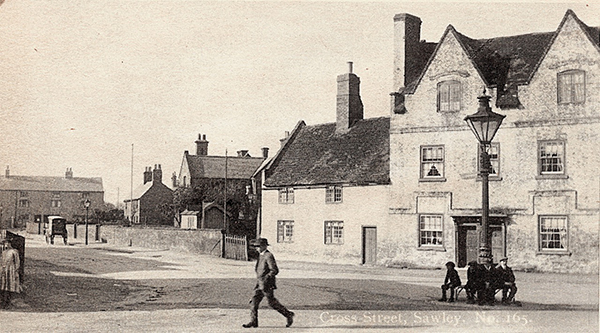
The fact that the hearth tax assessments tell us that the house was assessed on ten hearths enables us to be sure that the gabled, brick house recorded in 19th century paintings and Edwardian photographs was certainly in existence then. Furthermore, the steep gables with stone kneelers and brick banding between the floors suggest that the house was probably built in the early 17th century, originally with deeper windows, probably with mullions and transoms. The lower string course rises up over the later windows, indicating that more modest sashes were inserted, probably during the Regency period, and it may very well be that the first-floor windows had also once reached up to the upper string course. The same phenomenon may be seen on the south front of Shardlow Hall or, more explicitly, at Shirland Park Farm, near Alfreton.
The lower range to the north may well be a remnant of an earlier house, for the surviving four bay, two gabled façade does not suggest a house large enough to have ten working hearths, although old OS maps do suggest that there was a substantial amount of house stretching back facing north-south, which may have contained south-facing reception rooms.
Sir William Leche, of course, moved back to Shipley Hall and the Pymmes resumed residence at the old Manor and gradually doffed the final ‘-me’ from their name. In the time of William Pym of Sawley (1714-1782) and his wife Mary née Barker, the freehold was sold by the Mundys, who had inherited Shipley Hall to the Holdens of Aston Hall.
William Pym had three sons and four daughters, of whom the second son John’s son, William (born 1774), was the last of the name to live there, whilst William’s third son Joseph, moved to Derby, having married in 1775 Dorothy, daughter of Benjamin Strong, a pipe maker in whose kilns André Planché made the very first porcelain animals, which represented the beginning of porcelain manufacture in Derby. One of their sons, Benjamin Strong Pym (1791-1872) became a Derby estate agent. His brother Joseph founded the Belper branch of the family, later solicitors, as were the descendants of Benjamin’s daughter Mary, married to J. H. Woolley.
Around the later 18th century, the Manor was much reduced, a cross-wing being taken down, probably to make room for the Nag’s Head, itself named after the crest of the Meynell family, of which Barabara (1699-1762) – who had married Henry Barker of Chiswick, Mrs William Pym’s mother – was eldest daughter of Godfrey Meynell of Meynell Llangley.
The Holdens soon sold the estate – now much built over – back to the stanhopes, in this case the Earls of Harrington, who lived at Elvaston Castle. Their agent divided the remaining portion of the old house into two cottages by replacing one staircase with two rather meaner ones, putting an axial wall through the original hall and providing two new front doors, side by side.
When the leases fell in – presumably during the war – the house became empty and by the time peace came, both cottages had become derelict and the decision was taken by the Harrington estate to demolish them. Only a fragment of the south gable end remains, still tenaciously attached to the end wall of the pub – the only trace of an ancient, but enigmatic, Derbyshire lost house.