The Lost Houses of Derbyshire – Foston Hall
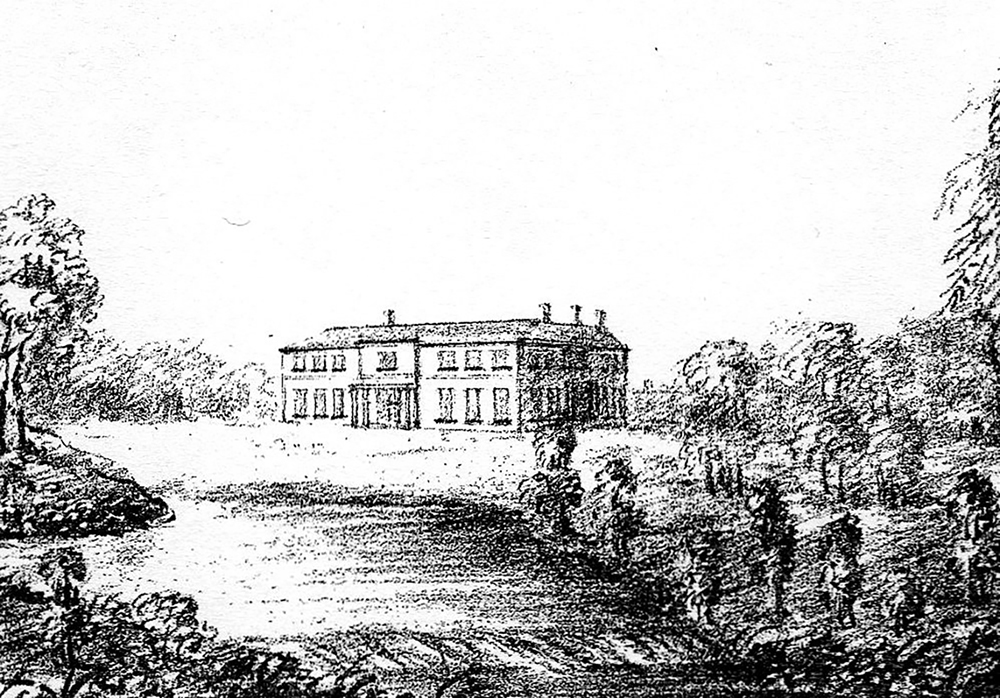
Most readers, on seeing the title of this piece, might instantly be tempted to pen a letter to the editor complaining that Foston Hall is not lost at all, but a prison for convicted women criminals, easily seen from the modern A50. Well, that is true, but we know of two previous houses on the site, both significant and worth recording. The first, of which no known picture exists, was built in the Tudor or early Stuart period, but was replaced in 1809 by a very stylish Regency house, of which some vestiges remain embedded in the present structure. We do not know who the sub-tenant of Henry de Ferrers was at Foston at the time of the Domesday Book in 1086, but it came to Henry de Derby in around 1100 (he may have married the heiress of the first sub-tenant) and was in the hands of his son Robert when the latter died without issue in 1130 and left the manorial estate to his younger brother John. It is unclear exactly who these de Derbys were; a family of that name (and of Norse descent) were virtual rulers of Derby from shortly after the Conquest until they were finally decimated during the Black Death, but Henry does not show up on their pedigree as reconstructed from surviving charters. By 1286 one Walter de Agard held Foston and we are told by one ancient document that he was fifth in descent from the first of his family to settle at Foston (presumably by marrying the heiress of the de Derbys) and that this man, Richard de Agard, was from Lancashire. Allowing 25 years per generation this would suggest that Richard Agard married a daughter or sister of John de Derby, which at least fits: only positive documentation is missing. All this suggests that there must have been a capital mansion at Foston from an early date, but where it stood is unclear. The park was landscaped in the late 18th century (perhaps by William Emes, a lake enthusiast) and the complex of lakes to the south of the present house, fed by the Foston Brook, may have been adapted from a moat. (I must confess to being unable to say whether these survive, for on my visit to Foston over thirty years ago, I was told by my personable hostess, Miss Scriven the then governor, that a survey of the grounds was understandably not possible for security reasons, and of course, I forgot to ask about any surviving features.. The Agards take their name from the Danish Ǻgǻrd, a habitation name (which does not appear to have survived to be entered into modern gazetteers) comprising the Norse elements à (= river) and gard (= enclosure), which hardly hands us any clues as to where in Lancashire they may have come from! They continued as proprietors of Foston, Scropton, Sapperton and Osleston into the Tudor period, when Clement Agard’s second son Arthur (1540-1615), was appointed Escheator and Coroner to the Honour of Tutbury and of the Bailiwick of Leek (Staffs.), a post he held for an astonishing 45 years. He was succeeded by his nephew, Sir Henry whose right to hold these profitable offices was challenged by the Crown, but he maintained he held it by tenure of ‘A white hunter’s horn, garnished with silver, inlaid with gold, in the middle and at both ends. To which is fixed a girdle of black silk, adorned with certain buckles of silver embellished with the arms of England’ which he claimed Arthur had received on appointment by and from his predecessor, and that the item had descended from Walter de Agard in the late 13th century. The coat of arms on the horn (which still exists) is in fact that of John of Gaunt, as Duke of Lancaster (but used to represent the honour of Tutbury, the seat of the Duchy’s control in our area) impaling the arms of Ferrers, once Earls of Derby, which confirms its status as a hereditable badge of office so the article must date from after about 1375. The horn continued in the family until the death of Sir Henry in 1635, when it passed to as distant cousin, Sir Charles Agard, previously of Mackworth, Croxall and Osleston. He was assessed for tax on 12 hearths at Foston, suggesting a medium sized Tudor or slightly later manor house, the first hint we get of anything about the place. Unfortunately Sir Charles found himself, at the Restoration, facing financial disaster as a result of having supported the King in the Civil War, a predicament that even holding the High Shrievalty of the County in 1660 had failed to ameliorate. His son John, having died before him, he sold Foston in 1675 and died five years later, when his remaining property passed through marriage of his daughter to the Stanhopes of Elvaston, including the horn and what by then was its remaining perk, the right to appoint the coroner for the area. Later, one of the Earls of Harrington sold it with its privileges to Samuel Foxlowe and from him it descended to the Bagshawes of Ford. The Foston estate, was sold to Col. William Bate, who owned an estate in Barbados too and was a colonel of militia there. His father had come into the property through shrew conduct, having arrived in the Caribbean as a surgeon. William’s son Richard married Mary, daughter of John Newton of King’s Bromley and it was her brother Samuel who was living in the hall when Woolley wrote of him in 1712 as ‘…having a very good commodious seat there and to complete its pleasantness there is a pretty brook runs through his garden.’ The brook being the same that probably formed a medieval moat round the first house and was later to be dammed to created the double lake which was the centrepiece of the modest parkland from the end of the 18th century. Richard’s son married Arabella, one
Return to the Isle of Wight
The mere few miles of Solent waters separating Hampshire and the Isle of Wight starts the journey to an island where Queen Victoria spent much of her widowhood in isolation, feel like moving to a foreign land. Brian Spencer took the opportunity of renewing his love for the island when he and his wife joined one of Matlock based Slack’s Coaches tours. Having spent a few years living near Winchester in the past, where I was able to join my sailing friend Terry on day jaunts around the Solent, dodging massive tankers on their way to Esso’s Fawley refinery – they never seemed to remember the rule about steam giving way to sail! This time we took a more leisurely route by way of Red Funnel Ferries, past a clutch of monstrous cruise liners. The last time I visited the island was planned to coincide with a few hours pottering about on the water. Unfortunately I hadn’t taken any notice of the weather, after all it looked quite fine when I joined the Portsmouth to Ryde ferry. Things began to change rapidly as we left harbour and the ferry tried to copy some nautical jig; up down, side to side, the boat never seemed to know which way it should be heading. Terry’s first words when I set foot on solid earth were some of the best I have ever heard, they were: ‘it’s a bit too rough for my little boat, so I suggest we go for a walk instead’. A walk on Tennyson Down (the poet spent his holidays on the island), seemed an excellent alternative, especially when I found a huge ring of blue caps, a mushroom favoured by Nottingham folk, but not apparently by passing walkers; all I could hear was the one word ‘poisonous’. As a result I had no qualms in filling my rucksack with the delicious fungi which kept us going for months. The land to the west of Tennyson Down narrows to the awe inspiring Needles, a place where many a small boat has come to grief. During that last visit to the island, due to the occasional ‘Blue Streak’ rocket whizzing out from trial launching pads high above the Needles, a close view of these attractive chalk stacks was strictly out of bounds. However, since Britain’s love affair with space flight was abandoned, the land immediately to the east of the Needles is now owned by the National Trust. We took a short stroll along the cliff-edge path before going for a look at Alum Bay and its famous coloured sands where a chair lift now takes the strain of climbing up and down the steep path. During the Napoleonic Wars and even as far back as Henry VIII’s time, the Isle of Wight being strategically placed across the mouth of the Solent became a land-based gun-ship. Remains of Prime Minister Lord Palmerston’s folly (the guns were never fired in anger) line the cliff tops near that more modern folly, the rocket launching pads. Slack’s coach drivers are a knowledgeable lot. We had met Steve before and knew we could trust him to find the sort of place his passengers would enjoy. Everywhere we stopped was conveniently close to somewhere new to explore. From Alum Bay we were dropped off right next to Yarmouth, where the sturdy RNLI rescue lifeboat was ready and waiting to rush off at a moment’s notice. Yarmouth Castle was one of Henry VIII’s strongholds, its guns could blast away at any French privateer trying to sneak past. Considering its age, the tiny castle still looks ready to mount its cannons. As a plus to our visit to Yarmouth, we found a perfect little pub down one of the streets leading to the marina. We stayed at the Trouville in Sandown, a sea front hotel with only a narrow strip of road between it and the sandy beach. As usual with a Slack’s tour, everything at the hotel was just right – pleasant staff, excellent food and rooms with a view out to sea where all manner of shipping waited patiently to nip up the Solent and into dock. Our stay coincided with the annual scooter rally, when the promenade became a similar version of Matlock Bath, but with smaller bikes. Any concerns about ‘mods and rockers’ rioting were soon dispelled when we realised that the polite middle aged riders were probably the grandsons of those mods and rockers of the late fifties. Queen Victoria’s beloved Prince Albert had Osborne House built to his design. It was here she came out of her lengthy widow-hood, helped by Scotsman John Brown. This was our only disappointment. We would have liked to combine a trip to Cowed with a private visit to Osborne House, but due to Covid restrictions, only pre-booked visits can be made just now. Fortunately both Sheila and I have been there before, but maybe next time, who knows. We were able to enjoy an afternoon in Ryde as a pleasant alternative. The place is an unspoilt Victorian gem, everything one could wish for in a holiday resort, sandy beach, a long pier and carefully tended municipal flower beds and children’s play parks and, not a single kiss-me-quick hat or candy floss stall anywhere. Although it wasn’t on the itinerary, we both wanted to see the Roman Villa at nearby Brading. It must be thirty years since I first saw it. Then it was the centre of an archaeological dig busy discovering the beautiful mosaics the Romans used before carpets were invented. Now the villa’s main rooms and other features are protected within a light catching, airy museum. Nothing has been removed from the time when archaeologists ranging from John Philip Munns (1809 – 1864), who first found the villa, to modern explorers still discovering wonders beneath surrounding fields. We were enthralled by mosaics, ranging from portraits of Roman gods such as Orpheus and angry looking Medusa with her head dress of snakes, to
How Eyam Dealt With Two Epidemics

Hopefully the Covid – 19 pandemic is beginning to show signs of at least slowing down. Members of the Peakland village of Eyam like the rest of us, must be grateful for the slow easing of restrictions, while at the same time taking sensible precautions in case yet another Covid variant comes along. The folk memory of this village, more than anywhere, must have been jogged in wondering whether this was going to be a repeat of the Great Plague that ravaged the country in 1665. In 1665 it was an outbreak of Bubonic Plague, imported into Eyam from London within a parcel of cloth that brought with it an unwelcome guest. Unlike now, there were no wonder drugs available and it had to be dealt with by a successful form of Social Distancing led by a courageous vicar, the Rev. William Mompesson. In the early autumn of 1665, life in Eyam was pleasantly relaxed. The rigours of Oliver Cromwell’s Commonwealth were fast disappearing with the restoration of King Charles II to the throne, and with a particularly good harvest safely gathered in, village folk were looking forwards to an easier time, enjoying themselves on the run-up to the new year. No doubt news of a plague that was currently ravaging London, was brought, word of mouth by travellers, but there was no need to be too bothered, wasn’t London far away to the south of Derbyshire, needing a journey lasting at least three days. Bubonic Plague had been around since at least Roman times. Bacillus yarsinia pestris had entered the country at Bristol from Europe where it was running out of control. Carried by fleas, it soon found its way to densely overcrowded London where rats passed the infected fleas to human beings. Within a matter of a month around 7000 deaths were occurring each week. We have to thank the diarist Samuel Pepys and other writers for their descriptions of masses of victims needing to be buried in plague pits rather than in conventional churchyard graves. It was from this horrific situation that the disease found its way to the quiet Peakland village of Eyam, coming as part of an innocent parcel of cloth. George Viccars an itinerant tailor was lodging with Alexander Hadfield in the centre of a row of terraced cottages that still stand, close to the church gate. It was he who waited for the parcel, but when it arrived it was found to be slightly damp and so he spread its contents in front of the kitchen stove in order to dry. Unfortunately the material was full of flea eggs that began to hatch in the warm atmosphere. They then spread rapidly around the cottage and also began to move next door to the Hadfields on the handy backs of wandering rats, inevitably beginning to spread plague around the village. Symptoms of the plague started with swellings which spread rapidly around the victim’s neck, immediately followed by a high fever, soon ending in death. Within three days George Viccars and the Hadfields were the first to die, followed rapidly by their next door neighbours. All too soon the disease was rampaging around Eyam and surrounding farms. People began to panic as the plague spread through the village and those who could escape, including Squire Bradshaw, moved away. Of the 350 who remained, 260 were to die before the disease had run its course. With the squire gone the only person the villagers could turn to was the vicar, William Mompesson who, with the help of his ‘Puritan’ predecessor Thomas Stanley who had been sacked from his living on the accession of King Charles II. Sinking their ideological differences the two men set about finding a way to save as many members of their flock as possible, but at the same time preventing the plague from spreading to other parts of the district. Mompesson wanted to send his family away to stay with relatives near Barnburgh in west Yorkshire, but while his wife Katherine agreed to send the children she insisted on staying at her husband’s side, an action that effectively became her death warrant. As the plague began to inexorably spread around the village, people turned to strange remedies, such as drinking molten pig fat, simply because a woman who eventually survived had drunk it towards the end of her illness. Other weird and wonderful ‘cures’ ranged from breathing into the rear of a chicken in order to ‘draw’ the plague, or letting a frog sit on a victim’s stomach. None of these could possibly work, but the plan devised by Mompesson prevented the plague from spreading, simply sitting-out the disease until it had run its deadly course. In this way survivors built up a form of group immunity. Like the early days of the Covid pandemic, villagers were instructed not to travel, or congregate anywhere indoors, adopting an early form of Social Distancing. No funerals were allowed in the churchyard, which led to the horrific sight of survivors burying their dead relatives in back gardens or nearby fields. Elizabeth Hancock from Riley Farm on the outskirts of Eyam buried her husband and six of their children within the space of eight days. Somehow the poor distraught woman became immune and was able to move to Sheffield and stay with her eldest son who happened to be away when the plague struck. The family graves – Riley Graves as they are known, lie inside a circular wall in a field above the old lane leading from Eyam to Stoke Wood to the east of Eyam, while others are dotted around the village. Katherine Mompesson who died of the plague while courageously helping her husband, is the only person to be buried in the churchyard Mompesson’s courageous plan to quarantine Eyam was simple, but effective. Backed by the Earl of Devonshire (the dukedom was to follow in later years), who agreed to supply the village with food and fuel left at various
Celebrity Interview – Adam Buss

Are we going to spend the rest of our lives bemoaning the fact that something’s not happening or are we as a city going to do something collectively about it? Critics have found it comical that Derby, whose leading entertainment venue has been closed for more than seven years, has submitted a bid to become UK City of Culture in 2025. They may also titter at the fact that the executive leading the bid was once classed as Derby’s funniest man. But Adam Buss who runs QUAD, Derby’s £11 million art gallery and cinema, isn’t laughing. He regards it as a “massively tough” competition, especially as a record number of applications, 20, have been submitted for the 2025 accolade. So, does Derby have a chance of success? “Absolutely.” Adam, a former actor, stand-up comedian and marketing expert, explains how Derby can come out on top despite being without the Assembly Rooms since March 2014 because of a fire that caused extensive damage. “City of Culture isn’t a beauty contest. In terms of the challenge that Derby’s got, we’ve been very open about them in our bid and said we want City of Culture to be a catalyst for change. “In terms of the Assembly Rooms, it would have been great if it was all sorted six months after the fire happened but it wasn’t. “Are we going to spend the rest of our lives bemoaning the fact that something’s not happening or are we as a city going to do something collectively about it?” Adam, Derby’s City of Culture interim bid director, is loath to criticise previous UK City of Culture winners Derry-Londonderry, Hull and Coventry. He points out that Derby would do things differently. “What other Cities of Culture have done is they’ve largely brought in a group of culture professionals to deliver a year of exciting stuff. What we’re saying is we want to build from within, so we want to prioritise the talent that exists within Derby.” This is from a man who grew up on a council estate in Hastings, East Sussex, with little access to the arts. When he was at secondary school Adam showed an aptitude for drama and his teacher impressed on him that he could have a career in the creative industries. When it came to choosing a university that offered a drama course, Adam drew up a shortlist of four. He rejected Winchester – “not the sort of place you want to go to when you’re 18 or 19” – before turning down Birmingham because it felt “too big” and Bretton Hall, part of the University of Leeds, which was “too remote”. “Derby was the only place that I didn’t go and visit. I chose Derby because I didn’t want to go to the other places! “It wasn’t a big city but it was a city and it had a course that was a bit more flexible that gave me the opportunity to try out different things. “It was by far the best decision I’ve ever made in my life, coming here in the first place.” While at university Adam met a lecturer who was a former stand-up comedian. He started up a group for budding comics. He had contacts which enabled Adam to get short slots as a stand-up and he was on the comedy circuit for about three years. The pinnacle was when Adam reached the final of the Leicester Mercury comedian of the year contest in which he came up against Jimmy Carr, John Bishop and Miles Jupp. “Basically everyone else who was in the final is now a very successful, professional stand-up comedian and I’m not. So that tells you all you need to know!” Adam didn’t win the competition, so he decided a change of career was necessary. But there’s one title he hasn’t relinquished. “The university and the Students’ Union ran a comedy competition for about three years. I was the last person to win it, so I’m still Derby’s funniest man!” Adam then secured a job at a London marketing agency working with big companies including Sony PlayStation, mobile phone provider Orange, Top Man and Air France. “Our job was to turn commercial brands into live experiences for people to be able to understand the brand and ultimately sell more stuff. “It was a great experience and I learned a lot. But one of the key things I learned was that I’m not well suited to the commercial world. I understand it but I don’t care enough about it, to be honest.” Adam began to look at other jobs that were not in London. A vacancy for a press officer at Derby Playhouse, as it then was, brought him back to the city. “It just felt right straightaway because it was a venue I knew from my time at the university, I knew the city and I still had friends here. Fortunately I got that job and I’ve been in Derby ever since.” Adam had been doing odd acting jobs which enabled him to get his Equity card and an agent. But he never fully committed to being on stage. “I was able to do work with people like 1623 theatre company and do some really interesting Shakespeare stuff. Artistic director Ben Spiller is the person who got me to understand Shakespeare and love it.” Adam performed at the National Theatre and in a Royal Shakespeare Company festival but he still regarded it as a second job. His full-time work changed again when he joined Q Arts, the organisation which merged with the Metro Cinema to become QUAD, although it would be another two years before its £11 million building took shape and became its Market Place home in 2008. There was a feeling at the time, says Adam, that there was a lack of ambition in Derby. “Maybe that’s unfair. Maybe it was a sense of ‘things are okay as they are’. QUAD was a disruptor to that and said we can
Product Test – Weleda

This month we’re testing the 100 year old beauty brand Weleda. Since it was established, Weleda has followed aims which sprang from its founding principles. Our products are intended to support people in their personal development, in maintaining, promoting and restoring their health and in their efforts to achieve physical well-being and a balanced lifestyle. This company philosophy determines Weleda’s economic approach and will remain the guiding principle for our future. Following the launch of Weleda’s beautifully indulgent Skin Food Body Butter last year, as a range extension to Weleda’s iconic Skin Food, the company is now repackaging the sumptuous Body Butter in a premium glass jar for Weleda’s Centenary year. Skin Food Body Butter enjoyed a meteoric rise – from zero to hero – to no.4 in the Weleda best sellers list, and regardless of season has featured continually in the Top 10, which also includes the Skin Food Original, Skin Food Light and Skin Food Lip Balm. Its vegan formulation has proved particularly popular. Harmony Shower Gel 200ml £8.25 Weleda is excited to introduce its new AROMA SHOWERS which have been scientifically proven to positively impact emotional wellbeing. Growing focus on mental health means adults are increasingly seeking out solutions to help ease stress levels. HARMONY – this shower gel combines essential oils of silver fir, Siberian fir and lavandin, for an invigorating ‘forest bathing’ experience. Skin Food Body Butter 150ml £19.75 Weleda is excited to introduce its new AROMA SHOWERS which have been scientifically proven to positively impact emotional wellbeing. Growing focus on mental health means adults are increasingly seeking out solutions to help ease stress levels. HARMONY – this shower gel combines essential oils of silver fir, Siberian fir and lavandin, for an invigorating ‘forest bathing’ experience. Prickly Pear 24h Hydrating Facial Cream 30ml £11.95Vegan NATRUE-certified The solution to thirsty skin, this long-lasting cream absorbs quickly and delivers weightless moisture, leaving skin feeling softer and healthier with a beautiful dewy sheen. The silky formulation, made with 90.5% organic ingredients including organic shea butter and safflower oil, is truly a master at keeping the skin looking and feeling hydrated, supple and radiant all day long. A natural glow-getter, the light non-comedogenic cream is proven to provide day-long hydration. For normal to dry skin. TRIED & TESTED :: TRIED & TESTED :: TRIED & TESTED Skin Food Body Butter I love the fact that Weleda use so many natural and organic ingredients. I found this was smooth to use, quickly absorbed and left my skin feeling supple and well nourished. I’m also grateful that the fragrance is subtle. JP Shower Gel Smells like a spa in a bottle – lovely scent. Lathers up great. A good price too. Definitely worth getting. VP Weleda 24h hydrating facial lotion Keeps skin super hydrate all day – will be a perfect product for the winter months when your skin tends to be drier. It doesn’t leave your skin too oily or greasy and smells amazing! CB 00
Places Pevsner Forgot 2 – Foston
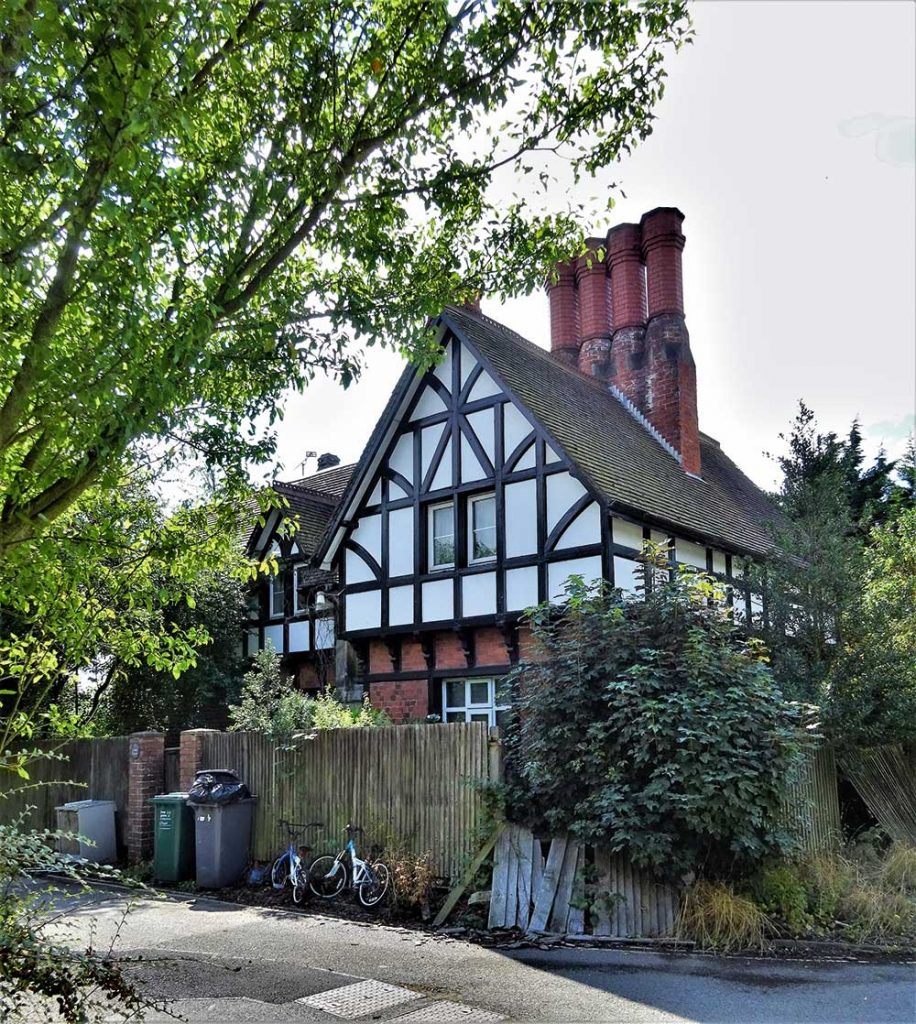
It might reasonably be argued that the reason that Sir Nikolaus Pevsner omitted certain settlements from his magisterial series The Buildings of England was that they contained no buildings worthy of note. Yet times change, tastes change, scholarship uncovers matters closed to Sir Nikolaus when he began his project in 1948. Last time, we looked at Milton, a forgotten gem of an estate village, really quite formal, and which today its omission would seem inexplicable. Hence, we chose another estate village today, but one much less formal, and which has suffered a great disaster. It is also one where even the listed hall did not attract the compilers’ attention. The village is Foston, west of Derby along the old Uttoxeter Road. A recent issue of Country Images looked at the early history of the place and the hall up to the moment it burnt down in 1836 and left, as Samuel Bagshaw, the compiler of the 1846 Directory of Derbyshire says, ‘a smoking ruin, which it still remains.’ The great disaster, the destruction of the Regency hall aside, was the completion of the A50 trunk road in 1996. This went right through the centre of the village, involving some destruction of buildings, and sundered the historic hall, on the south side, from the community built to serve it, on the north. Not only that, but the incessant roar of the traffic is overpowering, and left us glad to find a few places where intervening buildings managed to muffle it. It must have totally destroyed property values there; inside one’s house armed with triple glazing is one thing, but how can one sit out in one’s garden with that continuous roar? We parked in the main street, formerly the A511 old Uttoxeter Road, which merges with the A50 here. The only listed building this side of the A50 is Broomhill farm to the north and not accessible to the public, but is a pleasant if unremarkable brick built farmhouse with outbuildings dating from the second quarter of the 18th century but given a rebuild in the early 19th century. If one walks to the junction with the A50 (using ear defenders!)where one may cross on a steel footbridge, the stub of the old road veers off right, which brings one to the walled kitchen garden of the hall. This is undoubtedly impressive, and the bricks employed suggest a mid-19th century date. Furthermore, it has two divisions, the southernmost one full of caravans and the northern one, grassed over, faces the 19th century buildings of home farm, which has an equestrian adjunct and of which some of the outbuildings have been converted as residences. Returning to the road, a number of modern residences have been built on the left as one walks away from the A50, whilst on the right a long low building with an oeuil-de-boeuf gable window would appear to have been the estate’s wheelwright’s shop, probably mid-19th century. Probably the Broadhurst family turned their attention to improving the village once the new hall was complete. From before 1827 until almost the turn of the century the wheelwright (also a farmer) was William Alsop and his son William after him. Beyond it, end-on to the road, is an early 19th century brick cottage which without doubt started off as more than one, perhaps part of it was chez Alsop. Beyond this, is a range of what must once have been three cottages, gable end to the road, and partly harled with pebbledash, with the easterly gable-ended cottage joined to the others by a link. From 1827 there had been a grocer and a butcher in the hamlet, and by 1891 the grocer had also become the Post Office, which continued to flourish until 1980s. The door of the westerly gabled range is currently blocked with new herringbone brickwork, but its tiled canopy suggest that this must have been the former Post Office and store. Indeed, the Post Office might have moved, for in 1891 it was run by the blacksmith, John Hollis but, by 1908, it was run from the general store. It might be added that in 1846, there was also a pub, The Crown. The parish historian claims there is a record of a pub in the village as far back as 1577 and recorded again (un-named) in 1686. Whether there was any continuity or not is obscure, but The Crown closed its doors in 1890, leaving the villagers to traipse off to Scropton for a drink to a pub that is also now closed! Opposite these relatively pleasing buildings, is the only substantial house in the hamlet bar the outlying farms and the hall and The Cottage, which we failed to locate (if it still exists). This is The Firs, a two storey rendered brick villa which took on it present form sometime after the Second War, one suspects. On the old 6 inch OS maps, it is L-plan with a range end-on to the road, its end wall actually on it, and another range at right angles, parallel to the street. Today, this end-on-to-street range has disappeared to be replaced with a substantial brick gable separated from the other range by what appears to be a newish two storey porch with re-used stone quoins enclosing a room over the stone entrance, all topped by a stone coped gable with prominent kneelers. The range to the right, though, is clearly older, possibly much older. Although rendered, the bricks in the chimneys with their decorated stacks are narrower than standard, suggesting older work than c. 1830s. Beyond are a range of outbuildings, once stabling, farriery and hay barns, all now converted into separate homes. The Firs is not listed in the directories until 1891, when Fraser Tytler lived there, followed for well over 20 years by Edwin Caldecott JP, and I suspect it was the house for the agent of the hall estate. Having been privatised when the estate was finally sold up it probably underwent
Walk Derbyshire – Walking Eyam, Bretton Edge and Foolow
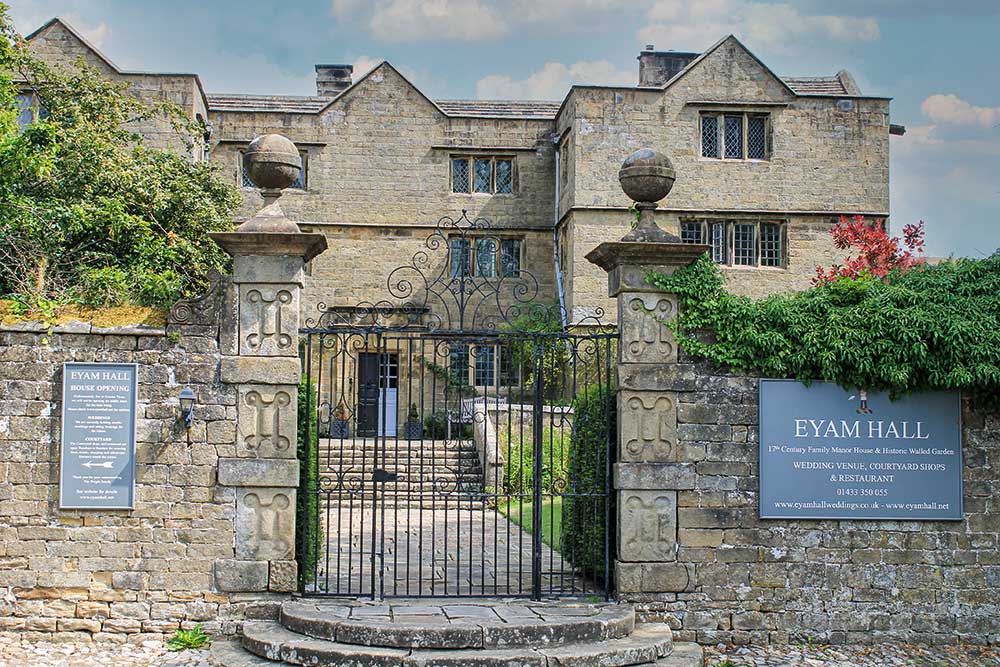
Here is a walk through some of the historical countryside surrounding the plague village of Eyam, a village where the Covid-19 pandemic must have jogged some deep folk memories from a time when the inhabitants of Eyam made a courageous stand against an outbreak far worse than that which beset them in more recent days. The walk starts logically one might say, from the car park directly opposite a small, but fascinating museum devoted to the stand made by those villagers in 1665/6, when led by a far sited young rector, the Reverent William Mompesson and assisted by his friend and predecessor, Puritan minister Thomas Stanley. Simply by what was surely firm and sensible leadership, they managed to persuade the people of Eyam to hold themselves in total isolation, despite more than half their number succumbing to the dreaded virus known as Bubonic Plague. All around Eyam village you can find relics of that terrible experience, from the natural pulpit in Cucklet Dell where Mompesson preached in the open air. Other relics are Mompesson’s Well high above the village on the edge of Eyam Moor where the far sighted vicar aided by the local landowner, the Earl of Devonshire, arranged for kind hearted suppliers to leave essential supplies, paid for by cash left in the purifying waters of the well. Another transfer point is the limestone boulder beside the path leading down to Stoney Middleton. Money dropped into holes filled with vinegar carved in its surface was rendered safe by the purifying action of the vinegar. Along with these exchange points are the number of simple graves dug into places well away from the village church; they were dug by survivors who had the onerous task of burying their nearest and dearest in places ranging from local fields and even gardens. This is a walk that starts by tasking the ability of all those who are prepared to make the steep climb up to the Sir William Hill road, high up on the edge of Eyam Moor. Fortunately this is the one and only climb, and a climb where the effort offers a reward of some of the finest views in the Peakland. Descending from Bretton Edge, the walk passes through Foolow followed by a mile or so of field paths leading all the way back to Eyam. USEFUL INFORMATION 6 miles (9.6km) of moderate walking , beginning with a steep climb from Eyam up a woodland path, followed by open fields leading to moorland road walking, then by a fairly level path across small fields, back into Eyam. Excellent wide-ranging views from Bretton Edge. RECOMMENDED MAP Ordnance Survey 1:25000 scale Explorer Map, Sheet OL24; The Peak District, White Peak Area. PUBLIC TRANSPORT Buses from Bakewell and Sheffield via Grindleford. REFRESHMENTS Eyam village. The Barrel at Bretton and the Bull’s Head in Foolow (open Sat & Sun from 12 noon) CAR PARKING On outskirts of Eyam village, opposite the village museum. Directions : From the car park opposite Eyam Museum, turn left and left again to follow the village’s main street, past the Jacobean hall and then the plague cottages where the dreadful virus first struck. Go through the church gates on your left and follow the path through the graveyard, past the church and then climb out into open fields. (Look out for the amusing memorial stone to a famous county cricketer). Cross the road and climb steeply up the woodland path a few yards uphill from the entrance to Beech Hurst Youth Hostel. Continue steadily uphill across three small fields above the wood, until the path reaches a side lane. (Mompesson’s Well is a little over a quarter of a mile to your right if you wish to make a diversion to this historical place). The walk turns left and crosses the lane for a couple of yards and then turns right to climb over a stone stile in the gritstone boundary wall. Keeping on the left of a boundary wall, climb steadily over Bole Hill which was the site of a small lead smelter for nearby Ladywash Mine. After a quarter of a mile of walking through pasture above Ladywash Mine whose chimney can be seen in trees over to the right, climb over a ladder stile and join the Sir William Hill road. Turn left and walk down the unsurfaced road until it joins a narrow lane at a sharp bend near the start of Bretton Edge. Spend time admiring the wide ranging views, both north and south across the Peak District moors and pastures. Walk along the road for about a hundred yards and then turn right along a descending rough track. The track becomes a narrow surfaced lane servicing the scattered cottages overlooking Bretton Clough. Keep with the lane as it climbs to the left past Bretton hostel in order to reach the ridge-top road once more. It is next to the Barrel Inn. (Food available, both inside the pub and out). Turn right on joining the top road beside the Barrel and begin to walk downhill. After about a quarter of a mile, take the left-hand fork and continue downhill along the road, past a small well and for about three quarters of a mile until it reaches Foolow. (There have never been any people who can be classed as foolish living in and around Foolow. The name actually means Foo’s Hill – Foo would have been the name of an early Saxon settler in these parts). Turn left beside the tiny non-conformist chapel on entering the village and walk past the duck pond overlooked by the village cross on your right and a bull ring almost lost in the grass. With the Bull’s Head pub on your left, follow the Bretton road, bearing left at the fork for about 150 yds. Look out for a stone stile in the wall on your right. Go through the stile and bear left to cross four narrow fields, using stiles in their boundary
Lost Houses of Derbyshire – Rivetts House
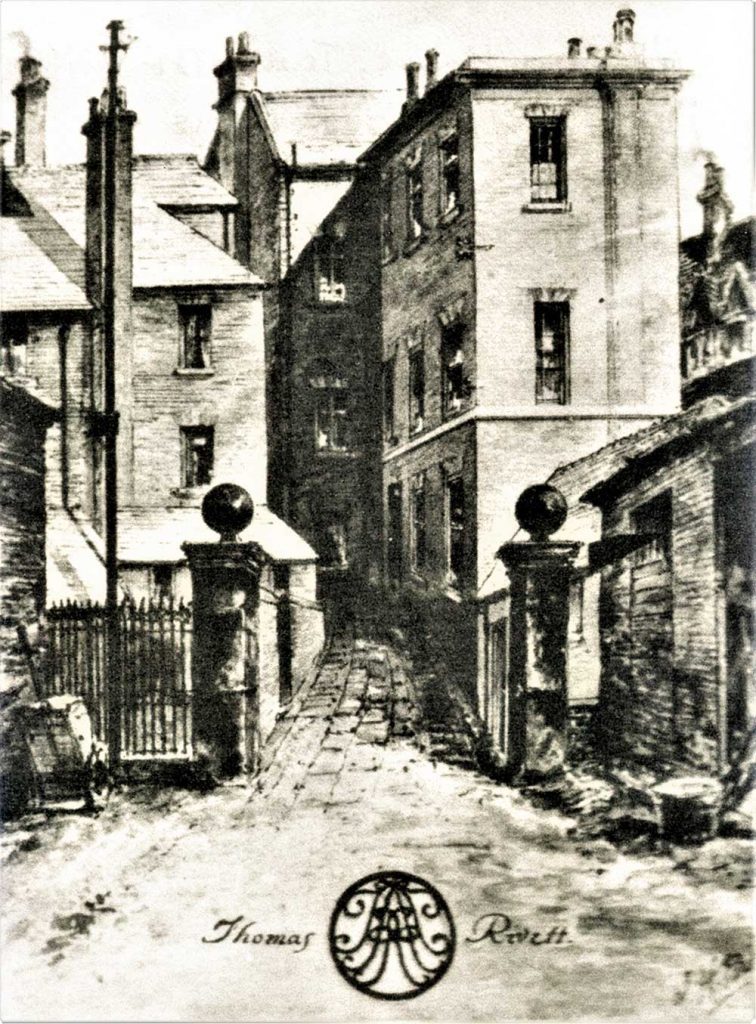
Alderman Thomas Rivett (1713-1763) was an example of the astonishing social mobility that was far more commonplace in the 17th and 18th centuries than professional social commentators like to admit. Rivett was a third generation maltster in Derby, a city which was then famous for the quality of its beer, long pre-dating the fame of Burton. His great-grandfather, also Thomas, had come to Derby from Repton before the Civil War and had set up as a blacksmith. His son, Thomas II (died 1679) was sufficiently well off on his father’s death in 1660 to become a maltster, a trade that revived with the lifting of the puritanical strictures of the Commonwealth on the return of Charles II. His son, Thomas III continued the trade and married Rebecca, daughter of Charles Agard of Mackworth (of a junior branch of the Agards of Foston Hall). The fourth generation, however, started to spread their wings. Thomas and Rebecca had an eldest son, yet another Thomas (IV) who was born in 1678. In 1708 he married Elizabeth daughter of Humphrey Eaton of Derby and was then already a brother of the Corporation, becoming Alderman in 1710 and Mayor of Derby in 1715. In 1718 he was wealthy enough to begin to piece together an estate in Staffordshire at Blore, and by 1720 he was lord of the manor and impropriator of the church (that is, he acquired the right to nominate a new rector). However, he died in 1724 leaving Elizabeth with seven young children, his fourth child and eldest son being – yes, you guessed it! – Thomas (V), born in 1713. Thomas’s responsibilities began early when he was required to nominate a new incumbent for Blore in 1728, the lucky person being his mother’s cousin, Revd. Richard Blackwall, although he died in 1732, requiring a successor, who was Revd. Charles Sibley, previously of Bath. Thomas came of age in 1734, becoming a brother of the Corporation in 1740, having gained his freedom of the borough in 1738. He had attended the Inner Temple in 1732 and was called to the bar in 1738, too. He was elected to Parliament in the Whig interest a decade later, continuing until 1754, and in 1749 married ‘the celebrated’ Anna Maria, daughter of Mr. Sibley, the rector of Blore (although the rector had died by this time). Incidentally, her uncle, Revd. George Gretton, later also Rector of Blore, was father of Elizabeth, who married Thomas’s exact contemporary and Derby neighbour, John Whitehurst FRS. In 1757 he was High Sheriff of the County, and the same year he also purchased an estate at Mapleton, building the handsome Mapleton Manor shortly afterwards, a house in which he subsequently resided. He served as Mayor of Derby in 1761 and was appointed High Sheriff for the second time two years later, but died at Bath in the April before taking up office. Needless to say, he was also a JP. He left four sons and four daughters. He was also an entrepreneur, and in 1751 with local banker John Heath, put up the money to found the Cockpit Hill pottery works, run by potter William Butts, just a few yards along from the rather spacious house he built in Tenant Street, two doors down from the Thorn Tree inn, and adjacent to the Old Mayors Parlour (see Country Images May 2014), on reaching his majority. This became his permanent home until he moved to Mapleton, after which it was his town house which he used when in Derby on business. This house was of brick, four bays wide and three stories high with a parapet to the front hiding a hipped roof. The sashed windows had gauged brick lintels centered by a stone keyblock, and it had a fine timber staircase and some interior ornamental plasterwork. The house also boasted a garden running down to the river bank, where Rivett added a small brick Gothick summerhouse in which to sit and read of an evening, although the expanding copper rolling mills, established opposite only a year or two later on The Holmes, must have quickly rendered it less idyllic fairly quickly. Robert Bakewell made a handsome set of gates with an arched overthrow with his monogram in a roundel below his crest – an arm holding a broken sword – at the top. These stood at the rear of the house between a pair of simple stone piers topped with ball finials with attendant spear-headed railings and led onto an avenue leading down to the banks of the Derwent Navigation. When the Jacobite army was nearing Derby in autumn 1745, Thomas Rivett was hastily made a deputy lieutenant of the county by the Duke of Devonshire (the Lord Lieutenant) and commissioned as a Captain into the hastily raised militia then being recruited. Once Bonnie Prince Charlie had arrived, on December 4th, this militia, called The Blues, made a strategic withdrawal to Nottingham, Rivett included. This left Rivett’s aged mother landed with the duty of having to billet no less a personage than the Prince’s joint commanding officer, James Drummond, 6th Earl and 3rd (Jacobite) Duke of Perth as a guest in the house, although his stay was just two nights, as he was obliged to lead the army back to Scotland at dawn on the 6th. After Thomas’s death, his wealth relatively undiminished, despite the bankruptcy of John Heath and his brothers in 1779 and the consequent failure of the Cockpit Hill pot works. The house remained in the family, although lived in by the third son, Peter Charles Sibley Rivett, who died unmarried there in 1784. It was then occupied by his sister Anna Maria, but she married William Richards in 1788 after which she lived at Penglais, his house in Cardiganshire. Meanwhile the youngest son, James Rivett-Carnac was assistant governor of Bombay (and father of Sir James, also governor of Bombay and the man who suppressed the practice of infanticide in Gujerat, made a baronet in 1836)
Product Test – UpCircle Beauty

As well as being 100% natural, our skincare range is also 100% brilliant. Because you shouldn’t have to choose between doing the right thing and getting the best results. With UpCircle, you get to enjoy the uplifting benefits of nature’s own skin rejuvenators – and do the planet some good, too. That’s all round better skincare. BODY CREAM, 125ml £24.99 An award-winning hydrating body cream for all skin types with nourishing shea butter, linseed and olive oil. This body cream is made with the anti-inflammatory extract of leftover date seeds, a by-product of date farming. Soothe dry or irritated skin with this calming blend of ingredients. This cream will help to reduce inflammation and leave your skin feeling smooth and supple. Winner of the Eco Hero category in the Get The Gloss Beauty and Wellness Awards 2020. Housed in a glass jar with an aluminium lid and a cardboard outer box. 100% plastic-free packaging. Natural, vegan, cruelty-free, 100% recyclable and handmade in the UK. FACE SERUM, 30ml £14.99 Our multi-award-winning Face Serum brightens the skin with coffee oil from repurposed grounds Applied after moisturiser, this 100% oil-based serum is suitable for all skin types and helps to brighten and nourish the skin. The serum is formulated with hydrating rosehip and skin supporting sea buckthorn oil. The face serum is our best-selling product and with over 1,300 5* reviews it’s easy to see why. Housed in a glass bottle with a plastic dropper and a cardboard outer box. Each bottle can be returned and reused as part of our refill scheme. Natural, vegan, cruelty-free, 100% recyclable and handmade in the UK. Tried & Tested :: Tried & Tested :: Tried & Tested Body Cream Super smooth and melts into the skin really well. Nicely scented throughout the day. You can feel the hydration of this product. I love the fact this is using a by-product of farming. Wish more brands would do things like this – well done! VP Face Moisturiser Using natural ingredients, this is a rich face moisturiser that felt extremely soothing and was easily absorbed into my skin. Made with fine powder of discarded Argan shells this lovely moisturiser is natural, suitable for vegans, sustainable and cruelty free. LOR Face Serum Suitable for all skin types. This serum instantly is absorbed and leaves the skin bright! CB 00
Walk Derbyshire – Walking from Golden Valley to Codnor Castle

Here is a walk through history – from medieval times through the industrial revolution to the present day. Starting at the quaintly named Golden Valley, it passes the monument to a Victorian ironmaster and civil engineer, before crossing farmland slowly recovering from the depredation of open-cast coal mining in order. From here farm lanes reach a castle built by one of William the Conqueror’s knights. On the way back the walk follows the line of an abandoned section of the Cromford Canal. When the tunnel taking the Cromford Canal was dug beneath Butterley Park near Ripley, extensive amounts of ironstone and lime were discovered, making the raw materials founding the Butterley Ironworks. Specialising in large innovative projects, the company is best known for its construction of the Falkirk Wheel in recent times, to the famous pillars that still support St Pancras Station roof. What is not so well known is that the company made the cast-iron ‘trough’ carrying the Llangollen Canal over the river Dee. Such was the value and range of useful ores found during the canal tunnel’s construction that gave the name to Golden Valley. Although later roof falls made it necessary to close Butterley Tunnel, a long narrow lake that once held water to top up canal locks lower downstream, has settled into the countryside. It is popular with both walkers and anglers, some of whom were startled when their hook snagged an unexploded German bomb. Cottages, many of them once the homes of ironstone or coal miners exploiting the mineral wealth of Golden Valley. Codnor and Ironville are relics of that industrial past, but now mainly offer accommodation to those working in nearby factories dotted around the modern industrial estates. The walk starts from any one of the car parking spaces dotted around the valley road alongside Codnor Park Reservoir. Actual walking starts a few yards below the dam and follows a village street through Codnor, climbing out into open fields. Very soon a 70 foot high pillar comes into view; this is a memorial to William Jessop, civil engineer and canal builder, one of the founders of Butterley ironworks. An attractive feature for today’s visitor, it created great controversy when it was first proposed. Although it may not have pleased the pundits, it did however, soon become a popular attraction, with parties of school children coming out into the countryside and even train loads of visitors from as far afield as Sheffield. Following a farm lane, the way carries on beyond the pillar, past a farmhouse, until it reaches a crossing of four tracks where Codnor Castle’s ruins are a hundred yards or so further on, half right across a rough field. From the castle, another track to the left of the crossing, drops down towards the valley bottom and the railway line. This is crossed by way of a footbridge and the path now descends further through woodland until it reaches a dried up section of the canal. The towpath runs to the right towards Langley Mill; and to the left back to Codnor: this is the one we must follow. After passing beneath the railway line, the path swings to the left and then follows a straight track all the way back to the reservoir, where if luck is with you, there will be a portable refreshment cabin offering all things necessary to slake your thirst, or fill an empty gap in your stomach. The Walk : From the car park walk along the road towards the reservoir dam. Continue further for about 200 yards and turn right, uphill, along a side road through the built-up part of Codnor village. At the top of the village road, turn right at the junction with another road. Follow this as it swings left, uphill as a farm lane into lightly spaced trees. Lookout for the tall pillar of Jessop’s Monument. Also look out for a large circular concrete water tank above and to your left. Continue forwards to a four-way track junction and turn hard right. After a quick look at the monument and making the right hand turn, continue as far as a ‘T’ junction. Turn left here and follow the track, over a low rise for about half a mile to another four way track junction. Turn left here and begin to go downhill. Codnor Castle is directly to your front on the far side of a meadow reached by a stile. On the left of the track it is possible to get closer to the castle, but only as far as the surrounding fence. Continue down the track and then cross the footbridge over the railway line. Almost immediately cross a narrow footbridge over a drainage ditch. Walk on, past a narrow wood until you reach the abandoned canal. Follow the remnant of a towpath for a little over a mile alongside woodland covering the far side of the old canal. Bearing left, go under the railway and follow the towpath for a little under half a mile, past Codnor village on your left and Ironville to your right, as far as the canal’s dam wall. Continue along the road and back to your parked car. USEFUL INFORMATION An easy 4 mile (6.4km) rural walk along farm tracks and old canal tow paths. RECOMMENDED MAP Ordnance Survey 1:25,000 scale Outdoor Leisure Explorer Sheet 269. Chesterfield and Alfreton. PUBLIC TRANSPORT Busses between Ripley and Alfreton via Leabrooks stop near the turning for Codnor. REFRESHMENTS Mobile kiosk usually parked above the reservoir. CAR PARKING Roadside along the south bank of Codnor Park Reservoir. 00