Celebrity Interview – Chris Hadfield

On Earth And Space – Chris Hadfield’s Guide To The Cosmos will feature the Canadian astronaut and former commander of the International Space Station sharing his thoughts on the new age of space travel and what it will mean for life on earth. Moustachioed Chris was the first Canadian to walk in space. Not only that, he’s in the extraordinarily rare position of having spent 15 hours in space – not in a rocket or on board a space station but on space walks during his 21-year career as an astronaut for NASA and the Canadian Space Agency. He says he’s looking forward to his new show which he’ll deliver 11 times in nine different cities. “I’ve previously toured across the UK, Australia, Germany, the US and Canada and sold out wherever we’ve gone. It’s such a joy to connect and share ideas with so many people. “It’ll be an evening of discovery and digging into many ideas about space, of where we’ve come from, where we are and where it’s leading to, helping us to understand more about where space exploration is heading with the technological advancements like today’s rockets and the James Webb telescope.†The James Webb Space Telescope is conducting infrared astronomy. As the largest optical telescope in space, it’s equipped with high-sensitivity instruments, allowing it to view objects that are too old, distant or faint for the Hubble Space Telescope which was launched more than 30 years ago. Chris Austin Hadfield was born on 29 August 1959 in Sarnia, Ontario. His journey to space began when he was nine: he recalls watching Armstrong and Aldrin take part in the first lunar landing and moon walk. He set his heart on following in their footsteps and made it his own mission to succeed. “What I saw was the most exciting thing human beings had ever done and I wanted to be part of that.†When he was 15 Chris learned to fly and enlisted with the Canadian Armed Forces where he eventually became a combat fighter pilot and test pilot. He spent time with both the US Navy and US Air Force, being recognised as their top test pilot, before he was accepted into the Canadian Space Agency’s astronaut programme when he was 33. He calls that an “amazing†moment: “To put it in context, a recent intake to NASA saw 18,300 applications for 11 places. When I applied to the Canadian Space Agency in 1992, there were 5,300 applicants for four places. “Gaining the qualifications to be selected is extremely difficult, but then it has to be combined with luck, hard work and being there at the right time. “To get that phone call to say Canada would like you to be an astronaut is incredible.†It took him four years to prepare for his first step into space which is “literally and figuratively an other-wordly experienceâ€. He explains the gravity of it: “It’s very dangerous. There’s a huge number of things to squeeze in in a wildly different environment, at very high stakes. “The vast majority of what you’re thinking about is the life and death enormity of performing each step and paying attention to each minor detail as well as dealing with the things that can and do go wrong. “It’s also immensely exciting and the absolute personification of what I dreamed about as a nine-year-old boy. The physical experience of pulling yourself out of a small airlock on the International Space Station is so exhilarating. You’re no longer an earthling in that moment and it really strikes home. “It’s overwhelming. It gobsmacks you and stops thought. It’s an amazing time and place to be in your life.†Chris has orbited the earth 2,650 times and he says the last was even more enlightening and enriching than the first. “The earth is flashing by at 8km per second (almost 18,000mph) – you cross the UK in a matter of seconds. “You find yourself looking for things you know, for touchstones of familiarity, and you get better at looking. “Viewing earth from space is like watching the planet take a breath. You see winter and summer swap between the northern and southern hemispheres. Because the planet is on a tilt, and not all planets have that, we have our distinctive seasons. Seeing that unfold above you is extremely provocative.†Chris’s feat of being the first Canadian to spacewalk is commemorated on the Canadian five-dollar bill. But that isn’t his only claim to fame: when he was commander of the International Space Station he sang and played guitar on a version of David Bowie’s hit Space Oddity. It’s been viewed on YouTube no fewer than 52 million times. Entrepreneurs including Richard Branson and Elon Musk are gravitating towards conquering space and their plans have rocketed in the past few years. Chris believes the sky isn’t the limit. “When I was born, no one had flown in space. We reached space 62 years ago as part of that natural urge to explore which was previously limited by technology. Now we’re at a place where the technology is rapidly improving and opening many, many opportunities. “As humans, we’re explorers by nature. We’re looking imminently at a settlement on the moon, initially robotic, but then human settlement. The reality of getting people there is increasing. tChris has had many astronomical achievements in his career but he’s remarkably grounded about what he regards as his greatest moment in life. “Condensing 63 years of life into a few publicly shining moments, you trivialise it and miss so much of what is important to me. “I met my wife Helene in a high school play. She was turning 15, I was 16, and that’s probably the most significant moment in my life as we’ve been together ever since. That relationship has hugely influenced the life we’ve had together and all that we’ve accomplished.†Since retiring in 2013 Chris has written four best-selling books including his autobiography and a thriller set in
Dining in Derbyshire – The Curry Lounge, Somercotes

It was early on a Wednesday evening when we parked on the Market Place in Somercotes adjacent to the familiar restaurant entrance. The welcoming, contemporary designed foyer hadn’t changed but for one addition; in pride-of place, the wall facing the door was adorned with a large ceramic plaque. On it, in bold type, it reads Best Restaurant Awards 2022. The restaurant was awarded the prize for Best Indian & Bangladeshi Restaurant at the Curry Life awards in October last year. Curry Life is a British independent trade magazine for the Bangladeshi and Indian restaurants and takeaways in Great Britain. With over 300 reviews taken in to account the prestigious award was made for their top class food, excellent service and overall customer experience. We made our way into the restaurant and bumped in to Syed Hussain, owner of the Curry Lounge, and congratulated him on his fabulous achievement. Obviously proud of his award he showed us a video on his phone of the ceremony. We were shown to a table for two by the window and started to unpack our drinks. The Curry Lounge doesn’t have a licence to serve alcohol but there’s nothing to stop you bringing your own. There’s something a bit naughty about walking into a restaurant with your own favourite beer or wine clinking in a much used ‘bag for life’. Our waiter provided the appropriate glasses: one wine glass and one for beer. Plus a very essential bottle opener. The menu had several items ‘flagged’ as new and we decided to order one each of the kitchen’s latest creations. We started with pickles and poppadoms; part of the curry meal ritual. A smooth mango chutney, a refreshing chunky tomato salad and spicy dark amber tamarind dip accompanied the two huge poppadoms. Plus a smooth raita that was, at our request, to stay on the table. A platter of onion bhajis was the next course. So often with these little morsels of loveliness there’s too much gram flour and very little onion but these were full of sweet onion. Soft and pillowy in the middle and cracklingly crunchy on the outside. Accompanied with the sauce boat of raita I could have made a meal of them. From one of the new additions to the list of Curry Lounge signature dishes I chose the gulbahar lamb. It’s a mildly spicy dish that was loaded with succulent lamb. The mild sauce was studded with mushrooms, onion and green peppers and a sweet spicy note lingered on the palate. I ordered a bowl of pilau rice to go with the dish. However, when I saw the peshwari naan that Sue had ordered I was tempted to try it with the gulbahar. The naan was warm, soft and overflowed with coconut giving a lovely, slightly sweet flavour to the bread. As it turned out it was a different but perfect accompaniment to the spicy lamb. Susan had ordered special vegetable paneer korai; also on the list of new additions to the Curry Lounge signature dishes. It is a combination of fresh vegetables and paneer (cubed Indian cottage cheese) cooked in a tandoori sauce with onion, peppers and tomatoes and is served in a hot tandoor dish. It’s mid-range spicy and bursting with flavour. The fresh, green vegetables were tender and flavourful. The plain paneer is a perfect vehicle for any sauce but especially delicious when coated with a sauce of tandoor spices and yoghurt. The peshwari naan turned out to be equally delicious with the paneer korai. Next time we’ll skip the rice and order two naans. We’d had a wonderful evening with delicious food, attentive service and the pleasure of trying new dishes. The Curry Lounge, Market Place, Somercotes, Derbyshire. Tel 01773 528 588 00
Lost Houses of Derbyshire – Brizlincote Old Hall
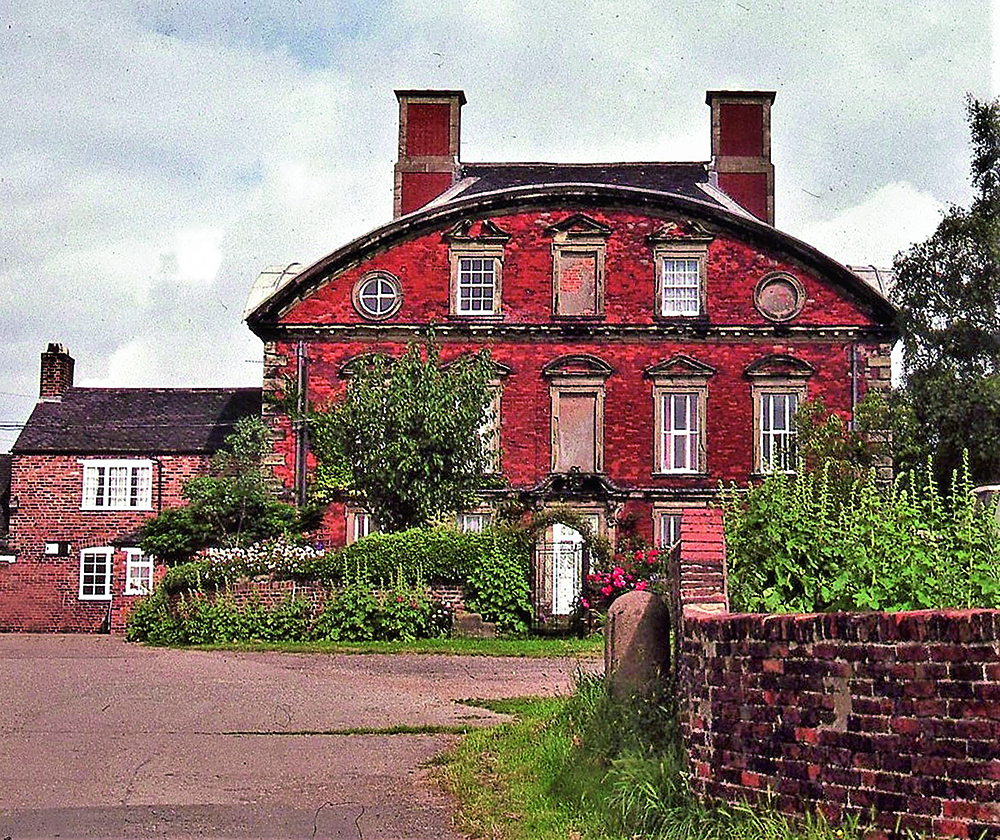
The present hall at Brizlincote is visible for miles around, set on its dominant hill and looking for all the world like an inverted helmet-type coal-scuttle with its legs in the air, represented, of course, by the chimneys and the giant segmental pediments which ensign the facades on all four sides. I have argued in the past that this extraordinary Baroque house was designed by Nottinghamshire’s famous ‘wrestling baronet’, Sir Thomas Parkyns of Bunny, for Lord Stanhope, eldest son of 2nd Earl of Chesterfield, and in the 22 years following, nobody has yet proved me wrong! Here, however, we have to consider the history of its long-vanished predecessor and although the parish (created from Winshill in 2003) is deemed to be in Staffordshire (since 1888) the hall still lies in Derbyshire. Originally, Brizlincote was part of the holdings of the great abbey of Burton, given as part of the foundation charter by the Saxon grandee Wulfric Spot in 1004. By the early twelfth century, the estate there was tenanted under the Abbot by one Mabon de Brizlincote, whose grandson Richard acquired the estate by grant of the Abbey c. 1175. The heiress of the Brizlincotes brought it to the Leicestershire family of Cuilly and the heiress of that family, Elizabeth, married John Stanhope of Rampton, newly arrived in Nottinghamshire from his native Northumberland in 1349. The de Brizlincote family probably built the first seat there, within a moat, substantial remains of which remain, slightly to the north of the present house, off Brizlincote Lane. These earthworks, which have never been investigated archaeologically, are said locally to hide vestiges of the house, too. The Stanhopes did not then have an interest in Derbyshire and thus they disposed of the estate to Robert Horton of Catton who died in 1423. Over a century later, his descendant Walter Horton sold it yet again to William, 1st Lord Paget of Beaudesert KG, an enormously rich courtier of Henry VIII, who had managed to engross almost all of Burton Abbey’s holdings at the Dissolution of the Monasteries in 1539. Paget clearly felt he needed a house near the epicentre of his extensive new holdings, Cannock Chase (in which Beaudesert lay) being some distance away, so having acquired the estate from Walter Horton, in January 1546 he obtained a licence from the king to ‘empark and crenellate’ the house. Thus, the land now lying between Ashby Road, the Beaufort Road/Violet Way estate, the A444 and the north west edge of Newhall (the clue is in the name: Park Road, Newhall) became Lord Paget’s parkland (something like 40 acres, if the size of the later farm is any guide) and his house, no doubt erected around a substantial courtyard, was suitably defensive in appearance, with plenty of – essentially ornamental – battlements, probably in the form of merlons. Although we have no illustration of the house (as we found with Bretby Castle: see March edition of Country Images) a 17th century writer said of it that it was ‘a large stone house that was set in its moat on a bleak ridge’ – probably cold and windy in winter but with incomparable views towards Needwood Forest and the Trent Valley! Lord Paget appears also to have walled the house round in stone, too, for we have 18th and earlier 19th century accounts of surviving stone walls but none remain today.. William Paget retired from state business in 1555, having survived his perhaps injudicious signing of Edward VI’s will – leaving the throne to the ill-starred Queen Jane – and the consequent obloquy heaped upon him by Queen Mary, to be re-instated by Elizabeth I. He died in 1563, having sold Brizlincote to a London merchant, John Merry in 1560. John Merry, of a Hertfordshire family, was a merchant tailor whose father had been clerk to the spicery of Henry VIII; he was a Roman Catholic, too. By 1560, recusancy was becoming an un-safe position, and expensive in fines, as well. His reason for buying in Derbyshire may have been influenced by Sir Christopher Alleyne, who had acquired the nearby estate of Gresley Old Hall only four years before. The fact that Merry’s wife Agnes was an Allsopp may also have been an influencing factor. Despite its prominent position, however, the recently rebuilt and fortified house may have enabled him to feel safe from the depredations of such as Lord Shrewsbury, bent on weeding out recalcitrant Catholics. Not that Brizlincote was his only acquisition. He also bought the estate of Barton Blount from the financially challenged Lord Mountjoy, as well as substantial land at Stanton-by-Bridge and at Sutton-on-the-Hill. John Merry appears to have lived at Barton, where he created a priests’ hole. His son John appears to have been settled at Brizlincote by about 1565. Meanwhile, his elder brother Henry of Barton Blount had four sons, of whom the third, Edmund left issue, settled at Radbourne where in 1670 his son Valentine paid tax on but two hearths, so was presumably farming as a tenant of the Pole family. The second son, John, succeeded his uncle at Brizlincote, but was a stout Royalist in the Civil War; he and his wife Anne found their estate sequestrated by the Commonwealth authorities in 1650 and he died not long afterwards. This Royalist left two sons and a daughter, the elder son, Gilbert, managing to recover Brizlincote Hall by compounding for his estate with Cromwell’s commissioners, but he then demised it to his younger brother, John Merry who was described as ‘late of Brisslincoate Esq.’ when he came into his brother’s other lands at Kniveton and Stanton-by-Bridge. John Merry left two sons, Gilbert of Stanton-by-Bridge, and George, the younger son, who had married Dorothy who, after his death in 1657 continued to live there with her second husband, William Dakin ‘of Brisslincoate, yeoman’ who seems to have farmed there. They were gone by about 1685, for we find it had a new tenant in the person of Worcestershire-born William Barnes,
Tutbury Castle
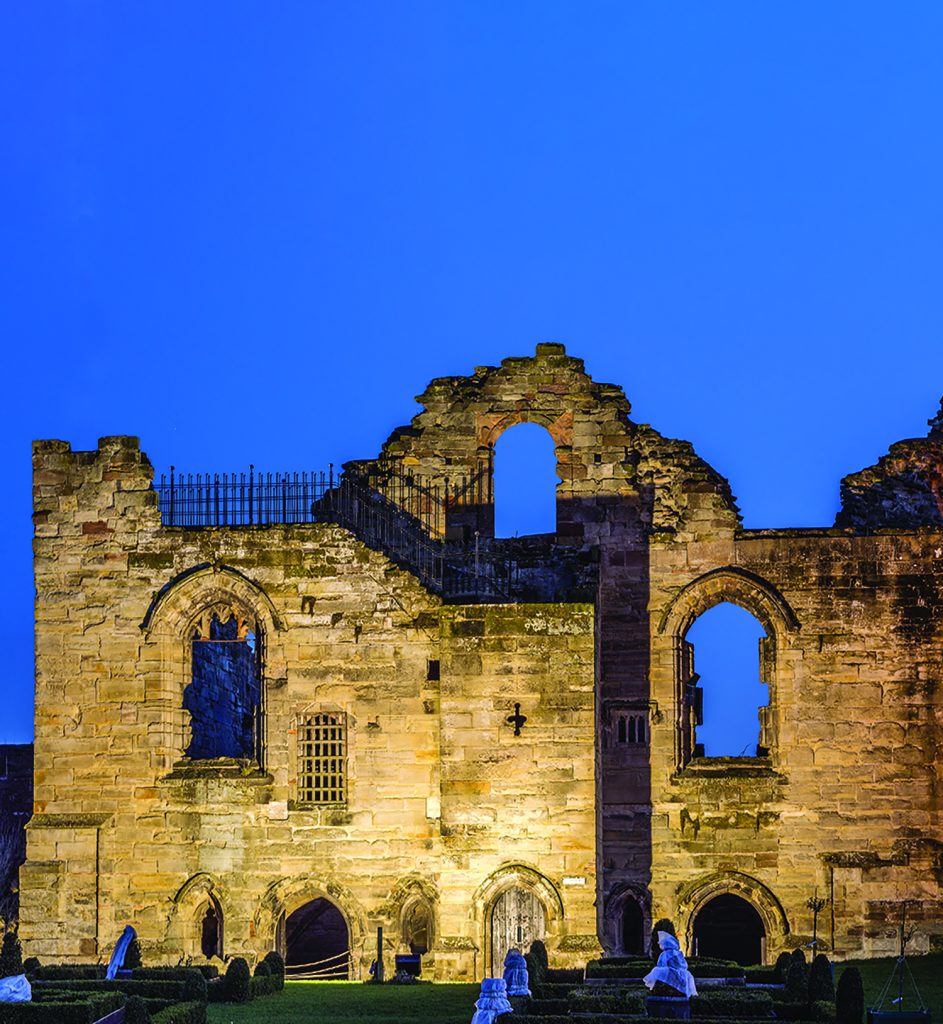
Tutbury Castle has stood guard over the Trent Valley for centuries, especially during the time of unsettled political rivalry that seemed common place until the late seventeenth century. The only way for anyone attempting to attack the fortress had to be along a steep narrow gully rising from the town. To do this was potentially suicidal, not only was it so narrow that it restricted movement to anything more than three or four attackers in line-abreast, but far more important from their point of view, the way passed beneath the castle’s eastern walls, totally without any shelter from missiles raining down from above. There has been a stronghold of one sort or another on this site since at least Neolithic times; during the Viking invasion of northern England it became a winter shelter. The castle we see today was first built by Hugh d’Avranches, to command part of the lands granted to him by William of Normandy as a reward for the knight’s services up to and including the Battle of Hastings. He built a motte and bailey castle on this site – typically a fortified tower overlooking a walled enclosure housing military guards, retainers and domestic animals living cheek by jowl following the castle’s self-supporting design adopted by medieval times. Strangely no wall or tower was built to defend the castle’s western side. Perhaps this was because the grassy slope below that side was considered too steep to be climbed easily by attackers. Tutbury seems to have led a comparatively quiet existence, changing hands only after battles further afield. This was especially so during the Wars of the Roses that took place in other parts of the country. The only hint of violence in Tutbury’ s existence seems to have been a couple of times during the English Civil War when the castle was besieged by Parliamentary troops attacking the Royalists, but even then it appears to have been half-hearted affairs, ending when both sides ran out of food. It was during the rebellious times beginning in twelfth century that Tutbury became a royal castle. In later years it frequently changed hands, with its individual then current owners either repairing the damages caused by weather or accidental fire, or maybe improving the strength of its walls. In 1362 the castle was inherited by John of Gaunt, then the holder of the Duchy of Lancaster, the first of a long line of kings and queens to own it, including our present King Charles lll. Queen Elizabeth ll visited the castle twice during her reign, in 1957 and 1982, culminating the 1957 visit when along with Prince Philip, Duke of Edinburgh, planted two horse chestnut trees that are now fast approaching maturity. MARY QUEEN OF SCOTS IMPRISONMENT AT TUTBURY Following the orders of Queen Elizabeth I, Mary Queen of Scots was held prisoner for nineteen years prior to her execution on the orders of Queen Elizabeth I in the morning of 8th February 1587 at Fotheringay Castle. During the nineteen years of captivity, the Scots Queen had been held on Queen Elizabeth’s orders by the Earl of Shrewsbury, the husband of Bess of Hardwick the intrepid scion of the Cavendish dynasty. During the Scots Queen’s imprisonment, the two ladies became good friends whose mutual skills in embroidery can still be seen at places like Hardwick Hall, or Tutbury Castle. During this time and despite her accommodation being quite comfortable, Queen Mary was moved around properties in the north Midlands owned by the Earl of Shrewsbury. The reason the queen was moved so frequently is that the places where she stayed were singularly lacking in sanitary arrangements and soon became foul stinking places. As a result they had to be left until both nature and man-power had sorted things out. Mary’s lodgings were in a half-timbered cottage below the North Tower. Because of the nature of its design, a half-timbered structure with walls made from dried mud and straw, only the foundation stones remain. EXPLORING THE CASTLE TODAY Entering the castle as it stands at the head of a winding lane from the town, the way into the castle is through John of Gaunt’s Gate. It stands at the northern end of a wide grassy space, called the bailey, an open area with its two attractive, small formal gardens and the remains of two crumbling lookout towers. The more extensive outlines of abandoned buildings appear in the centre of the bailey; these are all that is left of St Peter’s Chapel where, no doubt the doomed queen once prayed for freedom. A line of foundation stones beneath the North Tower and another set closer to John of Gaunt’s Gate are, apart from the slightly more modern buildings lining the castle’s south wall all that is left of this once active fortress. The grassy open space on and around the bailey makes an ideal place for events ranging from civil war re-enactments, costume displays, to weddings, or simply a place where children can play and have adventurous forays around the ruined castle. In the far south west corner of the bailey, a large mound, known as a motte, is crowned with what at first glance looks like a ruined tower. It fits well into the overall ambience of the place, but the tower is, in fact an eighteenth century folly. Following the wall eastwards, the next buildings along it encompass in order of appearance moving away from the motte, the tea rooms, then a house built in the seventeenth century to accommodate the curator. The staircase from here reaches up to the first floor of the King’s Hall, standing high above the semi-ruined spaces of the Great Hall. Beyond this building the outer wall abuts on to the South Tower, the largest part of Tutbury’s defences. LESLEY SMITH – HISTORIAN & CURATOR OF TUTBURY CASTLE AND HISTORICAL PERSONALITIES RE-ENACTOR Lesley Smith, doubles her job as Curator of Tutbury Castle with authentically costumed historical figures, ranging from Queen Boudica to Margaret Thatcher,
Dining In Derbyshire – The Bulls Head, Holymoorside
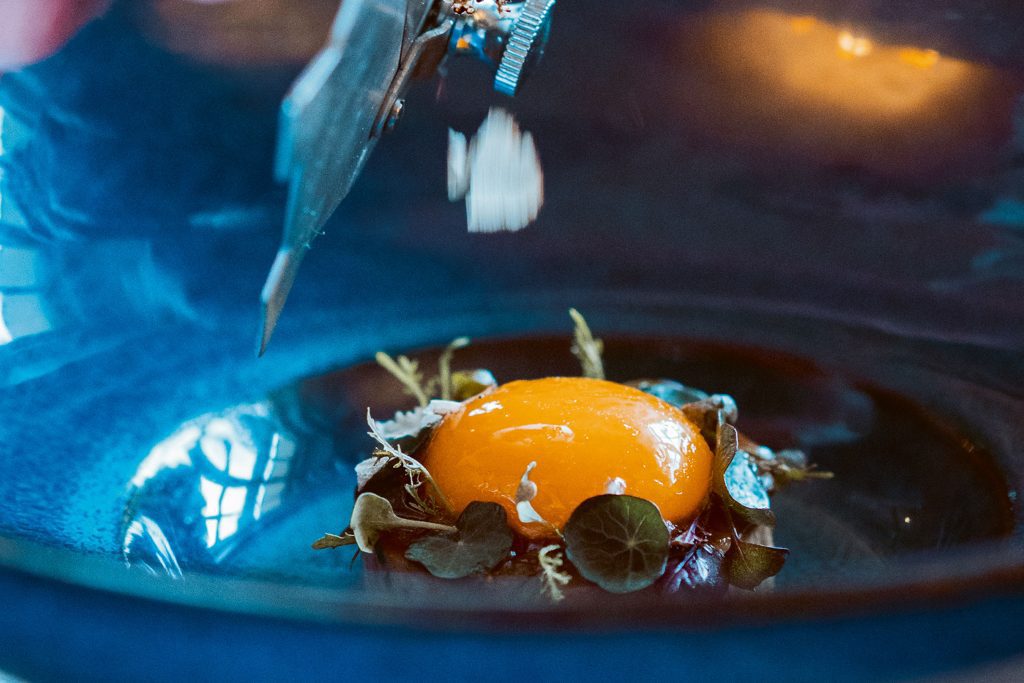
On first glance, The Bulls Head appears your typical, traditional pub; four square it hunkers down comfortably in the centre of Holymoorside, a delightful village on the moor-side of Chesterfield. Just a scenic 20 minutes or so away from the Amber Valley, it’s an area I’m well acquainted with from my childhood and easily accessible. Through the old door the general bar area belies the restaurant beyond and the food on offer here. Please don’t underestimate the experience you are about to embark on, as it truly is a remarkable journey and one that would comfortably sit in a high-end London restaurant, but which we were to enjoy much closer to home. The restaurant area has a simple decor in deep muted shades, with wooden tables well-spaced. Greeted by the friendly smile of Sharron Stone the sommelier, we were shown to our table and drinks order taken. From here we embarked on our epic journey through the 9 courses of the special taster menu, Mark Aisthorpe, head chef and owner truly at the helm in the kitchen. You’d be forgiven for thinking the name is familiar as Mark has appeared on BBC’s 2022 Great British menu as runner up in the northeast and Yorkshire heat. Mark has also worked with Gordon Ramsey and Marcus Wareing at Clivedon House and Petrus, so has an impressive pedigree. Beginning with a selection of Canapes, the deconstructed chicken wing coated with a sticky BBQ sauce and sesame seeds was soft, succulent and a gentle start to awaken our taste buds, the finely chopped venison tartare was richer with a tangy citrus flavour mellowed by the crunch of the diced turnip and served in its own pastry case, cheese and pickled walnut gougères, delivered by one of the chefs Joe Stubbs, completed a perfect trio. Amie Foster, restaurant manager, gave us an excellent description of each course as it arrived, and certainly had a great understanding of every dish. The most delicious, warm malted bread arrived with quenelles of salted butter and marmite butter, wow what a simple idea but inspired. Then a small but perfectly formed potato topped with sliced baby leeks, sprinkled with tiny crisp and airy pork puffs was surrounded in a deep flavoured dulse sauce. Dulse is both very healthy as it’s packed with Iron and proteins, but also adds a rich saltiness. The following course and perhaps my most favourite was the hand dived King scallop; cooked to perfection with tiny brown shrimps, roe which popped in your mouth and a beautifully balanced sabayon sauce. Next, the shredded ham, finished with a warm egg yolk and brioche served separately, was followed by another outstanding fish course. West coast Bass, with a crisp skin and firm flesh found its traditional complement in an asparagus spear, but with the clean taste of sea vegetable fingers, samphire and mussels the wild garlic sauce took it to another level. Spring lamb with its caramelised skin and juicy pink centre was served with a jus and a morel mushroom whose nutty flavour partnered the meat. Rounding out the dish was a carrot and a pea puree. Finishing with a spectacular flourish Mark arrived and set up a side table for his performance, juggling liquid nitrogen, to produce a desert fitting to crown our evening… but I think rather than trying the impossible task of describing it, I will leave it a secret for you to discover for yourselves!! …and just when we were ready for a little something sweet a clever selection of dark chocolate desserts arrived, crunchy, cooling, smooth, intense and spongy all not overly sweet and on one plate…. just desert heaven!! You may wonder what Mark’s ethos is behind this imaginative menu, simply put it is local produce, fresh and in season alongside foraged ingredients, to produce a refined modern British Cuisine. This is not an evening to rush, the relaxed atmosphere at the Bulls Head slowed us down to enjoy each step of this exceptional culinary experience. Tasting each nuance of flavour, some familiar and some not so brought a unique experience. We would like to thank Mark and all his staff for a most delightful evening, and the tour of the newly refurbished bedrooms afterwards. His hard work, enthusiasm and undoubted talents have rewarded Derbyshire with an outstanding venue. 00
Walk Derbyshire – Exploring Shipley Country Park

In 1086 when Duke William of Normandy’s monks were compiling the Domesday Book in order to record the value or otherwise, of the conquerors’ ‘new country’, in listing the wealth of lands in the north Midlands, they recorded details of a section of countryside close to what is now called Ilkeston which was a private hunting estate owned by the king. This became part of Shipley Park, land that was to enhance the wealth of subsequent owners down the succeeding centuries. This wealth came, not from hunting in the nearby forest, but from below ground covering large amounts of high quality coal, discovered and exploited from the sixteenth century and onwards.. The major benefactors of this wealth creating coal were the Miller-Mundeys, a nearby industrial-based family, who chose to live close to their collieries, giving them direct hands on control of their interests. They lived in a then comparatively small farm house and by using their growing wealth, in the eighteenth century, managed to build the first version of Shipley Hall, designed to stand proudly at the centre of their estate. In 1765 the Miller-Mundy family acquired the ownership of Shipley Colliery, developing its increased production by opening the Nutbrook Canal in order to move coal to fuel more rapidly to the burgeoning mills and factories of the Industrial Revolution. This canal, subsequently replaced by rail traffic, ran down to the Erewash Canal and then joined the Trent and Mersey Canal for onward transmission through the industrial Midlands. All that is left of the Nutbrook Canal is the name of a walking and riding trail that passes the delightfully named Swan Lake where, until the local council in its wisdom forced the closure of the entrepreneurial well-run mobile café, at one time the popular stopping place for lovers of the outdoors and all that it has to offer. With their steadily growing wealth, in 1799 the Miller-Mundy’s expanded their estate by building a palatial new house and farm buildings, alongside a water tower, the whole ensemble together with its Italianate pergola was designed by William Linley, a fashionable Doncaster based architect. Following the custom of grand house builders of the time, attractive flower gardens, set amidst semi-natural woodland running downhill from a mansion set on a slight rise. Due to subsequent mining operations, all that is left of this semi-regal splendour is the outline ground plan of the house, a few outbuildings and a lodge; together with the remains of gardens, now tended by the local council’s gardeners. Shipley Country Park, together with the grounds of Shipley Hall are open to the public and well worth spending time in their midst, especially in summer when all the carefully tended bedding plants are in full bloom. In 1887 scandal overtook the placid pace of life at the hall, when Ellen, the wife of Captain Miller-Mundy, ran off with the nineteen year-old Earl of Shrewsbury, Charles Chetwynd-Talbot. The elopement doesn’t appear to have upset Captain Miller-Mundy over much. On his death the house and colliery interests were held briefly by his descendants. The house and coalmining interests were sold to Shipley Colliery Company in 1922. The main purpose of the sale was to enable the new owners to extend their mine beneath the hall. Regrettably this led to pollution of local water courses and subsidence within the hall’s structure. In 1948 the now decrepit hall and surrounding estate were sold to the National Coal Board. With this state ownership, the surrounding farmland and nearby woods were restored, giving nature a chance to reclaim what was once its own. This policy has continued and as a result wildlife has colonised the ponds and surrounding woodlands. Derbyshire County Council took on the ownership of Shipley Estate in 1980, using the land to create the short-lived American Experience Adventure Park, surrounding Shipley Lake. Now only waterfowl enjoy the amenities where children once took advantage of the exciting rides. Part of the land has been built over for housing, but the rest and larger part of the once thriving colliery estate is open for walkers, cyclists and bird watcher’s enjoyment. The walk described below starts and finishes at the Visitor Centre, which is accessed by a side road from nearby Heanor. It then follows three medium sized ponds down to the head of Nutbrook Trail where a short section of path leads over a small wooded rise towards the ruins of Shipley Hall and its gardens. The hall drive is then followed by a field track, crossing the Heanor to Mapperley lane before turning right on to a side path across a couple of fields, back to the Visitor Centre and the chance of refreshment. USEFUL INFORMATION: A short easy walk of 2½miles (4km) on easy, well-made paths and tracks across gently undulating farmland and through deciduous woodland. The paths and tracks are mainly suitable for push chairs and similar. RECOMMENDED MAP: 1; 25,000 scale Ordnance Survey Explorer Map; Sheet 260, Nottingham & Vale of Belvoir. PARKING:Close to the Visitor Centre (pay & display), at the end of the access road into Shipley Country Park. PUBLIC TRANSPORT:Frequent buses to Heanor from Nottingham and Derby. REFRESHMENTS:Visitor Centre at the start of the walk. Also pubs and cafes in nearby Heanor. The Walk :: The Walk :: The Walk :: Following road signs into Shipley Country Park, drive along the side road from Heanor towards the start of the walk, which is next to the Visitor Centre. Turn left, away from the car park and walk down to a surfaced track following the route of an abandoned colliery railway. Turn right and walk along the track. Cross a narrow side road and then turn right on this for about three quarters of a mile until it reaches two narrow ponds. At the end of the second pond, turn right at a track junction and walk slightly downhill, and then up, through mature deciduous woodland for about a quarter of a mile until the track reaches the ruins and
Celebrity Interview – Henry Normal
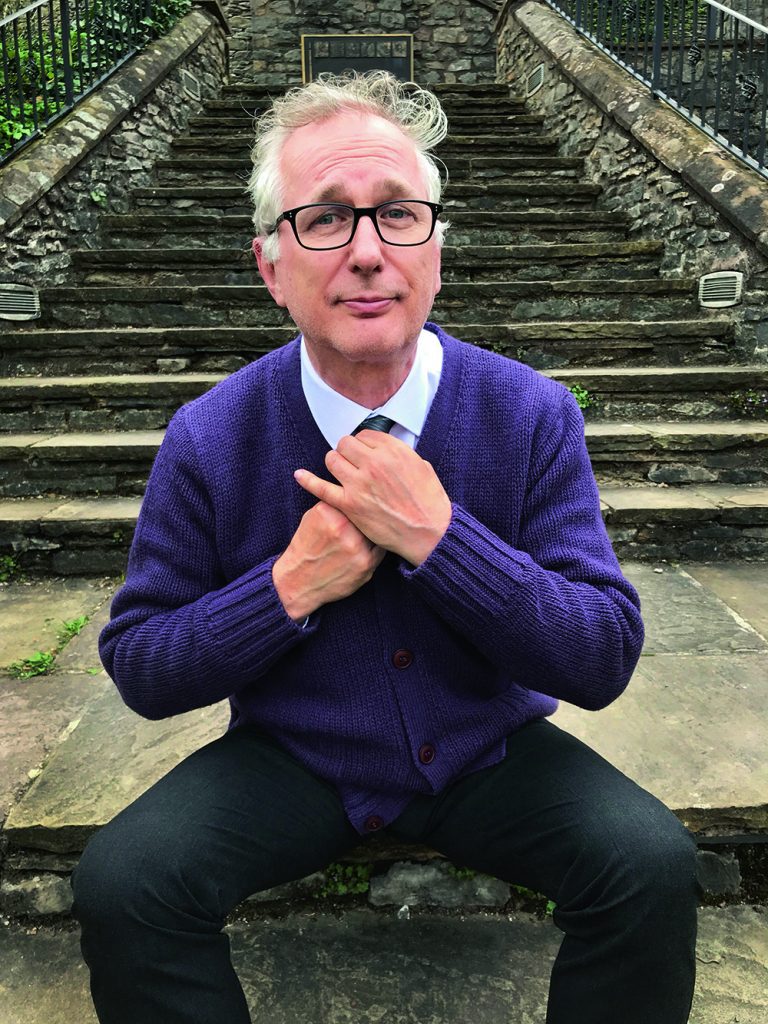
It’s not normal for anyone to have a beer and a bus named after them in their home city. But not everyone can be like Henry Normal. He was the man behind hundreds of comedy programmes as a writer and producer, being honoured with a special BAFTA for services to television. He then went into semi-retirement and returned to his first love – poetry. Henry will perform his new show, Collected Poems and Other Landfill, in both Nottingham and Buxton this month. He took time off from preparing for the show to talk about being brought up in Nottingham, moving to Manchester where he set up a production company with Steve Coogan, the bereavement that encouraged him to spend more time with his family and why he can’t disguise his accent, even when he appears on BBC Radio 4. He’ll be going on the road at various times this year and explained that all the shows will be slightly different. “I like to experiment and enjoy meself. The trouble is if you do exactly the same thing all the time it becomes a bit like karaoke or you become a tribute band to yourself! “I’m doing bits from all my poems which I’ve written since I was about 14. I’ve written over 1,200 poems, I would say. There’ll be a few jokes, a few stories and a few poems – a mixture.†So as a performer what does he get out of doing live dates? “Lots of things. Just to be in the moment, to be with people and enjoy people’s company. I’m always exploring, so that brings new things and I have a laugh. I get to express myself. “For me, doing the gigs is great fun. Luckily they pay me. It’s lovely to be paid for something you enjoy doing. Usually I learn something and I try to apply that for the next gig.†When I ask him how he defines his poetry, he laughs. “To me it’s all about communicating my perception of the world. And that’s all it is really. “Essentially what you’re trying to communicate is that I see this particular part of the world and the universe in this way and I’m trying to say does that resonate with you or does that give you a different way of looking at it. “Very often people laugh because you’re telling them something they know – we’ve either forgotten it or we didn’t know we knew it.†Henry James Carroll was born on 15 August 1956 in St Ann’s, Nottingham. When he was 11 his mum died in a car crash. “There were lots of skinheads around at the time and disenfranchised youth. And for me getting into books was my escape. “I went to the library and I got out lots of comedy books, the Goon Show books and Monty Python. Then I saw a book by Spike Milligan called Small Dreams of a Scorpion. I thought it was a comedy book but it was a book of serious poems and they made me cry. I thought it was magical that somebody that’s so funny can touch me in such a way. I thought that’s what I want to do.†Henry, his dad and his four siblings moved to Bilborough, with Henry pursuing his interest in books by visiting Bracebridge Drive library and also going to the Angel Row library in Nottingham city centre. “I went to a writers’ group when I was about 19. That made me take myself seriously as a writer because I saw other working-class writers and I thought it’s not just for posh people in tweed jackets and (smoking) pipes – it’s something I can be involved in. “Luckily by doing that I’ve built a career and bought a house and made a living as a writer and a TV producer.†Henry moved to Hull and Chesterfield before settling in Manchester where he met comedy greats including Steve Coogan, Caroline Aherne, Frank Skinner and Linda Smith. “It was quite a hotbed and a brilliant place to be. A lot of bands used to do acoustic sets alongside poets. It was a fun time to be there.†Henry was the first of the Manchester crowd to get a television series. In 1991 he appeared in Channel 4’s late-night comedy series Packet of Three. He tried to get all his mates involved – and when they got their own shows, they asked Henry to help. He wrote the Mrs Merton Show and the first series of The Royle Family with Caroline Aherne as well as the Paul and Pauline Calf Video Diaries and Coogan’s Run for Steve Coogan. Writing took over from performing. That led to Henry and Coogan setting up the company Baby Cow. Among their successes were Red Dwarf as well as programmes by Coogan’s alter ego Alan Partridge. Henry said the company always looked for quality: “I would ‘ope that when you look at all the shows I’ve been involved with either as a writer or a producer, not only are they funny but there’s a certain poetry to them, a certain truth in there and a certain authenticity. “It was fun doing it but I was working very hard. We made 450 television programmes and a dozen films in 17-and-a-half years and I thought that was probably enough. “My dad gave me a very big work ethic so I was trying to obtain security as well as express myself.†When his brother died of cancer Henry decided to step back and enjoy himself more at his current home in Fairlight, East Sussex. “I get to enjoy the seaside and the countryside and I get to ‘ave fun with people doing gigs, so it’s not bad.†So what was the highlight of his time with Baby Cow? Henry cites a film he made with his wife, screenwriter Angela Pell, called Snow Cake. The romantic comedy starred Sigourney Weaver and Alan Rickman. “It’s based a little bit on my
The Lost Houses of Derbyshire – Netherthorpe Old Hall

Netherthorpe Old Hall was a stone built Elizabethan small manor house situated in Netherton, one of the group of modest hamlets which surround Staveley – Barrowhill, Mastin Moor, Norbriggs, Poolsbrook and Woodthorpe. Built of coarse ashlar of thin coal measures sandstone, there were hefty quoins and at one time dressings to the doorcases, windows and gables. The roof must once have been of stone slate too, but was latterly of Welsh slate, brought in by rail of the back of the rapid industrialisation of Staveley itself. When new, the house no doubt had a great hall set to one side of the central section, for the bold innovation of a through hall, being introduced by Robert Smythson at Wollaton, Worksop and Hardwick, were still in the future, and without doubt the house will have had all the accoutrements of that of a well-to-do minor gentleman: linenfold wainscotting, ribbed plaster Sheffield School ceilings, and a grand oak staircase. The hearth tax, however, tells us that it was taxed on a modest five hearths in 1670, probably because, with a great hall being the focus of domestic life, there were only four other heated rooms, one of which would have been the kitchen. In the only surviving view of the house, the chimney to the right probably served the great hall and that to the left the kitchen, with the other three sharing one or the other. Generally speaking, it probably looked like an expanded version of Staveley’s Furnace House, a building of similar vintage which ended up in the middle of the giant Staveley Works, surrounded by railway lines and which seems to have literally fallen to pieces around 1906. Yet over the centuries, Netherthorpe Old Hall managed to get modernised, losing its mullioned windows in favour of sashes and later casement openings. There had probably originally been stone copings to the gables with finials, and the great hall was later divided both horizontally and vertically from the seventeenth century to down-grade the accommodation quality in favour of extra space. The history of the place is a trifle complex, but readers of this element of Country Images will evince no surprise at that, one imagines. At Domesday, Staveley was held in chief by a Breton ‘baron’ called Hascoit or Acuit Musard, whose descendants held on there until 1294 when the dynasty ended somewhat chaotically. Ralph Musard who died in 1265 held two knight’s fees in Staveley, and his house was most likely on or near the site of the hall. His grandson John died without issue in 1294, leaving as heir an uncle, Nicholas, who was then rector of Staveley, who had children. At that time, parish priests were still allowed to marry, but that state was one that managed to pass Nicholas by, leaving his children illegitimate, although they were left in his will modest pieces of land locally and one sired the line of de Steynesbys from having acquired land at Stainsby. Therefore, when Nicholas died in 1301, his three sisters inherited the extensive estate in three portions. The eldest, Amicia married Anker de Frecheville, another man of Norman descent, whilst her sister Margaret married John de Hibernia (‘of Ireland’) and the youngest, Isabel, married William de Chellaston. The Frechevilles’ portion included the Musard seat. This three-way split soon reduced to two, though, for the Chellaston marriage left no issue and the Ireland portion, which included Netherthorpe, soon became forfeited to the Crown. In November 1308 as a sort of coronation present, Edward II granted this two thirds of Staveley to Robert de Clifford, 1st Lord Clifford, who was in attendance on the occasion. He immediately settled it, for life only, on the husband of his aunt, Idoine de Vipont, who was John, 1st Lord Cromwell, an old comrade-in-arms of Clifford’s from a campaign in France some years before. The quid pro quo was that Clifford in exchange took a portion of the manor of Appleby, Westmorland, giving him control over the whole Hundred of Appleby. Cromwell probably did not visit his two thirds of Staveley, and it is doubtful if there was at this time any house on it, as all the Musards’ successors had perfectly good houses elsewhere – the Cliffords at Skipton Castle and the Cromwells at Tattershall. On Cromwell’s death in 1335, however, the property reverted to the Cliffords, which family held on to it (presumably granting the manor house to a tenant or bailiff) until John, 9th Lord Clifford was killed in action during the Wars of the Roses fighting on the Lancastrian side in 1461. He was posthumously attainted and his lands once again reverted to the Crown and the estate was again tenanted under the Crown a situation which pertained until 1544. During this time, the Crown’s tenants at Netherthorpe in the later fifteenth century at least, appear to have been called Carter. Indeed, the Christian name of Anker Carter, who surrendered his lease in 1543, suggests that his father John, of Netherthorpe, must have been married to a daughter of one of the Frechevilles, for that family had enthusiastically adopted that distinctive name from their Musard ancestors. Thus in 1543, the new tenant was Robert Sitwell, from nearby Eckington. In 1544, Henry VIII granted the Crown’s two-thirds portion of Staveley to Francis Leake of Sutton Scarsdale, who within a year had sold his unexpected windfall to Sir Peter Frecheville of Staveley Hall, who was keen to re-unite the manorial estate. Needless to say, he also inherited Robert Sitwell, whose lease was almost certainly for ‘three lives’ a medieval system whereby a property could be held until the death of the third person to inherit it from the original grantee, when they could either pay to renew, extend, or merely surrender it. Sitwell was the descendant of a family much more famous now than then, although he was the founder of the family’s fortunes. The family’s origins are obscure. One Walter de Boys, or de Bosco (from French, bois = wood
The Beauty Report with Virtue

All virtue products are free of parabens, sulfates, pthalates, colors, and dyes, and are safe for color treated hair. Gluten free. Cruelty free. Vegan. FULLShampoo £15 &Conditioner £16 Fine, thin hair struggles to hold style. It suffers from breakage, appearing limp and lackluster. Virtue Full products dissolve excess oil and residue, then plump each strand for increased overall volume. RecoveryShampoo £15& Conditioner £16 Damaged hair gets dry and breaks. It loses its luster. It suffers from split ends from being overworked and overexposed – and damage is happening constantly, just from everyday wear. Virtue Recovery products are clinically proven to provide ongoing, daily repair with exclusive, multi-patented Alpha Keratin 60ku® technology. SmoothShampoo £15 & Conditioner £16 Virtue Smooth products are clinically proven to smooth cuticles and reduce frizz with exclusive, multi-patented Alpha Keratin 60ku® technology. Alpha Keratin 60ku® smooths and seals the hair shaft, making it more resistant to humidity and environmental factors. Fragrant notes of calming lavender, rejuvenating mint and creamy woods, coupled with a nourishing cocktail of pink pomelo, phospholipids and asiaticoside neutralize free radicals and provide essential vitamins and minerals. After 5 uses, Alpha Keratin 60ku® delivers up to: • 67% reduction in frizz Plus: • 138% increase in color vibrancy • 86% reduction in breakage • 64% increase in gloss area. PRODUCT TEST :: PRODUCT TEST :: PRODUCT TEST :: FULL You can tell it’s a premium brand. Such a lovely feeling on the hair and from the first wash instantly felt thicker and well looked after. VP SMOOTH A little goes a long way with this shampoo. It leaves your hair feeling soft and nourished without the greasy feeling. Perfect for heat damaged hair or hair that’s prone to go frizzy. CB RECOVERY As I’ve got older my hair has got finer and more fragile. This product helped my hair become more manageable especaily after regular use for a short time. JP For more information and to buy online visit virtuelabs.com 00
Three Cotswolds Gardens & A Country Park

By Brian Spencer Travelling south on a Slack’s Travel coach, we made a stop for our driver’s statutory break at the Georgian spa town of Royal Leamington Spa. Wide streets lined by pure white elegant Cotswolds stone terraces built in the Regency stile, made a perfect introduction to the countryside of our destination. We were dropped off directly opposite the gracefully colonnaded Royal Pump Rooms where in Regency times, attractively dressed ladies would dally with their squires, or chat to their friends while ‘taking the waters’. With changes of fashion, no longer are the Pump Rooms used for their original purpose, but nowadays have a second life housing the Leamington Spa Art Gallery and Museum, together with Royal Leamington Spa’s Information Centre. Directly opposite the Royal Pump Rooms a gateway opens on to the Grade II Listed Spa Gardens, a series of three winding gardens alongside the meandering River Leam. This attractive green space has become today’s equivalent of a place to gently exercise, or meet friends. With only an hour or so at our disposal, we chose to wander round Jephson Gardens that were laid out in 1846, allowing patrons of the Royal Pump Rooms across the road to take exercise after taking the spa waters. JEPHSON GARDENS The flower beds were just being laid with bedding plants, but their colour was already there, making itself felt as we made for what we thought was a large aviary, but it turned out to be a welcome café. A little further along the winding riverbank path we came to a large domed temple-like building named after Dr Henry Jephson, after whom the park is also named. Below Dr Jephson’s memorial a tiny rose garden is in memory of the people of Lidice, a small town near Prague. They were murdered on masse, or deported to concentration camps in revenge for the assassination of Reinhard Heydrich on 27 May 1942. He was responsible for the slaughter of thousands of innocent Czechs. The memorial garden also commemorates the Czech Special Forces soldiers who carried out the attack, after training near Royal Leamington Spa. From Leamington Spa we made our way to Shakespeare’s birthplace, Stratford upon Avon, our base for the next few days. SUDELEY CASTLE This our first garden was once the home of Tudor Queen Katherine Parr, the last and only surviving wife of King Henry VIII. She is buried in the castle’s Church of St Mary that stands within the castle making Sudeley the only castle with an English queen buried in its grounds. The gardens fill most of what are now the ancient ruins, with the Banqueting Hall forming a pleasing background to the formal flower beds. The castle has over 1,000 years of royal history. Over the millennia, many royal personality have stayed there, ranging from Richard III, to most of Henry VIII’s wives and the king himself. Henry’s daughter, Queen Elizabeth I also rested there, but neither she nor anyone until modern times, could possibly have come up against the sight of polar bears, or elephants apparently wandering freely around the garden, or on a small island in the mill pond. These are made of wicker twigs by a local artist. Sudeley Castle and its gardens have been home for its present owner, Elizabeth, Lady Ashcombe for fifty years. She can occasionally be met while strolling around the grounds, enjoying them just like any other visitor. Inside the castle where rooms can be explored, there is a small exhibition of the castle’s history. Outside, a playground and a pleasantry can occupy the energies of any child, or provide them with ice cream while parents enjoy a welcome cup of tea. The garden proper is laid out in small formal beds surrounding a fish pond where a carefully placed plank acts as a kind of ladder to help this year’s baby frogs enter their main world. It was whilst walking past the mill pond on our way up to the castle that my eye was caught by movement a little way beyond the pond. What appeared to be an un-manned lawn mower was steadily making its way down the steep hillside, towards the pond. As I watched in awe, it reached the pond, but rather than topple over into the water, it simply turned and began to cut another ruler stripe, this time going up to a man operating a hand-held transmitter – clever eh? HIDCOTE AND ITS GRADE II LISTED GARDEN The Arts and Crafts rooftop outline of an Edwardian manor house drew us forwards beyond Hidcote’s secluded car park, not far from Chipping Campden. This was to be our venue for the day, a place to explore at will. The 10 acre garden laid out by Major Lawrence Johnston in the early nineteen hundreds, is now owned by the National Trust. During his military service in India, he wandered far and wide in the Himalayas, becoming an avid plant collector. During his retirement, he developed skills as a garden designer, finding the right environments for plants he first came across on his travels throughout the Indian sub-continent. He was also responsible for several gardens around England, as well as his own at Hidcote. A small gate in a corner of the main courtyard leads off past a welcoming café and into a series of interlocking flower beds and borders. Being late spring, most of the daffodils had finished, but late flowering wild narcissi were in full bloom; open sections were all ready for bedding out colourful annuals in beds sheltered by sturdy, well-tended hedges. A left turn led to the aptly named Old Garden, a collection of small beds to the front of the main house. Next, and on returning to the main garden area, the raised circular pond known as the Bathing Pool, but to my mind only deep enough for paddling, had the by now ubiquitous ladder to help young frogs swap their environment from deep water to damp grass. Arrow-straight paths