Exploring Matlock

Matlock started off as a collection of small settlements in the Middle Ages which, thanks to the coming of the railway and a consequent astonishing boom in demand for hydropathic health treatments, quickly became subsumed into a new, rather homogenous whole. When it came to treatments, the Regency upper classes favoured Matlock Bath; the Victorian bourgeoisie, Matlock’s hydros.  I say homogenous, because the main spur to expansion was the first of the successful hydros, founded by John Smedley in 1853, and which movement had all but burned out by the outbreak of the Great War 60 years later. To build so much housing, so many shops, chapels and other necessary adjuncts to life in just a few decades produced a town of architectural uniformity. Unrelieved locally quarried millstone grit buildings, often rock faced, few were designed by architects of any flair. What relieves the uniformity, though, is the topography and the views: the one vertiginous, the other incomparable. To pick out exceptional items of interest was, therefore our intention when setting out. This tour requires a walk that is practically vertical from north of Crown Square, so you need to be fit! We put our vehicle in a car park at the end of Olde Englishe Road, a right turn off the A6, here Dale Road, as you approach Matlock Bridge: £2.50 for a couple of hours The street name, by the way, is derived from a former large pub of ponderous arts-and-crafts appearance set on the corner with Dale Road. How it acquired its name is beyond comprehension, although we were told the additional ‘e’s are a more recent conceit. To get to Dale Road, however, we also passed a really rather good stone apartment block with the pleasant Cool River Bistro in its ground floor. Deservedly, we felt, it won the RIBA award for 2015. Dale Road is lined with a motley selection of undistinguished late Victorian buildings, all shops, relieved only by a pair of former banks on the right, and almost at the end (ex-HSBC) with an angled entrance surmounted by a good turret clock in a pediment by Smith of Derby (1913), its stolid impact contrasting with the dignified provincial Baroque revival of the 1901 ex-NatWest, a really good building, probably by Derby’s John Somes Story. We also dallied in the antiques emporium a little further along. This was once Matlock’s premier shopping street. Yet, looking to our left, we spotted a curved Doric peristyle (a row of columns supporting an entablature to you and me) recently reconstructed after being demolished by an errant lorry, overborne by an impressive weeping elm, beyond which one can see the finest Georgian house in Matlock, stone-built ex-RBS Bank House. It looks early Georgian, but Clare Hartwell in the new Pevsner reckons it’s late 18th century; either way it presents a most elegant façade, despite clumsy extensions to right and left. We decided to go for broke and tackle Bank Road, which rose straight up in front of us as we crossed the Medieval bridge over the Derwent (tactfully widened on the south side in 1904) and encountered Crown Square, which modern traffic requirements has turned into Crown roundabout to no good effect. The Crown Inn, between Chesterfield and Bank Roads, with its teetering Louis XIV tower and openwork metal coronet, is no longer a pub but a Costa. Opposite, backing on to Hall Leys Park is the jolly Arts-and-Crafts Nationwide Building Society building, ornamental black and white gables on two fronts joined by a drum tower with a finialled lead dome. The square boasted a pavilion-style tram shelter from 1899 to 1927, but this went to leave only a small island bearing a crown apparently made of roller bearings sat on a concrete cushion, complete with tassels. Even its lack, though, reminded us that it was from here that cable-operated counterbalanced tramcars operated, bankrolled by locally born publisher of Tit-Bits, Sir George Newnes, to obviate the punishing climb up the Bank and Rutland Street. We of course, felt we were made of sterner stuff and tackled the Bank. A few notable buildings, including a plethora of dissenting chapels (all, oddly, on the east side) marked the ascent, including Bridge House of 1861, extended as a hydro later, extended around 1900 with tall first floor arcaded windows as the Town Hall, but now still serving municipal duty for Derbyshire Dales Council. The churches included Our Lady & St Joseph’s (RC) by Derby’s tragically short-lived Edward Fryer of 1883; further up beyond a pair of good Georgian style modern stone houses, the Methodist/URC chapel of 1882 with its spindly tower and spire tacked on in rock-faced ashlar in 1900. Beyond again, the odd matching pair of Primitive Methodist chapel and school, in rather odd Gothic with miniscule flying buttresses along the sides. For those even more unfit than Carole and me, a welcome seat has been installed just below Smedley Street which is ideally placed to provide respite from the relentless ascent. This brought us to Smedley Street, on the corner of which stands the 1853 hydro founded by John Smedley, notorious a few decades back as the ‘Matlock Kremlin’, but a building of stupendous size, extended by Smedley himself with a new range to the east in 1867, magnificently lavish interiors (no wonder it was chosen as the County Council’s HQ in 1955!) and stretched again in castellated style to the NW, ending in the domed 1900 winter garden. The latter we saw from Smedley Street, having passed the grand entrance of the hydro of 1885, by G E Statham of Matlock, although walking down the street is like a journey up a man-made canyon between stone cliffs, for the road is not wide and the ashlared walls of the hydro are tall, one side being connected to the other by a striking pair of double decker bridges. Smedley obviously liked these, building another at his mills at Lea. We enjoyed the front of the solarium annexe
The Lost Houses of Derbyshire – Cockpit Hill House, Derby
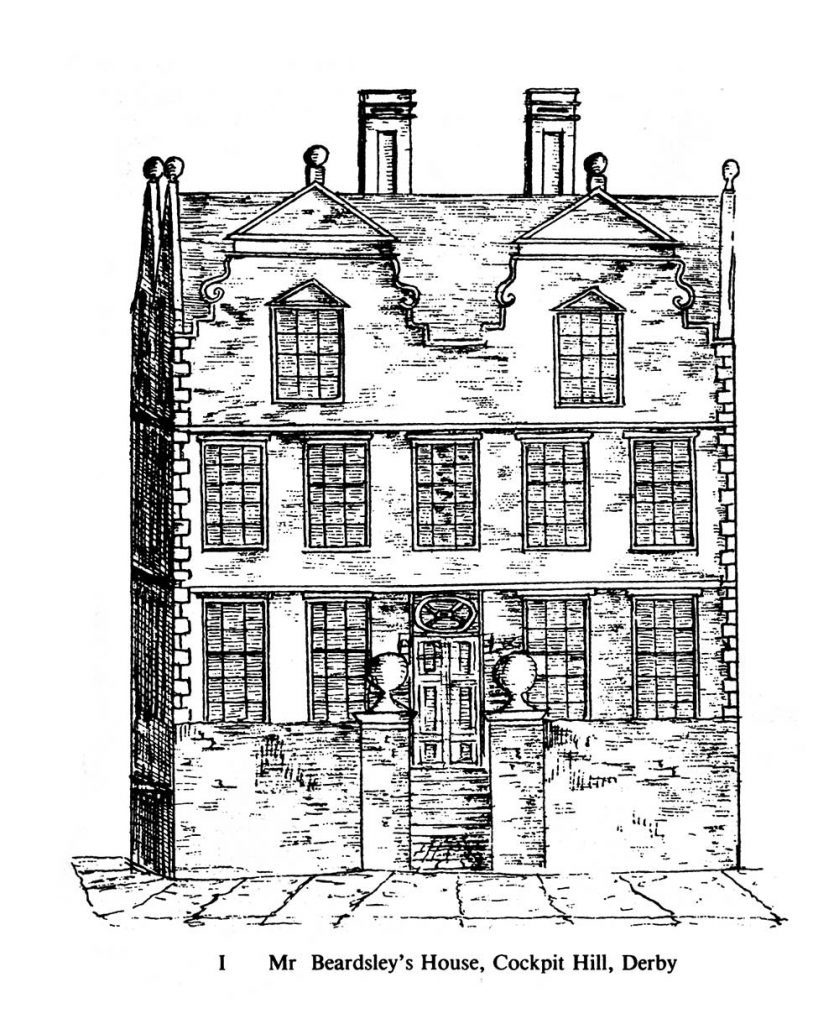
‘On the west side of the Mill Stream is a good house, built by Mr. Beardsley – on the side of a hill on which was formerly a castle still called Castle Hill, but by others Cockpit Hill.’ Written in 1713, William Woolley, Derbyshire’s first historian, of Cockpit Hill House. This enigmatic building suffers from having been demolished before the era of photography, so our only record of it is a sketch made by Woolley himself (not a particularly accurate recorder in this medium), and views included incidentally amongst the plethora of East Prospects of Derby painted or drawn of the Borough between 1695 and 1735. The house also appears in Glover’s History and Gazetteer of Derbyshire as a woodcut by Orlando Jewitt, an excellent artist, but as the house had by the date of first publication been demolished almost a decade, one wonders why it was included at all. Worse, Jewett was unable to draw it from life, so merely made a more workmanlike copy of Woolley’s drawing, thus adding absolutely nothing to our knowledge of its appearance. For all the difficulty of trying to understand what it looked like, there is much we can say of it. It was, for instance, a classic example of the Dutch style of architecture imported into this country after the Restoration and which underwent a revival with the accession of Dutch King William III in 1688, thanks to the desire of the Whig élite to trip over themselves to ingratiate themselves with the new regime: tall, compact and classical. The house was tall and narrow, like an Elizabethan tower house – Wothorpe, just outside Stamford springs to mind, Lincolnshire, as does Tupton Hall, described here a couple of years ago. It was brick built with stone dressings, of three storeys, five close-set bays of windows being grouped together on each of its four sides in stone surrounds with brief entablatures above each and quoins at the angles. We know from two of the East Prospects that the windows were of the mullion and transom cross type, with iron casements (as survive at the Green Man St. Peter’s street), but Woolley wrongly shows it sashed with three over five pane glazing bars. As Woolley’s sketch was probably done in 1712 and the two East Prospects are c. 1730, we have to conclude that Woolley may have made a quick sketch on site and then worked it up at home, giving the house its rather more modern windows in the process. There was a horizontal band between the floors and the second storey was treated by the architect as an attic (despite being full-height) to allow for a parapet from which rose on each side a pair of Dutch gables and the windows here given pediments. Most people call any shaped gable ‘Dutch’ but strictly speaking, they have to be topped with a pediment, as at Cockpit Hill House, where the gables were so treated and supported on curved volutes and topped with ball finials: very correct. Even more true to the Dutch idiom (although not at all apparent in Woolley’s drawing) was a flat top to the roof with a timber balustrade between the panelled chimneys surrounding a tall central lantern or cupola enabling guests to emerge and safely take the air after supper on the roof. Similar ones in Derby surmounted the roof of 3, Market Place (Franceys’s House, where Kieran Mullin is) and Flamsteed’s House in Queen Street. The best surviving example in the Midlands, although on a much grander scale, is the roof of Belton Hall (Lincolnshire); another, part of a house of very similar form to Cockpit Hill, is Lord Craven’s lodge at Ashdown, Berks., intended for Elizabeth, Winter Queen of Bohemia. Woolley’s drawing (and hence Jewitt’s) also endows the side elevation with straight gables, more probably because Woolley had not the draughtsmanship to express them), but we know from the East Prospects (and a South prospect, too) that the gables were Dutch ones all round. The classic views show the entrance gates in Morledge, with ball finials to the gatepiers and a fine oval toplight above the front door, lighting the hall. We have no surviving account of the interior, but taking our cue from similar houses, like Ashdown Park, we may be sure that it boasted fielded oak panelling, at least in the dining room, quite possibly frescoed ceilings, as at Franceys’s House – and therefore likely to have been the work of Derby’s own fresco painter Francis Bassano (1675-1746). We might also suppose an oak staircase with bulgy balusters set upon a string, and a general ambience of understated luxury. The grounds boasted parterres and a small pavilion at the river bank: idyllic in 1692 when the house was built, but progressively less so in the decades that followed. The builder was William Beardsley, a lead merchant with connections in Wirksworth, who married Rebecca Richardson and bought the site of the house, previously part of the grounds of the house near The Spot, latterly called Babington House, from William Sacheverell of Morley (whose town residence it was) for £180. We do not know who the architect was, but it could have been a London man, for Beardsley had trading connections on the capital. However, Beardsley had died without issue by 1715, when it was in the hands of the Sitwells of Renishaw, no doubt intended by them as a town residence, but by 1722 they had sold to Coventry-born Thomas Bayly (1695-1734), who was Whig MP for Derby from that year until 1727, having stepped in for William Stanhope of Elvaston who was temporarily absent abroad. His period in residence had seen the Derwent canalised by engineer George Sorocold to enable loaded boats to reach the Trent, which made access to the house’s garden across the river more difficult. On 25th October 1734 the Derby paper reported: ‘Yesterday morning dyed at his house on Cockpit Hill in this town Thomas Bailey [sic] Esquire who some years
In the footsteps of King Richard III
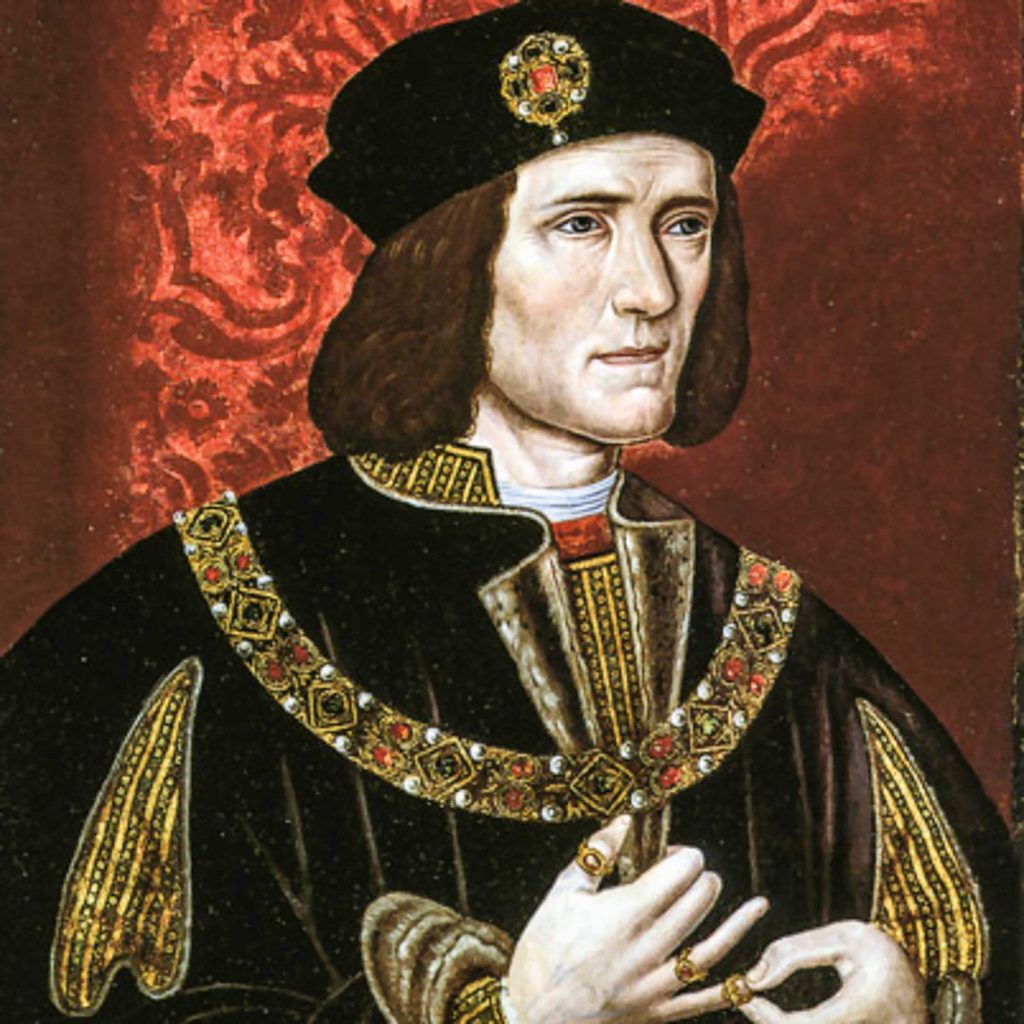
While we know the central and western parts of the Yorkshire Dales, the eastern edges alongside the Vale of York are, to say the least, a bit hazy to us. After doing a bit of research, we found that Richard spent his childhood and trained in knightly skills at Middleham Castle in the lower reaches of Wensleydale. These skills helped him take part in the battle of Tewkesbury (1471) aged just nineteen. It was at Middleham that he met and married Anne, younger daughter of the Earl of Warwick, head of the influential Neville family. Through that marriage young Richard eventually became owner of a whole range of castles, especially those guarding the eastern approaches to the Yorkshire Dales. It therefore seems likely that Richard had a special affection for Middleham, because he appears to have spent much time there, both in childhood and then as a family man, where his son Edward was born. It was this that coloured our decision to make a tour of the countryside Richard would have known so well. Our accommodation in Middleham was an attractive one-time cosy cottage in the shadow of the castle walls. Today, Middleham is home to around 500 young racehorses training for future glories on the flat. Each morning we watched them elegantly trotting away from the village, out towards the training gallops on the nearby Downs; perhaps we were admiring a future Derby winner. Middleham and its friendly locals, most of them involved with racehorse breeding, were always ready to chat over a socially distanced pint of Black Sheep in one of the three pubs; our favourite incidentally was the Richard III. The castle is just off the extensive old market square and is cared for by English Heritage. With the easing of lock-down the castle was open to prior bookings. As there is little or no Wi-Fi in Middleham, that took time, but we eventually managed to book a convenient visit. The castle has suffered as a ready-made source of building material over the centuries, but it still remains in remarkably good shape for its age. Three parts of the outer curtain wall are complete and the central keep could still echo with the sound of feasting lords and ladies enjoying life. There is a modern statue to King Richard inside the castle walls, but his most intriguing memorial is the worn lump of rock on a plinth at the top end of the market place. Although it takes more than a bit of imagination, this is all that remains of the carving of a wild boar, King Richard III’s emblem. Monasteries were at the height of the commercial power and influence during Richard’s lifetime. With their wealth built on wool and careful farming husbandry, lands around the Vale of York are home to a great number of monastic ruins. Attractive ruins the result of Henry VIII’s jealousy, are within easy driving distance of Middleham. We started our tour at Jervaulx Abbey, a short drive along the Ripon road from Middleham. Small by comparison with other abbeys, Jervaulx has attracted visitors over the centuries; the artist JMW Turner came this way while on a sketching tour in 1816. The main claim to fame though, is down to the early monks making the very first Wensleydale cheese. This forerunner of the cheese loved by Wallace and his faithful hound Grommit, was made from ewe’s milk, unlike today which traditionally is made from cow’s milk. Further along the Ripon road, the village of Masham is home to two breweries, both of which can be visited when things are different than today. Theakston’s is the oldest, dating from 1827, and Black Sheep Brewery is the other. Black Sheep was founded by Paul Theakston, fifth generation of master brewers in 1992 when the older company was bought out by one of the national brewing organisations. Travelling via Ripon, we arrived at Fountains Abbey bang on our previously booked time. The abbey is in the bottom of a wooded valley, secluded from car parks and Visitor Centre, but separated only by half a mile of winding path. If there was a competition for the most beautiful abbey ruins, then Fountains would be high on my voting list. No matter how many visitors there might be around once restrictions are removed, Fountains will remain a place of tranquil beauty, a place for quiet contemplation. It was founded in 1132 by a group of 13 disaffected monks who broke away from the mother church of St Mary’s Abbey in York. Here at Fountains they found what they were looking for, hidden from the world in a wild and wooded valley where living an austere life, they could follow a simpler and more devout existence. Members of the Carthusian Order, they were also known as the ‘white monks’ because of the undyed sheep’s wool habits they wore. Spending much of the day in contemplation and prayer, they also found time to develop skills as shepherds, tanners, master-builders and brewers. All these skills helped expand the abbey’s finance’s. By 1200 Fountains was one of the largest and most powerful houses in Britain. Despite damage by Henry VIII’s men who followed his dissolution edict, many of the abbey’s features remain virtually unspoilt, such as the gracefully arched cellars where freshly brewed ale was stored, to the appearance of its almost Victorian Gothic bell tower. A culverted stream which once provided water for the abbey’s needs, winds down the wooded valley for a little way before being slowed by a series of ponds and water gardens. This is part of Studley Royal, an attractive addition to Fountains Abbey created by John Aislabie and his son William in the eighteenth century. John was an over ambitious politician who fell from favour. As a result he retreated here and along with William, the pair managed to buy Fountains Abbey and set about designing the water gardens where their elegantly attired guests could stroll at leisure while
Crich Tramway Village

Recently it has become almost fashionable for major cities to bring back trams to their streets. Some like say Manchester, have done it with the minimum interruption to normal street traffic. There, it was managed by mainly using defunct railway tracks, but in other places the radical idea of reinventing a long gone system of transport developed into a political shuttlecock.  Mainly because of spiralling costs and also the prospect of snarled-up roads well into the foreseeable future prompted both Nottingham and Edinburgh to drastically amend their individual schemes. Only time will tell especially in Edinburgh, if the apparently chopped-off tracks currently puzzling observant by-standers will eventually continue along the way to their planned termini. Tramcars developed as a means of mass transport for commuters and shoppers living in the crowded towns and cities expanding to meet the demands of the Industrial Revolution. They filled that need perfectly until motorised transport began to compete for space on the narrow roads laid out in more leisurely times. As a result trams disappeared off the streets at a rapid pace, a pace some forward thinking people thought was too much and too soon. No longer do the behemoths of yesterday clatter and spark along wet cobbled streets, but fortunately many of them were saved from the breaker’s yard and, carefully restored can be seen moving at their stately pace at the foot of Crich Stand. Only Blackpool kept its trams, making them something of a tourist attraction. The founders of Crich tramway village and museum could not have chosen a more perfect site, both scenically and historically. Set amidst trees on a high ledge overlooking the southern corner of the White Peak where the Derwent carves its majestic way south, the view must be one of the finest in Derbyshire. Historic connections go back to the early days of the railway network. This was when George Stephenson towards the latter part of his career built a network of narrow gauge railways from Cliff Quarry down to lime kilns at Ambergate. It is one of his tracks that now bears the weight of the trams trundling along from the tramway village to its terminus above Wakebridge. The friendly co-operation of the current quarry owners has allowed a worked out section of quarry floor to be used as a car park. From the entrance kiosk and, armed with our old currency pennies later to be exchanged for as many tram rides as we wanted, we walked the few yards down into the tramway village and so stepped back in time to the 1950s, or earlier. It is hard to realise that many of the buildings and even the cobbles beneath our feet have seen service in towns around the North Midlands. Now housing a video theatre and historic tram displays, the most imposing building is the sandstone façade of the elegant Georgian Derby Assembly Rooms, salvaged from a disastrous fire in 1963. At its front in what could pass as an Edwardian town centre, Town End as it is now called, is the main tram terminus. Dotted around amongst other last century artefacts are an old rectangular telephone box complete with its still working A & B buttons and a Police Sentry box. To the right is the Eagle Press where hand-set printed leaflets are produced to order, with much hissing and thumping of a beautiful piece of machinery. Next in line is Frederick’s Ice Cream Parlour, then Barnett’s Sweet Shop complete with its jars of sticky offerings, alongside a display of wartime rationed tins of food with their paper-saving half labels. For a good cup of tea there is nothing to beat Rita’s Tea Rooms, a cafe that must surely have once adorned the semi-rural edge of some Midlands town. Below it and offering something stronger than tea is the Red Lion, a pub rescued brick by brick from the Stoke on Trent developers. There was a tram waiting at Town End as we emerged from Rita’s cafe, so we decided to save the exhibition and workshops until later. This tram turned out to be one of Glasgow Corporation’s 1940s vintage models. Resplendent in its cream and brown livery I must admit to a feeling of insecurity as we reached our wood-slatted seats. My memory of Glasgow trams goes back to the days when I passed through on my way to climbing trips in the Highlands. It seemed to me that each trip was marked by the memory of one of these monsters lying on its side in some Glasgow side street. I mentioned this to the conductor when he came round and much to my amazement he was fully aware of the problem and was quick to assure me that it wasn’t the trams that were faulty, but the fact that many sections of the Glasgow network had bends too tight for the trams then operating. Parting with our pennies and half pennies, we were given tickets validated by a 1920s ticket punch and were told to hang on to them as they gave us the right to travel on as many trams as we wanted. Clanking and swaying our way up the track, passing beneath the ornate Bowes-Lyon Bridge from Stagenoe Park in Hertfordshire, one of the estates belonging to the Queen Mother’s family, we made our way to the track end above Wakebridge. Trams don’t need to do a three-point turn, the driver simply walks from one end to the other and, after the trolley pole is turned round and reconnected to the over head cable, with the odd spark creating much amusement to young time travellers, the vehicle is ready to start its return journey. We stopped off at the Glory Mine to visit Peak Historical Mining Society’s excellent display, and then walked through the tree-lined glade opposite to marvel at the array of wood sculptures, such as the massively realistic giant ant; inverted root heads have been turned into yet more green men, or
Product Test – Paula’s Choice

Paula’s Choice Calm Repairing Serum, £33 This silky-soft serum soothes sensitive skin and calms redness with a gentle yet powerful blend of antioxidant plant extracts and skin-replenishing ingredients. The concentrated anti-ageing formula minimises the appearance of wrinkles while leaving skin soft, hydrated and calm. What are the key ingredients? SEA WHIP EXTRACT Extract from the sea that has skin-soothing properties, especially suitable for sensitive or redness-prone skin. CERAMIDES Major components of skin’s outer layers, necessary for their water-retention capacity and provide replenishing and restoring benefits. BETA-GLUCAN Excellent ingredient for improving the look of redness and other signs of sensitive skin. It has some antioxidant properties and is a skin-soothing agent Paula’s Choice Calm Nourishing Cleanser, £20 This lightweight gel cleanser for normal to oily skin gently removes excess oil and make-up. Skin replenishing ingredients work to soften and soothe red, irritated skin, making it perfect for the most sensitive of complexions. Paula’s Choice Calm Mineral Moisturizer SPF 30, £30 This gentle daytime moisturiser replenishes dry, sensitive skin while shielding it from daily sun damage with mineral-based sunscreens. A redness-minimising blend of soothing plant extracts, antioxidants and peptides works to calm sensitive skin so it looks visibly younger and feels healthier. Tried & Tested :: Tried & Tested :: Tried & Tested :: Mineral Moisturiser Very cool and calming, a gentle product with reassuringly natural ingredients. I did find it made me look a little pale, but if you need to calm any redness down this would be perfect. Ideal for use in the summer months as it has a high SPF of 30. Repairing Serum After about 2 weeks I could tell the difference using this product. My skin looked smoother and did seem a little less sensitive which is great! VP 00
Celebrity Interview – Val McDermid

Her books have sold 16 million copies worldwide, been translated into 40 languages and recently her work topped the fiction, non-fiction and children’s book charts all in the same week. But Val McDermid isn’t sitting back basking in her success: she’s always looking for new challenges. The 64-year-old crime writer is working on her next thriller, she’s been commissioned to write a play and she’s developing a graphic novel. Apart from that, she’ll be speaking next month at Derby Book Festival and she’ll also be “murdering†songs – not my description – with her band Fun Lovin’ Crime Writers. She will no doubt be promoting her current paperback, How The Dead Speak, the 11th book featuring clinical psychologist Tony Hill and police detective Carol Jordan. Val will probably talk too about her next release, the sixth involving cold-case detective Karen Pirie, which is due to be published in August. ITV is working on a dramatization of the Karen Pirie novels although there is no date yet for transmission. It will do well to match the popularity of one of Val’s earlier TV series, Wire In The Blood, which was first broadcast from 2002 until 2009. It starred Robson Greene as Hill and Hermione Norris as Jordan. Val thinks ITV did a really good job with the series: “I thought Robson Greene was a very good Tony Hill. I thought the scripts were great, as were the production values. “It’s still running on TV now, people still watch it. People Tweet me: ‘I’ve just discovered Wire In The Blood, I think it’s amazing.’ If you look at it now you see a lot of things we pioneered that have been picked up subsequently by other crime series.†Some of Val’s readers might be wondering why more of her work hasn’t transferred to the small screen. She says it’s the luck of the draw. “All my books have been optioned pretty much at one time or another. Some have got made, others haven’t. “I had a series called Traces at the end of last year on the Alibi channel. I created it, did the storyline and Amelia Bullmore (actor who appeared in the crime series Scott & Bailey) wrote the scripts. That was the most successful drama Alibi have ever shown.†Val says she likes to be involved when her work is turned into television but she realises she can’t exert control over how it appears. “it’s a completely different medium and they have different storytelling values and different ways of telling stories. “What you can do is work with people that you trust. I’ve said ‘no’ plenty of times because I didn’t like the people or I didn’t trust them or I thought they didn’t get what I was trying to do.†She adds: “Ultimately what you want is good television. It doesn’t have to slavishly follow the books, it has to have the same sort of ambience as the book. What you want is for someone to make a good television series that brings more readers to your books because ultimately it’s about getting people to engage with the books which of course are much more dense, much more complex than the television series because you can’t compress 400 pages even into six hours of television and not leave stuff out.†Val is renowned for her gritty novels and some commentators refer to her descriptions of violence. But when I bring up this part of her work she lets out a deep sigh and maintains that it is merely one strand. “The Tony Hill and Carol Jordan novels deal very directly with the nature of violence, what it is and the effect it has on people. “Every week in this country three women are murdered by their partners. There’s serious sexual violence around us all the time and ignoring it is not going to make it go away. I think we have to deal with the world as it is, not as we would like it to be.†Val McDermid was born on 4 June 1955 in Kirkcaldy, Fife to a working-class family. She was the first student to be admitted to St Hilda’s College, Oxford from a Scottish state school. After graduating in English she became a journalist, working for 14 years on national newspapers in Glasgow and Manchester. She started writing her first novel, Report For Murder, in 1984. It was published three years later. It wasn’t until 1991 that she finally gave up her day job. Val has so far published 32 novels. She mainly writes four series featuring Hill and Jordan, Karen Pirie, journalist Lindsay Gordon and private investigator Kate Branningan. There have also been nine stand-alone stories. She has penned two books of short stories, three non-fiction works including a picture book for children called My Granny Is A Pirate and a couple of radio plays. So what drives her on to keep coming up with new projects? “I like to take on new challenges. That’s how I keep interested in what I’m doing. I couldn’t just write one set of characters. I don’t understand how people can keep one single series going all through their career and never write anything else. “I have a very low boredom threshold I’m afraid. I can’t write two books back to back with the same characters. So I try doing different things and when the opportunity arises I’ll grab it with both hands.†Just like Agatha Christie, Val has been dubbed the queen of crime, something she’s not entirely comfortable with. “It’s very flattering but it’s also quite embarrassing really, particularly since I’m a republican. One journalist called me the shop steward of crime which I find much more satisfying in many ways.†Away from her keyboard Val divides her time between south Manchester and Edinburgh where she lives with her partner and son. She is a staunch football fan and sponsors the shirts of Raith Rovers, “the mighty Raith†as she calls them, who this season
Lost Houses of Derbyshire – Hazelbarrow Hall, Eckington

Like Norton, about which I wrote last year, Hazelbarrow – part of Norton in my opinion, but according to Historic England belonging to Eckington – is one of those places which were included in the considerable chunk of our county which was appropriated by the City of Sheffield in 1936 to boost rate income. Hazelbarrow Hall, which Joseph Hunter described as a ‘good old mansion’, was a particularly venerable house, built in the 16th century (probably the 1570s) on an H-plan: that is with a central great hall with entrance offset to one side, flanked by a pair of cross-wings, quite long to the south (entrance front) and ending in coped gables. Of two storeys and attics, the house was constructed of ashlar, partly of coursed rubble and with ashlar dressings of coal measures sandstone, and latterly with a slate roof, although undoubtedly built with a rood of stone slates. At the rear there was a stair tower containing a stone newel staircase, and an entrance there was equipped with a depressed four- centered arch in true 16th century style. The entrance was not only offset from the centre of the 4 recessed great hall part, but was via an attached and gabled two storey porch facing across the courtyard, rather like one at Whittington Old Hall (now vanished and about which we will write in the future), and also at Barlborough Old Hall, although the latter, housed in a crenelated porch, is now plain. The windows were mullioned and transomed, superimposed eight-light ones gracing the gable ends of the cross-wings with cranked hood moulds, and un-transomed four-light windows to the central section and porch, whilst the attic windows were simple two-light mullioned ones, but still with hood moulds. Ancient panelling apparently survived within, and a bowling alley was listed in a survey of 1635. The surviving picture (a painting by Miss Pearson of Norton Vicarage done shortly prior to demolition in 1810, and an ink copy by John Fenney Parkin of Sheffield) makes the house look pretty modest, but as tax was paid on eleven hearths in the 1670 Hearth Tax Assessment, it was in fact, bearing in mind its age, getting on for medium sized for a typical Derbyshire Gabled manor house. The estate was small but ancient, having originally been held by a family who took their name from the estate, but an heiress transferred it briefly to a Lincolnshire family from whom it was purchased by Robert Selioke before 1313. The Seliokes were a local family, taking their name from Selloak in neighbouring Cold Aston, a locale now remembered in Selloak Spring Wood. Indeed, their coat-of-arms includes three oak leaves proper (i.e. in their natural colour), a herald’s take on their surname. These may be seen on an alabaster grave-slab in the church at Norton, which came to light during G E Street’s alterations in the 1880s. His descendant in the ninth generation, William son of George Selioke, was the supposed builder of the house, but his son mortgated the estate in 1587 to William Dickenson of Sheffield who, after the foreclosure of which, sold it to Peter Frescheville of Staveley Hall, who let it to a family called Beverley, The heiress of Frescheville’s son 1st Lord Frescheville, disposed of it in 1635 for £2,450 to Anthony Morewood of the Oaks, the neighbouring estate. Somehow, it has a habit of continually changing hands: in 1670, the Morewoods sold it to lead merchant John Storey (who paid the hearth tax), from whom it passed on his death only four years later to John Wingfield (1651-1732), a descendant of the Wingfields of Leatheringsett in Norfolk and thus distant cousins of the Irish Viscounts Powerscourt. A forebear had obtained land in Derbyshire by marriage with a coheiress of Sir Robert Goushill of Barlborough and John’s mother was the sister-in-law of Lord Frescheville’s co-heiress, demonstrating that the new owners were very nearly ‘family’ after all! Wingfieold made various improvements to the house, including the provision of a pair of imposing rusticated gatepiers with large ball finials, the centrepiece of an ornamental timber screen which ran across the front of the house (like the surviving iron one in front of nearby Beauchief Hall) to enclose a cour d’honneur and an ornamental garden. The heiress of John brought the estate to her husband, Robert Newton of Mickleover – and also of Norton House, whom we met when that lost house was being described. With the death of their son, Robert, unmarried in 1790, the Newtons let the house to the Jenkin family. His heirs included William Cunliffe-Shaw whose daughter Priscilla carried the estate to her husband Wingfield Wildman, whose mother had also been a Wingfield of Hazelbarrow. Wildman’s daughter, Harriet who in 1810 terminated the lease of the tenant Edward Jenkyns and pulled down the old house, this in spite of Robert Newton’s will specifying a legacy of £2,000 ‘to lay out and expend on improvement of the said house and place’. The site, I am told, lies just to the north of the farm, partly covered by tree planting. Harriet’s heirs continued to own the estate throughout the 19th century, and had developed the closely adjacent home farm, in the rebuilding of which, a mullioned attic window and a Gothic doorcase were incorporated, whilst numerous pieces of walling were retained, along with the imposing gate piers which John Winfield added in the 1680s and which now rather prosaically provide a grand entrance to the stackyard. The group, including the gatepiers, are now (with the farmhouse) listed grade II by Historic England. As regards the present century, the City of Sheffield, once possessed of the parish, proceeded to buy the farmhouse and the remaining estate (by then 250 acres) ‘as part of the green Belt’, which, miraculously, it has remained, with the farm still tenanted and worked. 00
Walk Derbyshire – Holymoorside

DISTANCE: 3½miles (5.6km) of easy walking along farm lanes and woodland, plus by-roads and side lanes. RECOMMENDED MAP: Ordnance Survey 1:25000 scale Explorer Map, Sheet 269, Chesterfield & Alfreton. PUBLIC TRANSPORT: Stagecoach X17 from Matlock. CAR PARKING: Roadside on Belland Lane, connecting the A632 Matlock/Chesterfield road to the B5057 Darley Dale /Two Dales road. REFRESHMENTS: Bull’s Head in Holymoorside and Peak Edge Hotel near Stone Edge. High fields Farm Shop and Restaurant about a quarter of a mile to the west (Darley Dale Side) of Belland Lane is highly recommended. This short walk visits Holymoorside, one of Chesterfield’s satellites, a little bit of rural attachment left behind when the Industrial Revolution swept across the north Midlands.  Apart from a street name, nothing remains of the one cotton mill that was powered by water from what is now the local duck pond. There was even a short-lived silver mine, but this failed a long time ago. What we do have from time gone by, are a couple of strategically placed pubs and a popular farm café, all within striking distance of the walk, whether it be at the start, or around the half-way point. Holymoorside village lies below the eastern edge of Beeley moor. The village has many tales associated with its isolation. Local legend has it that there is a tunnel from Chander Hill Farm just off the Chatsworth Road, passing under Holy Moor to reach Harewood Grange, once a monastic farm. Despite all these myths and legends, there has never been an explanation of the term Holy Moor, or Holymoorside. There are two ways to start the walk, the first and the main one described in the text, starts and finishes on Belland Lane just off the Darley Dale road near Stone Edge. The alternative uses public transport; the X17 Stagecoach Matlock/Chesterfield/Sheffield service from Matlock. Ask to be dropped at the Stone Edge stop on the A632 and follow the woodland path starting directly from the bus stop up to and across the golf course. This path joins the walk near the club house. The return bus stops opposite the point where the Bage Hill/High Lane road meets the A632 Chesterfield road. Belland, or Belond is an old Derbyshire word for the disease cattle caught by grazing on grass contaminated by lead – there was a smelter nearby, its chimney still stands, a lonely sentinel on the adjacent skyline.  The local pronunciation of Stone Edge is Stanage for some reason. THE WALK 1 From the car parked carefully on Belland Lane, walk down to the B5057 Darley Dale road and cross. The lone stone chimney over to your left on walking down the lane, is the tangible remains of a lead smelter that once stood here. The fumes would pollute the surrounding land, poisoning grazing cattle, giving them the Derbyshire disease called ‘belland’. 2 Follow the narrow lane opposite, down past a group of stone farm buildings and continue towards woodland to your front. 3 continue to follow it until it passes the club house of Stanage Golf Club. 4 The alternative route joins the main at this point (see end of main description). 5 Walk on past the club house, continuing forwards for about 100 yards when the lane turns left towards a group of farm buildings. Go forwards on a grassy path. 6 Look out for a sign post beside a small hut and turn left on a path leading towards woodland. Follow this along the edge of the trees and then into them. 7 At the far side of the woods, follow a track along the right hand side of them. 8 When the track reaches a farm lane, turn right along it and follow it up to the farm. 9 Reaching the farm, turn left on to a path and follow it with more woodland on your right. 10 When the path reaches a track, continue forwards, downhill to a pond. 11 Walk round the edge of the pond until the track reaches houses on the outskirts of Holymoorside village. 12 Turn left to reach the Bull’s Head. 13 With the pub on your left, walk back up the road and climb the section called Cotton Mill Hill. 14 Look out for an un-signposted road junction and turn right on to Bage Hill. Follow this for about a mile. There is no footpath, so walk on your right hand side of the road and take a careful look out for traffic. 15 In about three quarters of a mile, the road forks. Turn right and walk on until this road bears sharp right at a pair of houses. If using the bus ignore the next set of instructions and climb up to the main road. Cross over in order to stand at the stop for Matlock. The X17 Stagecoach service is hourly. 16 For the main walk, do not pass the houses, but turn right immediately before them and go through a wooden stile. 17 Walk forwards on a footpath towards the golf club, taking care not to encroach on the fairways. 18 Reaching the club house, walk on along the narrow lane back to the Darley Dale road and cross it to reach Belland Lane. 00
A Passion For Mosaic
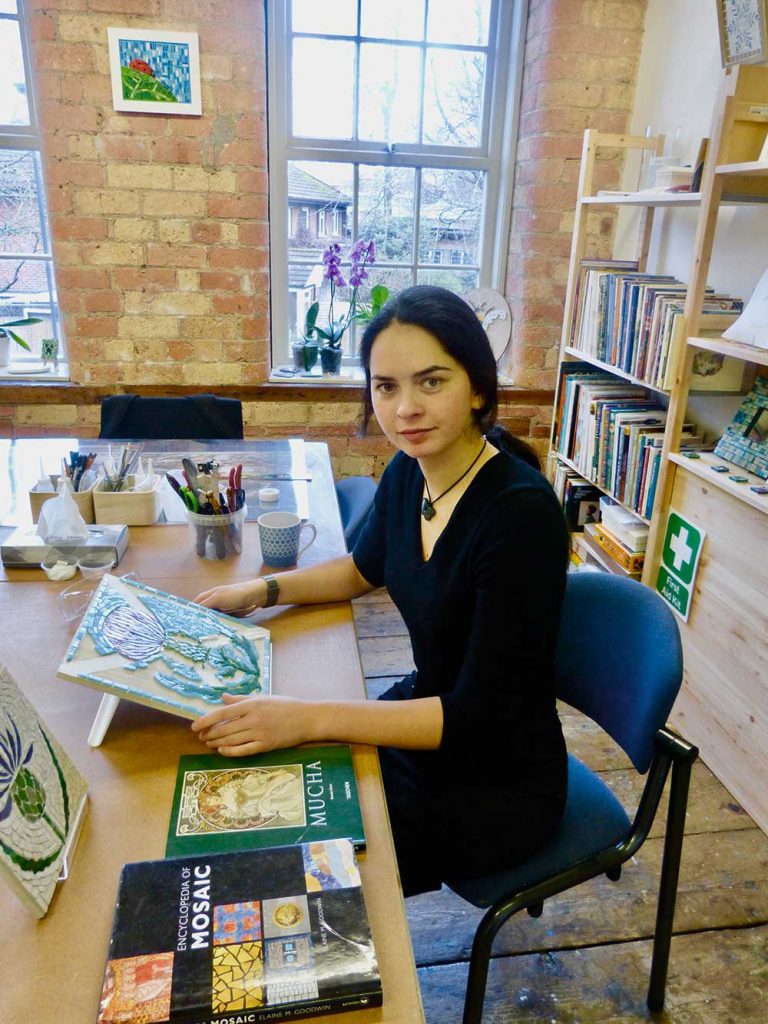
Although it’s a while since I waved a hot glue gun in anger, I’m confident I could give craft queen Kirstie Allsopp a run for her money if only I had the time, money and patience to follow basic instructions. Sadly, my previous attempts at crafting – toy making and calligraphy – only left me with a scar on my thumb and ink stains I’ll never get out of my dungarees. But putting aside my husband’s complaints that my homemade Fox Terrier project was a waste of good pipe cleaners; I decide to have one more stab at mastering a craft without having paramedics on stand-by. Thanks to the handmade boom (the £3bn UK craft market is currently growing by 4.5% a year) it really is possible to learn the basics of most crafts via workshops. Although I was tempted by batiking in Belper and weaving woodland animals in the Peaks, I reached out to multi-media artist and animator Magdalena Aron (30), because her motto ‘If life gives you broken pieces, make a mosaic,’ appealed to both my artistic soul and my clumsy fingers. “Don’t worry,†Magdalena reassures when I tell her about the unhappy hour I’d spent unravelling thread from my sewing machine after completing a six-week sewing course. “We will be making heart-shaped mosaic but I can adapt the class to suit all levels from absolute beginners to professional artists.†Transylvanian-born Magdalena has loved mosaics since visiting historical sites in Italy when she was a teenager. Her initial stab at mosaic, a beautiful self-portrait, re-ignited this passion and eventually led her to set up Minoan Mosaic Studio in July 2019. Since then, she’s on a personal crusade to breathe new life into this 3,000-year old discipline. In addition to Magdalena’s own projects, she sets aside regular Sunday mornings to host workshops for children and adults creating everything from decorated vases to Faberge-style eggs (workshops usually cost £25-30 for a session). “Even people with no drawing or painting skills can be successful with mosaics,†Magdalena says. “I think the outcome of mosaic is more predictable than say painting and will teach patience and calm like no other medium. It’s so rewarding when tiny tiles come together to make a story. Once you try it, and find out how amazing it is, you’ll become addicted.†The smiling faces of fellow students together with a large cup of Italian coffee does much to allay my pre-craft nerves. Most of the attendees at Magdalena’s stunning workspace in Bank Mill Studios, Derby, have done previous workshops and they are potty about mosaic. “I’ve made a heart before and a thistle,†says Angie Bethwaite, of Littleover. “I’m hoping to make something different and don’t mind if it’s something challenging or fiddly. I’d love to make a butterfly.†It’s a tribute to Magdalena’s teaching prowess (as a freelance instructor, she’s taught a variety of art and ceramic classes to children and adults over the past six years) that she doesn’t raise an eyebrow when others decide to do their own thing. She’s equally enthusiastic when Anna Pearman, of Borrowash, prepares to make a mosaic replicating patterns in her mum’s Persian rug. “I think we’ve all got the urge to be creative,†Anna says as she starts work on the intricate mosaic she intends to gift to her mum. “I tend to devote my weekends to learning a craft. That’s why I love my weekends so much.†Before we are allowed to get too creative (we are all giddy with the excitement of rifling through the delicious assortment of candy coloured tiles) Magdalena gives us a safety briefing on how to handle the tools of the mosaic trade. “You have to be careful as chips can fly everywhere,†Magdalena says handing out safety goggles. “Even into your coffee so don’t leave cups on the table. It does happen, I was cleaning up after a session with a soft brush and a little piece flew into my eye. Keep the glasses on when cutting and use tweezers to pick up glass to avoid cuts.†“It reminds me a bit of the welding course I once did,†Pauline Axby, of Sawley, laughs as she adjusts her goggles. “I can tile a wall so I might be able to put my skills to good use today. I’m also going to make a butterfly because I have the perfect spot for it at the top of my stairs. I love anything to do with nature.†Although I stick to the allotted task – decorating a pre-cut heart – I decide to add a flower cut from opaque glass using a wheeled nipper (a fancy tile cutter). Thanks to Magdalena’s calm encouragement, it’s all done without loss of any fingers. “It’s a lovely thing to do and in such a friendly atmosphere,†Jenny Woolley, of Mickleover, observes as we get busy with our nippers. “Everyone should make space in their life for crafts, it’s so relaxing.†Jenny is spot on. I didn’t expect the mood to change so quickly from one of skittish excitement to sheer calm. When Magdalena suggests we break for coffee and cream cakes, she almost has to click her fingers to get us back into the room. “After teaching art to people for years, I can often see the positive effect on people’s moods. It’s like a yoga class for the mind,†Magdalena concludes. “It’s even more beneficial learning in a group as people support and inspire each other. I think we’ll live to see a day when people view art’s centres in the same way as they do the gym; one exercises the body, the other the mind.†The positive effects of crafting certainly resonate with Gerry Henegan-Barr, a professional artist and holistic therapist from Nottingham. “My mum was big on craft. She had five children in total so I think making things gave her an outlet from the family and much-needed time on her own,†Gerry recalls. “I also find arts and craft help
Tried & Tested – Nourish with Diptyque

Fresh Lotion For The Body £36 200ml Cool, fluid, pleasing. The bright scent of Orange Blossoms. Like a morning breeze that awakens the bay of Alexandria, this lotion refreshes sleepy skin, leaving it soft and replenished. Smoothing Body Polish £48 200ml Sumptuous, rich, regenerating. “Queen of All Fruits†the bountiful pomegranate from Carthage is brimming with virtues. This unique body polish provides twice the benefits: delicately exfoliating dead skin cells while generously restoring a supple, resilient look and feel. The Formula: Pomegranate Seed Oil, rich in fatty acids and antioxidants, moisturizes and protects the skin, leaving it soft and silky. Jasmine Floral Water is a natural antiseptic that gently purifies the skin and activates cell renewal. Peach Butter comforts and nourishes the skin, making it extra supple. The Fragrance: Spiked with the crisp, fruity notes of Pink Peppercorns and Peach, Jasmine Sambac is delightfully tender on the skin. Revitalizing Body Balm £52 125ml Silky, invigorating, nourishing. This moisturizing cream absorbs almost instantly, leaving the skin soft and smooth as satin. Blood orange stimulates and invigorates the entire body. The Formula:Blood orange oil extract stimulates and invigorates the skin, leaving it soft and supple. Sesame oil, rich in essential fatty acids, helps the skin restructure and renew itself. Moringa oil revitalizes the skin, revealing its radiance. For more information and to buy online visit www.diptyqueparis.com/en_uk Product Test Smoothing Body Polish I love the product packaging for the polish. The polish itself smells absolutely luxurious and divine. It rubs on well to your skin and leaves such softness behind it’s well worth using. VP Revitalizing Body Balm This feels a truly luxurious balm, with a beautiful fresh fragrance. I used it regularly after showering and was surprised how quickly it melted into my skin. My hands too felt the benefit especially after the winter winds. JP Fresh Lotion The fragrance is absolutely delicious, fresh and lively. The cream I found really softened my skin and was easily absorbed and long lasting. A beautiful, luxurious product. CB 00