Lost Houses of Derbyshire – Appleby Hall
It is astonishing how many country houses and estates were lost to Derbyshire in the boundary adjustments of 1888 and 1936; in this column we have visited several, including Measham and Willesley Hall, Norton House, Hazlebarrow with others. As they had been part of Derbyshire for about 900 years prior to their unwilling transfer, I for one continue to regard them as Derbyshire country houses, lost or not. One of that plethora of islands of Derbyshire marooned within the borders of Leicestershire and lost in 1888 (in exchange for which we gained only Nether and Over Seal in this area) was the delightful village of Appleby. Appleby Magna lay partly within our county whilst the subsidiary township of Appleby Parva was mainly in Derbyshire. Anciently the manor belonged to the Applebys, whilst an estate that included the Derbyshire portions of Appleby Parva came to the Vernons of Haddon. Whether the latter had a manor house there, like the splendid moated remnant of the seat of the Applebys, still standing in Appleby Magna, seems unlikely. In 1598 a man called Charles Moore purchased much of the old Vernon estate, to which was added two decades later further land along with part of Norton-juxta-Twycross by his homonymous son. Although the old histories, like William Woolley describe the family as ‘of mean account’ this was clearly not the case, mainly because both Charleses had the money to buy the land in the first place, the elder having lived previously at Stretton-in-Shirland, and because the family, who began indeed as farming stock in Lancashire, were then London merchants. The second Charles’s younger son was Sir John Moore, Lord Mayor of London 1681-1682 and Tory MP for the City of London, a man who enormously increased the family’s wealth. Sir John’s father or elder brother (a third Charles), seems to have built a manor house, but lived at Snarestone, letting it in the 1670s to Henry, the newly married son and heir of Henry Kendall of Smisby Hall, and on which he was taxed for 13 hearths, indicating that the house was of moderate size. Unfortunately, we have no evidence of what it looked like, although if the precedent of Sir John Moore’s Grammar School nearby, designed by Sir Christopher Wren (albeit somewhat diluted by the dubious talents of Sir William Wilson), is anything to go by, it might have been very handsome. John Nichols’ History of Leicestershire informs us that it was pulled down in 1770 and became the site of its successor. In 1775, Charles Moore of Appleby FRS (again, a non-resident) died without issue, having five years earlier demolished the family seat. His uncle Thomas had living in Appleby manor house, but died in 1762 leaving an elder son, Revd. Thomas Moore, who built in a new house in 1770 called The White House, illustrated by Nichols, but which stood to the NE of Appleby Magna, safely in Leicestershire (hence Nichols’ inclusion of it.) Thomas too died without issue in 1795 upon which the estate came to his half-brother George Moore, later High Sheriff of Leicestershire. He set about building a new house on the site of the previous manor, at first called Appleby House. The contract still exists in family hands for its building, signed by the architect/builder Thomas Gardner of Uttoxeter, a former colleague of Joseph Pickford of Derby, who oversaw on his behalf the erection of Etruria Hall, works and workers’ village for Josiah Wedgwood. At the time, Gardner was building the hall nearby at Thorpe Constantine for the Inge family, who still have these plans and elevations. It was thanks to the late Ambrose Moore that I was able to see the contract for Appleby, which was estimated at £1,861, and to his much-missed son Peter that I was able to glean further information. The document makes it clear that the house was more or less as photographed in Edwardian times; of ashlar coal measures sandstone, two and a half storeys high with a south front of five bays, the central one being embellished by a pediment supported on attached Ionic columns flanked by matching pilasters, with a heavy-looking tetrastyle portico at ground floor level in baseless Doric. The parapet was supported upon a grooved entablature and there were antae (plain broad pilasters) at the angles. The east front consisted of two shallow bows with tripartite windows on the ground floor and first floor in the centre only. The north front was of but four plain bays and was otherwise unembellished although throughout all the windows were set in moulded surrounds. This handsome and modest sized house stood in parkland perhaps landscaped by William Emes, part of an estate that then ran to 3,778 acres. The house was a more elaborate version of Barton Blount, completed by Gardner for Derby banker Samuel Crompton a few years before; many of his larger houses are much more austere as, indeed, Thorpe Constantine and Loxley in Staffordshire. Inside, decoration was restrained with good chimneypieces but there was a magnificent top-lit cantilevered Hopton Wood stone well staircase rising throughout the house in its centre, with an iron rail almost identical to that at Barton Blount. A contemporary lodge was built to the west on New Road – essentially the original road south from Magna but re-aligned to allow the parkland to be laid out. Gardner also designed the elegant red-brick rectory nearby which, happily, still survives. The lodge was raised by a storey post war, and more recently extended to the north and also survives. George More was a great agricultural improver and under him the estate flourished, so much so that his son was able to extend the house in a two storey approximately matching style to increase accommodation and enlarge the two and a half storey service wing, the employment of additional staff and the formalizing of life in the country house becoming a feature of the period. The year was 1836 and the architect Henry Goddard of Leicester.
Changing Landscapes
The change in season brings with it many delights and yet there are some areas that on occasion turn from foreboding landscapes into fascinating scenes of vibrant colour and light. On a summers evening in August the Cat and Fiddle road that connects Buxton to Macclesfield was a delight to traverse necessitating a stop just opposite the now closed Cat and Fiddle public house to take in the most wonderful views. It all looks so inviting as the sun starts to dip over the hills, but this ever changing landscape makes this area on a winters day, or summer for that matter, fraught with danger. I have travelled this road in a pea- souper of fog as the headlights desperately fought to pick out the cats eyes on the road , and in a blizzard with the wipers straining hard against the fast falling snow. The black ice, hidden from view, suddenly causing the tyres to loose their grip and manically trying to avoid going off the edge of the road. Throwing everything into the mix it’s a pretty deceptive landscape that has seen its fair share of fatalities, but it is one of outstanding beauty when the soft colours of heather outline the moors with their fingers. The road now is subject to average speed cameras. This decision is mainly due to those who attempt to overtake in the wrong place and cause enormous problems. It’s a great road if used properly but sadly many don’t seem to have grasped that and so take risks and pay the price. Reports show that of the 264 casualties on the road since 2001, approximately 70% of those killed or seriously injured were motorcyclists. I suppose for all who enjoy driving it’s a drivers road and brings with it an elements of excitement but needs treating with respect. Whilst the Cat and Fiddle area can be a very inhospitable place you only have to travel a mile or two in each direction to be in areas of outstanding natural beauty with country walks. Dropping from the Cat towards Macclesfield near the village of Wildboarclough (Wilbercluff if you’re a local! ), the area of Maccclesfield Forest is rich in beautiful country walks. The Cat and Fiddle Inn is the second-highest inn or public house in England at 1,689 feet or 515m, Having been closed as a pub for a few years it is now occupied by The Forest Distillery where its cellars, that are 1600 above sea level provide perfect conditions for whisky to mature. Tha Cat and Fiddle is currently open for coffee and take outs, and if you fancy a tour they can be booked on line. There are four reservoirs in the vicinity, Ridgegate and Trentabank reservoirs provide Macclesfield with drinking water. Trentabank is home to the largest heronry in the Peak District. The forest timber is regularly felled and replanted so the woodland scenery is always changing . Pay and display parking is available at the Visitor Centre near Trentabank Reservoir and at another small car park at Standing Stone. There are also other minor car parking areas in lay-bys in the forest. Travel back from the Cat towards Buxton to visit Derbyshire Bridge, originally the county boundary between Derbyshire and Cheshire. It nestles in The Goyt Valley which was once the home of a thriving coal mining industry. Remnants of mine shafts can still be seen dotted around. There is a car park and picnic site which offer some stunning scenery and walks across the moors. Sadly there’s no access to Goyt valley by car as there is a one way system in operation so you will need to attack the rest of the valley by taking the A5004 Buxton to Whaley Bridge Road. From Derbyshire Bridge a lovely walk takes you alongside the River Goyt down to Packhorse Bridge and back taking approximately one and a half hours. Wildboarclough, nestled in a valley in Macclesfield Forest, Cheshire is such a fascinating little village steeped in history. It was an area of industry with two mills linked in with the carpet industry which used Clough Brook as its power source to run the machinery. The bridge over the river has a plaque on it to commemorate the loss of life after a flash flood in 1989. It is also reputedly the place where the last wild boar in England was killed although that fact is a little disputed! The nearby summit of Shutlingsloe gives outstanding views of the Cheshire Plains and on a clear day you can see the Mersey Estuary and the Welsh Clwydian Hills 40 miles away. We sawJodrel Bank clearly in the distance as we drove along. Whatever your preference, sitting on the top of the Cat and Fiddle is a great place to take a coffee and cake and just soak in the atmosphere come rain or shine. You may even get to see the planes taking off and landing at Manchester airport if it’s clear. All in all a great day out and only a hop skip and a jump from home. 00
Walk Derbyshire – Howden & Derwent Reservoir Walk
Distance: 10.3 miles of easy road walking, mostly through woodland followed by a gravel track above Howden and Derwent Reservoirs. Recommended Map: Ordnance Survey Outdoor Leisure Series Sheet1; The Peak District, Dark Peak Area Public Transport: Hulleys and TM Travel 273, 274 & 275 Two Hour Service from Bakewell and Sheffield via Castleton and Bamford. Car Parking: Fairholmes Visitor Centre. N.B. Please note that the valley road is open to walkers, cyclists and horse riders, but it is closed to cars and motor cycles on Sundays and Bank Holidays from Easter to end October. Bus service from Bakewell, Sheffield via Castleton and Bamford (railway station). Refreshments: Fairholmes Visitor Centre. Although man-made, the flooded section of the Derwent Valley can vie with most of the English Lake District. Three reservoirs built over fifty years during the early to mid-twentieth century, have mellowed into an attractive amenity for all users. Trees planted at the same time as the reservoirs were built, have now matured and generally being of mixed varieties, make a perfect foil to a remote scene composed of water backed by wild moorland. Starting with Howden at the upper section of the valley, each dam and ancillary features such as culverts and filter beds, were built individually, one after the other gradually moving downstream. In order to accommodate the over a thousand-strong workforce, a village of corrugated iron huts was erected, catering for every need from groceries, to a doctor’s surgery and a barber’s shop. The village was known officially as Birchinlee, but soon found its way into the vernacular as ‘Tin Town’. The walk passes the site of Tin Town. Nothing remains of the actual buildings, but overgrown terraced ledges still mark the street pattern. A roadside plaque tells the story of a village that disappeared once its purpose was fulfilled. However, one of the corrugated iron buildings managed to survive, not above the reservoirs, but in Hope village where it serves as a ladies’ hairdresser’s salon. Another feature part of which can be traced on the ground, is the track bed of a light railway built to carry massive blocks of stone each weighing several tons, and destined to become part of the reservoir dam walls. It ran from a quarry near Bamford. During World War 2, because of its resemblance to the Mohne and Eder reservoirs in Germany’s industrial Ruhr, crews from the R.A.F’s 617 Squadron used Howden dam to hone their skills in dropping Barnes Wallace’s ‘bouncing bomb’. To do this the Lancaster bombers, based in Lincolnshire had to fly under cover of darkness in order to reach Howden. Using the twin towers of the dam as aiming points, the cylindrical bombs were skimmed along the water up to the dam, and then rolled down to it before exploding near its foot. In Germany the exploding bombs created pressure waves that destroyed the dam’s structure, releasing billions of tons of water to flood a vast part of the Ruhr industrial belt. There is a small museum commemorating the exploits of 617 Squadron, the ‘Dam Buster Squadron’, in the western tower of Derwent Dam. Ladybower, the largest and most southerly and last of the reservoir threesome was completed around 1945. The whole complex was officially opened by HRH King George VI who planted an oak tree now officially known as the King’s Tree. Growing steadily for seventy-five years near the end of the valley road, it has developed into a sturdy young memento of the king’s visit. This walk passes the tree on the final leg of the section above the west bank of both reservoirs. The track no longer has to cross the Derwent by hopping over a series of stepping stones, well known as Slippery Stones. The crossing is now done dry-shod, by way of the narrow pack-horse bridge that once stood near Ashopton village. When Ladybower reservoir was built, the village together with its hall and church had to be demolished (along with the dozen or so farms flooded by it and Derwent and Howden). To re-house families displaced by flooding the valley, a new village, Yorkshire Bridge, was built below Ladybower dam. At one time during droughts, the spire of Ashopton church appeared once more, but as it was considered a danger to anyone trying to get close, it was demolished. All that is left of the village are the twin gate stones standing at what was once the entrance drive to the hall, and the memorial plaque to Tip a faithful sheep dog who kept vigil over his master’s body when they were lost in a blizzard. The walk starts and finishes at the Peak District National Park Fairholmes Visitor Centre car park, close to the head of Derwent Reservoir. There are public toilets and a refreshments cabin available throughout the year. Please note that the valley road is closed to visiting cars and motor cycles on Sundays and Bank Holidays from Easter to the end of October. A bus service (Hulleys and TM Travel 273,274 & 275) runs from Bakewell and Sheffield, both via Castleton and Bamford every two hours. DIRECTIONS From Fairholmes car park, turn right on to the valley road, and start to follow it past the dam wall of Derwent Reservoir. Follow the road. Although traffic is light even during times when it is open to cars, please take care to be on the lookout for oncoming cars. As you walk beneath the mature trees on either side of the road, look for a series of terraces, the road layout of ‘Tin Town’, once the home of over a thousand navies and their families when they built the three reservoirs. There is a roadside plaque which tells the story of this long abandoned village. Passing the dam of Howden Reservoir, continue along the road and bear left, then right with it around the western arm of one of Howden’s feeder streams (Westend River). Continue along the road for a couple more miles until it reaches the King’s
The Peak District Mining Museum
The easing of lockdown made it possible for museums at least to partially re-open, and the Peak District Mining Museum in Matlock Bath’s Grand Pavilion was quick to take advantage of it. With its easy access, visitors can explore the story of lead mining in the Peak District. Everything is open except the popular children’s climbing shafts, which cannot be reopened in case the dreaded Corvid-19 virus lurks in dark recesses. Otherwise everything, including the popular Temple Mine is open to carefully spaced visitors. Lead mining is the Peak’s oldest industry, it began in pre-Roman times, in fact it was the acquisition of lead for their plumbing and roofing needs that first attracted Roman conquerors to Derbyshire. Apart from a handful of sites, lead mining was very much a two-men and a dog sort of industry. A glance at the Ordnance Survey map of the White Peak shows literally scores of sites marked as Mine (disused), or simply shown as mounds dotted across open fields. The place name Bole Hill is another frequently mentioned link with a long-gone industry. Usually on or near a hilltop, it indicates that a bole, or crude smelter was once nearby. Boles were small affairs, simply a three-sided stone fireplace facing the prevailing wind. It was here that a charcoal fire melted lead ore which was then run off into moulds, creating the traditional ‘pigs’, or ingots of useful lead. It took an age to produce a fother (ton) of lead and another thousand years or so to make any improvements. This came about in the mid eighteenth century with the invention of reverberatory or Cupola smelters. Rather than mix fuel with ore, the new system relied on intense heat bounced off furnace walls, producing greater amounts of refined lead. One of them can still be explored; it surrounds the square chimney standing on high ground at Spitewinter between the Matlock/Chesterfield and Darley/Dale Chesterfield roads. Once inside the museum, the first exhibit is a lifelike miner and his truck of ore. Behind him, but currently out of bounds is the entrance to one of the climbing shafts. These realistic effects run between the ground and first floor of the museum, making a perfect adventure playground post Coronavirus. A word of warning though to any well-padded adult, don’t try climbing while wearing bulky clothes like I once did. Reaching daylight at the top, I managed to get well and truly stuck. All I could see was a large pair of shoes at floor level topped by a bulky male. Looking down at me, he grinned and said; ‘Another daft b—– like me, give us your hand’. A quick yank and I was out, and I’ve never tried it again, but the grandchildren loved to disappear into the gloomy recesses. Set pieces like the miner figures made from plastic tubes are shown amongst the tools of their trade, such as the ‘whisket’, a simple basket which held their day’s delving below ground. Don’t try to pick up the massive lump of lead ore as it weighs over half a ton. There cannot have been many similar lumps brought out of Peakland mines, most of the daily production was at best, made up of pieces the size of a man’s fist, or smaller. It had to be dressed (broken up), usually by miners’ wives and washed in the river to remove as many impurities as possible. Water below ground and removing it was always a problem. The most efficient way was by a drain, or ‘sough’ (pronounced ‘suff’), if the mine was above the level of a convenient river, but this was a rare event. The alternative was by a mechanical pump, or the cruder rag pump like the one on display. Another popular children’s exhibit, it is an endless chain of rag-filled links which, when turned by a handle, mops up water and brings it to the surface. A clanking and grinding sound usually indicates that some child (or adult for that matter), is enjoying the task, but imagine spending all day turning the heavy handle. A more efficient system stands opposite the rag pump. Basically a vertical pipe a little over a foot in diameter festooned with all manner of valves and mysterious pipes, it came out of Wills’ Founder Mine at Winster where it had done yeoman service for the best part of a century. The work of dismantling it underground and then rebuilding it in the museum, was done by volunteer members of the Peak District Historic Mining Society. Photographs, each telling a story are dotted around the museum and range from a poignant shot of Charles Henry Millington (1878-1968), the Peak District’s last working lead miner, to historical shots of now long abandoned mines. On display are fascinating models of mechanical pumps and surface views of mines such as Magpie Mine near Sheldon, or horse-drawn stone crushing circles, the remains of which can still be found half hidden in bracken dotted around the local countryside. Attractive displays of stone collections show just how colourful many of the ores buried deep beneath the ground can be. Temple Mine is an abandoned drift mine running directly into the limestone hillside a little way beyond the entrance to Gulliver’s Kingdom. It was last used to mine fluor spa (calcium fluoride a source of the fluoride in tooth paste). We were lucky to find a family of four there, taking advantage of their museum entrance fees. They had just spent part of the previous hour on a guided tour exploring the mine’s inner nooks and crannies and were finishing off their visit with a spell of panning for gold. There really is gold in them thar hills, but it is of the fool’s variety – iron pyrites, (iron sulphide FeS2). Currently the Peak District Mining Museum is open Wednesday, Saturday and Sunday from 11:00 a.m, until further notice. Please wear face masks and keep a couple of metres away from other visitors. 00
Bugsworth Canal Basin
Brian Spencer takes a trip to Bugsworth canal basin, once the largest inland port in England’s canal network. Drive along the A6 Chapel-en-le-Frith bypass and the odds are you will be unaware that below the road there was once a busy inland port handling stone and lime brought down from the hills in horse-drawn wagons running on rails. In the latter years of the 18th Century, the high demand for building stone and lime created by the Industrial Revolution meant that a system to ease movement of these raw materials had to be created. As this was before the advent of steam railways, the most efficient method of transporting heavy goods was by canal; so by 1794 a proposal was made to link the limestone quarries around Dove Holes near Buxton to the country-wide canal network. This would be carried out by laying a 14½ mile (23km) cut to link with the Macclesfield to Ashton canal at Marple. Driving a canal into the upper reaches of the Goyt Valley from Marple was comparatively easy, but once it reached Whaley Bridge progressively hilly country made it impractical to cover the ground by canal. Furthermore, all this was to take place in a predominately limestone region where water for the system of locks needed to lift the canal hundreds of feet up to Dove Holes was almost none-existent. Therefore a unique proposal was made in order to bring stone from the quarries to the canal along horse-drawn tramways and load it into waiting barges. It was originally planned to build a canal/rail interchange basin at Chapel Milton, a village between Chapel-en-le-Frith and Chinley. Unfortunately this meant the construction of a flight of locks and a reservoir to feed them, so the idea was scrapped in favour of Bugsworth a mere two miles or so to the west. The site chosen was reasonably wide and flat and with the nearby Black Brook a tributary of the River Goyt offering a plentiful water supply, Benjamin Outram and Thomas Brown the leading canal engineers of the day began the construction of both the canal and its tramway network. In the remarkably short time of six years, the canal from Marple, plus a complex of lime-kilns, wharves at Bugsworth and linking railways were built. Very soon the quiet valley was alive to the sound of clattering wagons and together with smoke from the limekilns, it brought the otherwise rural idyll to an end. The A6 from Dove Holes crosses one of the quarry tramway routes immediately south of the junction of the A623 Chesterfield road with the A6 Buxton road at Barmoor Clough. Along this the stone sleepers which can still be seen up and down the track, carried a tramway downhill to the interchange at Bugsworth Basin. Here wagons were emptied by tipplers worked by an ingenious system operated by men turning a 14ft diameter wheel to lift each wagon, discharging its load on to the wharf-deck below. It would then be hand-loaded into waiting barges. Sidings took other loads to the tops of limekilns where it was slowly burnt to create lime powder. The loaded barges then made their sedate way, drawn by patiently plodding horses, to the far end of the basin, where in a narrow section of the canal, each boat would be ‘gauged’ by a method similar to the Plimsoll Line, in order to assess the weight of its load. This then determined the amount of stone on board and from it the cost of tolls to move sedately towards England’s industrial heartland. The complex of wharfs and kilns was divided into three basins, upper, middle and lower. There was also a turning place known as The Wide where barges were made ready for their outward journeys. Support industries followed the building of the canal, ranging from a blacksmith, to stone crushing workers, and warehousemen who made sure that the lime made by the men feeding the kilns was kept dry. An overseer known as the Wharfinger lived beside the gauging narrows and had a horse provided to help him ride up and down the canal when necessary; one of the earliest recorded jobs with a perk. Pubs opened to slake the thirsts created by the heavy work and at one time as many as four inns offered refreshment; but of them only the aptly named Navigation remains on the site it has occupied since 1795. Not only was ready-crushed stone, or lime from the kilns below Gnat Hole loaded into the barges at Bugsworth, but other materials such as raw cotton from Liverpool brought in to feed the as yet infant textile industry. All this took place at a busy canal’s inland port. Whole families lived and worked aboard their one-horse-powered barges. As they came up to Bugsworth they would call out to friends who lived in the row of canal-side cottages known as ‘Teapot Row’, so-called from the inhabitants’ practice of emptying teapots into the canal. Next they would pass through the Gauging Stop by the Wharfinger’s House in order to determine their unladen weight, before moving on into one of the upper basins to collect their load. Here ingenious bridges allowed the horse to transfer from one side of the canal without being unhitched. Of the two which once spanned the canal only one, a reconstruction remains in situ. Life while appearing idyllic was not always so, for in 1898 John Hannah murdered his wife in the cabin of their boat while it was moored in the Upper Basin. Why he did it is unclear, but reports of the time suggest it was during a drink inflamed jealous rage brought on by his wife talking to another man. After his trial at Derby Crown Court he had the doubtful honour of being the last man to be publicly hanged in Derby on the 21st December 1898. With the growth of the rail transport network, the use of canals slowly died and by the early
Product Test – Annabelle Minerals

Annabelle Minerals products are completely natural and based on few ingredients only. Annabelle Minerals cosmetics offer high-quality natural make-up suited to the needs of every skin type, from oily to dry and sensitive. The products are suitable for vegetarians and vegans. The brand offers the following organic cosmetics: make-ups, blushes, concealers, eyeshadows, translucent finishing powders, highlighters and accessories such as make-up brushes and sponges and cosmetic bag. Royal Glow Mineral Highlighter Pure minerals enriched with vitamin E and natural oils The content of blackcurrant seed oil, sunflower seed oil and vitamin E helps regenerate the skin, tightens it and makes it more elastic. Natural Cream Mineral Concealer Full coverage Camouflages spots, discoloring, broken capillaries Proper for sensitive and problematic skin Helps reducing imperfections Natural Medium Matte Foundation Spf10 Buildable, up to high, coverage Does not burden the skin Proper for oily and problematic skin After 4 weeks of use: reduces inflammatory by 25%, decreases sebum secreted by 21%, reduces visibility of skin pores by 21% (study on a group of 25 women with different skin types) For more information and to buy online visit www.annabelleminerals.com PRODUCT TEST :: PRODUCT TEST :: PRODUCT TEST Foundation With a damp brush, this foundation glides on leaving a flawless complexion. Very impressed! Highlighter You need a really tiny amount of this highlighter. It gives a fantastic glow! Concealer Brilliant product – it can be gradually built up to give a medium to full coverage, instantly gives you a brighter look and naturally covers dark circles! 00
Adam Henson Joins The Country Food Trust as Patron

Adam is a familiar face to many as a TV presenter and tenant of the Cotswold Farm Park, a 650-hectare mixed farm in the Cotswolds, home to more than 50 breeding flock and herds of British rare breed farm animals. The Country Food Trust recently hit its five-year target of providing more than one million meals for people in need one year earlier than expected, and since the beginning of May has donated another 400,000 meals, thanks to the incredible success of its COVID 19 appeal. The charity currently produces two ready meals made from pheasant – a curry and a casserole – developed by ex-River Cottage chef and Trustee Tim Maddams. These pouches do not require refrigeration and can be eaten straight from the packet, meaning they can be sent to charities without cooking facilities, and food banks. They also source meat straight from dealers and send this out to charities with kitchens. Tim Woodward, CEO of the Country Food Trust, said: “Our research showed that of all food donated to food banks, there was a real shortage of protein, so we developed our meals with this in mind. “We are delighted that Adam is joining us as patron. We are looking at different ways to provide protein to feed the growing number of people in need and Adam’s knowledge will be hugely useful in this area. We’re looking forward to working with him to raise awareness about the issue of food poverty and feeding even more people across the UK. Adam said of his appointment: “I have been following The Country Food Trust keenly since inception. It’s brilliant how quickly the charity has grown and to see what it has achieved as it nears the 1.5 million mark of meals donated to people in food poverty. Sadly, the number of people needing help with food in the UK is continually increasing and I’m delighted to have been asked to become a patron.” Tim added: “We’re also always looking for dynamic people with skills in fundraising and organisation to become Ambassadors for our charity at grass-roots level across the country, so if you’d like to get involved, please contact us!” 00
Walk Derbyshire – Into The Past Through Five Historic Sites
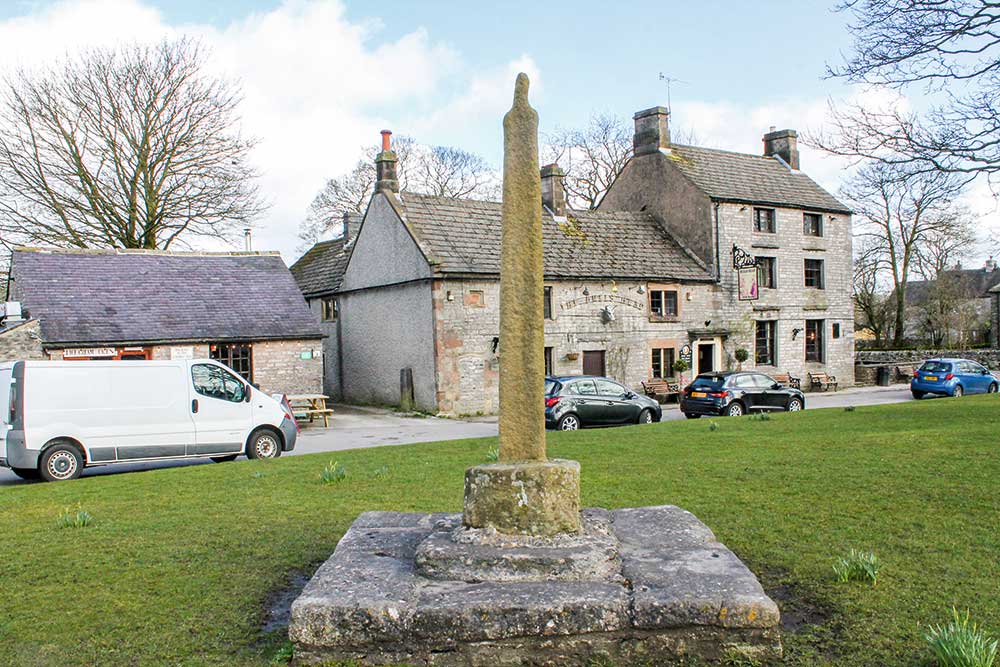
History is everywhere with us in the Peak District. People have lived on and shaped the land for thousands of years, from the erectors of prehistoric standing stones and henges, right down to the current developments needed to house today’s expanding population. This walk touches a sample of five different ways the Peak has been affected throughout the centuries, each one leaving its mark as time moves on. The walk starts and finishes at Monyash, a small village on the limestone uplands, where farming is still the major occupation of many of its residents. Their predecessors left their mark when, in the eighteenth century, the Enclosure Acts allowed landowners to define field patterns, creating a maze of dry-stone walls typifying the Derbyshire landscape to this day. The next relic will probably be unnoticed, but the Roman road from Derby to Buxton will be crossed twice along the way. After crossing this road and its modern equivalent, the A515, a footpath drops down to the High Peak Trail, a walking and cycling track following part of the abandoned railway from Cromford to Buxton. Next comes the highlight of the walk, Arbor Low. Here is a stone circle built by our neolithic ancestors around 5,000 years ago, once the land became usable after the end of the Ice Age. Finally, the modern dairy and sheep farm at One Ash Grange started life as a monastic penitencery for recalcitrant monks from Roche Abbey near Rotherham. Alongside these five historical features, prehistoric burial mounds and capped lead mine shafts scattered around the fields were left by our recent ancestors, each and every one as well as us, leaving theirs and our mark on the landscape for good or bad. The walk is suitable for all weathers, and has gentle gradients throughout. At the start, the way is across tiny meadows and along green lanes. Beyond the A515, the few miles of level walking on the High Peak Trail are just made for striding out while enjoying the wide ranging views across the rolling Derbyshire limestone uplands. Next comes a short but unavoidable stretch of road walking. This is to reach Abor Low and also the turn-off for One Ash Grange Farm. Fortunately the normally quiet road between Parsley Hay and Youlgreave is generally used by local traffic, but never-the-less it should be walked with care. From One Ash Grange the way back to Monyash is along a footpath across a series of fields, eventually reaching one of the access roads into the village. When talking about the history of places and features along the walk, Monyash can claim to have its roots in prehistory. Situated in the heart of the White Peak, the limestone based part of the Peak District, where the villagers often had to carry water for miles, Monyash is uniquely endowed with four meres (five if you count filled-in Jack Mere, now the village car park). A ‘mere’ is the Derbyshire word for a man-made pond, used to store water. The meres owe their existence to a deep bed of watertight clay laid down at the end of the last ice-age some 10,000 years ago, making them possibly the oldest feature in the landscape. Monyash has a single pub, the Bull’s Head and next to it, the old smithy has been converted into a popular café. Narrow lanes radiate from the village green and footpaths seem to go in all directions. The village has access to Lathkill Dale. USEFUL INFORMATION DISTANCE: 9¼ miles (15km) of moderate walking on field paths, green lanes, historic railway trail and by-roads. Fairly level walking all the way. RECOMMENDED MAP: Ordnance Survey Outdoor Leisure Sheet OL24, White Peak Area. PUBLIC TRANSPORT: Hulleys Bakewell/Monyash 178 service Monday – Saturday, hourly service from 09:55. One bus only on Sunday & Bank Holidays, (177 Bakewell/Buxton via Monyash) at 11:50 out and 15:28 back. CAR PARKING: Jack Mere opposite the Methodist Chapel in Chapel Street, Monyash. REFRESHMENTS: Bull’s Head Inn and Smithy Café in Monyash. Light refreshments at Parsley Hay cycle hire and information centre. THE WALK From Jack Mere car park on Chapel Street, go through the adjacent stone stile and bearing left walk past the last of a row of cottages. The next section of the walk is across a series of narrow fields dating back to the Enclosure Act of 1771, defining shared plots in what were originally three huge communal fields. Bear half left away from the cottage and follow the grassy path using stiles in the stone boundary walls of seven narrow fields and an access track. Joining a farm track, turn right and follow it past a stone barn for about a quarter of a mile. At the junction of five tracks, turn sharply left and follow the walled-straight track for a little under one mile. Go past the donkey sanctuary and, on reaching the main A515 Buxton/Ashbourne road turn right towards the front of the Bull-I’-Thorn for four or five yards and then left. All the time on the lookout for speeding traffic, cross over, aiming for a signposted stile. The modern road is parallel to the Roman Road from Derby to Buxton and you will cross its position a yard or so after entering the first field beyond the A515. Go down the field to a stile next to a footpath sign. Cross this and bear half left, still downhill to the railway track. Climb up to the track and turn left. This is the High Peak Trail which is followed for a couple of miles. High Peak Trail follows part of the 33 mile Cromford and High Peak Railway, first opened in 1831 as a link between Cromford and High Peak Canal at Whaley Bridge. Built by canal engineers, it climbed steep inclines, the equivalent to canal locks, by using steam-powered cables; the stations were called wharfs. Parsley Hay cycle hire depot marks the end of this section of the walk. Call in for a coffee and then
Celebrity Interview – James Graham

Quiz question: Who is James Graham? Is he (a) the writer of the TV drama about the coughing scandal on Who Wants To Be A Millionaire?; (b) a collaborator working on a new musical with Elton John; (c) the winner of an Olivier Award for a comedy; or (d) the man who penned an episode of the Netflix Royal family series The Crown? If you picked any of those, you’d be correct. James Graham from Kirkby-in-Ashfield, Nottinghamshire has been writing professionally for 15 years, in that time having one of his works voted play of the decade and being appointed OBE for services to drama and young people. The 38-year-old playwright began at the age of six tapping out short stories on a typewriter. Now his work gets praise from critics as well as the public, with one national journalist describing him as “a writer of rare talent”. That was evident during the three-part television series Quiz which analysed whether Charles and Diana Ingram and accomplice Tecwen Whittock cheated to win the top prize on Millionaire. More than ten million people tuned in to the drama which aired for three consecutive nights. It’s the most-watched drama on television this year. The cast featured Michael Sheen as Chris Tarrant, with Matthew Macfadyen and Sian Clifford as the Ingrams. James was thrilled by the reaction to Quiz and considers himself lucky to be able to write a television drama which started on primetime: Easter Monday. “As someone who lives and breathes sharing work and engaging with an audience, to be able to share Quiz in quarantine with people who were locked in their homes wanting entertainment felt like a huge privilege. was in some cases it was the first time that families had sat down and watched the same thing with their kids in the same room on the same device, as opposed to being in different rooms of the house watching different things. That was really exciting.” James admits that he has a fixation with Who Wants to be a Millionaire? “I absolutely fell in love with it as a kid, watching it at my grandparents’ house in Mansfield on a Saturday night. I was obsessed with the coughing major trial as much as anybody else and whether these relatively well-to-do, respectable people had tried to steal a million pounds live in front of cameras and a studio audience. That’s such a compelling story.” When writers pen a TV drama, they may not meet the cast until they start recording, unlike a theatre production where actors can have weeks in the rehearsal room. James didn’t meet Michael Sheen until he arrived on set. “Michael had just flown in from filming an American TV drama. When he first walked onto the set, with his wig and his tan, and started to transform into Chris Tarrant, I was giddy like a schoolchild. You don’t think you’ll get to work with such famous talent and brilliant actors. “The reason I fell in love with Michael as an actor was because of his political work, being Tony Blair and David Frost. “To be honest, we didn’t know when we offered Michael the part whether he would think it silly and ludicrous, the idea of representing Chris Tarrant and a supporting role as well – not the lead part. “I was grateful that he seemed so fixated and compelled by this story that he was willing to have a laugh and give it a go.” Born on 8 July 1982, James Graham went to Kirkby Woodhouse primary school and Ashfield School. He developed his love of plays and theatre at Ashfield before becoming the first in his family to go to university, studying drama at Hull. While there he teamed up with another former Ashfield pupil, Gary Roden, to write a play, Coal Not Dole, which they took to the Edinburgh Festival in 2002. Growing up in Nottinghamshire, surrounded by down-to-earth people who weren’t afraid to say what they thought, influenced James’ writing. “My access to art was through school plays and going to see pantos at Nottingham Theatre Royal. I remember seeing some Shakespeare that was touring to the Theatre Royal as well. I saw Pete Postlethwaite playing Macbeth which was hugely influential on me. I was inspired by that. “Normally in certain areas there’s a level of ideological conformity. I always admired and loved my little pocket of north Nottinghamshire because it’s been incredibly inconsistent. If you look at the miners’ strike, in the heart of Nottingham miners went back to work and formed a breakaway union. In my villages they were often split down the middle with different people making different choices. “I think that’s instilled in me a desire to see different sides and a balance in my political writing.” James’ first major play, This House, is set in the Palace of Westminster in the whips’ office between the 1974 general election and a vote of no confidence in the government of James Callaghan five years later. It premiered at London’s National Theatre in 2012 and in a public vote received the accolade Play of the Decade. In 2018 James won an Olivier Award for his play Labour of Love – another political offering. It tells the story of a Labour MP over 25 years in Kirkby-in-Ashfield. Surprisingly the award was for best new comedy. James stresses that he tries to put comedy into his plays. “Having not grown up with a huge amount of theatre, I think what’s important is make people want to come and have a good night as opposed to staying at home and watching Netflix. I think you have a responsibility to entertain. “Labour of Love was such a joy because I set it in the constituency office of the Labour Party in Ashfield. The sound of that accent, those colloquialisms and ‘ayup me ducks’ – it was such a mischievous treat to place that on a West End stage. The fact that I got an Olivier was the
Exploring Matlock

Matlock started off as a collection of small settlements in the Middle Ages which, thanks to the coming of the railway and a consequent astonishing boom in demand for hydropathic health treatments, quickly became subsumed into a new, rather homogenous whole. When it came to treatments, the Regency upper classes favoured Matlock Bath; the Victorian bourgeoisie, Matlock’s hydros. I say homogenous, because the main spur to expansion was the first of the successful hydros, founded by John Smedley in 1853, and which movement had all but burned out by the outbreak of the Great War 60 years later. To build so much housing, so many shops, chapels and other necessary adjuncts to life in just a few decades produced a town of architectural uniformity. Unrelieved locally quarried millstone grit buildings, often rock faced, few were designed by architects of any flair. What relieves the uniformity, though, is the topography and the views: the one vertiginous, the other incomparable. To pick out exceptional items of interest was, therefore our intention when setting out. This tour requires a walk that is practically vertical from north of Crown Square, so you need to be fit! We put our vehicle in a car park at the end of Olde Englishe Road, a right turn off the A6, here Dale Road, as you approach Matlock Bridge: £2.50 for a couple of hours The street name, by the way, is derived from a former large pub of ponderous arts-and-crafts appearance set on the corner with Dale Road. How it acquired its name is beyond comprehension, although we were told the additional ‘e’s are a more recent conceit. To get to Dale Road, however, we also passed a really rather good stone apartment block with the pleasant Cool River Bistro in its ground floor. Deservedly, we felt, it won the RIBA award for 2015. Dale Road is lined with a motley selection of undistinguished late Victorian buildings, all shops, relieved only by a pair of former banks on the right, and almost at the end (ex-HSBC) with an angled entrance surmounted by a good turret clock in a pediment by Smith of Derby (1913), its stolid impact contrasting with the dignified provincial Baroque revival of the 1901 ex-NatWest, a really good building, probably by Derby’s John Somes Story. We also dallied in the antiques emporium a little further along. This was once Matlock’s premier shopping street. Yet, looking to our left, we spotted a curved Doric peristyle (a row of columns supporting an entablature to you and me) recently reconstructed after being demolished by an errant lorry, overborne by an impressive weeping elm, beyond which one can see the finest Georgian house in Matlock, stone-built ex-RBS Bank House. It looks early Georgian, but Clare Hartwell in the new Pevsner reckons it’s late 18th century; either way it presents a most elegant façade, despite clumsy extensions to right and left. We decided to go for broke and tackle Bank Road, which rose straight up in front of us as we crossed the Medieval bridge over the Derwent (tactfully widened on the south side in 1904) and encountered Crown Square, which modern traffic requirements has turned into Crown roundabout to no good effect. The Crown Inn, between Chesterfield and Bank Roads, with its teetering Louis XIV tower and openwork metal coronet, is no longer a pub but a Costa. Opposite, backing on to Hall Leys Park is the jolly Arts-and-Crafts Nationwide Building Society building, ornamental black and white gables on two fronts joined by a drum tower with a finialled lead dome. The square boasted a pavilion-style tram shelter from 1899 to 1927, but this went to leave only a small island bearing a crown apparently made of roller bearings sat on a concrete cushion, complete with tassels. Even its lack, though, reminded us that it was from here that cable-operated counterbalanced tramcars operated, bankrolled by locally born publisher of Tit-Bits, Sir George Newnes, to obviate the punishing climb up the Bank and Rutland Street. We of course, felt we were made of sterner stuff and tackled the Bank. A few notable buildings, including a plethora of dissenting chapels (all, oddly, on the east side) marked the ascent, including Bridge House of 1861, extended as a hydro later, extended around 1900 with tall first floor arcaded windows as the Town Hall, but now still serving municipal duty for Derbyshire Dales Council. The churches included Our Lady & St Joseph’s (RC) by Derby’s tragically short-lived Edward Fryer of 1883; further up beyond a pair of good Georgian style modern stone houses, the Methodist/URC chapel of 1882 with its spindly tower and spire tacked on in rock-faced ashlar in 1900. Beyond again, the odd matching pair of Primitive Methodist chapel and school, in rather odd Gothic with miniscule flying buttresses along the sides. For those even more unfit than Carole and me, a welcome seat has been installed just below Smedley Street which is ideally placed to provide respite from the relentless ascent. This brought us to Smedley Street, on the corner of which stands the 1853 hydro founded by John Smedley, notorious a few decades back as the ‘Matlock Kremlin’, but a building of stupendous size, extended by Smedley himself with a new range to the east in 1867, magnificently lavish interiors (no wonder it was chosen as the County Council’s HQ in 1955!) and stretched again in castellated style to the NW, ending in the domed 1900 winter garden. The latter we saw from Smedley Street, having passed the grand entrance of the hydro of 1885, by G E Statham of Matlock, although walking down the street is like a journey up a man-made canyon between stone cliffs, for the road is not wide and the ashlared walls of the hydro are tall, one side being connected to the other by a striking pair of double decker bridges. Smedley obviously liked these, building another at his mills at Lea. We enjoyed the front of the solarium annexe