Walk Derbyshire – Walks from Stately Homes – Lyme Park
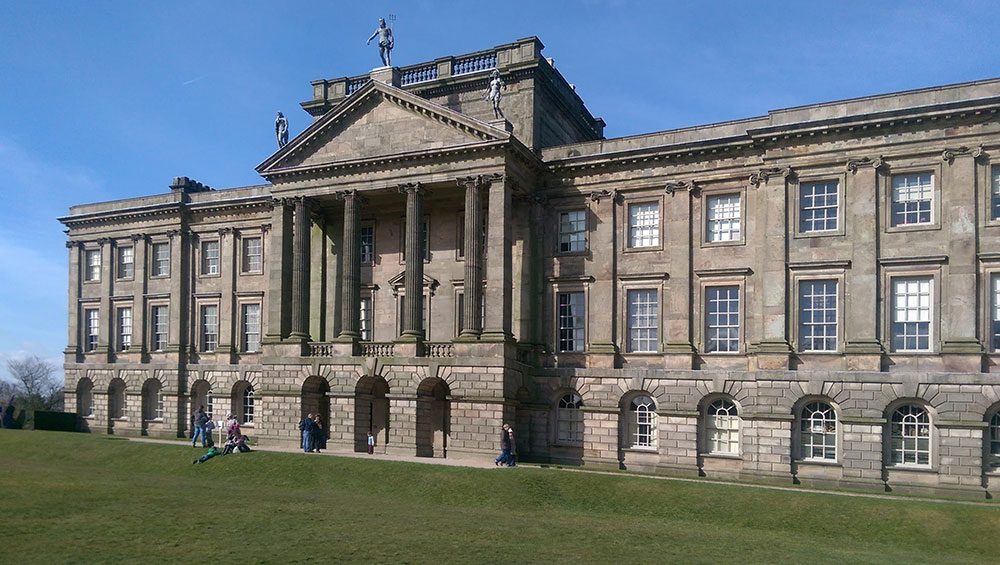
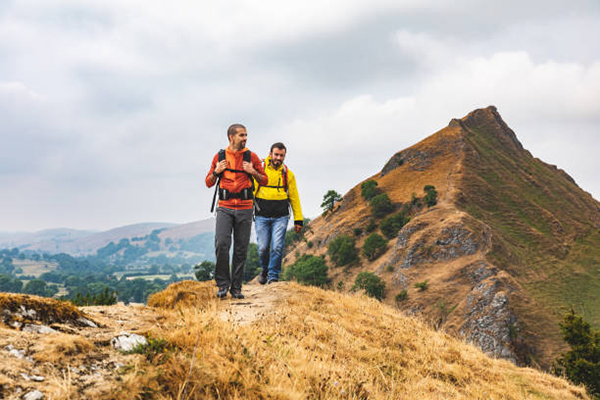
DISTANCE: 3½ miles (5.6km) of moderate forest track, open moorland, surfaced road, waymarked field path and rough access drive. 525 foot (160m) climb. RECOMMENDED MAP: Ordnance Survey Outdoor Leisure Sheet 1, Dark Peak. 1:25,000 scale. PUBLIC TRANSPORT: Hourly TP service buses to Buxton, then bus or train to Disley where a short walk along a back road leads to the driveway beyond North Lodge. CAR PARKING: Official car park below Lyme Hall. Pay and display on entering the park via North Lodge on the A6. Access to Lyme is free for National Trust members. REFRESHMENT: Old Workshop near pond beyond the car park. I thought I had finished my walks from and around the grand houses up and down the Peak District, but recently it was brought to my attention that there is at least one other I have overlooked. This is Lyme Park, the grand Palladian mansion set in the heart of 1,400 acres of woodland and high moors on the north western boundary of the Peak District National Park. A mere ten miles or so from the southern boundary of Greater Manchester, it acts as a popular breathing space for the citizens of towns surrounding what was once called Cottonopolis. Having said that, access is easy for anyone living more to the south; the A6 passes the northern entrance to the park, and regular trains and buses from Buxton stop at nearby Disley. Now jointly owned by Stockport Metropolitan Borough Council and the National Trust, Lyme was the ancestral home of the Legh family for over five and a half centuries. Originally created by King Richard II who in 1398 granted land in the Royal Forest of Macclesfield to Piers Legh and his wife Margaret D’anyers. Over the centuries what was once a hunting lodge became the magnificent Palladian mansion set amongst a rolling moorland background and the attractive formal and informal gardens of today. Orangeries and sheltered rose gardens compete throughout the seasons to the delight of visitors, but it is the Dutch garden on a terrace below the west side of the house which draws the greatest admiration when its formal displays of tulips are at their best. It is not just the house and gardens that visitors come to see. High on a ridge overlooking the main driveway from the A6, a prospect tower known as ‘The Cage’ offers wide ranging views over the Cheshire Plain where, on a clear day the outliers of the Welsh giants of Snowdonia come into view. Another reason why visitors come to admire and enjoy the house and moorland walks on offer, is thanks no less to the BBC. In 1995 Lyme became immortalised as Pemberley in the BBC TV production of Jane Austen’s Pride and Prejudice. The walk passes the pond where semi-naked Mr Darcy (played by Colin Firth) unexpectedly emerges from a lake in full view of Elizabeth Bennet, played by Jennifer Ehle. The walk passes the pond, but be prepared for a surprise, not only will there be no Dashing Mr Darcy, but the pond is usually a muddy slimy affair, hardly something to attract a swimmer on a hot summer’s day. Starting from the car park below the hall, the walk climbs out through Knightslow Wood, out on to Park Moor where you might be rewarded with a view of magnificent red deer, part of the herds roaming unhindered throughout the park. At the top of the climb an enigmatic pair of upright stones known imaginatively as the Bowstones, are probably the remains of two late Saxon preaching crosses, minus their cross pieces. Bowstones is the highest point of the walk. An access lane from the remote farmhouse drops down to a side road linking Kettleshulme and Disley, but the walk does not join it. A left turn on to a farm track leads to open fields as far as the old eastern route into Lyme. Turning left at East Lodge the walk follows this old track back to the hall and the welcoming refreshment stop at the old timber yard and its workshops. The Walk 1 From the car park, turn left away from the hall and follow the surfaced lane curving left, uphill. 2 Turn left on to a wide track at the top of the hill and go through a metal swing-gate. 3 Following a Gritstone Trail signpost, continue uphill with trees on your left and rough moorland fields to the right. Although there is no access from the track you should be able to get a glimpse to your left of the small pond where Colin Firth aka Mr Darcy emerged under the flustered gaze of Elizabeth Bennet (played by Jennifer Ehle in the BBC adaptation of Pride and Prejudice). 4 Enjoying views of Lyme Hall on your left, go through Knightslow Wood, following the track until it reaches the park boundary. 5 Cross or go through the wall and turn left on to a rough path climbing steadily uphill. Aim for a group of telecommunication masts on the ridge-top ahead. 6 Climb over the moorland boundary wall and keeping to the right of Bowstones Farmhouse, aim towards the farmhouse’s access drive. Two enigmatic stones within a small iron-fenced enclosure are the Bowstones. Folklore says they were used for bending new bows in Saxon times, but they are more likely to be the uprights of a pair of late Saxon preaching crosses with their cross pieces broken off by zealots during the Commonwealth following the English Civil War. 7 Walk down the drive for about a mile until it meets the main road and almost immediately turn left on to a farm lane. 8 Follow the lane as far as Cock Knoll Farm. 9 Go through the farmyard as directed by waymarking signs and out through a gate. 10 Following a boundary wall, go down the left side of the couple of fields beyond the farm. 11 Descend into and cross a shallow valley on a waymarked field
Celebrity Interview – Susan Boyle
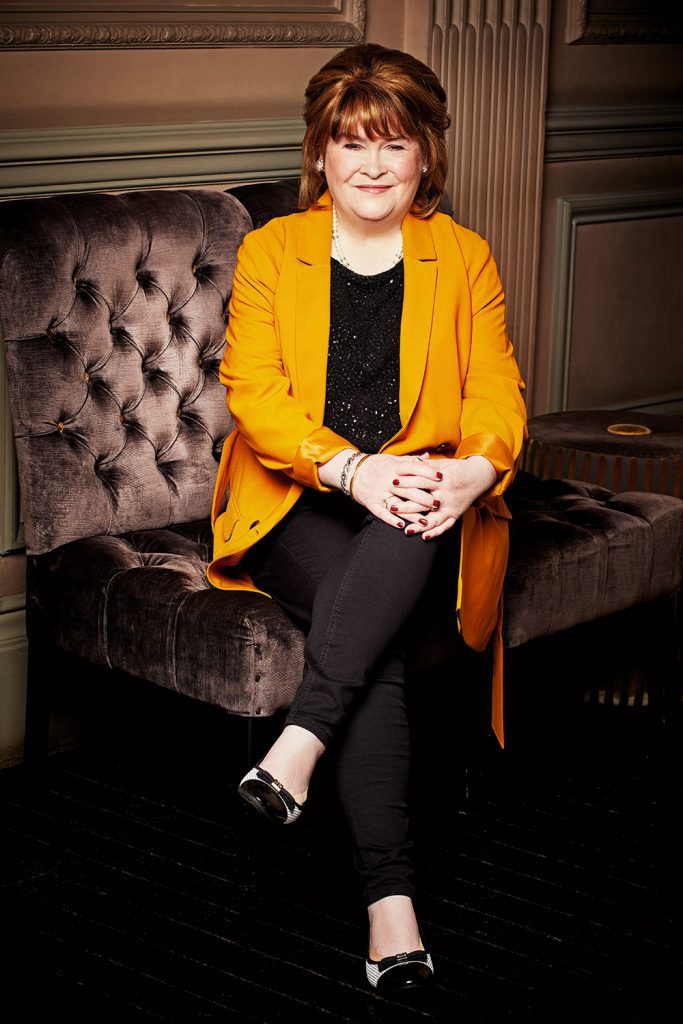
More than ten years on from her unforgettable rendition of I Dreamed A Dream from the musical Les Misérables, Susan is heading out on tour to do what she loves most of all: singing to an audience. When she stepped onto the Britain’s Got Talent stage, few people could have imagined the impact she would have. It would change her life. Despite finishing second in the final to dance troupe Diversity on the show watched by 17.3 million viewers, Susan went on to have unparalleled success. Her first album I Dreamed A Dream is the fastest-selling UK debut album of all time. She became the oldest female to reach number one on the UK albums chart with her second offering The Gift. Only three acts have topped both the UK and the US charts twice in the same year. Susan is one of them. All this from a woman who was bullied at school and was brought up thinking she had a learning disability. It was only after she had become a household name that she was told she had been misdiagnosed: she had Asperger’s syndrome and an above-average IQ. Before I spoke to Susan about coming to Nottingham on her latest tour, her publicist told me that Susan doesn’t like structured interviews and I should regard our conversation as a casual chat. Susan, who was born in Blackburn, West Lothian, has a pronounced Scottish accent. It can be a bit difficult to understand but after a while she comes over as gentle, caring and unruffled by anything the music world can throw at her. So what will she be singing on the tour? “There’ll be a mixture of songs from the latest album and a lot of new stuff. It won’t be as classic as last time – it’ll be more informal. There’ll be songs to get people up and dancing in the aisles. It’s fun!” Naturally she will sing I Dreamed A Dream: “It’s my signature tune. I have to include that. That’s what it’s all about and how I got there in the first place. People expect it.” Susan Magdalane Boyle was born on 1st April 1961. Her father was a miner and a singer while her mother was a shorthand typist. The youngest of four brothers and five sisters, Susan took singing lessons and performed at local venues. Her mother urged her to enter Britain’s Got Talent. She almost abandoned the plan because she thought she was too old. So did she ever think she would get through? “I didn’t think anything, to be honest. I just went on and had some fun.” Was she nervous? “Who wouldn’t be? It’s such a big event. In front of Simon Cowell who can be quite strict with you. Of course I was nervous but you get over it.” When she said her wish was to become as famous as the British singer, actress and presenter Elaine Paige, Simon Cowell smirked. But he was stunned when he heard her sing. One American news organisation described her as “the woman who shut up Simon Cowell”. She says: “When they saw me step out on stage, people thought I was going to be awful. I proved them wrong. You don’t judge a book by its cover.” Can she believe it is ten years since her first appearance on the reality TV show? “One day you’re sitting in a room with your cat not doing anything, the next you’re on stage and in a competition. It was a complete turnaround. Ten years – I can’t believe it’s gone by.” Within nine days of her first appearance on Britain’s Got Talent, the video of I Dreamed A Dream was viewed 103 million times on 20 different websites. Newspapers around the world including China, Brazil and the Middle East carried articles about her performance. She was interviewed via satellite by several US television stations. Simon Cowell signed Susan to his recording label and controls much of her output. She pays tribute to the man derided by so many people. “Simon was very supportive and very kind. I can’t say a bad word about him.” Susan’s eighth studio album called Ten – marking a decade in the business – was released last May and another one will follow after the tour. “Being in a recording studio is peaceful. It’s a kind of different world,” she said. “I’ve been entrusted to do another album with Simon himself. The whole album’s being discussed at the moment. It’ll be full of surprises. It’s really exciting and I hope to go on from there. I don’t stop, you know!” So far Susan has sold more than 25 million albums, performed to half a billion people on the final of China’s Got Talent, written her autobiography and had cameo roles in a couple of films. What has the past decade been like? “I’ve been round the globe, I’ve sung for the Pope, I’ve sung for the Queen, the list goes on – I’ve done so much.” In 2012 Susan performed at Windsor Castle for the Queen’s diamond jubilee pageant, singing Paul McCartney’s Mull of Kintyre. Last year she met the Pope at the Vatican in Rome. Susan, Lionel Richie and Bonnie Tyler all sang at an annual Christmas concert there, raising money for the Amazon rainforest. A practising Roman Catholic, Susan was overawed by the experience: “The Pope’s a very family-oriented man. Indescribable, the feeling really. Very close to God himself.” She appears to take everything in her stride and believes it’s because when she went on Britain’s Got Talent she was more mature than many of the contestants who go onto TV reality shows. “When you’re young you’re more fazed than when you get to a certain age – you become more relaxed. I’m living the dream! I’ve enjoyed every second of it.” There are some people whose musical tastes might not include the kind of music that Susan Boyle sings so well. But few people can begrudge her the
Cruising Up The Rhine

When Brian Spencer went on a Rhine cruise, little did he realise that the high point of the trip was, for more than one reason, several thousand feet above the level of the river. A mere four hours after leaving Matlock, we emerged care of Eurostar into bright sunshine on the French side of the Channel Tunnel. Somewhere near Lille the line branched left and in no time at all we were in Brussels. Here a coach whisked us away over the border to Cologne and our first view of the busy River Rhine. Our home for the next week was the MS George Eliot, one of the luxury river cruisers which tour the major European rivers. These rivers, especially the Rhine, are wide and deep enough to carry huge commercial barges, everyone loaded with anything from liquid gas to sand and gravel. Many of those we saw had comfortable living accommodation above the stern, and some even had a small car perched on top of the wheelhouse. Settled in our cosy cabin and fed like royalty, we could sit back and enjoy the gentle pace of our cruise up Father Rhine. In this lower part of the river, the scenery was of gentle farmland, but as the valley sides steepened, castles and vineyards began to make an appearance. Twin riverside towers are the poignant remains of the Remagen Bridge, the site of the famous battle during World War 2. It must be hard deciding where and when to stop and explore the multitude of interesting places along the river. Our first port of call was the ancient wine centre of Koblenz, standing at the junction of the Moselle and Rhine. Narrow cobbled streets and tiny pedestrianised squares seem timeless, places where there is something new round every corner. In one of the squares, the statue of a boy spits water at irregular intervals, much to the surprise of unwary tourists. The point where the two rivers meet is called the ‘German Corner’ (Deutsches Eck). Above it is the massive equestrian statue of Kaiser William 1st, the first emperor of Unified Germany in 1897. Just a stride or two beyond it is the ground station of a cable car service to the 16th century Ehrenbreitstein Fortress. Meant to guard the river approaches to central Germany, it fell to the French during one of the Franco-Prussian wars in 1799. Entering the Middle Rhine above Koblenz, hillsides above both banks are lined with vineyards, they seem to cling at impossibly steep angles to catch the warm sunlight. Dotted at regular intervals are castles of all shapes and sizes, many no longer the home of some wine growing baron, they now find a modern use as hotels, or schools. Around a point about half way along the 1,000 kilometre length of the Rhine, the 393 metre high Lorelei rock confines the river into a narrow, fast flowing channel. Today’s traffic operates on a one-way system, but in times gone by many ships came to their doom on the treacherous rocks. Romantic German poets founded the legend of a beautiful girl, who lured unsuspecting sailors to their fate. If you look carefully, you should be able to see her riverside statue low down on the riverbank. This is the main German wine country where all the finest vintages are on offer in bars and restaurants. Tiny historic Drosselgasse lies at the heart of Rüdesheim, and attracts visitors from all over the world. Not content with producing fine local wines, the Asbach GMBH distillery produces German brandy (‘weinbrand’). This premium spirit is not made from German wine, but French for some unknown reason. Speyer is a busy place dating from Roman times and whose medieval city centre is built around a cathedral, the largest Romanesque church still in existence in the world. Medieval emperors are buried here, but it is the church’s links with formation of Protestantism when it broke away from the Holy Roman Empire. Speyer cathedral was one of the places where in 1521 Martin Luther posted his 95 Theses and, much to the delight of today’s schoolboys, the Diet of Worms. Down a side street off the cathedral square stand the ruins of the ‘Judenhof’, Jews’ town. Many of its original features can still be found, either as artefacts in the small museum, or within the ancient walls. Steps lead down to the ritual baths that have an uncanny similarity to the gas chambers of Auswitz where the horror of holocaust were played out. Alternating with Brussels, Strasbourg, the capital of Alsace is the meeting place of the Council of Europe. The city has changed hands many times during wars involving France and Germany and, as a result, the architecture is a delightful mix of both styles. Half-timbered buildings hundreds of years old line streets and squares surrounding a 13th century cathedral; its Gothic spire built in 1500 was once the tallest building in the world. Hundreds of biblical figures decorate the west façade, but it is the interior which takes the breath away. Much of the medieval stained glass has a luminous effect in almost any light and in the south transept, the Renaissance astronomical clock and the 13th century Angel Column are special highlights. Still moving upstream, our cruise entered the region of the Black Forest. Mooring at Breisach an attractive little town perched high above the east bank of the river, coaches took us to Titisee, a smart little town built on the north bank of its lake. A base for walkers since Chancellor Otto von Bismarck escaping the rigours of high office, spent many happy hours exploring the Black Forest. Meet and greet ladies dressed in what can be described as a female version of a Yeoman Warder’s uniform were there to answer questions, but not why a man passed us with a pig on a lead! Titisee is famous for its cuckoo clocks, no longer are they assembled by farmers trapped by
Allestree – From Norman Doors to Arts & Crafts

Allestree’s ancient village – the only part of what is now a huge amorphous suburb really worth dawdling round – is remarkably compact, which makes a tour that much less complicated. It is also high enough above the city to the south, to ensure clear, breathable fresh air. Not to be sneezed at, as one might say. The reason for its compactness is that it was always a subordinate settlement. At Domesday Book (1086) it was an outlier of the manorial estate of Markeaton, for instance. Ironically, while the ancient village of Markeaton virtually disappeared in the re-landscaping of William Emes in the 1760s, Allestree ultimately flourished. Given to the Abbey of Darley by one of the Touchet family, then lords of Markeaton, it remained Abbey property until the Dissolution in 1538. Interestingly, during that period the Abbot granted freedom to his villein Elias de Allestrey [sic] ‘and all his brood.’ He is thought to have been a member of a family of free tenants fallen into debt or through some other problem, which resulted in servitude, and his gentry descendants can be traced (some still in the area) to the present day. In 1538 the Mundys of Markeaton re-united the place with Markeaton, and it remained with them until Francis Noel Clarke Mundy sold the estate in 1786 to Bache Thornhill of Stanton-in-Peak, who a decade later began to build the hall. It was not until the inter-war period when the estate was finally broken up, that the village ceased to be a small, compact estate village. From then on housing development filled in the areas closest to the village with standard semis, but after the war, in the 1960s, new building westward to Kedleston Road virtually created a new suburb, served by Park Farm and Woodlands shopping centres. To take in the core of the settlement, park up near the pub, the Red Cow (known locally by a less complimentary name which we cannot be repeated here!), a seventeenth century building a pub by 1753, re-fronted c. 1800, and clunkily extended in the 1930s, complete with stained leaded lights incorporating ‘cigarette packet’ heraldry. Stocks once stood outside, and a mortuary behind, we are told. Inside, a stuffed dog once graced the bar, with a bone ring round its neck. From the pub walk to King’s Croft (take a brief glimpse en route at the steeply gabled pretty stone parsonage, by H I Stevens 1867, just east of the church hall) and then turn right into Robin Croft Road, so as to enjoy the architecture of the old Victorian school and the adjacent school house, the latter really rather nicely done and tactfully extended. As the church was rebuilt in 1866-67 by Derby’s Henry Isaac Stevens, the chances are that his handiwork is on display here too. It is a delight to walk onwards from there past the recreation ground, the gift of the last lord of the manor, Col. Lionel Guy Gisborne CMG and his son Capt. Guy Gisborne MC (had they been reading too much Robin Hood, one wonders?) as a memorial to the casualties of the great War. Given some re-landscaping, this could be a delight. Beyond and on the opposite side of the road, lie a run of exceedingly pretty brick cottages, in groups of four, each with a small coped gable – mid-19th century estate workers’ cottages built for Alderman Sir Thomas William Evans, Bt. MP of the hall (and of Darley Abbey mills). Some have been disfigured by render before designation as a conservation area, but the houses directly opposite the recreation ground, private infills of the early 1930s, were designed somewhat to echo the rhythm of the old cottages. At the place where Cornhill joins, one is faced with a pair of much older cottages and if you look just a little further down the road you can see the early 18th century Hollies Farm, now converted into separate homes. However, it is best to turn right into Cornhill, where you will pass another row of 18th century cottages sporting a substantial chimney-stack, the end part with an arched vehicular entry, marking the whole as the house, forge and yard of the village smithy, although they are today three separate freeholds, the ancient brickwork anaesthetised under a coat of render and the windows replaced by thick uPVC casements. One delight, are the ancient stone walls lining the streets almost everywhere, some original, others reconstructed from stone reclaimed from demolished barns and other estate buildings. Cornhill thereafter turns east again with a raised pathway from which one descends to one of Allestree’s little gems, the group of three delightful buildings: Yew Tree Cottage, 17th century (or earlier) white painted brick and timber with thatched roof, a Victorian school house – almost too pretty to be by Stevens, although of that period – and a substantial late 17th century three storey brick farmhouse, like the cottage, end-on to the road. The downside is that someone sold off part of Yew Tree Cottage’s garden on which development has been allowed. Diagonally opposite, beyond the unlovely Evergreen Hall, is another ancient brick cottage (listed) with what looks like a former Regency shop window lighting the ground floor room. Beyond, a further row, but a bit too primped up to have been listed. At their east end is the village pump, upon reaching which one should turn and look south along St. Edmund’s Close, where the cottages on the right make a fine vernacular show undulating away from you. They, with a row of three opposite and a bit beyond them, with the church and pub beyond, make a really charming sight. On the SE corner the Memorial Hall by that distinguished Arts-and-Crafts architect Percy Currey, rewardingly detailed, and set on an elevated bank. However, resist the temptation to go that way; instead continue along Park Lane, past another two groups of estate cottages, some in early brick and set upon a massive boulder plinth. It
Lost Houses of Derbyshire – New Hall, Castleton

When Mick Stanley and I were researching the first edition of The Derbyshire Country House around 1980 our attention was drawn by a colleague of Mick’s at the Derbyshire Museum Service (of blessed memory) to an item in a north Derbyshire auction. Provenanced from a vendor in Buxton, this was a fine oak 17th century dresser – really a court cupboard – which had come from New Hall, Castleton. This was identified by a friend who knows his oak furniture as probably being of west Derbyshire origin, although the flowing vine frieze and tubby pilasters were of a pattern which appears to have originated in the Wakefield area. We were unable to establish anything about this mysterious house at the time, nor to discover a picture of it, which guaranteed that we would not be able to write about it, for our book was an illustrated one, after all. However, whilst looking into what is known as Sheffield School plasterwork in the late 16th and early 17th century, especially as found in Derbyshire country houses, a colleague at Sheffield Museum sent us a copy of an article in Vol. III of the Transactions of the Hunter Archaeological Society in which a short account of this house appeared. He also found us a fairly scratchy photograph. The house was situated on rising ground on the north side of the road which runs west from the centre of the village, not so far north of the Methodist chapel, build within its immediate surroundings, such a position being favoured by one or two other gentry houses on the edges of the village, like Losehill Hall. In its last phase, the house was a lowish two storey structure of carboniferous limestone rubble with a single crosswing, itself higher and endowed with chunky ashlar quoins. Indeed, it much resembled a slightly scaled up version of Hazelbadge Hall as seen in a mirror, and the crosswing was probably of similar date – later 15th century. The superimposed five-light mullioned windows had a decorative treatment of their heads of a closely similar style and, after all, Hazlebadge is only just over the hill to the south, and the same mason may well have been responsible for both. When the house was originally built, the great hall would have been open to the roof with either a central fireplace venting through a hole in the timber roof, or – here more likely given that we cannot trace the house back that far – by a fireplace and stout chimney breast on the long side opposite the door. Here, right of the door would have been a passage from which the kitchen and other offices opened. Where it differed from Hazelbadge is that the great hall range (missing at Hazelbadge), at right angles to the crosswing, had clearly been demolished at some stage, probably in the very early 19th century and replaced with a simple farmhouse of the most rudimentary architecture. What survived of this part until the demise of the house was a lowish (distinctly lower than the crosswing) two storey range, also of random rubble, albeit latterly harled, with six bays, bays two and four having no fenestration but each a door, the former into the house through a very plain stone surround and the latter into the byre with a re-used stone Tudor doorcase. The windows are all sashes, paired with a mullion in between and set in simple stone surrounds. Both wings had stone slate roofs, and latterly, too, the late Medieval wing had a door crudely inserted at the gable end to the right of the windows. To the left was what was probably a further part of the original house which may, indeed, have been built round a courtyard. What appeared as a ruined barn rejoiced in a six light mullioned window with similarly decorative head, but with some mullions missing. Probably this was moved when the original great hall wing was taken down and saved, whether out of sentiment or a typically Derbyshire desire not to waste something of use and beauty. The crosswing held most of the surviving Sheffield School decorative plasterwork, although mutilated re-positioned scraps were also preserved in the ground floor of the main range, which must have been spared later alterations, probably out of sentiment or through merit. Fortunately, a painting of an unknown house appeared at Bamford’s auctions in December 2003, which we managed to identify, from the topography, provenance and detail, as New Hall, Castleton. Although anonymous, it clearly dated from the Regency period, and the great boon was that it showed the previous range intact. Several changes were discernable. The crosswing originally was steeper to the gable (which had decorative coping) and boasted attics, lit by a two-mullion window, with decorative coping to the gable itself. This was later lowered and simplified. The main range was the same length but originally had five light windows to the left of the four-centered arched entrance, those on the ground floor with a transom too. Beyond the entrance, the fall of the ground enabled there to be an attic, this section running to two bays again with transoms to the ground floor windows. This in itself probably represented a later 17th century rebuilding, where the great hall, to the left of the entrance was floored over and rooms made above it, a common change to surviving medieval houses of the period. Indeed, the portion beyond the entrance may have been added at this time. The house seems to have been built by Thomas Savage, second son of Sir Thomas Savage of Rocksavage, Cheshire, ancestor of the present Marquess of Cholmondeley. Another cadet branch of this family had previously held Tissington, and the senior line were of Stainsby, by Ault Hucknall, until a later Savage sold it to Bess of Hardwick who, needless to say, pulled down their ancient moated manor house. John Savage increased his estate through marriage to Alice, one of the co-heiresses of Humphrey
Product Test – Avon

Game-Changing Skincare from Avon The NEW game-changing skincare brand from Avon celebrates clean beauty without compromise. The collection is composed of 9 innovative skincare and colour products which combine high-performance, vegan-friendly ingredients with beautiful textures, environmentally conscious packaging and an ethical mindset. Lip Rush £12 It’s the unique blend of ingredients combined with the soft, cushiony tip applicator that gives you a pout that’s always on point. With pure colourants for a vibrant, potent lip colour and vegan emollients for a clean conscious, Lip Rush is The One you’ve been waiting for. Unique whipped-up texture and vibrant, potent colour infused with mineral pigments, pure colourants, vitamin E and vegan emollients Available in 9 naturally beautiful shades This lip colour is: Vegan and eco-conscious* Fragrance free Ethanol free Clinically tested Dermatologically tested Allergy tested Shadow Shots Eyeshadow £10 Our mineral eye shadows give you vibrant colour in one guilt-free swipe. The specially purified, high-impact mineral pigments are blended with vegan emollients to deliver a potent punch of buttery-soft colour. Vibrant colour and buttery-soft texture Infused with naturally occurring minerals, vegan emollients and organic corn starch Available in 7 naturally beautiful shades Vitamin C-Shot Powder £22 About me: Vitamin C is at its purest, most potent and effective in powder form. A pure shot of this vitamin C face powder to your moisturiser will leave you with brighter, more luminous looking skin. Oh, and we also added in some vitamin E for extra oomph. • Suitable for all skin types • 100% vitamin C & vitamin E • Vegan & eco-conscious* For more information visit www.avon.uk.com TRIED & TESTED TRIED & TESTED TRIED & TESTED Vitamin C Shot I’ve never used anything like this before which isn’t already added to a moisturiser so it’s great that you can just pop two shakes onto your hand and add to your own. It leaves skin instantly brighter and looks healthier. VP Lip Rush Stunning shades of gloss. Last ages on your lips. Slightly sticky but all glosses are. Lovely product. JP Shadow Shots Eyeshadow Lovely, crease free eyeshadow. Lasts all day. Easy to apply with a brush or finger. CB 00
Taste Derbyshire – Buying Direct From The Farm

Taste Derbyshire’s Amanda Volley discovered, buying your groceries down on the farm makes for a deliciously different shopping experience and helps to boost the rural economy. There is something very appealing about buying direct from the farm. On top of the feel-good-factor of buying fresh from the fields, there’s a chance of getting up close and personal with the producers. In this case, a herd of 70 Friesian cows at Hooks Farm Dairy in Borrowash. “Don’t worry, they are just curious,” reassures farmer Dan Smith (25), when one gets close enough to lick my camera lens. “They are quite docile unless they have calves to protect” Hooks is one of a growing number of UK dairy farms selling ‘old fashioned’ milk (fresh, in glass bottles and creamy enough to pour on a pudding) from a state-of-the-art vending machine. “The cows have already produced 350 litres of milk today,” says farmer Dan Smith (25), as he shows me round the ‘Cow Shed’ where customers can buy milk (plus local spuds and free-range eggs) and admire pin-ups of ‘Dusky Girl’ ‘Easter Molly’ and other stars from the herd. “My dad John and I got up for milking at 6.30am and finished at 10.30 for a croissant and some coffee. I’d say the milk in the machine is about two hours old.” According to a report by NFU Mutual (2018), more than 63 per cent of farmers have a side-business. Of these, nine out of ten feel this second income stream is vital in securing their farm’s future. This was certainly the case at Hooks. Dan Smith says his family were forced to look beyond their traditional market (sending all their milk to a co-operative) when milk prices dipped to 13p per litre in 2005 (they are currently at 27p). “We had to do something to safeguard the farm for future generations. My dad is a fourth-generation farmer who moved here in 1956. Farming isn’t just our livelihood – it’s a way of life,” he explains. “We began researching ways to add more value to the milk and visited farms where they made dairy products like ice cream. We loved the convenience of a vending machine and people told us they’d be happy to pay £1 per litre (£1.80 for two) for milk fresh from our herd.” The Smiths installed the milk vending machine in November 2018. “We were painting the cow shed into the night – that’s why some of the hand-painted letters are a bit wobbly,” laughs Dan. “On the first day, a Friday, we sold nine litres. The second day we sold 40 and the milk ran out. On the Sunday we sold more than 100 litres and we had around 50 cars in the yard. We sold 50,000 litres of milk through the vending machine in our first year. We’re very grateful for all the support.” Dan has been thrilled with the feed-back from the customers; “Everyone comments on the taste of the milk. Its reputation has spread by word-of-mouth alone. That’s the best compliment of all, our customers telling their friends to try it,” he says. “The milk is rich and creamy because our herd is fed on grass from March until November or even December depending on the weather. That’s why it tastes so good.” The Smiths are also happy for their customers to meet the cows including Dermott, the magnificent bull, who was responsible for a spike in the birth-rates last Christmas. “We do everything for our animals – my dad jokes that they have better bedding than most humans. We have to make sure our milk is good enough to keep people coming back again and again,” Dan says. “We even found one chap in the yard at midnight. He’d just been to the pub and said his missus would kill him if he didn’t take a bottle of our milk home.” As for the future, Dan says it’s important to keep pushing forward; “We’ve got a lot of ideas including installing a hot drinks machine and maybe doing skimmed milk so we can use the cream to make something like soft scoop ice cream or milkshakes,” he says. I’m also keen to set-up a live video stream so our customers can see the cows being milked. It’s the least we can do to thank people for keeping us in business. I’d like to think there will always be a member of the Smith family involved in farming.” Leaving Hooks Farm, I drive seven miles to Stanley Common to join the crowds flocking towards the impressive shop-cum-café at Oakfield Farm. Forget all those preconceptions about muddy yards and chilly sheds; Oakfield Farm Shop is on a Grand Designs scale and the bespoke oak building is terribly smart both inside and out. No wellies required. “We come here every Tuesday for coffee and to shop, we love it,” explains Sue Rice, of Spondon, who is heading for the butchery counter for pork chops and lamb’s liver. “The food is great; the staff are so helpful and friendly. The meat looks delicious so you can imagine how good it tastes.” He husband Geoff laughs; “If I wasn’t on a diet I could go mad here. All those homemade pies and the cheese. It’s just such different quality to what you’d find in a supermarket. It’s all top-notch.” Andrew Wint (59), who runs the business with wife Karen (56), says farm shops are gaining in popularity as customers increasingly want fresh, quality produce on their door-step. “The lamb on this counter was born on this farm” says Andrew. Our customers love the fact that the beef and lamb come from animals raised here. All of the cakes, sausage rolls, pies, quiches and even the faggots are made on-site.” Andrew laughs when asked about his farming roots. “I was a milkman and my dad, a miner” he says. “But I’ve always loved farming. Even as a youngster growing up in Stanley Common, I’d help on farms at
Cruising gently along the Rhone – Part Two Vienne to Lyon

Leaving Vienne and its Roman links, we sailed through the night, past Lyon where we would eventually return and, joining the River Saône, made our way into Beaujolais countryside, past villages well known to wine lovers. Hopefully we would be enjoying their produce later. Today’s visit was to be Beaune, the wine capital of Burgundy. As it is set well back from the Saône, we woke alongside the Quai des Messageries and spent the morning enjoying the quiet shopping streets of Chalon-sur-Saône. Opposite us on a small island, the Doyenne Tower still guides river traffic, but not on the scale as when wine was shipped from quays similar to the one to which we were tied. Chalon has been a famous wine exporting centre since Roman times when it was called Cavillonum, then Cabyllona when Emperor Constantius used it as a base for his 7th Legion in 354 AD. Even earlier than Roman times, Chalon-sur-Saône was an important centre. Before assuming its modern name which is derived from the river goddess Souconna, it was known as Arar by the local Gallic tribes. The gentle Saône rises near Vioménil in the Vosges Mountains to the east before joining the Rhône near Lyon. Apparently a stage of the Tour de France was due to end in Chalon–sur-Saône later in the month, and the town hall, the Hotel de Ville, was decorated with yellow bunting, ready to welcome the day’s winner of the yellow jersey. Along with welcoming professional cyclists, the town has a couple of famous sons. Nicéphore Niépore, an early inventor of one of the versions of photography came from here; there is a museum dedicated to his work not far from the Quai des Messageries. Another son, Dominique Vivant was involved with the creation of the Louvre Museum in Paris. This came about soon after the French Revolution, when the state was looking for somewhere to display the collection of gems and medals inherited from the guillotined King Louis XVI. A small fleet of coaches took us up to Beaune, one of France’s most famous wine producing regions, home of Meursault, Volnay and Pommard to name just a few. There are still a few traces of the city wall that once surrounded Beaune. Following it from the out-of-town bus park, we passed a stream issuing from what was once the town’s water supply. At one time this would have combined a source of fresh water with the local equivalent of a medieval launderette. Not only would local women visit it to do their weekly wash, but they would use it to keep up to date with the current gossip. Medieval streets lead away from the ring road, into what cannot fail but to tell the world that here is the capital of Burgundy’s wine production. Almost the first building we passed on the way in was the 13th century wine market, then the Musée des Vins de Bourgogne, followed by inviting entrances to all the competing ‘caves’, the warehouses of different wine retailers. We spent a happy hour in one, sampling what was on offer, but I was able to remain sober enough to spot the competing sign advertising Jura whisky outside a neighbouring establishment selling some quite rare single malts! Now that is salesmanship if ever there was. Beaune was founded by the Dukes of Burgundy, with dynasties stretching back to the 9th century with imaginative names such as John the Fearless, Charles the Bold, Philip the Good and Philip the Handsome – obviously they were not afraid of a bit of self publicity now and then. Probably the finest building in the town is the magnificent Hospices de Beaune, or Hotel-Dieu with its instantly recognisable multi-coloured tiled roof. Considered one of the finest examples of French 15th century architecture, it was founded in 1443 after the Hundred Years War by Nicolas Rolin, Chancellor to Duke Philip the Good. At that time the majority of most of the town’s inhabitants were destitute as the result of the long conflict and the hospital became a refuge for the poor, together with orphaned children along with the disabled, sick and elderly; a charity that has lasted unbroken from the Middle Ages to this day. Nowadays funding is raised by way of an annual wine auction. An afternoon drive took us through the section of Burgundy-cum- Beaujolais known locally as the Côtes d’Or. To say wine production is a uni-crop is putting it mildly. Acre upon acre, or should one say hectare upon hectare fill the valley sides south of Dijon. The northerly part, the so-called Côte de Nuits, specialises in red wines from the late harvested Pinot Noir grape, while the southern section, the Côte de Beaune embraces full-bodied white wines made from Chardonnay grapes. Reds are not overlooked and include such famous names as Chambertin, Clos de Vougeot, Romanée, Nuits-Saint-Georges, Corton, Beaune Pommard and Volnay, while Montrachet, Meursault and Corton-Charlemagne account for some of the finest white-wine vintages. In addition the district produces a range of light rosés, along with the sparkling crémant wines. A final night cruise took us back to Lyon for a day to explore the city before travelling back via the famed TGV and Eurostar. France’s third largest city (population around 1.2 millions), Lyon climbs above the Rhône’s east bank and also fills the spit of land, the ‘presqu’ile’ dividing it from its confluence with the Saône. This part is the old city, Vieux Lyon, and to the west of both parts, high above the Saône is where the Roman’s entertained the population at a huge theatre built on the site of an earlier Gallic settlement. Topping everything beyond the theatre is the Basilica of Notre Dame de Fourvière with the finest view of the city. The Roman city of Lugdunum grew from a small Gallic settlement when Marcus Agrippa made what became Lyon the starting point of principal Roman roads throughout Gaul and ultimately its capital. Emperor Claudius conqueror of
Walk Derbyshire – Lathkill Dale & Over Haddon

Lathkill Dale is one of my favourite walking areas of the Peak. I don’t know how many times I have walked beside what Izaac Walton called ‘the purest of streams’. I have walked there and enjoyed it in all weathers and in every season of the year. There are almost unlimited variations of footpath routes on either side of the dale, north, south, east and west. This walk was taken in early autumn when the leaves were just beginning to turn and the damp air had just a little hint of the winter still to come. The dale’s steep sides are now densely crowded with all manner of trees and shrubs, a haven for wildlife and the area below farmland on either side of the dale is classed as a National Nature Reserve. It is hard to realise that the trees are a comparatively modern addition to Lathkil Dale. Not so very long ago, a mere century past, this was an industrial zone with lead mines and a flour mill; and even a short-lived gold rush that cost its investors a fortune, but all that is long gone. Nothing remains but the ruins of Mandale Mine, one of the largest lead mines in the Peak, together with the pathetic attempts to dig into the hillside for what turned out to be fool’s gold. Probably the only place where a small but steady profit was made for its owners was the flour mill at the end of the forested section of the dale, but even that is dead and gone. Nowadays the only income from Lathkil Dale is the result of fees paid by anglers and shooting parties who come in search of trout, or to catch the raucous pheasants heard calling amongst the shrubbery. The walk begins and ends in Over Haddon, the little village south of Bakewell that perches on a limestone ledge high above the northern bank of the River Lathkil. It has a single pub and a tearoom waiting to slake the thirsts or fill the stomachs of all who follow this walk. Parking is in the small pay and display car park at the start of the lane down to the valley bottom where the main footpath begins. An easy to navigate walk, it follows the dale upstream, through a mature wild wood to its upper boundary. This is the site of the ruined and long abandoned flour mill where a right turn joins a winding path up to the lower of Haddon Grove Farms. From here the way back to Over Haddon is along a quiet high level by-road. Please note: the path along the dale bottom is concessionary and is occasionally closed during the shooting season. 1 From the car park, follow the steep, winding lane down to the lodge in the dale bottom. A slight diversion for a few yards continuing beyond the lodge reaches an ancient stone-slabbed clapper bridge. A rarity in the Peak, there are however, three within a radius of a little over a mile from this one. 2 Returning to the lane, turn left and go through a wooden gate, (or go straight on if you are not going to look at the clapper bridge). Follow the riverside path along the valley. Look out for two trial holes carved into the outcropping rock on the right of the path. These are the remains of an attempt to mine gold in Lathkil Dale. Investors lost fortunes in what soon became a mine excavating nothing but fool’s gold – iron pyrites. 3 At the start of the wooded section of the walk you will have reached the remains of Mandale Mine to your right. Water to drive a pumping engine was brought from further up the dale along an aqueduct; all that remains are three or four ruined stone pillars that once carried a water trough from one side of the river over to the mine. 4 Look out for two fenced hollows at the right of the path. They are sink holes and are a natural way for water to drain away underground. A small plaque on the fence explains how they work. 5 Continuing along the woodland track, pause and cross over the wooden ‘willow pattern’ bridge on your left a little way beyond the aqueduct’s pillars. It leads to the ruins of a cottage where the mine manager and his wife lived in the 1800s. The kitchen was built over an entrance to a side mine. Within it a newly developed pump was hidden from competitors’ eyes. Unfortunately the floor was not strong enough and the poor lady once disappeared into the depths, fortunately without too many cuts and bruises. A metal ladder now descends safely into what was the cellar and a hand cranked dynamo lights up the depths below. 6 Returning over the bridge cross over and turn left to re-join the woodland track. Follow it for about three-quarters of a mile to the woodland boundary. 7 Go through a gate in the boundary fence and turn right, going past the scant remains of the local flour mill. Apart from a few stones remaining from the outer walls, you might spot the millstones lying mute in amongst the weeds. 8 Follow the track going right as it winds steeply zig-zagging uphill for about half a mile until it reaches the lower of Haddon Grove Farms. 9 Keeping to the right of the farm buildings, join the access drive and follow it for a little over a hundred yards until it reaches the Monyash Over Haddon road. 10 Turn right along this scenic by-road and follow it for about a couple of miles, back into Over Haddon. 11 Continue past the car park if in search of refreshment. Both the tea room and the pub are on this street; the tea room is half way along and the pub at the far end, beyond where the road makes a left-hand turn in the direction of
Modern Collectibles – Trench Art

On my desk at home is a small brass receptacle in which I have always kept my paperclips. It is brass, of circular form and has a domed brass lid engraved, a little crudely, with the arms of Derby, and with the word Derby below it. The top fits the base with wonderful accuracy, and the base was made from a 75mm French shell case and the lid adapted from a 77mm German field gun shell case. I bought it on the market for a pound when I was education officer at the Museum, merely because it was a local souvenir. Later, I came to realise that this was an excellent local piece of trench art. Trench art includes items made by serving soldiers, primarily in the two great wars, from whatever waste material was to hand, although in the first world war this was mainly brass from shell cases – for this was essentially an artillery war. In the second, one tends to find the use of Duralumin from crashed aircraft (easier to work than brass) too. Looking back further, I can recall shell cases in my maternal grandmother’s home in use as vases – for my grandfather, an Anglo-Irish renegade who had run away to sea before the conflict, was commissioned into a Canadian Regiment in Halifax, Nova Scotia and was in 1916 posted to the Western front – and survived. At home we had an undecorated 9.2inch howitzer shell case on our hearth as a spill vase, allegedly another of grandpapa’s spoils of war. There is much evidence to prove that some trench art was made in the trenches during the Great War, although it is probable that only the very smallest bone, wooden and metal objects like rings were created in the front line on both sides of the conflict. The primary source is more likely to be support troops working behind the lines: Royal Engineers, REME, later RASC and so on. They had the materials, machinery, skill and occasional spare time, and money could be made selling souvenirs to soldiers heading home. Behind the lines, work to make souvenirs was also given to displaced civilians. Trench art was also made therapeutically by wounded and convalescing men, for whom such work formed part of their rehabilitation. And many no doubt personalised such souvenirs made by others by adding inscriptions of their own: regimental badges, mottoes, names and so on. Yet there was a large manufacturing trade during and after the war well away from war zones. Thus, an item may have been bought – by the soldier, or by a relative on a subsequent battlefield visit. The major department stores were complicit in this. In the immediate post-war period they offered to turn war souvenirs such as shell fuse heads – often brought back by soldiers – into wooden-based paperweights and other items. A fine desk set recently came through Bamfords and made £85. Furthermore, if ex-soldiers had no souvenir, they could be provided. This is the explanation for the considerable number of examples of bulkier trench art, such as dinner gongs and poker stands made from shell charge cases. These would never have fitted into a kitbag! With regards work done actually on the front line, the autobiography of soldier George Coppard tells of pressing uniform buttons into the clay floor of his trench, then pouring molten lead from shrapnel into the impressions to cast replicas of the regimental badge for application to shell case vases, the commonest form of Great War trench art. Many smaller items such as rings and knives were made by soldiers in quieter parts of the line. Coppard also recalled that, while recuperating from wounds at a private house back in England (‘Blighty’ in those days!) ‘…one kind old lady brought a supply of coloured silks and canvas and instructed us in the art of embroidery. A sampler which I produced under her guidance so pleased her that she had it framed for me.’ Another category of trench art consists of items made by prisoners of war and interned civilians, both endowed with limitless free time albeit with limited resources. Much POW work was therefore done with the express intention of trading the finished article for food, money, cigarettes or other privileges. At the war’s end, when civilians began to reclaim their shattered communities, a new market appeared in the form of pilgrims and tourists. Over the ensuing twenty years mountains of discarded debris, shell casings, and castoff equipment were slowly recycled, with mass-produced town crest motifs being stuck onto bullets, shell casings, fuse caps, and other items to be sold to tourists. Likewise, surplus matériel was sold by the government and converted to souvenirs of the conflict. Also, the dismantling of ships by scrap firms, particularly if the ship had been involved in significant events such as the Battle of Jutland, resulted in much of the wood from the ship being turned into miniature barrels, letter racks, pipe stands and boxes, with small brass plaques attached giving source and provenance. At Bamford’s our late November library sale included a couple of batches of decorated shell-case vases, which usually come in pairs, and were estimated at £30-50. At antique fairs, £50-60 is about par for the course for these, but recently I also saw a pair of ashtrays with vesta cases supported on a spike rising from the middle for the very same price and a repoussé work jardinière made from a 12inch railway howitzer shell, again for £55. A pin tray was inset with a period Edward VII halfpenny and, if you turned over there was a 10c Belgian coin underneath! Spent and unspent bullets were also favoured. British .303 and German 7.62mm ones abound. A second world war Lockheed P-38 Lightning fighter on a stand made from a shell case bottom, was fashioned in the Pacific theatre from 7.62mm bullets and Duralumin strips, later being chrome plated: yours for £90. The recent centenary of the Great War