Bugsworth Canal Basin
Brian Spencer takes a trip to Bugsworth canal basin, once the largest inland port in England’s canal network. Drive along the A6 Chapel-en-le-Frith bypass and the odds are you will be unaware that below the road there was once a busy inland port handling stone and lime brought down from the hills in horse-drawn wagons running on rails. In the latter years of the 18th Century, the high demand for building stone and lime created by the Industrial Revolution meant that a system to ease movement of these raw materials had to be created. As this was before the advent of steam railways, the most efficient method of transporting heavy goods was by canal; so by 1794 a proposal was made to link the limestone quarries around Dove Holes near Buxton to the country-wide canal network. This would be carried out by laying a 14½ mile (23km) cut to link with the Macclesfield to Ashton canal at Marple. Driving a canal into the upper reaches of the Goyt Valley from Marple was comparatively easy, but once it reached Whaley Bridge progressively hilly country made it impractical to cover the ground by canal. Furthermore, all this was to take place in a predominately limestone region where water for the system of locks needed to lift the canal hundreds of feet up to Dove Holes was almost none-existent. Therefore a unique proposal was made in order to bring stone from the quarries to the canal along horse-drawn tramways and load it into waiting barges. It was originally planned to build a canal/rail interchange basin at Chapel Milton, a village between Chapel-en-le-Frith and Chinley. Unfortunately this meant the construction of a flight of locks and a reservoir to feed them, so the idea was scrapped in favour of Bugsworth a mere two miles or so to the west. The site chosen was reasonably wide and flat and with the nearby Black Brook a tributary of the River Goyt offering a plentiful water supply, Benjamin Outram and Thomas Brown the leading canal engineers of the day began the construction of both the canal and its tramway network. In the remarkably short time of six years, the canal from Marple, plus a complex of lime-kilns, wharves at Bugsworth and linking railways were built. Very soon the quiet valley was alive to the sound of clattering wagons and together with smoke from the limekilns, it brought the otherwise rural idyll to an end. The A6 from Dove Holes crosses one of the quarry tramway routes immediately south of the junction of the A623 Chesterfield road with the A6 Buxton road at Barmoor Clough. Along this the stone sleepers which can still be seen up and down the track, carried a tramway downhill to the interchange at Bugsworth Basin. Here wagons were emptied by tipplers worked by an ingenious system operated by men turning a 14ft diameter wheel to lift each wagon, discharging its load on to the wharf-deck below. It would then be hand-loaded into waiting barges. Sidings took other loads to the tops of limekilns where it was slowly burnt to create lime powder. The loaded barges then made their sedate way, drawn by patiently plodding horses, to the far end of the basin, where in a narrow section of the canal, each boat would be ‘gauged’ by a method similar to the Plimsoll Line, in order to assess the weight of its load. This then determined the amount of stone on board and from it the cost of tolls to move sedately towards England’s industrial heartland. The complex of wharfs and kilns was divided into three basins, upper, middle and lower. There was also a turning place known as The Wide where barges were made ready for their outward journeys. Support industries followed the building of the canal, ranging from a blacksmith, to stone crushing workers, and warehousemen who made sure that the lime made by the men feeding the kilns was kept dry. An overseer known as the Wharfinger lived beside the gauging narrows and had a horse provided to help him ride up and down the canal when necessary; one of the earliest recorded jobs with a perk. Pubs opened to slake the thirsts created by the heavy work and at one time as many as four inns offered refreshment; but of them only the aptly named Navigation remains on the site it has occupied since 1795. Not only was ready-crushed stone, or lime from the kilns below Gnat Hole loaded into the barges at Bugsworth, but other materials such as raw cotton from Liverpool brought in to feed the as yet infant textile industry. All this took place at a busy canal’s inland port. Whole families lived and worked aboard their one-horse-powered barges. As they came up to Bugsworth they would call out to friends who lived in the row of canal-side cottages known as ‘Teapot Row’, so-called from the inhabitants’ practice of emptying teapots into the canal. Next they would pass through the Gauging Stop by the Wharfinger’s House in order to determine their unladen weight, before moving on into one of the upper basins to collect their load. Here ingenious bridges allowed the horse to transfer from one side of the canal without being unhitched. Of the two which once spanned the canal only one, a reconstruction remains in situ. Life while appearing idyllic was not always so, for in 1898 John Hannah murdered his wife in the cabin of their boat while it was moored in the Upper Basin. Why he did it is unclear, but reports of the time suggest it was during a drink inflamed jealous rage brought on by his wife talking to another man. After his trial at Derby Crown Court he had the doubtful honour of being the last man to be publicly hanged in Derby on the 21st December 1898. With the growth of the rail transport network, the use of canals slowly died and by the early
Product Test – Annabelle Minerals

Annabelle Minerals products are completely natural and based on few ingredients only. Annabelle Minerals cosmetics offer high-quality natural make-up suited to the needs of every skin type, from oily to dry and sensitive. The products are suitable for vegetarians and vegans. The brand offers the following organic cosmetics: make-ups, blushes, concealers, eyeshadows, translucent finishing powders, highlighters and accessories such as make-up brushes and sponges and cosmetic bag. Royal Glow Mineral Highlighter Pure minerals enriched with vitamin E and natural oils The content of blackcurrant seed oil, sunflower seed oil and vitamin E helps regenerate the skin, tightens it and makes it more elastic. Natural Cream Mineral Concealer Full coverage Camouflages spots, discoloring, broken capillaries Proper for sensitive and problematic skin Helps reducing imperfections Natural Medium Matte Foundation Spf10 Buildable, up to high, coverage Does not burden the skin Proper for oily and problematic skin After 4 weeks of use: reduces inflammatory by 25%, decreases sebum secreted by 21%, reduces visibility of skin pores by 21% (study on a group of 25 women with different skin types) For more information and to buy online visit www.annabelleminerals.com PRODUCT TEST :: PRODUCT TEST :: PRODUCT TEST Foundation With a damp brush, this foundation glides on leaving a flawless complexion. Very impressed! Highlighter You need a really tiny amount of this highlighter. It gives a fantastic glow! Concealer Brilliant product – it can be gradually built up to give a medium to full coverage, instantly gives you a brighter look and naturally covers dark circles! 00
Adam Henson Joins The Country Food Trust as Patron

Adam is a familiar face to many as a TV presenter and tenant of the Cotswold Farm Park, a 650-hectare mixed farm in the Cotswolds, home to more than 50 breeding flock and herds of British rare breed farm animals. The Country Food Trust recently hit its five-year target of providing more than one million meals for people in need one year earlier than expected, and since the beginning of May has donated another 400,000 meals, thanks to the incredible success of its COVID 19 appeal. The charity currently produces two ready meals made from pheasant – a curry and a casserole – developed by ex-River Cottage chef and Trustee Tim Maddams. These pouches do not require refrigeration and can be eaten straight from the packet, meaning they can be sent to charities without cooking facilities, and food banks. They also source meat straight from dealers and send this out to charities with kitchens. Tim Woodward, CEO of the Country Food Trust, said: “Our research showed that of all food donated to food banks, there was a real shortage of protein, so we developed our meals with this in mind. “We are delighted that Adam is joining us as patron. We are looking at different ways to provide protein to feed the growing number of people in need and Adam’s knowledge will be hugely useful in this area. We’re looking forward to working with him to raise awareness about the issue of food poverty and feeding even more people across the UK. Adam said of his appointment: “I have been following The Country Food Trust keenly since inception. It’s brilliant how quickly the charity has grown and to see what it has achieved as it nears the 1.5 million mark of meals donated to people in food poverty. Sadly, the number of people needing help with food in the UK is continually increasing and I’m delighted to have been asked to become a patron.” Tim added: “We’re also always looking for dynamic people with skills in fundraising and organisation to become Ambassadors for our charity at grass-roots level across the country, so if you’d like to get involved, please contact us!” 00
Walk Derbyshire – Into The Past Through Five Historic Sites
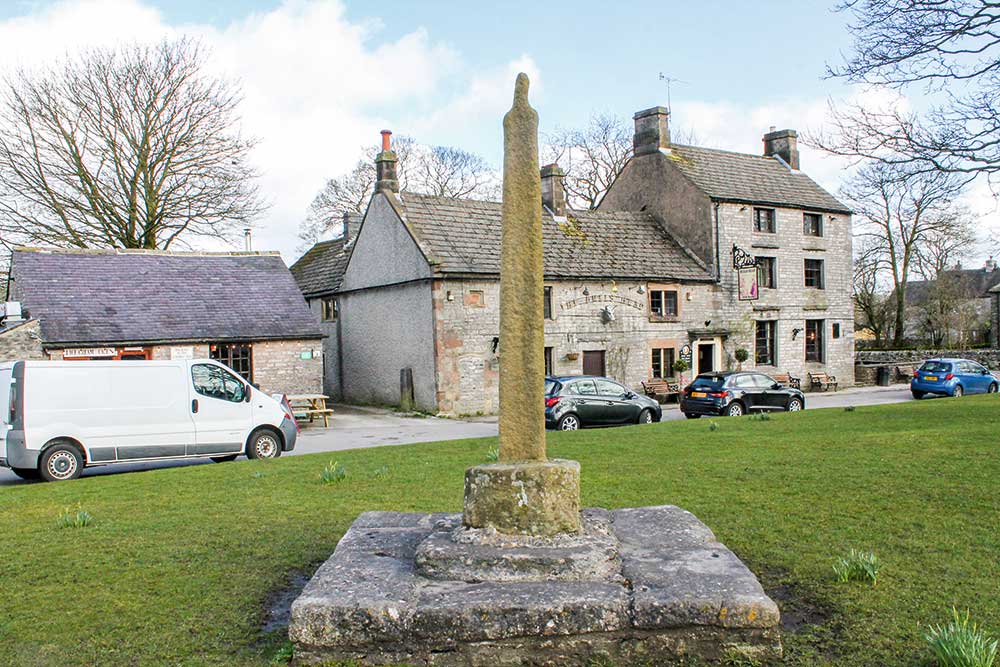
History is everywhere with us in the Peak District. People have lived on and shaped the land for thousands of years, from the erectors of prehistoric standing stones and henges, right down to the current developments needed to house today’s expanding population. This walk touches a sample of five different ways the Peak has been affected throughout the centuries, each one leaving its mark as time moves on. The walk starts and finishes at Monyash, a small village on the limestone uplands, where farming is still the major occupation of many of its residents. Their predecessors left their mark when, in the eighteenth century, the Enclosure Acts allowed landowners to define field patterns, creating a maze of dry-stone walls typifying the Derbyshire landscape to this day. The next relic will probably be unnoticed, but the Roman road from Derby to Buxton will be crossed twice along the way. After crossing this road and its modern equivalent, the A515, a footpath drops down to the High Peak Trail, a walking and cycling track following part of the abandoned railway from Cromford to Buxton. Next comes the highlight of the walk, Arbor Low. Here is a stone circle built by our neolithic ancestors around 5,000 years ago, once the land became usable after the end of the Ice Age. Finally, the modern dairy and sheep farm at One Ash Grange started life as a monastic penitencery for recalcitrant monks from Roche Abbey near Rotherham. Alongside these five historical features, prehistoric burial mounds and capped lead mine shafts scattered around the fields were left by our recent ancestors, each and every one as well as us, leaving theirs and our mark on the landscape for good or bad. The walk is suitable for all weathers, and has gentle gradients throughout. At the start, the way is across tiny meadows and along green lanes. Beyond the A515, the few miles of level walking on the High Peak Trail are just made for striding out while enjoying the wide ranging views across the rolling Derbyshire limestone uplands. Next comes a short but unavoidable stretch of road walking. This is to reach Abor Low and also the turn-off for One Ash Grange Farm. Fortunately the normally quiet road between Parsley Hay and Youlgreave is generally used by local traffic, but never-the-less it should be walked with care. From One Ash Grange the way back to Monyash is along a footpath across a series of fields, eventually reaching one of the access roads into the village. When talking about the history of places and features along the walk, Monyash can claim to have its roots in prehistory. Situated in the heart of the White Peak, the limestone based part of the Peak District, where the villagers often had to carry water for miles, Monyash is uniquely endowed with four meres (five if you count filled-in Jack Mere, now the village car park). A ‘mere’ is the Derbyshire word for a man-made pond, used to store water. The meres owe their existence to a deep bed of watertight clay laid down at the end of the last ice-age some 10,000 years ago, making them possibly the oldest feature in the landscape. Monyash has a single pub, the Bull’s Head and next to it, the old smithy has been converted into a popular café. Narrow lanes radiate from the village green and footpaths seem to go in all directions. The village has access to Lathkill Dale. USEFUL INFORMATION DISTANCE: 9¼ miles (15km) of moderate walking on field paths, green lanes, historic railway trail and by-roads. Fairly level walking all the way. RECOMMENDED MAP: Ordnance Survey Outdoor Leisure Sheet OL24, White Peak Area. PUBLIC TRANSPORT: Hulleys Bakewell/Monyash 178 service Monday – Saturday, hourly service from 09:55. One bus only on Sunday & Bank Holidays, (177 Bakewell/Buxton via Monyash) at 11:50 out and 15:28 back. CAR PARKING: Jack Mere opposite the Methodist Chapel in Chapel Street, Monyash. REFRESHMENTS: Bull’s Head Inn and Smithy Café in Monyash. Light refreshments at Parsley Hay cycle hire and information centre. THE WALK From Jack Mere car park on Chapel Street, go through the adjacent stone stile and bearing left walk past the last of a row of cottages. The next section of the walk is across a series of narrow fields dating back to the Enclosure Act of 1771, defining shared plots in what were originally three huge communal fields. Bear half left away from the cottage and follow the grassy path using stiles in the stone boundary walls of seven narrow fields and an access track. Joining a farm track, turn right and follow it past a stone barn for about a quarter of a mile. At the junction of five tracks, turn sharply left and follow the walled-straight track for a little under one mile. Go past the donkey sanctuary and, on reaching the main A515 Buxton/Ashbourne road turn right towards the front of the Bull-I’-Thorn for four or five yards and then left. All the time on the lookout for speeding traffic, cross over, aiming for a signposted stile. The modern road is parallel to the Roman Road from Derby to Buxton and you will cross its position a yard or so after entering the first field beyond the A515. Go down the field to a stile next to a footpath sign. Cross this and bear half left, still downhill to the railway track. Climb up to the track and turn left. This is the High Peak Trail which is followed for a couple of miles. High Peak Trail follows part of the 33 mile Cromford and High Peak Railway, first opened in 1831 as a link between Cromford and High Peak Canal at Whaley Bridge. Built by canal engineers, it climbed steep inclines, the equivalent to canal locks, by using steam-powered cables; the stations were called wharfs. Parsley Hay cycle hire depot marks the end of this section of the walk. Call in for a coffee and then
Celebrity Interview – James Graham

Quiz question: Who is James Graham? Is he (a) the writer of the TV drama about the coughing scandal on Who Wants To Be A Millionaire?; (b) a collaborator working on a new musical with Elton John; (c) the winner of an Olivier Award for a comedy; or (d) the man who penned an episode of the Netflix Royal family series The Crown? If you picked any of those, you’d be correct. James Graham from Kirkby-in-Ashfield, Nottinghamshire has been writing professionally for 15 years, in that time having one of his works voted play of the decade and being appointed OBE for services to drama and young people. The 38-year-old playwright began at the age of six tapping out short stories on a typewriter. Now his work gets praise from critics as well as the public, with one national journalist describing him as “a writer of rare talent”. That was evident during the three-part television series Quiz which analysed whether Charles and Diana Ingram and accomplice Tecwen Whittock cheated to win the top prize on Millionaire. More than ten million people tuned in to the drama which aired for three consecutive nights. It’s the most-watched drama on television this year. The cast featured Michael Sheen as Chris Tarrant, with Matthew Macfadyen and Sian Clifford as the Ingrams. James was thrilled by the reaction to Quiz and considers himself lucky to be able to write a television drama which started on primetime: Easter Monday. “As someone who lives and breathes sharing work and engaging with an audience, to be able to share Quiz in quarantine with people who were locked in their homes wanting entertainment felt like a huge privilege. was in some cases it was the first time that families had sat down and watched the same thing with their kids in the same room on the same device, as opposed to being in different rooms of the house watching different things. That was really exciting.” James admits that he has a fixation with Who Wants to be a Millionaire? “I absolutely fell in love with it as a kid, watching it at my grandparents’ house in Mansfield on a Saturday night. I was obsessed with the coughing major trial as much as anybody else and whether these relatively well-to-do, respectable people had tried to steal a million pounds live in front of cameras and a studio audience. That’s such a compelling story.” When writers pen a TV drama, they may not meet the cast until they start recording, unlike a theatre production where actors can have weeks in the rehearsal room. James didn’t meet Michael Sheen until he arrived on set. “Michael had just flown in from filming an American TV drama. When he first walked onto the set, with his wig and his tan, and started to transform into Chris Tarrant, I was giddy like a schoolchild. You don’t think you’ll get to work with such famous talent and brilliant actors. “The reason I fell in love with Michael as an actor was because of his political work, being Tony Blair and David Frost. “To be honest, we didn’t know when we offered Michael the part whether he would think it silly and ludicrous, the idea of representing Chris Tarrant and a supporting role as well – not the lead part. “I was grateful that he seemed so fixated and compelled by this story that he was willing to have a laugh and give it a go.” Born on 8 July 1982, James Graham went to Kirkby Woodhouse primary school and Ashfield School. He developed his love of plays and theatre at Ashfield before becoming the first in his family to go to university, studying drama at Hull. While there he teamed up with another former Ashfield pupil, Gary Roden, to write a play, Coal Not Dole, which they took to the Edinburgh Festival in 2002. Growing up in Nottinghamshire, surrounded by down-to-earth people who weren’t afraid to say what they thought, influenced James’ writing. “My access to art was through school plays and going to see pantos at Nottingham Theatre Royal. I remember seeing some Shakespeare that was touring to the Theatre Royal as well. I saw Pete Postlethwaite playing Macbeth which was hugely influential on me. I was inspired by that. “Normally in certain areas there’s a level of ideological conformity. I always admired and loved my little pocket of north Nottinghamshire because it’s been incredibly inconsistent. If you look at the miners’ strike, in the heart of Nottingham miners went back to work and formed a breakaway union. In my villages they were often split down the middle with different people making different choices. “I think that’s instilled in me a desire to see different sides and a balance in my political writing.” James’ first major play, This House, is set in the Palace of Westminster in the whips’ office between the 1974 general election and a vote of no confidence in the government of James Callaghan five years later. It premiered at London’s National Theatre in 2012 and in a public vote received the accolade Play of the Decade. In 2018 James won an Olivier Award for his play Labour of Love – another political offering. It tells the story of a Labour MP over 25 years in Kirkby-in-Ashfield. Surprisingly the award was for best new comedy. James stresses that he tries to put comedy into his plays. “Having not grown up with a huge amount of theatre, I think what’s important is make people want to come and have a good night as opposed to staying at home and watching Netflix. I think you have a responsibility to entertain. “Labour of Love was such a joy because I set it in the constituency office of the Labour Party in Ashfield. The sound of that accent, those colloquialisms and ‘ayup me ducks’ – it was such a mischievous treat to place that on a West End stage. The fact that I got an Olivier was the
Exploring Matlock

Matlock started off as a collection of small settlements in the Middle Ages which, thanks to the coming of the railway and a consequent astonishing boom in demand for hydropathic health treatments, quickly became subsumed into a new, rather homogenous whole. When it came to treatments, the Regency upper classes favoured Matlock Bath; the Victorian bourgeoisie, Matlock’s hydros. I say homogenous, because the main spur to expansion was the first of the successful hydros, founded by John Smedley in 1853, and which movement had all but burned out by the outbreak of the Great War 60 years later. To build so much housing, so many shops, chapels and other necessary adjuncts to life in just a few decades produced a town of architectural uniformity. Unrelieved locally quarried millstone grit buildings, often rock faced, few were designed by architects of any flair. What relieves the uniformity, though, is the topography and the views: the one vertiginous, the other incomparable. To pick out exceptional items of interest was, therefore our intention when setting out. This tour requires a walk that is practically vertical from north of Crown Square, so you need to be fit! We put our vehicle in a car park at the end of Olde Englishe Road, a right turn off the A6, here Dale Road, as you approach Matlock Bridge: £2.50 for a couple of hours The street name, by the way, is derived from a former large pub of ponderous arts-and-crafts appearance set on the corner with Dale Road. How it acquired its name is beyond comprehension, although we were told the additional ‘e’s are a more recent conceit. To get to Dale Road, however, we also passed a really rather good stone apartment block with the pleasant Cool River Bistro in its ground floor. Deservedly, we felt, it won the RIBA award for 2015. Dale Road is lined with a motley selection of undistinguished late Victorian buildings, all shops, relieved only by a pair of former banks on the right, and almost at the end (ex-HSBC) with an angled entrance surmounted by a good turret clock in a pediment by Smith of Derby (1913), its stolid impact contrasting with the dignified provincial Baroque revival of the 1901 ex-NatWest, a really good building, probably by Derby’s John Somes Story. We also dallied in the antiques emporium a little further along. This was once Matlock’s premier shopping street. Yet, looking to our left, we spotted a curved Doric peristyle (a row of columns supporting an entablature to you and me) recently reconstructed after being demolished by an errant lorry, overborne by an impressive weeping elm, beyond which one can see the finest Georgian house in Matlock, stone-built ex-RBS Bank House. It looks early Georgian, but Clare Hartwell in the new Pevsner reckons it’s late 18th century; either way it presents a most elegant façade, despite clumsy extensions to right and left. We decided to go for broke and tackle Bank Road, which rose straight up in front of us as we crossed the Medieval bridge over the Derwent (tactfully widened on the south side in 1904) and encountered Crown Square, which modern traffic requirements has turned into Crown roundabout to no good effect. The Crown Inn, between Chesterfield and Bank Roads, with its teetering Louis XIV tower and openwork metal coronet, is no longer a pub but a Costa. Opposite, backing on to Hall Leys Park is the jolly Arts-and-Crafts Nationwide Building Society building, ornamental black and white gables on two fronts joined by a drum tower with a finialled lead dome. The square boasted a pavilion-style tram shelter from 1899 to 1927, but this went to leave only a small island bearing a crown apparently made of roller bearings sat on a concrete cushion, complete with tassels. Even its lack, though, reminded us that it was from here that cable-operated counterbalanced tramcars operated, bankrolled by locally born publisher of Tit-Bits, Sir George Newnes, to obviate the punishing climb up the Bank and Rutland Street. We of course, felt we were made of sterner stuff and tackled the Bank. A few notable buildings, including a plethora of dissenting chapels (all, oddly, on the east side) marked the ascent, including Bridge House of 1861, extended as a hydro later, extended around 1900 with tall first floor arcaded windows as the Town Hall, but now still serving municipal duty for Derbyshire Dales Council. The churches included Our Lady & St Joseph’s (RC) by Derby’s tragically short-lived Edward Fryer of 1883; further up beyond a pair of good Georgian style modern stone houses, the Methodist/URC chapel of 1882 with its spindly tower and spire tacked on in rock-faced ashlar in 1900. Beyond again, the odd matching pair of Primitive Methodist chapel and school, in rather odd Gothic with miniscule flying buttresses along the sides. For those even more unfit than Carole and me, a welcome seat has been installed just below Smedley Street which is ideally placed to provide respite from the relentless ascent. This brought us to Smedley Street, on the corner of which stands the 1853 hydro founded by John Smedley, notorious a few decades back as the ‘Matlock Kremlin’, but a building of stupendous size, extended by Smedley himself with a new range to the east in 1867, magnificently lavish interiors (no wonder it was chosen as the County Council’s HQ in 1955!) and stretched again in castellated style to the NW, ending in the domed 1900 winter garden. The latter we saw from Smedley Street, having passed the grand entrance of the hydro of 1885, by G E Statham of Matlock, although walking down the street is like a journey up a man-made canyon between stone cliffs, for the road is not wide and the ashlared walls of the hydro are tall, one side being connected to the other by a striking pair of double decker bridges. Smedley obviously liked these, building another at his mills at Lea. We enjoyed the front of the solarium annexe
The Lost Houses of Derbyshire – Cockpit Hill House, Derby
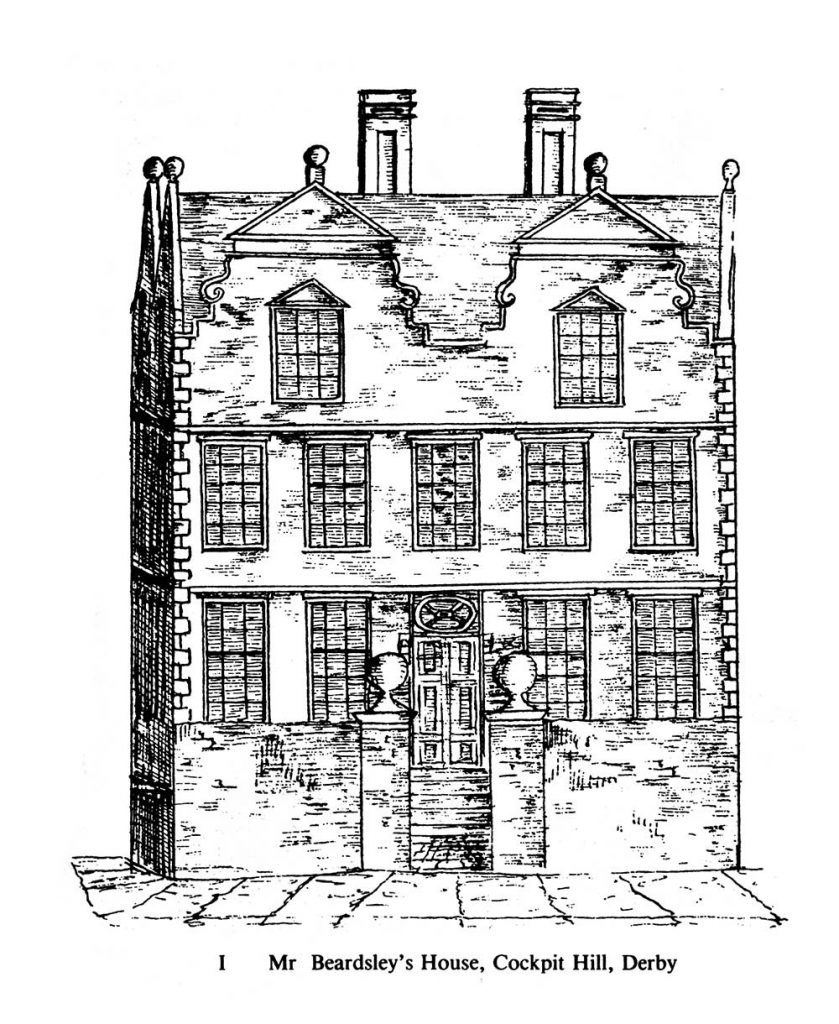
‘On the west side of the Mill Stream is a good house, built by Mr. Beardsley – on the side of a hill on which was formerly a castle still called Castle Hill, but by others Cockpit Hill.’ Written in 1713, William Woolley, Derbyshire’s first historian, of Cockpit Hill House. This enigmatic building suffers from having been demolished before the era of photography, so our only record of it is a sketch made by Woolley himself (not a particularly accurate recorder in this medium), and views included incidentally amongst the plethora of East Prospects of Derby painted or drawn of the Borough between 1695 and 1735. The house also appears in Glover’s History and Gazetteer of Derbyshire as a woodcut by Orlando Jewitt, an excellent artist, but as the house had by the date of first publication been demolished almost a decade, one wonders why it was included at all. Worse, Jewett was unable to draw it from life, so merely made a more workmanlike copy of Woolley’s drawing, thus adding absolutely nothing to our knowledge of its appearance. For all the difficulty of trying to understand what it looked like, there is much we can say of it. It was, for instance, a classic example of the Dutch style of architecture imported into this country after the Restoration and which underwent a revival with the accession of Dutch King William III in 1688, thanks to the desire of the Whig élite to trip over themselves to ingratiate themselves with the new regime: tall, compact and classical. The house was tall and narrow, like an Elizabethan tower house – Wothorpe, just outside Stamford springs to mind, Lincolnshire, as does Tupton Hall, described here a couple of years ago. It was brick built with stone dressings, of three storeys, five close-set bays of windows being grouped together on each of its four sides in stone surrounds with brief entablatures above each and quoins at the angles. We know from two of the East Prospects that the windows were of the mullion and transom cross type, with iron casements (as survive at the Green Man St. Peter’s street), but Woolley wrongly shows it sashed with three over five pane glazing bars. As Woolley’s sketch was probably done in 1712 and the two East Prospects are c. 1730, we have to conclude that Woolley may have made a quick sketch on site and then worked it up at home, giving the house its rather more modern windows in the process. There was a horizontal band between the floors and the second storey was treated by the architect as an attic (despite being full-height) to allow for a parapet from which rose on each side a pair of Dutch gables and the windows here given pediments. Most people call any shaped gable ‘Dutch’ but strictly speaking, they have to be topped with a pediment, as at Cockpit Hill House, where the gables were so treated and supported on curved volutes and topped with ball finials: very correct. Even more true to the Dutch idiom (although not at all apparent in Woolley’s drawing) was a flat top to the roof with a timber balustrade between the panelled chimneys surrounding a tall central lantern or cupola enabling guests to emerge and safely take the air after supper on the roof. Similar ones in Derby surmounted the roof of 3, Market Place (Franceys’s House, where Kieran Mullin is) and Flamsteed’s House in Queen Street. The best surviving example in the Midlands, although on a much grander scale, is the roof of Belton Hall (Lincolnshire); another, part of a house of very similar form to Cockpit Hill, is Lord Craven’s lodge at Ashdown, Berks., intended for Elizabeth, Winter Queen of Bohemia. Woolley’s drawing (and hence Jewitt’s) also endows the side elevation with straight gables, more probably because Woolley had not the draughtsmanship to express them), but we know from the East Prospects (and a South prospect, too) that the gables were Dutch ones all round. The classic views show the entrance gates in Morledge, with ball finials to the gatepiers and a fine oval toplight above the front door, lighting the hall. We have no surviving account of the interior, but taking our cue from similar houses, like Ashdown Park, we may be sure that it boasted fielded oak panelling, at least in the dining room, quite possibly frescoed ceilings, as at Franceys’s House – and therefore likely to have been the work of Derby’s own fresco painter Francis Bassano (1675-1746). We might also suppose an oak staircase with bulgy balusters set upon a string, and a general ambience of understated luxury. The grounds boasted parterres and a small pavilion at the river bank: idyllic in 1692 when the house was built, but progressively less so in the decades that followed. The builder was William Beardsley, a lead merchant with connections in Wirksworth, who married Rebecca Richardson and bought the site of the house, previously part of the grounds of the house near The Spot, latterly called Babington House, from William Sacheverell of Morley (whose town residence it was) for £180. We do not know who the architect was, but it could have been a London man, for Beardsley had trading connections on the capital. However, Beardsley had died without issue by 1715, when it was in the hands of the Sitwells of Renishaw, no doubt intended by them as a town residence, but by 1722 they had sold to Coventry-born Thomas Bayly (1695-1734), who was Whig MP for Derby from that year until 1727, having stepped in for William Stanhope of Elvaston who was temporarily absent abroad. His period in residence had seen the Derwent canalised by engineer George Sorocold to enable loaded boats to reach the Trent, which made access to the house’s garden across the river more difficult. On 25th October 1734 the Derby paper reported: ‘Yesterday morning dyed at his house on Cockpit Hill in this town Thomas Bailey [sic] Esquire who some years
In the footsteps of King Richard III
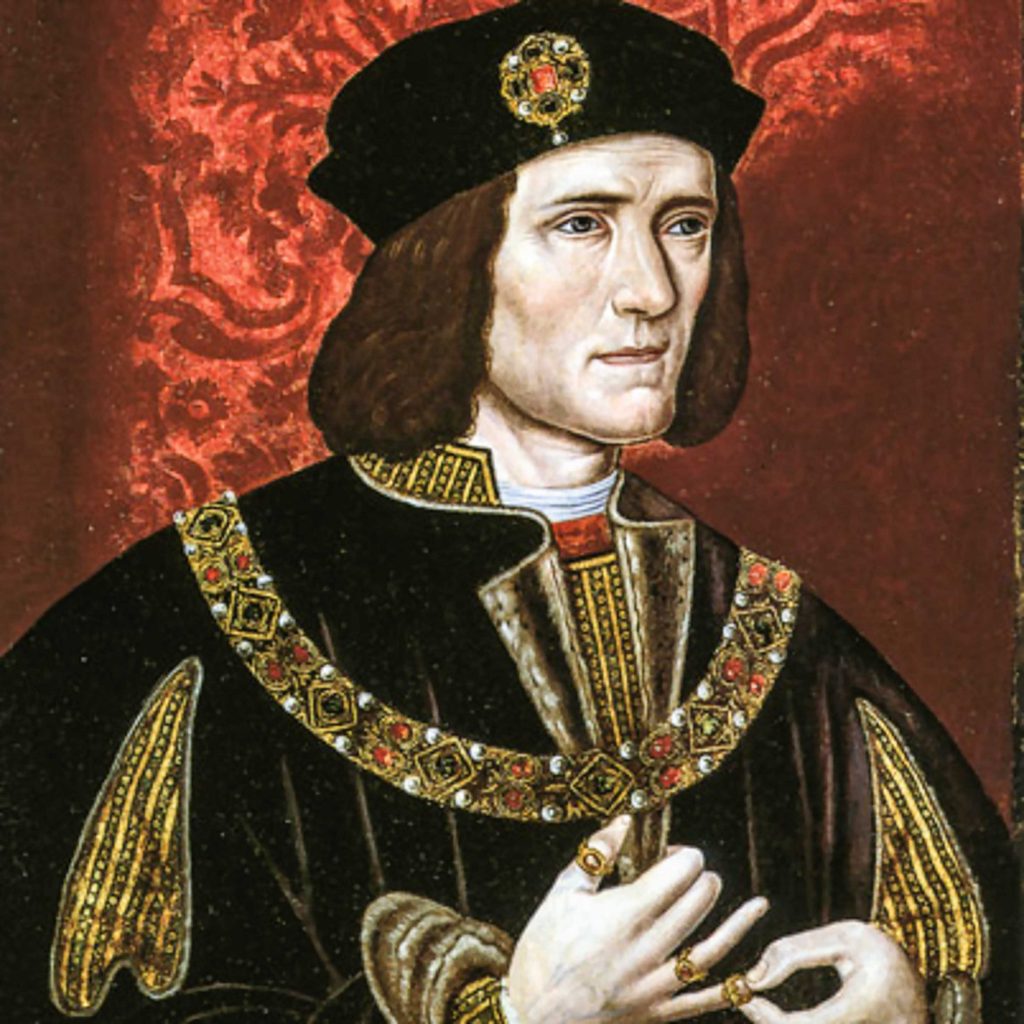
While we know the central and western parts of the Yorkshire Dales, the eastern edges alongside the Vale of York are, to say the least, a bit hazy to us. After doing a bit of research, we found that Richard spent his childhood and trained in knightly skills at Middleham Castle in the lower reaches of Wensleydale. These skills helped him take part in the battle of Tewkesbury (1471) aged just nineteen. It was at Middleham that he met and married Anne, younger daughter of the Earl of Warwick, head of the influential Neville family. Through that marriage young Richard eventually became owner of a whole range of castles, especially those guarding the eastern approaches to the Yorkshire Dales. It therefore seems likely that Richard had a special affection for Middleham, because he appears to have spent much time there, both in childhood and then as a family man, where his son Edward was born. It was this that coloured our decision to make a tour of the countryside Richard would have known so well. Our accommodation in Middleham was an attractive one-time cosy cottage in the shadow of the castle walls. Today, Middleham is home to around 500 young racehorses training for future glories on the flat. Each morning we watched them elegantly trotting away from the village, out towards the training gallops on the nearby Downs; perhaps we were admiring a future Derby winner. Middleham and its friendly locals, most of them involved with racehorse breeding, were always ready to chat over a socially distanced pint of Black Sheep in one of the three pubs; our favourite incidentally was the Richard III. The castle is just off the extensive old market square and is cared for by English Heritage. With the easing of lock-down the castle was open to prior bookings. As there is little or no Wi-Fi in Middleham, that took time, but we eventually managed to book a convenient visit. The castle has suffered as a ready-made source of building material over the centuries, but it still remains in remarkably good shape for its age. Three parts of the outer curtain wall are complete and the central keep could still echo with the sound of feasting lords and ladies enjoying life. There is a modern statue to King Richard inside the castle walls, but his most intriguing memorial is the worn lump of rock on a plinth at the top end of the market place. Although it takes more than a bit of imagination, this is all that remains of the carving of a wild boar, King Richard III’s emblem. Monasteries were at the height of the commercial power and influence during Richard’s lifetime. With their wealth built on wool and careful farming husbandry, lands around the Vale of York are home to a great number of monastic ruins. Attractive ruins the result of Henry VIII’s jealousy, are within easy driving distance of Middleham. We started our tour at Jervaulx Abbey, a short drive along the Ripon road from Middleham. Small by comparison with other abbeys, Jervaulx has attracted visitors over the centuries; the artist JMW Turner came this way while on a sketching tour in 1816. The main claim to fame though, is down to the early monks making the very first Wensleydale cheese. This forerunner of the cheese loved by Wallace and his faithful hound Grommit, was made from ewe’s milk, unlike today which traditionally is made from cow’s milk. Further along the Ripon road, the village of Masham is home to two breweries, both of which can be visited when things are different than today. Theakston’s is the oldest, dating from 1827, and Black Sheep Brewery is the other. Black Sheep was founded by Paul Theakston, fifth generation of master brewers in 1992 when the older company was bought out by one of the national brewing organisations. Travelling via Ripon, we arrived at Fountains Abbey bang on our previously booked time. The abbey is in the bottom of a wooded valley, secluded from car parks and Visitor Centre, but separated only by half a mile of winding path. If there was a competition for the most beautiful abbey ruins, then Fountains would be high on my voting list. No matter how many visitors there might be around once restrictions are removed, Fountains will remain a place of tranquil beauty, a place for quiet contemplation. It was founded in 1132 by a group of 13 disaffected monks who broke away from the mother church of St Mary’s Abbey in York. Here at Fountains they found what they were looking for, hidden from the world in a wild and wooded valley where living an austere life, they could follow a simpler and more devout existence. Members of the Carthusian Order, they were also known as the ‘white monks’ because of the undyed sheep’s wool habits they wore. Spending much of the day in contemplation and prayer, they also found time to develop skills as shepherds, tanners, master-builders and brewers. All these skills helped expand the abbey’s finance’s. By 1200 Fountains was one of the largest and most powerful houses in Britain. Despite damage by Henry VIII’s men who followed his dissolution edict, many of the abbey’s features remain virtually unspoilt, such as the gracefully arched cellars where freshly brewed ale was stored, to the appearance of its almost Victorian Gothic bell tower. A culverted stream which once provided water for the abbey’s needs, winds down the wooded valley for a little way before being slowed by a series of ponds and water gardens. This is part of Studley Royal, an attractive addition to Fountains Abbey created by John Aislabie and his son William in the eighteenth century. John was an over ambitious politician who fell from favour. As a result he retreated here and along with William, the pair managed to buy Fountains Abbey and set about designing the water gardens where their elegantly attired guests could stroll at leisure while
Restaurant Review – Shapla Spice

I’ve always thought of Ripley town centre as a comfortable place. A wide variety of shops; well connected by public transport, which runs through the centre of the town, and there’s plenty of car parking. Ripley isn’t overpowering; part of its charm is that it’s all on a human scale. That comfortable feeling doesn’t vanish as night falls and on a blustery, chilly winter’s evening Shapla Spice was a warm welcoming sight as Susan and myself hurried from our taxi and into the restaurant. Situated on the corner of Church Street and Mosley Street, Shapla Spice is very convenient for both buses and taxis. Plus the added advantage of that very large car park across the road; Ripley marketplace. We were greeted by Amin, the owner, and shown to our table. The smart exterior and the contemporary decor of the softly lit interior, reflects the restaurant’s understated elegance. The layout is not overcrowded. The tables, with their white linen tablecloths and napkins and stylish place settings enhance the restaurants modern ambience. We chatted to Amin who told us how a chance meeting with a local businessman persuaded him, with his several decades of experience, to open a restaurant in Ripley. Over the years Shapla Spice has grown in size but always remained on this busy corner of the marketplace. The restaurant does not have an alcohol license but does offer a selection of soft drinks. One advantage of this absence is that you can turn up with your favourite beer or wine. We arrived with both and without asking, the appropriate glasses and ‘openers’ arrived on our table courtesy of one of the attentive but unobtrusive waiters. Shapla Spice specialises in traditional Bangladeshi cuisine. Amin talked us through the extensive menu indicating how spicy, hot, creamy or sweet each dish was. And so for my starter, following his suggestion, I chose the sea bass. Sue, not wanting to spoil her appetite, said she would share it with me. While we waited for our starter we nibbled on two warm poppadoms. These came with the usual lime pickle, a sweet tomato sauce and an onion and tomato salad. Plus a delicious mint and yoghurt sauce; a perfect balance of sweet and sour. My starter, the sea bass fillet, was panfried with a lightly spiced dusting on the skin. It added to, but didn’t mask, the delicate flavour of this perfectly cooked fish. It was served on a bed of sautéed peppers and a few strands of onion, accompanied by a dash of sweet chilli sauce. Light, slightly spicy and full of flavour; this dish is far removed from the pakoras and kebabs that traditionally start an ‘Indian’ meal. For her main Susan had chosen laseez and a garlic naan. Laseez is a chicken tikka dish prepared with diced onion, tomato, garlic and a hint of chilli in a sauce finished with double cream. This mildly spiced dish is combined with spinach and topped with melted cheese. The chicken was moist and tender and the cream sauce, with its many spices, was full of flavour. Rice would have been lost on this dish but the fluffy garlic naan that Susan had ordered was the ideal commitment for mopping up the rich sauce. I had selected the Akbori lamb and pilau rice. The meat had been marinated, barbecued and served in a spicy tomato sauce along with roast potatoes, garlic, crispy onion, fresh coriander and a slice of lemon. The pilau rice, with the fragrant aroma from its traditional spices, was presented in the centre of the dish surrounded by the tender lamb. The rice and lamb made perfect partners. The lamb sauce was mildly spicy but not enough to mask the flavours of the pilau rice. It had been a wonderful evening. We could have stayed longer chatting and drinking the excellent coffee topped up by the ever attentive waiter but the taxi we had booked was waiting. We said our goodbyes and hurried out into the cold night. Settling into the back of the taxi we reflected on how relaxed the evening had been and how we had discovered new delights from that vast subcontinent. 00
Taste Derbyshire – Canine Delights
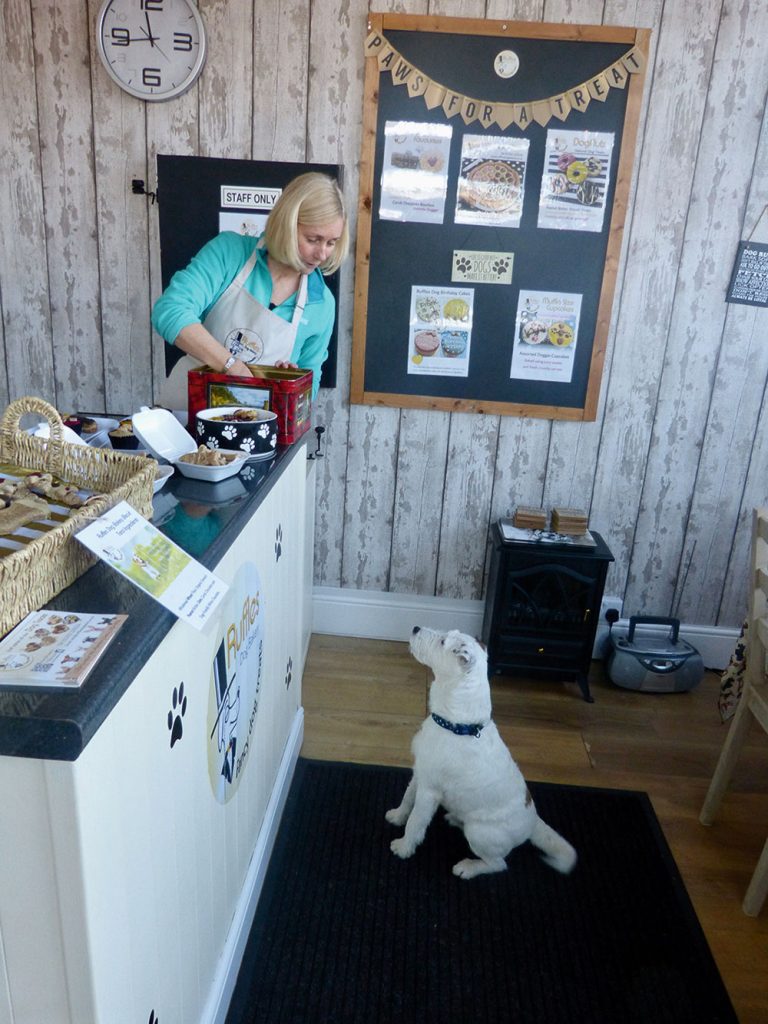
More and more restaurants and cafés are opening their doors to canine customers and Derby even has a fancy bakery exclusively for dogs. Taste Derbyshire’s Amanda Volley went along with her naughty pup Eddie to find out what would happen if you put a Jack Russell in a bakery. My Jack Russell, Eddie, is typical of his breed in that he lacks any kind of self-control around food. I say ‘food’ but some of the snacks he has enjoyed between meals include a clump of squirrel fur, an empty cake box, rabbit droppings and a hair bobble. Moreover, he has no qualms about stealing from shopping bags, picnic mats and the hands of old ladies trying to feed bread to birds. Which explains my trepidation when Eddie and I were invited to sample the culinary delights on offer at Ruffles; an upper-crust bakery on London Road, Alvaston, catering exclusively for dogs. Never mind sugarplums, I had visions of compensation claims dancing through my head. Owner Donna Wakeman, (54), was confident the quality of her bakes would be enough to turn Eddie from a treat-seeking missile into a perfectly behaved pooch worthy of top-notch nibbles. “I’ve never had a problem with a badly-behaved dog,” Donna smiles as she puts a selection of deliciously decorated gourmet bakes onto her counter. “I organise private parties which means all the dogs tend to know each other and we can just lock the door, let them off the lead and everyone can relax. Most dogs are a bit nervous in a new environment but yours seems lovely.” Remarkably, she is right. Subdued by the promise of free samples, Eddie looks ready to take his place in polite café society as Donna talks us through her morning’s baking. “The biscuits are made from healthy ingredients like wholemeal wheat flour, oats, and organic smooth peanut butter,” she says popping the odd morsel into the mouth of my canine companion. “They’re decorated with dog-friendly white chocolate or Carob and I only use natural colourings – the gold is turmeric which is great for doggies with arthritis and the pink is beetroot powder which tastes just like strawberry. They are delicious with no hidden nasties. The only things I ever add are natural ingredients like fresh herbs and grated carrot.” As Eddie casts an approving eye over the delightfully decorated ice cream cones, cup-cakes and DogNuts (dog-friendly doughnuts), Donna explains why she began baking for dogs. “I started making homemade treats because my rescue dog Alfie, now four, was such a fussy eater,” explains Donna, of Boulton Moor. “We were trying to train him with supermarket treats but he’d either ignore them or go and bury them. I found lots of dog treats recipes on the internet but it took three months of trial, error and tweaking to get one Alfie loved.” It wasn’t just Alfie who turned somersaults for the snacks. “My friend’s dogs liked them so much, they started putting in orders and it just snowballed from there,” she laughs.“I’m a web-designer so I decided to launch an on-line business. The bakery’s name was inspired by a visit to Raffles Hotel in Singapore. My logo is a dog in a top hat, monocle and bow tie and people love it so much, I’m thinking about putting it on a range of accessories like feeding bowls.” The on-line bakery business was so successful, Donna soon out-grew her home kitchen. “When I moved here in July 2018, I was attracted by the large kitchen and I knew the position on a busy, main road into Derby was useful for advertising to potential customers,” Donna says. “Last Christmas, they were queuing out the door. One chap, who was just working in the area, came in and bought ten doggie hampers which included treats shaped like fir trees, turkeys and puddings. This month (February) I’ll be making lots of love hearts for Valentines.” There’s room in the bakery for doggy toys and accessories (Eddie was excited to find dog-friendly Prosecco ‘Pawsecco’ and beer on the shelves) and an enormous table for all the doggie events. “I love catering for afternoon teas and birthday parties. I’ll make dog- friendly sandwiches like peanut butter and cream cheese and serve them from a tiered cake stand,” says Donna.“The selection will include biscuits like the bourbons and custard creams, eclairs, cup-cakes and DogNuts. The owners often bring hats and I play doggie themed music and I always make a special cake for the day.” Donna is understandably proud of her occasion cakes and gives me a sneak preview of one smothered in pink frosting which she’s made for a lucky pup called Luna. “The cakes are made from self-raising wholemeal flour, my homemade apple puree, peanut butter and grated carrot,” she explains.“They are made fresh to order and, if kept in the fridge, they should last up to ten days. Not that I’ve heard a dog ever taking that long to eat one.” As if on cue, we are joined by loyal customer Ella Conway who is at the bakery to buy special goodies for her pet chihuahuas Alfie and Ziggy. “They love coming to Ruffles. If I even mention the name, they start barking and run to the door,” laughs Ella Conway (20), of Shelton Lock. “You can’t buy anything like this at the pet stores. Donna even makes spongy treats for Alfie as he’s eleven now and only has a few teeth. Donna sells fish and chip and pizza shaped biscuits so we can all have a take-away night.” In the long-term Donna would love to branch out into offering franchises as she’d love to see a Ruffles Dog Bakery in places up and down the country. For now, she is content with fulfilling her many orders, hosting canine celebrations and developing new lines including a dog-friendly cocktail called ‘Singa-paw Sling”. “I do have people who think the idea of a dog bakery is a little crazy or that you