Lead Smelters of the Peak District

The Derbyshire Peak was once the major supplier of lead in the world. There is the possibility of lead being dug from close to the surface in pre-Roman times, but it was one of the reasons why Rome decided to annexe Britain to its empire. There is a folk memory of a kind of concentration camp at Bradwell in the Hope Valley from which slaves were made to mine deep within the hillside. Once dug from the bowels of the earth, lead needed to be changed from crude ore into a product that could be moulded or beaten into its useful final form. Ore came from the mines, whose remains still dot the fields and hillsides of the limestone-based White Peak. Known as ‘bouse’ it was full of impurities and it was the job of women whose husbands toiled far underground to beat the ore bearing lumps of rock and wash the resulting powder in convenient streams, or specially made leats, channels flowing from small dams. More sophisticated methods used stone or wooden troughs called ‘buddles’, where water and ore flowed over baffles to catch the heavier particles of ore. Lead mines were mostly run by one or two men at a time whose daily output was often no more than a few hundredweights of ore bearing rock; a Peakland saying is that if a miner could fill his ‘weskit’ (waistcoat), pockets with ore, then he could finish for the day. Crushed and washed by miners’ wives, the ore was stored for safe keeping in a coe, one of the small barn-like buildings that still dot the fields above places like Bonsall or Wirksworth. A fine example of one of these stores stands beside the B5056 Bakewell to Ashbourne road, about a quarter of a mile south of the Miners’ Standard pub outside Winster. Railings have replaced the stout wooden doors, but it is easy to visualise miners pouring their ore through a slot in the back wall, into an early form of night safe. Periodically lead agents would collect the results of miners’ toil. They were an important link in the chain but often had an unpopular reputation for their so-called unscrupulous dealings and price fixing, but without them the ore would never find its way to its final markets. Trains of pack-ponies employed by the agents carried the crushed and washed ore to smelters sighted on the surrounding hills. Routes taken by the ponies can often be traced by the number of Jaggers’ Lanes that appear throughout our region, such as in Darley Dale, or Ashover. The word Jagger is thought to come from the Old German word Jaeger, a breed of small tough ponies used by huntsmen. With only one recognisable example, Peakland lead smelters have all but disappeared, the only clue to their whereabouts being marked on the map by the number of times the words Bole Hill appear on Ordnance Survey maps. Bole is an old word for a primitive open smelting hearth where lead ore and kindling were mixed together on top of a stone hearth. As the fire burned and fanned by the wind, it generated sufficient heat to melt the lead, separating it from impurities allowing the molten lead to flow into a suitable collecting dish. Later bellows were used to create extra draught so greater heat, but even so open hearth methods were slow and inefficient. With the passing of time more efficient methods of ore smelting were developed which became known as cupolas, or reverberatory furnaces. Basically in this type of furnace the fuel, coal which was plentiful to the east of the Peak District, was burned in a grate separated from the ore by a firebridge. Flames passed over the firebridge and ‘reverberated’ from the roof of the hearth, heating the lead ore, causing the lead to separate from the waste material, before passing through flues to a tall chimney built to provide the necessary draught. The resulting slag or waste was either raked or drawn off, while the molten lead ran into a receptacle. In later furnaces the flues were extended to cool and condense escaping lead vapour which was given off along with waste gasses. As the condensed lead ended up clinging to the sides of the flue it was someone’s, usually small boys’ job to scrape it from the brick or stonework. Unfortunately not only did they then come into contact with potentially poisonous lead, but with numerous other lethal substances which had a saleable interest to the smelter’s owner. Flues in Derbyshire smelters would meander over anything up to half a mile or so beneath surrounding fields before they reached the chimney, unlike those in the Yorkshire Dales that can still be traced, running for several miles up then out on to the fell tops. The reason for the difference in flue design is because unlike the Derbyshire smelters that ran on coal, those in Yorkshire had to rely on burning peat which being less heat efficient, would require a considerably greater flow of air in order to produce anything like enough heat. One of the many environmentally unfriendly side effects of lead smelting is the way lead fumes spilling out on to the surrounding fields poisoned the grass. Any cattle eating this poisoned grass would become very sick and probably die and in Derbyshire this became known as ‘bellands’, a kind of stiffening of the joints. Farmers kept their stock away from tainted ground by surrounding it with stone walls and planting shelter belts of trees. At aptly named Spitewinter on the highest point of the A632 Matlock to Chesterfield road, Belland Lane links the A632 to the B5057 from Two Dales, a sure hint that the soil around about was once severely poisoned. With the passage of time and regular rainfall, local grazing no longer gives cattle this dread disease. 00
Modern Collectibles – Motor Car Club Badges

Both my parents were keen motorists, and I was often as a child taken to events where like-minded people congregated. Whilst out driving with my mother, I was taught to recognise all the makes and models of cars on the road – this was early 1950s, I might add, when the roads were still littered with vehicles from well before the war. Consequently, I used to amuse myself by admiring cars, armed with some knowledge, when at some event I had quickly become bored with the main fare. This rapidly acquainted me with the tantalising array of bright metal and enamel badges sported on many cars. Most impressive were the sort of sports car, the front of which was embellished with a chrome-plated horizontal bar in front of the grille, mounted with an array of such badges. The most obvious ones were the yellow-backed AA ones and the blue-backed RAC examples. They remind one that the fitting of badges to motor vehicles goes back to the early 1900s. In 1897 Frederick Richard Simms, who is often referred to as the father of the British motor industry, founded the Automobile Club of Great Britain and Ireland. The Automobile Club soon started to attract some of the most influential people of the era. In 1907 Edward VII became its patron. Thereafter the club became known as The Royal Automobile Club, more commonly referred to by the initials RAC. The first brass badges were made by Elkingtons and in good order will cost you £100 or more. In June 1905 another major British motoring club was formed, this was The Automobile Association. Like the RAC, it is also more commonly referred to by its initials. In March 1906 the AA produced the very first motoring club badge. Earliest examples carried an impressed signature of the club’s first secretary, Stenson Cooke. A little later, the badges also featured the word secretary. The example shown, on offer at £40, looks a bit too good to be true to my eye; the engraving looks machine cut as well; hand engraving always has trailed-off ends. The RAC soon acquired an impressive club in Pall Mall which still exists although, like the RAC, the badge represents what is essentially an insurance organisation which today has no connection whatever with the London clubs. Both AA and RAC badges are datable from the numbers stamped upon them. For instance, early AA ones run from 1 to 999,999 (1906-1930). More modern versions of both can go for between £5 and £20 depending on condition. At Bamfords we occasionally get pre-Great War AA and RAC badges (upwards of £40), but rarely others. My father latterly sported one familiar to me, the Veteran drivers’ club: a ‘V’ with a central button denoting the number of years over which the member had been driving; a post-war example should cost in the £20-£30 bracket. Father also passed the Advanced Motorists’ Club exam, and bore their red, white and silver badge (earlier examples about £20), not to mention the Baltic Exchange Motoring Club! The latter would be very rare today, and command upwards of £80, but a Liverpool example was recently on offer for £70; the smaller the club, though, the rarer the badge and the higher the price; yet some go for less than £20. Civil Service Motoring Club badges, quite well cast, are surprisingly common, for instance. There are also owner’s clubs for most significant marques, especially sports car marques. A common post-war MG one is likely to be £10-£20 only, although others carry a premium. Father belonged to the Packard Register, but I cannot recall there being a badge. The most expensive one I have come across recently is a Lancia Owner’s Club badge in only passable condition for £150. Vehicle badges of course are not restricted to motoring clubs. They can, and often do, represent a wide range of hobbies and interests; regimental ones used to be very popular when the army was much larger. Being stuck on the front of a car, most tend to look aged, with chrome or brass oxidised or discoloured, and enamel chipped, and these are the ones to avoid unless you spot a real rarity. As ever, always go for those in the best condition and there are a lot out there – numerous car owners got their badges and never got round to having them put on (or didn’t particularly want to). Again, smaller, long-since amalgamated regiments are the most sought after, along with guards regimental badges and those of the Parachute Regiment, although the latter are surprisingly common yet can go for more than £50. Yet if you had an RAC or AA badge showing, their respective road scouts would always salute you, and the badge came with a key (sometimes for sale with the relevant badge) to give access to the roadside boxes, of which a superbly restored (and listed) example – box No. 530 – survives in a lay-by near Brancaster Staithe in North Norfolk. Those were the days! Indeed, the car badge is the longest living vehicle accessory, and many badges are still produced today. But beware: some collectible ones are re-produced today and end up being sold as the real McCoy. Check wear and finish. 00
Walk Derbyshire – Youlgreave & Its Two Dales

5 miles (8km): easy riverside walking along two attractive dales, linked by an interesting village street. RECOMMENDED MAP: Ordnance Survey 1:25,000 scale Outdoor Leisure Series; Sheet 24, The Peak District, White Peak Area. PUBLIC TRANSPORT: Hulley’s 171 hourly service from Bakewell (no Sunday service). CAR PARKING: laybys at roadside beyond River Lathkill bridge outside Alport. REFRESHMENTS: three walker friendly pubs in Youlgreave village. Here is a lovely walk following dales on either side of Youlgreave, one of the largest yet unspoilt village in the Peak. To its north is Lathkill Dale which is the first dale to be followed; a short stroll along the village street leads to a woodland path into Bradford Dale which is followed back to the starting point of the walk, and also the point where streams flowing down the twin dales, meet. Although the Ordnance Survey and the County Council use the first letter ‘e’ in the ‘greave’ part of Youlgreave, the locals usually spell the name Youlgrave, but in any case prefer to call it ‘Pommy’ just to confuse visitors! The village proudly maintains its independent water supply brought by pipeline from a source beneath gritstone moorland to the south. Before this came about Youlgreave had a severe water problem, especially in dry summers when many of the village wells dried up. The circular stone tank opposite the one-time co-op shop, now a youth hostel, was used to store piped water which first came to the village in 1829. Now every house has piped water like the rest of us. Although the custom is possibly much older, the five village wells have been dressed in floral motives since 1829 during the week following the Saturday nearest to St John the Baptist’s Day. Youlgreave has several buildings worth more than a passing glance, from farmhouses within the immediate confines of the village to its two-storied hall, the garden of which is occasionally open to the public, especially during well dressing week. The church is a delight and contains the tombs of several medieval knights alongside its Norman font. Unusual in its design, the font bowl is supported by a central column together with four small shafts. An upside down dragon on the main bowl holds a smaller bowl in its mouth, thought to have been made to hold consecrated oil. The font has a curious history, having once stood in Elton church. The east window was designed by William Morris and Burne-Jones, the Pre-Raphaelite artists. Church records from 1609 tom1715 record fees paid to the official dog-whipper. Deep pools in the River Lathkill are stocked with trout below Conksbury Bridge and monster-sized fish can sometimes be spotted lazing beneath the narrow pack-horse bridge below Raper Lodge, making a popular spot for children. Fishing and the immediately riverside meadow is strictly private, but you will get an excellent view as you follow the path beyond Alport, the starting point of the walk. The two dales meet and their waters mingle at Alport. The quiet hamlet is a little way from the road, a pleasant group of stone cottages with attractive gardens; a hump-backed bridge carries the side road and downstream, the remains of a grinding mill is where lead ore was prepared for smelting. Observant passers-by will see a curious notice on the gable-wall of a farm on the Youlgreave road, warning vagrants to keep away. The Walk : 1. From the road go through the gate on your left beyond the farm house. Follow the field path with the River Lathkill on your right, up-stream until it reaches a path and track junction. It is worth making a short diversion at this point by going to your right, down a short path as far as an ancient pack-horse bridge over the River Lathkill. Children especially will enjoy looking out for trout lazing beneath the bridge. Return to the path/track junction. 2. Walk uphill past Raper Lodge, (the cottage on your left). Follow the surfaced track, uphill until it reaches a minor road. Turn left and walk into Youlgreave village. 3. At the staggered cross roads in front of the church, turn right and walk through the village for about half a mile. Ignore the footpath sign on the left between two rows of cottages. Continue along the road as far as the end of the village. Look out for the water tank that once supplied the village with pure water. Nowadays Youlgreave enjoys piped water like the rest of us, but their’s still comes from a spring on Stanton Moor. 4. A little way beyond the last house in the village, go through a kissing gate set back on your left. 5. Follow the woodland path, steeply in parts, downhill into the dale. N.b. the path can be slippery in wet weather. 6. Turn left on to a wider path descending from your right. 7. Cross the stone bridge and go left along the riverside track. Small ponds along the dale were created to conserve water for the wheel driving the ore-mill in Alport. One of them, closer to Youlgreave, has been converted into the village swimming pool. (But don’t expect the water to be warm!). 8. Reaching a stone clapper bridge, cross and go through a stile on your right. Continue to follow the River Bradford, downstream until it reaches the outskirts of the lower part of Youlgreave. 9. Cross the side road and go through the gate opposite. 10. Continue to follow the river, still downstream, past an attractive packhorse bridge (but do not cross). 11. Walk on past the dramatic rock face of Rheinstor Crag until the track reaches the road. Turn left for your parked car. 00
Lost Houses of Derbyshire – Chesshyre’s House, Derby

The Chesshyre family has been amongst the elite tradesmen of Derby since the beginning of the seventeenth century, when brothers Robert and John Cheshire, sons of a Breadsall farmer, set up in business in the town. John (1613-1689) was Mayor in 1680 and left descendants in the town, as did Robert (1602-1673) who was a lawyer. He married Isabella Blood and had four sons and a daughter, of whom Samuel was Mayor of Derby as well, taking the post only a decade after his uncle. The third son was Gilbert Chesshyre mercer and gentleman, who in 1696 married an heiress of considerable fortune, Catherine, daughter of Revd. Thomas Meynell of Langley, of which place he was both rector and lord. With the death of his grandson in 1758, his estate was split nine ways, two parts coming to the descendants of the marriage. The family were well established in the parish of St. Werburgh, but Gilbert and Catherine, determined to have a new house, chose a plot – possibly close to the family’s previous residence – on the corner of Friar Gate and Ford Street. The house was probably begun at the time of their marriage, although to subsequent generations of Derby residents it was known as The Queen Anne House. Its first known appearance on record, however is in a document of 1702. This new house, no. 25, Friar Gate, was exceedingly handsome and well proportioned, and represented the finest quality money could buy in late seventeenth century Derby. Had it survived it would probably have been listed Grade II*. It was of brick, three storeys, and five bays wide under a hipped roof. It was a building of some architectural pretension with stone dressings: quoins, bolection moulded architrave surrounds to the windows, punctuated with keyblocks. The central entrance was embellished by grooved rusticated sweeps, Doric columns and a modillion frieze. The roof was also supported on modillions and was crowned by impressive cruciform-plan stacks. Indeed, the style resembled a mature development of Franceys’ House in Market Place and may well have been by the same (unknown) hand. Nor do we know anything of the interior, bar the fact that there was a timber staircase with turned balusters on a string, fielded panelling (which extended to the main rooms) and chimneypieces carved from local polished limestones. Franceys’s house boasted a frescoed ceiling by Francis Bassano, so it would not be beyond the bounds of possibility that this house boasted something along the same lines. There was also a garden extending down to the Markeaton Brook by Willow row (then still so embowered) and a fine wrought iron railing protected the street front from the vicissitudes of Derby Football. The couple’s only son was another Gilbert who, with his two sisters, inherited a portion of Langley in 1758. Born in 1694, he managed to acquire a small landed estate west of Radbourne and thus described himself as ‘of Dalbury Lees, Esq.’. He was a colonel in the militia raised by the 3rd Duke of Devonshire to oppose the southward progress of Bonnie Prince Charlie in the autumn of 1745. His reward was the high shrievalty in 1759, shortly after he inherited his share of the Langley estate. However, in 1761 he disinherited his surviving son (who died unmarried in 1764) and died eighteen months later. He had married in 1720 Dorothy Beighton of Crich, and in 1744 clearly decided to improve the roof, installing fresh rainwater goods including a lead hopper clearly monogrammed: At the same time, a Robert Bakewell side gate was installed to allow access past the west side of the house into the garden. It is close in design to that at Tissington Hall, datable to the same period. In 1938, this ended up in the museum, but presents a problem, for the coat-of-arms on it read oddly. The cast crest of an unicorn’s head erased collared and chained is fine, and may relate to the unofficial arms used by the Chesshyres, but the original shield has been at some stage removed and replaced by a thin iron confection looking like an incandescent light bulb, bearing the device vert on a chevron between three stags statant or as many trefoils slipped gules. Since I have known it, this has been tinctured to conform with the arms of Robinson of Yorkshire, but these may not have been the original colours. Presumably the shield was changed after the Chesshyres and Cheneys left. At Gilbert’s death his three parts of the Langley estate was re-divided between his daughters Dorothy and Catherine. The latter died unmarried in 1764, leaving her entire estate, including the Dalbury Lees land and a single part of Langley, to a close friend – how close in not clear, but she was only 22 when she inherited from her father – Dr. Philip Gell, who was her tenant at Kirk Langley. His son, by Honor Borough of Castlefields, was another Philip who, in 1789, on the death of a relative, inherited thereby another half of a third of Langley. Meanwhile Catherine’s elder sister Dorothy inherited the Derby house and in 1753 married a neighbour, Henry Peach of Full Street, who died in 1758. By Peach she had six children, one born posthumously and including a pair of twins. Three years later, by now the inheritor of her portion of Langley she married Robert Cheney, by whom she had a son, Robert, born 1766. She lived in the family’s house in Derby with Peach, but two years into her second marriage she inherited her portion of Langley, which happened to include the hall, into which they moved, and where Cheney lived until his own death in 1809. At this stage the impressive Derby house descended to Cheney’s eldest son, Maj. Gen. Robert Cheney (1766-1820), whilst Langley Hall was inherited by Dorothy’s eldest son by Henry Peach, also Henry (1754-1833), a clergyman who had married the niece and co-heiress of Derby’s eminent Lunar Society co-founder, John Whitehurst, FRS.
Images of Donegal & Ulster

Only a country like Ireland could have its most northerly point in the south, but as Brian Spencer discovered on a recent visit, that is part of the enjoyment of a visit to this delightful neighbour of ours across the Irish Sea. An early start from Slack’s Coaches at Matlock brought us to Holyhead’s seaport terminal in good time for the early afternoon Stena ferry to Dublin. As stormy crossings seem par for the course, the journey was not without its excitement, but we arrived off the mouth of the River Liffey on time. Unfortunately the Liffey channel is rather narrow and due to the rough sea we had to wait our turn circling for about an hour with other ships until there was room to dock. Leaving the ferry soon brought us on to an example of the way Ireland is being helped by European Union money. At one time the journey across Dublin could take hours, but now the way seems to mostly go beneath the city. Joining the outer ring of motorways we were soon at Enfield to the north-west for an overnight stay at the Johnstown Estate Hotel. If as I suspect, the hotel is an example of the way the Celtic Tiger economy is back on its feet, then all is well for our near neighbour. We were treated almost like royalty, an introduction to the superlative standard of hospitality on offer throughout the island of Ireland. Easy going along the almost empty motorway network took us westwards and north over the border to Enniskillen and back into the United Kingdom. This was our first experience of the so-called invisible border that is giving Prime Minister Theresa May a few headaches. Since the Good Friday Agreement there are no longer border posts such as the one where during the ‘Troubles’ a colleague and I were held at gunpoint while our details were checked – apparently the hire car we were driving was the same model and colour as one used in a bit of bother earlier in the day! Now the only way of telling which country you are in is by the road signs changing from kilometres to miles and vice-versa. Enniskillen is a small market town on the banks of a short stretch of river between Upper and Lower Lough Erne. An old fashioned sort of place that seems to happily cater for the needs of country-folk, it came as a shock to see the war memorial where thirty years ago fifteen people were killed by a bomb on Remembrance Sunday. There is nothing to commemorate the tragic event, but that is probably the way the Irish are trying to overcome their unhappy past. The actors Timothy West and Prunella Scales cruised around the nearby lough in one of their TV programmes about canal journeys. Huge almost sea-going cruisers were tied up at the bottom of Enniskillen’s main shopping street. Downstream, but still very much part of the town is the castle. Built in the days when lowland Scots were ‘planted’ in order to keep the native population under control, its garrison supported King James II and withstood siege by the troops of Dutch William of Orange, King ‘Billy’. A museum of the town and local regiment, the Iniskillen Fusiliers’ history occupies the main part of the castle – Iniskillen, spelt with a capital ‘I’ is apparently the old form of Enniskillen. Moving north and westwards again, but back into southern Ireland we were greeted by the sort of weather the Irish refer to as ‘a gentle sort of day’, in other words rain on and off, the way Ireland keeps its grass green. Making our way to the ‘Wild Atlantic Way’, we followed the coast, past tiny white-cottaged villages and deserted beaches backed by crashing surf. It was here that we took a wrong turning at Maas. It led us along ten miles of twisting single-track road with only one passing place for the whole journey. Fortunately this was the only place we met another vehicle. After lunch at Dunglow, a typical Irish village where every other shop doubled up as a pub (the others were betting shops), we moved on through Glenveagh National Park. This is an area of wild moorland topped by Erigal Mountain. At its highest point, a perfect cone of quartz-like stones overlooked Lough Nacung. Donegal town was our headquarters for the next couple of days. This market town is the central point for County Donegal. It sits at the head of a wide bay-like estuary fed by the River Eske, with scenery very similar to Devon’s south coast. Overlooking the sea, what was once a Franciscan monastery is now the town’s tranquil graveyard, and, like Enniskillen, the place has a castle dominating the town centre. Mostly Jacobean on earlier foundations, it was once the home of the O’Donnell’s, good and bad; one of the latter, Red O’Donnell unsuccessfully attacked it on behalf of James II in the seventeenth century. Constantly wary of attack, anyone using the garderobe (lavatory), was kept safe from receiving an arrow in a very delicate place by the exterior drain having a sharp bend to prevent arrows reaching anyone sitting on the ‘throne’. Donegal was another place where we met friendly people who made us feel at home. The briefest smiles on our part would be turned into a welcome excuse to stop and chat. We looked into a restaurant at lunchtime and although it seemed full, the proprietor immediately cleared a table for us and though he was busy, he managed to chat to us as though we were long-standing customers. By going south we turned back into Northern Ireland in order to spend a few hours in Derry–Londonderry. With its background as a hotbed of murder and mayhem, we quickly realised that this is now history and the town and its people are simply getting on with their lives. The town centre is surrounded by ancient walls and was busy
Product Test – Weleda

Replenish with Weleda Sea Buckthorn Replenishing Body Lotion 200ml £18.95 Intensive body care for dry skin. Fresh, fruity fragrant and replenishing body lotion to help your skin back to its natural beauty balance. Sun-ripened riches in a bottle – organic sea buckthorn fruits and seeds yield the oil which makes this lotion rich and replenishing. The vigorous oils are full of nutrients and natural fatty acids, easily absorbed to help build skin’s natural defences against moisture loss. We add gentle mallow extract, shea butter and fresh, fruity fragrance from natural essential oils. With over a third natural oils, it’s a thirst-quencher for dry skin. 37% Increased skin moisture (Tested after 28 days) 96% Visible care for dry skin (Self-assessment after 28 days) Pomegranate Regenerating Body Lotion 200ml £24.95 Daily use body lotion to prevent the premature ageing of the skin. Light, all-over care and skin nourishment with a sensuous fragrance. Body love at your fingertips. All you want is for your skin to stay soft – so you’ll be glad you have Pomegranate Regenerating Body Lotion close to you. With a rich mix of natural ingredients, like skin- loving organic pomegranate seed oil, gossamer apricot kernel oil, and nourishing shea butter, Weleda whips up a light, sensuously fragrant lotion designed to love skin that’s not ready to age. Daily use stimulates new cells, protects from environmental harm, and leaves you velvet-smooth all over, naturally Wild Rose Pampering Body Lotion 200ml £24.95 Light floral lotion to soften normal to dry skin. Only roses could bring this velvety bloom to your skin. Only Weleda makes it flawlessly natural. The bloom of a rose defines velvety softness – something we all want for our skin. Weleda’s light Wild Rose Pampering Body Lotion asks the tough and vigorous wild rose for her secret seed oils, which regenerate and stimulate skin, while damask rose petals bring a delicate, indulgent fragrance. Natural ingredients do nothing but good to your body, making this silky lotion a sensory treat that works wonders. Breathe in the harmonising, rich scent and feel long- lasting, beautifully soft results. Tried & Tested :: Tried & Tested :: Tried & Tested :: Sea Buckthorn Lotion This is a lovely light summer lotion which sinks into the skin really quickly and leaves the skin feeling hydrated all day. Very pleased with this product. VP Wild Rose Pampering Body Lotion Excellent coverage softens skin leaving a velvet like feel, and being wild rose smells so nice! Also Benefits from a mess free bottle so perfect for no waste and travelling. LJ Pomegranate Regenerating Body Lotion This is a beautifully light body lotion that absorbs quickly into your skin, leaves your skin feeling soft. Its free of all synthetic colourants and fragrances and is full of natural plants oils which means it smells beautiful and summery. Perfect for a summer moisturiser. CB 00
Celebrity Interview – Kate Humble
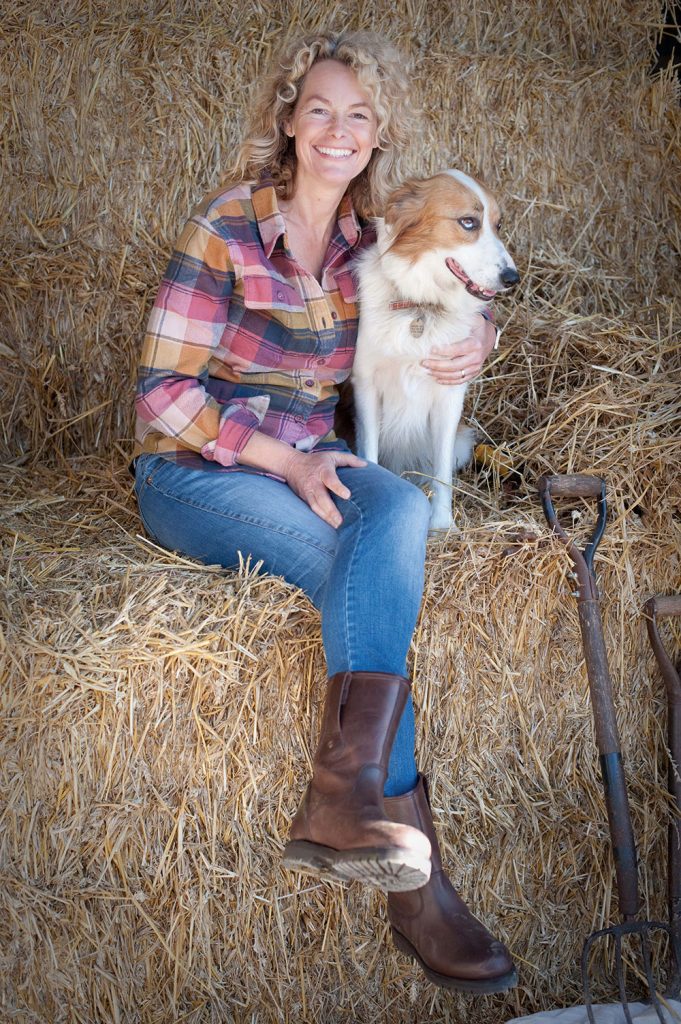
“There’s nothing better than walking into a mucky stable or a mucky barn with a pitchfork and a wheelbarrow and cleaning it out” The feeling of writer and TV presenter Kate Humble who’s known mainly for specialising in wildlife and science programmes for the BBC. She’s also appearing in theatres around the country and will bring her show An Evening With Kate Humble to Derbyshire next month as part of the Buxton International Festival. She broke off from preparing for that show to tell me how she thrives on live television, how appearing in front of an “Evening With” audience can be “scary“ and why she has a lifelong passion for mucking out. Her appearance in Buxton will be one of a series of dates that she’s fitting in around her television work. Kate takes to the stage only a couple of times a week to present an evening of stories and adventures that she’s experienced over a 20-year career in broadcasting. The show is in two halves and during the interval Kate gets the audience to write down questions which she then goes on to discuss. “I show video clips of some of the programmes that I’ve done and I talk about some of the madcap things that I’ve ended up doing in the name of a career,” says Kate. “The second half for me is entirely unpredictable. There are still clips and stories but there’s also this lovely, unplanned element which is dependent on the audience, which I really enjoy.” Kate admits being on stage is very different from appearing on TV: “It’s a lovely opportunity for me to be face to face with an audience. It’s quite scary. I’m nervous before every single show. But it’s lovely to be able to have a more direct connection with the audience.” Our chat actually started more than an hour-and-a-half later than scheduled. That was because Kate had to meet a deadline for an article she was writing for the Daily Telegraph. She’s always been a freelance writer and had her first article published by the Telegraph in 1996. She admits her latest assignment was a tough one. “My father died earlier this year and they asked me to write about that for their Father’s Day edition. It was a really important tribute to my dad and I hope it resonated with people dealing with the incredibly complex emotions that go alongside grief.” Katherine Humble was born on 12 December 1968 in Wimbledon. She grew up in rural Berkshire in a house next to a farm. She had what she describes as a “proper childhood” – building camps, racing snails and climbing trees interspersed with trips to hospital to get patched up when she broke bones. She reckons she’s still a tomboy. When she was 18 she left home and did odd jobs so that she could fund a year travelling in Africa. She wrote for the Telegraph about her adventures. Then she got her first job at the BBC, working as a runner on Animal Hospital and then The Holiday Programme. On her second day in the Holiday office the programme’s editor realised that Kate would make a good presenter despite her reservations. “It was never my plan or intention and when people say ‘how can I have your job?’, the truthful answer is the best thing to do is not to want my job and it might just come along by accident. “In my case it came along because it’s that awful trite line of, I was in the right place at the right time and I could offer the thing that they wanted, which was somebody who was a genuine traveller who enjoyed doing things at a local level. The first bit of filming I did was doing a local journey around France telling people about it. And it went from there.” Since then she’s become well-known for appearing on programmes such as Springwatch, Wild In Africa and Volcano Live. She feels that she’s been “very lucky” to have done lots of different things. “I’ve done documentary series that I’m enormously proud of, things like Living With Nomads (a BBC2 series in 2015, filmed in some of the world’s most remote wildernesses) and Extreme Wives (a 2017 series exploring the roles of women in three communities in Kenya, Israel and India). “I’ve also loved doing things like Animal Park (a BBC documentary series about the lives of keepers and animals at Longleat Safari Park, Wiltshire) which I’m still doing after 20 years. I’m also very lucky that new projects come along. I’m always challenged and excited by those. “I’m very careful about what I choose to do and I only take on projects that I genuinely care about because I think the audience are very smart – they can spot somebody who’s just taking a job because they want to be on telly rather than really believing in the programme.” Live television is known to be hugely problematic but it holds no fears for Kate. “People always say what happens when something goes wrong? Well, in my view nothing goes wrong – you’re just showing exactly what’s happening. Some things may not go according to plan and you may not be able to predict everything, particularly when you’re dealing with wildlife which jolly well does what it wants. “But that’s the exciting thing about doing something like televising wildlife live. And that’s why I love it so much. It’s unpredictable, it’s exciting, there’s a very good reason for it to be live. You want people to be there, to feel absolutely connected with the action. So as far as I’m concerned it’s a lovely, exciting way of broadcasting. I don’t see it as something that’s problematic at all.” When Kate was 23 she married television producer Ludo Graham. Nine years ago they moved from Chiswick, west London to a smallholding in the village of Trellech, Monmouthshire. They live with a variety of feathered and furry livestock
Restaurant Review – The New Inn @ Milford

A Fusion of Flavours I’m not ashamed to say ‘I love Derbyshire’; every bit of it. From the Dark Peak of the moorland above Glossop to the ambling course of the River Trent as it twists and turns through the floodplain at the southern tip of the county. I also love its diverse industrial history. None more so that the Derwent Valley stretching from the cotton mills at Cromford to the Silk Mill in Derby. Now designated a World Heritage Site the valley has, at its half way point, the historically important mill town of Belper. Part of the charm of the town is that it has retained a lot of its original features. One of them being the many alleyways that offer short cuts that can only be used by pedestrians. One of these in Milford links Hopping Hill with Derby Road and, occupying the whole of one side of the pathway is the New Inn. Because of its location it has elevations on to both Hopping Hill and Derby Road; the A6 where the New Inn’s car park is located. Myself and Susan had a table booked at the restaurant at The New Inn. The first thing you notice, before you enter, is the view from the terrace, overlooking the Derwent and on to the Chevin. Even with the poor weather of early June it’s worth a minute to stop and take it in. We made our way into the bar area to a warm welcome from Hollie who asked if we would like a drink while we went through the menu. An extensive refurbishment has given the interior a new look with light, modern colours that are off-set by simple, bold upholstery. Also, there’s cosy seating in the bay window where you can linger with a pre-dinner drink and take in more of that view before you dine. With a chilled white wine for Susan and pint of Doom Bar for myself we nibbled on tasty tomato bruschetta drizzled with sweet Balsamic while we chose our evening meal. The menu is styled as British Italian fusion cuisine and the dishes are created using fresh, seasonal produce, locally sourced. Although it retains a lot of Italian influence from the restaurant’s previous incarnation quite a few English classics are now available. The Italian dishes range from the simple but tasty spaghetti carbonara to a creamy risotto. The majority of the Italian dishes are available in smaller portions as starters as well as mains. Unhurried we finished our drinks and were shown to our table. I took a look at the wine list. It’s not extensive but it’s excellent for a restaurant of this size; with something for most tastes and reasonably priced. We ordered a bottle of Chilean Sauvignon Blanc that proved to be a perfect accompaniment for all of our chosen dishes. I chose my starter from the specials board while Susan was tempted by the cream of vegetable soup. The soup lived up to its billing; creamy with a deep, fresh mixed vegetable flavour. I chose the pan fried chicken livers in a cream and brandy sauce. The livers were cooked beautifully. They had a smooth texture and melted in the mouth. The sauce was rich and full of flavour and I cleaned my plate with the aid of 2 slices of ciabatta. Susan chose her main course of pan fried hake from the specials board. It came on a crushed new potato fondant served with a cream and garlic sauce. Presented skin side up, the fish was a delight to eat. The skin was crispy and the flesh was flaky and white. The garlic sauce was well balanced, not too powerful, and the potato gave the dish texture. I chose the Gressingham duck breast. The succulent pink duck was served with an orange reduction that had a citrus zing and was not too sweet. The duck was tasty, tender and full of flavour. Both dishes were accompanied by carrot batons, broccoli spears and crispy diced potato. To finish we shared a portion of home made tiramisu that had us wanting more! Head chef Kyle is a member of the family that own and run the restaurant. He worked his way up to his current position, starting at the New Inn as a pot washer, with the previous owners. He has now achieved one of his ambitions: to run his own restaurant. The unhurried atmosphere, the smiling, uniformed staff and Kyle’s memorable dishes made the evening one that we want to experience again. +70
Northern Tea Merchants – A World of Teas Under One Roof
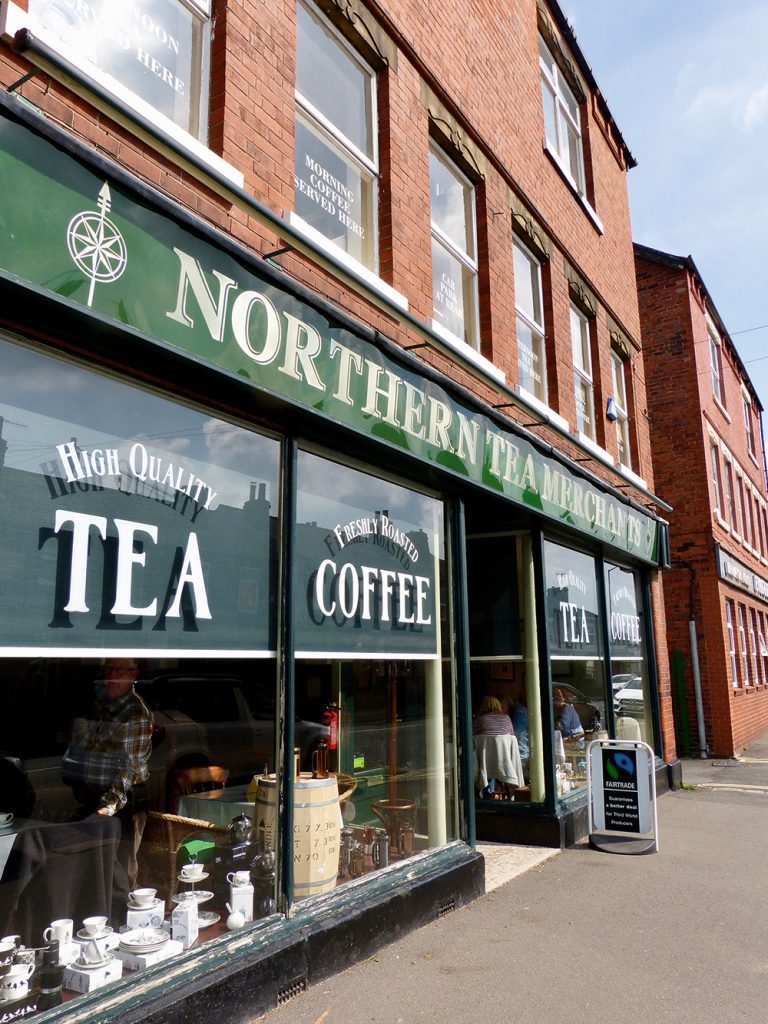
My lack of tea-making skills is legendary. Even workmen choking on brick dust refuse to drink it. It doesn’t matter how much gourmet blend and organic milk I throw into the cup – it always has the slight undernote of a licked battery. In short, if I want people to drink my tea, I get my son to make it. I blame my parents. They were both of solid Northern stock and liked their tea as strong, dark and brooding as the skies. You could stand a spoon in my mum’s tea, and if it was anything lighter than dark shoe polish brown, it was condemned as ‘ribby’. In the UK, making good tea does matter. It’s the first thing offered to a visitor, someone in shock or a stressed colleague. Just as there are an infinite variety of teas – it pays to know your Assam from your oolong – there are as many fuss-pots who claim they’ll drink your tea ‘as it comes’ before laying down a few unbreakable rules about bag shape and brewing times. And it’s wise to establish if your guest is a Mif (milk in first) or someone who thinks this is an abomination on a par with putting trousers on before your underpants. Naturally, when the subject of how to make tea can drive mild mannered people to boiling point, it’s wise to turn to an expert. In tea terms, James Pogson is an undisputed connoisseur of char. As director of the award-winning Northern Tea Merchants, James and his father (David) and his father’s father (Albert) have been trading in quality tea for 60 years. Someone overseeing the production of 100 million tea bags a year must be able to help the likes of me and the four out of five Britons who, according to research by University College London and the British Science Museum, are doing it wrong when it comes making our favourite brew. “For me, there’s no right or wrong,” smiles James Pogson (47), which is a refreshing opening statement from a man who claims that, if you cut him, ‘he bleeds tea’. “If you want to drink your tea out of a wellington boot with clotted cream and brown sugar I really don’t mind – as long as it’s my tea.” James agrees to give me a master-class on tea-making after giving me a potted history of tea at the company’s base on Chatsworth Road in Chesterfield. His office is packed with testing bowls and tiny pots – it’s where much of the testing and blending takes place – which explains why James can sample a 100 cups a week with a further 37 slurped purely for pleasure. “Our kettle is never cold,” he jokes. “If we’re testing tea, we do spit it out otherwise we’d have caffeine over-load. Even so, I bet my father, who is 82, has drunk in excess of half a million cups in his life-time. We both still enjoy tea, it’s just so nice.” James’ devotion to tracking down the world’s finest tea not only has him tasting samples, but travelling to estates and plantations around the world. “Tea isn’t just about the liquid in the pot. I think you appreciate tea so much more if you understand the person behind the process,” he explains, showing me some photographs of a 2017 trip to Hubei tea estate in China where the firm buys some of their black tea for their Keemun Mao Feng. “All our tea is touched by human hands. I like to have a personal relationship with the growers and I enjoy trying the local tipples. In Morocco, tea is made in front of the guest and poured from a height of more than a foot in the air. As the saying goes the taste changes over the course of three cups from ‘as bitter as life, to as strong as love and the third is as gentle as death’.” While tea accounts for a third of his sales, (the firm roasts 250 tonnes of coffee per year and pack 120 tonnes of cocoa and chocolate) James laughs at the suggestion that coffee could take-over as our national drink. “Let’s put it this way, we drink 165 million cups a day in the UK which makes it the most popular drink excluding water. Around 95 per cent is consumed in the home but people tend to go out for coffee – hence all the coffee shops. We’re the fifth biggest consumers of tea in the world,” he says. “Although we think it’s our traditional drink, tea was only imported to Britain in the 1700s and there was such a high tax on it so only the nobility could afford it – that’s why they had lockable tea caddies with the key worn around the neck. It was Queen Victoria who started the fashion for afternoon tea and this habit spread to the middle and lower classes when tea became more affordable.” At this point, James introduces me to his dad David, who tells me his own father started out in in 1926 working for the Ceylon Tea Growers Association going from door to door in Nottingham trying to convince house wives to buy tea for ‘economy and health’. “Tea was promoted as good for the digestion, ‘PG’ in PG tips is short for pre-digested as it was supposed to help dyspepsia,” explains David who also sold tea on the doostep when he established the company in May 1959. “Typhoo is Chinese for doctor.” Even today, James says there are always fresh claims being made about the health benefits of tea – last year green tea was linked with a reduction in the risk of heart attacks – and many of these are investigated by The UK Tea and Infusions Association; an independent body for whom James has been both president and vice president. James is convinced tea gives people a lift; “It’s a treat and the brain registers this and you get
Lost Houses of Derbyshire – Green Hall, Belper

The story of the Strutt family and that of modern Belper, which they more or less created, are intertwined. They built the mills and the workers’ housing (to a very high standard for the period) and over several generations endowed the town with numerous benisons, leaving the built environment the better for it; today it is a settlement with, for its size, an extraordinary number of listed buildings. Some, however, failed to survive to be listed, or at least to benefit from the 1968 planning act. This obliged listed buildings to be put through a series of evaluations, resulting in consent or otherwise to demolish or alter them. Prior to 1st January 1969 one had merely to notify the local authority and the Royal Commission on Historic Monuments (so they could record the building) before doing anything drastic. One Belper building to fall to the wrecking ball was Green Hall, situated at the top of King Street on the north side. It was one of a group of three local country houses built in the period 1790-1810 for various members of the Strutt family: Milford House, Makeney House and Bridge Hill House being the others, of which the latter appeared in these pages in November 2012. Three of these houses were designed by Jedediah Strutt’s eldest son, William Strutt, FRS, an amateur architect who worked in a Neo-Classical style and who was usually sensible enough to employ what we would today call an executant architect, for instance Samuel Brown when he designed the Derbyshire General Infirmary at Derby, 1806-1810. The latter year is that in which the sources agree the house was built at Green Hall. The idea was to provide a house for Jedediah Strutt the younger, second son of George Benson Strutt, younger son of the first Jedediah, and founder of the Belper branch of the family. G. B. Strutt lived at Bridge Hill House, and in 1810, his son married on 12th April, Susannah, daughter of Rotherham steel maker Joshua Walker. Green Hall was to be their home until such time as Jedediah’s father died and they could move to Bridge Hill. The house was nothing like as grand as Bridge Hill, and once extended lacked the latter’s symmetry and elegance, although the hand of uncle William can still be discerned in it. Yet it is a bit of a hotch-potch when viewed from the small garden on its west, nor was the short, south (entrance front) particularly architectonic either. The North side was blank and the east side was aggressively plain and stood flush to the west edge of Green Lane. The west front had five bays and although the entire house was of two storeys, the range to the North was higher, under a hipped roof and dwarf parapet; This contained the high-ceilinged dining room. To the right was a conservatory fronted room beyond which was the only symmetrical portion, three bays with a central pediment under which were superimposed tripartite windows, where were the drawing room with master bedroom above. This part had a slightly higher hipped slate roof, and was the original William Strutt-designed house. On the east side the extension created a recessed court yard which acquired a glazed roof. From the asymmetrical extensions it becomes clear that as Jedediah and Susannah’s family increased, so the house was extended accordingly, hence the taller block at the NW angle and the linking range. The need to entertain may have increased too, after the death of Jedediah’s elder brother George in 1821, unmarried. Jedediah was henceforth the heir and thereafter the manager of the mills. The house was filled with gadgetry of the type pioneered by John Whitehurst and Erasmus Darwin (the latter a mentor of William Strutt) designed to improve what was then called the domestic economy and included improved kitchen ranges with back boilers to heat water for bathing, flushing lavatories and clever ventilation systems, all of which William Strutt had tried out in St. Helen’s House, Derby. There was only a low stone wall in front of the main range and a patch of lawn with a near-circular path, the remainder of the pleasure grounds lay on the other side of King Street, which in 1830 was cut through the grounds between stone retaining walls. Part of the grounds to the west of the house even oversailed shops built into the retaining walls. To ensure continued access to all the pleasure grounds therefore, an iron bridge with a depressed Tudor arch was built, to connect to the land on its south side, called The Paddock. This was cast, at a cost of £42.10s.9d, at a local foundry, the bill being paid on completion in August 1832. All this was probably done at the behest of Jedediah who, as manager of the Strutt mills in the town, was a keen improver, like his father. The Paddock itself was the scene of public celebrations marking the passage of the Reform Act in the autumn of 1832, when the new bridge no doubt proved handy. When George Benson Strutt died aged eighty in 1841, Jedediah and his second wife moved into Bridge Hill House, leaving his own son, able to move into it when he came of age in 1847. In his turn he succeeded to Bridge Hill House on Jedediah’s death in 1854. It then became home to John Strutt, the youngest brother, who died unmarried in 1858. It remained, largely unoccupied until 1867, by which time it had become clear that no member of the family was likely to want it as a residence, a probable exacerbated by the construction of the railway station immediately to the west in 1840. Nor was any likely candidate found to take a lease on the place and in the end, it was let to a boys’ preparatory school and the garden bridge was removed in late autumn 1867. The Paddock itself was given to the Belper UDC in 1921 and the town’s war memorial,