Wirksworth Heritage Centre
Brian Spencer takes a visit to Wirksworth Heritage Centre where amongst other things, he learns about his ancestors who lived in the town over five hundred years ago. Tucked away almost hidden at the top of the Ecclesbourne Valley; Wirksworth is one of those places where a visit will open the eyes of even the most jaded visitor. Here is a town where its houses speak of a history marked not by decades, but by centuries; Georgian coaching houses and imposing one-time commercial buildings alongside Jacobean gentlemen’s residences, or tiny cottages half hidden within a maze of narrow alleys tell us that Wirksworth is a place where time has marched onwards without being frozen. This is a town where the past is forever with us, but rather than being a museum piece, it is vibrantly living in the twenty-first century. Change has happened, industries have come and gone, but rather than look depressed, Wirksworth is a place where life is for today. The main reason for this change and the way it links its past to today, is summarised in the new(ish) Heritage Centre on St John Street, just a few yards down the road from the market place. It tells in easy to follow displays within a modern setting, the story of what is once more a vibrant town. A short wander around its brightly lit rooms filling three floors brings to life in anecdote and reportage, the story of a place that fascinated HRH Prince Charles, Prince of Wales. At a high level luncheon at the Royal Albert Hall in 1985 he trumpeted the success of a rejuvenated town to a meeting of bewildered town planners and journalists. Many of them had no idea where Wirksworth was and had to delve in gazetteers and timetables before rushing north to see what had excited the prince so much. The exhibition at the Heritage Centre shows how industries have come and gone, but rather than be blighted by it, Wirksworth has picked itself up and literally shaken off the dust before moving on to the next stage in its life. For such a small place, it has seen many changes; Lead mining was the first and for centuries the main source of employment. As far back as Roman times, it’s yet to be found headquarters of Lutudarum, oversaw the production of pigs (ingots) of lead destined to be made into water pipes or to cover the rooftops of Rome’s imperial palaces. Ingots carelessly lost then found along the way are marked Lut. as coming from Lutudarum and Ex. Arg. to confirm that the lead’s silver content had been removed. Lead mining went on throughout the centuries, controlled by a Barmote Court, the oldest legal system in existence which still meets in April every year to settle mining disputes. Although quarrying, which later became the major industry for the area, had an almost disastrous effect upon the town, Wirksworth had a number of smaller industries, ranging from the ubiquitous cotton spinning, to hosiery knitwear silk weaving, and the little known, but important production of tapes. It is said that Wirksworth every year produced enough red tape to go twice round the world. Alongside this symbol of the legal system, everything from decorative ribbons to laces for Edwardian ladies’ corsets, boot laces and the fuse-bindings of Mill’s bombs used in the Great War were also made here. At least two authors had links with Wirksworth. Following a holiday here at the home of an aunt, Anne Elizabeth Evans, better known from her pen name George Eliot, used the town as the setting for Adam Bede. Haarlem Mill, one of the main tape producers where her uncle was manager became the prototype for Mill on the Floss – his tool chest is one of the Heritage Centre’s exhibits. With prosperity came the need for banks. In 1780 John Toplis and later Richard Arkwright, founded a bank to handle the wealth of the town’s prominent citizens: the notorious Georgiana, Duchess of Devonshire was one of its early clients, but she was not over popular due to her uncontrollable gambling habits. The bank produced its own bank notes – quite a courageous act in its day; two printer’s plates for these notes are on display. The bank eventually became known as Lloyds Bank plc which flourishes to this day. The other author to use Wirksworth as his home was D.H Lawrence. For several years he lived with his German-born wife at Mountain Cottage above the Via Gellia. During the Great War, xenophobia put anyone not British under suspicion, insisting they frequently report to the police. At one time Freda being German was considered a spy, especially when she and Lawrence were spotted enjoying a walk along a Cornish cliff-top. As a result they had to move back to the east Midlands, away from the sea and close to a police station. It was quarrying that almost destroyed Wirksworth, yet at the same time it became the catalyst which helped preserve many of the ancient buildings. The massive beds of limestone surrounding the town provided stone for everything from building material, to the 120,000 war grave-markers that were made from a fine-grained stone found in Hopton Wood quarry between Middleton and Wirksworth. What did almost destroy the lovely old market town, was a quarry a matter of yards from the town centre. Known locally as the ‘Big Hole’, daily it covered nearby houses with layers of dust, or worse by bombarding them with flying debris. As a result people began to abandon their homes, leaving historic houses to gradual decay. It was only when the quarry became uneconomical that those with an eye to the potential of the semi-derelict buildings decided to bring them back to life. Part of the exhibition shows how once tumble-down Jacobean houses were rejuvenated. Shops around the market place regained their Victorian ambience; one in particular, Mason’s iron mongers is commemorated by an almost bewildering display of stock
A Local Incident During the English Civil War
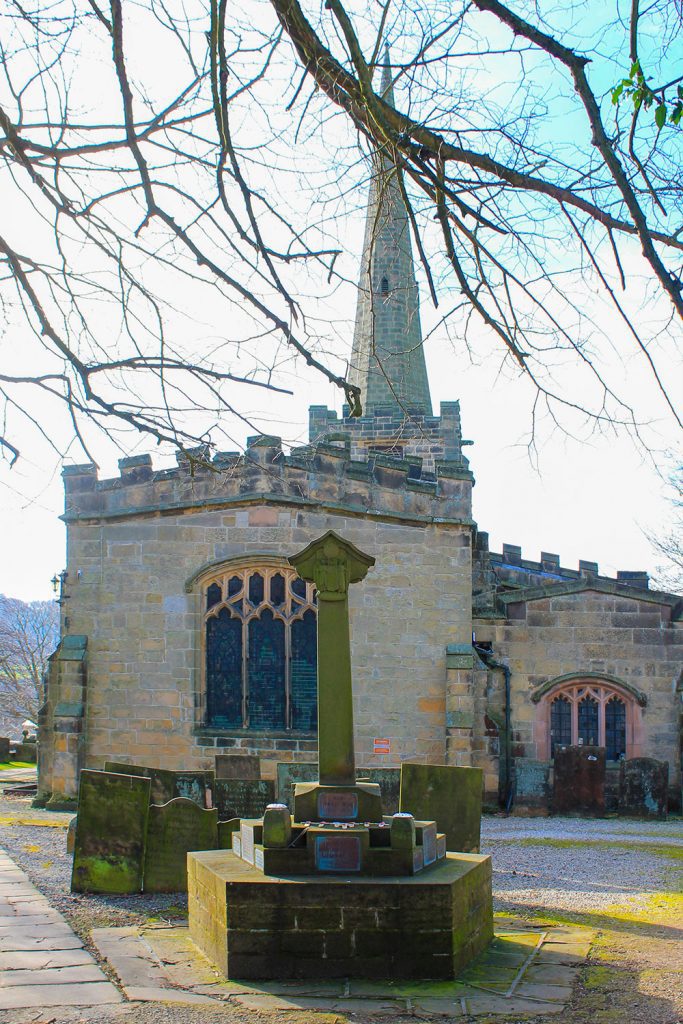
The Civil War brought tragedy to both countryside and town, none more so than in a quiet corner of the Derbyshire countryside. Brian Spencer reports one small, but horrific event which occurred in the sleepy village of Ashover, near the head of the Amber Valley. The quiet village of Ashover sits amidst sunny fields near the head of the Amber Valley, a place of tranquillity, but during the Civil War it, like many other hamlets, did not escape the rigours of a conflict that divided the nation. During the reign of King James I relationships between the crown and parliament were far from easy, and when his son Charles I acceded the throne in 1625, things went from bad to worse. The king’s High Church views and ever increasing demands for war funds, provoked disputes with parliament, which were so severe that in 1630 the king dispensed with it all together and embarked on almost a decade of personal rule. For a time all was relatively stable, but Charles’ lack of understanding and stubbornness led to the collapse of his authority, gradually, culminating in 1642 when the nation fell into a state of rebellion and civil war. Hard fought battles between parliamentary forces and those supporting the crown raged across the country for four years. Neither side could claim to have the upper hand, until a series of major strategic errors by the king led to the royalists suffering crushing defeats at Naseby, Langport, Bristol and finally at Oxford in May 1646. Supported only and on dictated terms by a Scottish army, the autocratic king refused to submit to the will of parliament and following a rumoured plot to assassinate him he escaped to Carisbrooke Castle on the Isle of Wight. Here he was held as a virtual prisoner until he was taken to London for trial and subsequent execution in 1648. History only records the major battles fought in the Civil War, but up and down the country minor scuffles occurred as well as brutish events perpetrated by ill-disciplined troops from both armies. Ill-fed and poorly led, they acted like marauding hosts rampaging up and down the country and it was during this time that Ashover was to suffer not once but three times at the hands of both parliamentarian and royalist troops. Being then as it is now, in something of a backwater, the Rector of Ashover, the Rev Immanuel Bourne tried to keep the village out of harm’s way by supporting neither side while appearing to support both. The war tended to be fought around major towns and cities with Chesterfield and Nottingham being the main garrisons for the conflicting armies. In order to protect the road west out of Chesterfield from incursions by roundhead soldiers of the parliamentary army, a detachment of fifty royalist dragoons were stationed at Eddlestow Hall on the far side of Slack Hill above Ashover. In keeping with the way armies were run at that time they had no provisions and depended on the ‘benevolence’ of whoever they were billeted with, in other words, by levying blackmail. As the owner of Edlestowe, Sir John Pershall was away, they had free run of the place, slaughtering all the stock of pigs, sheep and poultry and drinking his ale and wine in an orgy of high living. Bored by inactivity and well-oiled with Sir John’s wine and ale, a mob of drunken royalist dragoons descended on Ashover looking for more supplies. Stopping at the Crispin Inn next door to the church they were held at bay by the brave landlord Job Wall. He stood at the door refusing to let them in, telling them they had already had too much to drink. Severely outnumbered he was beaten up and thrown out of his own inn from where he could only watch while they literally drank the place dry. Full of bravado the royalists eventually moved out, rampaging around the village, going first to Eastwood Hall about half a mile away, the home of Rev Bourne. Here they demanded he pay them ten pounds for the King’s use, in other words themselves, otherwise they threatened to burn down his house, a threat they again made while extorting similar amounts from two other local notable families, the Dakyns and Hodgkinsons. Not content with this the mob continued round the district demanding smaller sums from miners and farmers in the locality. Hardly the bravest of troops, once the royalists heard that a strong force of roundheads was marching on Chesterfield under the command of Sir John Gell of Hopton Hall near Wirksworth, they quickly retreated to safer climes, leaving the village in comparative safety. But this was not to last. If the Reverent Bourne thought the deserting royalists were the end of his troubles he was sadly mistaken, for Ashover received a visit from a local parliamentarian named White of nearby Milltown, where he had been keeping a low profile while the king’s troops were on the rampage. Hearing that his opponents had been given money, he assembled his own scratch troop of dragoons and fronting the rector demanded that as the latter had been able to pay ten pounds to the royalists he could therefore give double that amount to the other cause. Poor old Immanuel was in a complete quandary and his threat to report White to his superiors was simply answered by the counter-threat that if the rector and all the others did not pay up, their cattle would be taken off them in part payment. Unable to face the loss of their animals, they submitted, thankful in Bourne’s words, ‘to see the back of such a nave’. With the next turn of the tide in the fortunes of war, the Earl of Newcastle took command of Chesterfield in the name of King Charles, so poor Immanuel switched sides yet again, only to find that once things were back in favour of parliament, he was on the wrong side
Dining Out – Afternoon Tea on the Ecclesbourne Valley Railway
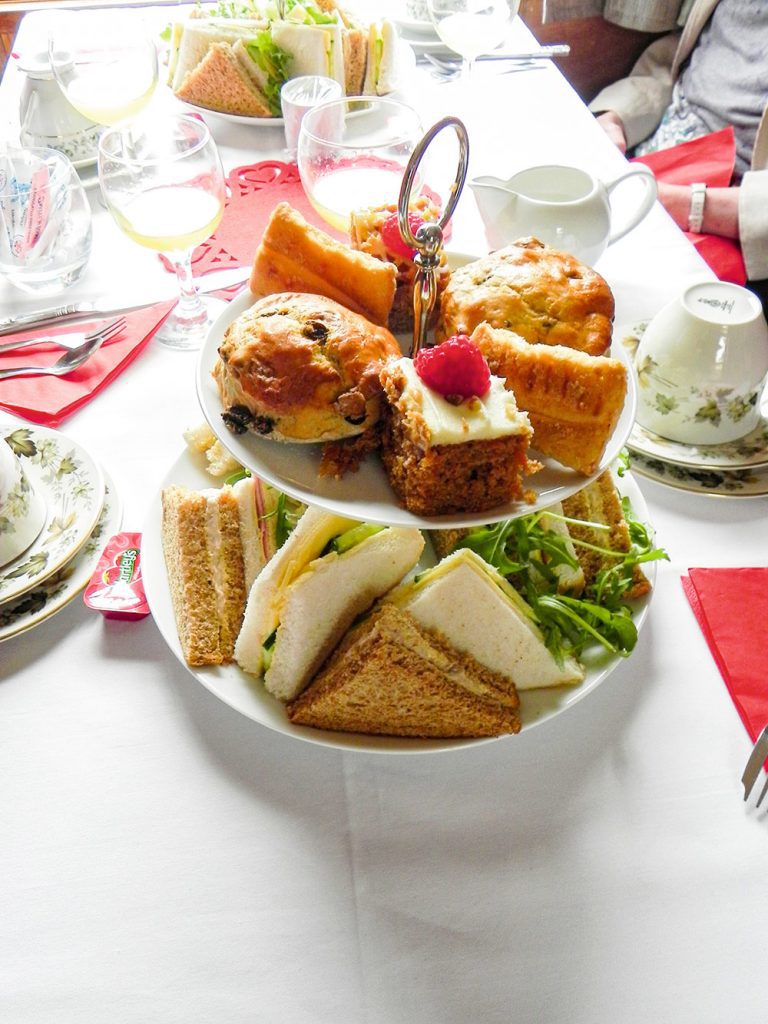
We’ve dined on some memorable trains; breakfast on the Lake Shore Limited as it skirted the edge of Lake Erie on its route from New York to Chicago. Lunch at 190 miles per hour on one of the Frecciarossa trains between Naples and Florence and dinner on board the California Zepher as it made its long trek through the Rockies from the Pacific Ocean to our destination, Denver. So, I jumped at the opportunity for Susan and myself to expand our dining experiences with afternoon tea on the local Ecclesbourne Valley Railway. The line, which runs from Wirksworth to Duffield, was closed to passenger traffic 70 years ago and to freight 40 years later. With the help of volunteers the line has been re-opened and buildings restored. Many years ago the original Wirksworth station building was demolished to make way for a mineral loading dock. That has now been removed and a new station building, on the site of the old one, is under construction; built with modern materials and thankfully, up to date facilities. Our journey started at the headquarters of the heritage railway center situated on Coldwell Street, Wirksworth, once the terminus of the old Duffield Wirksworth Midland Railway branch line. We parked in the large car park attached to the station site and made ourselves known at the souvenir shop; it also doubles as the booking office. We were told that this afternoon’s service would leave from platform 2. The luxury afternoon teas are pre-booked and served on the 14:10 service from Wirksworth to Duffield. When the train arrived at platform 2 one of the many volunteers escorted us to our reserved compartment. The carriages are mid-20th century corridor style with opening top windows, brass door handles and a lot of polished woodwork. We could see that each compartment on the train was set for a party of 4. Tickets are sold in pairs and so, waiting for us in our compartment were 2 ladies we would be sharing the journey with: Barbara and Jane. The compartment is designed to seat 6 people. However, for the afternoon tea, it’s restricted to 4. The table was decked out ready for the service: bright cutlery, china tea service, white table cloth and 4 glasses of buck’s fizz. We introduced ourselves and before the train had left the station all of us had started on the fizz! As the train moved slowly away from Wirksworth station service began. The tea included a varied selection of freshly made sandwiches including tuna, cheese and cucumber and ham served on the bottom plate of a traditional tiered china stand. The top layer contained 2 delicious fruit scones with jam and clotted cream, 2 moist slices of carrot cake and an apricot filled pastry. Our empty glasses were taken away and replaced with a pot of fresh tea and for a coffee drinker like me, a pot of fresh coffee; regular or decaffeinated. Throughout the journey we were asked if we’d like more tea or coffee. Although the journey is only a round trip of 18 miles we discovered a lot to chat about with our fellow travellers; who both had railway connections. We stayed on the train in Duffield for the return journey to Wirksworth. We finished the cakes and scones and were offered yet more tea and coffee. It had been a delightful experience. Afternoon tea at a leisurely pace; watching the countryside glide past. Nothing to do for almost 2 hours but enjoy the food, conversation and scenery. The experience includes a full day rover ticket so that guests can enjoy the freedom of the line on the day and explore the surrounding countryside. A comfortable way to explore is by leaving the train at Idridgehay and walking to Shottle to catch the next train or walking to Idridgehay from Shottle. You can also use the day ticket to start at Duffield before the dining train and return there afterwards on the last train of the day. For the railway enthusiasts the locomotive hauling the train was a diesel BR Class 33 no. 33103, named Swordfish after the bi-plane not the predatory sea creature. 00
Product Test – Soap Co.

The Soap Co. is an ethical luxury brand that creates sophisticated cruetly-free body care products to nuture and care for your skin. Wild Nettle & Sage Hand Lotion 300ml £18 13 natural oils including healing sage, uplifting rosemary and stress relieving thyme provide the delicate herbal notes for our Wild Nettle & Sage hand lotion. It’s fresh scent is a true celebration of the great British countryside and has been crafted with natural, vegan and eco-certified ingredients. It is also enriched with antioxidants, sage oil, natural bee friendly borage and calendula botanicals and organic cocoa butter to nourish and protect your skin. Free from parabens, PEGs, synthetic fragrance, synthetic colour, mineral oils, TEA, petrochemicals, silicones, EDTA and artificial colours. Wild Nettle & Sage Hand Wash 300ml £16 13 natural oils including healing sage, uplifting rosemary and stress relieving thyme provide delicate herbal notes to our Wild Nettle & Sage hand wash. Its fresh scent is a true celebration of the great British countryside and our hand wash is crafted with natural, vegan and eco-certified ingredients. Enriched with skin softening sugar esters from coconut oil, vitamins, sage oil and natural bee friendly botanicals it’s kind to your skin and the environment. Also free from SLS/SLES, PEGs, triclosan, synthetic colour, DEA, petrochemicals, silicones, EDTA, parabens and artificial colours. Now cleanliness is really one step closer to godliness! Wild Nettle & Sage Body Lotion 400ml £22 13 natural oils including healing sage, uplifting rosemary and stress relieving thyme provide the delicate herbal notes for our Wild Nettle & Sage body lotion. A guaranteed hit for those that love herbs this rich body lotion absorbs quickly into the skin and is enriched with antioxidants, sage oil and bee friendly borage and calendula botanicals for soft and healthy glowing skin. Created with natural, vegan and eco-certified ingredients it also contains organic cocoa butter and sweet almond oil for total body happiness. Free from parabens, PEGs, synthetic fragrance, synthetic colour, mineral oils, TEA, petrochemicals, silicones, EDTA and artificial colours. For more information and to buy online visit www.thesoapco.org Tried & Tested Hand Lotion A really light, non greasy hand lotion which sinks into your skin straight away. A light fragrance too, perfect to keep by the kitchen sink. VP Body Lotion This looks, feels and is eco- friendly. Smooth and easy to apply, the fragrance isn’t overpowering but delicate. Simply packaged, this product really impressed me. JP Body Wash I found that this was easy to rinse off and didn’t leave my skin feeling dry. I also like the fact that there are no artificial ingredients. I felt that I really was using a product that was back to nature. CB 00
Celebrity Interview – Julia Watson
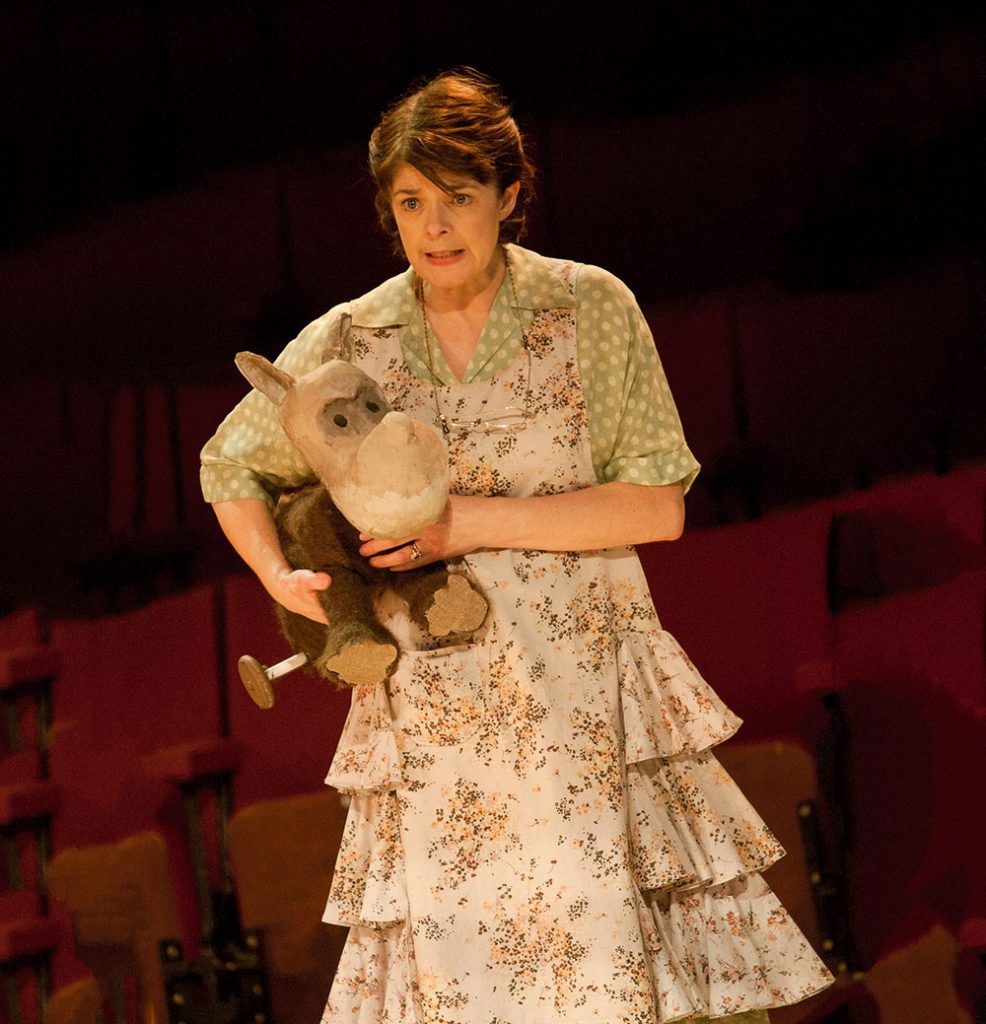
Oozing confidence, charm and charisma, Julia Watson saunters around a church she’s known for many years, entertaining a rapt crowd with tales of her career and reciting some of literature’s greatest lines. It’s obvious that she was cut out to be on stage and it’s no surprise later when she tells me “I love acting”. Brought up in Derby and introduced to the theatre at an early age, Julia is best known for playing Barbara “Baz” Wilder in the BBC medical drama Casualty, a role she returned to on a couple of occasions. But as she demonstrates when appearing at All Saints Church, Mackworth village, she’s a talented all-rounder who completely inhabits a character – including Margaret Thatcher who she played in a theatrical production in 2017. A couple of days later Julia spoke to me from her home in Barnes, south west London about how she loved her time with Derby Shakespeare Theatre Company, why she became a fire-eater and how questions were asked about Baz in Parliament after she was featured on the front page of the Sunday Times. She revealed that she wasn’t desperate to play Baz and told her agent she wasn’t sure if she wanted to be in a medical drama. Her agent replied: “Brenda Fricker and Derek Thompson are in it. You just do it. It’s going to be very high profile.” When talking about her career, Julia often uses the phrases “great fun” and “happy time”. That’s how she describes Casualty. “Originally it was only supposed to be 15 episodes. It’s extraordinary to think it’s still going. I did the first series and then I was offered something else and decided I didn’t want to stay. I was a junior doctor and junior doctors move on, so I would have had to move to another part of the hospital and come back as a love interest with Charlie (Fairhead) and I didn’t want to do that.” Nine years later Julia was asked to return to the series and her relationship with Charlie grew. “I came back two or three times. It was a very happy time, actually. It was great fun to work on.” So how much of Julia was there in Baz? “In a sense those kind of parts on television are about personality acting, I always think. You’re cast for who you are. So of course there’s an element of you within that character. You just have to be careful not to say ‘I don’t think my character would do this’ because it’s actually not you. But there is a point when you’ve played her for so long you start to know her almost better than some of the scriptwriters because they don’t know the back story like you do. She was huge fun to play because in the first series she wasn’t very competent at her job. She was popping pills to keep going and getting drunk. “I ended up on the front page of the Sunday Times and there were questions asked in Parliament about how the NHS and a junior doctor could be portrayed in that way. But of course they’d done their research and it was all accurate. Charlie knew much more about everything than Baz did. And yet she was in charge of him. There were interesting hierarchies that the first series explored very well.” The storyline in which Baz had an affair with Charlie Fairhead provoked some strong reactions from viewers, including nasty letters disapproving of the way Baz behaved. “Charlie is a national treasure,” says Julia. “If Baz wasn’t treating Charlie very well I used to get it in the neck when I bumped into people. But I’d say ‘it’s not me, it’s a character’.” Eventually Julia left the series in 2004 when Baz was killed in a car crash. “I thought there was a limit to how many times I could come back,” she says. “We’d done everything. Charlie and I had been married, divorced, married to other people – there wasn’t really any further for the storyline to go.” She confesses it might have been a bad decision because the casting director of the spin-off series Holby City said if she hadn’t been killed, she could have worked on that programme. “But I never wanted to be a long-running character. I’ve always liked variety and to do stage as well as television. So I thought it was time to leave Casualty.” She also admits there was pressure from her husband, writer David Harsent, and her daughter Hannah to give up Casualty because they hardly saw her as she was away filming in Bristol for ten months of the year. “Although I would have two days off a week, sometimes they weren’t concurrent, so I spent my life on the motorway just driving back and forth. David said ‘this just isn’t working – either you’re part of this family or you’re not’. By that time I was playing consultant head of department so I was in every episode. It became hard and I felt I was missing out on Hannah’s life. This profession is never easy when you’ve got children.” Julia Watson was born on 13 September 1953 in a small village in south Wales. Her father moved to Derby to work at Rolls-Royce when Julia was a baby. She says she had a very happy childhood. “We were perfectly placed. We were only 60 miles from Stratford. My father was passionate about Shakespeare so from the age of eight I saw virtually every play in every season. And there was lots of amateur theatre in Derby. There was lots to keep me occupied.” She joined Derby Shakespeare Theatre Company, working backstage and being cast in small roles before at the age of 16 she got the part of Juliet in Romeo and Juliet. “It was a very happy time. I loved my time at Derby Shakespeare Society. It was wonderful to be around people who were so passionate about theatre and
The Lost Houses of Derbyshire – Old Saint Helen’s House, Derby

One often comes across houses – not always ancient ones – which have names carrying the suffix ‘Priory’ or similar. Very often, such houses were built on former monastic land or even adapted from monastic buildings, although it has to be admitted that sometimes the connection is spurious and the nomenclature arrived at quite vicariously. The present St. Helen’s House in Derby is a case in point. Thanks to the enterprise and dedication of Richard Blunt, this magnificent mansion of 1766-67 by Joseph Pickford, is not qualified as a subject for this series, being now again resplendent on King Street, although a decade ago one might have been forgiven for assuming it was well on the way to being so included. The name goes back to the existence of a lost parish church on a site almost opposite, dedicated to St. Helen. Such dedications, if traceable to the early 12th century and beyond as here, are usually taken to be ancient, possibly even late Roman in origin, the dedicatee being in this case the mother of the Emperor Constantine the Great and discoverer of the True Cross. This parish church, although likely of pre-conquest origin, is not thought to have been one of the six recorded in Domesday Book for, as Dr. David Roffe pointed out – when he was working with us at Derby Museum and with the former Derbyshire Museums Service in 1985 to re-evaluate the Derbyshire Domesday for the nonocentenary of the original – much more than one might imagine were omitted, mainly because they were free of the burden of tax payable to the Crown. This included some proprietory churches, especially in towns, which were often built by a landowner on his town property – his urban fee – as a personal holding. Thus in c. 1135 a burgess of the burgh of Derby, one Tovi, or Towy, probably a man of Norse descent, gave property on King Street, then part of the spinal road passing through Derby from north to south, as a monastery, including a well called St. Helen’s. Within a decade, another grandee, Hugh de Derby, had given land at Little Derby, now Darley Abbey, for the foundation which had then transferred to its new site to become the largest monastic foundation in the county. This donation had the benefit of the support of the Earl of Derby. Thus the small foundation in King Street then became an oratory, a sort of outlier to the main monastic foundation, and by the reformation had become an hospital staffed by nuns. In 1538, it was dissolved with the main abbey in the second round of the dissolution, a move that must have placed many in the town and surrounding area into distress. These days, people forget that the monasteries were the original welfare state, providing mainly medical care both in-patient and external, hospitality for traveller, and educational services for children. All of these were furnished by the Abbey of Darley, and post-dissolution Derby School was formed to replace the latter function, albeit only nominally in continuous succession to the Abbey, until ‘comprehensivised’ in the 1960s and then losing its identity entirely in a move by the County Council thirty years ago. The site was sold in 1545 to an asset-stripper, William Berners (later Sir William) and part at least of the conventual buildings, thus secularised and described as a messuage (house outbuildings and grounds) rather than an hospital, was sold off at a profit. The site of St. Helen’s, apparently including the original church, adapted as an internal chapel, was sold to the powerful knightly family of Foljambe, of Walton Hall, near Chesterfield. They also had a substantial holding in Derby, just south west of the town on the far side of the Odd Brook, called rughedyche, today’s suburb of Rowditch which did not, it would seem include a residence. This later presence of the Foljambes may be reflected in the much earlier foundation of another chapel (or the original chapel re-dedicated), dedicated to St. John, within the Hospital of St. Helen, and endowed with Foljambe lands at Brampton by Chesterfield in the 1220s. It may be that Sir Godfrey Foljambe purchased Berners’s portion and united the holding, enabling him to build a house for the use of his family when in Derby. It is likely that St. Helen’s adapted, was used also by their bailiff for Rowditch and by the family when in Derby on official business, as grandees like the Foljambes were expected to serve as High Sheriff and perform other legal functions as well as looking after their business interest which, in the Foljambes’ case included both coal and lead. In other words, the site became their Derby town house. By the Jacobean period, a new two storey and attics house appears to have existed which had segmentally coped curved attic dormers both on the front and side elevations, with mullioned windows. The presumption is that this was built onto the north side of the existing (and surviving) conventual buildings. These latter were probably of stone, for monastic houses tended toward a more permanent, solid, if expensive, method of construction, although the domestic parts might have been timber framed. It is not clear if the Foljambe addition – probably the work of Sir Francis Foljambe, of Aldwark, 1st Baronet – was of brick or stone, but when the building was drawn in February 1792, the main block had lost its original fenestration and had been adapted as an artist’s studio for our most celebrated painter, Joseph Wright. Such alterations would have been far simpler to have been made in a brick building than stone. The grounds of the house included the King Street frontage at least up to Lodge Lane, which probably took its name from a gatehouse and lodging relating to the convent there. It also included orchards and gardens to the south beyond the present St. Helen’s Street stretching to the NW boundaries of the houses on the
Modern Collectibles – Cinema Posters
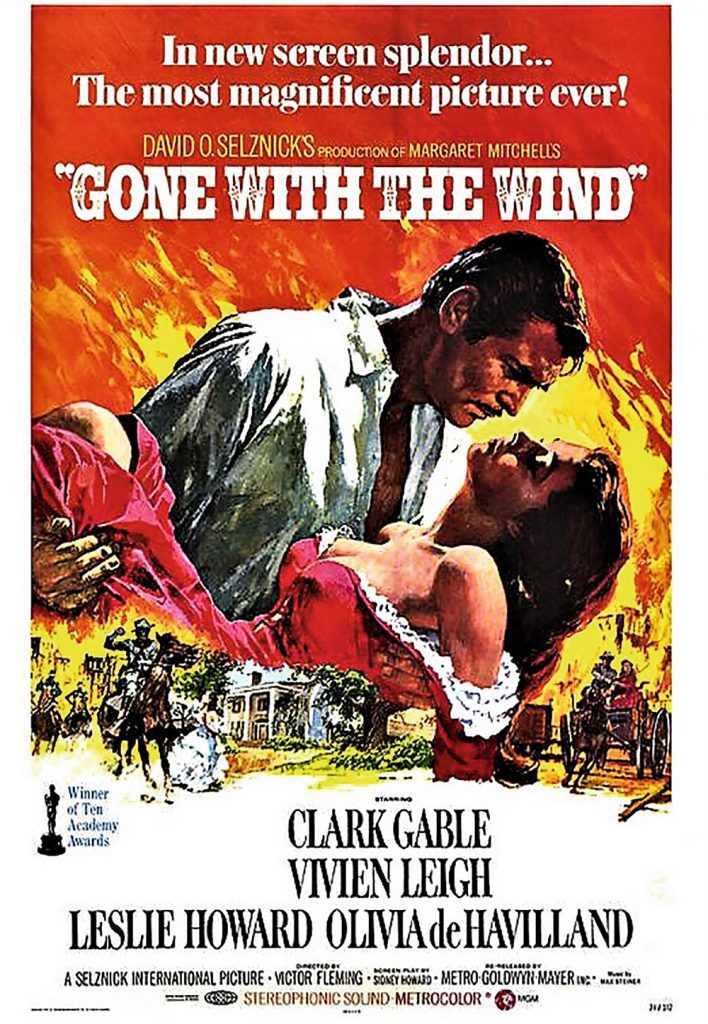
Recently the original of the poster for the classic Carry-on film Carry on Cleo was offered for sale at an anticipated four-figure sum. This caught my eye more for its anticipated price as for anything. Of course, the film, was memorable for Kenneth Williams as Caesar’s wonderful line, ‘Infamy, infamy – they’ve all got it in for me!’ and for us historians, the appearance of Hengist and Horsa (Kenneth Connor & Jim Dale, two ‘Britons’) was hilarious, these semi-legendary Saxon freebooters appearing 500 years ahead of their time! The idea was inspired by the 20th Century Fox Elizabeth Taylor and Richard Burton Cleopatra epic of 1963 and the intention was to use the costumes and sets of the Hollywood epic film made at Pinewood Studios in England before that production moved to Rome and built new sets there. Carry On Cleo was therefore a glorious send-up of the epic. Of course, Hollywood is famous for its leaden sense of humour (to put a positive spin on it), especially where commercial interests were at stake. The original poster (the one for sale in June) by artist Tom Chantrell directly parodied the Hollywood version but was withdrawn from circulation after 20th Century Fox successfully brought a copyright infringement case against the distributor. This version was thus swiftly pulped leaving only a few originals out there, although you can get a reprint for a tenner. The second (replacement) version was not nearly so good, either. An original of the Hollywood Cleopatra will set you back between £80 and £100 retail, the parody can go as high as £595 retail, whereas the revised Carry On Cleo poster comes in at £15, all of which sums up the range of prices cinema posters tend to command, although the fame or notoriety of the film counts, too as does the age. The standard later 20th century size is 27 x 40 inches. Intentional or not, many of the items being sold today as original posters, particularly through online auctions, do not meet the criteria used by most collectors to be deemed a collectable item. Often the word ‘original’ is misunderstood to mean ‘collectable’; however, there is a big difference. Posters strictly speaking are promotional aids produced by film studios for distribution directly to cinemas or distribution centres are considered to be legitimate ‘movie art’. They are generally printed domestically to where the film is released. They are designed, produced and distributed solely as advertising materials. Once they have been used for the purpose of advertising they are then returned or destroyed. This makes them harder to find, once a film has departed from the cinema, thus creating a very limited supply. Less collectable are posters deliberately printed for sale to collectors (nice paradox!), reprinted posters – £10-15 usually – and anniversary issues or limited editions released officially; I shall ignore TV and video posters, which are rather different again. Another complicating factor is that particularly ‘iconic’ (grossly overworked cliché) films had multiple releases, like Gone with the Wind released in 1939 which, since its original release, has been re-released in 1940, 1941, 1947, 1953, 1954, 1961, 1967, 1968, 1970, 1974, 1980 and 1998, each time with newer versions of the poster sometimes featured new or up-dated images. Thus a 1939 one recently went for £4,150 whereas a 1954 one made £120 and a 1998 one £15. Posters vary in size (numerous small ones could be posted up on one billboard) and were usually delivered folded. Rolled up ones tend to be reproductions although even repros. themselves can be quite venerable! Collectors grade them from mint through near mint, very good, good, fair and poor. As with coins, only experience can enable you to grade them accurately. To provide an example: an original poster for the enjoyable spaghetti western The Good, The Bad & The Ugly (1966) 40 x 30 folded, mint, was sold recently for £390 retail; the re-release (1971) poster near mint £245 and the same, only fair £65. When you bear in mind the sheer number of films ever released to an unsuspecting public, you realise that there must be a lot of original poster out there, despite the return clause imposed by the studios on cinemas. Thus your favourite films are probably going to be the more popular ones, and thus with the added burden of demand, more expensive, yet going after niche ones and obscurities is a good idea. But then, you might want to buy an old film poster just to put on the wall to brighten up your room, flat, apartment or house. In this case, a reprint should be fine and £20 or less should be about right. Serious collectors do not frame their specimens up, but keep them in map cabinets, or if folded in filing cabinets. The other day a pile of folded original came through Bamfords estimated at £40-60, but not including any very memorable titles, yet at a Jaguar antique fair at the former Railway School of Transport we saw another folded pile all at £30 each. Therein, of course the essential difference between auction and dealer prices. Nevertheless, original artwork usually goes via auctions as well as original of ‘iconic’ titles. The place not to buy, unless you’re looking at very modest prices for posters of dubious authenticity, is on-line. With cinema posters, seeing for yourself and handling them is essential if you are after the real McCoy. 00
Walk Derbyshire – Around Matlock Moor

A short 4 mile (6.4km) easy walk along clear paths and a quiet upland road. One steady climb of 220ft (67m). Muddy sections near both farms and woodland passed along the way. Recommended Map: Outdoor Leisure Map Sheet 24 The Peak District – White Peak Area. Transport: The X17 Chesterfield service leaves Matlock bus station (M&S) at ten minutes past every hour. Refreshments: Nothing en-route, but several pubs and cafes in and around Matlock town centre. Car Parking: Roadside opposite Highfields School on Lumsdale Road, or layby opposite Matlock Golf Club. New houses are being built on either side of the Matlock/Chesterfield road, the A632 on the town side of Matlock Golf Club. With starter homes on one side of the road, and an estate of larger properties opposite, they are fulfilling at least part of Matlock’s obligations to build much needed homes within its boundaries. Despite this development, Matlock’s eastern built-up limits soon come to an end, with the golf club on one side of the Chesterfield road, and farmland filling the other. Backing all this is the long line of mature forestry trees stretching for a good four miles across the skyline on either side of Matlock Moor. This walk touches just one corner of the moor, following a route around the golf course on one side and crossing farmland on the opposite side of the A632. The walk pivots around a huge boulder, the Cuckoo Stone, a mysterious looking rock standing in the middle of one of the fair-ways. Maybe it was brought here by ancient people as a form of pagan ritual, or possibly by way of the last ice sheet to cover Derbyshire. All this is unknown, but it certainly adds an aura of mystery to the walk. While there is a right of way passing close to the stone, this footpath’s potentially dangerous way is avoided for safety reasons. The alternative in any case is arguably more attractive and only extends the walk by about a quarter of a mile. The walk starts and finishes on the road beside Highfields School. Crossing the main Matlock/Chesterfield road, it then follows a side road lined with properties before linking with an unsurfaced track. This is followed, past Sandy Lane Farm and an abandoned quarry hiding in mature trees,. Soon the walk makes a change in direction by leaving the track at a narrow wooden gate. Here a footpath leads down to the upper reaches of Bentley Brook, a watercourse that once powered Matlock’s first industrial estate. Crossing the stream, the path climbs up to a second path and a right turn follows it all the way to the main road. This is crossed in order to reach the access to Wayside Farm and then field paths are used to reach a second farm whose name indicates its links with packhorse trains in time gone by. A quiet back lane runs between grazing on one side and mixed rhododendron and scrub woodland. At a sharp left-hand turn, the way is forward, past the remains of three of the many gritstone quarries once active around this Matlock hillside. A sharp descent leads down to the top of Lumsdale and the silted remains of the upper reservoir where the penned-up waters of Bentley Brook waited to power small mills in the lower valley. 1. From the car park opposite Highfields School, walk up to the main road and turn left. (Or walk to this point if parking in the layby opposite Matlock Golf Club). 2. Cross over and follow the pavement for about 200 yards in order to reach Sandy Lane which will be on your right, pointing away from the main road. 3. Turn right along Sandy Lane and follow it until its surfaced part turns left. 4. Continue forwards, climbing steadily uphill on a rough surfaced lane, going to the right with it on reaching Sandy Lane Farm. 5. Follow this now the highest part of the walk, for about half a mile between grazed fields on your right and rough woodland and long abandoned quarries to your left. 6. When Cuckoostone House comes into view, go half right, leaving the access lane and go through a narrow wooden gate. 7. A walled path descends towards the golf course where the Cuckoostone stands proud. A right of way crosses the links at this point, but for safety’s sake it is not recommended without a hard hat! 8. Follow the gently descending path, through a muddy section as far as Bentley Brook. 9. Cross the stream by a footbridge and then at a stile to bear left to start the short climb up the opposite hillside. 10. Go through a stile at the corner of a stone wall in order to climb steeply up to unmade Cuckoostone Lane, and turn right. 11. Follow the rough lane for a little under a mile, high above the golf course on your right and the mature trees of Bottom Wood forestry plantation to your left. 12. Go through the gate next to a house and continue forwards, now along a surfaced way. As you walk along Cuckoostone Lane, pause now and then to admire the view down the Derwent Valley. John Smedley’s Riber Castle dominates the near skyline with Crich Stand over to its left. 13. On reaching the main road, turn left and follow the pavement for about 150 yards as far as a bus stop sign. 14. Cross over and go down the access lane to Wayside Farm. 15. Skirting the farmyard, go through two adjacent field gates in order to follow the line of a dry-stone wall on your left. 16. Go through a stile at the end of the field and cross the next field. 17. Aim towards a stone house, passing it on your left and then go through a squeezer stile. Follow a wall cut by two more stiles, with a ditch separating your path from a caravan site. 18. Beyond the second
Repton Captial of the Kingdom of Mercia

The history of the North Midlands is writ large on this ancient town set high above the quiet meadows bordering the River Trent. Its history is traced from Saxon and Norman times, through Tudor to the present day. Even the Danes who came this far up the Trent in their longships, made it their winter base during their attempted expansion south from Northumbria into King Alfred’s Wessex. Repton’s parish church of St Wystan is built on Saxon foundations, part of the priory that brought Christianity to this part of the Midlands. Remains of the ruined 12th century ecclesiastical house are incorporated within the famous school, the most important remnants being Prior Overton’s Tower, now part of the Headmaster’s House. The school can trace its foundations back to the time when the earliest Saxons settled here; today it is the North Midland’s major centre of learning. The parish church, that most recognisable part of that monastery still stands, with a needle-like spire beckoning the faithful over miles of water-meadows. It shelters a rare old crypt as well as overlooking the fine school buildings old and new, with grey walls and red walls, gables and red roofs, green carpeted church yard sheltered by ancient trees, the whole overlooked by delightful cottages – along the road to Bretby there is even a rare example of a black and white house with a room that overhangs its porch. When those early Saxons erected their simple timber and mud-walled church some time around the middle of the 7th century, it began a thousand years of building, giving us one of the most noble of village shrines. They gave us a crypt which grew in fame until it became the northern equivalent of Westminster Abbey. Beginning with King Æthelbald (AD716-757) it became the final resting place of Mercian kings and queens including King Wiglaf and martyred Prince Wystan his grandson, who was murdered in AD849. For many years the crypt beneath the church sheltered the remains of the martyred prince who had been treacherously murdered by his cousin, but in 874 his remains were transferred to Evesham on the approach of invading Danes. By this time Wystan had been made a saint and his shrine a place of pilgrimage. Such was the popularity of a pilgrimage to St Wystan’s Repton tomb that the crypt was regularly dangerously overcrowded by devout pilgrims. As a result an extra set of stairs was made, creating an early example of a one-way system, which stands to this day. Around this time the Danes were for ever making a nuisance of themselves and after one particular foray in 850, they destroyed the monastery which had stood there for more than 200 years. When later Saxons built a church on the site of the old abbey, they laid its foundations on the remains of the old chancel walls, walls that are still standing to this day. Part of this rebuilding left us a crypt that has been called the most perfect example of Saxon architecture, certainly in this part of England. Only 17 feet square, it has a vaulted roof with small rounded arches resting on four spirally wreathed pillars, and eight extra half pillars on the walls. Modern windows have been cut into the walls to let light in and show us the crypt to its best advantage. There are still traces of an old altar, and an opening in the western wall which is believed to have been a peep-hole in by-gone days when lepers or the infirm could view the shrine without struggling up and down the steps. The crypt was desecrated during Henry VIII’s Act of Dissolution and forgotten until the end of the 18th century, when a workman accidentally fell into it while digging a grave. Near an entrance to the crypt from the outside, a holy-water stoup, made for the use of the priory can still be seen. Today’s visitors have none of the struggle early pilgrims experienced. Modern lighting allows access even though it must be remembered that the stone stairs both in and out are hundreds of years old. Today’s visitors to St Wystan’s, Repton’s parish church, can see the work of the 12th century and later builders who reshaped the Saxon church but the chancel walls are mostly as they were when the original 10th century craftsmen downed tools on their last day’s work. There are still the remains of two Saxon pillars with square capitals which were once part of the 13th century nave arcades, but now stand in the two-storied porch. Above its ancient door, St Wystan looks out from a small niche, watching visitors, old and young who come to see his wonderful Saxon church. Outside and on the side of the support tower of the slender spire is a clock, which prides itself as being half the size of Big Ben’s clock on the Houses of Parliament in Westminster. It comes as something of a shock when wandering around the churchyard, to see the number of Commonwealth War Graves tucked away in a secluded corner. With only the odd exception they hold the remains of trainee glider pilots killed during training flights from their school based on the site of what is now Toyota’s Burnaston factory off the A38 near Derby. Repton School celebrated its 400th Anniversary in 1957. Built on the site of the old priory church, its spacious main hall was designed in 1886 by Sir Arthur Blomfield, a major Victorian architect, in memory of Doctor Stuart Pears. It was under his rule that what was then a grammar school, became in the space of twenty years one of the great public schools in the country. The friendly local pub the Bull’s Head offered to look after our dog while using the inn’s toilets in a village without such public conveniences for visitors, rounded off a day visiting this one-time capital of Mercia, one of England’s original four kingdoms. A stroll around this attractive not-so-sleepy
Taste Derbyshire – Food Festivals
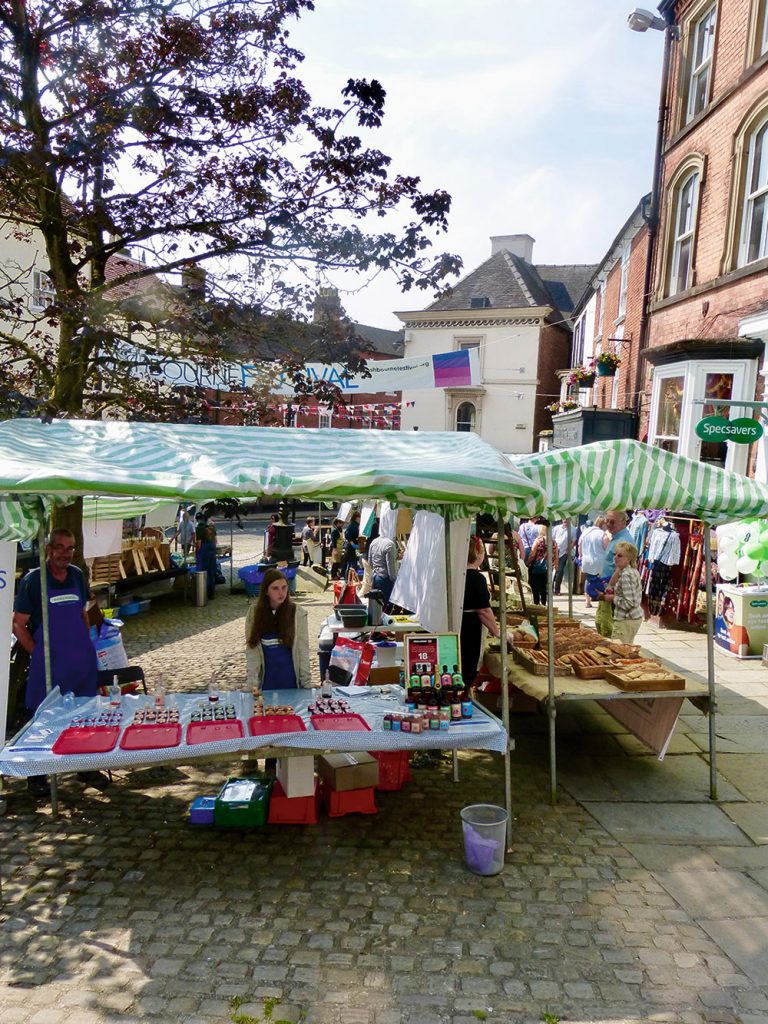
Move over Glastonbury, Y Not and Download, the hottest festivals in the UK this year are more likely to feature ciabatta than The Cure. While some hardy folk still enjoy wading through slippery mud and vegan jugglers at music festivals – everyone, and their Labrador, loves a food festival. They are everywhere and so the headline acts have to be increasingly more-ish to stand-out (chicken wings and whisky weekender anyone?). On the day I decided to swan off to Ashbourne Food Fest’ – lured by a tasty line-up of the Cheddleton cheeses, giant sausage rolls and sweet chilli jam – I had to turn down my VIP pass to a man v doughnuts challenge at the Big Food Festival on Shipley Park. “Food festivals are such a great way to spend a weekend,” enthuses Lisa Wallace, owner of Ashbourne Bakehouse and organiser of the food fest’ held in Victoria Square as part of the Ashbourne Festival. “One of the reasons I wanted Ashbourne to have one is that I’m a food festival groupie myself – much to my husband’s dismay.” Lisa originally tried an on-line market selling food to a select group of local producers but, while the idea attracted hundreds of followers on social media, it only converted into a handful of customers. “I think people want to meet the people and hear the story behind the food,” Lisa said to explain why the real-life food festival was such an instant success when it launched last year. “Like me, I think food festival-goers are excited by new things but they also want to try before they buy. The festival is a lot of fun and I’m pleased to say all of the producers asked to come back next year. It’s good for the town because people come up and say ‘Oh wow – Ashbourne is so lovely’.” While many of the UK’s food festivals are big productions featuring live cooking demonstrations, celebrity chefs and even pop-up cookery bookshops, Lisa was keen to keep Ashbourne’s ‘little and local’. “It was never about creating a profit stream, it’s a way of promoting great producers who don’t always have a shop window,” she says. “The stall-holders are chosen carefully so they complement each other. If someone buys my sour-dough bread I’ll recommend some Staffordshire cheese and a jar of Sarah Ball’s chutney from the neighbouring stalls. In fact, it’s a perfect blend of stalls if someone can get a complete meal – with drinks – from the festival complete with after-dinner chocolates and great coffee.” For details of the forthcoming Christmas foodie events, contact Lisa Wallace, Ashbourne Bakehouse, 29 Market Place, Ashbourne 01335 347206. ‘Taste Derbyshire’ writer Amanda Volley was despatched with wicker basket in hand to the Ashbourne Food Fest’ to grill some of the stall-holders and ask the burning question ‘Have you got any free samples?’ Kniveton Cider Company It was seeing so many apples left to rot on the ground in and around Kniveton which sparked an idea in the mind of locals Kev Woolley, wife Hannah Barton and a group of their friends. “It was such a waste of drinkable apples,” Kev smiles in a way which lets you know he wasn’t thinking of pressing them into non-alcoholic juice. We all chipped in to buy the equipment to make 800 litres of cider. Trouble was, we gathered so many apples we couldn’t drink the lot and approached local pubs to see if they wanted the surplus.” That was the start of the commercial operation which saw the soon-to-be cider company double the production of their award-winning ciders (Never Mind the Hillocks, Four in a Corner, Wynnsum and OB1) every year. It was so successful Kev had to look for larger premises and – as the original friends dropped out – give up his job to work on cider production full-time. “I worked in pubs before I got a proper job. Ironically, I then had to give it up to work with booze again,” he laughs. Festivals and markets are how we like to retail it,” says Hannah who is the only woman on the board of SICA (Small Independent Cidermaker’s Association). “We now stock seven pubs but we still rely on friends and family for apples from their trees. In fact, we collect from trees just 500 metres from this very market stall…you can’t get more local than that.” Find out more about Kniveton Cider Company by visiting www.knivetoncider.co.uk Cup and Saucer A passion for good tea and food festivals saw Gail Hannan having a light-bulb moment when she was made redundant after spending 15 years working in the social care sector. “I went to lots of food festivals and markets and, as a tea enthusiast, I didn’t see anyone doing any exciting loose-leaf tea blends,” says Gail, of North Wingfield. “I’d always wanted to be my own boss but it was my daughter Jess (28), who provided the push. She’s one of those annoying optimists who told me redundancy wasn’t an ending but an opportunity to pursue my dream – and she was right.” Although Gail is at pains to stress she doesn’t grow the tea – it’s a bit too chilly in North East Derbyshire – she perfects the blends by hand, often using fruit and flowers she has grown and dried. “I’m forever coming up with ideas for blends,” Gail smiles when I survey shelves bursting with tea blends which helped her win Chesterfield Food Producer of the Year at last year’s food and drinks awards. The best part of what I do is taking those blends to food festivals and meeting people. Funnily enough, I thought I’d be mostly selling to older people but they’re the ones who say ‘I prefer Typhoo’ when I ask them to sample something like my ‘Roaring Rhubarb’ blend. Younger people are far more adventurous with tea.” As for tourists who visit Derbyshire food festivals, Gail says she can predict the teas which will end up in their