Restaurant Review – M.A.D.E @ No. 18

To spend 2 or 3 hours in one restaurant it has to be good. To spend the entire Friday evening at M.A.D.E.@No.18 it has to be exceptional and something different. It was early on a Friday evening that our taxi delivered us to M.A.D.E. @ No 18; a café-bistro at the top of the old market place in Alfreton. It has a unique style that is reminiscent of the fashionable bistros of the mid 1970s. It’s the place to enjoy scrumptious freshly made breakfasts, lunch with both traditional and Mediterranean dishes or afternoon tea. You can eat in the fully licensed cafe-bistro with its eclectic décor or dine alfresco on the terrace amid a cottage style garden. On Thursday, Friday and Saturday evenings, there’s a new venture to accompany their bistro style menu. We arrived at 6.30 in the evening to enjoy the bistro’s tapas and ‘take in a movie’. The interior of the bistro is deceptively spacious. We introduced ourselves to David, the owner, who showed us to a corner table where we could take in the atmosphere and study the tapas offerings. We nibbled on appetisers of olive oil, diced tomato and aioli on crispy toast while we lingered over our first glass of wine. Susan and myself chose 3 dishes each that we could share. They arrived in earthenware pots on 2 wooden platters. This is the sort of spread that you want to linger over. There was a dish of sliced, spicy Chorizo and cherry tomatoes in a honey and red wine dressing. This is a dish to be nibbled between sips of wine. Susan had ordered the calamari: 2 pieces of soft and succulent squid, dusted with flour and lightly grilled which was served with a Jerusalem artichoke purée. I’d selected the gambas al ajillo: seared prawns in a mild chilli and garlic oil. Full of flavour and very indulgent. Another of my selections was the albonbigas: meatballs in a smokey paprika based tomato sauce. A joint choice was the traditional Spanish dish of patatas bravas: potatoes served with a spicy sauce of tomato and mild chilli. Finally, every tapas has to have tortilla Espanola: a slice of a Spanish omelette. This generous portion was light and packed with the flavours of garlic, onion, potato and peppers. David was busy all evening; chatting to customers, dispensing wine and taking bookings for M.A.D.E. @ No 18’s very popular, mid-morning breakfast. There’s something magical about going to the cinema. The thought of enjoying a beautifully crafted piece of entertainment, surrounded by a few like-minded people, uninterrupted; all there and of one mind to enjoy the evening. As 8 o’clock approached we made our way, along with some of the other diners, to the ‘cinema’. With only 30 or so seats, split into 6 rows, the cinema isn’t large but the screen fills the end of the room and so occupies almost your entire field of vision. We settled in to our seats, re-claimed theatre seats from a London venue, with our popcorn and a bottle of chilled sauvignon blanc. There’s a lot of legroom between the rows; we had room for a narrow table to put our glasses on. This evening the film was Widows; a popcorn heist flick with a feminist soul. The original story was written by Lynda la Plante and serialised, many years ago, on ITV. Although the action in this up to date American version, has moved from London to Chicago director Steve McQueen has retained the original story’s concept of powerful female lead characters. There has been a screening of a diverse selection of films from a matinee showing of Mary Poppins Returns, aimed at a younger audience, to an early evening James Dean in Rebel Without a Cause and one of my favourite’s: the original Blade Runner, The Director’s Cut; another Friday evening treat; all parceled up and delivered in one place. It was 10.30 before we climbed back into our taxi. We’d enjoyed a memorable 4 hours of fabulous food, hospitality and entertainment. +30
Modern Collectibles – Royal Crown Derby Paper Weights

The Royal Crown Derby (RCD) china factory on Osmaston Road had been going since 1878 and received a Royal Warrant to prefix its name with ‘Royal’ in 1890. In 1935 the firm absorbed the King Street China factory, thereby acquiring a virtually unbroken ceramic tradition going back to the foundation of the original factory on Nottingham Road in 1750 or thereabouts. Since the later 20th century it has endured ups-and-downs, changes of ownership – some good, some less beneficial – and so on. The problem has always been to maintain sales at a level commensurate with keeping the company profitable. This has involved the marketing men, one of whom in 1981 suggested that to launch a range of anthropomorphic Imari painted paperweights might be a good idea. A modest range was introduced from that September and indeed, collectors liked them, although the first series were a little fragile and, being filled with sand, were heavy to post and leaked. The leakages were because the base was fitted with a gilt-metal stopper which could come loose. Consequently, the bodies were made stronger and were made more robust. The stoppers for the first seventeen of this revised range were ceramic and fired on, with a hole beside the position to aid firing. This, too was found to be unsatisfactory – the marketing men discovered the collectors did not like ceramic false stoppers. So from this point the gilt stoppers were re-introduced and the paperweights sold empty of sand, allowing the punter to install his own makeweight. The models were also boxed, and if you decide to collect these modest but attractive and colourful items, buying one with its box is absolutely essential. To date there seem to have been some 488 different models, mostly birds, animals and mythical creatures, but occasionally a building (a model of a typical pub called The Admiral Lord Nelson to commemorate Trafalgar’s 200th anniversary in 2005 for instance) or other less animate object, like crowns. A miniature range numbering some 50 different designs was also introduced, although how effective these would be at holding down one’s papers in a stiff breeze is open to question. Models were ‘retired’ and replaced by new ones regularly, thus ensuring rarity and other commemorations made. Indeed, to celebrate the 21st anniversary of the entire paperweight range in 2002, a special seven-sided gilt metal stopper was introduced on a limited basis. To buy these paperweights new from RCD tends to be expensive, for each one is hand-decorated by one of the company’s china painters, so no two are exactly alike. Hence today prices range from a modest £100 for a Blue Tit, through to a gilt butterfly for £180, a golden eagle (close) for £335, to the giddy heights of the Old Imari gold band limited edition swan which will leave you with but a fiver in change from a £600 punt. If you are going to collect, you have to buy second hand; at auction is perhaps best. Bamford’s recently had a howling wolf on offer estimated at £40-60 (boxed) and an unboxed lama at £25-35 with gold stopper. For smaller ones, we tend to lot them in groups, especially if lacking boxes. On e-bay too bargains may be had. I noticed one called Boris on offer at £70, and clicked upon it wondering if it was a caricature of a well-known blonde politician, but – alas! – it turned out to be a rather nice badger introduced in February 2006 and priced at £70, although when I was young, badgers tended to be called Bill and were friends of Rupert. A popular paperweight from 2003 was a limited-edition Derby County ram decorated by Sue Rowe which retailed at £95. Only 200 were made, so today that would turn out to be a good investment, with prices ranging recently from £120 to an eye-watering £275. Another popular one is the well-known meerkat from a certain TV advertisement and named (ironically) after a member of a Russian Princely family. From an initial price of over £100, examples with gold stopper and box are turning up ranging from £55 to £95 – clearly you need to buy second hand: simples. Incidentally, you will encounter examples with silver coloured stoppers – sometime quite difficult to distinguish from certain gold coloured ones, so care is needed when examining them. These are to distinguish ‘seconds’ from top quality examples, and command somewhat lower prices. If you want to collect them for the sheer enjoyment of their varied forms and vivid colours, then silver stoppers might suit your taste and pocket. But if you require quality, and something which will, if you keep it long enough, represent a reasonable investment, you need to buy examples unchipped with colours uncompromised, with gold coloured stoppers and with box of sale in good condition. Furthermore, some limited editions, like the Derby County ram, do appreciate well, although not much movement on The Lord Nelson as yet, I’m afraid. They are always marked on the underside and carry the usual RCD date, so you can date your acquisitions, too. Nevertheless, if you buy on-line or at auction, you can if you are lucky pick up items at a very reasonable cost and indeed at auction you might catch one of the rarer ones at an affordable price. 00
All About The Eyes – Clarins

New 4 Colour Pen £28 Fun, practical and innovative, Clarins multi-use make-up pen, loved by women the world over, is back! New shades, new packaging and all the magic of an all-in-one, these easy to apply automatic pens feature 3 eye liners and 1 lip liner using a retractable function meaning you can wave goodbye to sharpeners. Half skin care, half make-up, all colours are enriched with sunflower wax complex, jojoba and black acacia to nourish and comfort eyes and lips. Introducing two NEW harmonies: Harmony 1 Deep Black eye liner Blue Marine eye liner Forest Green eye liner Rosewood lip liner Harmony 2 Deep Black eye liner Platinum Grey eye liner Essential Brown eye liner Clarins Red lip liner The four retractable colours are easy to apply and perfect for any complexion. Mascara Supra Volume £22 Clarins has reinvented its volumising mascara, with a blend of plant waxes at the heart of its formula that will coat and shape each lash, leaving them perfectly supple, for exceptional and long-lasting volume. The Clarins revolutionary ‘Volume Booster Complex’ Proven ‘Lash-Thickening’ effectiveness Clarins laboratories have developed a new ‘Volume Booster’ Complex: an unprecedented combination of key ingredients that help thicken lashes. With repeated application, your lashes increase in volume. Lash volume increases +17.6%* after 4 weeks of use. Volume: At the heart of the formula are carnauba wax powder and cassie flower forming a film on lashes to coat and shape each lash. Strength: Lashes are strengthened through the action of the panthenol contained in the formula. Definition: Ultra-supple brush fibres gently hug lashes to help even application and intense clump-free colour. The conical tip provides precise application to the inner and outer corners of the eye. Supra Volume Mascara is dermatologist and ophthalmologist tested. *Clinical Study: evaluation of lash care effect on bare lashes – 30 women – 4 weeks For more information and to buy online visit www.clarins.com Mascara Supra Volume This mascara has a lovely full brush which makes application nice and easy, it also builds length nice and smoothly without having lumpy bits. In all, I found it to be a great product as always from Clarins. JP Colour Pen Great idea to have 3 eyeliners and 1 lipliner in one applicator. It’s really easy to use, colours are great and blend well. A really quirky product. VP. 00
Celebrity Interview – Sergei Podobedov
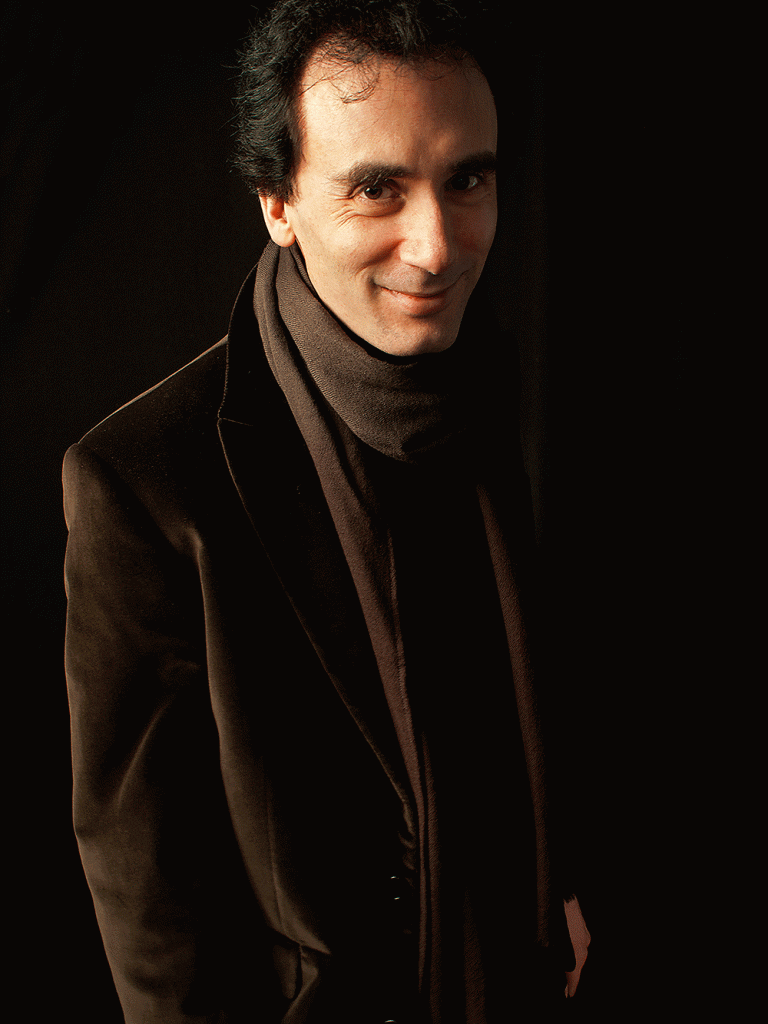
A strand of his wispy hair falls over bushy eyebrows as Sergei Podobedov, dressed in a dark T-shirt and casual trousers, makes coffee. There’s nothing unusual about his demeanour as he goes about everyday tasks without taking undue care of his hands. But this isn’t a manual labourer or someone who’s been thrust into the uppermost echelons of celebrity without having a talent. This is a Russian-born classical pianist who’s given concerts all over the world – and he’s living in Belper. He admits he doesn’t do any heavy lifting. Otherwise he just gets on with life, paying little attention to the dynamic digits that have catapulted him to the top of his profession. His hands aren’t even insured. I first came across Sergei when some friends invited my wife and I to a concert he was giving last September at the Strutts Centre in Belper where he also practises. Everyone who experienced it was captivated by his dexterity, natural ability and mastery of the piano. I also wondered how someone with his virtually unparalleled talent had made his home in Derbyshire and was playing at the former Herbert Strutt School. “I don’t know. It has something to do with the laws of the universe!” he told me. “I had a studio in London but I had to move because the house was going on sale. I wanted a change. So a friend in Bonsall invited me to stay on her farm for a couple of months. “I thought ‘I really like it here’ and eventually I ended up with friends who invited me to stay long-term. It’s all their fault!” During our chat 46-year-old Sergei laughs a lot. He speaks confidently and eloquently. On occasions he takes his time answering questions but that’s not because he has problems with the language; he’s thinking deeply about what he wants to say. He’s obviously content in his new surroundings which are unlike London: “It’s really nice here. Everybody is so friendly – it’s a different world.” When he was in the capital he enjoyed practising at night. He can do the same in Belper. But if you drive past the Strutts Centre in the early hours, don’t expect to see lights on in the building when he’s playing his piano – he likes to practise in the dark. “If you see lights it’s probably because someone forgot to switch them off! But to me the atmosphere in this building is very positive. He says those who attended last September’s concert were “fantastic”. They were “a very warm audience and I feel that I’m somehow useful to the community, which for me is important.” The programme included Beethoven’s Piano Sonata No 14, the “Moonlight” Sonata, as well as Schumann and Chopin. He maintains that he tries to practise “as efficiently as possible” and doesn’t want to do too much. But he confesses he had to work hard on the Chopin Mazurka that he played for an encore. “It’s a very short piece, it’s very simple. But basically I practised the last two lines for a whole night. I sat down around one o’clock in the morning and by the time I felt that I owned those last two lines, I think it was around nine. But then once you’ve done that you own the piece.” Sergei Podobedov was born in 1972, growing up in Moscow and spending three summer months in a Black Sea resort. He started playing the piano when he was five or six. “My mother was a first violin in one of the major orchestras in the Soviet Union. I grew up in an orchestra because she took me to all the rehearsals and concerts. And I listened to a lot of records when I was a kid. “I was fond of every possible instrument. I think she was a bit apprehensive when I was near the violin because she always said it’s torture for a child to start playing it.” He chuckles loudly before explaining what drew him to the piano. “I went to a concert where my mother’s orchestra was playing. There was Tchaikovsky’s Piano Concerto No 1 on the programme and I came back home and started listening to it obsessively. “My uncle came for my birthday and he brought a recording of the concerto by Emil Gilels (regarded as one of the greatest pianists of the 20th century). He told me ‘this is better than the pianist you are listening to’. “I listened to it and I didn’t like it at first. But after listening to it a few times I thought ‘it is better!’ Gilels has amazing sound which was uniquely his own. In terms of musical breath it was completely different. Other recordings weren’t so alive. “Since then I’ve heard many recordings of the concerto. Some of them are great but there’s still nothing like Gilels. I guess you can’t really explain it but it will always remain something very special.” Sergei made his orchestral debut when he was 12. Shortly afterwards he went to the Moscow Central School of Music. “We got a sense of what it’s like to be on tour and what it’s like to play on all sorts of instruments in all sorts of circumstances. It was fun.” Six years later, in 1990, he came to London to study at the Royal College of Music which he describes as a “great experience”. He and another pianist were the first two Russians ever to study at the College. Its patron was the Queen Mother who that year celebrated her 90th birthday. Sergei played for her and was invited back the following year to do a joint concert with Sir John Gielgud who read poetry. It’s another event which Sergei remembers as being “very special”. Since then Sergei has played all over the world including the United States, Paris and, surprisingly, Turkey where he says audiences for classical music are “amazing”. He has performed at London’s Wigmore Hall, the Tchaikovsky
Stowe Gardens

One of Capability Brown’s earliest works, Stowe Gardens in Buckinghamshire was looking at its best when Brian Spencer visited it during a recent autumn break. The gardens of Grade 1 listed Stowe House are the idyllic setting for Stowe School. The public school sits at the top of rising ground overlooking grounds that are, as the master gardener Capability Brown probably said, now looking at their best, having matured over three centuries. Our visit coincided with the sturdy beeches being decked in colours ranging from varying shades of yellow to brightest orange; their fallen leaves made patterns on the still waters of ornamental ponds dug by the hands of eighteenth century navvies. The original estate was built by Sir George Gifford (1498-1557) whose wealth was based on wool. Very early in the fortunes of Stowe, the place became a popular venue for visits of the great and the good. This interest prompted later owners to expand the garden, making it an ideal retreat for politicians looking for somewhere to meet and plot with their confrères, and maybe meet up with their lady friends on the odd occasion. Throughout the years the different owners all seem to have been able to extend the work of their predecessors, bringing in the top architects and garden designers of their day. Throughout the 1700s the house and its grounds were a hive of activity, starting with architects of their day, such as Charles Bridgeman and then Sir John Vanbrugh, designer of Blenheim Palace. He worked on Stowe for six years until his sudden death in 1726 and was followed by James Gibbs whose speciality was the English Baroque style – a feature that shows itself in both the house and the garden’s stone-work. Most gardeners will agree that gardens take time to develop. In the case of Stowe, the time lapse was decades, almost running into centuries. Most of the work on Stowe Gardens took place in the mid-1700s. It was during this time that the young Lancelot Brown who had moved to Buckinghamshire as a free-lance garden designer, came to the notice of Lord Cobham at Stowe. He became head gardener, working closely with James Gibbs the architect responsible for the house and William Kent who had already laid out features such as the Elysian Fields, Temple of Ancient Virtue and also the Temple of English Worthies. It was while Brown was developing Stowe’s gardens that he developed the style which was to give him the nickname ‘Capability’. Continuing Kent’s work, he laid out the garden making it look as natural as possible, in what became known as the Serpentine, or English style. As can be seen at Stowe, the central features are inter-linked winding, or ‘serpentine’ lakes joined by bridges and cascades; all this is surrounded by follies, encircling carriage drives and clumps of trees. All of his work has now grown to maturity, confirming Brown’s opinion of the garden’s ‘capability’. It was during Capability Brown’s tenure at Stowe that his ideas and skills came to the notice of the fashionable elite of the country and so in 1751 he left Lord Cobham’s employment at Stowe, to spend the rest of his working life advising the owners of great estates of the ‘capabilities’ of their properties. At the zenith of its popularity, Stowe became the ideal meeting place where politicians came to unwind and discuss strategies with their fellow MPs. Prime Minister William Pitt the Younger rented the estate at one time, making it an early version of Chequers the grace and favour residence of future prime ministers. Like many grand houses and their estates, Stowe has passed its usefulness as a place where the great and good of society could use their wealth. Due to escalating maintenance costs, Stowe had to be found other uses. The result was that the house became a public school and the gardens given over to the care of the National Trust. While the house and the school’s sports facilities are not open to the public, visitors can stroll round the gardens and parkland on any day of the year. Like visitors from earlier times, the entrance to the 750 acre estate and its 40 listed historic monuments and temples is past the imposing Corinthian Arch and the Oxford Gates; the latter incidentally are built of wrought iron salvaged from a World War One German battleship. Long before Stowe gardens became a National Trust property, the then current owners realised that it was necessary to provide somewhere for visitors to stay, or at least rest and take some refreshment. The New Inn close by the entrance was built to provide this and it now serves as an entry and information point at the start of a tour round the gardens. Although no longer providing overnight accommodation it does offer excellent meals and light refreshments, all to the usual high standards of the National Trust. The New Inn also houses a useful information section where, along with a note detailing the birds currently seen around the grounds, as well as being the start of walks guided by experienced National Trust staff. The short Bell Drive leads down to the start of the graded paths that meander over the gently sloping land on either side of the lakes and past monuments and temples. Children are well catered for with the choice of three walks, non-more than 1.3 miles in length. Even for adults, a walk around the garden need not be too exhausting; the following is just one of the strolls on offer and because we did it on our visit, we can say it was most enjoyable. 00
Restaurant Review – Alfreton Golf Club

The carvery is a brilliant concept; a meal served in a pub or a restaurant where cooked meat is freshly sliced to order for diners, served in a buffet style for a fixed price. It lends itself, in a casual way, to the traditional Sunday lunch. But all too often we associate it only with the large pub and hotel chains and their corporate style of cooking. Myself and Susan had been invited to try the Sunday lunch carvery at Alfreton Golf Club where everything is cooked from fresh and served by husband and wife team Steve and Sharron Slater. The Sunday roast dinners of my childhood were huge, drenched in gravy and always accompanied by Two Way Family Favourites on the radio. So, with the promise of home cooking, how would this, our first visit to a carvery, measure up? You don’t have to be a member to visit Alfreton Golf Club and it isn’t large. It’s only 11 holes, and for that reason it’s very friendly. The car park is in front of the entrance. A few paces up to the door, through the foyer and you’re into the club house bar. From the bar area there are pleasant views of the manicured greens. The carvery has it’s own space; beyond the bar area in more intimate surroundings. We had been greeted at the well stocked bar, where I ordered our lunchtime drinks, and shown to a beautifully presented table for 2. I noticed that the other tables were a mix of sizes catering for couples and families: small and large. Unhurried, we made our way over to the carvery counter and picked up our ‘proper’ size dinner plates. There were 3 meats on the carving platters: a boned out turkey joint that was all meat and very moist, a blush pink gammon joint with a roasted finish and, my choice, a large piece of roast beef, still a bit pink in the middle, complete with just enough dark yellow fat. Steve carved me 2 generous, thick slices. All the meats are supplied by local butcher, Owen Taylor. Next to the meats was a tray of pigs in blankets and sage and onion stuffing balls. Susan chose the 4th mains option: a serving of beef casserole that was rich with meat and had a deep beef flavour. It was topped with a cheese, scone style, cobbler that was beginning to absorb the meaty juices. The cheese didn’t overwhelm the cobbler but lightly seasoned it. All the vegetables were beautifully cooked. The carrots still had a little bit of bite to them, the cabbage was green, vibrant and the flavour had not been washed away. There was cauliflower and broccoli in a tangy cheese sauce but my favourite was the cabbage and smoked bacon in a cream sauce. There was a hint of the smoky bacon in the savoury sauce that coated the tender cabbage and by the way the dish was disappearing it was a real crowd-pleaser. There were two potato dishes on offer: a buttery mash that was seasoned with a hint of pepper and a large tray of roast potatoes; golden brown with crispy edges. The stuff a generous serving of beef is crying out for. And finally, the roast parsnips. A much maligned root crop that has attracted some unpleasant folklore; but not here. This sweet, healthy, nutritious vegetable had been roasted to perfection. Yorkshire puddings are the make or break ingredient of a good Sunday roast and these ticked all the boxes. They were whoppers and served with lashings of gravy. They’d been cooked in beef dripping and were crisp on the outside with a soft inner that melted in the mouth. Something that big would fight for space with the vegetables on the plate and so, for that reason it adorned, like a crown, the very top of the meat and veg. There was a choice of 3 homemade puddings to finish the meal: a syrup sponge and 2 cheesecakes. We shared a slice of the fresh fruit cheesecake. It had a crisp biscuit base, a smooth filling and topped with a generous helping of fresh fruit. It had been a ‘proper’ Sunday roast complete with all the ‘comfort food’ vegetables and lashings of gravy. The only things that were missing (for those who remember) were the voices of Cliff Michelmore and Jean Metcalfe. The restaurant service is available for most of the time that the golf club is open; with a later finishing time during the Summer. However, the carvery is only available on Sunday. For the rest of the week there’s a varied menu; from afternoon tea to the usual pies, salads, filled baguettes, steaks and of course, fish and chips. The Golf Club can cater for a range of events and special occasions: weddings, birthday parties, christenings, baby showers and is a peaceful setting for a respectful funeral reception. 00
Tried & Tested – Benefit

Be Beautiful with Benefit Hello Flawless £29 WHY WE LOVE IT Say “hello” to flawless! This famous powder cover-up glides on naturally sheer and layers beautifully for customized coverage. The silky formula comes with a newly designed brush AND a sponge for any degree of coverage you desire. HOW TO APPLY Cheers to a charming compact Flip open for a flawless reflection. To achieve a satiny finish, sweep on with the brush using light, quick strokes and blend from the center of your face outward. For full coverage, apply evenly over entire complexion with the sponge. For a little extra spot coverage, pat gently and blend beautifully. Hello Happy £26 WHY WE LOVE IT Put on your happiest face! Hello YOU! This lightweight foundation evens out skintone and blurs imperfections with soft-focus optical blurring spheres. With a natural-matte finish and light-to-medium coverage, it looks like skin and feels like nothing at all. Happy looks good on you! HOW TO APPLY Feelgood foundation Cue the giggles. Start with a fresh face and prime skin with The POREfessional…just a dab will do! Shake this liquid foundation, then use your fingertips to apply one drop at a time. Repeat to build coverage. Blend in for an even finish. Gold Rush £26 WHY WE LOVE IT A rush of gilt-y pleasure! This golden-nectar blush gives any look a natural-looking warm glow! Embossed with a stunning “golden nugget” overspray, the specialised formula gradually lifts away to reveal a rich, nectar shade infused with delicate, golden flecks throughout the powder. The soft, blendable formula also features a signature scent with notes of citrus, vanilla & sandalwood. HOW TO APPLY Sweep on the luxe! Give into your gilt-y pleasure and treat your cheeks to a rich, golden-nectar glow. Dust this peachy blush onto the apples of your cheeks and blend upwards along your cheekbones for a Gold Rush flush! Sweep & repeat! For a deeper pop of peach, reapply as you like. Tried & Tested Hello Happy This is quite a thin liquid foundation which blends really easily and leaves no tell tale marks. Good for paler skin tones. Hello Flawless Really handy compact with a mirror. Choice of full coverage with the brush or smaller coverage with the brush. Gold Rush This comes in a cute little box! It gives a natural warm glow,with delicate gold flecks, its infused with citrus, vanilla and sandlewood so smells beautiful too! Perfect for a night out. For more information and to buy online visit benefitcosmetics.com 00
Celebrity Interview – Maxwell Caulfield

Whenever anyone lists the finest actors who originated from Derbyshire, names such as the late Alan Bates and John Hurt usually crop up, closely followed by current heavyweights such as Robert Lindsay and Jack O’Connell. It’s rare that Maxwell Caulfield is included. Born in Duffield, Maxwell can genuinely be described as a Hollywood superstar. He was playboy Miles Colby in the blockbuster series Dynasty and the spin-off The Colbys, he’s made more than 40 films, played Mark Wylde in more than 150 episodes of Emmerdale and has appeared as lawyer Billy Flynn in the long-running musical Chicago on Broadway and in London’s West End. He’s back in this country in The Lady Vanishes, a high-profile production based on the film directed by Alfred Hitchcock which is touring the country for most of this year. The bonus for Maxwell is that his 77-year-old wife Juliet Mills, sister of Hayley, is also in the cast. She’s 18 years older than Maxwell. They met on stage and fell in love. Critics said the marriage would never last. Last year they celebrated their 38th wedding anniversary. In a wide-ranging conversation Maxwell told me about his Derbyshire roots, why he loves coming back to this country so much and how he’s hoping to perform with his “English rose” Juliet in a play that features only the two of them. There’s no sign of pretentiousness with Maxwell. He sounded genuinely pleased that Country Images wanted to give publicity to The Lady Vanishes and he gladly gave up his time to be interviewed. And throughout our chat his love for Juliet shone through. He signed off with “the home-grown lad is proud to be coming back to the county and showing off with his beautiful bride.” In The Lady Vanishes Maxwell plays Austrian brain surgeon Dr Hartz. The play is set on a train hurtling through the Austrian Alps in the late 1930s on the eve of the Second World War. “The show is a bit of a runaway train in itself,” says Maxwell. “It’s got laughter, there are a couple of demented cricket fanatics who seem oblivious to everything that’s going on around them – they’re so hell bent on getting to the Test match at Old Trafford. “And there’s a burgeoning romance at the heart of it, the young heroine who’s haunted by the disappearance of the lady who befriended her at the train station in Austria before it set off.” The play is being produced by Bill Kenwright’s Classic Thriller Theatre Company and, according to Maxwell, Kenwright has spent “good money” on the set and costumes. “It’s a first-class production and we’ve got a very strong company. We think we’re delivering a good couple of hours’ entertainment, hopefully for a fair price. The price of a cinema ticket these days is the same price as a theatre ticket, so why not come and see something live and something that you’ll really remember. “I’ve always maintained that live performances stay with you, more so than a movie that’s knocked you out. All kinds of stuff happens in live performances. Guns jam, train compartment doors don’t close when they have to, actors playing multiple parts come on wearing the wrong costume. It keeps us all on our toes. Based on the curtain calls we’ve been taking, everybody seems to have enjoyed themselves which is the name of the game.” Strangely Maxwell and Juliet don’t have any scenes together in The Lady Vanishes. “It’s probably a relief for her not to have to deal with me for a couple of hours! I just love being on the boards with her. Because we’re in each other’s pockets all the time when we’re on tour, it’s a very intimate experience. If you’re not driving in the car you’re moving into the digs together and then into the theatre.” Maxwell Newby was born on 23 November 1959. His parents divorced when Maxwell was very young. His father lived in Chesterfield for a long time and died there, so Maxwell is delighted that The Lady Vanishes will be visiting the Pomegranate Theatre in the town. Although his mother took Maxwell and his brother Marcus to live in London, they would spend a lot of time in the summer holidays with their grandparents, Tom and Mavis, in Littleover. Maxwell’s aunt Margaret and uncle David live in Littleover and they’ll be meeting up when he and Juliet return to the county. “The connections to Derbyshire are very strong even though I didn’t spend a lot of time there in my youth. “It’s always good to come back and connect with your roots. Juliet and I both elected to live in America but it does come at a bit of a price. You get the sunshine although there’s a bit of a disconnect living all the way over on the west coast.” Maxwell is grateful that he can return to Britain on a regular basis. The first three UK tours he did all stopped off at the Theatre Royal in Nottingham: in 2010 he and Juliet were in the Alan Ayckbourn play Bedroom Farce, then musicals Singin’ In The Rain and Guys And Dolls. Maxwell even did a few dates at the Theatre Royal in The Rocky Horror Show, playing the Narrator. “I remember playing to an absolutely packed house. I’ve never heard such a torrent of abuse. I didn’t realise that part of the show has the audience barracking the narrator throughout. It was quite a shock. It was just like I’d missed a sitter at Pride Park!” That was one of the few occasions he wasn’t appearing alongside Juliet. They met in 1980, a couple of years after Maxwell had moved to the States, when they both performed in the play The Elephant Man. “That was a wonderful experience and we fell hook, line and sinker for one another,” says Maxwell. “We would like to work together more but it’s rare that you get cast in the same film or TV
Lost Houses of Derbyshire – Brailsford Hall

The manorial history of Brailsford is a long and distinguished one going back to the period of the Norman conquest. Then the manorial estate was held by one Elfin (as Domesday Book renders his name) or Aelfwine, clearly a man of Saxon descent. In 1086 he held not only Brailsford but also Thurvaston, Osmaston-by-Ashbourne, Culland and Bupton, the latter an estate were the settlement was later deserted and which was divided between Brailsford and Longford. None of these estates were in his hands prior to the conquest, so he must have in some way impressed his Norman masters. His son, Nicholas, a benefactor to the new priory at Tutbury, seems to have established a house in the manor, although there is no hint of its appearance other than charters attesting to his having a ‘capital mansion’ there. Two generations on his successor also held part of Wingerworth (with its lucrative coal) and had married an heiress who brought him Bradley and Mercaston, too. Various younger sons were settled on these properties – giving rise to the Culland and Osmaston families, amongst various other branches which kept the Brailsford name – but the senior line ended in 1356 when the daughter and heiress of Sir Henry de Brailsford carried the estate to Sir John Basset of Cheadle in Staffordshire. Their son Thomas was described as ‘of Brailsford’, but he, too, left an only daughter and heiress, from whom the estate passed to the Shirleys. The site of the Brailsfords’ house was presumably on the site of a large moat recorded in the 18th century south east of the former vicarage, all trace of which had vanished entirely by 1949, when a survey failed to locate the least trace of it. As the Brailsfords were knights of the shire and produced Sheriffs of the county (then held in tandem with Nottinghamshire) their house was likely to have been fairly impressive; a two courtyard house of some pretension in all probability but we have, alas, no evidence as to its appearance otherwise. Furthermore, with the death of Thomas Shirley in the early 15th century, the family had no use for the house and it was probably dismantled for its materials, unlike the family’s original home at Shirley nearby which was retained, much reduced, and adapted as a farmhouse. From then until the 18th century there was no capital mansion at all in Brailsford, bar a couple of neat Georgian village houses, still extant, despite the baleful effects of having to live on the A52. Then in 1771 a local man, William Cox, purchased much of the land in the parish from Washington Shirley, 5th Earl Ferrers, who was keen to raise money to pay for the rebuilding of the family’s main seat at Staunton Harold. When he was 81, old William Cox wrote smugly that ‘I was one month under thirty years of age when I purchased the Brailsford estate.’ His grandfather, also William, had been schoolmaster in the village and tutor to Lord Ferrers, although as Staunton Harold is really quite a long way from Brailsford (in 18th century terms) one has always harboured doubts about this. His son, another William, made his fortune trading flax and hemp, however, which is how the third William managed to buy the estate. He himself had already bought the Virgin’s Inn in Derby Market Place as a town residence (1763) and later established the lead works on the Morledge. The estate in 1771 contained an old farm house on the site of the present hall SE of the village, which Cox rebuilt in brick in unpretentious and rather old-fashioned Georgian style, and began to improve the estate. His switch from flax and hemp dealing to lead smelting is partly to be explained by his marriage to Mary, daughter of Gilbert Soresby, a successful local lead trader. Interestingly, William’s niece Margaret Lovatt went to America with her cousin, William’s like-named the second son. The latter founded an import-export business in Virginia whilst she married New England patrician John Cabot Lowell, whose son Francis was a co-founder of the city of Lowell, Massachusetts, in the 1820s and, dying before matters had been completed, gave his name to it, in lieu of ‘New Derby’ as planned). It was set up on his behalf by Kirk Boott II, whose Derby connections are well known. In 1795, the elder son, Edward Soresby Cox (1764-1846), set up home in the Brailsford house and, on marrying Gainsborough heiress Elizabeth Nettleship in 1813, had the house rebuilt and enlarged, although the resulting mansion – the new Brailsford Hall, still owed much to its mid 18th century rebuild; presumably Edward was as careful of his money as his father! Yet the extra room created would have been vital as the couple went on to have a son, William, and five daughters. William Cox’s original rebuilding had created a two-storey brick house with rusticated lintels and quite a high slate roof, and it faced, like the Farmhouse that preceded it, largely SE. What Leaper did was to create a new range facing the lane of three bays, still two storeys, but each taller with the roof hidden behind a plain coped parapet. The windows were shielded by cast iron sliding jalousies made by Thomas Glover’s foundry in Derby (later Weatherhead & Glover of Duke Street). The entrance was placed to the left of the façade, to ensure that the main reception room, entered right from the hall, could be as spacious as possible. This was really a conceit normally confined to town houses where there was a restricted site – one thinks of 36, St. Mary’s Gate, Derby, where the superb saloon occupies the entire façade with an entrance, similarly, to one side. The accepted practice for country villas (as built by Leaper himself) and seats, was a central entrance and a spacious room either side, but it may be that E S Cox, mindful of the relative newness of the house, forbore to
Modern Collectibles – Shell Guides
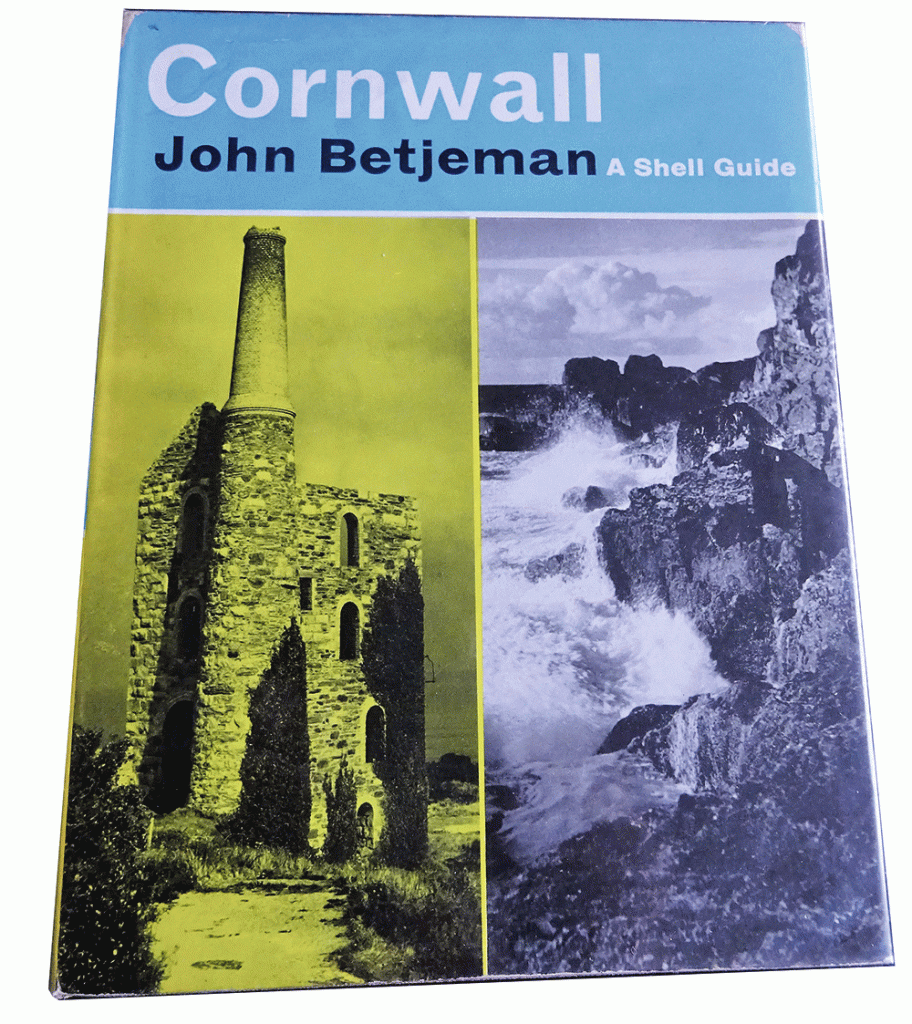
Being the sort of universal hack that I am (when it comes to writing history), in the days before the internet I always needed a handy guide to various counties which would give me a little local colour combined with compressed highly reliable fact. I always found Arthur Mee too cumbersome and The King’s England series likewise. Instead at an early age (by liberating a couple of volumes from the shelves of a relative) I came to realise that the perfect combination was to be met with in Shell Guides. The series began in June 1934 with Cornwall, which the publishers, the Architecture Press, selected John Betjeman to write. The sponsor was the oil company Shell; whose slogan then was ‘Shell: the Key to the Countryside’, in essence explains their willingness to under-write the series. Although the 1934 Cornwall was pretty simple: spiral bound, 62 pages, and not a few errors and omissions, the format stabilised the following year with its revised edition as hard backed 7×91/4 inches with colourful dust-wrapper, glossy paper, an introduction, pace-by-place gazetteer and a lot of excellent black & white photographs. The series was continued until 1984, by which time about half the country had been covered. The series was sponsored by the oil company Shell. The original guides were published on a county-by-county basis, under the editorial control of the poet John Betjeman and (later) his friend the artist John Piper. There were 13 pre-war titles, the publisher changing fairly soon to B T Batsford and then in 1939 to Faber & Faber who continued until 1984. In 1939 all the previous twelve titles were re-issued and one new one in the same format: David Verey’s Gloucestershire. The next one planned was Shropshire to be co-written by Betjeman and Piper. However, the Second World War intervened. Post-war, every bit of Wales was covered in five different titles. But it was not until 1951 that the series re-started with Shropshire. Jack Beddington, Shell’s advertising manager, was long involved with the Shell Guides and his influence led to the employment of so many artists: John and Edward Piper, John and Paul Nash and so on. From the late 1950s to the early 1970s, a series of general titles under the Shell Guide banner were also produced, covering most of the countries in northwest Europe. Guides to subjects such as rivers, islands, viewpoints, archaeology, gardens, flowers, history, wildlife and museums were also published, but these rather lie outside the collectors’ ambit. In 1987, Shell issued a final series of New Shell Guides, published by Michael Joseph and generally covering rather larger areas (e.g. Northern Scotland and the Islands) than in the earlier series. Whilst the original Shell County Guides are now highly collectible, the later titles (published by Faber & Faber, Ebury Press or Michael Joseph) tend to be shunned by collectors and book dealers alike, as supply exceeds demand. Also, since 2012 the Heritage Shell Guide Trust has been set up to re-start the series, beginning with West Yorkshire by William Glossop in 2012, a complete revision (due to boundary changes of the 1974 West Riding volume. It is too early to say whether these will become collectible, but all those I have seen are in paperback, are unlikely to be much sought after. The real joy of the original series, apart from the photographs, are the authors. You can see John Betjeman clambering on and off various hobbyhorses as he takes you, in the most gentle and civilised way, round his beloved Cornwall. As editor, his view was that the guides were all about ‘Readers will want to know what a place looks like now. Is it ruined with poles and wires? Has an old bridge been destroyed and a concrete one put in its place?’” Another regular author of the guides was the late Revd. Henry Thorold, whom Carole and I got to know well. He, too was a friend of John Piper (who landscaped his garden at Marston Hall, Lincolnshire) and of Betjeman, although his circle of acquaintances was staggeringly wide. He too, writes like Betjeman, amusingly, perceptibly, heart on sleeve and, like Sir John, his intimate knowledge of the five counties he wrote up was astonishing. Henry’s first effort was (with Jack Yates) Lincolnshire; on seeing which Betjeman wrote gleefully: ‘It is far the best of the Shell Guides so far and the text is really good too. We have got Pevsner on the run.’ He also wrote, Derbyshire, Durham, Staffordshire and Nottinghamshire (the last of the original series published), photographs mainly by Piper. The series was pulled by Shell in 1984 with Bedfordshire not quite ready for the press: it never appeared. Although many were reprinted in paperback, the original spiral bound card or hardback ones are those that are collectible. Even more so if you were lucky enough the get the author to sign you copies; I have never been pushy like that, but on a visit to Marston I later discovered that he had signed the two I’d brought and given us three others I had not even got round to buying! Likewise, when I lived in London, a friend who knew Betjeman well got Cornwall (1964 revision) signed. These signatures are the key to value, as some authors like Betjeman, Piper, Thorold, David Verey, Professor W G Hoskins, and so on were very well known in their own right. A Piper or Betjeman-signed pre-war edition is going to soar past £300 and do almost as well if it is a later edition (condition being right). The lesser, but still well-known, authors are probably going to command a premium of £30-40 over the value of an unsigned one. Largely speaking, signed copies are extremely rare. Prices for the unsigned pre-war spiral or comb-bound card covered editions (which frequently fail to survive) are upwards of £50 today, but a really good one could go for over £300, but the hard bound copies can still be had for around