Tried & Tested – Benefit

Be Beautiful with Benefit Hello Flawless £29 WHY WE LOVE IT Say “hello” to flawless! This famous powder cover-up glides on naturally sheer and layers beautifully for customized coverage. The silky formula comes with a newly designed brush AND a sponge for any degree of coverage you desire. HOW TO APPLY Cheers to a charming compact Flip open for a flawless reflection. To achieve a satiny finish, sweep on with the brush using light, quick strokes and blend from the center of your face outward. For full coverage, apply evenly over entire complexion with the sponge. For a little extra spot coverage, pat gently and blend beautifully. Hello Happy £26 WHY WE LOVE IT Put on your happiest face! Hello YOU! This lightweight foundation evens out skintone and blurs imperfections with soft-focus optical blurring spheres. With a natural-matte finish and light-to-medium coverage, it looks like skin and feels like nothing at all. Happy looks good on you! HOW TO APPLY Feelgood foundation Cue the giggles. Start with a fresh face and prime skin with The POREfessional…just a dab will do! Shake this liquid foundation, then use your fingertips to apply one drop at a time. Repeat to build coverage. Blend in for an even finish. Gold Rush £26 WHY WE LOVE IT A rush of gilt-y pleasure! This golden-nectar blush gives any look a natural-looking warm glow! Embossed with a stunning “golden nugget” overspray, the specialised formula gradually lifts away to reveal a rich, nectar shade infused with delicate, golden flecks throughout the powder. The soft, blendable formula also features a signature scent with notes of citrus, vanilla & sandalwood. HOW TO APPLY Sweep on the luxe! Give into your gilt-y pleasure and treat your cheeks to a rich, golden-nectar glow. Dust this peachy blush onto the apples of your cheeks and blend upwards along your cheekbones for a Gold Rush flush! Sweep & repeat! For a deeper pop of peach, reapply as you like. Tried & Tested Hello Happy This is quite a thin liquid foundation which blends really easily and leaves no tell tale marks. Good for paler skin tones. Hello Flawless Really handy compact with a mirror. Choice of full coverage with the brush or smaller coverage with the brush. Gold Rush This comes in a cute little box! It gives a natural warm glow,with delicate gold flecks, its infused with citrus, vanilla and sandlewood so smells beautiful too! Perfect for a night out. For more information and to buy online visit benefitcosmetics.com 00
Celebrity Interview – Maxwell Caulfield

Whenever anyone lists the finest actors who originated from Derbyshire, names such as the late Alan Bates and John Hurt usually crop up, closely followed by current heavyweights such as Robert Lindsay and Jack O’Connell. It’s rare that Maxwell Caulfield is included. Born in Duffield, Maxwell can genuinely be described as a Hollywood superstar. He was playboy Miles Colby in the blockbuster series Dynasty and the spin-off The Colbys, he’s made more than 40 films, played Mark Wylde in more than 150 episodes of Emmerdale and has appeared as lawyer Billy Flynn in the long-running musical Chicago on Broadway and in London’s West End. He’s back in this country in The Lady Vanishes, a high-profile production based on the film directed by Alfred Hitchcock which is touring the country for most of this year. The bonus for Maxwell is that his 77-year-old wife Juliet Mills, sister of Hayley, is also in the cast. She’s 18 years older than Maxwell. They met on stage and fell in love. Critics said the marriage would never last. Last year they celebrated their 38th wedding anniversary. In a wide-ranging conversation Maxwell told me about his Derbyshire roots, why he loves coming back to this country so much and how he’s hoping to perform with his “English rose” Juliet in a play that features only the two of them. There’s no sign of pretentiousness with Maxwell. He sounded genuinely pleased that Country Images wanted to give publicity to The Lady Vanishes and he gladly gave up his time to be interviewed. And throughout our chat his love for Juliet shone through. He signed off with “the home-grown lad is proud to be coming back to the county and showing off with his beautiful bride.” In The Lady Vanishes Maxwell plays Austrian brain surgeon Dr Hartz. The play is set on a train hurtling through the Austrian Alps in the late 1930s on the eve of the Second World War. “The show is a bit of a runaway train in itself,” says Maxwell. “It’s got laughter, there are a couple of demented cricket fanatics who seem oblivious to everything that’s going on around them – they’re so hell bent on getting to the Test match at Old Trafford. “And there’s a burgeoning romance at the heart of it, the young heroine who’s haunted by the disappearance of the lady who befriended her at the train station in Austria before it set off.” The play is being produced by Bill Kenwright’s Classic Thriller Theatre Company and, according to Maxwell, Kenwright has spent “good money” on the set and costumes. “It’s a first-class production and we’ve got a very strong company. We think we’re delivering a good couple of hours’ entertainment, hopefully for a fair price. The price of a cinema ticket these days is the same price as a theatre ticket, so why not come and see something live and something that you’ll really remember. “I’ve always maintained that live performances stay with you, more so than a movie that’s knocked you out. All kinds of stuff happens in live performances. Guns jam, train compartment doors don’t close when they have to, actors playing multiple parts come on wearing the wrong costume. It keeps us all on our toes. Based on the curtain calls we’ve been taking, everybody seems to have enjoyed themselves which is the name of the game.” Strangely Maxwell and Juliet don’t have any scenes together in The Lady Vanishes. “It’s probably a relief for her not to have to deal with me for a couple of hours! I just love being on the boards with her. Because we’re in each other’s pockets all the time when we’re on tour, it’s a very intimate experience. If you’re not driving in the car you’re moving into the digs together and then into the theatre.” Maxwell Newby was born on 23 November 1959. His parents divorced when Maxwell was very young. His father lived in Chesterfield for a long time and died there, so Maxwell is delighted that The Lady Vanishes will be visiting the Pomegranate Theatre in the town. Although his mother took Maxwell and his brother Marcus to live in London, they would spend a lot of time in the summer holidays with their grandparents, Tom and Mavis, in Littleover. Maxwell’s aunt Margaret and uncle David live in Littleover and they’ll be meeting up when he and Juliet return to the county. “The connections to Derbyshire are very strong even though I didn’t spend a lot of time there in my youth. “It’s always good to come back and connect with your roots. Juliet and I both elected to live in America but it does come at a bit of a price. You get the sunshine although there’s a bit of a disconnect living all the way over on the west coast.” Maxwell is grateful that he can return to Britain on a regular basis. The first three UK tours he did all stopped off at the Theatre Royal in Nottingham: in 2010 he and Juliet were in the Alan Ayckbourn play Bedroom Farce, then musicals Singin’ In The Rain and Guys And Dolls. Maxwell even did a few dates at the Theatre Royal in The Rocky Horror Show, playing the Narrator. “I remember playing to an absolutely packed house. I’ve never heard such a torrent of abuse. I didn’t realise that part of the show has the audience barracking the narrator throughout. It was quite a shock. It was just like I’d missed a sitter at Pride Park!” That was one of the few occasions he wasn’t appearing alongside Juliet. They met in 1980, a couple of years after Maxwell had moved to the States, when they both performed in the play The Elephant Man. “That was a wonderful experience and we fell hook, line and sinker for one another,” says Maxwell. “We would like to work together more but it’s rare that you get cast in the same film or TV
Lost Houses of Derbyshire – Brailsford Hall

The manorial history of Brailsford is a long and distinguished one going back to the period of the Norman conquest. Then the manorial estate was held by one Elfin (as Domesday Book renders his name) or Aelfwine, clearly a man of Saxon descent. In 1086 he held not only Brailsford but also Thurvaston, Osmaston-by-Ashbourne, Culland and Bupton, the latter an estate were the settlement was later deserted and which was divided between Brailsford and Longford. None of these estates were in his hands prior to the conquest, so he must have in some way impressed his Norman masters. His son, Nicholas, a benefactor to the new priory at Tutbury, seems to have established a house in the manor, although there is no hint of its appearance other than charters attesting to his having a ‘capital mansion’ there. Two generations on his successor also held part of Wingerworth (with its lucrative coal) and had married an heiress who brought him Bradley and Mercaston, too. Various younger sons were settled on these properties – giving rise to the Culland and Osmaston families, amongst various other branches which kept the Brailsford name – but the senior line ended in 1356 when the daughter and heiress of Sir Henry de Brailsford carried the estate to Sir John Basset of Cheadle in Staffordshire. Their son Thomas was described as ‘of Brailsford’, but he, too, left an only daughter and heiress, from whom the estate passed to the Shirleys. The site of the Brailsfords’ house was presumably on the site of a large moat recorded in the 18th century south east of the former vicarage, all trace of which had vanished entirely by 1949, when a survey failed to locate the least trace of it. As the Brailsfords were knights of the shire and produced Sheriffs of the county (then held in tandem with Nottinghamshire) their house was likely to have been fairly impressive; a two courtyard house of some pretension in all probability but we have, alas, no evidence as to its appearance otherwise. Furthermore, with the death of Thomas Shirley in the early 15th century, the family had no use for the house and it was probably dismantled for its materials, unlike the family’s original home at Shirley nearby which was retained, much reduced, and adapted as a farmhouse. From then until the 18th century there was no capital mansion at all in Brailsford, bar a couple of neat Georgian village houses, still extant, despite the baleful effects of having to live on the A52. Then in 1771 a local man, William Cox, purchased much of the land in the parish from Washington Shirley, 5th Earl Ferrers, who was keen to raise money to pay for the rebuilding of the family’s main seat at Staunton Harold. When he was 81, old William Cox wrote smugly that ‘I was one month under thirty years of age when I purchased the Brailsford estate.’ His grandfather, also William, had been schoolmaster in the village and tutor to Lord Ferrers, although as Staunton Harold is really quite a long way from Brailsford (in 18th century terms) one has always harboured doubts about this. His son, another William, made his fortune trading flax and hemp, however, which is how the third William managed to buy the estate. He himself had already bought the Virgin’s Inn in Derby Market Place as a town residence (1763) and later established the lead works on the Morledge. The estate in 1771 contained an old farm house on the site of the present hall SE of the village, which Cox rebuilt in brick in unpretentious and rather old-fashioned Georgian style, and began to improve the estate. His switch from flax and hemp dealing to lead smelting is partly to be explained by his marriage to Mary, daughter of Gilbert Soresby, a successful local lead trader. Interestingly, William’s niece Margaret Lovatt went to America with her cousin, William’s like-named the second son. The latter founded an import-export business in Virginia whilst she married New England patrician John Cabot Lowell, whose son Francis was a co-founder of the city of Lowell, Massachusetts, in the 1820s and, dying before matters had been completed, gave his name to it, in lieu of ‘New Derby’ as planned). It was set up on his behalf by Kirk Boott II, whose Derby connections are well known. In 1795, the elder son, Edward Soresby Cox (1764-1846), set up home in the Brailsford house and, on marrying Gainsborough heiress Elizabeth Nettleship in 1813, had the house rebuilt and enlarged, although the resulting mansion – the new Brailsford Hall, still owed much to its mid 18th century rebuild; presumably Edward was as careful of his money as his father! Yet the extra room created would have been vital as the couple went on to have a son, William, and five daughters. William Cox’s original rebuilding had created a two-storey brick house with rusticated lintels and quite a high slate roof, and it faced, like the Farmhouse that preceded it, largely SE. What Leaper did was to create a new range facing the lane of three bays, still two storeys, but each taller with the roof hidden behind a plain coped parapet. The windows were shielded by cast iron sliding jalousies made by Thomas Glover’s foundry in Derby (later Weatherhead & Glover of Duke Street). The entrance was placed to the left of the façade, to ensure that the main reception room, entered right from the hall, could be as spacious as possible. This was really a conceit normally confined to town houses where there was a restricted site – one thinks of 36, St. Mary’s Gate, Derby, where the superb saloon occupies the entire façade with an entrance, similarly, to one side. The accepted practice for country villas (as built by Leaper himself) and seats, was a central entrance and a spacious room either side, but it may be that E S Cox, mindful of the relative newness of the house, forbore to
Modern Collectibles – Shell Guides
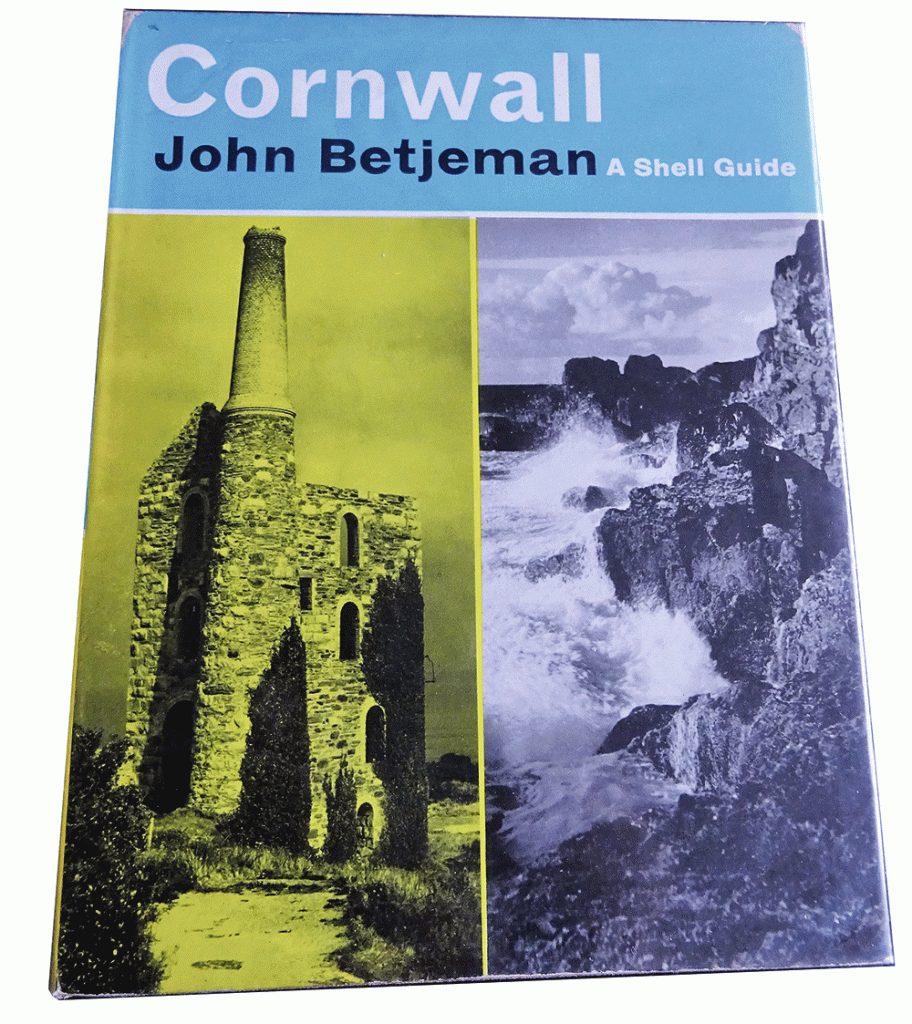
Being the sort of universal hack that I am (when it comes to writing history), in the days before the internet I always needed a handy guide to various counties which would give me a little local colour combined with compressed highly reliable fact. I always found Arthur Mee too cumbersome and The King’s England series likewise. Instead at an early age (by liberating a couple of volumes from the shelves of a relative) I came to realise that the perfect combination was to be met with in Shell Guides. The series began in June 1934 with Cornwall, which the publishers, the Architecture Press, selected John Betjeman to write. The sponsor was the oil company Shell; whose slogan then was ‘Shell: the Key to the Countryside’, in essence explains their willingness to under-write the series. Although the 1934 Cornwall was pretty simple: spiral bound, 62 pages, and not a few errors and omissions, the format stabilised the following year with its revised edition as hard backed 7×91/4 inches with colourful dust-wrapper, glossy paper, an introduction, pace-by-place gazetteer and a lot of excellent black & white photographs. The series was continued until 1984, by which time about half the country had been covered. The series was sponsored by the oil company Shell. The original guides were published on a county-by-county basis, under the editorial control of the poet John Betjeman and (later) his friend the artist John Piper. There were 13 pre-war titles, the publisher changing fairly soon to B T Batsford and then in 1939 to Faber & Faber who continued until 1984. In 1939 all the previous twelve titles were re-issued and one new one in the same format: David Verey’s Gloucestershire. The next one planned was Shropshire to be co-written by Betjeman and Piper. However, the Second World War intervened. Post-war, every bit of Wales was covered in five different titles. But it was not until 1951 that the series re-started with Shropshire. Jack Beddington, Shell’s advertising manager, was long involved with the Shell Guides and his influence led to the employment of so many artists: John and Edward Piper, John and Paul Nash and so on. From the late 1950s to the early 1970s, a series of general titles under the Shell Guide banner were also produced, covering most of the countries in northwest Europe. Guides to subjects such as rivers, islands, viewpoints, archaeology, gardens, flowers, history, wildlife and museums were also published, but these rather lie outside the collectors’ ambit. In 1987, Shell issued a final series of New Shell Guides, published by Michael Joseph and generally covering rather larger areas (e.g. Northern Scotland and the Islands) than in the earlier series. Whilst the original Shell County Guides are now highly collectible, the later titles (published by Faber & Faber, Ebury Press or Michael Joseph) tend to be shunned by collectors and book dealers alike, as supply exceeds demand. Also, since 2012 the Heritage Shell Guide Trust has been set up to re-start the series, beginning with West Yorkshire by William Glossop in 2012, a complete revision (due to boundary changes of the 1974 West Riding volume. It is too early to say whether these will become collectible, but all those I have seen are in paperback, are unlikely to be much sought after. The real joy of the original series, apart from the photographs, are the authors. You can see John Betjeman clambering on and off various hobbyhorses as he takes you, in the most gentle and civilised way, round his beloved Cornwall. As editor, his view was that the guides were all about ‘Readers will want to know what a place looks like now. Is it ruined with poles and wires? Has an old bridge been destroyed and a concrete one put in its place?’” Another regular author of the guides was the late Revd. Henry Thorold, whom Carole and I got to know well. He, too was a friend of John Piper (who landscaped his garden at Marston Hall, Lincolnshire) and of Betjeman, although his circle of acquaintances was staggeringly wide. He too, writes like Betjeman, amusingly, perceptibly, heart on sleeve and, like Sir John, his intimate knowledge of the five counties he wrote up was astonishing. Henry’s first effort was (with Jack Yates) Lincolnshire; on seeing which Betjeman wrote gleefully: ‘It is far the best of the Shell Guides so far and the text is really good too. We have got Pevsner on the run.’ He also wrote, Derbyshire, Durham, Staffordshire and Nottinghamshire (the last of the original series published), photographs mainly by Piper. The series was pulled by Shell in 1984 with Bedfordshire not quite ready for the press: it never appeared. Although many were reprinted in paperback, the original spiral bound card or hardback ones are those that are collectible. Even more so if you were lucky enough the get the author to sign you copies; I have never been pushy like that, but on a visit to Marston I later discovered that he had signed the two I’d brought and given us three others I had not even got round to buying! Likewise, when I lived in London, a friend who knew Betjeman well got Cornwall (1964 revision) signed. These signatures are the key to value, as some authors like Betjeman, Piper, Thorold, David Verey, Professor W G Hoskins, and so on were very well known in their own right. A Piper or Betjeman-signed pre-war edition is going to soar past £300 and do almost as well if it is a later edition (condition being right). The lesser, but still well-known, authors are probably going to command a premium of £30-40 over the value of an unsigned one. Largely speaking, signed copies are extremely rare. Prices for the unsigned pre-war spiral or comb-bound card covered editions (which frequently fail to survive) are upwards of £50 today, but a really good one could go for over £300, but the hard bound copies can still be had for around
Walk Derbyshire – Pentrich to Crich

When Country Images magazine was first launched in 1994 we were pleased to be able to include walks from ‘not so’ Old Perce. Over the following months he traversed the Amber valley and provided delightful walks that, as all walks should, start and finish at the local pub. With many village pubs closing that has become harder to do but in true style for 2019 ‘a little older and wider!’ Old Perce is back. Yes, he’s still around and walks incessantly around Amber Valley which is great news for us. So this month he shares with us one of his favourite walks. 1. From The Dog Inn Pentrich go up the main road towards Swanwick, then turn left onto Riley Lane, signposted Fritchley and Crich. 2. At the bottom of Riley Lane cross Chesterfield Road onto Park Lane to Wingfield Park, past Weir Mill farm and eventually turn left onto Lynam Road signposted Fritchley and through the hamlet of Boden. 3. Go past Boden House and Boden Farm and straight up the steep lane that veers to the right. A short walk up the lane gives fine views of Wingfield Manor to the right. 4. Go to the top of the lane and follow the beaten path through the woods. At the stile follow the directions on the yellow arrow left as it marks a pathway through the second part of the woodland. 5. Eventually you will reach a stone stile to cross. Turn immediately left and go through the second stile. Turn right and walk to the end of the lane 6. At the end of the lane turn right. Fifty yards before the hat factory follow the footpath sign to the right and through the woodland for just a short distance and then cross the stile on the left marked by a yellow arrow. Keep to the right hand side of the field by the hedgerow via a stile and metal gate. Follow the pathway and keep the woodland to your left. 7. Keeping the woodland to your immediate left cross over the gated stile and continue a short distance on and cross another stile. Turn left and immediately right over a metal gated stile and continue onto the top of the lane and into Crich Market Place. 8. Cross over the Market Place and up by the Baptist Chapel and onto Sandy Lane . After 100 yards turn left up by the pathway marked Derwent Valley. Walk as indicated by the yellow arrow on the post. Follow the metal sign marked Chadwick Nick and continue on this pathway for approximately half a mile. The views to the right show spectacular views of the Derwent Valley. The pathway via a set of stone steps leads to the tarmac road of Chadwick Nick where we turn right. 9. After 200 yards turn left at the signpost with the orange sticker on it. At the end of the pathway turn left. 10. Continue on the pathway ahead, don’t be tempted to veer off to the right or left. This pathway slowly meanders through some beautiful woodland for about a mile and leads to a stone bridge that crosses the Cromford Canal. Go over the bridge and cross back under it as though heading for Ambergate 11. Follow the towpath all the way to the end and cross a white painted bridge. Follow the path ahead keeping close to a wired fence all the way until it goes through a canopy of trees then follow the path inclined upwards. 12. After 3/4 of a mile or so the path will lead to a stone stile with barred wooden gate . Cross onto the lane which leads to Chadwick Nick and turn left up the lane. 13. Follow the lane to the top up the stone steps on the right and turn right on the pathway which leads us back into Crich. (At this point I recommend a pint or two in the Black Swan or coffee and cake in The Loaf and then wander our way back). 14. Turn left out of the Black Swan or straight out of The Loaf and walk down Dimple Lane and follow it to the end where it forks left and then turn left. 15. After half a mile or so ahead cross the stile on the right, marked Buckland Hollow and cross the field through the gate to the stone wall on the left. Cross here and turn right. 16. Follow the lane through the farmyard and left down the hill. At this point the pathway becomes ill defined, so at the property marked The Hall Gardens cut left over the fields and follow closely the contour of the river 17. At the end of the path, cross a small bridge and turn right onto a busy road. A few yards ahead on the left is a signpost and a path to Pentrich which we take. 18. A gated stile needs to be crossed ahead at the right hand side on the top of the field. Continue on by the side of the hedge and cross the next gated stile. At the very end of the hedgerow turn right and follow the footpath veering left through cemetary yard and back to the Dog Inn. 10 miles (16km): Moderate trails, field-paths and country lanes. With some muddy sections. RECOMMENDED MAP: Ordnance Survey 1:25000 scale OS Explorer, Chesterfield & Alfreton. CAR PARKING: Parking on the main road in Pentrich . REFRESHMENTS: Various pubs, cafes and shops along the route. 00
Restaurant Review – The Sanam, Alfreton

Choosing a place to take the grandkids for a meal can generally be quite a challenge for many of us. So when I said “we will go to the Sanam on King Street, Alfreton at 6pm for an early doors meal”, I’m not sure it was what they were expecting. It’s an Indian restaurant I explained. But they knew that, under normal circumstances their mum and dad regularly had an Indian takeaway and the grandkids usually had a pizza from across the road! Now I know they love their pizzas, pastas, chicken and roasties but how would this change of culture go down with them? When it came to ordering each one was asked by Iqbal “What do you like? Do you like fish, or chicken?” To our surprise the 8 year old opted for salmon. But she told us she wasn’t keen on Popadoms or naan bread. We encouraged them both to just try a little bite and from there on we didn’t get a look in. There was lots of “Can I try your chicken tikka and your korma?” and they went down well too. They did opt for some fries this time. All in all it was a resounding success and subsequent takeaways have now been embraced with great excitement and experimenting. The fries haven’t been mentioned since as the cheese Nan’s have gone down a treat and the salmon, in particular, has become the favourite choice. For us adults it was great to see that, whilst we know pizza, pasta and other foods will still be enjoyed by them, there’s a whole world of flavour out there to be tried and enjoyed; plus I get to go the Sanam, a popular place for the last 28 years for me, and have my traditional karahi chicken packed with succulent chicken, peppers and onions along with a cheese and garlic nan all washed down with a pint of Mongoose. There’s everything on the menu you’d expect but straying onto the ‘chef’s specials’ section if you fancy something a little more exciting will really tickle your taste buds. The sauces at the Sanam are rich in flavour and there’s plenty of substance to them. Our thanks to Iqbal and his friendly staff for continuing to make us welcome as a family and introducing the grandkids to a different cuisine. All in all a successful night out is assured. Advanced booking is always a good idea. Call 01773 830690 00
Taste Derbyshire – Vedi
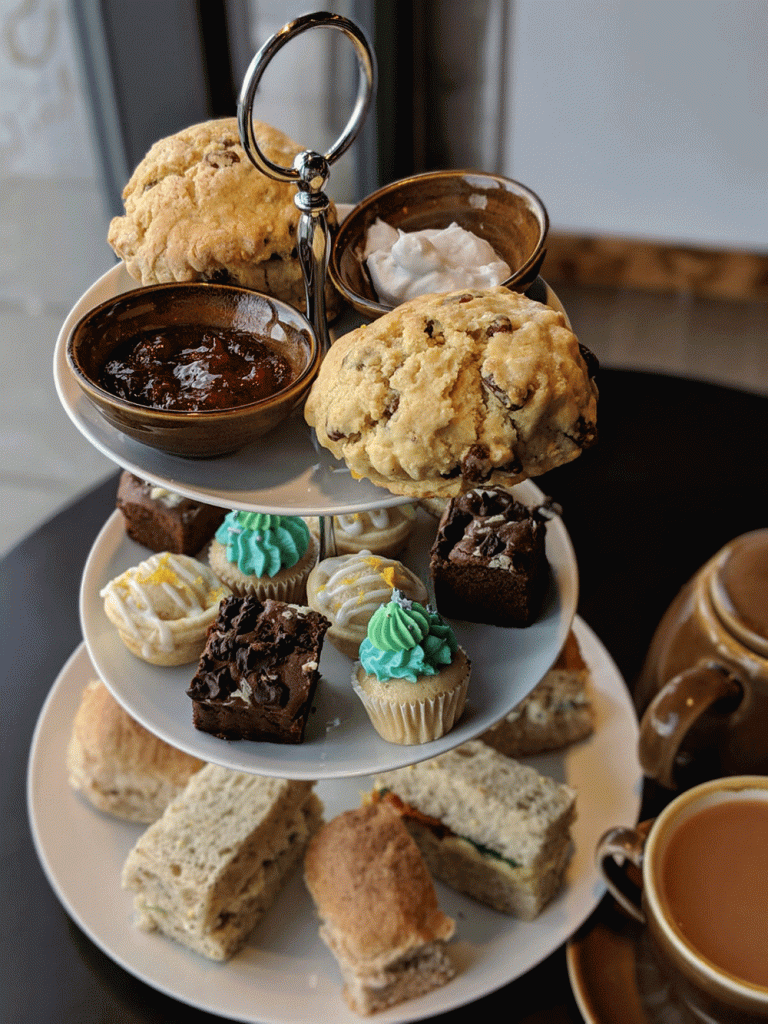
Saying you were once a vegetarian is like admitting you were a once better person. But here’s my guilty secret. After ten long years of eating mash and vegetables for Christmas dinner and crying into a bean burger at barbecues, I was lured off-course by the siren sizzle of bacon. Sixteen years of meat-eating later and my son – once the ultimate carnivore – has stirred my shame by embracing a semi-vegetarian diet. He’s not alone. One in eight Britons class themselves as vegetarian or vegan according to the Waitrose Food and Drink Report 2018-19. A further 21 per cent are ‘flexitarian’ – people with a largely plant based diet who are capable of being seduced by a cocktail sausage at parties. Veganism has also skyrocketed in the past four years. The number of people who shun all animal products has risen from 150,000 to 600,000 according to the Vegan Society. In my veggie days; vegans were a small, hard-core faction prepared to endure a dismally abstemious diet and risk fungal foot infections (a side-effect of plastic shoes) because of their unwavering principles. Now vegan food is affordable, edible and everywhere. Waitrose is just one of many high street stores and restaurants trying to woo shoppers with a range of meatless ready-meals like beetroot risotto and rainbow vegetable stew. Even Greggs, the home of the steak bake, has dominated the headlines with its vegan sausage roll. Better yet, there’s a fresh crop of vegetarian and vegan entrepreneurs popping up around Derby to help people give up meat for life and not just for Veganuary. People like Bal Dhamrait (32), who welcomes me to Vedi; a vegetarian café which he runs with his uncle Resh Dorka on Castleward Walk, Derby. Forget all the old hippy dippy clichés; the patrons of Vedi are more likely to be found chilling on a sleek grey sofa than chanting on an orange bean bag. There’s no sign of rabbit food. Bal uses family recipes to give a vegan twist to modern café favourites like paninis, burritos, jacket spuds and Bal’s famous ‘Roti ‘Rap’ – a roti bread filled with homemade curry and pickle. Then you have the cakes; glitter-strewn and lemon drizzled cupcakes and decadent brownies made by Molly Russell, who runs V Bakes. “Molly’s cakes are delicious, we can’t keep up with demand,” Bal says as we wait for Molly to join us for a chat. “Baking cakes without eggs and butter is not easy, we did try. Then my sister saw Molly’s stall at Well Fest at Derby’s Roundhouse and rang me to say ‘There’s a girl selling the most amazing cakes.’ You can’t tell they’re vegan – they just taste really good.” When Molly arrives, it’s obvious why the new business owners developed such an instant rapport. Both believe in gently encouraging people – even lapsed vegetarians like me – towards a meat-free diet by providing delicious alternatives. “We’re not saying people must change overnight when they may have been eating meat their whole lives,” says Molly (22), who works from her family home in Mackworth which she shares with parents Ian and Angela and sister Katy (19) – none of whom are vegetarian. “It might be people want one or two meat-less days a week and that’s great. I think what Bal and I are trying to do is produce food which is so good, people don’t feel they’re missing out. We don’t want to give anyone the excuse to fall off the wagon.” Bal insists the café, which offers 100 per cent vegan food, is for everyone – regardless of their diet. “People come because they’re curious or they’ve heard about us from friends,” he smiles. “The first thing they’ll say is ‘what’s that amazing smell?’ We’ll encourage them to taste a little of our curry or scrambled tofu. Once they taste it, they love it. They’re not thinking about the food being vegan – they’re just enjoying it.” The pairs relaxed approach to meat-eaters reflects the fact their conversion to a plant-based diet came from an initial desire to eat less meat. “I used to love meat,” Molly laughs. “In February 2016, I’d just returned from three months in Thailand and I’d eaten so much meat, I needed a break. I told my mum I was thinking of becoming veggie and she said I’d be eating bacon sandwiches again within the week. But I’d watched some documentary films about the meat industry. Once you’re doing something for ethical reasons, your determination is so much stronger.” Bal nods: “I used to eat a lot of meat because I was training in the gym,” he says. “But then I gave up chicken followed by bacon and sausages. The more meat I gave up – the better I felt. I eat as much as I used to and feel stronger and fitter.” Molly says her switch to vegetarianism, followed by veganism in January 2017, had a profound effect on her health. “Once I cut out cheese and milk my skin cleared-up, my digestion was better and I had so much more energy,” she says. “I remember being quite lethargic when I was in the 6th form and it didn’t occur to me it might be down to my diet. I’m not saying I’m invincible – but I don’t have that 3pm slump.” But it was the decision to start V Bakes – after finding it impossible to find a homemade vegan birthday cake in Derby – which dramatically changed Molly’s mental well-being. “I’d been having a really rough time with anxiety and depression,” she says. “When I launched the business in May 2018, I realised I’d finally found what I was meant to do and my mental health improved. Baking gave me a reason to get out of bed every day. I still get stressed but I direct it to something positive – making my business more successful.” Hearing about her flavoursome creations – cherry and ginger brownies, honeycomb and pretzel
The Manifold Valley

Two major Peakland rivers, the Dove and Manifold, begin their lives a little over a mile apart, high up on the gritstone moors of Axe Edge, between Buxton and Leek. They both flow south west, almost parallel to each other, separated by limestone ridges, before joining below Thorpe village; here they continue, now known simply as the Dove, southwards to enrich the waters of the River Trent. The river and its valley we are exploring is the Manifold. Unlike the Dove whose birthplace can be identified by a well that once provided drinking water for a farm at Dove Head, no single place can be identified as the true birthplace of the Manifold. Several streams rise from the bleak shales of Axe Edge, but they soon join to make the Manifold. But if one source must be identified then perhaps being the most northerly, it is the stream which rises near the Traveller’s Rest close by Flash village. Few if any tributaries join from the east, but several including the Hamps, the Manifold’s major side stream, flow in from the west. At one time there were plans to flood a wide shallow basin below Longnor, but fortunately they were abandoned in favour of Carsington Reservoir. The underlying rocks are shales as far as Hulme End. Here the river starts to meet limestone, a rock so porous that further down the dale, the Manifold frequently disappears underground, only to surface at a well in the grounds of Ilam Hall. Tiny farm-based villages dot the moors, with Longnor traditionally their focal point. The village sits on a high ledge above the Manifold and is where until recent memory that farmers brought their produce and animals for sale. Overlooking the cobbled square, the market house with its scale of charges on a board above the entrance, is now a craft workshop and café. Classified as a Conservation Area, Longnor is one of those places where quiet wandering down narrow side alleys leads the traveller to the discovery of attractive cottages and scenes. The village was once part of the Crewe and Harpur Estate, a fact highlighted by the name of the inn opposite the old market house. Although Longnor church was rebuilt in the 18th century, it stands on foundations at least 8oo years old. Look for the tombstone of William Billinge, who, if we are to believe records of the day, was 112 when he died in 1791. He was a soldier who fought under the command of the Duke of Marlborough and faced death so many times in action, that he believed it had overlooked him. A complex pattern of moorland roads run west then south above the headwaters of the Manifold’s higher tributaries. One of them leaves the Buxton/Leek road beyond the Royal Cottage pub where Bonnie Prince Charlie is supposed to have rested on his march south. This side road, never dropping much below 1400 feet, winds its way south across the Morridge moors where the remote Mermaid Inn is the only habitation for several miles. As befits such a remote spot, a nearby pool is said to be the haunt of a mermaid who drags the unwary to their doom. The inn once looked after the needs of coal miners who worked shallow pits on the surrounding moors, but is now much more upmarket. For several days on either side of mid-summer’s day, the sun when viewed from the Mermaid Inn appears to set twice when it passes behind Hen Cloud to the north-west. Warslow is on the Leek/Hartington road, a focal point for the surrounding farms. Again like Longnor, Warslow was a Crewe and Harpur estate village where the Calke Abbey dwelling family had a shooting lodge nearby. Moving east along the B5054, limestone appears at Hulme End, continuing south towards Ashbourne. Engine sheds and station buildings are now an information centre at Hulme End using what was once the northern terminus of a light railway that joined the standard gauge Leek-bound line at Waterhouses. Intended to find most of its trade carrying milk, it was also popular with passengers who travelled in its yellow-liveried coaches hauled by locomotives resplendent with massive headlamps; they came this way seeking the delights of the Manifold valley. Never profitable The Manifold Valley Light Railway became known as the railway that went from nowhere to nowhere, it was opened in 1904,but only ran until 1934. Since then the track has been converted to a cycle and walking trail. A large round hill dominates the landscape immediately to the south of Hulme End. This is Ecton Hill, a hill which gives little hint of the fortunes won and lost beneath its green slopes. Copper and lead were mined here for over three centuries, and although at one time its profits paid for the Duke of Devonshire’s plans to develop Buxton as a spa town, all that is left upon the surface are overgrown spoil heaps, the outflow from one of the mines close to the valley road and the restored Agent’s House (privately owned), with its green-coloured copper spire peeping through the trees. While the Manifold Valley Trail follows the old railway, the riverside road leaves the valley at Wetton Mill. There is a small car park and café here, making it easy to venture further afield by climbing up to Thor’s Cave where our ancestors dating from pre-historic to Romano-British times once sheltered. Earlier still, the shallow cave became the lair of hyenas and sabre-toothed tigers. At Wetton Mill, the river makes the first of its disappearing acts beneath the fissured layers of limestone, only reappearing finally at a ‘boil hole’ below Ilam Hall, about seven miles downstream. A waterwheel once powered Wetton’s mill by water carried along a leat that can be still traced from where it took water from the main river about a mile upstream. Three villages sit high above the valley. To the west is Butterton and across the fields, its neighbour, Grindon. Both are peaceful,
RSPB – Act Swiftly to Save this Incredible Bird

The RSPB is calling on homeowners and businesses in UK towns and cities to take simple steps to help save swifts. Swift numbers have plummeted by half in just twenty years. Now’s the time to act – before the birds return from Africa in spring to raise their families The British Trust for Ornithology (BTO) National Nestbox week, 14-21 February, is the perfect time to get bird boxes up. In just a few months’ time, swifts will be making their epic 6,000 mile journey here from Africa to bring up their chicks. But for many, the chance to lay their eggs will be thwarted: our buildings are changing and their former homes under the eaves are gone, as are the spaces we used to leave for them. These birds are now vanishing from our summer skies: half have gone in just twenty years. So the RSPB is appealing to the public to help provide as many new homes for them as possible. Just 1,000 additional new nestboxes could make a difference. Swifts are incredible birds, spending most of their lives on the wing and only landing when it’s time to nest. After flying its nest for the first time, a young swift may spend two or three years in the air, eating, drinking, sleeping, bathing and even mating! The swifts that nest in the UK arrive here in late April – May and may spend just 3 months with us; soaring and swooping over rooftops catching insects to eat. But they’re in serious trouble here, with numbers down to less than half of what they were just twenty years ago. Modern buildings lack the nooks and crannies they need, and swifts are struggling to find homes. Fortunately there are ways to help these birds. There are special swift nestboxes available, and if you’re having a building constructed or renovated, there’s also the option of the ‘swift brick’. This replaces a standard house brick and can easily be installed by a builder. Swift nestboxes and swift bricks can work especially well when put up in groups, as these birds like to be near other swifts. RSPB swift lead Jamie Wyver said “We know how to give swifts the new homes they need – now let’s bring them back to our towns and cities!” Having swifts as neighbours is enjoyed by many homeowners. Research by University of Gloucestershire Masters student Sarah Roberts in 2018 showed that people welcome the birds living on the outside of their homes. When asked whether they thought built-in boxes for bats or for birds like swifts were a good idea, 61% were positive and 36% unconcerned about having them in their own homes. “We need local councils and developers on board as they have the power to make an enormous difference” Jamie Wyver said “Think of all the new building that’s going on around the UK: with a few tiny changes we could be providing millions of homes for swifts.” Some developers are already integrating swift homes into new buildings. Prince Charles’ Duchy of Cornwall estate has a policy of providing one swift box for every new home on average and has already installed more than 500 swift boxes in Duchy developments from Cornwall to Oxfordshire, with thousands more in the pipeline. Barratt Developments Plc have added 200 on their Kingsbrook estate in Aylesbury and have plans to install many more around the country. Find out more at www.rspb.org.uk/homes-for-swifts Across the UK there are also dedicated swift experts and volunteers working to save swifts, including Swift Conservation, Action for Swifts and the Swifts Local Network. 00
Product Test – Nourish Naturally with Neal’s Yard Remedies

Spend a little bit of extra time on yourself with some natural products. Wild Rose Body Elixir£30 Blended with organic wild rosehip oil and acai, Wild Rose Body Elixir helps boost your skin’s radiance and hydration. Rich in antioxidants and essential fatty acids, with a balancing blend of organic geranium and patchouli essential oils, it will leave your skin feeling softer and glowing with radiance. • Luxurious, gel-like texture • Boosts skin’s radiance and hydration • Beautiful subtle fragrance • Certified organic Directions Massage into slightly damp skin after bathing. For best results use daily. Aromatic Body Butter £23 Our rich and creamy body butter is blended with organic shea and cocoa butters and a relaxing blend of Geranium, Lavender and Marjoram Essential Oils. Together they leave your skin feeling smooth and smelling divine. • Perfect for all skin types • Luxurious texture • Deeply relaxing blend of soothing aromatherapy oils • Organic butters help to moisturise skin so it feels smooth and supple How to use: Apply daily and after bathing. Warm the butter between your hands before massaging a small amount into the legs, arms and body. Beauty Sleep Body Butter £23 This sumptuously rich body butter is the perfect pre-sleep prep. Infused with calming Ylang Ylang and Patchouli Essential Oils and nourishing organic shea and cocoa butters, it has a restful aroma and works overnight for skin that feels soft and beautifully pampered. • Perfect for all skin types • Deeply nourishing • Beautiful blend of calming essential oils • Restful fragrance to help soothe the body and mind How to use: Use at bedtime or after bathing. Warm the butter between your hands before massaging a small amount into the legs, arms and body. TRIED & TESTED Wild Rose Body Elixir Beware, a small amount goes a very long way. It has a light fragrance and is easier to use after a shower. The results however are excellent and long lasting, it really does moisturise your skin and I found it a great boost after the winter. JP. Beauty Sleep Body Butter This has a lovely ‘spa’ scent. Glides on well and rubs in nicely. A really good nourishing butter perfect for winter months. VP. Aromatic Body Butter This is a lovely rich cream with aromatic soothing essential oils. I found it the perfect product to apply after a bath or shower and it lasts a long time as only a little amount is required. It absorbs easily into the skin, leaving you with a gorgeous calming aroma and feeling very relaxed! CB 00